BMP3003 Project: Designing a Game on Academic Integrity and Plagiarism

Verified

Added on  2022/12/19

|1
|648
|93
Project
AI Summary
This assignment involves the design of a game to educate students about academic integrity and plagiarism. The game, titled 'Roll the dice for plagiarism', is designed for a class of 20 students divided into two groups. The game uses a dice to determine the questions asked to students, focusing on academic misconduct. The assignment highlights the importance of academic integrity, emphasizing the development of ethical skills, communication, and adaptability. The solution also includes the skills needed to design the game and references relevant research on academic skills and integrity. The project aims to make students aware of the significance of honesty and ethical behavior in academic settings and the consequences of plagiarism, aligning with university policies and regulations. The game is designed to assess students' understanding of academic integrity and plagiarism. The project also includes the skills needed to develop the game and references relevant research on academic skills and integrity.
Document Page
Instructions for playing the game
Roll the dice for plagiarism
The first instruction is that students are divided in two groups. In a
class there are 20 students and theses students are divided as in
first group 10 student and in other group 10 student.
There are six number in a dice and design in different way and the
game start from this point.
One by one student will come and roll a dice as this game is done
to tell students about plagiarism and academic misconduct.
If even number will occur in dice then teacher will ask question as
per set time them whereas if odd number will occur then again
teacher will ask question.
There will be set of question and different questions will be asked.
If any student are unable to answer correctly then they will be out
from the game.
The last student who remain and continue in game will be the
winner of the game 'Roll the dice for plagiarism'
BMP3003 Further Academic Skills
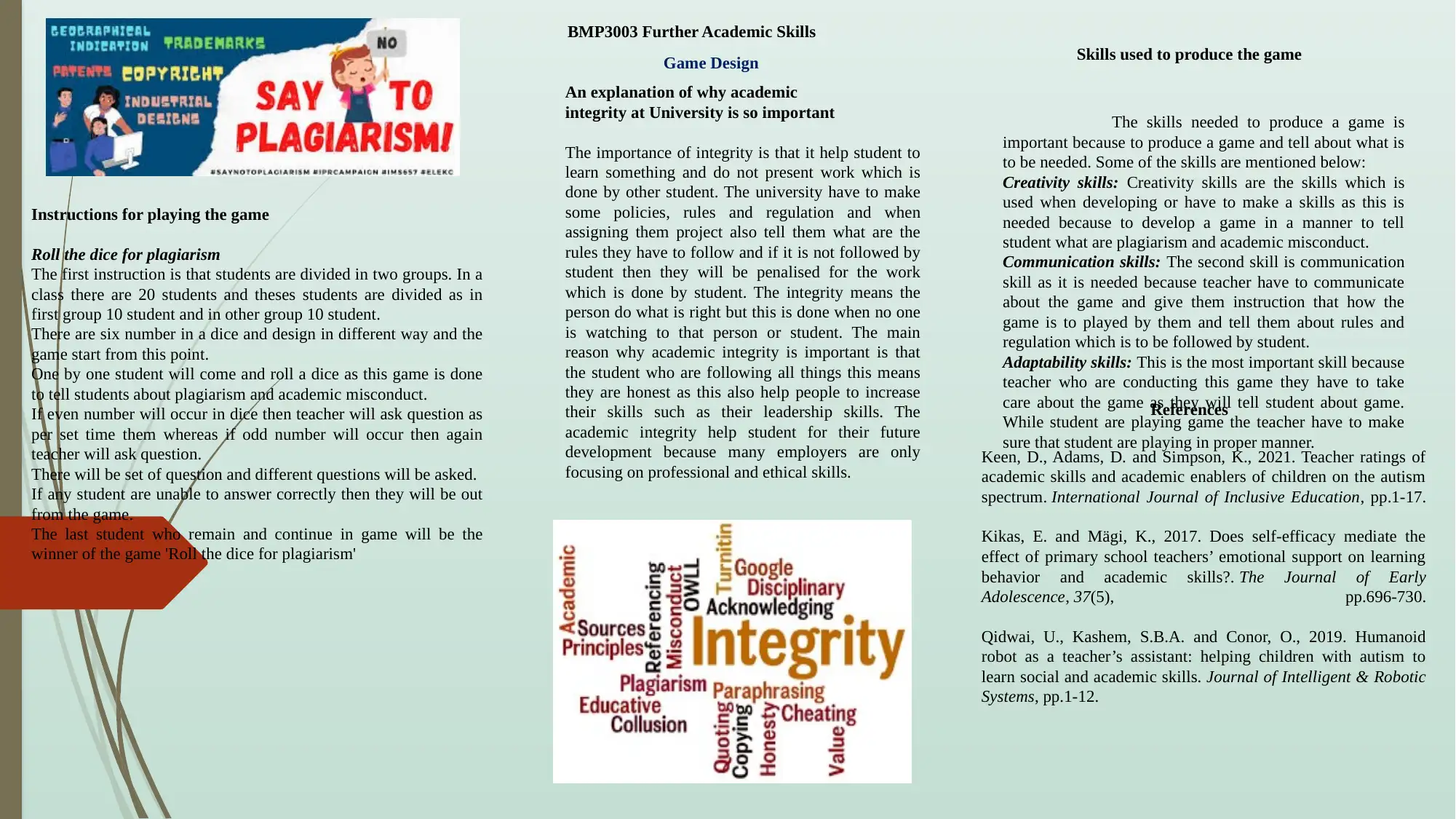
An explanation of why academic
integrity at University is so important
The importance of integrity is that it help student to
learn something and do not present work which is
done by other student. The university have to make
some policies, rules and regulation and when
assigning them project also tell them what are the
rules they have to follow and if it is not followed by
student then they will be penalised for the work
which is done by student. The integrity means the
person do what is right but this is done when no one
is watching to that person or student. The main
reason why academic integrity is important is that
the student who are following all things this means
they are honest as this also help people to increase
their skills such as their leadership skills. The
academic integrity help student for their future
development because many employers are only
focusing on professional and ethical skills.
Game Design Skills used to produce the game
The skills needed to produce a game is
important because to produce a game and tell about what is
to be needed. Some of the skills are mentioned below:
Creativity skills: Creativity skills are the skills which is
used when developing or have to make a skills as this is
needed because to develop a game in a manner to tell
student what are plagiarism and academic misconduct.
Communication skills: The second skill is communication
skill as it is needed because teacher have to communicate
about the game and give them instruction that how the
game is to played by them and tell them about rules and
regulation which is to be followed by student.
Adaptability skills: This is the most important skill because
teacher who are conducting this game they have to take
care about the game as they will tell student about game.
While student are playing game the teacher have to make
sure that student are playing in proper manner.
Keen, D., Adams, D. and Simpson, K., 2021. Teacher ratings of
academic skills and academic enablers of children on the autism
spectrum. International Journal of Inclusive Education, pp.1-17.
Kikas, E. and Mägi, K., 2017. Does self-efficacy mediate the
effect of primary school teachers’ emotional support on learning
behavior and academic skills?. The Journal of Early
Adolescence, 37(5), pp.696-730.
Qidwai, U., Kashem, S.B.A. and Conor, O., 2019. Humanoid
robot as a teacher’s assistant: helping children with autism to
learn social and academic skills. Journal of Intelligent & Robotic
Systems, pp.1-12.
References
.
tabler-icon-diamond-filled.svg

Paraphrase This Document

Need a fresh take? Get an instant paraphrase of this document with our AI Paraphraser
[object Object]