University Project: Designing a Game to Teach Academic Integrity
VerifiedAdded on 2022/11/24
|2
|831
|233
Project
AI Summary
The assignment details the design of a game called "PlagArrow" aimed at teaching students about academic integrity and preventing plagiarism. The game involves a dartboard with numbers corresponding to questions about academic honesty, misconduct, and plagiarism avoidance. Students, divided into teams, earn points for correct answers and face penalties for incorrect ones, fostering competitiveness and engagement. The project outlines the game's rules, emphasizing the importance of acknowledging others' contributions, avoiding plagiarism, and conducting ethical research. The reflection highlights the skills gained in designing the game, emphasizing the significance of academic integrity. References to relevant literature support the project's concepts.
Introduction
Plagiarism occurs whenever anyone presents anyone else's
production as their own, without really recognizing the
sources of said concepts (Bretag, 2020). Academic
misconduct happens when students obtain an unfair
academic edge by utilizing unethical academic methods such
as stealing information from the internet, cheating, and so on.
Game Design
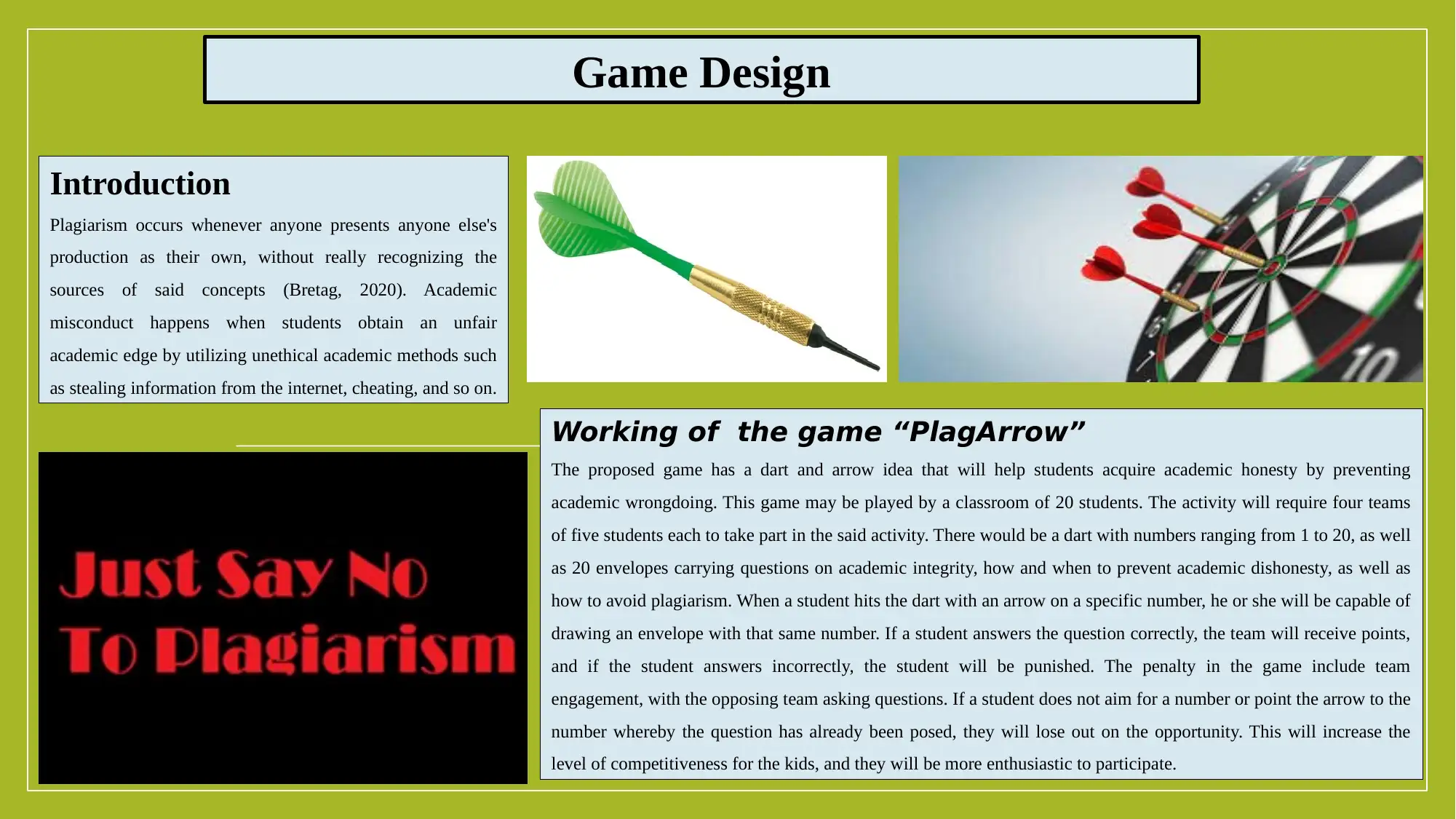
Working of the game “PlagArrow”
The proposed game has a dart and arrow idea that will help students acquire academic honesty by preventing
academic wrongdoing. This game may be played by a classroom of 20 students. The activity will require four teams
of five students each to take part in the said activity. There would be a dart with numbers ranging from 1 to 20, as well
as 20 envelopes carrying questions on academic integrity, how and when to prevent academic dishonesty, as well as
how to avoid plagiarism. When a student hits the dart with an arrow on a specific number, he or she will be capable of
drawing an envelope with that same number. If a student answers the question correctly, the team will receive points,
and if the student answers incorrectly, the student will be punished. The penalty in the game include team
engagement, with the opposing team asking questions. If a student does not aim for a number or point the arrow to the
number whereby the question has already been posed, they will lose out on the opportunity. This will increase the
level of competitiveness for the kids, and they will be more enthusiastic to participate.
Plagiarism occurs whenever anyone presents anyone else's
production as their own, without really recognizing the
sources of said concepts (Bretag, 2020). Academic
misconduct happens when students obtain an unfair
academic edge by utilizing unethical academic methods such
as stealing information from the internet, cheating, and so on.
Game Design
Working of the game “PlagArrow”
The proposed game has a dart and arrow idea that will help students acquire academic honesty by preventing
academic wrongdoing. This game may be played by a classroom of 20 students. The activity will require four teams
of five students each to take part in the said activity. There would be a dart with numbers ranging from 1 to 20, as well
as 20 envelopes carrying questions on academic integrity, how and when to prevent academic dishonesty, as well as
how to avoid plagiarism. When a student hits the dart with an arrow on a specific number, he or she will be capable of
drawing an envelope with that same number. If a student answers the question correctly, the team will receive points,
and if the student answers incorrectly, the student will be punished. The penalty in the game include team
engagement, with the opposing team asking questions. If a student does not aim for a number or point the arrow to the
number whereby the question has already been posed, they will lose out on the opportunity. This will increase the
level of competitiveness for the kids, and they will be more enthusiastic to participate.
Paraphrase This Document
Need a fresh take? Get an instant paraphrase of this document with our AI Paraphraser

Instructions for playing the game
“PlagArrow”
1. The game calls for 20 students to be matched into five
groups of five. There will be four teams in total.
2. Each time, one student out of each team will aim an arrow
at the dart.
3. Students will be able to choose an envelope from that
number question based on the number sought.
4. The team will receive 5 points if the student answers the
question correctly. If a student fails to respond, the other
team members are given the opportunity to respond.
5. Aiming a dart at the same number will lead in a missed
opportunity to re-aim. However, in this situation, an extra
rule is in place, in which the team with the most points
asks the team who have missed opportunities to answer
the question or to the team who did not aim correctly.
6. They will receive 4 points if they respond correctly, but if
they do not, the team that posed the question will receive
4 points.
Game Design
Reflection on the skills used
to produce the game
“PlagArrow”
It was a challenge for me to develop a game
to teach students about academic integrity
and how to prevent academic misconduct,
although it was a great experience. I am
ecstatic to have been granted this chance.
During the course of writing this report, I
discovered that there are several skills related
to academic integrity that must be acquired in
order to prevent academic misconduct.
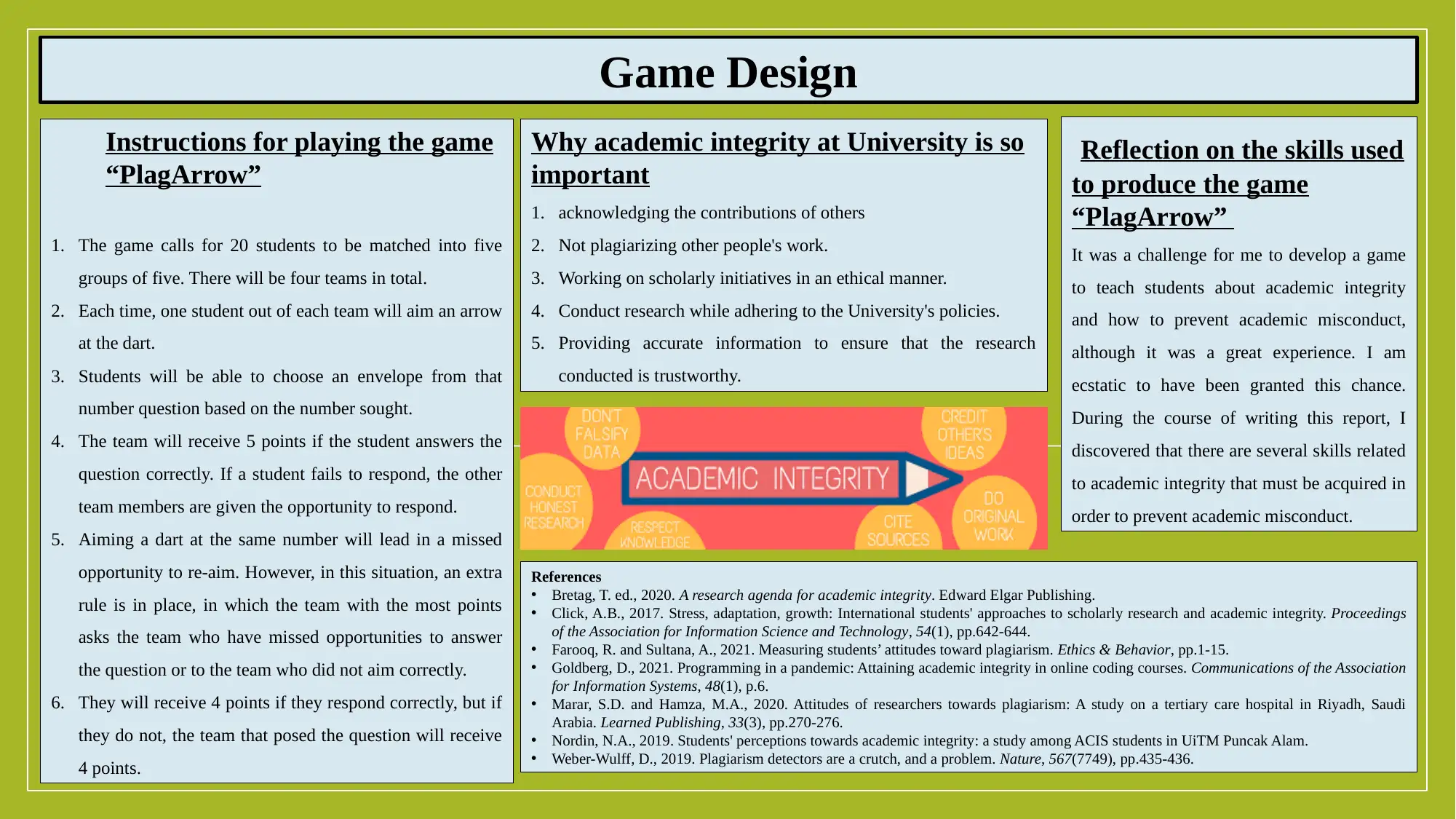
Why academic integrity at University is so
important
1. acknowledging the contributions of others
2. Not plagiarizing other people's work.
3. Working on scholarly initiatives in an ethical manner.
4. Conduct research while adhering to the University's policies.
5. Providing accurate information to ensure that the research
conducted is trustworthy.
References
• Bretag, T. ed., 2020. A research agenda for academic integrity. Edward Elgar Publishing.
• Click, A.B., 2017. Stress, adaptation, growth: International students' approaches to scholarly research and academic integrity. Proceedings
of the Association for Information Science and Technology, 54(1), pp.642-644.
• Farooq, R. and Sultana, A., 2021. Measuring students’ attitudes toward plagiarism. Ethics & Behavior, pp.1-15.
• Goldberg, D., 2021. Programming in a pandemic: Attaining academic integrity in online coding courses. Communications of the Association
for Information Systems, 48(1), p.6.
• Marar, S.D. and Hamza, M.A., 2020. Attitudes of researchers towards plagiarism: A study on a tertiary care hospital in Riyadh, Saudi
Arabia. Learned Publishing, 33(3), pp.270-276.
• Nordin, N.A., 2019. Students' perceptions towards academic integrity: a study among ACIS students in UiTM Puncak Alam.
• Weber-Wulff, D., 2019. Plagiarism detectors are a crutch, and a problem. Nature, 567(7749), pp.435-436.
“PlagArrow”
1. The game calls for 20 students to be matched into five
groups of five. There will be four teams in total.
2. Each time, one student out of each team will aim an arrow
at the dart.
3. Students will be able to choose an envelope from that
number question based on the number sought.
4. The team will receive 5 points if the student answers the
question correctly. If a student fails to respond, the other
team members are given the opportunity to respond.
5. Aiming a dart at the same number will lead in a missed
opportunity to re-aim. However, in this situation, an extra
rule is in place, in which the team with the most points
asks the team who have missed opportunities to answer
the question or to the team who did not aim correctly.
6. They will receive 4 points if they respond correctly, but if
they do not, the team that posed the question will receive
4 points.
Game Design
Reflection on the skills used
to produce the game
“PlagArrow”
It was a challenge for me to develop a game
to teach students about academic integrity
and how to prevent academic misconduct,
although it was a great experience. I am
ecstatic to have been granted this chance.
During the course of writing this report, I
discovered that there are several skills related
to academic integrity that must be acquired in
order to prevent academic misconduct.
Why academic integrity at University is so
important
1. acknowledging the contributions of others
2. Not plagiarizing other people's work.
3. Working on scholarly initiatives in an ethical manner.
4. Conduct research while adhering to the University's policies.
5. Providing accurate information to ensure that the research
conducted is trustworthy.
References
• Bretag, T. ed., 2020. A research agenda for academic integrity. Edward Elgar Publishing.
• Click, A.B., 2017. Stress, adaptation, growth: International students' approaches to scholarly research and academic integrity. Proceedings
of the Association for Information Science and Technology, 54(1), pp.642-644.
• Farooq, R. and Sultana, A., 2021. Measuring students’ attitudes toward plagiarism. Ethics & Behavior, pp.1-15.
• Goldberg, D., 2021. Programming in a pandemic: Attaining academic integrity in online coding courses. Communications of the Association
for Information Systems, 48(1), p.6.
• Marar, S.D. and Hamza, M.A., 2020. Attitudes of researchers towards plagiarism: A study on a tertiary care hospital in Riyadh, Saudi
Arabia. Learned Publishing, 33(3), pp.270-276.
• Nordin, N.A., 2019. Students' perceptions towards academic integrity: a study among ACIS students in UiTM Puncak Alam.
• Weber-Wulff, D., 2019. Plagiarism detectors are a crutch, and a problem. Nature, 567(7749), pp.435-436.
1 out of 2
Related Documents
Your All-in-One AI-Powered Toolkit for Academic Success.
+13062052269
info@desklib.com
Available 24*7 on WhatsApp / Email
Unlock your academic potential
Copyright © 2020–2025 A2Z Services. All Rights Reserved. Developed and managed by ZUCOL.