Acas Report: The Dispute Resolution Regulations Two Years On: Analysis
VerifiedAdded on 2022/04/28
|58
|21690
|85
Report
AI Summary
This report, based on Acas research, evaluates the outcomes of the Dispute Resolution Regulations implemented in April 2009, following the Gibbons Review of workplace dispute resolution in Great Britain. It examines the impact of policy changes, including the removal of fixed time periods for conciliation and revisions to the Acas Code of Practice. The report analyzes data from various Acas services, such as the helpline and pre-claim conciliation, to assess the effectiveness of interventions in promoting early dispute resolution and reducing Employment Tribunal claims. It highlights the customer experience and provides a foundation for future monitoring, policy development, and best practices in managing workplace disputes. The report also discusses the context of the Employment Act 2008 and the government's response to the Gibbons Review, emphasizing the importance of early resolution and the role of Acas in facilitating this process. The report's findings are particularly relevant to the current consultation on dispute resolution.
SETA survey of representatives in Tribunal cases 2008
Research Paper
The Dispute Resolution Regulations two years on: the
Acas experienceAcas experience
Ref: 07/11
s two yeas two yea s on: theon: thears oars o
t
20112011
Barbara DaveyBarbara Davey
Gill DixGill Dix
Acas Research and Evaluation SectionAcas Research and Evaluation Section
Research Paper
The Dispute Resolution Regulations two years on: the
Acas experienceAcas experience
Ref: 07/11
s two yeas two yea s on: theon: thears oars o
t
20112011
Barbara DaveyBarbara Davey
Gill DixGill Dix
Acas Research and Evaluation SectionAcas Research and Evaluation Section

Paraphrase This Document
Need a fresh take? Get an instant paraphrase of this document with our AI Paraphraser

ISBN 978-1-908370-04-4
For any further information on this study, or other aspects of the Acas
Research and Evaluation programme, please telephone 020 7210 3673
or email research@acas.org.uk
Acas research publications can be found at
www.acas.org.uk/researchpapers
For any further information on this study, or other aspects of the Acas
Research and Evaluation programme, please telephone 020 7210 3673
or email research@acas.org.uk
Acas research publications can be found at
www.acas.org.uk/researchpapers
The Dispute Resolution Regulations two years on:
the Acas experience
Barbara Davey
Gill Dix
Acas Research and Evaluation Section
May 2011
the Acas experience
Barbara Davey
Gill Dix
Acas Research and Evaluation Section
May 2011
⊘ This is a preview!⊘
Do you want full access?
Subscribe today to unlock all pages.

Trusted by 1+ million students worldwide
FOREWORD
The proposals set out in the 2007 Gibbons Review of Dispute Resolution
represented an important development in the approach to conflict handling in
workplaces in Great Britain. In the period since, Acas has overseen a number of
significant developments to reflect policy changes that emerged from the Review.
In particular, we have established arrangements that place new emphasis on
early dispute resolution. Such an approach is vital in addressing conflict and
reducing the costs and burdens on employees and employers.
This report sets out progress over the two years since the Employment Act 2008
and its implementation in April 2009. The evidence presented will provide an
important benchmark as Acas continues to develop its dispute resolution services.
John Taylor
Acas Chief Executive
The proposals set out in the 2007 Gibbons Review of Dispute Resolution
represented an important development in the approach to conflict handling in
workplaces in Great Britain. In the period since, Acas has overseen a number of
significant developments to reflect policy changes that emerged from the Review.
In particular, we have established arrangements that place new emphasis on
early dispute resolution. Such an approach is vital in addressing conflict and
reducing the costs and burdens on employees and employers.
This report sets out progress over the two years since the Employment Act 2008
and its implementation in April 2009. The evidence presented will provide an
important benchmark as Acas continues to develop its dispute resolution services.
John Taylor
Acas Chief Executive
Paraphrase This Document
Need a fresh take? Get an instant paraphrase of this document with our AI Paraphraser
CONTENTS
Section Page
No
Introduction 1
1 Dispute Resolution Policy Changes 2
2 Government Interventions and Acas response 5
3 Evaluation 9
4 Acas Code of Practice on Disciplinary and Grievance
Procedures 11
5 Acas Enhanced Helpline 15
6 Acas Pre-Claim Conciliation 19
7 Promotion of Mediation by Acas 30
8 Expanding the Evidence Base on Mediation 33
9 Conclusions 36
10 References 39
Annex A - Tables 41
Annex B – Acas Data Sources 49
Section Page
No
Introduction 1
1 Dispute Resolution Policy Changes 2
2 Government Interventions and Acas response 5
3 Evaluation 9
4 Acas Code of Practice on Disciplinary and Grievance
Procedures 11
5 Acas Enhanced Helpline 15
6 Acas Pre-Claim Conciliation 19
7 Promotion of Mediation by Acas 30
8 Expanding the Evidence Base on Mediation 33
9 Conclusions 36
10 References 39
Annex A - Tables 41
Annex B – Acas Data Sources 49
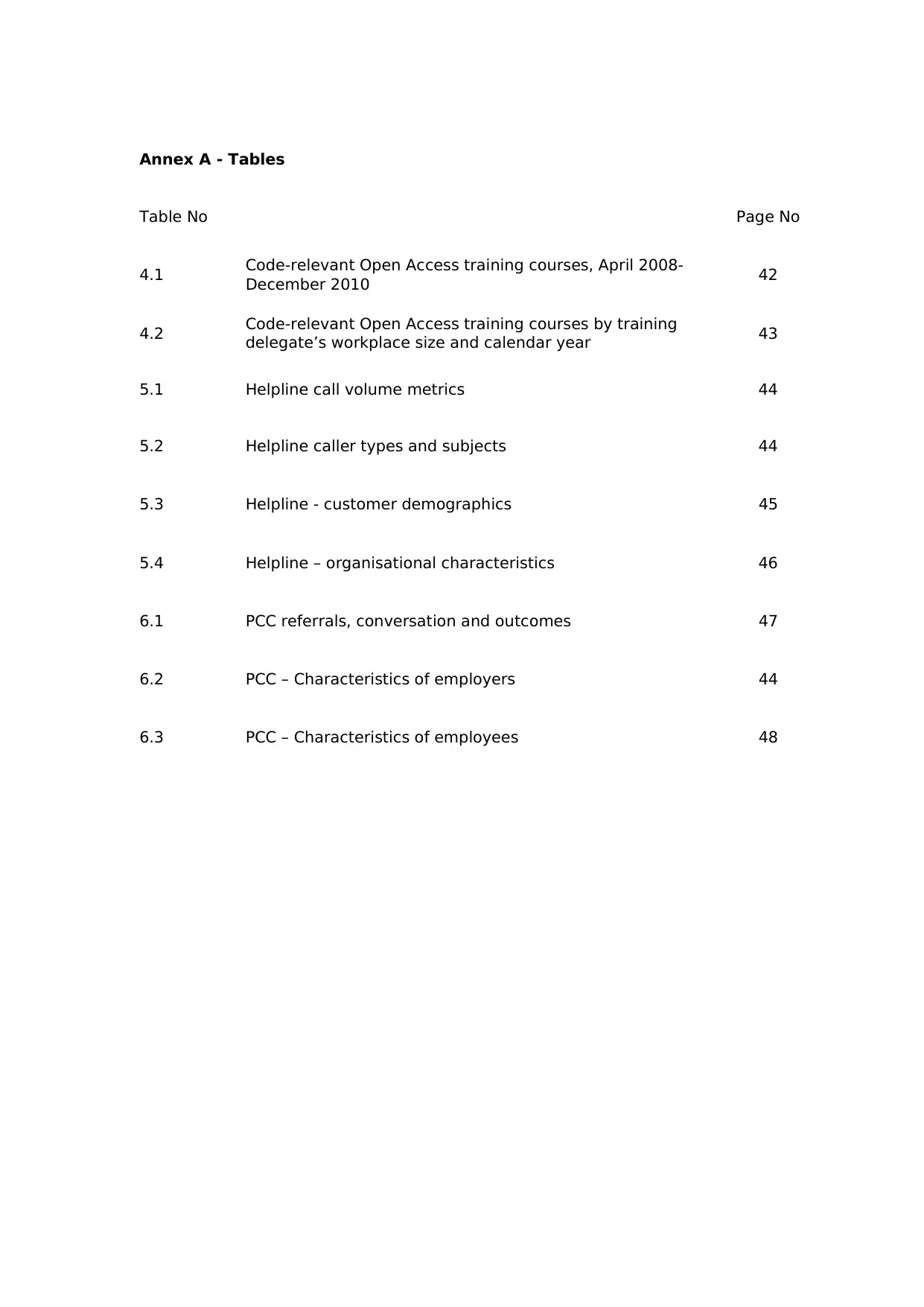
Annex A - Tables
Table No Page No
4.1 Code-relevant Open Access training courses, April 2008-
December 2010 42
4.2 Code-relevant Open Access training courses by training
delegate’s workplace size and calendar year 43
5.1 Helpline call volume metrics 44
5.2 Helpline caller types and subjects 44
5.3 Helpline - customer demographics 45
5.4 Helpline – organisational characteristics 46
6.1 PCC referrals, conversation and outcomes 47
6.2 PCC – Characteristics of employers 44
6.3 PCC – Characteristics of employees 48
Table No Page No
4.1 Code-relevant Open Access training courses, April 2008-
December 2010 42
4.2 Code-relevant Open Access training courses by training
delegate’s workplace size and calendar year 43
5.1 Helpline call volume metrics 44
5.2 Helpline caller types and subjects 44
5.3 Helpline - customer demographics 45
5.4 Helpline – organisational characteristics 46
6.1 PCC referrals, conversation and outcomes 47
6.2 PCC – Characteristics of employers 44
6.3 PCC – Characteristics of employees 48
⊘ This is a preview!⊘
Do you want full access?
Subscribe today to unlock all pages.
Trusted by 1+ million students worldwide

ABBREVIATIONS
Acas The Advisory, Conciliation and Arbitration Service
BIS The Department for Business Innovation and Skills
ET Employment Tribunal
LFS Labour Force Survey
PCC Pre-Claim Conciliation
SETA Survey of Employment Tribunal Applications
SME Small and Medium Enterprises
TS The Tribunal Service
Acas The Advisory, Conciliation and Arbitration Service
BIS The Department for Business Innovation and Skills
ET Employment Tribunal
LFS Labour Force Survey
PCC Pre-Claim Conciliation
SETA Survey of Employment Tribunal Applications
SME Small and Medium Enterprises
TS The Tribunal Service
Paraphrase This Document
Need a fresh take? Get an instant paraphrase of this document with our AI Paraphraser
1
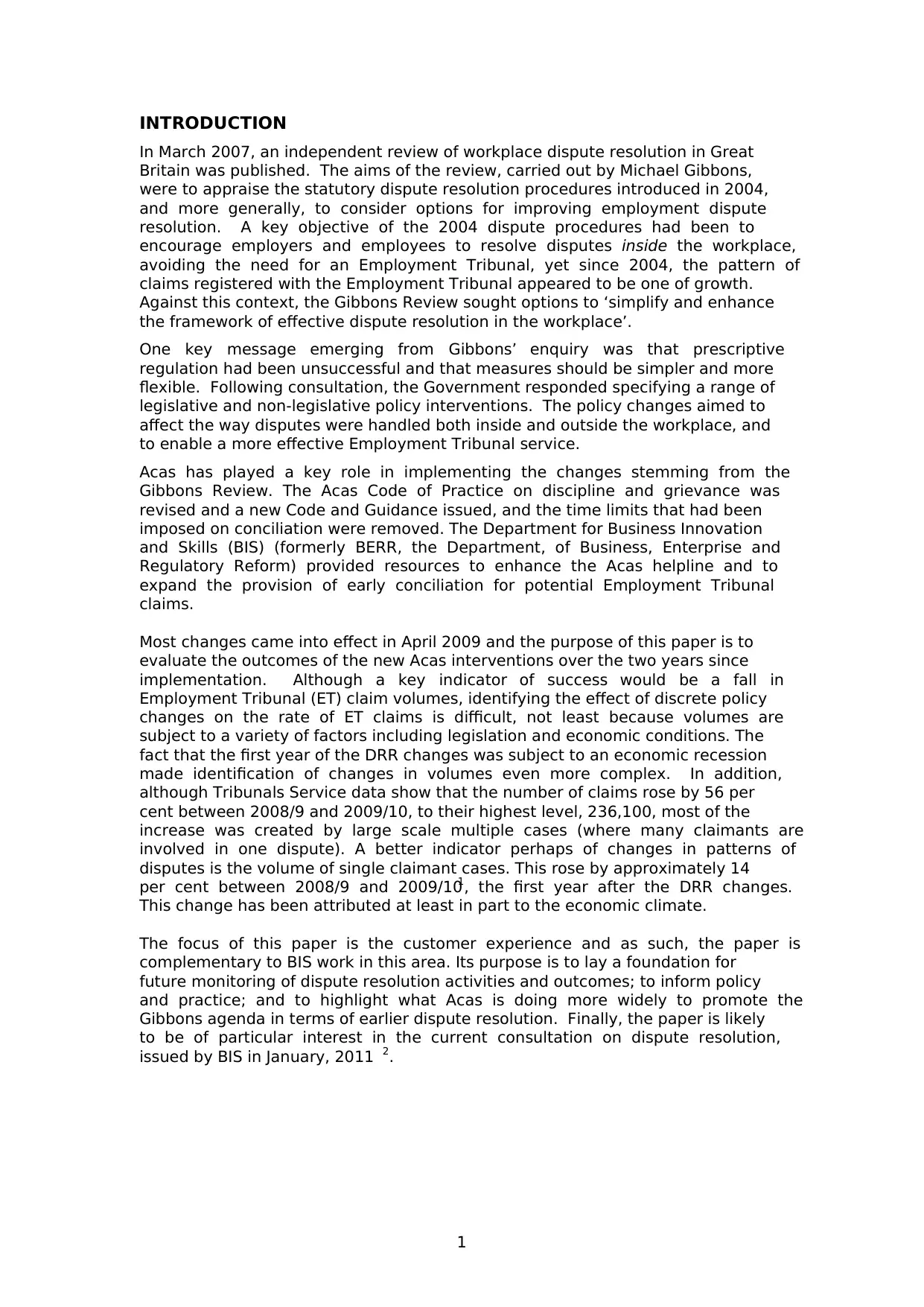
INTRODUCTION
In March 2007, an independent review of workplace dispute resolution in Great
Britain was published. The aims of the review, carried out by Michael Gibbons,
were to appraise the statutory dispute resolution procedures introduced in 2004,
and more generally, to consider options for improving employment dispute
resolution. A key objective of the 2004 dispute procedures had been to
encourage employers and employees to resolve disputes inside the workplace,
avoiding the need for an Employment Tribunal, yet since 2004, the pattern of
claims registered with the Employment Tribunal appeared to be one of growth.
Against this context, the Gibbons Review sought options to ‘simplify and enhance
the framework of effective dispute resolution in the workplace’.
One key message emerging from Gibbons’ enquiry was that prescriptive
regulation had been unsuccessful and that measures should be simpler and more
flexible. Following consultation, the Government responded specifying a range of
legislative and non-legislative policy interventions. The policy changes aimed to
affect the way disputes were handled both inside and outside the workplace, and
to enable a more effective Employment Tribunal service.
Acas has played a key role in implementing the changes stemming from the
Gibbons Review. The Acas Code of Practice on discipline and grievance was
revised and a new Code and Guidance issued, and the time limits that had been
imposed on conciliation were removed. The Department for Business Innovation
and Skills (BIS) (formerly BERR, the Department, of Business, Enterprise and
Regulatory Reform) provided resources to enhance the Acas helpline and to
expand the provision of early conciliation for potential Employment Tribunal
claims.
Most changes came into effect in April 2009 and the purpose of this paper is to
evaluate the outcomes of the new Acas interventions over the two years since
implementation. Although a key indicator of success would be a fall in
Employment Tribunal (ET) claim volumes, identifying the effect of discrete policy
changes on the rate of ET claims is difficult, not least because volumes are
subject to a variety of factors including legislation and economic conditions. The
fact that the first year of the DRR changes was subject to an economic recession
made identification of changes in volumes even more complex. In addition,
although Tribunals Service data show that the number of claims rose by 56 per
cent between 2008/9 and 2009/10, to their highest level, 236,100, most of the
increase was created by large scale multiple cases (where many claimants are
involved in one dispute). A better indicator perhaps of changes in patterns of
disputes is the volume of single claimant cases. This rose by approximately 14
per cent between 2008/9 and 2009/101, the first year after the DRR changes.
This change has been attributed at least in part to the economic climate.
The focus of this paper is the customer experience and as such, the paper is
complementary to BIS work in this area. Its purpose is to lay a foundation for
future monitoring of dispute resolution activities and outcomes; to inform policy
and practice; and to highlight what Acas is doing more widely to promote the
Gibbons agenda in terms of earlier dispute resolution. Finally, the paper is likely
to be of particular interest in the current consultation on dispute resolution,
issued by BIS in January, 2011 2.
INTRODUCTION
In March 2007, an independent review of workplace dispute resolution in Great
Britain was published. The aims of the review, carried out by Michael Gibbons,
were to appraise the statutory dispute resolution procedures introduced in 2004,
and more generally, to consider options for improving employment dispute
resolution. A key objective of the 2004 dispute procedures had been to
encourage employers and employees to resolve disputes inside the workplace,
avoiding the need for an Employment Tribunal, yet since 2004, the pattern of
claims registered with the Employment Tribunal appeared to be one of growth.
Against this context, the Gibbons Review sought options to ‘simplify and enhance
the framework of effective dispute resolution in the workplace’.
One key message emerging from Gibbons’ enquiry was that prescriptive
regulation had been unsuccessful and that measures should be simpler and more
flexible. Following consultation, the Government responded specifying a range of
legislative and non-legislative policy interventions. The policy changes aimed to
affect the way disputes were handled both inside and outside the workplace, and
to enable a more effective Employment Tribunal service.
Acas has played a key role in implementing the changes stemming from the
Gibbons Review. The Acas Code of Practice on discipline and grievance was
revised and a new Code and Guidance issued, and the time limits that had been
imposed on conciliation were removed. The Department for Business Innovation
and Skills (BIS) (formerly BERR, the Department, of Business, Enterprise and
Regulatory Reform) provided resources to enhance the Acas helpline and to
expand the provision of early conciliation for potential Employment Tribunal
claims.
Most changes came into effect in April 2009 and the purpose of this paper is to
evaluate the outcomes of the new Acas interventions over the two years since
implementation. Although a key indicator of success would be a fall in
Employment Tribunal (ET) claim volumes, identifying the effect of discrete policy
changes on the rate of ET claims is difficult, not least because volumes are
subject to a variety of factors including legislation and economic conditions. The
fact that the first year of the DRR changes was subject to an economic recession
made identification of changes in volumes even more complex. In addition,
although Tribunals Service data show that the number of claims rose by 56 per
cent between 2008/9 and 2009/10, to their highest level, 236,100, most of the
increase was created by large scale multiple cases (where many claimants are
involved in one dispute). A better indicator perhaps of changes in patterns of
disputes is the volume of single claimant cases. This rose by approximately 14
per cent between 2008/9 and 2009/101, the first year after the DRR changes.
This change has been attributed at least in part to the economic climate.
The focus of this paper is the customer experience and as such, the paper is
complementary to BIS work in this area. Its purpose is to lay a foundation for
future monitoring of dispute resolution activities and outcomes; to inform policy
and practice; and to highlight what Acas is doing more widely to promote the
Gibbons agenda in terms of earlier dispute resolution. Finally, the paper is likely
to be of particular interest in the current consultation on dispute resolution,
issued by BIS in January, 2011 2.
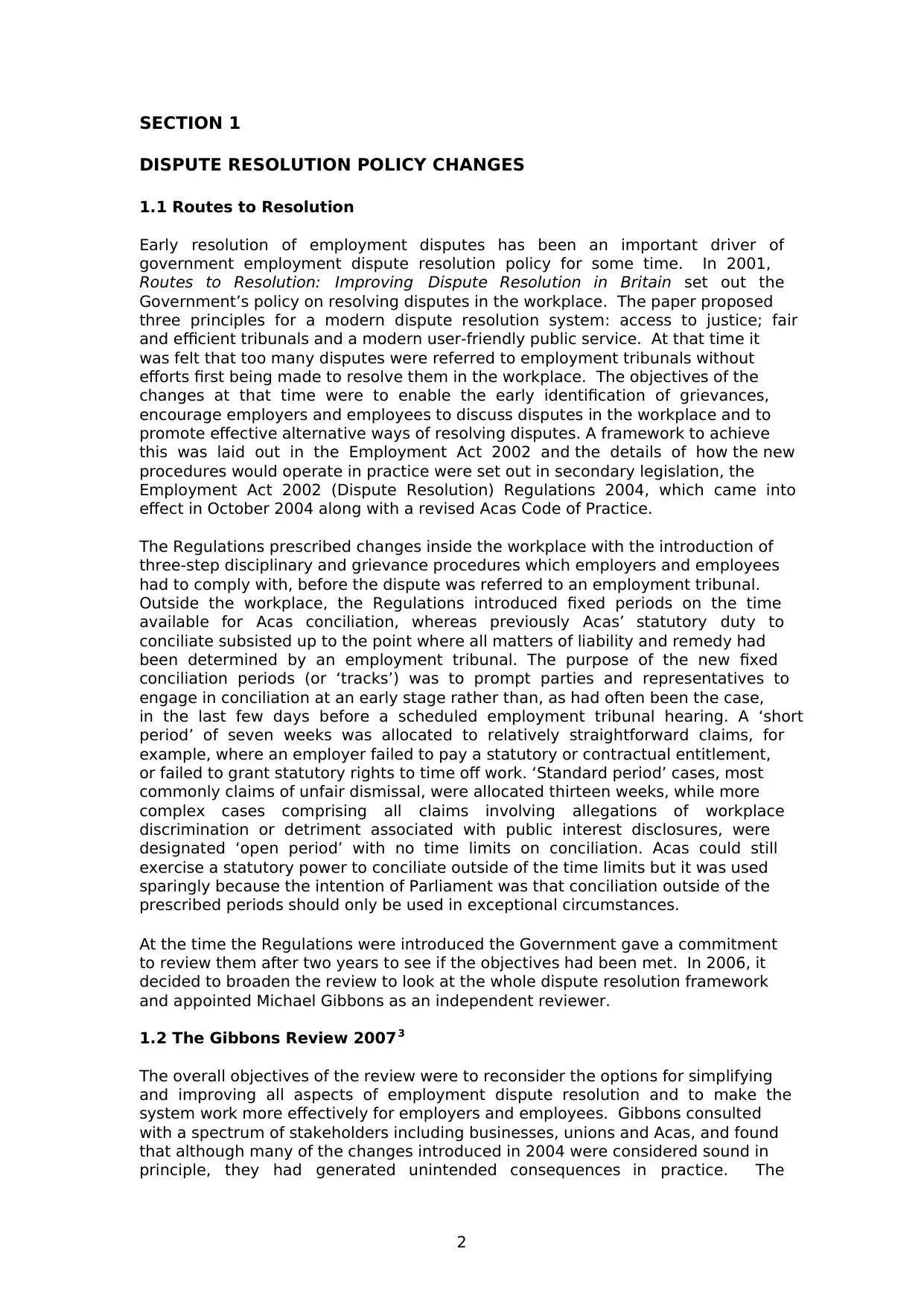
SECTION 1
DISPUTE RESOLUTION POLICY CHANGES
1.1 Routes to Resolution
Early resolution of employment disputes has been an important driver of
government employment dispute resolution policy for some time. In 2001,
Routes to Resolution: Improving Dispute Resolution in Britain set out the
Government’s policy on resolving disputes in the workplace. The paper proposed
three principles for a modern dispute resolution system: access to justice; fair
and efficient tribunals and a modern user-friendly public service. At that time it
was felt that too many disputes were referred to employment tribunals without
efforts first being made to resolve them in the workplace. The objectives of the
changes at that time were to enable the early identification of grievances,
encourage employers and employees to discuss disputes in the workplace and to
promote effective alternative ways of resolving disputes. A framework to achieve
this was laid out in the Employment Act 2002 and the details of how the new
procedures would operate in practice were set out in secondary legislation, the
Employment Act 2002 (Dispute Resolution) Regulations 2004, which came into
effect in October 2004 along with a revised Acas Code of Practice.
The Regulations prescribed changes inside the workplace with the introduction of
three-step disciplinary and grievance procedures which employers and employees
had to comply with, before the dispute was referred to an employment tribunal.
Outside the workplace, the Regulations introduced fixed periods on the time
available for Acas conciliation, whereas previously Acas’ statutory duty to
conciliate subsisted up to the point where all matters of liability and remedy had
been determined by an employment tribunal. The purpose of the new fixed
conciliation periods (or ‘tracks’) was to prompt parties and representatives to
engage in conciliation at an early stage rather than, as had often been the case,
in the last few days before a scheduled employment tribunal hearing. A ‘short
period’ of seven weeks was allocated to relatively straightforward claims, for
example, where an employer failed to pay a statutory or contractual entitlement,
or failed to grant statutory rights to time off work. ‘Standard period’ cases, most
commonly claims of unfair dismissal, were allocated thirteen weeks, while more
complex cases comprising all claims involving allegations of workplace
discrimination or detriment associated with public interest disclosures, were
designated ‘open period’ with no time limits on conciliation. Acas could still
exercise a statutory power to conciliate outside of the time limits but it was used
sparingly because the intention of Parliament was that conciliation outside of the
prescribed periods should only be used in exceptional circumstances.
At the time the Regulations were introduced the Government gave a commitment
to review them after two years to see if the objectives had been met. In 2006, it
decided to broaden the review to look at the whole dispute resolution framework
and appointed Michael Gibbons as an independent reviewer.
1.2 The Gibbons Review 20073
The overall objectives of the review were to reconsider the options for simplifying
and improving all aspects of employment dispute resolution and to make the
system work more effectively for employers and employees. Gibbons consulted
with a spectrum of stakeholders including businesses, unions and Acas, and found
that although many of the changes introduced in 2004 were considered sound in
principle, they had generated unintended consequences in practice. The
2
DISPUTE RESOLUTION POLICY CHANGES
1.1 Routes to Resolution
Early resolution of employment disputes has been an important driver of
government employment dispute resolution policy for some time. In 2001,
Routes to Resolution: Improving Dispute Resolution in Britain set out the
Government’s policy on resolving disputes in the workplace. The paper proposed
three principles for a modern dispute resolution system: access to justice; fair
and efficient tribunals and a modern user-friendly public service. At that time it
was felt that too many disputes were referred to employment tribunals without
efforts first being made to resolve them in the workplace. The objectives of the
changes at that time were to enable the early identification of grievances,
encourage employers and employees to discuss disputes in the workplace and to
promote effective alternative ways of resolving disputes. A framework to achieve
this was laid out in the Employment Act 2002 and the details of how the new
procedures would operate in practice were set out in secondary legislation, the
Employment Act 2002 (Dispute Resolution) Regulations 2004, which came into
effect in October 2004 along with a revised Acas Code of Practice.
The Regulations prescribed changes inside the workplace with the introduction of
three-step disciplinary and grievance procedures which employers and employees
had to comply with, before the dispute was referred to an employment tribunal.
Outside the workplace, the Regulations introduced fixed periods on the time
available for Acas conciliation, whereas previously Acas’ statutory duty to
conciliate subsisted up to the point where all matters of liability and remedy had
been determined by an employment tribunal. The purpose of the new fixed
conciliation periods (or ‘tracks’) was to prompt parties and representatives to
engage in conciliation at an early stage rather than, as had often been the case,
in the last few days before a scheduled employment tribunal hearing. A ‘short
period’ of seven weeks was allocated to relatively straightforward claims, for
example, where an employer failed to pay a statutory or contractual entitlement,
or failed to grant statutory rights to time off work. ‘Standard period’ cases, most
commonly claims of unfair dismissal, were allocated thirteen weeks, while more
complex cases comprising all claims involving allegations of workplace
discrimination or detriment associated with public interest disclosures, were
designated ‘open period’ with no time limits on conciliation. Acas could still
exercise a statutory power to conciliate outside of the time limits but it was used
sparingly because the intention of Parliament was that conciliation outside of the
prescribed periods should only be used in exceptional circumstances.
At the time the Regulations were introduced the Government gave a commitment
to review them after two years to see if the objectives had been met. In 2006, it
decided to broaden the review to look at the whole dispute resolution framework
and appointed Michael Gibbons as an independent reviewer.
1.2 The Gibbons Review 20073
The overall objectives of the review were to reconsider the options for simplifying
and improving all aspects of employment dispute resolution and to make the
system work more effectively for employers and employees. Gibbons consulted
with a spectrum of stakeholders including businesses, unions and Acas, and found
that although many of the changes introduced in 2004 were considered sound in
principle, they had generated unintended consequences in practice. The
2
⊘ This is a preview!⊘
Do you want full access?
Subscribe today to unlock all pages.
Trusted by 1+ million students worldwide
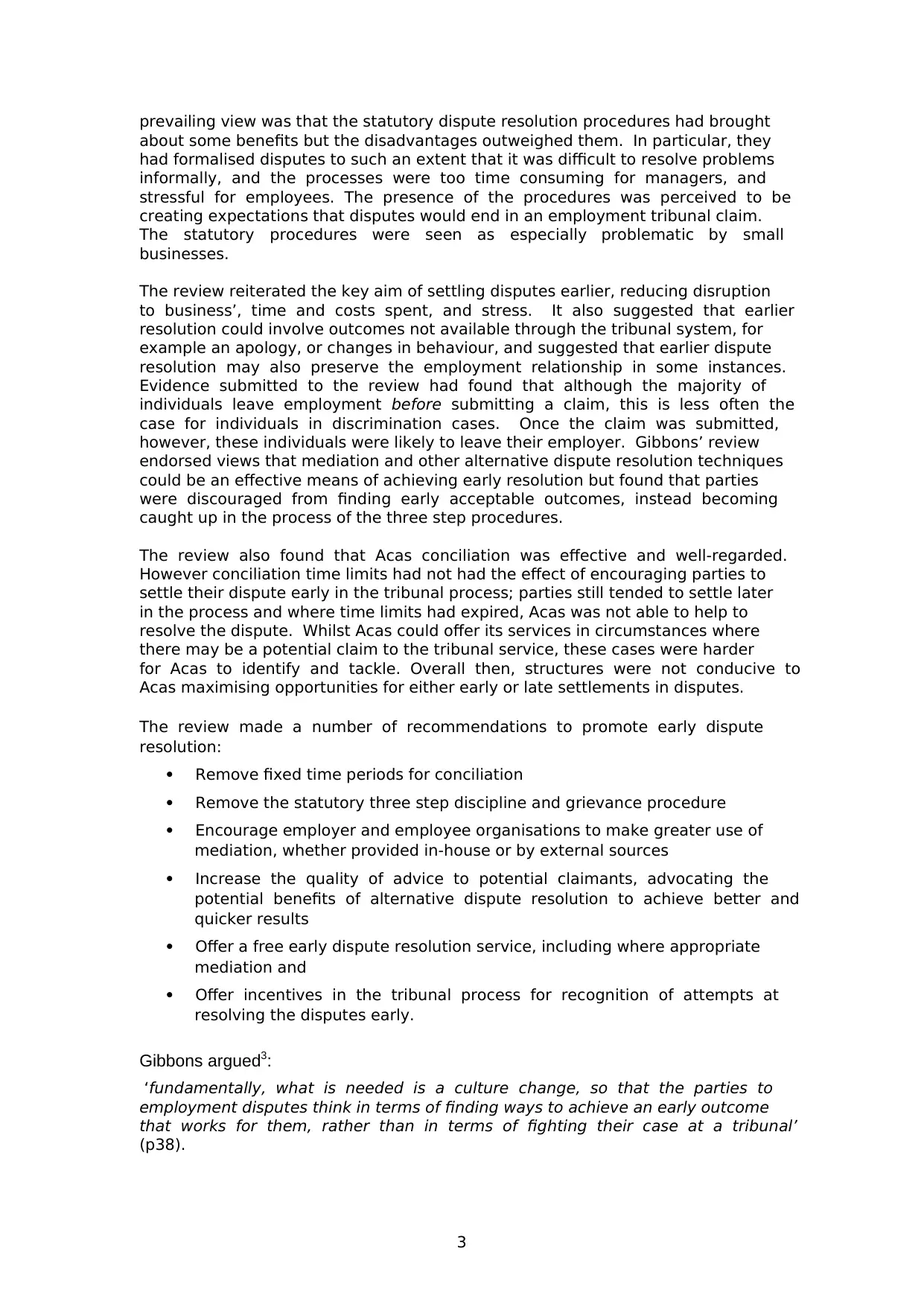
prevailing view was that the statutory dispute resolution procedures had brought
about some benefits but the disadvantages outweighed them. In particular, they
had formalised disputes to such an extent that it was difficult to resolve problems
informally, and the processes were too time consuming for managers, and
stressful for employees. The presence of the procedures was perceived to be
creating expectations that disputes would end in an employment tribunal claim.
The statutory procedures were seen as especially problematic by small
businesses.
The review reiterated the key aim of settling disputes earlier, reducing disruption
to business’, time and costs spent, and stress. It also suggested that earlier
resolution could involve outcomes not available through the tribunal system, for
example an apology, or changes in behaviour, and suggested that earlier dispute
resolution may also preserve the employment relationship in some instances.
Evidence submitted to the review had found that although the majority of
individuals leave employment before submitting a claim, this is less often the
case for individuals in discrimination cases. Once the claim was submitted,
however, these individuals were likely to leave their employer. Gibbons’ review
endorsed views that mediation and other alternative dispute resolution techniques
could be an effective means of achieving early resolution but found that parties
were discouraged from finding early acceptable outcomes, instead becoming
caught up in the process of the three step procedures.
The review also found that Acas conciliation was effective and well-regarded.
However conciliation time limits had not had the effect of encouraging parties to
settle their dispute early in the tribunal process; parties still tended to settle later
in the process and where time limits had expired, Acas was not able to help to
resolve the dispute. Whilst Acas could offer its services in circumstances where
there may be a potential claim to the tribunal service, these cases were harder
for Acas to identify and tackle. Overall then, structures were not conducive to
Acas maximising opportunities for either early or late settlements in disputes.
The review made a number of recommendations to promote early dispute
resolution:
Remove fixed time periods for conciliation
Remove the statutory three step discipline and grievance procedure
Encourage employer and employee organisations to make greater use of
mediation, whether provided in-house or by external sources
Increase the quality of advice to potential claimants, advocating the
potential benefits of alternative dispute resolution to achieve better and
quicker results
Offer a free early dispute resolution service, including where appropriate
mediation and
Offer incentives in the tribunal process for recognition of attempts at
resolving the disputes early.
Gibbons argued3:
‘fundamentally, what is needed is a culture change, so that the parties to
employment disputes think in terms of finding ways to achieve an early outcome
that works for them, rather than in terms of fighting their case at a tribunal’
(p38).
3
about some benefits but the disadvantages outweighed them. In particular, they
had formalised disputes to such an extent that it was difficult to resolve problems
informally, and the processes were too time consuming for managers, and
stressful for employees. The presence of the procedures was perceived to be
creating expectations that disputes would end in an employment tribunal claim.
The statutory procedures were seen as especially problematic by small
businesses.
The review reiterated the key aim of settling disputes earlier, reducing disruption
to business’, time and costs spent, and stress. It also suggested that earlier
resolution could involve outcomes not available through the tribunal system, for
example an apology, or changes in behaviour, and suggested that earlier dispute
resolution may also preserve the employment relationship in some instances.
Evidence submitted to the review had found that although the majority of
individuals leave employment before submitting a claim, this is less often the
case for individuals in discrimination cases. Once the claim was submitted,
however, these individuals were likely to leave their employer. Gibbons’ review
endorsed views that mediation and other alternative dispute resolution techniques
could be an effective means of achieving early resolution but found that parties
were discouraged from finding early acceptable outcomes, instead becoming
caught up in the process of the three step procedures.
The review also found that Acas conciliation was effective and well-regarded.
However conciliation time limits had not had the effect of encouraging parties to
settle their dispute early in the tribunal process; parties still tended to settle later
in the process and where time limits had expired, Acas was not able to help to
resolve the dispute. Whilst Acas could offer its services in circumstances where
there may be a potential claim to the tribunal service, these cases were harder
for Acas to identify and tackle. Overall then, structures were not conducive to
Acas maximising opportunities for either early or late settlements in disputes.
The review made a number of recommendations to promote early dispute
resolution:
Remove fixed time periods for conciliation
Remove the statutory three step discipline and grievance procedure
Encourage employer and employee organisations to make greater use of
mediation, whether provided in-house or by external sources
Increase the quality of advice to potential claimants, advocating the
potential benefits of alternative dispute resolution to achieve better and
quicker results
Offer a free early dispute resolution service, including where appropriate
mediation and
Offer incentives in the tribunal process for recognition of attempts at
resolving the disputes early.
Gibbons argued3:
‘fundamentally, what is needed is a culture change, so that the parties to
employment disputes think in terms of finding ways to achieve an early outcome
that works for them, rather than in terms of fighting their case at a tribunal’
(p38).
3
Paraphrase This Document
Need a fresh take? Get an instant paraphrase of this document with our AI Paraphraser
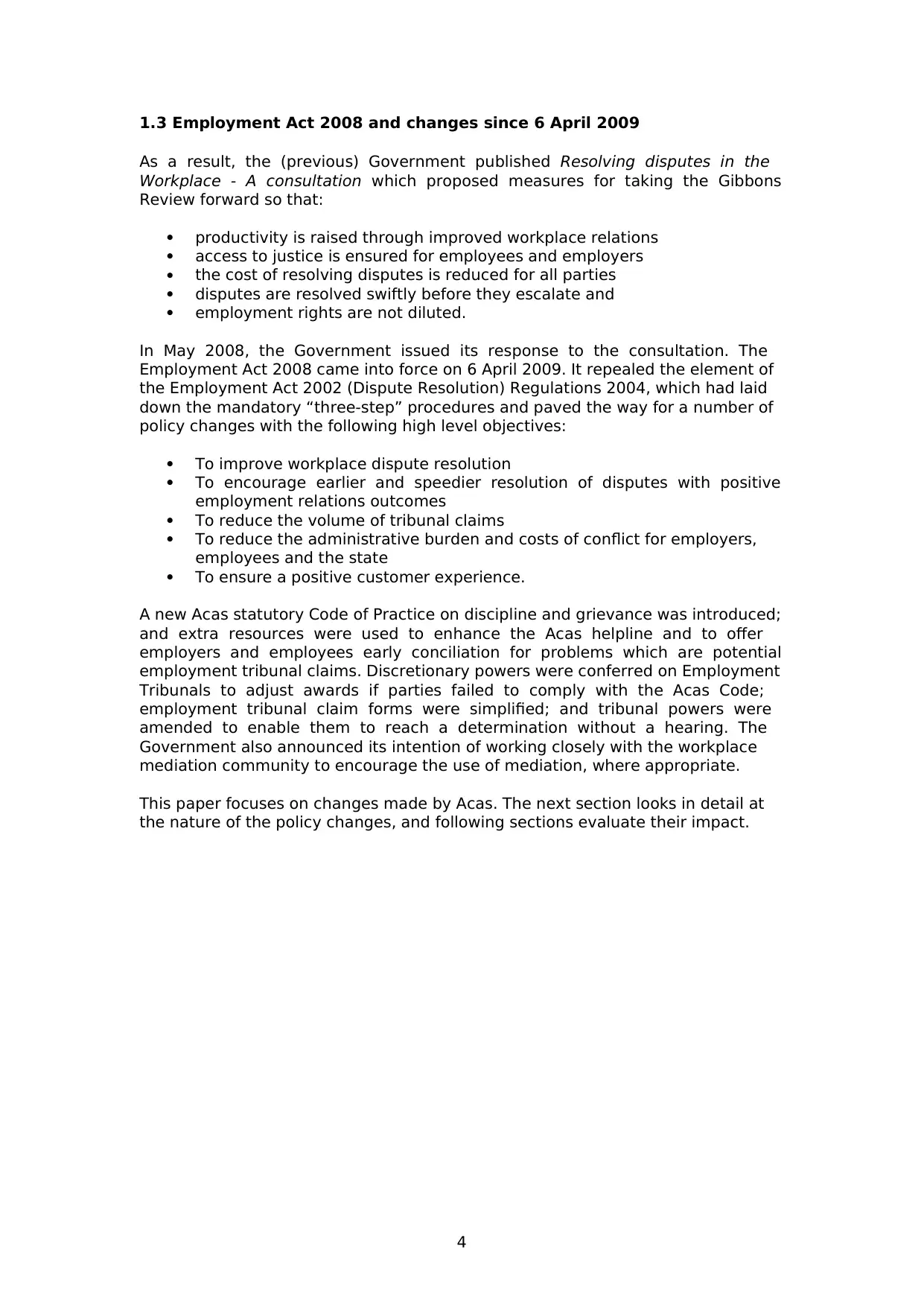
1.3 Employment Act 2008 and changes since 6 April 2009
As a result, the (previous) Government published Resolving disputes in the
Workplace - A consultation which proposed measures for taking the Gibbons
Review forward so that:
productivity is raised through improved workplace relations
access to justice is ensured for employees and employers
the cost of resolving disputes is reduced for all parties
disputes are resolved swiftly before they escalate and
employment rights are not diluted.
In May 2008, the Government issued its response to the consultation. The
Employment Act 2008 came into force on 6 April 2009. It repealed the element of
the Employment Act 2002 (Dispute Resolution) Regulations 2004, which had laid
down the mandatory “three-step” procedures and paved the way for a number of
policy changes with the following high level objectives:
To improve workplace dispute resolution
To encourage earlier and speedier resolution of disputes with positive
employment relations outcomes
To reduce the volume of tribunal claims
To reduce the administrative burden and costs of conflict for employers,
employees and the state
To ensure a positive customer experience.
A new Acas statutory Code of Practice on discipline and grievance was introduced;
and extra resources were used to enhance the Acas helpline and to offer
employers and employees early conciliation for problems which are potential
employment tribunal claims. Discretionary powers were conferred on Employment
Tribunals to adjust awards if parties failed to comply with the Acas Code;
employment tribunal claim forms were simplified; and tribunal powers were
amended to enable them to reach a determination without a hearing. The
Government also announced its intention of working closely with the workplace
mediation community to encourage the use of mediation, where appropriate.
This paper focuses on changes made by Acas. The next section looks in detail at
the nature of the policy changes, and following sections evaluate their impact.
4
As a result, the (previous) Government published Resolving disputes in the
Workplace - A consultation which proposed measures for taking the Gibbons
Review forward so that:
productivity is raised through improved workplace relations
access to justice is ensured for employees and employers
the cost of resolving disputes is reduced for all parties
disputes are resolved swiftly before they escalate and
employment rights are not diluted.
In May 2008, the Government issued its response to the consultation. The
Employment Act 2008 came into force on 6 April 2009. It repealed the element of
the Employment Act 2002 (Dispute Resolution) Regulations 2004, which had laid
down the mandatory “three-step” procedures and paved the way for a number of
policy changes with the following high level objectives:
To improve workplace dispute resolution
To encourage earlier and speedier resolution of disputes with positive
employment relations outcomes
To reduce the volume of tribunal claims
To reduce the administrative burden and costs of conflict for employers,
employees and the state
To ensure a positive customer experience.
A new Acas statutory Code of Practice on discipline and grievance was introduced;
and extra resources were used to enhance the Acas helpline and to offer
employers and employees early conciliation for problems which are potential
employment tribunal claims. Discretionary powers were conferred on Employment
Tribunals to adjust awards if parties failed to comply with the Acas Code;
employment tribunal claim forms were simplified; and tribunal powers were
amended to enable them to reach a determination without a hearing. The
Government also announced its intention of working closely with the workplace
mediation community to encourage the use of mediation, where appropriate.
This paper focuses on changes made by Acas. The next section looks in detail at
the nature of the policy changes, and following sections evaluate their impact.
4
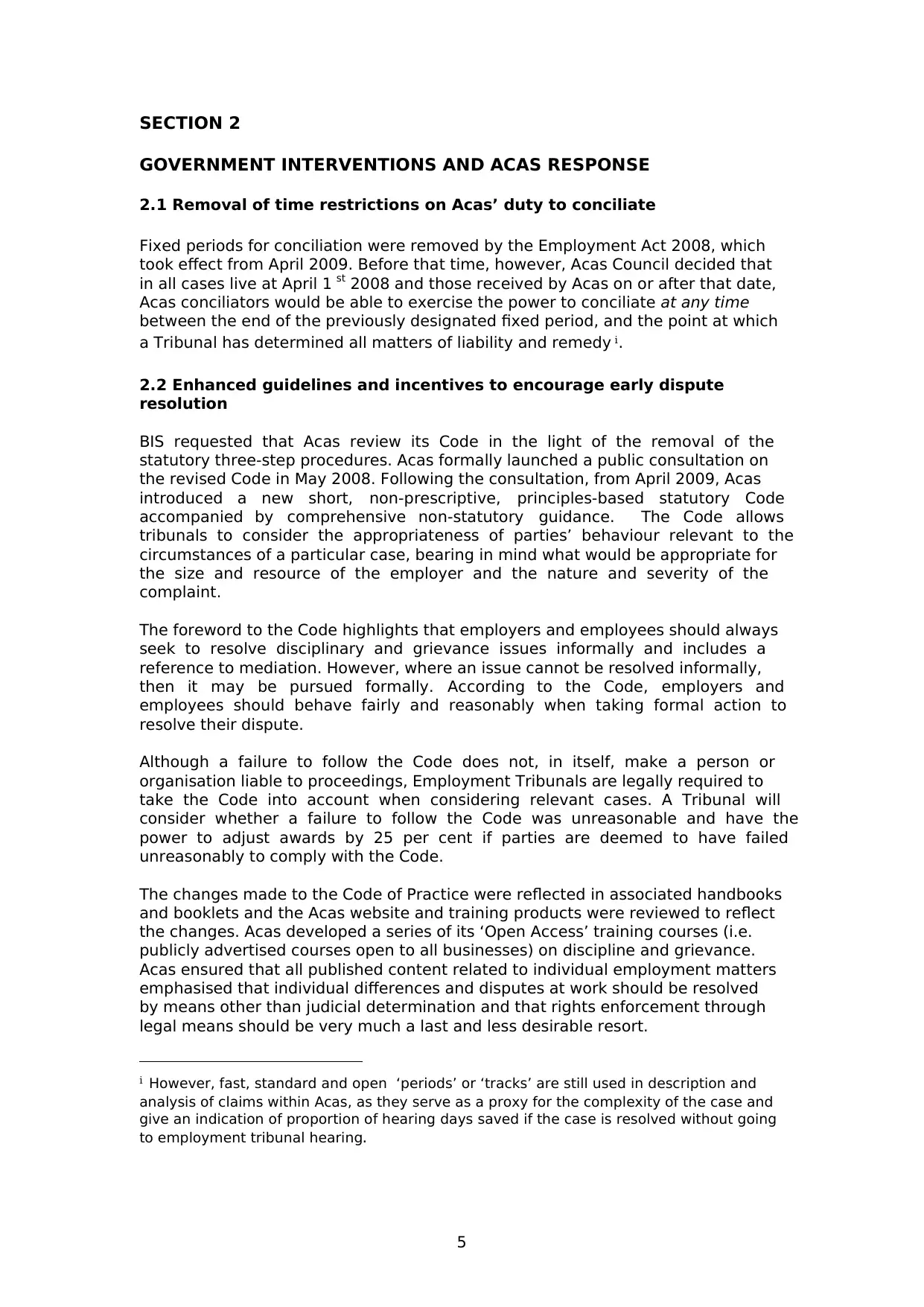
SECTION 2
GOVERNMENT INTERVENTIONS AND ACAS RESPONSE
2.1 Removal of time restrictions on Acas’ duty to conciliate
Fixed periods for conciliation were removed by the Employment Act 2008, which
took effect from April 2009. Before that time, however, Acas Council decided that
in all cases live at April 1 st 2008 and those received by Acas on or after that date,
Acas conciliators would be able to exercise the power to conciliate at any time
between the end of the previously designated fixed period, and the point at which
a Tribunal has determined all matters of liability and remedy i.
2.2 Enhanced guidelines and incentives to encourage early dispute
resolution
BIS requested that Acas review its Code in the light of the removal of the
statutory three-step procedures. Acas formally launched a public consultation on
the revised Code in May 2008. Following the consultation, from April 2009, Acas
introduced a new short, non-prescriptive, principles-based statutory Code
accompanied by comprehensive non-statutory guidance. The Code allows
tribunals to consider the appropriateness of parties’ behaviour relevant to the
circumstances of a particular case, bearing in mind what would be appropriate for
the size and resource of the employer and the nature and severity of the
complaint.
The foreword to the Code highlights that employers and employees should always
seek to resolve disciplinary and grievance issues informally and includes a
reference to mediation. However, where an issue cannot be resolved informally,
then it may be pursued formally. According to the Code, employers and
employees should behave fairly and reasonably when taking formal action to
resolve their dispute.
Although a failure to follow the Code does not, in itself, make a person or
organisation liable to proceedings, Employment Tribunals are legally required to
take the Code into account when considering relevant cases. A Tribunal will
consider whether a failure to follow the Code was unreasonable and have the
power to adjust awards by 25 per cent if parties are deemed to have failed
unreasonably to comply with the Code.
The changes made to the Code of Practice were reflected in associated handbooks
and booklets and the Acas website and training products were reviewed to reflect
the changes. Acas developed a series of its ‘Open Access’ training courses (i.e.
publicly advertised courses open to all businesses) on discipline and grievance.
Acas ensured that all published content related to individual employment matters
emphasised that individual differences and disputes at work should be resolved
by means other than judicial determination and that rights enforcement through
legal means should be very much a last and less desirable resort.
i However, fast, standard and open ‘periods’ or ‘tracks’ are still used in description and
analysis of claims within Acas, as they serve as a proxy for the complexity of the case and
give an indication of proportion of hearing days saved if the case is resolved without going
to employment tribunal hearing.
5
GOVERNMENT INTERVENTIONS AND ACAS RESPONSE
2.1 Removal of time restrictions on Acas’ duty to conciliate
Fixed periods for conciliation were removed by the Employment Act 2008, which
took effect from April 2009. Before that time, however, Acas Council decided that
in all cases live at April 1 st 2008 and those received by Acas on or after that date,
Acas conciliators would be able to exercise the power to conciliate at any time
between the end of the previously designated fixed period, and the point at which
a Tribunal has determined all matters of liability and remedy i.
2.2 Enhanced guidelines and incentives to encourage early dispute
resolution
BIS requested that Acas review its Code in the light of the removal of the
statutory three-step procedures. Acas formally launched a public consultation on
the revised Code in May 2008. Following the consultation, from April 2009, Acas
introduced a new short, non-prescriptive, principles-based statutory Code
accompanied by comprehensive non-statutory guidance. The Code allows
tribunals to consider the appropriateness of parties’ behaviour relevant to the
circumstances of a particular case, bearing in mind what would be appropriate for
the size and resource of the employer and the nature and severity of the
complaint.
The foreword to the Code highlights that employers and employees should always
seek to resolve disciplinary and grievance issues informally and includes a
reference to mediation. However, where an issue cannot be resolved informally,
then it may be pursued formally. According to the Code, employers and
employees should behave fairly and reasonably when taking formal action to
resolve their dispute.
Although a failure to follow the Code does not, in itself, make a person or
organisation liable to proceedings, Employment Tribunals are legally required to
take the Code into account when considering relevant cases. A Tribunal will
consider whether a failure to follow the Code was unreasonable and have the
power to adjust awards by 25 per cent if parties are deemed to have failed
unreasonably to comply with the Code.
The changes made to the Code of Practice were reflected in associated handbooks
and booklets and the Acas website and training products were reviewed to reflect
the changes. Acas developed a series of its ‘Open Access’ training courses (i.e.
publicly advertised courses open to all businesses) on discipline and grievance.
Acas ensured that all published content related to individual employment matters
emphasised that individual differences and disputes at work should be resolved
by means other than judicial determination and that rights enforcement through
legal means should be very much a last and less desirable resort.
i However, fast, standard and open ‘periods’ or ‘tracks’ are still used in description and
analysis of claims within Acas, as they serve as a proxy for the complexity of the case and
give an indication of proportion of hearing days saved if the case is resolved without going
to employment tribunal hearing.
5
⊘ This is a preview!⊘
Do you want full access?
Subscribe today to unlock all pages.
Trusted by 1+ million students worldwide

1 out of 58


Your All-in-One AI-Powered Toolkit for Academic Success.
+13062052269
info@desklib.com
Available 24*7 on WhatsApp / Email
![[object Object]](/_next/static/media/star-bottom.7253800d.svg)
Unlock your academic potential
Copyright © 2020–2026 A2Z Services. All Rights Reserved. Developed and managed by ZUCOL.