Analysis of Organisational Behaviour at Accenture: Report
VerifiedAdded on 2023/06/05
|13
|4318
|264
Report
AI Summary
This report provides an in-depth analysis of organisational behaviour within the context of Accenture. It begins by examining how an organisation's culture, politics, and power dynamics influence individual and team behaviour and performance, differentiating between various cultural types, political approaches, and power structures. The report then evaluates content and process theories of motivation, specifically Maslow's hierarchy of needs and equity theory, and how these theories and motivational techniques enable effective goal achievement. It differentiates between effective and ineffective teams, exploring team and group development theories. Finally, the report applies these concepts and philosophies of organisational behaviour to a given business situation, offering an evaluation of their impact on behaviour within Accenture. The analysis includes practical examples and insights into Accenture's organizational structure and practices.
Organisational
Behaviour
Behaviour

Paraphrase This Document
Need a fresh take? Get an instant paraphrase of this document with our AI Paraphraser
Table of Contents
INTRODUCTION...........................................................................................................................1
TASK...............................................................................................................................................1
P1 Analyse how an organisation’s culture, politics and power influence individual and team
behaviour and performance.........................................................................................................1
M1 Critically explain how the culture, politics and power of an organisation can influence
individual and team behaviour and performance........................................................................3
P2 Evaluate how content and process theories of motivation and motivational techniques
enable effective achievement of goals in an organisational context. .........................................3
M2 Critically explain how to influence the behaviour of others through the effective
implementation of behavioural motivational theories, concepts and models.............................5
P3 Explain what makes an effective team as opposed to an ineffective team........................6
M3 Analyse relevant team and group development theories to support the development of
cooperation within effective teams.............................................................................................8
P4 Apply concepts and philosophies of organisational behaviour within an organizational
context and given business situation...........................................................................................8
M4 Evaluate how concepts and philosophies of OB inform and influence behaviour within
a given business situation............................................................................................................9
CONCLUSION..............................................................................................................................10
REFERENCES..............................................................................................................................11
INTRODUCTION...........................................................................................................................1
TASK...............................................................................................................................................1
P1 Analyse how an organisation’s culture, politics and power influence individual and team
behaviour and performance.........................................................................................................1
M1 Critically explain how the culture, politics and power of an organisation can influence
individual and team behaviour and performance........................................................................3
P2 Evaluate how content and process theories of motivation and motivational techniques
enable effective achievement of goals in an organisational context. .........................................3
M2 Critically explain how to influence the behaviour of others through the effective
implementation of behavioural motivational theories, concepts and models.............................5
P3 Explain what makes an effective team as opposed to an ineffective team........................6
M3 Analyse relevant team and group development theories to support the development of
cooperation within effective teams.............................................................................................8
P4 Apply concepts and philosophies of organisational behaviour within an organizational
context and given business situation...........................................................................................8
M4 Evaluate how concepts and philosophies of OB inform and influence behaviour within
a given business situation............................................................................................................9
CONCLUSION..............................................................................................................................10
REFERENCES..............................................................................................................................11
INTRODUCTION
Organisational behaviour is the in-depth study of human behaviour in the context of effective
working in the organisation. There are number of employees in the organisation who have
different view points towards their work with the different approaches. Organisational behaviour
studies the human behaviour in specified organisations and implement the concepts which
motivates them in order to generate the work. There are different approaches of the
organisational behaviour which includes people working in the organisation, structure of the
company, technological upgradation in the company and the external environment which makes
impact on the working of the organisation. The report is being made in the context of Accenture
company is the enterprise which deals in software products and provide platforms in order to
generate industry knowledge and expertise in industrial knowledge(Agarwal, 2022) . The aim of
this report is to highlight the how an organisation can make improvement in their culture, politics
and power to make influence on individual as well as teams. Then it evaluates the different
theories of motivation which an organisation can implement in respect to make employees more
productive. Adding to that it also make complete differentiation on effectives versus ineffective
teams. And at last this report implement the different concepts and philosophies in the given
organisational context.
TASK
P1 Analyse how an organisation’s culture, politics and power influence individual and
team behaviour and performance.
The working structure of the organisation is defined by its cultures which influences the
workforce majorly. Having or developing effective implementation of the culture generates
more impactful results in the profitability and success (Earle, 2022) . There are different types of
cultures which an organisation can adopt in their working, some of them are discussed below:
Adhocracy culture- This is the type of culture which is bring more flexibility in the
working with no bureaucratic procedures. This implicates constant innovation and
improvements in the organisation.
1
Organisational behaviour is the in-depth study of human behaviour in the context of effective
working in the organisation. There are number of employees in the organisation who have
different view points towards their work with the different approaches. Organisational behaviour
studies the human behaviour in specified organisations and implement the concepts which
motivates them in order to generate the work. There are different approaches of the
organisational behaviour which includes people working in the organisation, structure of the
company, technological upgradation in the company and the external environment which makes
impact on the working of the organisation. The report is being made in the context of Accenture
company is the enterprise which deals in software products and provide platforms in order to
generate industry knowledge and expertise in industrial knowledge(Agarwal, 2022) . The aim of
this report is to highlight the how an organisation can make improvement in their culture, politics
and power to make influence on individual as well as teams. Then it evaluates the different
theories of motivation which an organisation can implement in respect to make employees more
productive. Adding to that it also make complete differentiation on effectives versus ineffective
teams. And at last this report implement the different concepts and philosophies in the given
organisational context.
TASK
P1 Analyse how an organisation’s culture, politics and power influence individual and
team behaviour and performance.
The working structure of the organisation is defined by its cultures which influences the
workforce majorly. Having or developing effective implementation of the culture generates
more impactful results in the profitability and success (Earle, 2022) . There are different types of
cultures which an organisation can adopt in their working, some of them are discussed below:
Adhocracy culture- This is the type of culture which is bring more flexibility in the
working with no bureaucratic procedures. This implicates constant innovation and
improvements in the organisation.
1
⊘ This is a preview!⊘
Do you want full access?
Subscribe today to unlock all pages.

Trusted by 1+ million students worldwide
Clan culture- This culture is suitable for mostly small and family businesses which is not
hierarchical in nature. Employees in this culture deals with situation in regards to their
values and the working environment is very supportive.
Hierarchy culture- It is the mostly followed organisational culture which follows a
defined working structure with established procedures and the level of authority.
Employees in this culture are fit in the chain of command and accountable as per the
ability to do work.
Market Culture- It is the type of culture which follows a complete profit margins and
focuses on the staying ahead in the competition. It varies from external factors and
ensures customers satisfaction firstly.
Accenture is making their operations on a huge level and functioning in various countries. The
company is following the combination of hierarchical culture and marketing culture in their
organisation (Egolf, 2022) . As professional basis of work with better customer assurance is
essential to maintain effective working in the organisation.
Politics makes huge impact as relevant politics in the organisation develop effective use of the
power and helpful in the procedure of social networking. There are four types of politics which is
discussed below:
The woods- This politics states that organisation should formally follows the procedures
and guidelines in order to fulfils the unspoken agendas and hidden assumptions. This
brings safety in the organisation and make evaluation of the areas which need changes.
The high ground- This type of politics implements the formal authority with the
organisational structure. Make balance between both creates set of rules, structure,
policies and different processes which develops base for political activities.
The weed- It is the way of politics which comprises personal influence with informal
working environment which helps in building organisation. Such as if an employee is not
performing well another should compensate on the behalf of that employee.
The Rock- This involves the communication process and the interaction in the
organisation can be conduct on formal basis and as per the suitability of the authority.
In the context of Accenture company they have developed their working structure on the basis
of rock and weed politics. And they make changes in the structure as per the requirements.
2
hierarchical in nature. Employees in this culture deals with situation in regards to their
values and the working environment is very supportive.
Hierarchy culture- It is the mostly followed organisational culture which follows a
defined working structure with established procedures and the level of authority.
Employees in this culture are fit in the chain of command and accountable as per the
ability to do work.
Market Culture- It is the type of culture which follows a complete profit margins and
focuses on the staying ahead in the competition. It varies from external factors and
ensures customers satisfaction firstly.
Accenture is making their operations on a huge level and functioning in various countries. The
company is following the combination of hierarchical culture and marketing culture in their
organisation (Egolf, 2022) . As professional basis of work with better customer assurance is
essential to maintain effective working in the organisation.
Politics makes huge impact as relevant politics in the organisation develop effective use of the
power and helpful in the procedure of social networking. There are four types of politics which is
discussed below:
The woods- This politics states that organisation should formally follows the procedures
and guidelines in order to fulfils the unspoken agendas and hidden assumptions. This
brings safety in the organisation and make evaluation of the areas which need changes.
The high ground- This type of politics implements the formal authority with the
organisational structure. Make balance between both creates set of rules, structure,
policies and different processes which develops base for political activities.
The weed- It is the way of politics which comprises personal influence with informal
working environment which helps in building organisation. Such as if an employee is not
performing well another should compensate on the behalf of that employee.
The Rock- This involves the communication process and the interaction in the
organisation can be conduct on formal basis and as per the suitability of the authority.
In the context of Accenture company they have developed their working structure on the basis
of rock and weed politics. And they make changes in the structure as per the requirements.
2
Paraphrase This Document
Need a fresh take? Get an instant paraphrase of this document with our AI Paraphraser
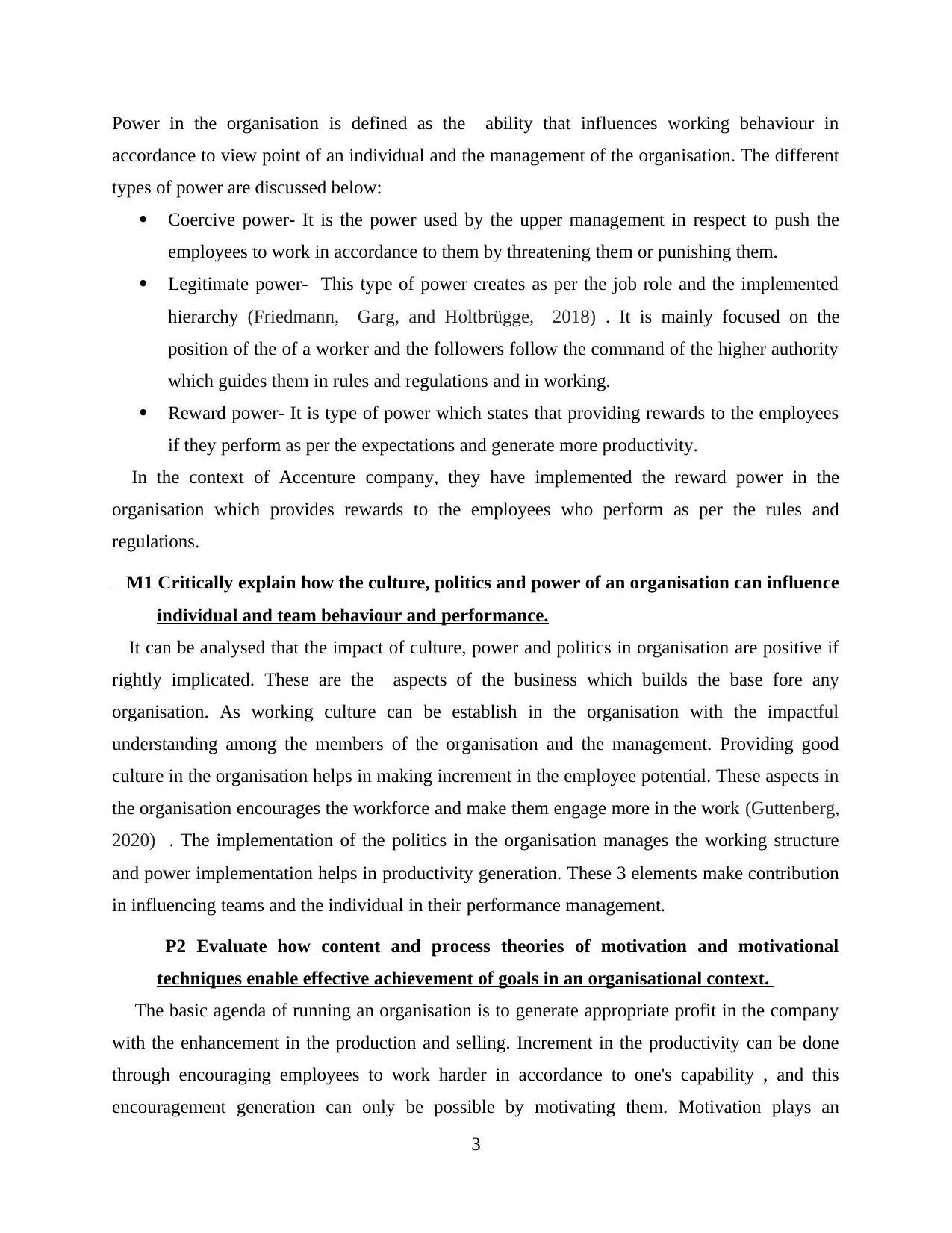
Power in the organisation is defined as the ability that influences working behaviour in
accordance to view point of an individual and the management of the organisation. The different
types of power are discussed below:
Coercive power- It is the power used by the upper management in respect to push the
employees to work in accordance to them by threatening them or punishing them.
Legitimate power- This type of power creates as per the job role and the implemented
hierarchy (Friedmann, Garg, and Holtbrügge, 2018) . It is mainly focused on the
position of the of a worker and the followers follow the command of the higher authority
which guides them in rules and regulations and in working.
Reward power- It is type of power which states that providing rewards to the employees
if they perform as per the expectations and generate more productivity.
In the context of Accenture company, they have implemented the reward power in the
organisation which provides rewards to the employees who perform as per the rules and
regulations.
M1 Critically explain how the culture, politics and power of an organisation can influence
individual and team behaviour and performance.
It can be analysed that the impact of culture, power and politics in organisation are positive if
rightly implicated. These are the aspects of the business which builds the base fore any
organisation. As working culture can be establish in the organisation with the impactful
understanding among the members of the organisation and the management. Providing good
culture in the organisation helps in making increment in the employee potential. These aspects in
the organisation encourages the workforce and make them engage more in the work (Guttenberg,
2020) . The implementation of the politics in the organisation manages the working structure
and power implementation helps in productivity generation. These 3 elements make contribution
in influencing teams and the individual in their performance management.
P2 Evaluate how content and process theories of motivation and motivational
techniques enable effective achievement of goals in an organisational context.
The basic agenda of running an organisation is to generate appropriate profit in the company
with the enhancement in the production and selling. Increment in the productivity can be done
through encouraging employees to work harder in accordance to one's capability , and this
encouragement generation can only be possible by motivating them. Motivation plays an
3
accordance to view point of an individual and the management of the organisation. The different
types of power are discussed below:
Coercive power- It is the power used by the upper management in respect to push the
employees to work in accordance to them by threatening them or punishing them.
Legitimate power- This type of power creates as per the job role and the implemented
hierarchy (Friedmann, Garg, and Holtbrügge, 2018) . It is mainly focused on the
position of the of a worker and the followers follow the command of the higher authority
which guides them in rules and regulations and in working.
Reward power- It is type of power which states that providing rewards to the employees
if they perform as per the expectations and generate more productivity.
In the context of Accenture company, they have implemented the reward power in the
organisation which provides rewards to the employees who perform as per the rules and
regulations.
M1 Critically explain how the culture, politics and power of an organisation can influence
individual and team behaviour and performance.
It can be analysed that the impact of culture, power and politics in organisation are positive if
rightly implicated. These are the aspects of the business which builds the base fore any
organisation. As working culture can be establish in the organisation with the impactful
understanding among the members of the organisation and the management. Providing good
culture in the organisation helps in making increment in the employee potential. These aspects in
the organisation encourages the workforce and make them engage more in the work (Guttenberg,
2020) . The implementation of the politics in the organisation manages the working structure
and power implementation helps in productivity generation. These 3 elements make contribution
in influencing teams and the individual in their performance management.
P2 Evaluate how content and process theories of motivation and motivational
techniques enable effective achievement of goals in an organisational context.
The basic agenda of running an organisation is to generate appropriate profit in the company
with the enhancement in the production and selling. Increment in the productivity can be done
through encouraging employees to work harder in accordance to one's capability , and this
encouragement generation can only be possible by motivating them. Motivation plays an
3
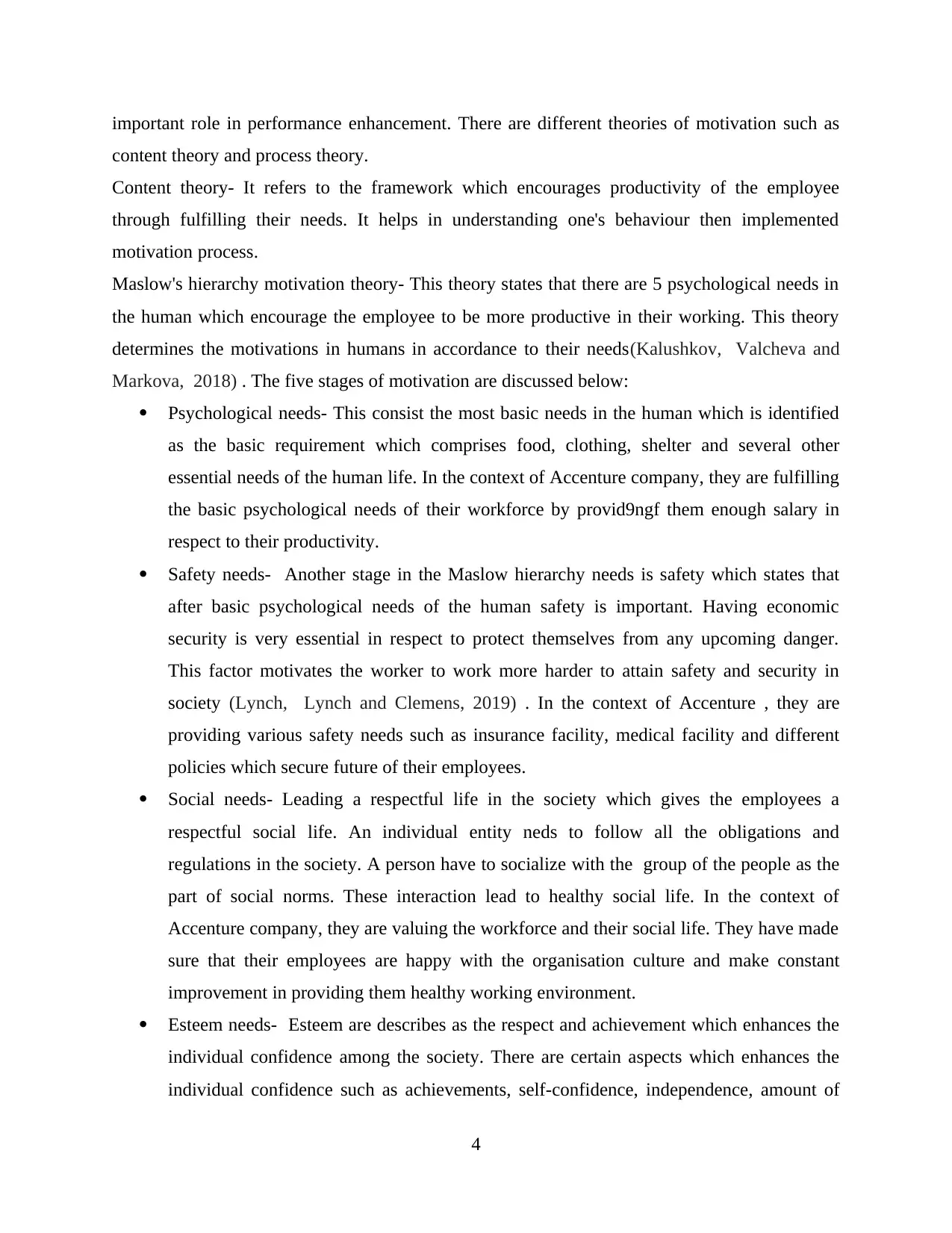
important role in performance enhancement. There are different theories of motivation such as
content theory and process theory.
Content theory- It refers to the framework which encourages productivity of the employee
through fulfilling their needs. It helps in understanding one's behaviour then implemented
motivation process.
Maslow's hierarchy motivation theory- This theory states that there are 5 psychological needs in
the human which encourage the employee to be more productive in their working. This theory
determines the motivations in humans in accordance to their needs(Kalushkov, Valcheva and
Markova, 2018) . The five stages of motivation are discussed below:
Psychological needs- This consist the most basic needs in the human which is identified
as the basic requirement which comprises food, clothing, shelter and several other
essential needs of the human life. In the context of Accenture company, they are fulfilling
the basic psychological needs of their workforce by provid9ngf them enough salary in
respect to their productivity.
Safety needs- Another stage in the Maslow hierarchy needs is safety which states that
after basic psychological needs of the human safety is important. Having economic
security is very essential in respect to protect themselves from any upcoming danger.
This factor motivates the worker to work more harder to attain safety and security in
society (Lynch, Lynch and Clemens, 2019) . In the context of Accenture , they are
providing various safety needs such as insurance facility, medical facility and different
policies which secure future of their employees.
Social needs- Leading a respectful life in the society which gives the employees a
respectful social life. An individual entity neds to follow all the obligations and
regulations in the society. A person have to socialize with the group of the people as the
part of social norms. These interaction lead to healthy social life. In the context of
Accenture company, they are valuing the workforce and their social life. They have made
sure that their employees are happy with the organisation culture and make constant
improvement in providing them healthy working environment.
Esteem needs- Esteem are describes as the respect and achievement which enhances the
individual confidence among the society. There are certain aspects which enhances the
individual confidence such as achievements, self-confidence, independence, amount of
4
content theory and process theory.
Content theory- It refers to the framework which encourages productivity of the employee
through fulfilling their needs. It helps in understanding one's behaviour then implemented
motivation process.
Maslow's hierarchy motivation theory- This theory states that there are 5 psychological needs in
the human which encourage the employee to be more productive in their working. This theory
determines the motivations in humans in accordance to their needs(Kalushkov, Valcheva and
Markova, 2018) . The five stages of motivation are discussed below:
Psychological needs- This consist the most basic needs in the human which is identified
as the basic requirement which comprises food, clothing, shelter and several other
essential needs of the human life. In the context of Accenture company, they are fulfilling
the basic psychological needs of their workforce by provid9ngf them enough salary in
respect to their productivity.
Safety needs- Another stage in the Maslow hierarchy needs is safety which states that
after basic psychological needs of the human safety is important. Having economic
security is very essential in respect to protect themselves from any upcoming danger.
This factor motivates the worker to work more harder to attain safety and security in
society (Lynch, Lynch and Clemens, 2019) . In the context of Accenture , they are
providing various safety needs such as insurance facility, medical facility and different
policies which secure future of their employees.
Social needs- Leading a respectful life in the society which gives the employees a
respectful social life. An individual entity neds to follow all the obligations and
regulations in the society. A person have to socialize with the group of the people as the
part of social norms. These interaction lead to healthy social life. In the context of
Accenture company, they are valuing the workforce and their social life. They have made
sure that their employees are happy with the organisation culture and make constant
improvement in providing them healthy working environment.
Esteem needs- Esteem are describes as the respect and achievement which enhances the
individual confidence among the society. There are certain aspects which enhances the
individual confidence such as achievements, self-confidence, independence, amount of
4
⊘ This is a preview!⊘
Do you want full access?
Subscribe today to unlock all pages.
Trusted by 1+ million students worldwide
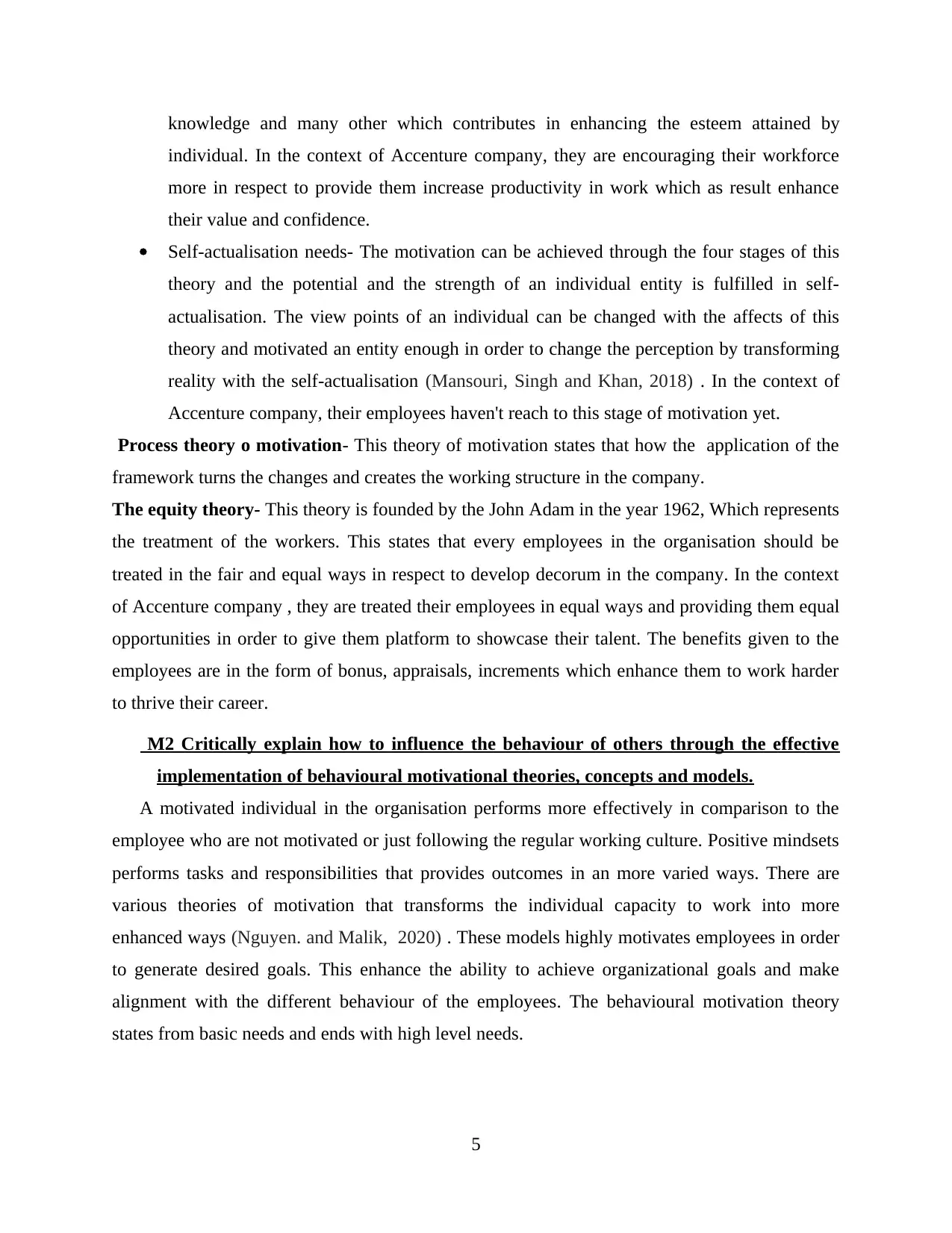
knowledge and many other which contributes in enhancing the esteem attained by
individual. In the context of Accenture company, they are encouraging their workforce
more in respect to provide them increase productivity in work which as result enhance
their value and confidence.
Self-actualisation needs- The motivation can be achieved through the four stages of this
theory and the potential and the strength of an individual entity is fulfilled in self-
actualisation. The view points of an individual can be changed with the affects of this
theory and motivated an entity enough in order to change the perception by transforming
reality with the self-actualisation (Mansouri, Singh and Khan, 2018) . In the context of
Accenture company, their employees haven't reach to this stage of motivation yet.
Process theory o motivation- This theory of motivation states that how the application of the
framework turns the changes and creates the working structure in the company.
The equity theory- This theory is founded by the John Adam in the year 1962, Which represents
the treatment of the workers. This states that every employees in the organisation should be
treated in the fair and equal ways in respect to develop decorum in the company. In the context
of Accenture company , they are treated their employees in equal ways and providing them equal
opportunities in order to give them platform to showcase their talent. The benefits given to the
employees are in the form of bonus, appraisals, increments which enhance them to work harder
to thrive their career.
M2 Critically explain how to influence the behaviour of others through the effective
implementation of behavioural motivational theories, concepts and models.
A motivated individual in the organisation performs more effectively in comparison to the
employee who are not motivated or just following the regular working culture. Positive mindsets
performs tasks and responsibilities that provides outcomes in an more varied ways. There are
various theories of motivation that transforms the individual capacity to work into more
enhanced ways (Nguyen. and Malik, 2020) . These models highly motivates employees in order
to generate desired goals. This enhance the ability to achieve organizational goals and make
alignment with the different behaviour of the employees. The behavioural motivation theory
states from basic needs and ends with high level needs.
5
individual. In the context of Accenture company, they are encouraging their workforce
more in respect to provide them increase productivity in work which as result enhance
their value and confidence.
Self-actualisation needs- The motivation can be achieved through the four stages of this
theory and the potential and the strength of an individual entity is fulfilled in self-
actualisation. The view points of an individual can be changed with the affects of this
theory and motivated an entity enough in order to change the perception by transforming
reality with the self-actualisation (Mansouri, Singh and Khan, 2018) . In the context of
Accenture company, their employees haven't reach to this stage of motivation yet.
Process theory o motivation- This theory of motivation states that how the application of the
framework turns the changes and creates the working structure in the company.
The equity theory- This theory is founded by the John Adam in the year 1962, Which represents
the treatment of the workers. This states that every employees in the organisation should be
treated in the fair and equal ways in respect to develop decorum in the company. In the context
of Accenture company , they are treated their employees in equal ways and providing them equal
opportunities in order to give them platform to showcase their talent. The benefits given to the
employees are in the form of bonus, appraisals, increments which enhance them to work harder
to thrive their career.
M2 Critically explain how to influence the behaviour of others through the effective
implementation of behavioural motivational theories, concepts and models.
A motivated individual in the organisation performs more effectively in comparison to the
employee who are not motivated or just following the regular working culture. Positive mindsets
performs tasks and responsibilities that provides outcomes in an more varied ways. There are
various theories of motivation that transforms the individual capacity to work into more
enhanced ways (Nguyen. and Malik, 2020) . These models highly motivates employees in order
to generate desired goals. This enhance the ability to achieve organizational goals and make
alignment with the different behaviour of the employees. The behavioural motivation theory
states from basic needs and ends with high level needs.
5
Paraphrase This Document
Need a fresh take? Get an instant paraphrase of this document with our AI Paraphraser
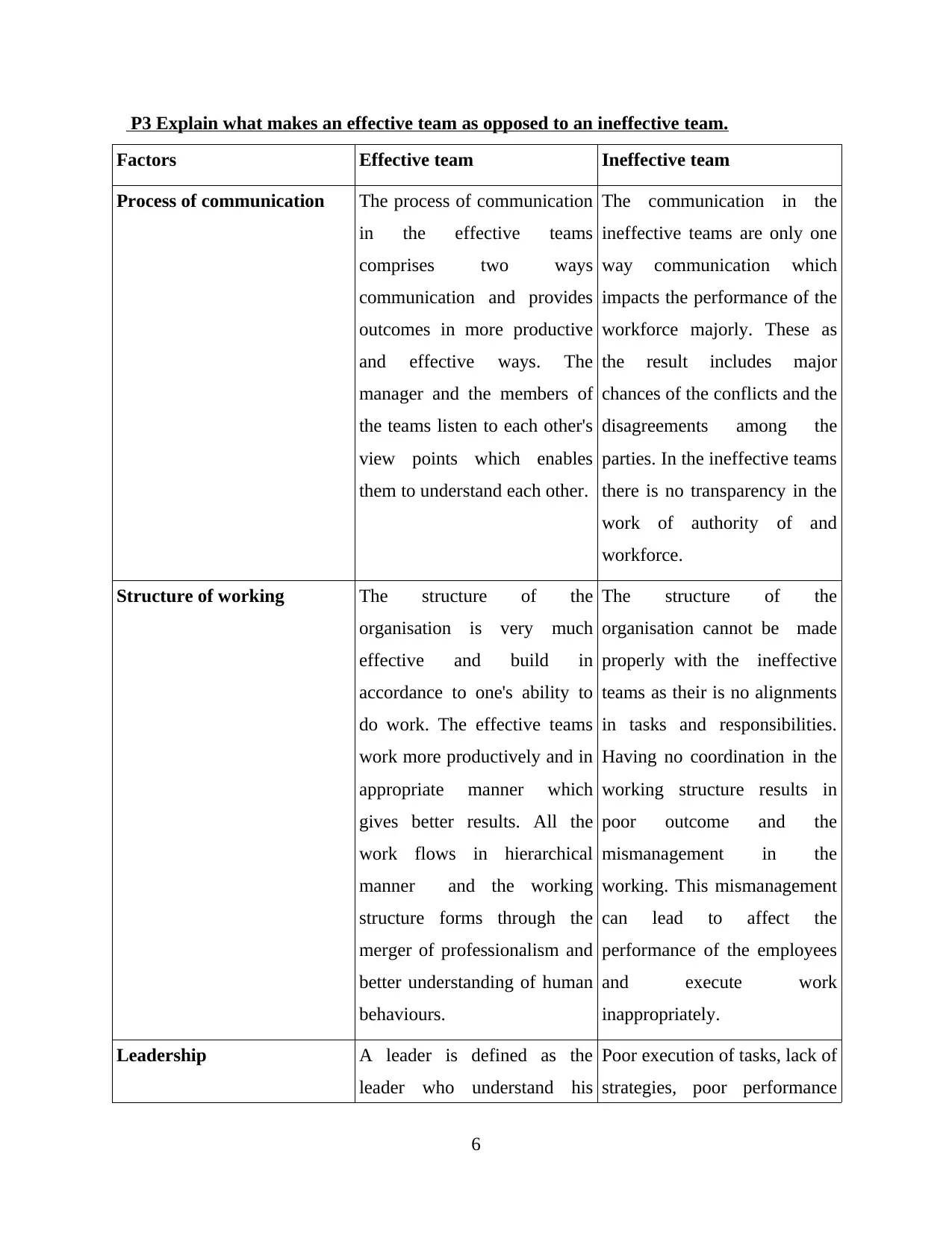
P3 Explain what makes an effective team as opposed to an ineffective team.
Factors Effective team Ineffective team
Process of communication The process of communication
in the effective teams
comprises two ways
communication and provides
outcomes in more productive
and effective ways. The
manager and the members of
the teams listen to each other's
view points which enables
them to understand each other.
The communication in the
ineffective teams are only one
way communication which
impacts the performance of the
workforce majorly. These as
the result includes major
chances of the conflicts and the
disagreements among the
parties. In the ineffective teams
there is no transparency in the
work of authority of and
workforce.
Structure of working The structure of the
organisation is very much
effective and build in
accordance to one's ability to
do work. The effective teams
work more productively and in
appropriate manner which
gives better results. All the
work flows in hierarchical
manner and the working
structure forms through the
merger of professionalism and
better understanding of human
behaviours.
The structure of the
organisation cannot be made
properly with the ineffective
teams as their is no alignments
in tasks and responsibilities.
Having no coordination in the
working structure results in
poor outcome and the
mismanagement in the
working. This mismanagement
can lead to affect the
performance of the employees
and execute work
inappropriately.
Leadership A leader is defined as the
leader who understand his
Poor execution of tasks, lack of
strategies, poor performance
6
Factors Effective team Ineffective team
Process of communication The process of communication
in the effective teams
comprises two ways
communication and provides
outcomes in more productive
and effective ways. The
manager and the members of
the teams listen to each other's
view points which enables
them to understand each other.
The communication in the
ineffective teams are only one
way communication which
impacts the performance of the
workforce majorly. These as
the result includes major
chances of the conflicts and the
disagreements among the
parties. In the ineffective teams
there is no transparency in the
work of authority of and
workforce.
Structure of working The structure of the
organisation is very much
effective and build in
accordance to one's ability to
do work. The effective teams
work more productively and in
appropriate manner which
gives better results. All the
work flows in hierarchical
manner and the working
structure forms through the
merger of professionalism and
better understanding of human
behaviours.
The structure of the
organisation cannot be made
properly with the ineffective
teams as their is no alignments
in tasks and responsibilities.
Having no coordination in the
working structure results in
poor outcome and the
mismanagement in the
working. This mismanagement
can lead to affect the
performance of the employees
and execute work
inappropriately.
Leadership A leader is defined as the
leader who understand his
Poor execution of tasks, lack of
strategies, poor performance
6
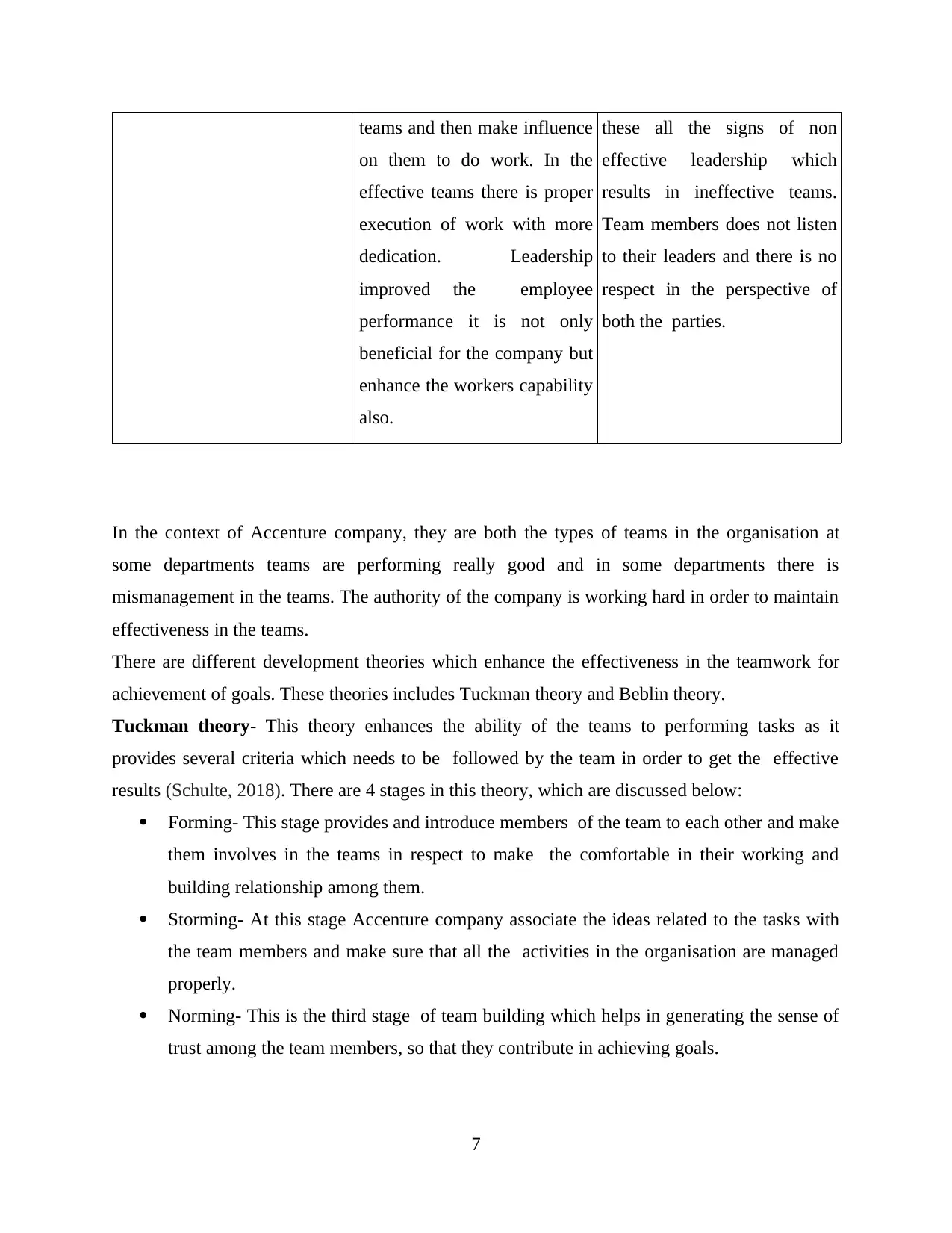
teams and then make influence
on them to do work. In the
effective teams there is proper
execution of work with more
dedication. Leadership
improved the employee
performance it is not only
beneficial for the company but
enhance the workers capability
also.
these all the signs of non
effective leadership which
results in ineffective teams.
Team members does not listen
to their leaders and there is no
respect in the perspective of
both the parties.
In the context of Accenture company, they are both the types of teams in the organisation at
some departments teams are performing really good and in some departments there is
mismanagement in the teams. The authority of the company is working hard in order to maintain
effectiveness in the teams.
There are different development theories which enhance the effectiveness in the teamwork for
achievement of goals. These theories includes Tuckman theory and Beblin theory.
Tuckman theory- This theory enhances the ability of the teams to performing tasks as it
provides several criteria which needs to be followed by the team in order to get the effective
results (Schulte, 2018). There are 4 stages in this theory, which are discussed below:
Forming- This stage provides and introduce members of the team to each other and make
them involves in the teams in respect to make the comfortable in their working and
building relationship among them.
Storming- At this stage Accenture company associate the ideas related to the tasks with
the team members and make sure that all the activities in the organisation are managed
properly.
Norming- This is the third stage of team building which helps in generating the sense of
trust among the team members, so that they contribute in achieving goals.
7
on them to do work. In the
effective teams there is proper
execution of work with more
dedication. Leadership
improved the employee
performance it is not only
beneficial for the company but
enhance the workers capability
also.
these all the signs of non
effective leadership which
results in ineffective teams.
Team members does not listen
to their leaders and there is no
respect in the perspective of
both the parties.
In the context of Accenture company, they are both the types of teams in the organisation at
some departments teams are performing really good and in some departments there is
mismanagement in the teams. The authority of the company is working hard in order to maintain
effectiveness in the teams.
There are different development theories which enhance the effectiveness in the teamwork for
achievement of goals. These theories includes Tuckman theory and Beblin theory.
Tuckman theory- This theory enhances the ability of the teams to performing tasks as it
provides several criteria which needs to be followed by the team in order to get the effective
results (Schulte, 2018). There are 4 stages in this theory, which are discussed below:
Forming- This stage provides and introduce members of the team to each other and make
them involves in the teams in respect to make the comfortable in their working and
building relationship among them.
Storming- At this stage Accenture company associate the ideas related to the tasks with
the team members and make sure that all the activities in the organisation are managed
properly.
Norming- This is the third stage of team building which helps in generating the sense of
trust among the team members, so that they contribute in achieving goals.
7
⊘ This is a preview!⊘
Do you want full access?
Subscribe today to unlock all pages.
Trusted by 1+ million students worldwide
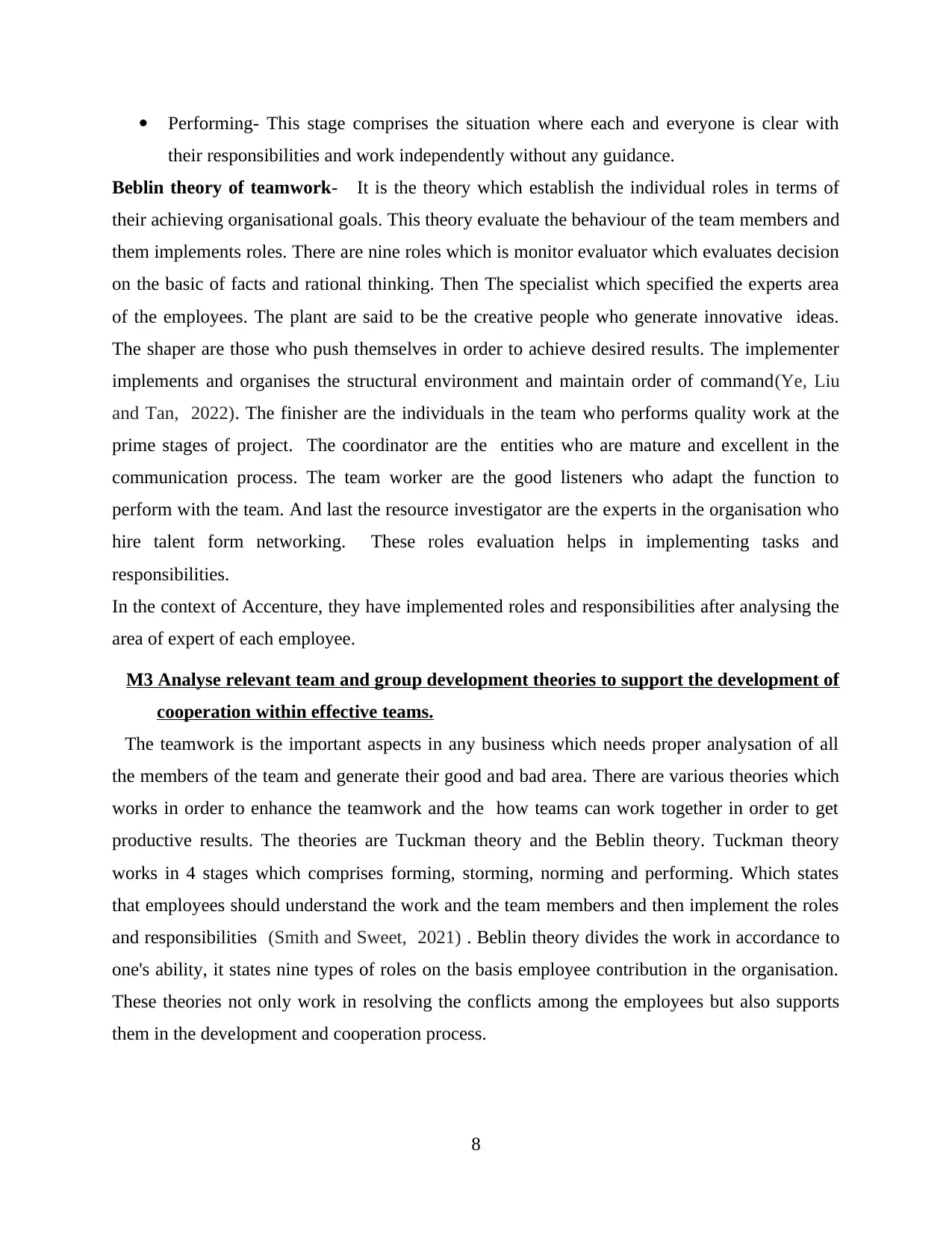
Performing- This stage comprises the situation where each and everyone is clear with
their responsibilities and work independently without any guidance.
Beblin theory of teamwork- It is the theory which establish the individual roles in terms of
their achieving organisational goals. This theory evaluate the behaviour of the team members and
them implements roles. There are nine roles which is monitor evaluator which evaluates decision
on the basic of facts and rational thinking. Then The specialist which specified the experts area
of the employees. The plant are said to be the creative people who generate innovative ideas.
The shaper are those who push themselves in order to achieve desired results. The implementer
implements and organises the structural environment and maintain order of command(Ye, Liu
and Tan, 2022). The finisher are the individuals in the team who performs quality work at the
prime stages of project. The coordinator are the entities who are mature and excellent in the
communication process. The team worker are the good listeners who adapt the function to
perform with the team. And last the resource investigator are the experts in the organisation who
hire talent form networking. These roles evaluation helps in implementing tasks and
responsibilities.
In the context of Accenture, they have implemented roles and responsibilities after analysing the
area of expert of each employee.
M3 Analyse relevant team and group development theories to support the development of
cooperation within effective teams.
The teamwork is the important aspects in any business which needs proper analysation of all
the members of the team and generate their good and bad area. There are various theories which
works in order to enhance the teamwork and the how teams can work together in order to get
productive results. The theories are Tuckman theory and the Beblin theory. Tuckman theory
works in 4 stages which comprises forming, storming, norming and performing. Which states
that employees should understand the work and the team members and then implement the roles
and responsibilities (Smith and Sweet, 2021) . Beblin theory divides the work in accordance to
one's ability, it states nine types of roles on the basis employee contribution in the organisation.
These theories not only work in resolving the conflicts among the employees but also supports
them in the development and cooperation process.
8
their responsibilities and work independently without any guidance.
Beblin theory of teamwork- It is the theory which establish the individual roles in terms of
their achieving organisational goals. This theory evaluate the behaviour of the team members and
them implements roles. There are nine roles which is monitor evaluator which evaluates decision
on the basic of facts and rational thinking. Then The specialist which specified the experts area
of the employees. The plant are said to be the creative people who generate innovative ideas.
The shaper are those who push themselves in order to achieve desired results. The implementer
implements and organises the structural environment and maintain order of command(Ye, Liu
and Tan, 2022). The finisher are the individuals in the team who performs quality work at the
prime stages of project. The coordinator are the entities who are mature and excellent in the
communication process. The team worker are the good listeners who adapt the function to
perform with the team. And last the resource investigator are the experts in the organisation who
hire talent form networking. These roles evaluation helps in implementing tasks and
responsibilities.
In the context of Accenture, they have implemented roles and responsibilities after analysing the
area of expert of each employee.
M3 Analyse relevant team and group development theories to support the development of
cooperation within effective teams.
The teamwork is the important aspects in any business which needs proper analysation of all
the members of the team and generate their good and bad area. There are various theories which
works in order to enhance the teamwork and the how teams can work together in order to get
productive results. The theories are Tuckman theory and the Beblin theory. Tuckman theory
works in 4 stages which comprises forming, storming, norming and performing. Which states
that employees should understand the work and the team members and then implement the roles
and responsibilities (Smith and Sweet, 2021) . Beblin theory divides the work in accordance to
one's ability, it states nine types of roles on the basis employee contribution in the organisation.
These theories not only work in resolving the conflicts among the employees but also supports
them in the development and cooperation process.
8
Paraphrase This Document
Need a fresh take? Get an instant paraphrase of this document with our AI Paraphraser
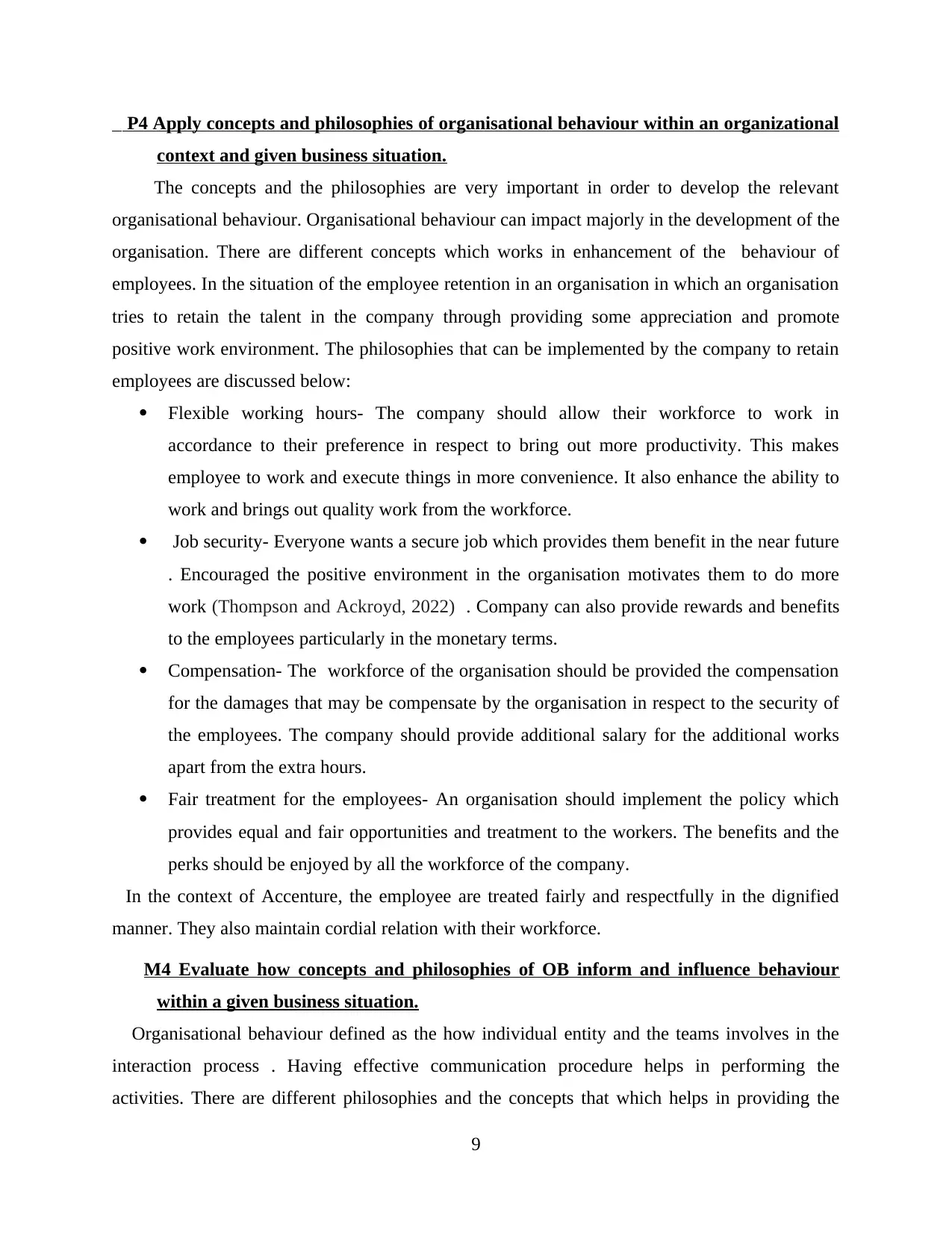
P4 Apply concepts and philosophies of organisational behaviour within an organizational
context and given business situation.
The concepts and the philosophies are very important in order to develop the relevant
organisational behaviour. Organisational behaviour can impact majorly in the development of the
organisation. There are different concepts which works in enhancement of the behaviour of
employees. In the situation of the employee retention in an organisation in which an organisation
tries to retain the talent in the company through providing some appreciation and promote
positive work environment. The philosophies that can be implemented by the company to retain
employees are discussed below:
Flexible working hours- The company should allow their workforce to work in
accordance to their preference in respect to bring out more productivity. This makes
employee to work and execute things in more convenience. It also enhance the ability to
work and brings out quality work from the workforce.
Job security- Everyone wants a secure job which provides them benefit in the near future
. Encouraged the positive environment in the organisation motivates them to do more
work (Thompson and Ackroyd, 2022) . Company can also provide rewards and benefits
to the employees particularly in the monetary terms.
Compensation- The workforce of the organisation should be provided the compensation
for the damages that may be compensate by the organisation in respect to the security of
the employees. The company should provide additional salary for the additional works
apart from the extra hours.
Fair treatment for the employees- An organisation should implement the policy which
provides equal and fair opportunities and treatment to the workers. The benefits and the
perks should be enjoyed by all the workforce of the company.
In the context of Accenture, the employee are treated fairly and respectfully in the dignified
manner. They also maintain cordial relation with their workforce.
M4 Evaluate how concepts and philosophies of OB inform and influence behaviour
within a given business situation.
Organisational behaviour defined as the how individual entity and the teams involves in the
interaction process . Having effective communication procedure helps in performing the
activities. There are different philosophies and the concepts that which helps in providing the
9
context and given business situation.
The concepts and the philosophies are very important in order to develop the relevant
organisational behaviour. Organisational behaviour can impact majorly in the development of the
organisation. There are different concepts which works in enhancement of the behaviour of
employees. In the situation of the employee retention in an organisation in which an organisation
tries to retain the talent in the company through providing some appreciation and promote
positive work environment. The philosophies that can be implemented by the company to retain
employees are discussed below:
Flexible working hours- The company should allow their workforce to work in
accordance to their preference in respect to bring out more productivity. This makes
employee to work and execute things in more convenience. It also enhance the ability to
work and brings out quality work from the workforce.
Job security- Everyone wants a secure job which provides them benefit in the near future
. Encouraged the positive environment in the organisation motivates them to do more
work (Thompson and Ackroyd, 2022) . Company can also provide rewards and benefits
to the employees particularly in the monetary terms.
Compensation- The workforce of the organisation should be provided the compensation
for the damages that may be compensate by the organisation in respect to the security of
the employees. The company should provide additional salary for the additional works
apart from the extra hours.
Fair treatment for the employees- An organisation should implement the policy which
provides equal and fair opportunities and treatment to the workers. The benefits and the
perks should be enjoyed by all the workforce of the company.
In the context of Accenture, the employee are treated fairly and respectfully in the dignified
manner. They also maintain cordial relation with their workforce.
M4 Evaluate how concepts and philosophies of OB inform and influence behaviour
within a given business situation.
Organisational behaviour defined as the how individual entity and the teams involves in the
interaction process . Having effective communication procedure helps in performing the
activities. There are different philosophies and the concepts that which helps in providing the
9
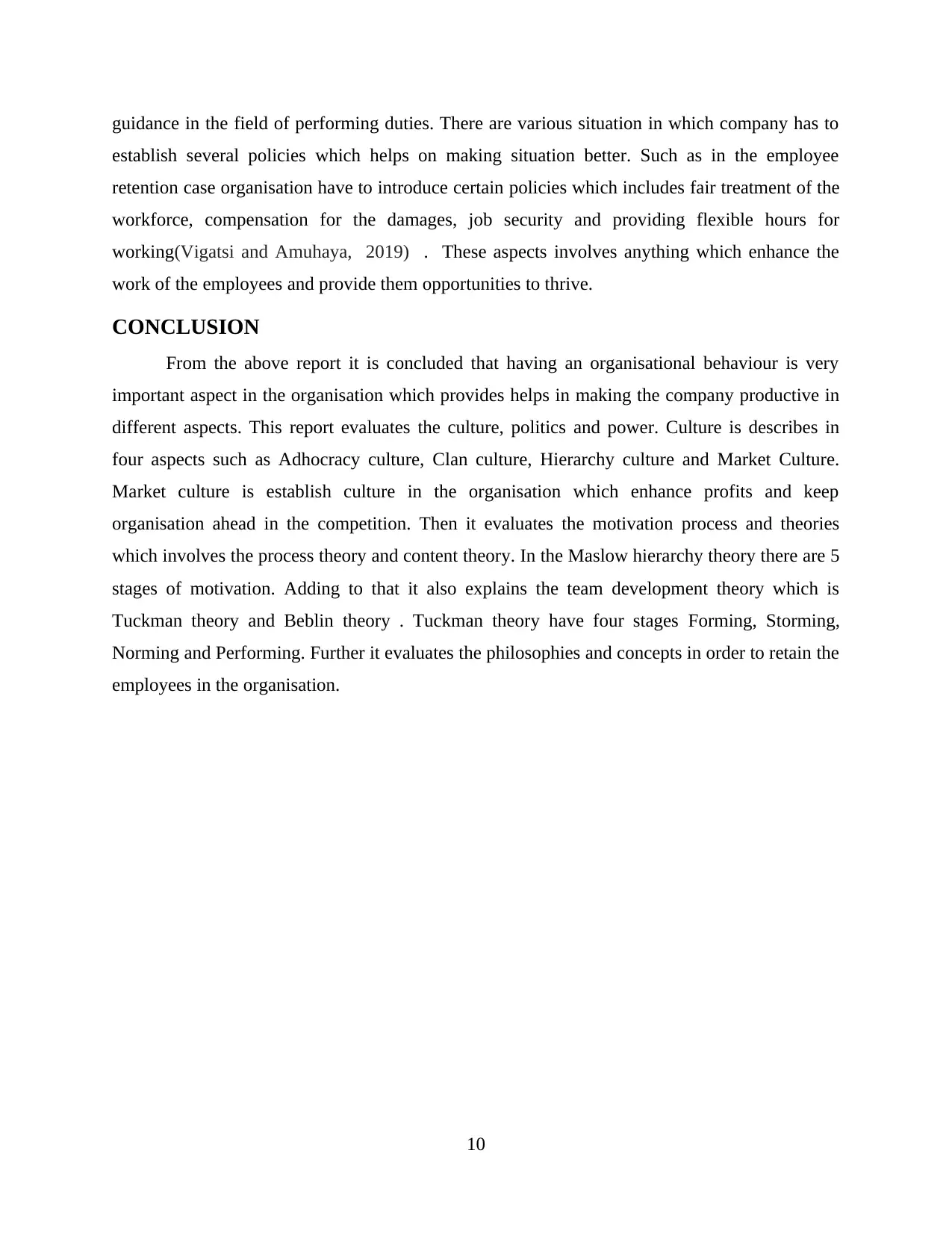
guidance in the field of performing duties. There are various situation in which company has to
establish several policies which helps on making situation better. Such as in the employee
retention case organisation have to introduce certain policies which includes fair treatment of the
workforce, compensation for the damages, job security and providing flexible hours for
working(Vigatsi and Amuhaya, 2019) . These aspects involves anything which enhance the
work of the employees and provide them opportunities to thrive.
CONCLUSION
From the above report it is concluded that having an organisational behaviour is very
important aspect in the organisation which provides helps in making the company productive in
different aspects. This report evaluates the culture, politics and power. Culture is describes in
four aspects such as Adhocracy culture, Clan culture, Hierarchy culture and Market Culture.
Market culture is establish culture in the organisation which enhance profits and keep
organisation ahead in the competition. Then it evaluates the motivation process and theories
which involves the process theory and content theory. In the Maslow hierarchy theory there are 5
stages of motivation. Adding to that it also explains the team development theory which is
Tuckman theory and Beblin theory . Tuckman theory have four stages Forming, Storming,
Norming and Performing. Further it evaluates the philosophies and concepts in order to retain the
employees in the organisation.
10
establish several policies which helps on making situation better. Such as in the employee
retention case organisation have to introduce certain policies which includes fair treatment of the
workforce, compensation for the damages, job security and providing flexible hours for
working(Vigatsi and Amuhaya, 2019) . These aspects involves anything which enhance the
work of the employees and provide them opportunities to thrive.
CONCLUSION
From the above report it is concluded that having an organisational behaviour is very
important aspect in the organisation which provides helps in making the company productive in
different aspects. This report evaluates the culture, politics and power. Culture is describes in
four aspects such as Adhocracy culture, Clan culture, Hierarchy culture and Market Culture.
Market culture is establish culture in the organisation which enhance profits and keep
organisation ahead in the competition. Then it evaluates the motivation process and theories
which involves the process theory and content theory. In the Maslow hierarchy theory there are 5
stages of motivation. Adding to that it also explains the team development theory which is
Tuckman theory and Beblin theory . Tuckman theory have four stages Forming, Storming,
Norming and Performing. Further it evaluates the philosophies and concepts in order to retain the
employees in the organisation.
10
⊘ This is a preview!⊘
Do you want full access?
Subscribe today to unlock all pages.
Trusted by 1+ million students worldwide

1 out of 13


Related Documents


Your All-in-One AI-Powered Toolkit for Academic Success.
+13062052269
info@desklib.com
Available 24*7 on WhatsApp / Email
![[object Object]](/_next/static/media/star-bottom.7253800d.svg)
Unlock your academic potential
Copyright © 2020–2026 A2Z Services. All Rights Reserved. Developed and managed by ZUCOL.