Access to Higher Education: IT Health Risks and Hazards

Verified

Added on  2023/05/29

|1
|343
|274
Report
AI Summary
This report delves into the health hazards and risks associated with the use of information technology, particularly focusing on the adverse effects of prolonged computer use and sedentary work habits. It highlights the development of musculoskeletal disorders due to poor posture and lack of ergonomic setup, as well as the impact of work-related stress on overall health and immune function. The report also discusses computer vision syndrome and the increased risk of conditions like tendinitis and ulnar nerve entrapment. Furthermore, it emphasizes the importance of proper exercise, stress management, and addressing digestive problems that arise from poor posture. The report also references relevant literature to support its claims.
Document Page
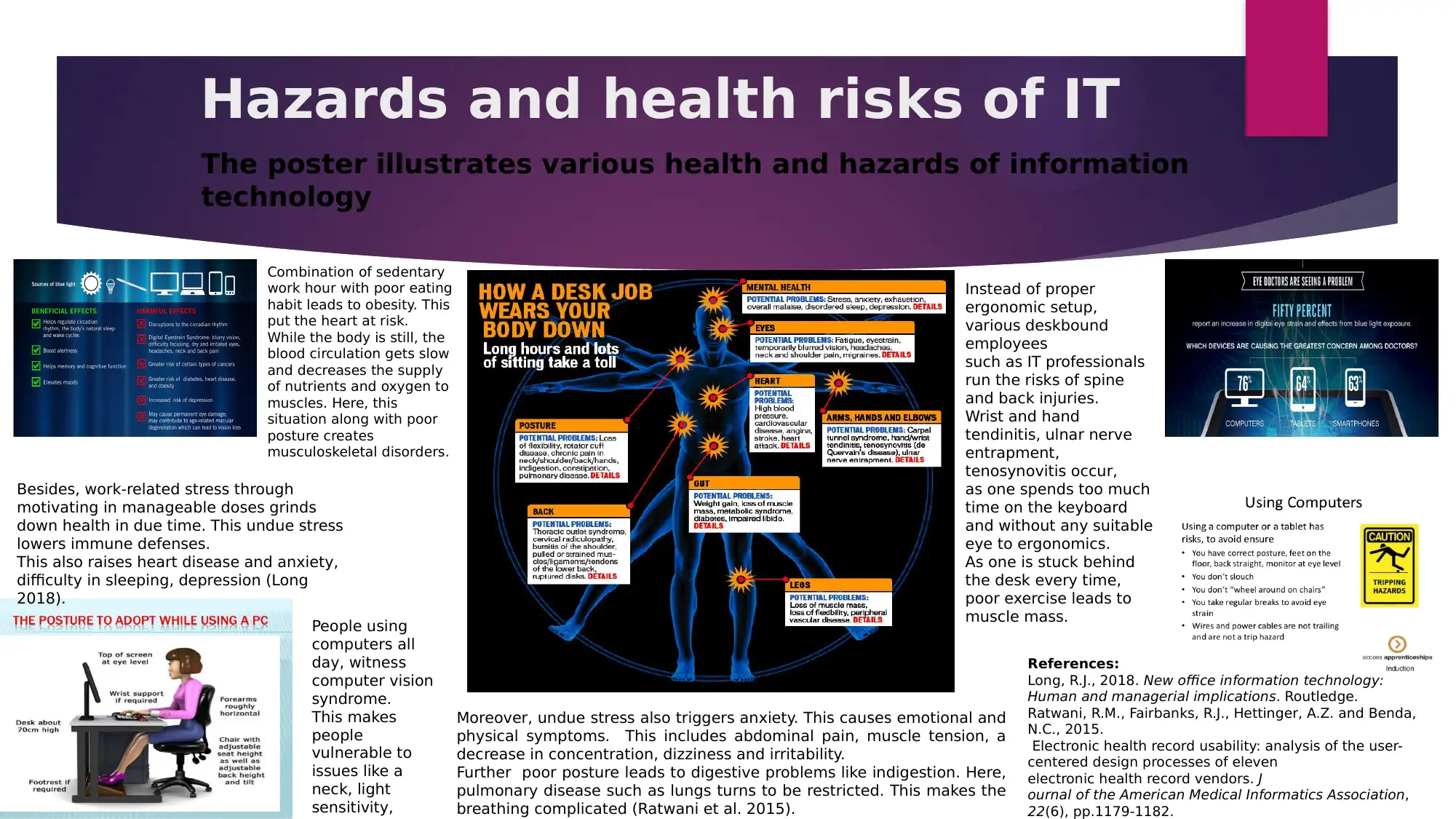
Hazards and health risks of IT
The poster illustrates various health and hazards of information
technology
Combination of sedentary
work hour with poor eating
habit leads to obesity. This
put the heart at risk.
While the body is still, the
blood circulation gets slow
and decreases the supply
of nutrients and oxygen to
muscles. Here, this
situation along with poor
posture creates
musculoskeletal disorders.
Besides, work-related stress through
motivating in manageable doses grinds
down health in due time. This undue stress
lowers immune defenses.
This also raises heart disease and anxiety,
difficulty in sleeping, depression (Long
2018).
People using
computers all
day, witness
computer vision
syndrome.
This makes
people
vulnerable to
issues like a
neck, light
sensitivity,
Moreover, undue stress also triggers anxiety. This causes emotional and
physical symptoms. This includes abdominal pain, muscle tension, a
decrease in concentration, dizziness and irritability.
Further poor posture leads to digestive problems like indigestion. Here,
pulmonary disease such as lungs turns to be restricted. This makes the
breathing complicated (Ratwani et al. 2015).
Instead of proper
ergonomic setup,
various deskbound
employees
such as IT professionals
run the risks of spine
and back injuries.
Wrist and hand
tendinitis, ulnar nerve
entrapment,
tenosynovitis occur,
as one spends too much
time on the keyboard
and without any suitable
eye to ergonomics.
As one is stuck behind
the desk every time,
poor exercise leads to
muscle mass.
References:
Long, R.J., 2018. New office information technology:
Human and managerial implications. Routledge.
Ratwani, R.M., Fairbanks, R.J., Hettinger, A.Z. and Benda,
N.C., 2015.
Electronic health record usability: analysis of the user-
centered design processes of eleven
electronic health record vendors. J
ournal of the American Medical Informatics Association,
22(6), pp.1179-1182.
tabler-icon-diamond-filled.svg

Paraphrase This Document

Need a fresh take? Get an instant paraphrase of this document with our AI Paraphraser
[object Object]