ACC100 Charles Sturt University: Roles, Ethics, and Structures
VerifiedAdded on 2023/06/11
|12
|2199
|119
Report
AI Summary
This report provides an overview of the roles of management and financial accountants, highlighting their functions, the information they provide, and the similarities and differences between them. It addresses an ethical dilemma faced by an accountant and suggests a model for resolution. Additionally, the report discusses various business structures, including partnership firms, sole proprietorships, trusts, and companies, with specific examples related to Alice and Sarah, Hugh, the Harold family, and Julie and Robert. The report uses references to support its analysis and recommendations. Desklib provides access to similar solved assignments and study resources for students.
Running Head: Types of accountants and business structures
MANAGEMENT ACCOUNTING
MANAGEMENT ACCOUNTING

Paraphrase This Document
Need a fresh take? Get an instant paraphrase of this document with our AI Paraphraser
Types of accountants and business structures 1
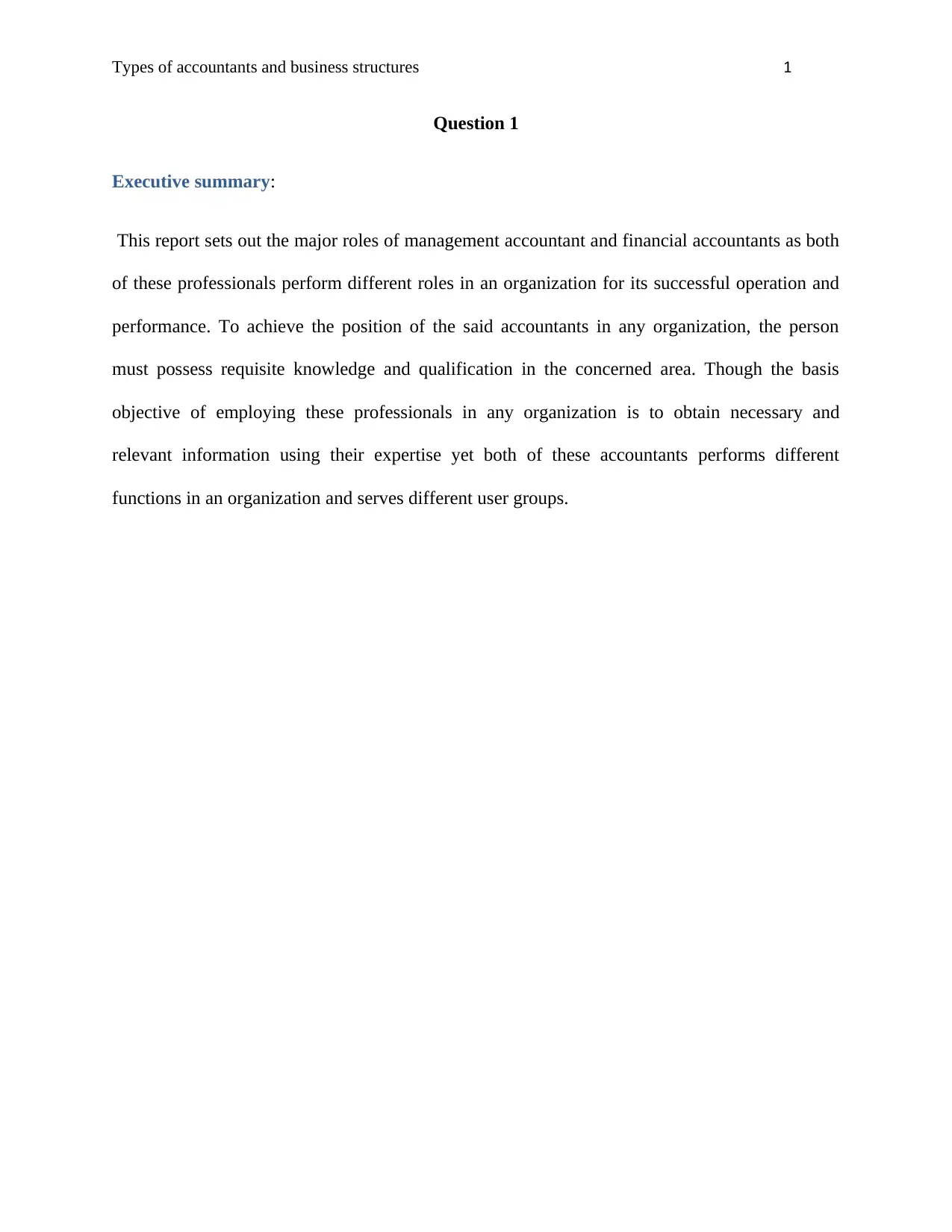
Question 1
Executive summary:
This report sets out the major roles of management accountant and financial accountants as both
of these professionals perform different roles in an organization for its successful operation and
performance. To achieve the position of the said accountants in any organization, the person
must possess requisite knowledge and qualification in the concerned area. Though the basis
objective of employing these professionals in any organization is to obtain necessary and
relevant information using their expertise yet both of these accountants performs different
functions in an organization and serves different user groups.
Question 1
Executive summary:
This report sets out the major roles of management accountant and financial accountants as both
of these professionals perform different roles in an organization for its successful operation and
performance. To achieve the position of the said accountants in any organization, the person
must possess requisite knowledge and qualification in the concerned area. Though the basis
objective of employing these professionals in any organization is to obtain necessary and
relevant information using their expertise yet both of these accountants performs different
functions in an organization and serves different user groups.
Types of accountants and business structures 2
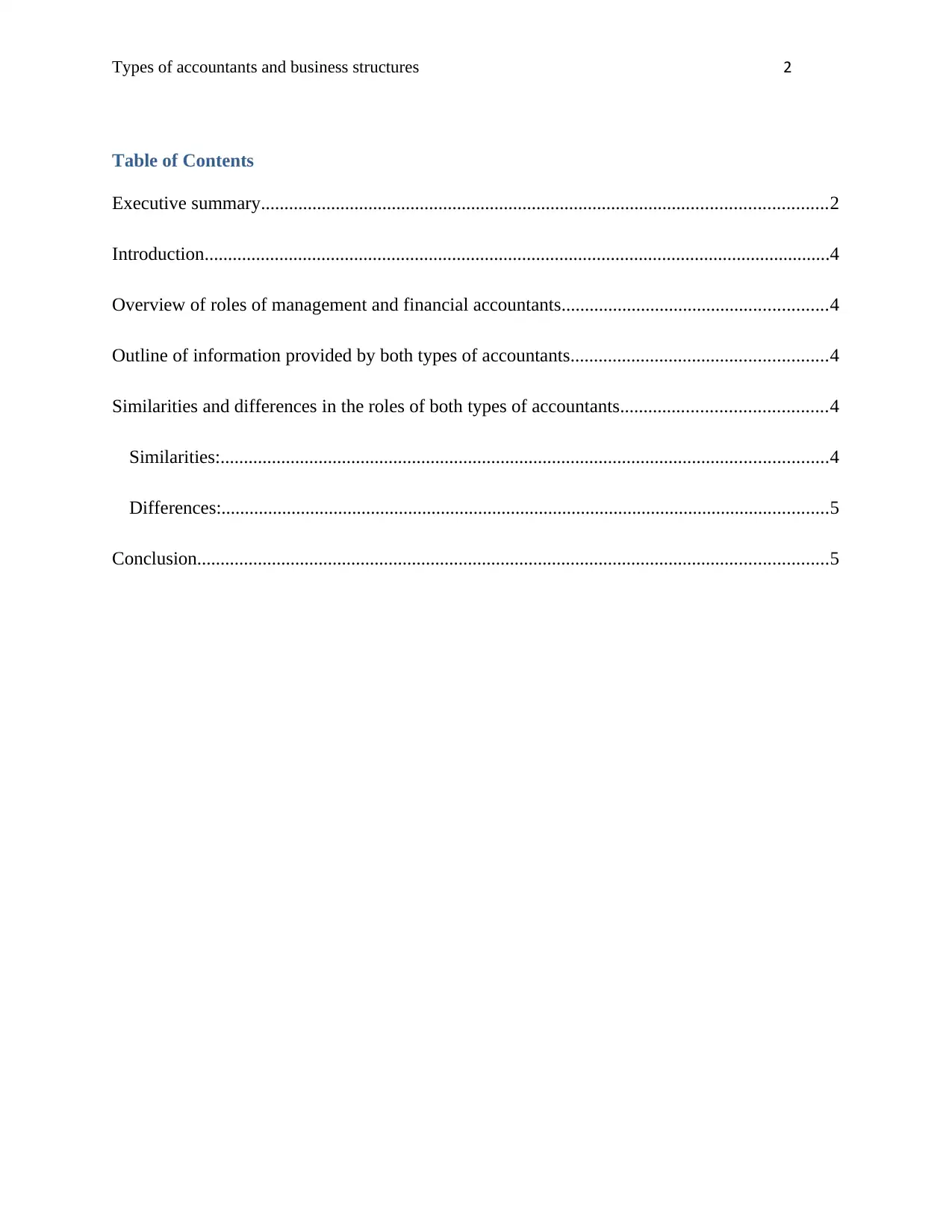
Table of Contents
Executive summary.........................................................................................................................2
Introduction......................................................................................................................................4
Overview of roles of management and financial accountants.........................................................4
Outline of information provided by both types of accountants.......................................................4
Similarities and differences in the roles of both types of accountants............................................4
Similarities:..................................................................................................................................4
Differences:..................................................................................................................................5
Conclusion.......................................................................................................................................5
Table of Contents
Executive summary.........................................................................................................................2
Introduction......................................................................................................................................4
Overview of roles of management and financial accountants.........................................................4
Outline of information provided by both types of accountants.......................................................4
Similarities and differences in the roles of both types of accountants............................................4
Similarities:..................................................................................................................................4
Differences:..................................................................................................................................5
Conclusion.......................................................................................................................................5
⊘ This is a preview!⊘
Do you want full access?
Subscribe today to unlock all pages.

Trusted by 1+ million students worldwide
Types of accountants and business structures 3
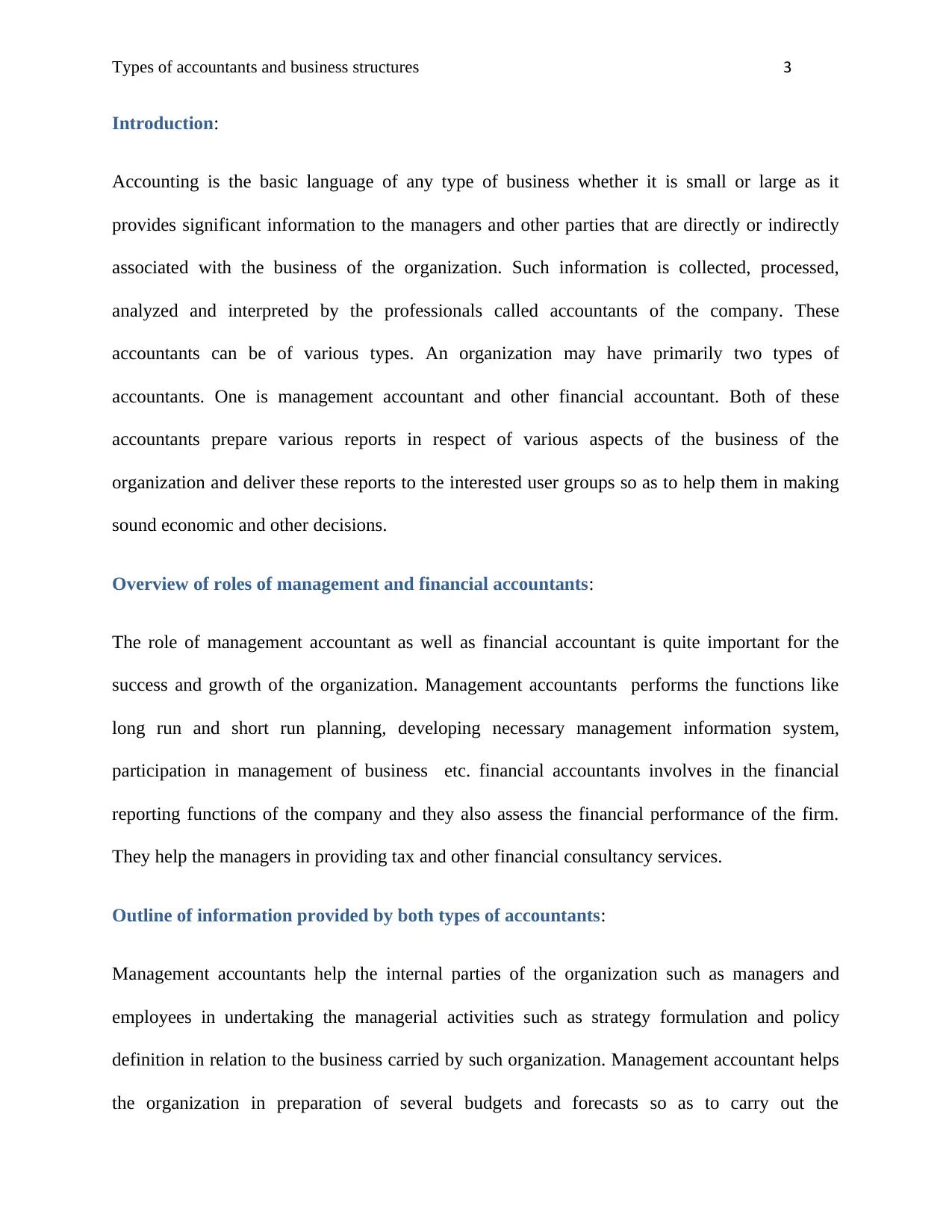
Introduction:
Accounting is the basic language of any type of business whether it is small or large as it
provides significant information to the managers and other parties that are directly or indirectly
associated with the business of the organization. Such information is collected, processed,
analyzed and interpreted by the professionals called accountants of the company. These
accountants can be of various types. An organization may have primarily two types of
accountants. One is management accountant and other financial accountant. Both of these
accountants prepare various reports in respect of various aspects of the business of the
organization and deliver these reports to the interested user groups so as to help them in making
sound economic and other decisions.
Overview of roles of management and financial accountants:
The role of management accountant as well as financial accountant is quite important for the
success and growth of the organization. Management accountants performs the functions like
long run and short run planning, developing necessary management information system,
participation in management of business etc. financial accountants involves in the financial
reporting functions of the company and they also assess the financial performance of the firm.
They help the managers in providing tax and other financial consultancy services.
Outline of information provided by both types of accountants:
Management accountants help the internal parties of the organization such as managers and
employees in undertaking the managerial activities such as strategy formulation and policy
definition in relation to the business carried by such organization. Management accountant helps
the organization in preparation of several budgets and forecasts so as to carry out the
Introduction:
Accounting is the basic language of any type of business whether it is small or large as it
provides significant information to the managers and other parties that are directly or indirectly
associated with the business of the organization. Such information is collected, processed,
analyzed and interpreted by the professionals called accountants of the company. These
accountants can be of various types. An organization may have primarily two types of
accountants. One is management accountant and other financial accountant. Both of these
accountants prepare various reports in respect of various aspects of the business of the
organization and deliver these reports to the interested user groups so as to help them in making
sound economic and other decisions.
Overview of roles of management and financial accountants:
The role of management accountant as well as financial accountant is quite important for the
success and growth of the organization. Management accountants performs the functions like
long run and short run planning, developing necessary management information system,
participation in management of business etc. financial accountants involves in the financial
reporting functions of the company and they also assess the financial performance of the firm.
They help the managers in providing tax and other financial consultancy services.
Outline of information provided by both types of accountants:
Management accountants help the internal parties of the organization such as managers and
employees in undertaking the managerial activities such as strategy formulation and policy
definition in relation to the business carried by such organization. Management accountant helps
the organization in preparation of several budgets and forecasts so as to carry out the
Paraphrase This Document
Need a fresh take? Get an instant paraphrase of this document with our AI Paraphraser
Types of accountants and business structures 4
organizational business smoothly and successfully (Horngren, Sundem, Stratton, Burgstahler &
Schatzberg, 2002). They generally provide both monetary and non-monetary information by
dealing with quantitative as well as qualitative data. Financial accountants, on the other hand,
perform the finance-related functions to provide financial information to various internal and
external parties of the organization such as shareholders, managers, providers of finance,
government etc. They basically undertake the functions relating to financial reporting and tax
compliances.
Similarities and differences in the roles of both types of accountants:
Similarities:
To perform the role of the accountant whether managerial or financial, the accountants are
required to hold an expertise in the area of accounting under any recognized educational degree.
As both management accounting and financial accounting requires collection, analyzing and
processing of relevant data from various sources, so as to report the processed information
through management or financial reports (Sunarni, 2013).
Management accountant and financial accountant hold a significant position in the organization
as they both provide necessary information to various internal and external parties of the
organization such as managers, employees, banks, financial institutions, government etc. so as to
enable them to make effective decision making (Zubac, 2012).
Differences:
Management accounting is mainly concerned with catering to the information needs of managers
and employees of the company and therefore management accountant serves the top and line
level managers with useful information that helps them in formulating effective strategies and
organizational business smoothly and successfully (Horngren, Sundem, Stratton, Burgstahler &
Schatzberg, 2002). They generally provide both monetary and non-monetary information by
dealing with quantitative as well as qualitative data. Financial accountants, on the other hand,
perform the finance-related functions to provide financial information to various internal and
external parties of the organization such as shareholders, managers, providers of finance,
government etc. They basically undertake the functions relating to financial reporting and tax
compliances.
Similarities and differences in the roles of both types of accountants:
Similarities:
To perform the role of the accountant whether managerial or financial, the accountants are
required to hold an expertise in the area of accounting under any recognized educational degree.
As both management accounting and financial accounting requires collection, analyzing and
processing of relevant data from various sources, so as to report the processed information
through management or financial reports (Sunarni, 2013).
Management accountant and financial accountant hold a significant position in the organization
as they both provide necessary information to various internal and external parties of the
organization such as managers, employees, banks, financial institutions, government etc. so as to
enable them to make effective decision making (Zubac, 2012).
Differences:
Management accounting is mainly concerned with catering to the information needs of managers
and employees of the company and therefore management accountant serves the top and line
level managers with useful information that helps them in formulating effective strategies and
Types of accountants and business structures 5
policies for the growth and survival of the firm (Parker, 2002). Whereas, financial accountants
serve the information needs of internal as well as external stakeholders of the company.
A single report is prepared and delivered by the financial accountants to the stakeholders of the
company whereas management accountant has to prepare various reports to carter the
information needs of different divisions and levels of the management of the organization (Sori,
2009).
Conclusion:
From the above study about the different roles of management accountant and financial
accountants of the company, it is clear that both of these professionals plays vital role in the
organizational success. Although the basis objective of these accountants is to help the different
user groups of an organization in their decision making but both of them perform certainly
different functions. Therefore management accountant and financial accountant hold different
position in an organization.
policies for the growth and survival of the firm (Parker, 2002). Whereas, financial accountants
serve the information needs of internal as well as external stakeholders of the company.
A single report is prepared and delivered by the financial accountants to the stakeholders of the
company whereas management accountant has to prepare various reports to carter the
information needs of different divisions and levels of the management of the organization (Sori,
2009).
Conclusion:
From the above study about the different roles of management accountant and financial
accountants of the company, it is clear that both of these professionals plays vital role in the
organizational success. Although the basis objective of these accountants is to help the different
user groups of an organization in their decision making but both of them perform certainly
different functions. Therefore management accountant and financial accountant hold different
position in an organization.
⊘ This is a preview!⊘
Do you want full access?
Subscribe today to unlock all pages.
Trusted by 1+ million students worldwide
Types of accountants and business structures 6
Question 2
The present case of Jess Newman involves the issue of ethical dilemma as being a professional
the accountant has to face a conflict of interest between his professional duty and the personal
relationships. While performing the professional services Jess has discovered certain items that
were not real but yet they were claimed as real expense for the purpose of obtaining tax benefit
thereon. As a part of professional responsibility the accountant must not include such expenses in
the income tax returns. But since, the client has some personal relationships with the
accountant’s firm, the supervisor instructed him to include such expense in the calculation of net
income. As an accountant it is important for Jess to respect both his professional duty as well as
the ethical values (Banks & Williams, 2005).
To solve the issue of ethical dilemma involved in the present case, the accountant must follow
Langenderfer and Rockness model as it provides a systematic approach to resolve ethical
dilemma:
Facts determination:
It is firstly required for the accountant to understand the facts of the case so as to identify the
opinion conflicts that are involved therein. It is also necessary on part of accountant to determine
as to who and what is going to be affected if a particular choice of action is made.
Identification of ethical issue and related stakeholders:
The interest of concerned stakeholders must be given due consideration once the first stage of
fact determination is completed. The consideration about the stakeholders must be taken beyond
Question 2
The present case of Jess Newman involves the issue of ethical dilemma as being a professional
the accountant has to face a conflict of interest between his professional duty and the personal
relationships. While performing the professional services Jess has discovered certain items that
were not real but yet they were claimed as real expense for the purpose of obtaining tax benefit
thereon. As a part of professional responsibility the accountant must not include such expenses in
the income tax returns. But since, the client has some personal relationships with the
accountant’s firm, the supervisor instructed him to include such expense in the calculation of net
income. As an accountant it is important for Jess to respect both his professional duty as well as
the ethical values (Banks & Williams, 2005).
To solve the issue of ethical dilemma involved in the present case, the accountant must follow
Langenderfer and Rockness model as it provides a systematic approach to resolve ethical
dilemma:
Facts determination:
It is firstly required for the accountant to understand the facts of the case so as to identify the
opinion conflicts that are involved therein. It is also necessary on part of accountant to determine
as to who and what is going to be affected if a particular choice of action is made.
Identification of ethical issue and related stakeholders:
The interest of concerned stakeholders must be given due consideration once the first stage of
fact determination is completed. The consideration about the stakeholders must be taken beyond
Paraphrase This Document
Need a fresh take? Get an instant paraphrase of this document with our AI Paraphraser
Types of accountants and business structures 7
the core accounting issues to the interest of stakeholders who are connected with the matter of
ethical issue.
Specification of possible alternatives:
The accountant must prepare a portfolio of possible actions that could be undertaken to deal with
the issue of ethical dilemma. These courses of actions must be determined on the basis of
legality, correctness and fairness of the act.
Comparison of available alternatives and their ultimate consequences:
This step is important as it involves a detailed comparison of all the possible alternative actions
by identifying the ultimate consequences of such actions and their direct impact on the
stakeholders of the case.
Final decision making:
The final step involves the final decision making by selecting the best possible course of action
that holds the ability to balance the ultimate consequences with the prime values of the
accountant through the elimination of various unethical options (Langenderfer & Rockness,
2006).
the core accounting issues to the interest of stakeholders who are connected with the matter of
ethical issue.
Specification of possible alternatives:
The accountant must prepare a portfolio of possible actions that could be undertaken to deal with
the issue of ethical dilemma. These courses of actions must be determined on the basis of
legality, correctness and fairness of the act.
Comparison of available alternatives and their ultimate consequences:
This step is important as it involves a detailed comparison of all the possible alternative actions
by identifying the ultimate consequences of such actions and their direct impact on the
stakeholders of the case.
Final decision making:
The final step involves the final decision making by selecting the best possible course of action
that holds the ability to balance the ultimate consequences with the prime values of the
accountant through the elimination of various unethical options (Langenderfer & Rockness,
2006).
Types of accountants and business structures 8
Question 3
1. Since Alice and Sarah are planning to join hands to provide the services to the people
who are getting married, they can form partnership firm. In this way they can share the
profits and losses of the business in the proportion as may be decided by them. Moreover,
partnership firm as a whole does not have to bear any tax liability since the tax burden is
ultimately borne by the individual partners on their share of profits. Also, a partnership
requires its TFN number for the purpose of filing its annual returns (Nyazee, 2002).
2. Hugh can start a sole-proprietorship form of business so that his business can be taken to
the next level without being distracted from his personal duties towards the family. As
Hugh makes the chairs himself he must operate this business as a sole proprietor in order
to expand the business to the local stores. In sole-proprietorship business, the proprietor
is individually responsible for all the tax obligations relating to the business and also
there is a requirement to get GST registration if the turnover reaches the limit of $ 75000
(Australian government, 2018).
3. The Harold family must set up a trust to hold the property as well as shares for the
benefits of the members of the family i.e. the beneficiaries of the trust. The trust form of
business organization need a formal trust deed which outlines the way in which the trust
must operate. The trustee of the trust is legally responsible for all the operations as he has
to provide the asset protection. Trust can be an expensive form of business organization
(Malhotra, 2000).
4. As Julie and Robert are involved in a manufacturing business since last 5 years, they
must switch to the company form of business organization with the increasing need of
funds to acquire more assets and warehouse. A company is a separate entity in the eyes of
Question 3
1. Since Alice and Sarah are planning to join hands to provide the services to the people
who are getting married, they can form partnership firm. In this way they can share the
profits and losses of the business in the proportion as may be decided by them. Moreover,
partnership firm as a whole does not have to bear any tax liability since the tax burden is
ultimately borne by the individual partners on their share of profits. Also, a partnership
requires its TFN number for the purpose of filing its annual returns (Nyazee, 2002).
2. Hugh can start a sole-proprietorship form of business so that his business can be taken to
the next level without being distracted from his personal duties towards the family. As
Hugh makes the chairs himself he must operate this business as a sole proprietor in order
to expand the business to the local stores. In sole-proprietorship business, the proprietor
is individually responsible for all the tax obligations relating to the business and also
there is a requirement to get GST registration if the turnover reaches the limit of $ 75000
(Australian government, 2018).
3. The Harold family must set up a trust to hold the property as well as shares for the
benefits of the members of the family i.e. the beneficiaries of the trust. The trust form of
business organization need a formal trust deed which outlines the way in which the trust
must operate. The trustee of the trust is legally responsible for all the operations as he has
to provide the asset protection. Trust can be an expensive form of business organization
(Malhotra, 2000).
4. As Julie and Robert are involved in a manufacturing business since last 5 years, they
must switch to the company form of business organization with the increasing need of
funds to acquire more assets and warehouse. A company is a separate entity in the eyes of
⊘ This is a preview!⊘
Do you want full access?
Subscribe today to unlock all pages.
Trusted by 1+ million students worldwide
Types of accountants and business structures 9
law. As a company can raise the funds through the public issue of shares and debentures,
it is feasible to start company form of business so that funds can be raised as per the
needs of the business. A company has a limited liability and involves huge cost in the
setting up process. Company is also required to file its separate return of income. The
company is also required to get itself registered under Corporations Act, 2001.
law. As a company can raise the funds through the public issue of shares and debentures,
it is feasible to start company form of business so that funds can be raised as per the
needs of the business. A company has a limited liability and involves huge cost in the
setting up process. Company is also required to file its separate return of income. The
company is also required to get itself registered under Corporations Act, 2001.
Paraphrase This Document
Need a fresh take? Get an instant paraphrase of this document with our AI Paraphraser
Types of accountants and business structures 10
References:
Australian government. (2018). Business Structure. Available at: <
https://www.business.gov.au/info/plan-and-start/start-your-business/business-structure>
Accessed on 27.05.2018.
Banks, S., & Williams, R. (2005). Accounting for ethical difficulties in social welfare work:
Issues, problems and dilemmas. British Journal of Social Work, 35(7), 1005-1022.
Horngren, C. T., Sundem, G. L., Stratton, W. O., Burgstahler, D., & Schatzberg, J.
(2002). Introduction to Management Accounting: Chapters 1-17. Prentice Hall.
Langenderfer, H. Q., &Rockness, J. W. (2006). Integrating ethics into the accounting
curriculum. Accounting Ethics: Theories of Accounting Ethics and their
Dissemination, 2(1), 346.
Malhotra, Y. (2000). Knowledge management and new organization forms: A framework for
business model innovation. Information Resources Management Journal (IRMJ), 13(1),
5-14.
Nyazee, I. A. K. (2002). Islamic Law of Business Organization Partnerships. International
Institute of Islamic Thought (IIIT).
O’Fallon, M. J., & Butterfield, K. D. (2005). A review of the empirical ethical decision-making
literature: 1996–2003. Journal of business ethics, 59(4), 375-413.
References:
Australian government. (2018). Business Structure. Available at: <
https://www.business.gov.au/info/plan-and-start/start-your-business/business-structure>
Accessed on 27.05.2018.
Banks, S., & Williams, R. (2005). Accounting for ethical difficulties in social welfare work:
Issues, problems and dilemmas. British Journal of Social Work, 35(7), 1005-1022.
Horngren, C. T., Sundem, G. L., Stratton, W. O., Burgstahler, D., & Schatzberg, J.
(2002). Introduction to Management Accounting: Chapters 1-17. Prentice Hall.
Langenderfer, H. Q., &Rockness, J. W. (2006). Integrating ethics into the accounting
curriculum. Accounting Ethics: Theories of Accounting Ethics and their
Dissemination, 2(1), 346.
Malhotra, Y. (2000). Knowledge management and new organization forms: A framework for
business model innovation. Information Resources Management Journal (IRMJ), 13(1),
5-14.
Nyazee, I. A. K. (2002). Islamic Law of Business Organization Partnerships. International
Institute of Islamic Thought (IIIT).
O’Fallon, M. J., & Butterfield, K. D. (2005). A review of the empirical ethical decision-making
literature: 1996–2003. Journal of business ethics, 59(4), 375-413.
Types of accountants and business structures 11
Parker, L. D. (2002). Reinventing the management accountant. Transcript of CIMA address
delivered at Glasgow University, 15.
Sori, Z. M. (2009). Accounting information systems (AIS) and knowledge management: a case
study. American Journal of scientific research, 4(4), 36-44.
Sunarni, C. W. (2013). Management accounting practices and the role of management
accountant: Evidence from manufacturing companies throughout Yogyakarta,
Indonesia. Review of Integrative Business and Economics Research, 2(2), 616.
Zubac, I. (2012). Financial accountant versus managerial accountant in the hotel business
system. Turizam, 16(1), 1-7.
Parker, L. D. (2002). Reinventing the management accountant. Transcript of CIMA address
delivered at Glasgow University, 15.
Sori, Z. M. (2009). Accounting information systems (AIS) and knowledge management: a case
study. American Journal of scientific research, 4(4), 36-44.
Sunarni, C. W. (2013). Management accounting practices and the role of management
accountant: Evidence from manufacturing companies throughout Yogyakarta,
Indonesia. Review of Integrative Business and Economics Research, 2(2), 616.
Zubac, I. (2012). Financial accountant versus managerial accountant in the hotel business
system. Turizam, 16(1), 1-7.
⊘ This is a preview!⊘
Do you want full access?
Subscribe today to unlock all pages.
Trusted by 1+ million students worldwide

1 out of 12


Related Documents


Your All-in-One AI-Powered Toolkit for Academic Success.
+13062052269
info@desklib.com
Available 24*7 on WhatsApp / Email
![[object Object]](/_next/static/media/star-bottom.7253800d.svg)
Unlock your academic potential
Copyright © 2020–2026 A2Z Services. All Rights Reserved. Developed and managed by ZUCOL.