Accounting Analysis of NSW Sydney Transportation Company Report

Verified

Added on  2021/04/21

|15
|2207
|31
Report
AI Summary
This report examines the contemporary accounting issues encountered by the NSW Sydney Transportation Company, a prominent entity listed on the ASX Top 100. The analysis delves into the company's application of the accounting conceptual framework, specifically focusing on its adherence to the Australian Accounting Standards Board (AASB) and its implications for financial reporting. The report explores key accounting concerns, including the efficient development of financial statements, regulatory compliance, and the maintenance of the conceptual framework. It then critically assesses the company's recognition criteria for assets, liabilities, equity, revenue, and expenses, as well as the qualitative characteristics of the conceptual framework, such as consistency, timeliness, verifiability, understandability, and faithful representation. The report concludes with recommendations for the company to improve the clarity and effectiveness of its financial reporting, including suggestions for presentation and adherence to conceptual principles like offsetting, cohesiveness, and classification. The report references relevant academic sources to support its analysis.
Document Page
Running head: CONTEMPORARY ISSUES IN ACCOUNTING
Contemporary Issues in Accounting
Name of the University:
Name of the Student:
Authors Note:
tabler-icon-diamond-filled.svg

Paraphrase This Document

Need a fresh take? Get an instant paraphrase of this document with our AI Paraphraser
Document Page
1CONTEMPORARY ISSUES IN ACCOUNTING
Table of Contents
Introduction..........................................................................................................................2
Accounting Issues................................................................................................................2
Conceptual Framework Application in the Company.........................................................3
Recognition Criteria for a Conceptual Framework.............................................................5
Assets...............................................................................................................................5
Liability............................................................................................................................6
Equity...............................................................................................................................6
Revenue...........................................................................................................................7
Expenses..........................................................................................................................7
Qualitative Characteristics of the Conceptual Framework..................................................8
Consistency......................................................................................................................8
Timeliness........................................................................................................................8
Verifiability......................................................................................................................9
Understandable................................................................................................................9
Faithful Representation....................................................................................................9
Recognition....................................................................................................................10
Conclusion and Recommendations....................................................................................10
References..........................................................................................................................12
Document Page
2CONTEMPORARY ISSUES IN ACCOUNTING
Document Page
3CONTEMPORARY ISSUES IN ACCOUNTING
Introduction
NSW Sydney Transportation Company is involved in the business of developing safe,
integrated along with effective transport systems for the people residing in Sydney. The
company’s consumers are the main focus of the company in developing strategies related with
transport planning, policy and procurement along with non-service delivery options. Delivery
functions of the company include all modes of transport such as rail, roads, ferries, light rail and
point to point (Transport.nsw.gov.au. 2018). The objective of this report is to analyse the
accounting concerns faced by NSW Sydney Transportation Company that is listed in ASX Top
100 Companies. Moreover, a critical and detailed evaluation of the company’s effectiveness to
address the obligations of the Australian accounting framework will be analysed.
Accounting Issues
The accounting issues faced by the NSW Sydney Transportation Company are observed
to be in the areas of offering efficient support to the companies in order to develop the financial
statements (Barth 2015). The issues dealt by the company is also regarding necessary
regulations, outlines along with standards that are offered to the business companies for
developing the financial statements. Other than that, certain other business accounting issues is
deemed to be associated with financial reporting that can be addressed in case the regulations
and norms of conceptual framework is implemented. This is the reason for which it is gathered
that maintenance of conceptual framework and General Purpose Financial Reporting guideline is
necessary in playing several roles in the financial aspects of the company (Bruce and Martínez
2016). Considering such concerns it has been gathered that the accounting conceptual framework
serves as a vital aspect for this transportation company in consideration to the financial reporting.
tabler-icon-diamond-filled.svg

Paraphrase This Document

Need a fresh take? Get an instant paraphrase of this document with our AI Paraphraser
Document Page
4CONTEMPORARY ISSUES IN ACCOUNTING
It can also be recognised that NSW Sydney Transportation Company deals with the issues
existing within their conceptual framework in IFRS for financial reporting. In such context, it
might also be recognised that the company faces issues related to abiding by the conceptual
accounting framework. This is considers by the company in order to offer meaningful
information to its stakeholders that can assist them in taking necessary financial decisions
regarding the firm.
Conceptual Framework Application in the Company
The annual report of NSW Sydney Transportation Company includes certain vital
information regarding compliance with several aspects of accounting conceptual framework
(Bryce, Ali and Mather 2015). Based on the annual report of 2017, it is gathered that the
company has followed policies and accounting guidelines of “Corporations Act 2001” and
“Australian Accounting Standard Board (AASB)” for financial reporting. One of the major
applications of this conceptual framework in NSW Sydney Transportation Company indicates
the responsibility of the company in offering meaningful and valuable financial information to its
stakeholders. This can assist them in making effective financial decisions (Camfferman and Zeff
2015).
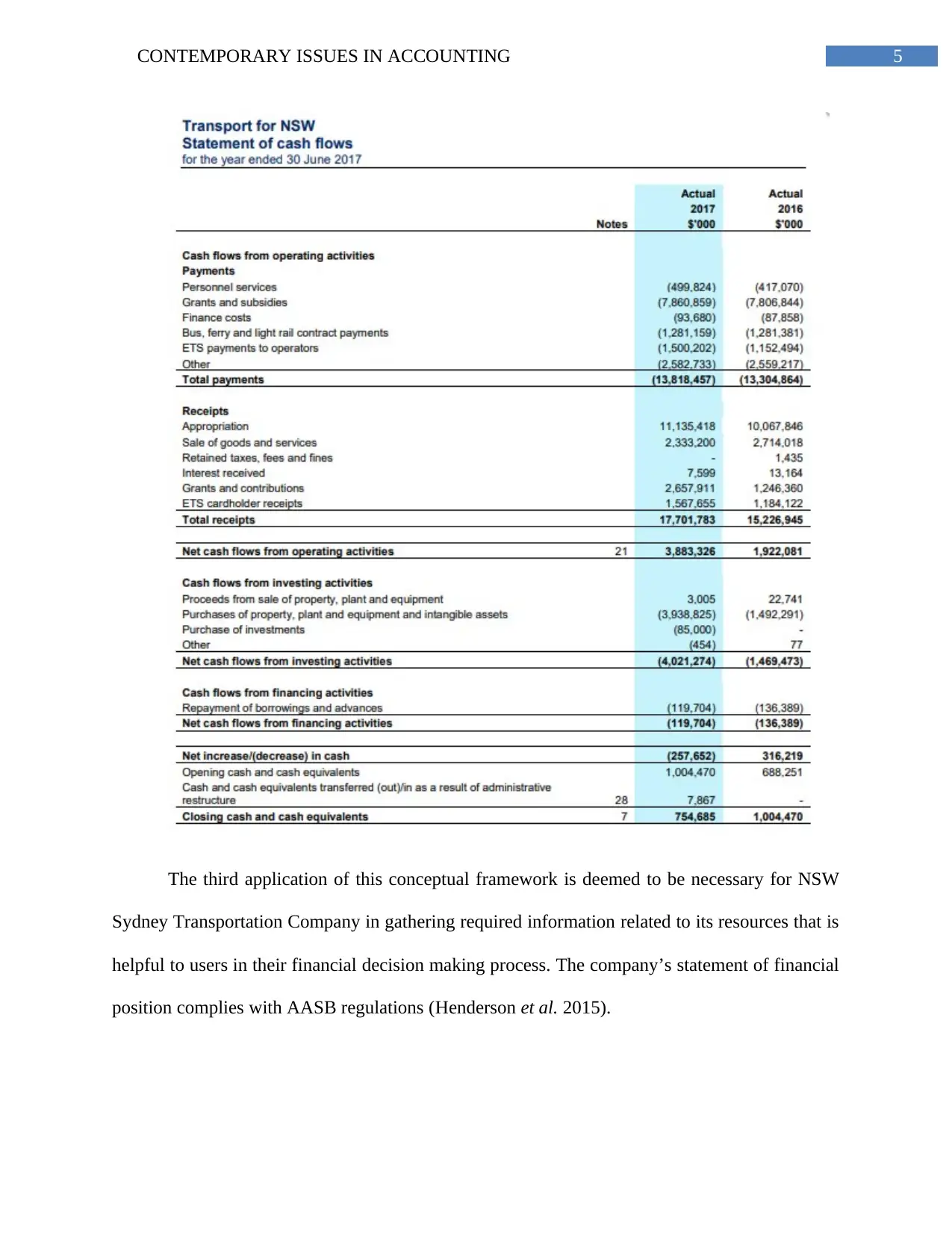
The second application of this accounting conceptual framework in the company is
focussed on explaining the financial information represented. This is in order to be helpful in
anticipating timing, amount along with uncertainties related with cash flows of the firm.
Considering the same, cash flow statement of NSW Sydney Transportation Company facilitates
users in gathering information regarding organizational cash inflows and outflows (Carson,
Farther and Zhang 2016).
Document Page
5CONTEMPORARY ISSUES IN ACCOUNTING
The third application of this conceptual framework is deemed to be necessary for NSW
Sydney Transportation Company in gathering required information related to its resources that is
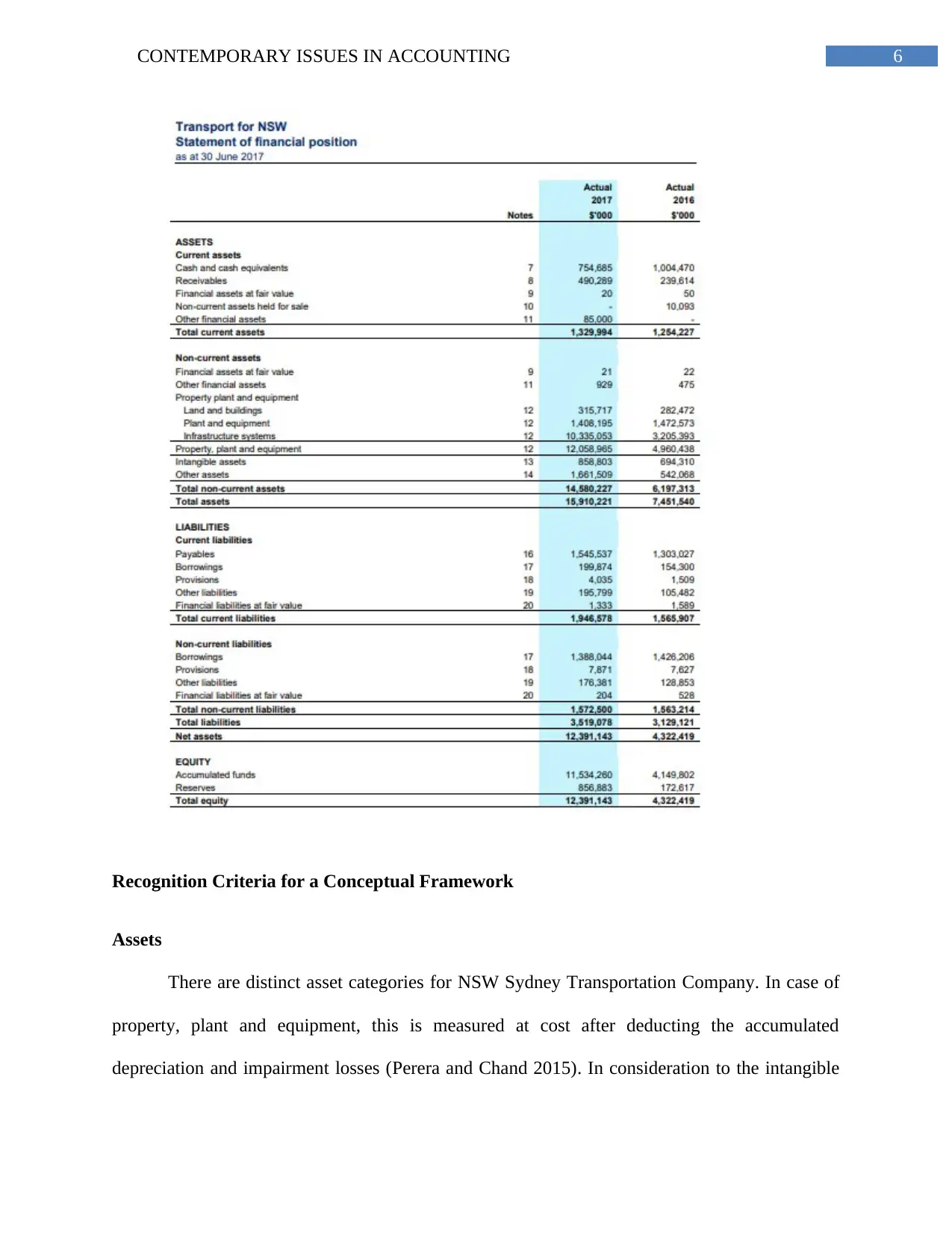
helpful to users in their financial decision making process. The company’s statement of financial
position complies with AASB regulations (Henderson et al. 2015).
Document Page
6CONTEMPORARY ISSUES IN ACCOUNTING
Recognition Criteria for a Conceptual Framework
Assets
There are distinct asset categories for NSW Sydney Transportation Company. In case of
property, plant and equipment, this is measured at cost after deducting the accumulated
depreciation and impairment losses (Perera and Chand 2015). In consideration to the intangible
tabler-icon-diamond-filled.svg

Paraphrase This Document

Need a fresh take? Get an instant paraphrase of this document with our AI Paraphraser
Document Page
7CONTEMPORARY ISSUES IN ACCOUNTING
assets, goodwill is measured at expenses less than impairment loss. The self-constructed assets
take into consideration the direct labour, part of overhead and material cost (Loyeung et al.
2016). Certain other intangible assets are measured at expense less accumulated impairment loss
and amortization of any type.
Liability
NSW Sydney Transportation Company encompasses several liability types as gathered
from the annual report. In consideration to deferred tax liabilities, the company follows the
method of balance sheet. This provides for the temporary variations between the carrying
amounts for taxation liabilities along with purposes of financial reporting (Watty et al. 2014).
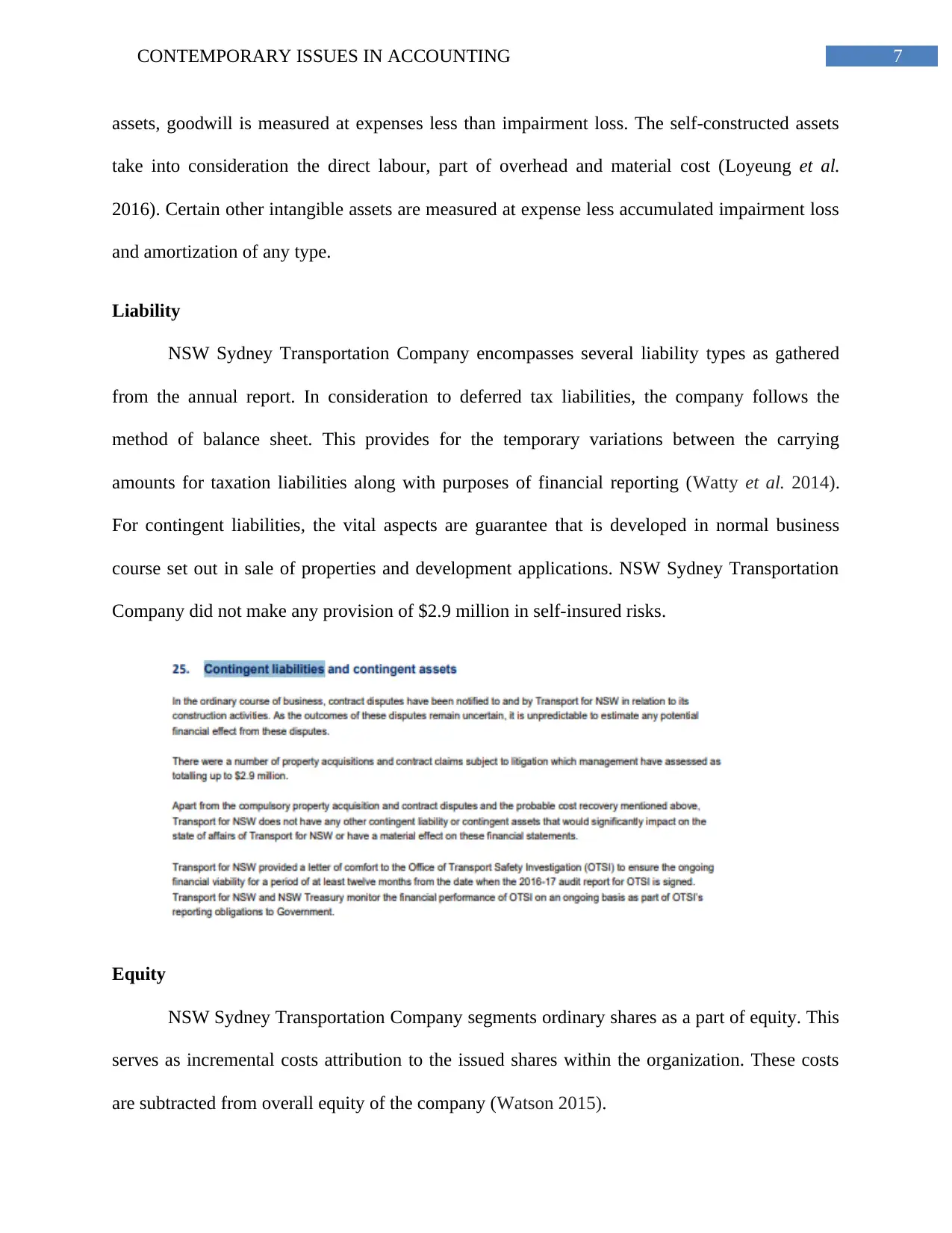
For contingent liabilities, the vital aspects are guarantee that is developed in normal business
course set out in sale of properties and development applications. NSW Sydney Transportation
Company did not make any provision of $2.9 million in self-insured risks.
Equity
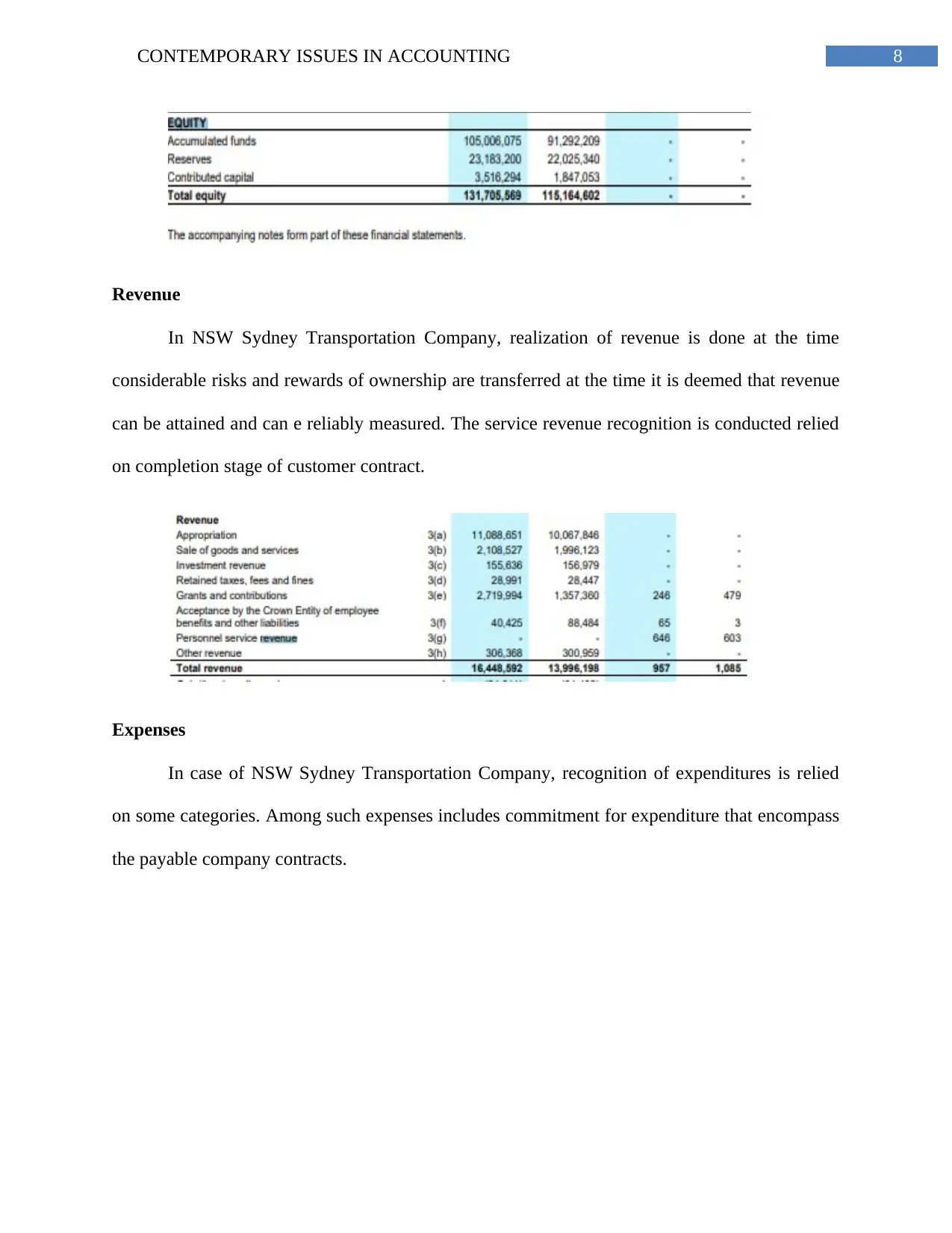
NSW Sydney Transportation Company segments ordinary shares as a part of equity. This
serves as incremental costs attribution to the issued shares within the organization. These costs
are subtracted from overall equity of the company (Watson 2015).
Document Page
8CONTEMPORARY ISSUES IN ACCOUNTING
Revenue
In NSW Sydney Transportation Company, realization of revenue is done at the time
considerable risks and rewards of ownership are transferred at the time it is deemed that revenue
can be attained and can e reliably measured. The service revenue recognition is conducted relied
on completion stage of customer contract.
Expenses
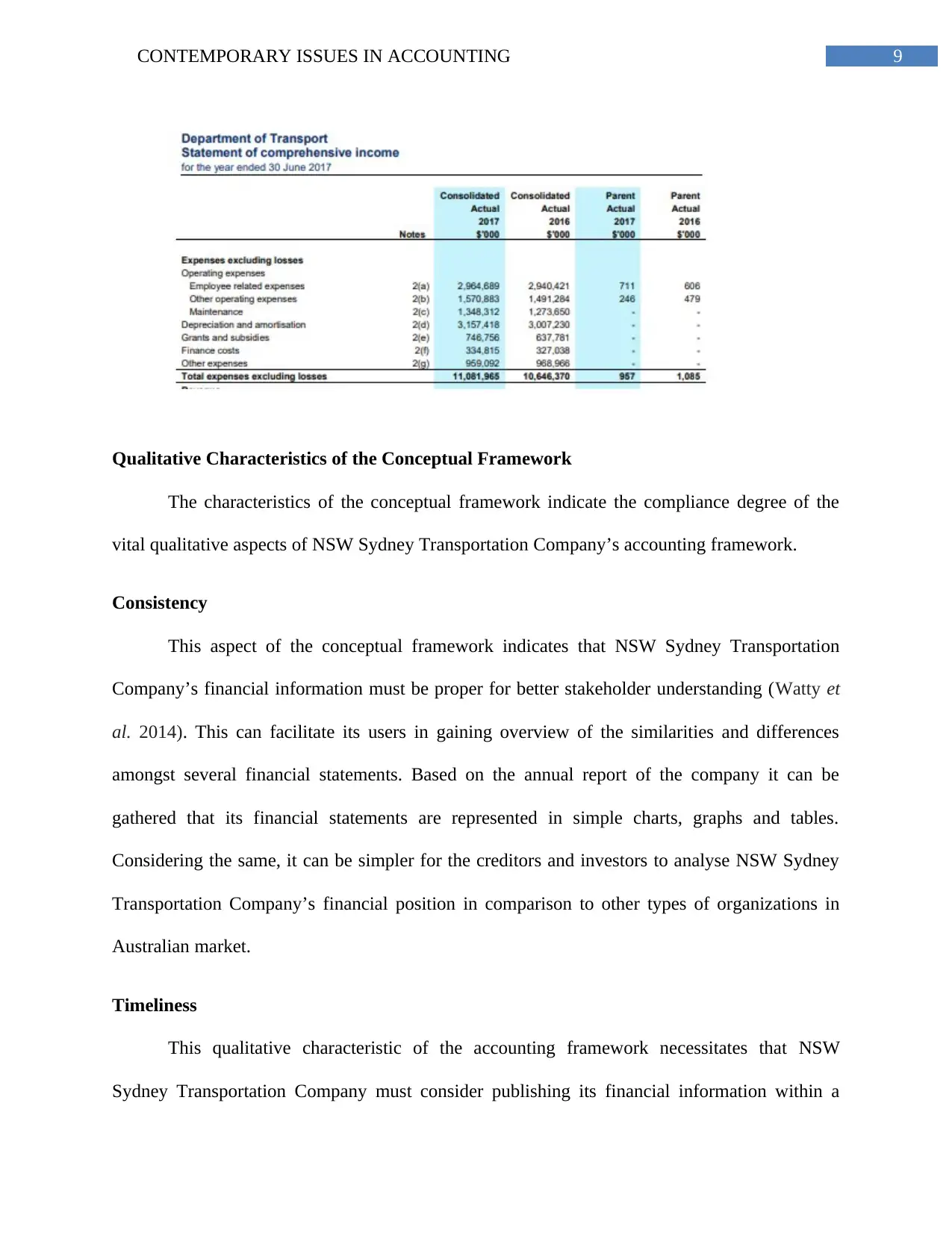
In case of NSW Sydney Transportation Company, recognition of expenditures is relied
on some categories. Among such expenses includes commitment for expenditure that encompass
the payable company contracts.
Document Page
9CONTEMPORARY ISSUES IN ACCOUNTING
Qualitative Characteristics of the Conceptual Framework
The characteristics of the conceptual framework indicate the compliance degree of the
vital qualitative aspects of NSW Sydney Transportation Company’s accounting framework.
Consistency
This aspect of the conceptual framework indicates that NSW Sydney Transportation
Company’s financial information must be proper for better stakeholder understanding (Watty et
al. 2014). This can facilitate its users in gaining overview of the similarities and differences
amongst several financial statements. Based on the annual report of the company it can be
gathered that its financial statements are represented in simple charts, graphs and tables.
Considering the same, it can be simpler for the creditors and investors to analyse NSW Sydney
Transportation Company’s financial position in comparison to other types of organizations in
Australian market.
Timeliness
This qualitative characteristic of the accounting framework necessitates that NSW
Sydney Transportation Company must consider publishing its financial information within a
tabler-icon-diamond-filled.svg

Paraphrase This Document

Need a fresh take? Get an instant paraphrase of this document with our AI Paraphraser
Document Page
10CONTEMPORARY ISSUES IN ACCOUNTING
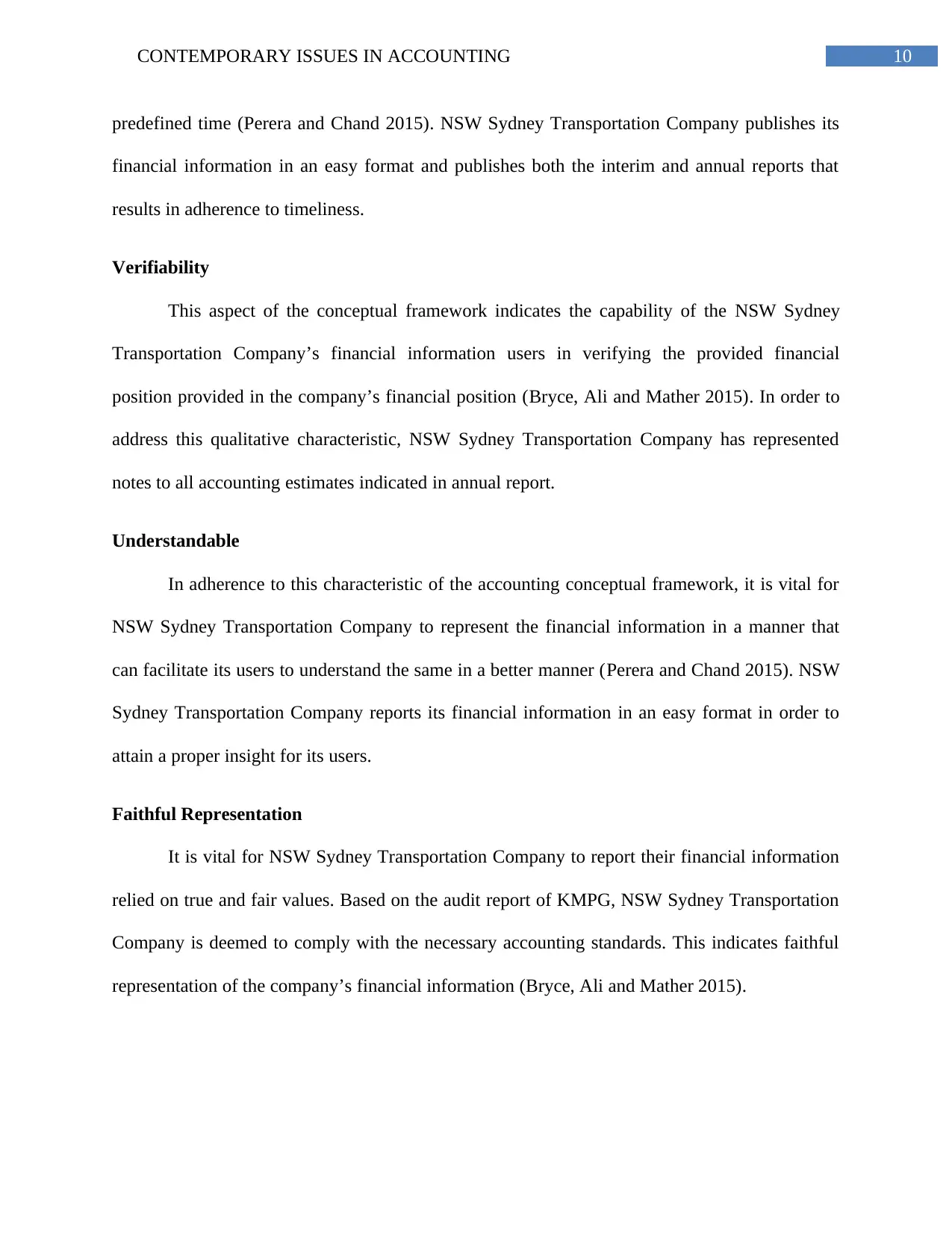
predefined time (Perera and Chand 2015). NSW Sydney Transportation Company publishes its
financial information in an easy format and publishes both the interim and annual reports that
results in adherence to timeliness.
Verifiability
This aspect of the conceptual framework indicates the capability of the NSW Sydney
Transportation Company’s financial information users in verifying the provided financial
position provided in the company’s financial position (Bryce, Ali and Mather 2015). In order to
address this qualitative characteristic, NSW Sydney Transportation Company has represented
notes to all accounting estimates indicated in annual report.
Understandable
In adherence to this characteristic of the accounting conceptual framework, it is vital for
NSW Sydney Transportation Company to represent the financial information in a manner that
can facilitate its users to understand the same in a better manner (Perera and Chand 2015). NSW
Sydney Transportation Company reports its financial information in an easy format in order to
attain a proper insight for its users.
Faithful Representation
It is vital for NSW Sydney Transportation Company to report their financial information
relied on true and fair values. Based on the audit report of KMPG, NSW Sydney Transportation
Company is deemed to comply with the necessary accounting standards. This indicates faithful
representation of the company’s financial information (Bryce, Ali and Mather 2015).
Document Page
11CONTEMPORARY ISSUES IN ACCOUNTING
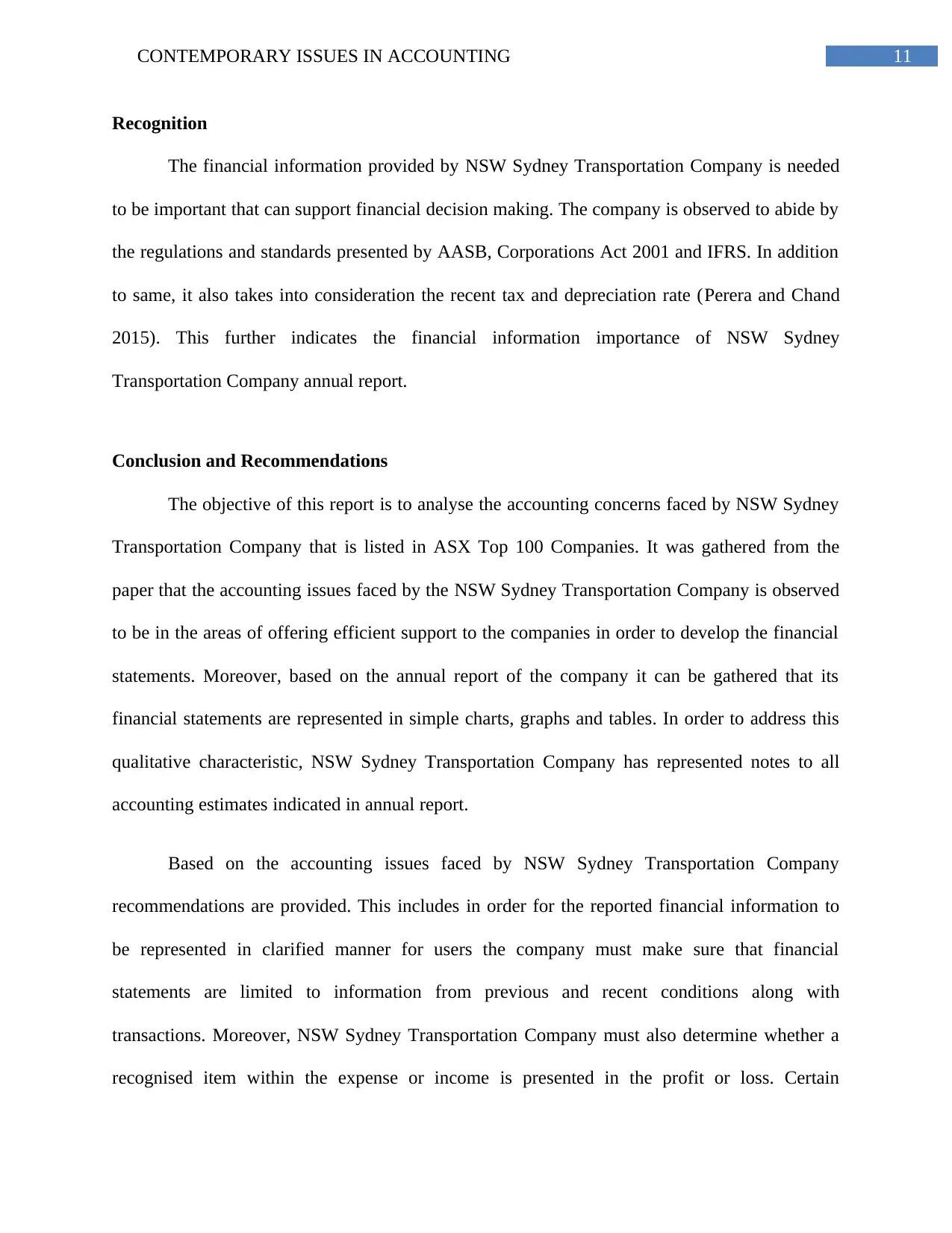
Recognition
The financial information provided by NSW Sydney Transportation Company is needed
to be important that can support financial decision making. The company is observed to abide by
the regulations and standards presented by AASB, Corporations Act 2001 and IFRS. In addition
to same, it also takes into consideration the recent tax and depreciation rate (Perera and Chand
2015). This further indicates the financial information importance of NSW Sydney
Transportation Company annual report.
Conclusion and Recommendations
The objective of this report is to analyse the accounting concerns faced by NSW Sydney
Transportation Company that is listed in ASX Top 100 Companies. It was gathered from the
paper that the accounting issues faced by the NSW Sydney Transportation Company is observed
to be in the areas of offering efficient support to the companies in order to develop the financial
statements. Moreover, based on the annual report of the company it can be gathered that its
financial statements are represented in simple charts, graphs and tables. In order to address this
qualitative characteristic, NSW Sydney Transportation Company has represented notes to all
accounting estimates indicated in annual report.
Based on the accounting issues faced by NSW Sydney Transportation Company
recommendations are provided. This includes in order for the reported financial information to
be represented in clarified manner for users the company must make sure that financial
statements are limited to information from previous and recent conditions along with
transactions. Moreover, NSW Sydney Transportation Company must also determine whether a
recognised item within the expense or income is presented in the profit or loss. Certain
chevron_up_icon
1 out of 15
circle_padding
hide_on_mobile
zoom_out_icon
[object Object]