University Accounting Diploma: Financial Strategies Assessment Report
VerifiedAdded on 2023/01/19
|19
|3203
|29
Report
AI Summary
This report presents a comprehensive assessment of financial strategies and accounting principles, tailored for an Advance Diploma in Accounting. It begins by defining strategic planning and its importance, followed by an exploration of mission and vision statements, exemplified by BHP Billiton and Wesfarmers. The report then delves into SMART goals, financial strategies, and various accounting concepts, including cost-benefit analysis, forecasting techniques, and risk management. It highlights the significance of data in financial statement preparation and examines the impact of incorrect financial decisions. The report also differentiates between short-term and long-term goals. Furthermore, the assessment includes case studies focusing on capital investment decisions, NPV vs. FV, and the application of ARR and payback period for investment analysis. Finally, it concludes with financial forecasts for a hypothetical business scenario.
Running head: ADVANCE DIPLOMA IN ACCOUNTING
Advance diploma in accounting
Name of the student
Name of the university
Student ID
Author note
Advance diploma in accounting
Name of the student
Name of the university
Student ID
Author note

Paraphrase This Document
Need a fresh take? Get an instant paraphrase of this document with our AI Paraphraser
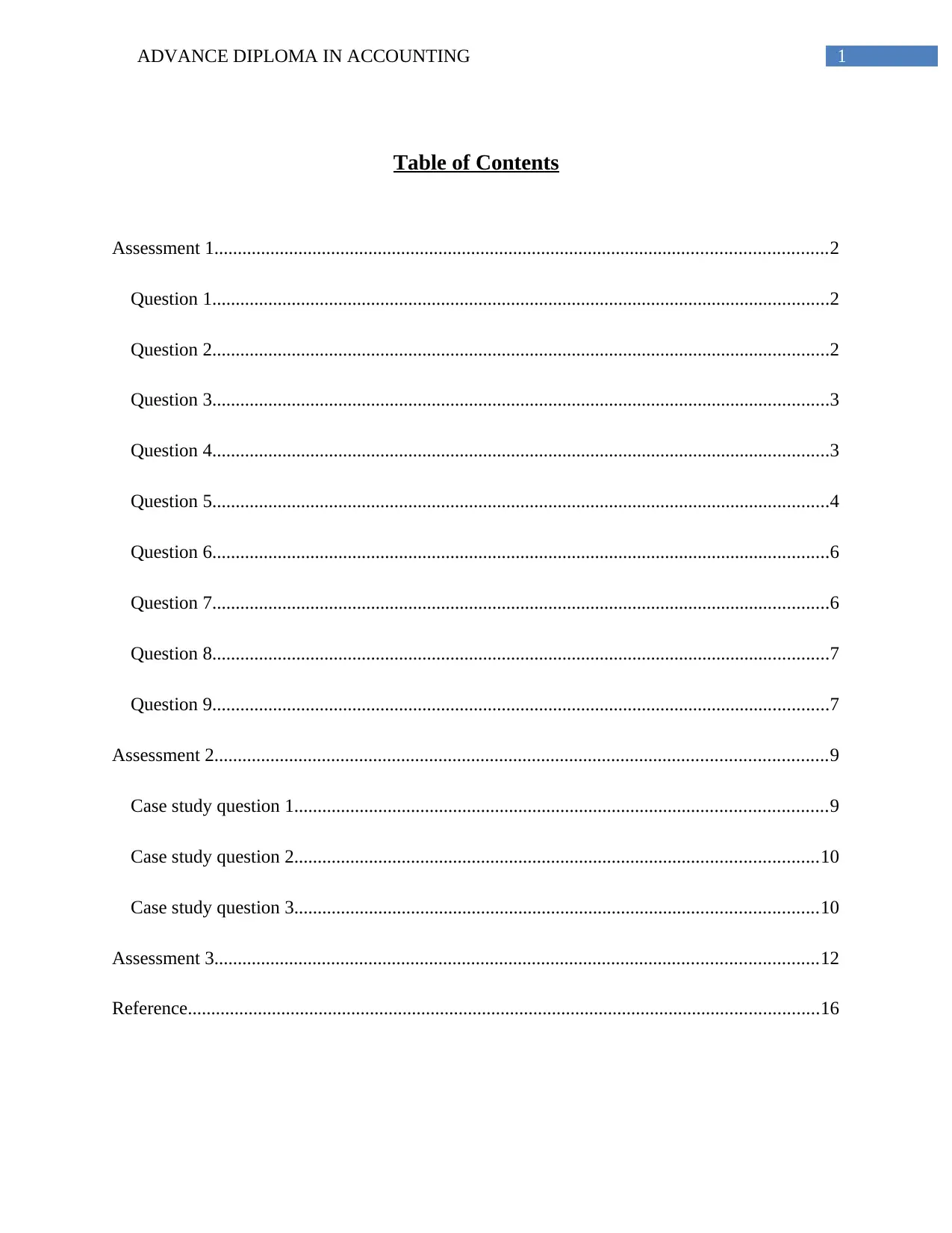
1ADVANCE DIPLOMA IN ACCOUNTING
Table of Contents
Assessment 1...................................................................................................................................2
Question 1....................................................................................................................................2
Question 2....................................................................................................................................2
Question 3....................................................................................................................................3
Question 4....................................................................................................................................3
Question 5....................................................................................................................................4
Question 6....................................................................................................................................6
Question 7....................................................................................................................................6
Question 8....................................................................................................................................7
Question 9....................................................................................................................................7
Assessment 2...................................................................................................................................9
Case study question 1..................................................................................................................9
Case study question 2................................................................................................................10
Case study question 3................................................................................................................10
Assessment 3.................................................................................................................................12
Reference.......................................................................................................................................16
Table of Contents
Assessment 1...................................................................................................................................2
Question 1....................................................................................................................................2
Question 2....................................................................................................................................2
Question 3....................................................................................................................................3
Question 4....................................................................................................................................3
Question 5....................................................................................................................................4
Question 6....................................................................................................................................6
Question 7....................................................................................................................................6
Question 8....................................................................................................................................7
Question 9....................................................................................................................................7
Assessment 2...................................................................................................................................9
Case study question 1..................................................................................................................9
Case study question 2................................................................................................................10
Case study question 3................................................................................................................10
Assessment 3.................................................................................................................................12
Reference.......................................................................................................................................16
2ADVANCE DIPLOMA IN ACCOUNTING
Assessment 1
Question 1
Strategic plan
Strategic plan is the procedure where the organizational leaders determine the vision for
future along with identifying the objectives and goals for the entity. This procedure further
includes establishment of sequence in which the goals shall fall which in turn will enable the
entity to reach the stated visions (Ansoff et al. 2018).
Question 2
Mission and vision statement
Mission statement describes the entity’s objective, its business and the approach for
reaching the objectives. On the other hand, the vision statements describe the company’s desired
future position. Components of vision and mission statements are generally combined for
providing the statements regarding company’s gals, purpose and values (Williams, Morrell and
Mullane 2014)
BHP Billiton –
Mission – At BHP Billiton the objective is to become the entity of choice and creating
sustainable value for the shareholders, contractors, hosts communities, business partners and
employees. It aspire zero harm to the people, environment and host communities and striving for
achieving leading practice in the industry
Assessment 1
Question 1
Strategic plan
Strategic plan is the procedure where the organizational leaders determine the vision for
future along with identifying the objectives and goals for the entity. This procedure further
includes establishment of sequence in which the goals shall fall which in turn will enable the
entity to reach the stated visions (Ansoff et al. 2018).
Question 2
Mission and vision statement
Mission statement describes the entity’s objective, its business and the approach for
reaching the objectives. On the other hand, the vision statements describe the company’s desired
future position. Components of vision and mission statements are generally combined for
providing the statements regarding company’s gals, purpose and values (Williams, Morrell and
Mullane 2014)
BHP Billiton –
Mission – At BHP Billiton the objective is to become the entity of choice and creating
sustainable value for the shareholders, contractors, hosts communities, business partners and
employees. It aspire zero harm to the people, environment and host communities and striving for
achieving leading practice in the industry
⊘ This is a preview!⊘
Do you want full access?
Subscribe today to unlock all pages.

Trusted by 1+ million students worldwide
3ADVANCE DIPLOMA IN ACCOUNTING
Vision – To create the long term value for the shareholder through acquisition, discovery,
marketing and developing the natural resources (BHP 2019)
Wesfarmers –
Mission – delivering satisfactory return to the shareholders. For achieving this, the company
developed highly focused, disciplined and unique business culture where it adheres to 4 core
values including accountability, boldness, openness and integrity.
Vision – to provide best quality products to customers and for succeeding in business it is
focused I product quality and the information delivery to customers (Group 2019).
Question 3
SMART goal
SMART goals are the goals those are specific, measurable, achievable and relevant and
time bound. It is the acronym for all these criteria and are called by the acronym (Bowman et al.
2015)
Annual goals for the organization are as follows –
Driving the responsible sources for all the key commodities by the end of current year
Increasing shareholder’s return at least by 10%
Reducing the impact of wastages at least by 50%
Question 4
Financial strategy
Vision – To create the long term value for the shareholder through acquisition, discovery,
marketing and developing the natural resources (BHP 2019)
Wesfarmers –
Mission – delivering satisfactory return to the shareholders. For achieving this, the company
developed highly focused, disciplined and unique business culture where it adheres to 4 core
values including accountability, boldness, openness and integrity.
Vision – to provide best quality products to customers and for succeeding in business it is
focused I product quality and the information delivery to customers (Group 2019).
Question 3
SMART goal
SMART goals are the goals those are specific, measurable, achievable and relevant and
time bound. It is the acronym for all these criteria and are called by the acronym (Bowman et al.
2015)
Annual goals for the organization are as follows –
Driving the responsible sources for all the key commodities by the end of current year
Increasing shareholder’s return at least by 10%
Reducing the impact of wastages at least by 50%
Question 4
Financial strategy
Paraphrase This Document
Need a fresh take? Get an instant paraphrase of this document with our AI Paraphraser
4ADVANCE DIPLOMA IN ACCOUNTING
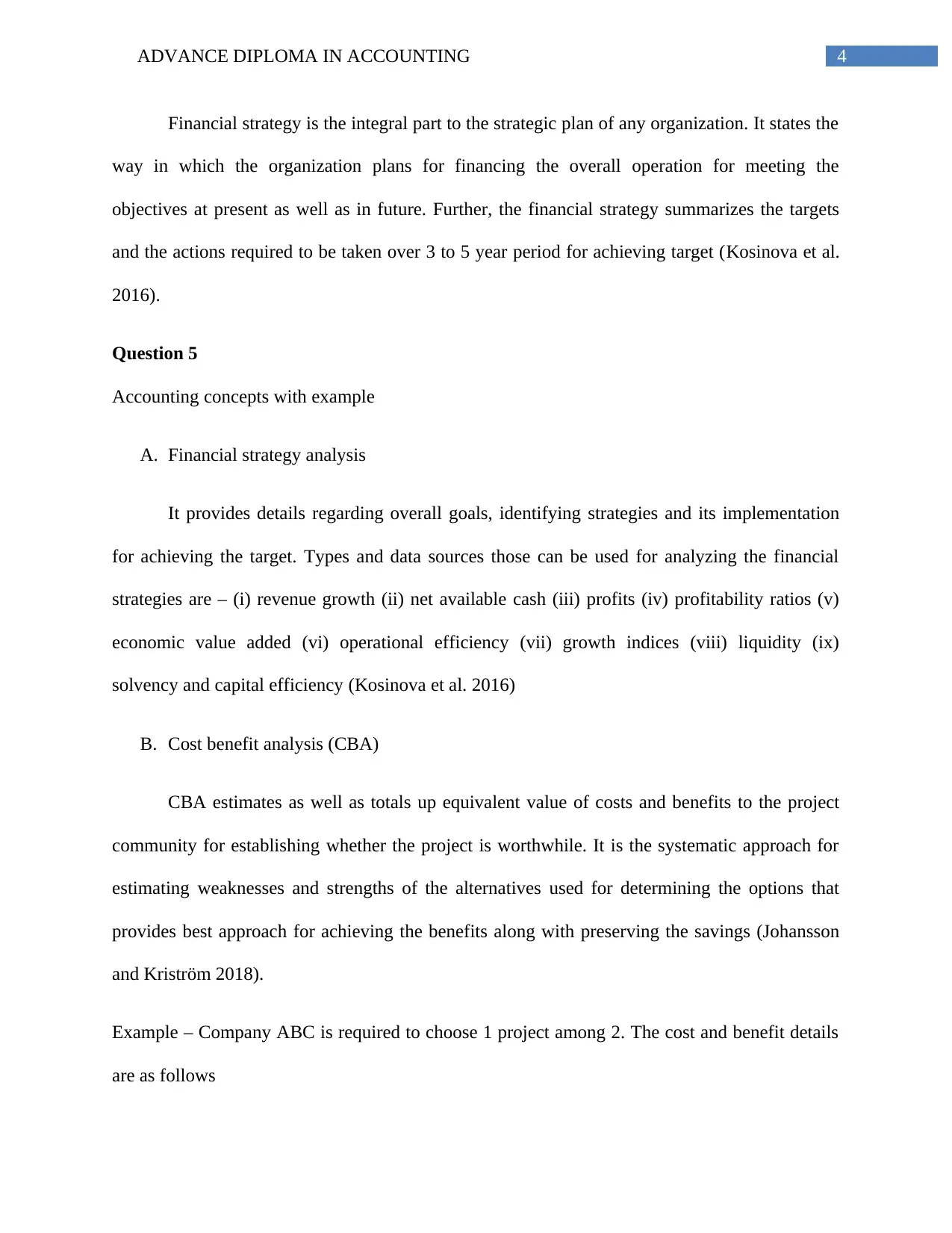
Financial strategy is the integral part to the strategic plan of any organization. It states the
way in which the organization plans for financing the overall operation for meeting the
objectives at present as well as in future. Further, the financial strategy summarizes the targets
and the actions required to be taken over 3 to 5 year period for achieving target (Kosinova et al.
2016).
Question 5
Accounting concepts with example
A. Financial strategy analysis
It provides details regarding overall goals, identifying strategies and its implementation
for achieving the target. Types and data sources those can be used for analyzing the financial
strategies are – (i) revenue growth (ii) net available cash (iii) profits (iv) profitability ratios (v)
economic value added (vi) operational efficiency (vii) growth indices (viii) liquidity (ix)
solvency and capital efficiency (Kosinova et al. 2016)
B. Cost benefit analysis (CBA)
CBA estimates as well as totals up equivalent value of costs and benefits to the project
community for establishing whether the project is worthwhile. It is the systematic approach for
estimating weaknesses and strengths of the alternatives used for determining the options that
provides best approach for achieving the benefits along with preserving the savings (Johansson
and Kriström 2018).
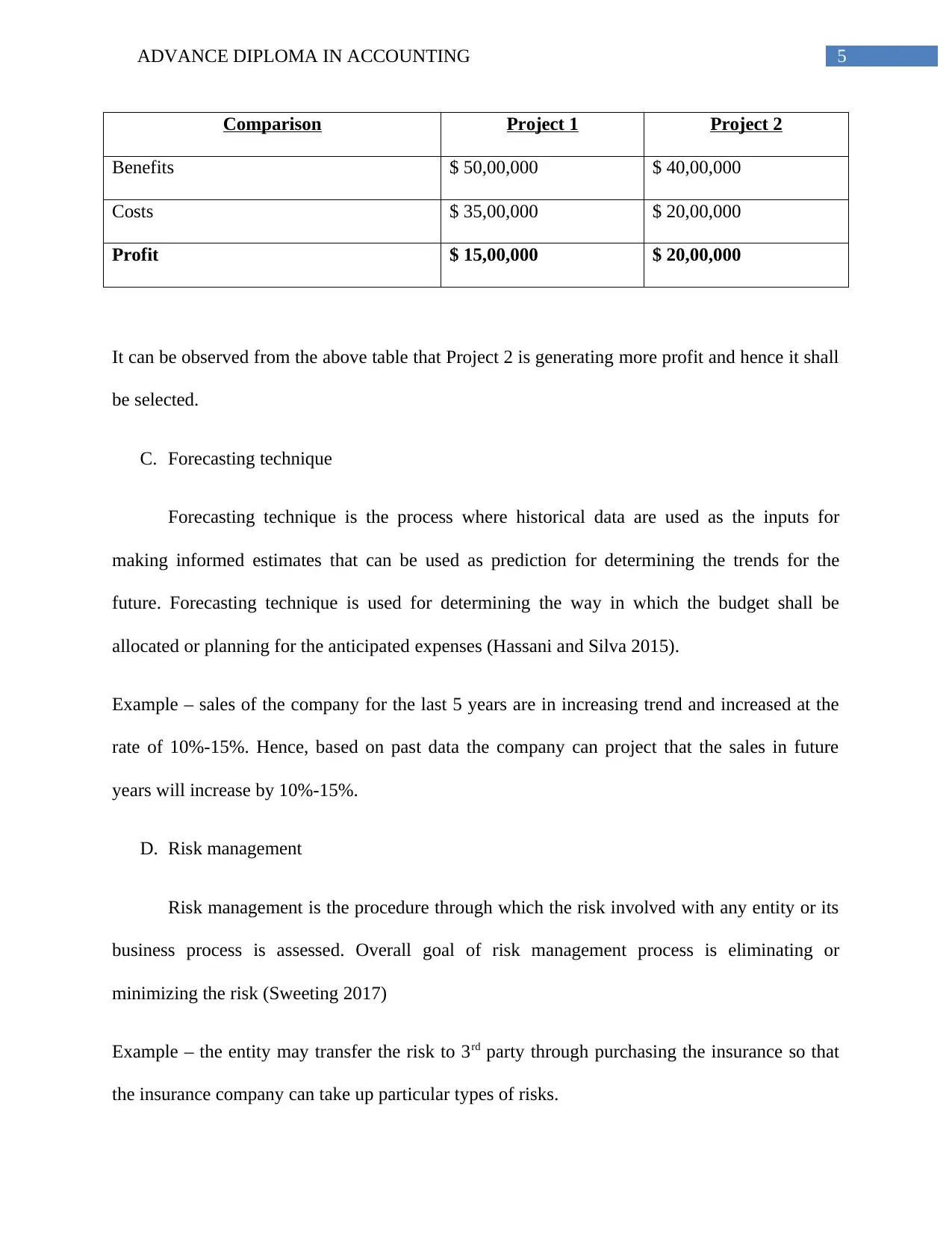
Example – Company ABC is required to choose 1 project among 2. The cost and benefit details
are as follows
Financial strategy is the integral part to the strategic plan of any organization. It states the
way in which the organization plans for financing the overall operation for meeting the
objectives at present as well as in future. Further, the financial strategy summarizes the targets
and the actions required to be taken over 3 to 5 year period for achieving target (Kosinova et al.
2016).
Question 5
Accounting concepts with example
A. Financial strategy analysis
It provides details regarding overall goals, identifying strategies and its implementation
for achieving the target. Types and data sources those can be used for analyzing the financial
strategies are – (i) revenue growth (ii) net available cash (iii) profits (iv) profitability ratios (v)
economic value added (vi) operational efficiency (vii) growth indices (viii) liquidity (ix)
solvency and capital efficiency (Kosinova et al. 2016)
B. Cost benefit analysis (CBA)
CBA estimates as well as totals up equivalent value of costs and benefits to the project
community for establishing whether the project is worthwhile. It is the systematic approach for
estimating weaknesses and strengths of the alternatives used for determining the options that
provides best approach for achieving the benefits along with preserving the savings (Johansson
and Kriström 2018).
Example – Company ABC is required to choose 1 project among 2. The cost and benefit details
are as follows
5ADVANCE DIPLOMA IN ACCOUNTING
Comparison Project 1 Project 2
Benefits $ 50,00,000 $ 40,00,000
Costs $ 35,00,000 $ 20,00,000
Profit $ 15,00,000 $ 20,00,000
It can be observed from the above table that Project 2 is generating more profit and hence it shall
be selected.
C. Forecasting technique
Forecasting technique is the process where historical data are used as the inputs for
making informed estimates that can be used as prediction for determining the trends for the
future. Forecasting technique is used for determining the way in which the budget shall be
allocated or planning for the anticipated expenses (Hassani and Silva 2015).
Example – sales of the company for the last 5 years are in increasing trend and increased at the
rate of 10%-15%. Hence, based on past data the company can project that the sales in future
years will increase by 10%-15%.
D. Risk management
Risk management is the procedure through which the risk involved with any entity or its
business process is assessed. Overall goal of risk management process is eliminating or
minimizing the risk (Sweeting 2017)
Example – the entity may transfer the risk to 3rd party through purchasing the insurance so that
the insurance company can take up particular types of risks.
Comparison Project 1 Project 2
Benefits $ 50,00,000 $ 40,00,000
Costs $ 35,00,000 $ 20,00,000
Profit $ 15,00,000 $ 20,00,000
It can be observed from the above table that Project 2 is generating more profit and hence it shall
be selected.
C. Forecasting technique
Forecasting technique is the process where historical data are used as the inputs for
making informed estimates that can be used as prediction for determining the trends for the
future. Forecasting technique is used for determining the way in which the budget shall be
allocated or planning for the anticipated expenses (Hassani and Silva 2015).
Example – sales of the company for the last 5 years are in increasing trend and increased at the
rate of 10%-15%. Hence, based on past data the company can project that the sales in future
years will increase by 10%-15%.
D. Risk management
Risk management is the procedure through which the risk involved with any entity or its
business process is assessed. Overall goal of risk management process is eliminating or
minimizing the risk (Sweeting 2017)
Example – the entity may transfer the risk to 3rd party through purchasing the insurance so that
the insurance company can take up particular types of risks.
⊘ This is a preview!⊘
Do you want full access?
Subscribe today to unlock all pages.
Trusted by 1+ million students worldwide
6ADVANCE DIPLOMA IN ACCOUNTING
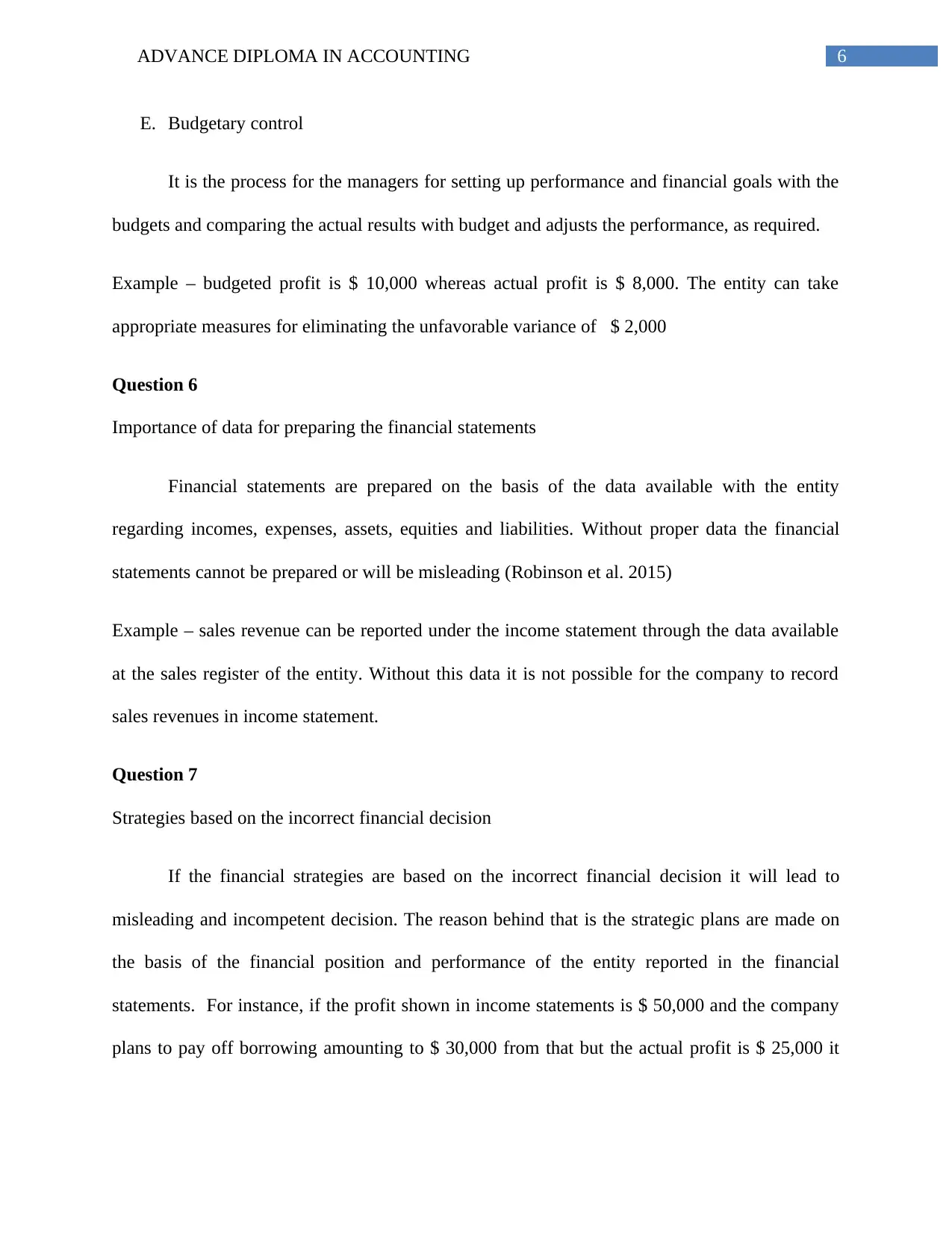
E. Budgetary control
It is the process for the managers for setting up performance and financial goals with the
budgets and comparing the actual results with budget and adjusts the performance, as required.
Example – budgeted profit is $ 10,000 whereas actual profit is $ 8,000. The entity can take
appropriate measures for eliminating the unfavorable variance of $ 2,000
Question 6
Importance of data for preparing the financial statements
Financial statements are prepared on the basis of the data available with the entity
regarding incomes, expenses, assets, equities and liabilities. Without proper data the financial
statements cannot be prepared or will be misleading (Robinson et al. 2015)
Example – sales revenue can be reported under the income statement through the data available
at the sales register of the entity. Without this data it is not possible for the company to record
sales revenues in income statement.
Question 7
Strategies based on the incorrect financial decision
If the financial strategies are based on the incorrect financial decision it will lead to
misleading and incompetent decision. The reason behind that is the strategic plans are made on
the basis of the financial position and performance of the entity reported in the financial
statements. For instance, if the profit shown in income statements is $ 50,000 and the company
plans to pay off borrowing amounting to $ 30,000 from that but the actual profit is $ 25,000 it
E. Budgetary control
It is the process for the managers for setting up performance and financial goals with the
budgets and comparing the actual results with budget and adjusts the performance, as required.
Example – budgeted profit is $ 10,000 whereas actual profit is $ 8,000. The entity can take
appropriate measures for eliminating the unfavorable variance of $ 2,000
Question 6
Importance of data for preparing the financial statements
Financial statements are prepared on the basis of the data available with the entity
regarding incomes, expenses, assets, equities and liabilities. Without proper data the financial
statements cannot be prepared or will be misleading (Robinson et al. 2015)
Example – sales revenue can be reported under the income statement through the data available
at the sales register of the entity. Without this data it is not possible for the company to record
sales revenues in income statement.
Question 7
Strategies based on the incorrect financial decision
If the financial strategies are based on the incorrect financial decision it will lead to
misleading and incompetent decision. The reason behind that is the strategic plans are made on
the basis of the financial position and performance of the entity reported in the financial
statements. For instance, if the profit shown in income statements is $ 50,000 and the company
plans to pay off borrowing amounting to $ 30,000 from that but the actual profit is $ 25,000 it
Paraphrase This Document
Need a fresh take? Get an instant paraphrase of this document with our AI Paraphraser
7ADVANCE DIPLOMA IN ACCOUNTING
will have adverse impact on the strategies made by the managements based on the profit
(Robinson et al. 2015)
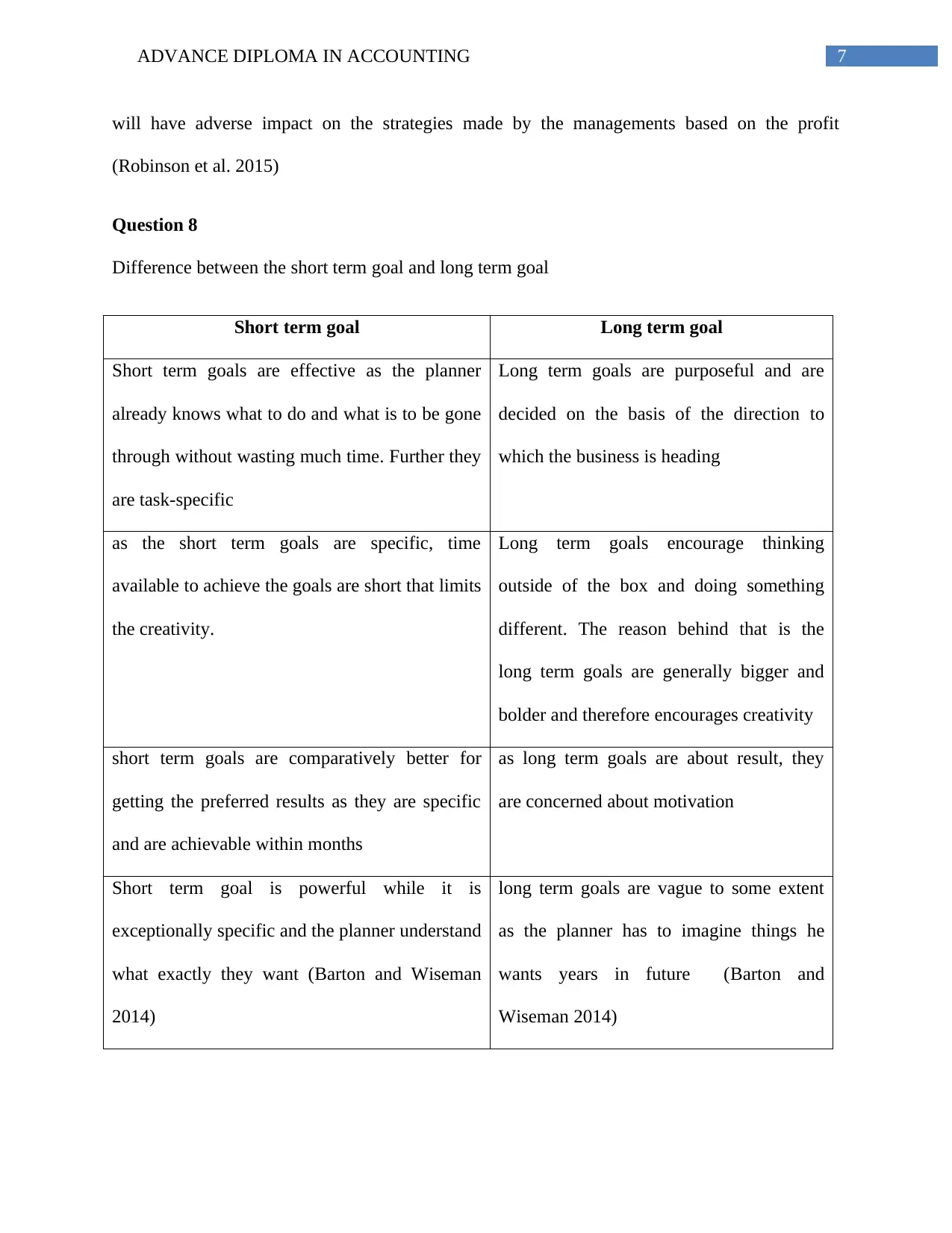
Question 8
Difference between the short term goal and long term goal
Short term goal Long term goal
Short term goals are effective as the planner
already knows what to do and what is to be gone
through without wasting much time. Further they
are task-specific
Long term goals are purposeful and are
decided on the basis of the direction to
which the business is heading
as the short term goals are specific, time
available to achieve the goals are short that limits
the creativity.
Long term goals encourage thinking
outside of the box and doing something
different. The reason behind that is the
long term goals are generally bigger and
bolder and therefore encourages creativity
short term goals are comparatively better for
getting the preferred results as they are specific
and are achievable within months
as long term goals are about result, they
are concerned about motivation
Short term goal is powerful while it is
exceptionally specific and the planner understand
what exactly they want (Barton and Wiseman
2014)
long term goals are vague to some extent
as the planner has to imagine things he
wants years in future (Barton and
Wiseman 2014)
will have adverse impact on the strategies made by the managements based on the profit
(Robinson et al. 2015)
Question 8
Difference between the short term goal and long term goal
Short term goal Long term goal
Short term goals are effective as the planner
already knows what to do and what is to be gone
through without wasting much time. Further they
are task-specific
Long term goals are purposeful and are
decided on the basis of the direction to
which the business is heading
as the short term goals are specific, time
available to achieve the goals are short that limits
the creativity.
Long term goals encourage thinking
outside of the box and doing something
different. The reason behind that is the
long term goals are generally bigger and
bolder and therefore encourages creativity
short term goals are comparatively better for
getting the preferred results as they are specific
and are achievable within months
as long term goals are about result, they
are concerned about motivation
Short term goal is powerful while it is
exceptionally specific and the planner understand
what exactly they want (Barton and Wiseman
2014)
long term goals are vague to some extent
as the planner has to imagine things he
wants years in future (Barton and
Wiseman 2014)
8ADVANCE DIPLOMA IN ACCOUNTING
Question 9
Short description
A. Annual report
Annual report is the financial summary of any organization’s activities for the particular
year that must be provided to the shareholders annually for stating their financial and operational
conditions (Wahlen, Baginski and Bradshaw 2014)
B. Five year plan
Five year plan is the series of financial development that the company is planning to do in
next 5 years. It includes the plan for incomes and expenses of the company and the plan
regarding the business operation.
C. Business plan
Business plan is the written document that describes the nature of business, marketing
and sales strategy, financial background and includes the projected profit and loss statements.
D. Cash flow statement
Cash flow statement delivers the details regarding the changes in the cash and the cash
equivalent of any business through classifying the cash inflows and outflows into financing,
investing and operating activities (Wahlen, Baginski and Bradshaw 2014)
Question 9
Short description
A. Annual report
Annual report is the financial summary of any organization’s activities for the particular
year that must be provided to the shareholders annually for stating their financial and operational
conditions (Wahlen, Baginski and Bradshaw 2014)
B. Five year plan
Five year plan is the series of financial development that the company is planning to do in
next 5 years. It includes the plan for incomes and expenses of the company and the plan
regarding the business operation.
C. Business plan
Business plan is the written document that describes the nature of business, marketing
and sales strategy, financial background and includes the projected profit and loss statements.
D. Cash flow statement
Cash flow statement delivers the details regarding the changes in the cash and the cash
equivalent of any business through classifying the cash inflows and outflows into financing,
investing and operating activities (Wahlen, Baginski and Bradshaw 2014)
⊘ This is a preview!⊘
Do you want full access?
Subscribe today to unlock all pages.
Trusted by 1+ million students worldwide
9ADVANCE DIPLOMA IN ACCOUNTING
Assessment 2
Case study question 1
(a) Issues in making decisions related to capital investment
Competitor’s strategy – strategy of the competitor regarding capital investment have
significant influence on the company’s investment decision. For instance, if the
competitor continues installing more of the equipment and produce better products the
existence of the company will be threatened if it continues with old equipment (Rossi
2015)
Opportunities from change in technology – changes in technology create the new
equipment that may represent major changes in the process and hence there emerges
requirement for re-evaluation of the existing capital equipment. Proper evaluation of this
aspect is required for making investment in wise way
Market forecast – long as well as short market forecasts are important factors in the
decision of capital investment. For participating in the long run forecast for the market
potentials it is required to take potential critical decisions (Rossi 2015)
(b) Difference between NPV (net present value) and FV (future value)
NPV is the difference among PV of cash inflows and the PV of cash outflows over the
specific period of time. On the other hand, PV is current value of future cash flows or stream of
cash flows given the specified return rate. Main difference among the two is NPV formula
considers the initial capital outlay required for funding any project along with cash inflows
whereas PV only considers the cash inflows (Rossi 2014)
Assessment 2
Case study question 1
(a) Issues in making decisions related to capital investment
Competitor’s strategy – strategy of the competitor regarding capital investment have
significant influence on the company’s investment decision. For instance, if the
competitor continues installing more of the equipment and produce better products the
existence of the company will be threatened if it continues with old equipment (Rossi
2015)
Opportunities from change in technology – changes in technology create the new
equipment that may represent major changes in the process and hence there emerges
requirement for re-evaluation of the existing capital equipment. Proper evaluation of this
aspect is required for making investment in wise way
Market forecast – long as well as short market forecasts are important factors in the
decision of capital investment. For participating in the long run forecast for the market
potentials it is required to take potential critical decisions (Rossi 2015)
(b) Difference between NPV (net present value) and FV (future value)
NPV is the difference among PV of cash inflows and the PV of cash outflows over the
specific period of time. On the other hand, PV is current value of future cash flows or stream of
cash flows given the specified return rate. Main difference among the two is NPV formula
considers the initial capital outlay required for funding any project along with cash inflows
whereas PV only considers the cash inflows (Rossi 2014)
Paraphrase This Document
Need a fresh take? Get an instant paraphrase of this document with our AI Paraphraser
10ADVANCE DIPLOMA IN ACCOUNTING
Example - assume a project requires initial outlay of $15,000 and is expected to generate
revenues of $3,500, $9,400 and $15,100 in the next three years and the company's discount rate
is 7%.
PV = $3,500/ / (1+0.07)1 + $9,400 / (1+0.07)2 + $15,100 / (1+0.07)3 = $23,807
NPV = $23,807 - $15,000 = $ 8,807.
Case study question 2
(a) ARR
ARR = Average net profit / initial investment
ARR for retirement village = (11/4) / 8 = 34.38%
ARR for library complex = (14/5) / 8 = 35%
Hence, on the basis of ARR, library complex project is more profitable.
(b) PP
Payback period = initial investment / annual profit
PP = 8 / 14 = 0.57 years.
Case study question 3
(a) ARR
Example - assume a project requires initial outlay of $15,000 and is expected to generate
revenues of $3,500, $9,400 and $15,100 in the next three years and the company's discount rate
is 7%.
PV = $3,500/ / (1+0.07)1 + $9,400 / (1+0.07)2 + $15,100 / (1+0.07)3 = $23,807
NPV = $23,807 - $15,000 = $ 8,807.
Case study question 2
(a) ARR
ARR = Average net profit / initial investment
ARR for retirement village = (11/4) / 8 = 34.38%
ARR for library complex = (14/5) / 8 = 35%
Hence, on the basis of ARR, library complex project is more profitable.
(b) PP
Payback period = initial investment / annual profit
PP = 8 / 14 = 0.57 years.
Case study question 3
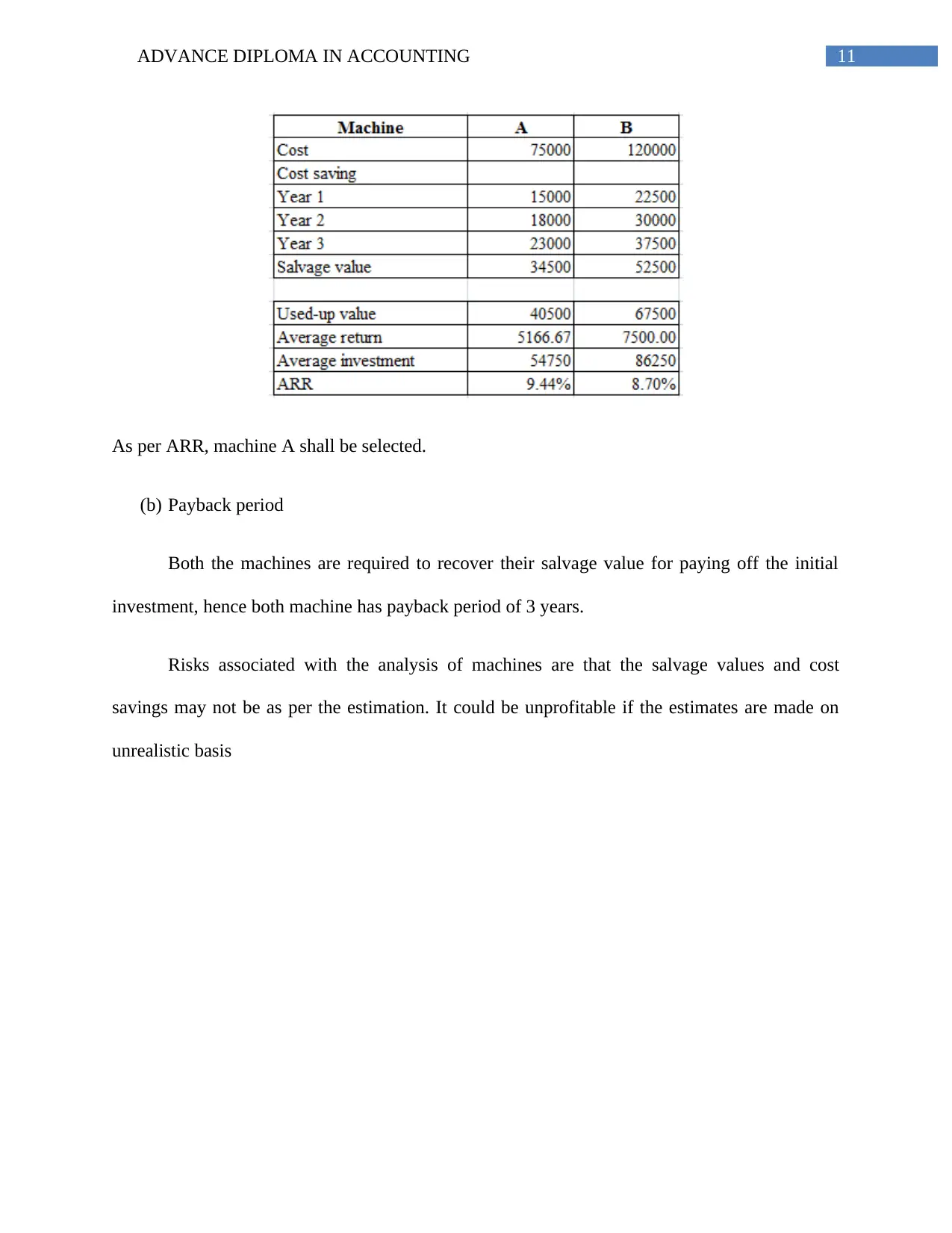
(a) ARR
11ADVANCE DIPLOMA IN ACCOUNTING
As per ARR, machine A shall be selected.
(b) Payback period
Both the machines are required to recover their salvage value for paying off the initial
investment, hence both machine has payback period of 3 years.
Risks associated with the analysis of machines are that the salvage values and cost
savings may not be as per the estimation. It could be unprofitable if the estimates are made on
unrealistic basis
As per ARR, machine A shall be selected.
(b) Payback period
Both the machines are required to recover their salvage value for paying off the initial
investment, hence both machine has payback period of 3 years.
Risks associated with the analysis of machines are that the salvage values and cost
savings may not be as per the estimation. It could be unprofitable if the estimates are made on
unrealistic basis
⊘ This is a preview!⊘
Do you want full access?
Subscribe today to unlock all pages.
Trusted by 1+ million students worldwide

1 out of 19


Related Documents


Your All-in-One AI-Powered Toolkit for Academic Success.
+13062052269
info@desklib.com
Available 24*7 on WhatsApp / Email
![[object Object]](/_next/static/media/star-bottom.7253800d.svg)
Unlock your academic potential
Copyright © 2020–2026 A2Z Services. All Rights Reserved. Developed and managed by ZUCOL.