Accounting Treatments: Beachlife Ltd. and Contingent Liabilities

Verified

Added on  2020/05/28

|4
|1124
|71
Report
AI Summary
This report addresses the accounting treatment of contingent liabilities and provisions, focusing on a case study involving Beachlife Ltd. It analyzes two key issues: a pending legal claim for patent infringement and a sales agreement with Alpine Ltd that includes equipment maintenance and potential refunds. The report applies AASB 137 to determine the appropriate accounting treatments, including disclosure through notes, recognition of provisions, and classification of liabilities. It provides detailed calculations for the potential financial impact of the legal claim and outlines how to account for sales revenue, maintenance obligations, and contingent liabilities. The analysis emphasizes the distinction between provisions and contingent liabilities, highlighting when each should be recognized in the financial statements or disclosed in the notes. The report suggests that the legal claim should be disclosed as a contingent liability, while the maintenance obligation should be recognized as a current liability and provision. The potential refund should also be disclosed as a contingent liability.
Document Page
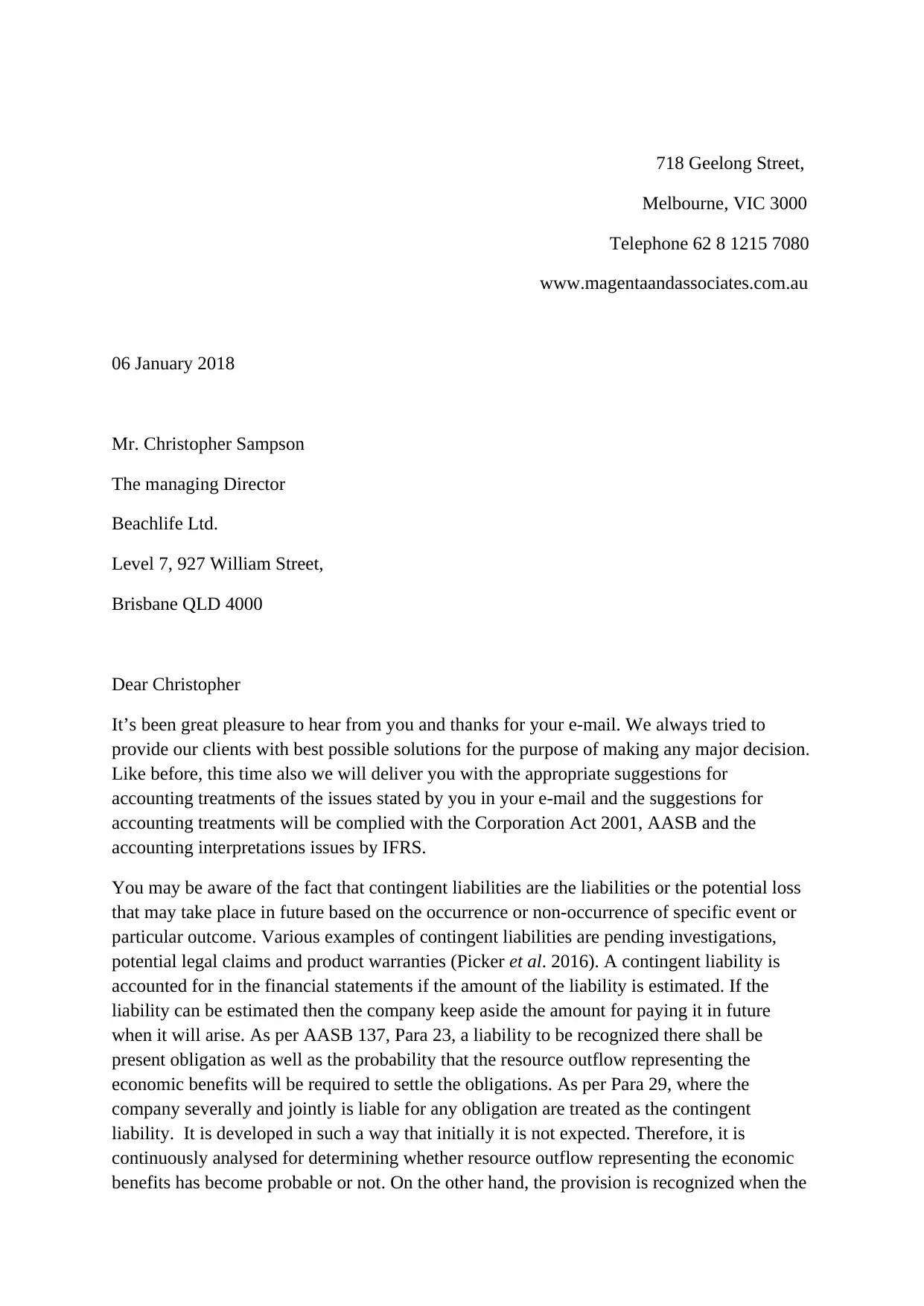
718 Geelong Street,
Melbourne, VIC 3000
Telephone 62 8 1215 7080
www.magentaandassociates.com.au
06 January 2018
Mr. Christopher Sampson
The managing Director
Beachlife Ltd.
Level 7, 927 William Street,
Brisbane QLD 4000
Dear Christopher
It’s been great pleasure to hear from you and thanks for your e-mail. We always tried to
provide our clients with best possible solutions for the purpose of making any major decision.
Like before, this time also we will deliver you with the appropriate suggestions for
accounting treatments of the issues stated by you in your e-mail and the suggestions for
accounting treatments will be complied with the Corporation Act 2001, AASB and the
accounting interpretations issues by IFRS.
You may be aware of the fact that contingent liabilities are the liabilities or the potential loss
that may take place in future based on the occurrence or non-occurrence of specific event or
particular outcome. Various examples of contingent liabilities are pending investigations,
potential legal claims and product warranties (Picker et al. 2016). A contingent liability is
accounted for in the financial statements if the amount of the liability is estimated. If the
liability can be estimated then the company keep aside the amount for paying it in future
when it will arise. As per AASB 137, Para 23, a liability to be recognized there shall be
present obligation as well as the probability that the resource outflow representing the
economic benefits will be required to settle the obligations. As per Para 29, where the
company severally and jointly is liable for any obligation are treated as the contingent
liability. It is developed in such a way that initially it is not expected. Therefore, it is
continuously analysed for determining whether resource outflow representing the economic
benefits has become probable or not. On the other hand, the provision is recognized when the
tabler-icon-diamond-filled.svg

Paraphrase This Document

Need a fresh take? Get an instant paraphrase of this document with our AI Paraphraser
Document Page
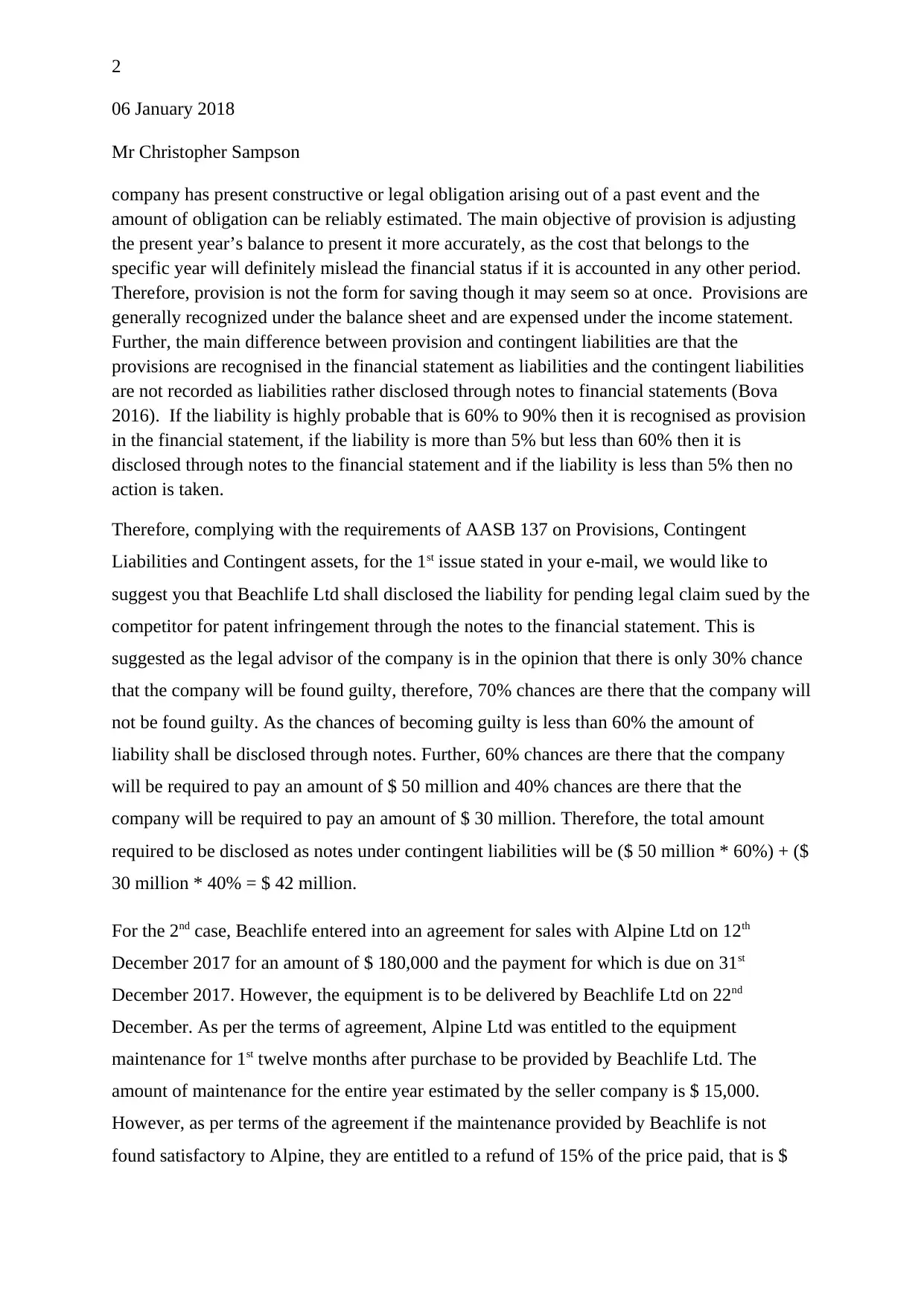
2
06 January 2018
Mr Christopher Sampson
company has present constructive or legal obligation arising out of a past event and the
amount of obligation can be reliably estimated. The main objective of provision is adjusting
the present year’s balance to present it more accurately, as the cost that belongs to the
specific year will definitely mislead the financial status if it is accounted in any other period.
Therefore, provision is not the form for saving though it may seem so at once. Provisions are
generally recognized under the balance sheet and are expensed under the income statement.
Further, the main difference between provision and contingent liabilities are that the
provisions are recognised in the financial statement as liabilities and the contingent liabilities
are not recorded as liabilities rather disclosed through notes to financial statements (Bova
2016). If the liability is highly probable that is 60% to 90% then it is recognised as provision
in the financial statement, if the liability is more than 5% but less than 60% then it is
disclosed through notes to the financial statement and if the liability is less than 5% then no
action is taken.
Therefore, complying with the requirements of AASB 137 on Provisions, Contingent
Liabilities and Contingent assets, for the 1st issue stated in your e-mail, we would like to
suggest you that Beachlife Ltd shall disclosed the liability for pending legal claim sued by the
competitor for patent infringement through the notes to the financial statement. This is
suggested as the legal advisor of the company is in the opinion that there is only 30% chance
that the company will be found guilty, therefore, 70% chances are there that the company will
not be found guilty. As the chances of becoming guilty is less than 60% the amount of
liability shall be disclosed through notes. Further, 60% chances are there that the company
will be required to pay an amount of $ 50 million and 40% chances are there that the
company will be required to pay an amount of $ 30 million. Therefore, the total amount
required to be disclosed as notes under contingent liabilities will be ($ 50 million * 60%) + ($
30 million * 40% = $ 42 million.
For the 2nd case, Beachlife entered into an agreement for sales with Alpine Ltd on 12th
December 2017 for an amount of $ 180,000 and the payment for which is due on 31st
December 2017. However, the equipment is to be delivered by Beachlife Ltd on 22nd
December. As per the terms of agreement, Alpine Ltd was entitled to the equipment
maintenance for 1st twelve months after purchase to be provided by Beachlife Ltd. The
amount of maintenance for the entire year estimated by the seller company is $ 15,000.
However, as per terms of the agreement if the maintenance provided by Beachlife is not
found satisfactory to Alpine, they are entitled to a refund of 15% of the price paid, that is $
Document Page
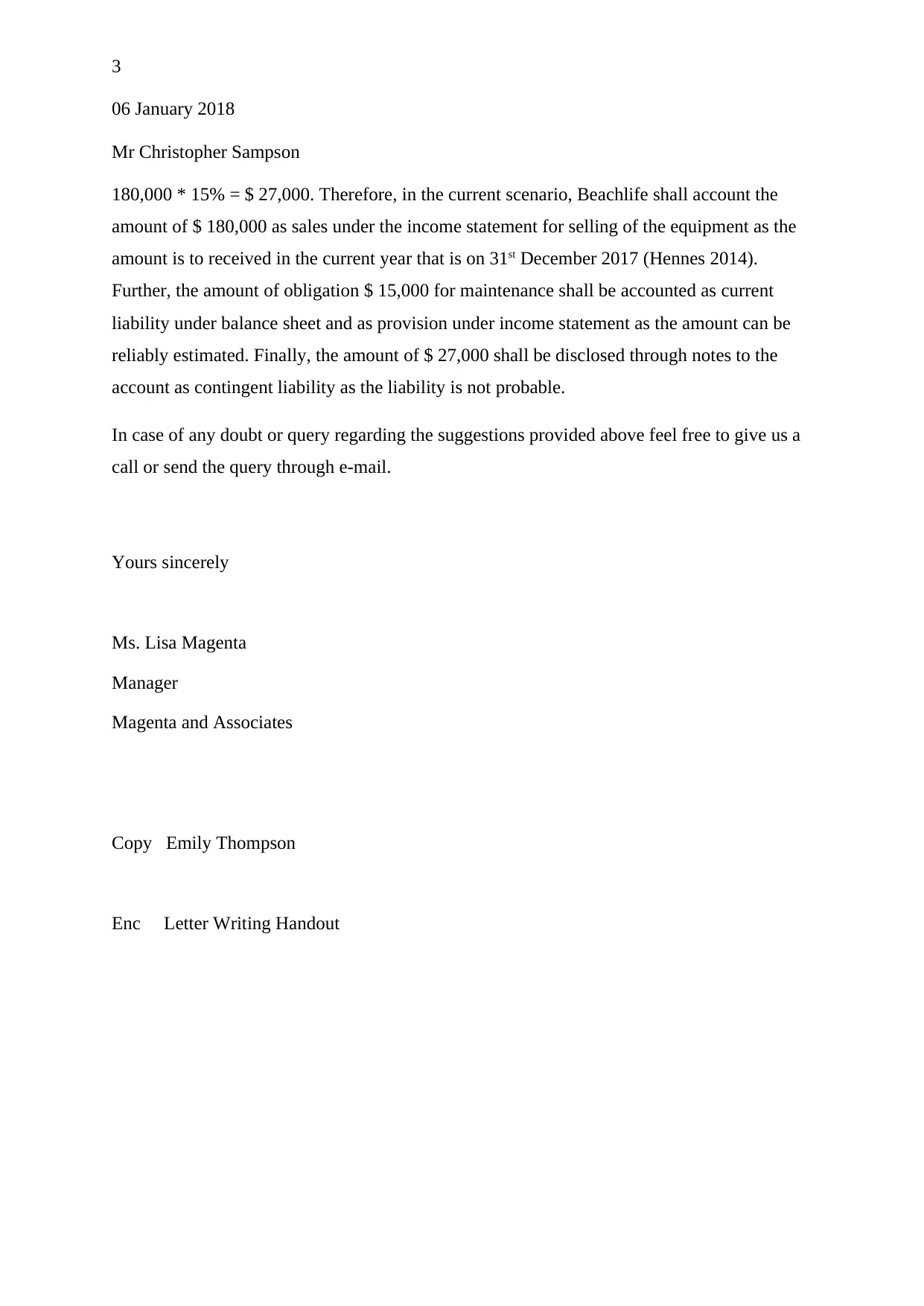
3
06 January 2018
Mr Christopher Sampson
180,000 * 15% = $ 27,000. Therefore, in the current scenario, Beachlife shall account the
amount of $ 180,000 as sales under the income statement for selling of the equipment as the
amount is to received in the current year that is on 31st December 2017 (Hennes 2014).
Further, the amount of obligation $ 15,000 for maintenance shall be accounted as current
liability under balance sheet and as provision under income statement as the amount can be
reliably estimated. Finally, the amount of $ 27,000 shall be disclosed through notes to the
account as contingent liability as the liability is not probable.
In case of any doubt or query regarding the suggestions provided above feel free to give us a
call or send the query through e-mail.
Yours sincerely
Ms. Lisa Magenta
Manager
Magenta and Associates
Copy Emily Thompson
Enc Letter Writing Handout
Document Page
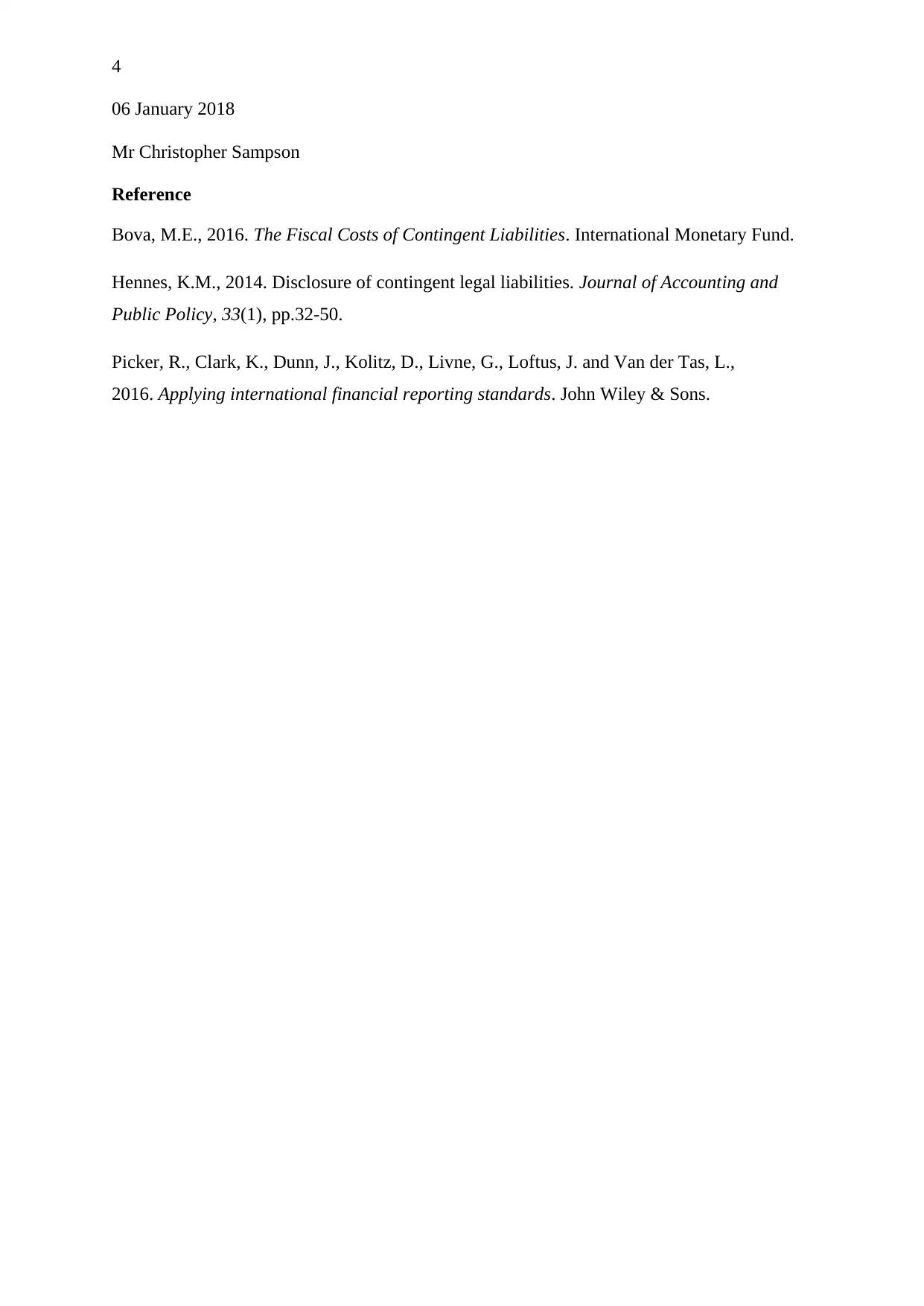
4
06 January 2018
Mr Christopher Sampson
Reference
Bova, M.E., 2016. The Fiscal Costs of Contingent Liabilities. International Monetary Fund.
Hennes, K.M., 2014. Disclosure of contingent legal liabilities. Journal of Accounting and
Public Policy, 33(1), pp.32-50.
Picker, R., Clark, K., Dunn, J., Kolitz, D., Livne, G., Loftus, J. and Van der Tas, L.,
2016. Applying international financial reporting standards. John Wiley & Sons.
chevron_up_icon
1 out of 4
circle_padding
hide_on_mobile
zoom_out_icon
[object Object]