Analysis of Challenges in Global Accounting Standards Harmonization

Verified

Added on  2020/04/07

|7
|1975
|340
Report
AI Summary
This report delves into the significance of establishing a unified set of accounting standards worldwide, emphasizing the need for transparency and comparability in financial reporting. It highlights the benefits of standardized accounting practices, such as facilitating easier financial comparisons between companies across different countries, aiding investors and creditors in evaluating investment opportunities and creditworthiness, and simplifying expansion plans for organizations. The report also addresses the challenges inherent in standardizing accounting practices, including issues of national sovereignty, integration complexities, potential negative impacts on smaller businesses, and difficulties in enforcement and licensing. It underscores the importance of considering diverse business practices, cultural preferences, and accounting traditions when developing globally accepted standards. The report concludes by reiterating the need for a single set of accounting standards while acknowledging the complexities involved in its implementation.
Document Page
Issues in Contemporary Accounting
1
tabler-icon-diamond-filled.svg

Paraphrase This Document

Need a fresh take? Get an instant paraphrase of this document with our AI Paraphraser
Document Page
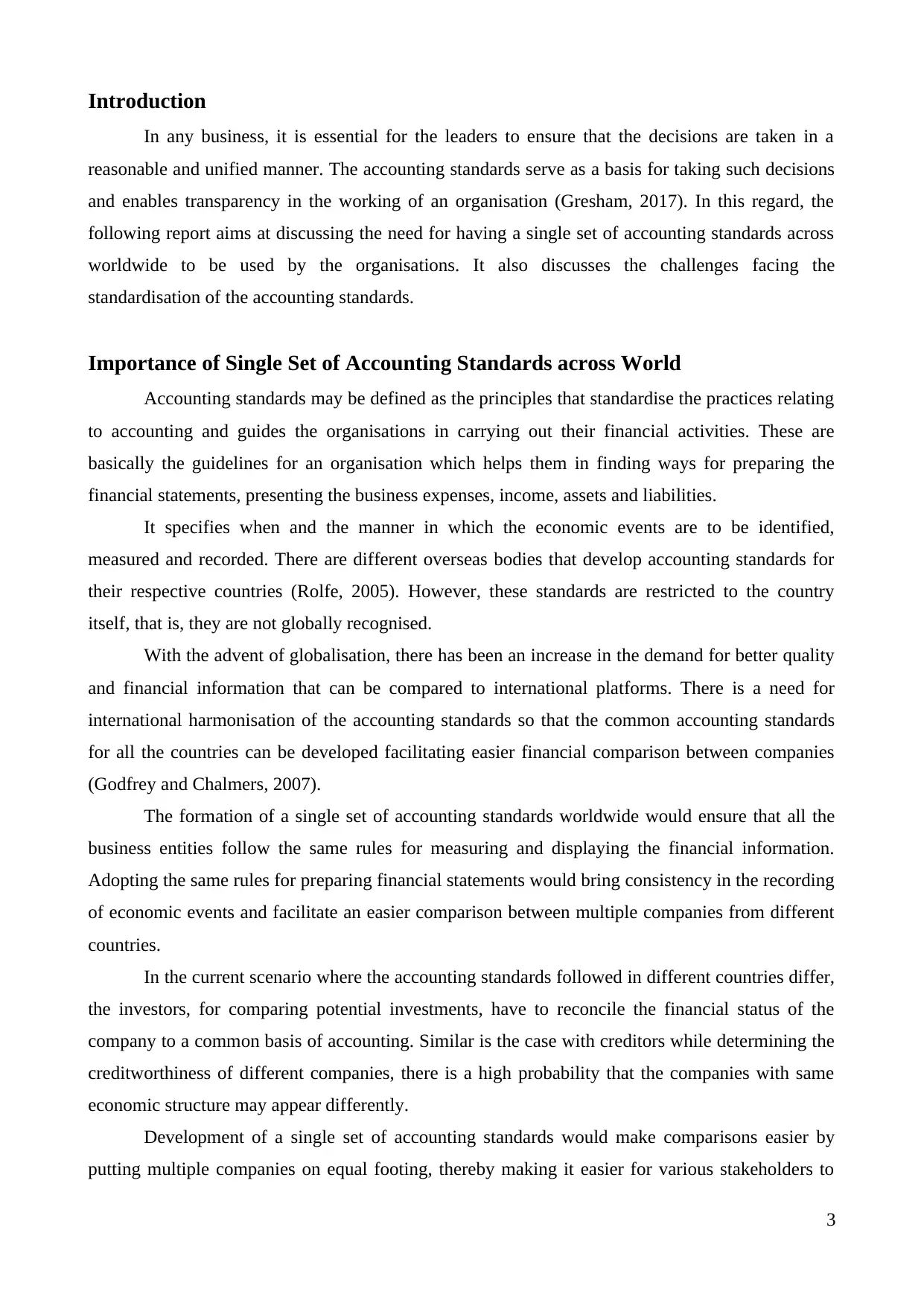
Table of Contents
Introduction..........................................................................................................................................3
Importance of Single Set of Accounting Standards across World.......................................................3
Challenges facing Standardization of Accounting Standards..............................................................4
Conclusion............................................................................................................................................6
References............................................................................................................................................6
2
Document Page
Introduction
In any business, it is essential for the leaders to ensure that the decisions are taken in a
reasonable and unified manner. The accounting standards serve as a basis for taking such decisions
and enables transparency in the working of an organisation (Gresham, 2017). In this regard, the
following report aims at discussing the need for having a single set of accounting standards across
worldwide to be used by the organisations. It also discusses the challenges facing the
standardisation of the accounting standards.
Importance of Single Set of Accounting Standards across World
Accounting standards may be defined as the principles that standardise the practices relating
to accounting and guides the organisations in carrying out their financial activities. These are
basically the guidelines for an organisation which helps them in finding ways for preparing the
financial statements, presenting the business expenses, income, assets and liabilities.
It specifies when and the manner in which the economic events are to be identified,
measured and recorded. There are different overseas bodies that develop accounting standards for
their respective countries (Rolfe, 2005). However, these standards are restricted to the country
itself, that is, they are not globally recognised.
With the advent of globalisation, there has been an increase in the demand for better quality
and financial information that can be compared to international platforms. There is a need for
international harmonisation of the accounting standards so that the common accounting standards
for all the countries can be developed facilitating easier financial comparison between companies
(Godfrey and Chalmers, 2007).
The formation of a single set of accounting standards worldwide would ensure that all the
business entities follow the same rules for measuring and displaying the financial information.
Adopting the same rules for preparing financial statements would bring consistency in the recording
of economic events and facilitate an easier comparison between multiple companies from different
countries.
In the current scenario where the accounting standards followed in different countries differ,
the investors, for comparing potential investments, have to reconcile the financial status of the
company to a common basis of accounting. Similar is the case with creditors while determining the
creditworthiness of different companies, there is a high probability that the companies with same
economic structure may appear differently.
Development of a single set of accounting standards would make comparisons easier by
putting multiple companies on equal footing, thereby making it easier for various stakeholders to
3
Document Page
examine international options for cash management and investment. Adoption of this system would
ensure that the investors are in a better position to comprehend and make a comparison of the
financial statements of the businesses which are headquartered in different nations.
Shifting to a single set of accounting standards would also help the organisations with their
expansion plans as it is likely to eliminate the barriers that pose in the form of domestic accounting
standards (Rolfe, 2005). When an organisation plans to expand their operations in the
international markets, it has to consider international expenses relating to compliance.
This signifies that the organisation has to adopt a new set of accounting standards that are
being followed in the foreign country so that the statutory requirements of such country are
fulfilled. In certain cases, this may even double the accounting costs of the company. For various
small businesses, this increased accounting costs dwarfs down the benefits that are to be realised on
the expansion.
However, in the presence of a single set of accounting standards for all the countries, the
organisations can easily expand their operations globally as the accounting costs for meeting the
statutory requirements would be same (Godfrey and Chalmers, 2007). From the perspective of
policy making, adoption of a single set of accounting standards worldwide would put the authority
to make rules to a central authoritative body. In the present context, the accounting standards are
framed by the individual bodies of the countries and international groups.
The organisations are supposed to follow and comply both the domestic and international
accounting standards. In case of any non-compliances, there is a possibility of disagreements
between the international and domestic boards. Adoption of a single set of standards would not only
reduce the disagreements between these governing bodies but would also help in reducing the costs.
These standards would also help in bringing transparency and accountability to the
businesses. It even would assist in ensuring economic efficiency in business transactions, as it
provides the investors information about the opportunities and risks that are available in various
multinational organisations (Gee, 2004). Moreover, it would provide a single and uniform
accounting language for the businesses that would help them in lowering their costs relating to
capital and international reporting.
Challenges facing Standardization of Accounting Standards
From the discussion above, it is apparent that there is a need for globally acclaimed
accounting standards that are standardised for all the countries. It provides a number of benefits to
the organisations and people who are associated with such organisations. However, it is not easy to
just develop and implement the accounting standards in all the countries.
4
tabler-icon-diamond-filled.svg

Paraphrase This Document

Need a fresh take? Get an instant paraphrase of this document with our AI Paraphraser
Document Page
There are various factors that pose challenges in the standardisation of the accounting standards
(Bradshaw and Miller, 2008). According to the literature, the most significant challenge is the
sovereignty issues at the international level. As per this challenge, it is required that if a single set of
accounting standards is developed for all the countries, the nations adhere to such standards and
make sure that they do not make any modifications in it while implementing it in their respective
countries.
There are two possibilities in which the globally framed standards would not be effective.
Firstly, when the countries do not accept and adopt these standards in their economic system.
Secondly, if any country alters or makes any modifications in the globally developed standards,
there arises a difference which makes the international comparison between multiple companies
headquartered in different countries difficult.
Even though, the standardisation or the harmonisation of the accounting standards would
reduce transactional risks, improve accountability and transparency, it consists of various
integration issues. The standards developed by the countries are complex and vary between nations.
Adoption of a single set of standards would require changes in the accounting systems of the
nations (McGee and Preobragenskaya, 2006).
For example- the Securities and Exchange Commission in the US requires the publicly
traded companies to follow GAAP principles, which follows straight line depreciation method for
the companies. However, as per the Internal Revenue Service tax codes, the depreciation method to
be used by the companies is specified as Modified Accelerated Cost Recovery System.
Now if the country adopts the harmonised accounting standards, such as IAS accounting
model, it is required that it make changes in its tax accounting systems also, which creates the
integration problems for the standardisation of the accounting standards. Another challenge that
affects the standardisation of the standards is its negative impact on the smaller businesses.
As a proportion of their revenues, the smaller businesses spend more on the regulatory
compliance in comparison to the large firms. These expenses in form of regulatory requirements
add costs to their working and reduce the probabilities for expanding their operations in the global
market.
After the standardisation or the harmonisation of standards, the smaller businesses have to
fulfil additional compliance mandates, which in turn would further add to their costs and worsen
their competitiveness. The standardisation of the accounting standards also has a challenge
concerning the enforcement and licensing issues (Houston, 2017). If the accounting standards are
standardised, the tax lawyers, CPAs and accountants would be required to obtain licensing and
comply with the international body responsible for making rules.
5
Document Page
In terms of enforcement issues, if the rulemaking international body does not have the
enforcement power, the breaking of international laws would be very common as there would be no
prosecution authority available. On the other hand, even if the international rule-making body holds
the enforcement power, the prosecution law may conflict with the rights of the offender available to
it in the domestic country.
In addition to this, it is also difficult to determine what every single accounting standard
should stand for, that is, what it should convey. The standardised accounting standards should be
developed in such a manner that it corporates the preferences of all the countries across the world
(Deloitte, 2014). However, there are various business practices, cultural preferences, or the
accounting traditions that are practised in different countries, making it difficult to decide which
factors are to be included in the standardised accounting standards.
Conclusion
The accounting standards are the principles and guidelines that help the organisations with
the economic events. It helps the organisation to determine when the economic events are to be
identified, measured and displayed and in which manner. With the increased international trade
between countries, it has become necessary to have a single set of accounting standards for
organisations to use across different countries.
Adopting a single set of standards would allow transparency, better accountability, and
comparability. It would make it easier for the investors and other parties associated with the
business to comprehend and analyse the financial statements by bringing them on a standard
platform. However, it is not easier to develop such standards as their standardisation poses certain
challenges. These include integration issues, enforcement and licensing issues, and sovereignty in
the settings of the accounting standards.
References
Bradshaw, M.T. and Miller, G.S. 2008. Will harmonizing accounting standards really harmonize
accounting? Evidence from non-US firms adopting US GAAP. Journal of Accounting, Auditing &
Finance 23(2), pp. 233-264.
Deloitte. 2014. Ian Mackintosh discusses the challenges of global standardisation. [Online].
Available at: https://www.iasplus.com/en/news/2014/05/mackintosh-speech [Accessed on: 23
September 2017].
Gee, P. 2004. Spicer and Pegler's Financial Reporting for Business and Practice 2004. London:
Gulf Professional Publishing.
6
Document Page
Godfrey, J.M. and Chalmers, K. 2007. Globalisation of Accounting Standards. Cheltenham:
Edward Elgar Publishing.
Gresham, T. 2017. The Importance of Accounting Standards. [Online]. Available at:
http://smallbusiness.chron.com/importance-accounting-standards-44927.html [Accessed on: 23
September 2017].
Houston, G. 2017. The Disadvantages of Harmonizing Accounting Standards. [Online]. Available
at: http://smallbusiness.chron.com/disadvantages-harmonizing-accounting-standards-25107.html
[Accessed on: 23 September 2017].
McGee, R.W. and Preobragenskaya, G.G. 2006. Accounting and Financial System Reform in a
Transition Economy: A Case Study of Russia. Berlin: Springer Science & Business Media.
Rolfe, T. 2005. Financial Accounting and Tax Principles. Boston: Elsevier.
7
chevron_up_icon
1 out of 7
circle_padding
hide_on_mobile
zoom_out_icon
[object Object]