Accounting for Business: Concepts & Financial Report Characteristics

Verified

Added on  2023/06/18

|7
|1548
|344
Report
AI Summary
This report provides an overview of business accounting, focusing on key accounting concepts used in the preparation of financial statements and the qualitative characteristics that make financial reports useful to users. It discusses five accounting concepts: economic entity, monetary unit, cost principle, full disclosure principle, and matching principle, explaining their significance in maintaining accurate and transparent financial records. Furthermore, it explores the qualitative characteristics of financial reports, including relevance, materiality, reliability, and faithful representation, highlighting how these traits ensure that financial information is understandable, dependable, and comparable for decision-making purposes. The report references academic journals to support its analysis of accounting principles and reporting standards.

Document Page
Accounting for Business
tabler-icon-diamond-filled.svg

Paraphrase This Document

Need a fresh take? Get an instant paraphrase of this document with our AI Paraphraser
Document Page
Document Page
Contents
INTRODUCTION...........................................................................................................................................3
MAIN BODY.................................................................................................................................................3
(a) Discuss five accounting concepts used in the preparation of financial statements............................3
(b) Discuss the qualitative characteristics of financial reports that make information useful to users. . .4
REFERENCES................................................................................................................................................6
Document Page
INTRODUCTION
The process of acquiring and evaluating financial data on business operations, reporting
financial, and preparation of financial statements is known as business accountancy. An
accounting system is a method of storing and organizing financial data in a business. It can be
done manually or automatically. The most crucial aspect to use an accounting system is to take
care of your costs, revenue, and other operations (Wei and Yao, 2020). Fundamentally, maintain
a focus on all information that has an impact on a company’s financial position. In this report
consist of qualitative characteristics of financial information and define accounting concepts
used in preparation of financial statements.
MAIN BODY
(a) Discuss five accounting concepts used in the preparation of financial statements
The organisation and operation of a business are defined by key accounting concepts.
They establish a framework for the books of accounts. If most of these expectations are
incorrect, it may be required to change the financial data a company produces and reports in its
financial reports.
Economic entity: It shows the division of a business's many departments. Each division
keeps its own books of accounts that are unique to the company's business. Authorities and
financiers, for example, evaluate a firm's earnings documents to judge its success. As a result, it's
critical that the activities truly capture the entity's activity. A person analyzing a corporation's
documents considers that all of the business's operations are being analyzed as per the economic
entity concept.
Monetary unit: All financial action must be documented in the same money, according
to the monetary unit assumption concept. It's the cause need to finish your business accountancy
for international payments. Furthermore, evidence supporting this fundamental accounting
principle is that monetary spending power remains constant over time. In other respects, even
though a company has been in operation for centuries, hyperinflation is not taken into account in
its financial statements (Brown-Liburd and Joe, 2020).
tabler-icon-diamond-filled.svg

Paraphrase This Document

Need a fresh take? Get an instant paraphrase of this document with our AI Paraphraser
Document Page
Cost principle: If the expense of recording or reporting financial data surpasses the
advantage, the Cost Benefit Principle is used to restrict the level of knowledge and time it takes.
As a result, if documenting a little incident would impact the economy a large sum of money, it
should be avoided. This key accounting principle serves as a reminder to entrepreneurs not to
mix cost with value. Even though the worth of objects and assets fluctuates throughout time, the
return of their liabilities is only recorded when they are sold or depreciated. Instead of depending
on accounting records, they'll really do have to collaborate with an appraisal to get a true
business assessment while issuing bonds (Melegy and Alain, 2020).
Full disclosure principle: This principle states that any information that could have a
meaningful impact on a balance sheet user's opinion concerning the business must be included in
the financial statement references. This eliminates the possibility of future corporations
concealing relevant evidence about accounting standards or anticipated eventualities. To
maintain full visibility in the firm' finances, this principle stipulates that all financial report
concerns to the firm must be reported accurately, with none concealed statistics, to the small
businessman (Huterski, Voss and Huterska, 2020).
Matching principle: This principle states that all expenditure and income must be
paralleled and documented in the time. They were expended, not since they were reimbursed.
This principle is used in conjunction with the following calculation to ensure that all profits and
losses are reported on an accrual basis. Salary, trade discounts, and certain service cost are
examples of these expenditures. Unless a tax forms is prepared using the monetary cost model,
an auditor may create financial reporting to use the accrual approach.
(b) Discuss the qualitative characteristics of financial reports that make information useful to
users
The traits that make the data supplied in financial reports meaningful to consumers are
known as qualitative features. Understandability, relevance, dependability, and comparability are
the four main qualitative criteria.
Relevance: Data must be relevant to users' judgment wants in order to be valuable.
Whenever affect the brain consumers' economic decisions by assisting them in evaluating past,
present, or future occurrences, or by verifying or rectifying their previous views, it is said to be
Document Page
relevant. Data and information prediction and confirming functions are intertwined (Mameche,
OMRI and Hassine, 2020). Account will be charged data on the current amount and architecture
of investment income, for illustration, whenever attempting to forecast the entity's potential to
seize opportunities and respond to bad circumstances. The same data confirms previous forecasts
about, for particular, the organization of the business or the results of supported employment.
Materiality: The nature and substance of information have an impact on its relevance. In
certain circumstances, the size of the study is enough to decide its usefulness. For addition,
regardless of the significance of the new sector's results during the period ending, the disclosure
of a specific generation may have an impact on the entity's evaluation of threats and
uncertainties. In some circumstances, both type and materiality play a role, such as the volumes
of inventory stored in every one of the main classifications related to the company (Musov,
2020).
Reliability: Knowledge must also be trustworthy in order to be valuable. Whenever
material is devoid of material inaccuracy and prejudice and can be relied upon by readers to
maintaining what it essentially means or could possibly be assumed to reflect, it is said to be
reliable. Change may affect, but its form or portrayal is so unpredictable that its acknowledgment
could be deceptive. If the legality and quantity of a legal claim behind court proceedings are
challenged, for illustration, it may be incorrect for the business to record the total balance of the
complaint in the accounting records, even if it is permissible to declare the number and
conditions of the complaint.
Faithful representation: Data must accurately reflect the transactions and activities it
intends to understand or could legitimately claim to describe in order to be considered
trustworthy. For illustration, a balance sheet should authentically portray the events and
transactions that resulting in the investor’s portfolio, creditors, and capital at the end of the
reporting period, as long as the identification requirements are met. Every accounting record has
a chance of not being a true depiction of what it claims to be (Jaber, 2020).
Document Page
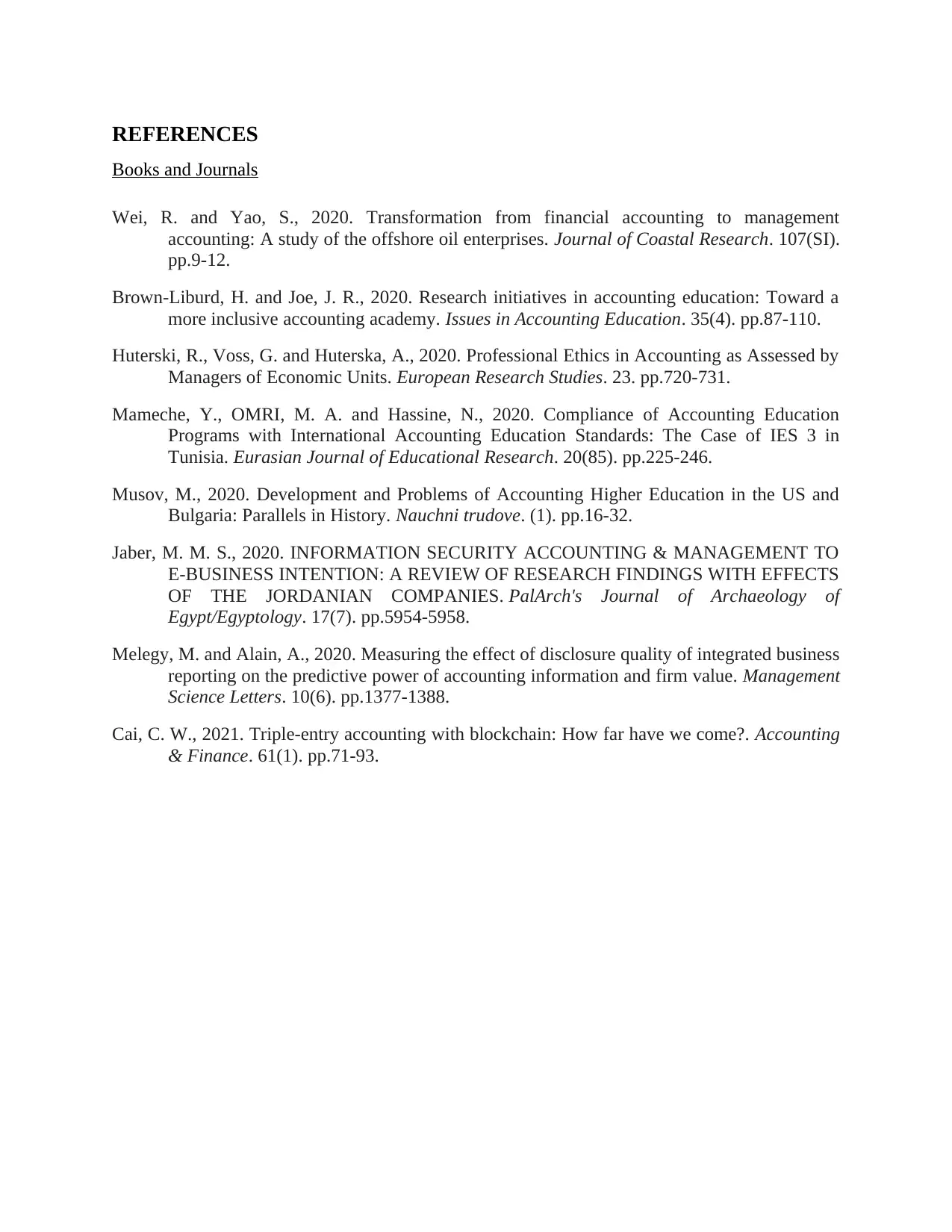
REFERENCES
Books and Journals
Wei, R. and Yao, S., 2020. Transformation from financial accounting to management
accounting: A study of the offshore oil enterprises. Journal of Coastal Research. 107(SI).
pp.9-12.
Brown-Liburd, H. and Joe, J. R., 2020. Research initiatives in accounting education: Toward a
more inclusive accounting academy. Issues in Accounting Education. 35(4). pp.87-110.
Huterski, R., Voss, G. and Huterska, A., 2020. Professional Ethics in Accounting as Assessed by
Managers of Economic Units. European Research Studies. 23. pp.720-731.
Mameche, Y., OMRI, M. A. and Hassine, N., 2020. Compliance of Accounting Education
Programs with International Accounting Education Standards: The Case of IES 3 in
Tunisia. Eurasian Journal of Educational Research. 20(85). pp.225-246.
Musov, M., 2020. Development and Problems of Accounting Higher Education in the US and
Bulgaria: Parallels in History. Nauchni trudove. (1). pp.16-32.
Jaber, M. M. S., 2020. INFORMATION SECURITY ACCOUNTING & MANAGEMENT TO
E-BUSINESS INTENTION: A REVIEW OF RESEARCH FINDINGS WITH EFFECTS
OF THE JORDANIAN COMPANIES. PalArch's Journal of Archaeology of
Egypt/Egyptology. 17(7). pp.5954-5958.
Melegy, M. and Alain, A., 2020. Measuring the effect of disclosure quality of integrated business
reporting on the predictive power of accounting information and firm value. Management
Science Letters. 10(6). pp.1377-1388.
Cai, C. W., 2021. Triple‐entry accounting with blockchain: How far have we come?. Accounting
& Finance. 61(1). pp.71-93.
chevron_up_icon
1 out of 7
circle_padding
hide_on_mobile
zoom_out_icon
[object Object]