A Detailed Study of Accounting Conventions and Fundamentals

Verified

Added on  2023/06/14

|2
|1140
|182
Essay
AI Summary
This essay provides a detailed overview of accounting conventions and fundamentals crucial for business operations. It explains key principles such as the Corporate Entity Principle, the Currency Principle, the Dual Aspect Principle, the Matching Principle, and the Stability Principle, illustrating each with examples. The essay emphasizes the importance of these conventions for analyzing, evaluating, and summarizing business activities, enabling long-term growth and competitive advantage. It also highlights the necessity for firms to adapt to the dynamic environment by consistently applying these accounting practices, ensuring accurate financial reporting and informed decision-making. The document is contributed by a student and available on Desklib.
Document Page
Introduction
Business Accounting is one of the most important aspect of each and
every company that is operational in the market as it helps in
analysing, evaluating, and summarising all of the activities that are
conducted in the business so that it can help in the long term growth
and development of the firm and thus also enabling it to sustain and
survive in the market and also to thrive in the industry and be in a
better position as compared to its rivals that are operational in the
similar market structure.
Accounting fundamentals
Accountancy Fundamentals are a list of common conventions which
could be employed as guidelines and standards while working with
or confronting accountancy difficulties. Those ideas have been
incorporated into a number of accountancy principles, including the
Global Accountancy Principles. As a result, while implementing a
norm, the users would not encounter any difficulties with any of the
accountancy principles.
Accounting fundamentals
Sir John primarily uses one automobile for private usage and the
remaining two vehicles for company reasons, thus the 20000 is a
legal company expenditure, whereas the remaining amount is
referred to as the withdrawals. The next principle is the Matching
Principle, which states that income received throughout an
accountancy period must be linked with the relevant expenditures, or
spending, that were utilized to produce the income. This notion
would instruct the company about how to connect expenditures to
income in order to determine the precise gain or losses at any given
period. Gain occurs when income exceeds expenditures, whereas
losses occur when income is below the said expenditures.
Dual aspect principle
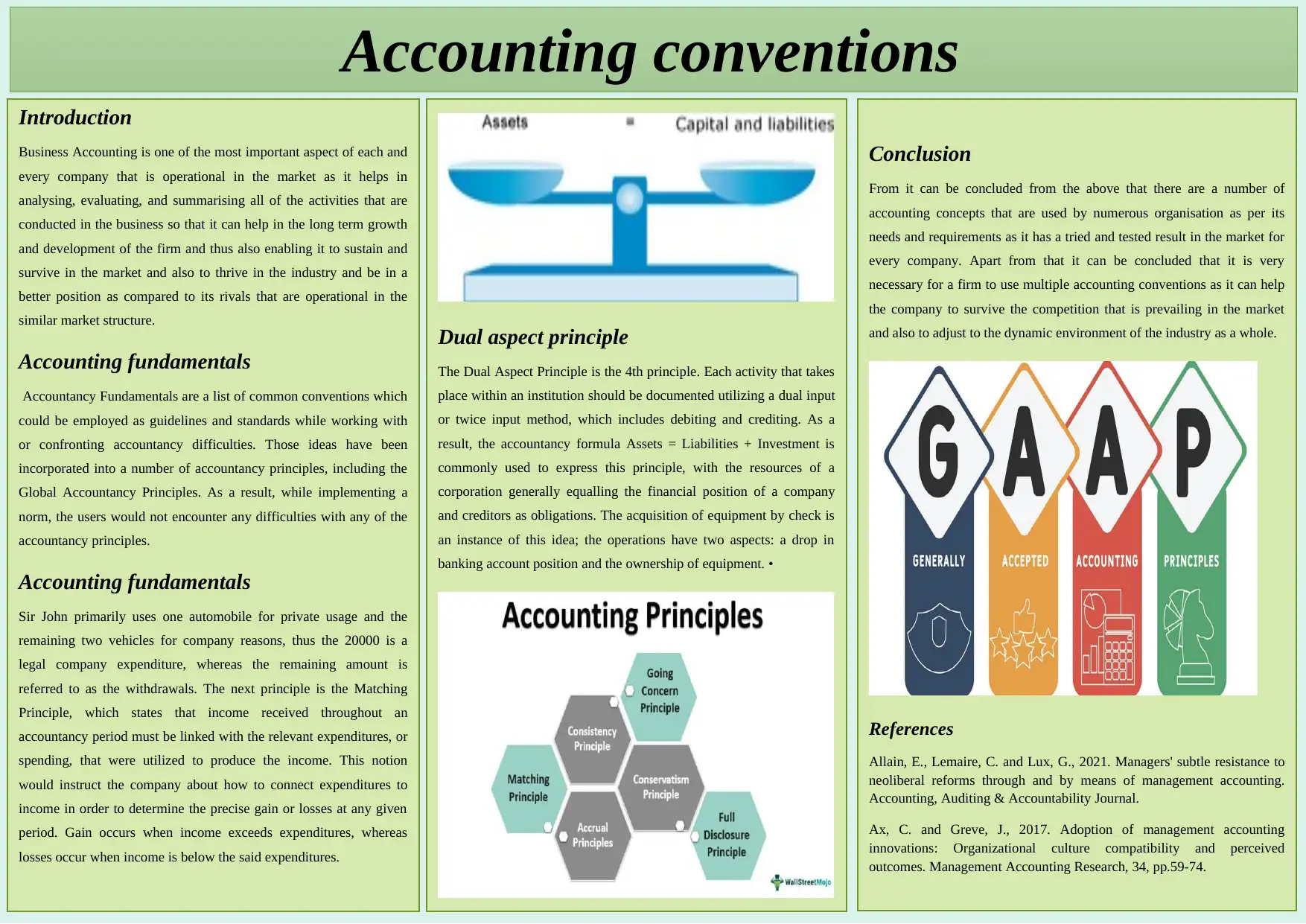
The Dual Aspect Principle is the 4th principle. Each activity that takes
place within an institution should be documented utilizing a dual input
or twice input method, which includes debiting and crediting. As a
result, the accountancy formula Assets = Liabilities + Investment is
commonly used to express this principle, with the resources of a
corporation generally equalling the financial position of a company
and creditors as obligations. The acquisition of equipment by check is
an instance of this idea; the operations have two aspects: a drop in
banking account position and the ownership of equipment. •
Accounting conventions
Conclusion
Conclusion
From it can be concluded from the above that there are a number of
accounting concepts that are used by numerous organisation as per its
needs and requirements as it has a tried and tested result in the market for
every company. Apart from that it can be concluded that it is very
necessary for a firm to use multiple accounting conventions as it can help
the company to survive the competition that is prevailing in the market
and also to adjust to the dynamic environment of the industry as a whole.
References
Allain, E., Lemaire, C. and Lux, G., 2021. Managers' subtle resistance to
neoliberal reforms through and by means of management accounting.
Accounting, Auditing & Accountability Journal.
Ax, C. and Greve, J., 2017. Adoption of management accounting
innovations: Organizational culture compatibility and perceived
outcomes. Management Accounting Research, 34, pp.59-74.
tabler-icon-diamond-filled.svg

Paraphrase This Document

Need a fresh take? Get an instant paraphrase of this document with our AI Paraphraser
Document Page
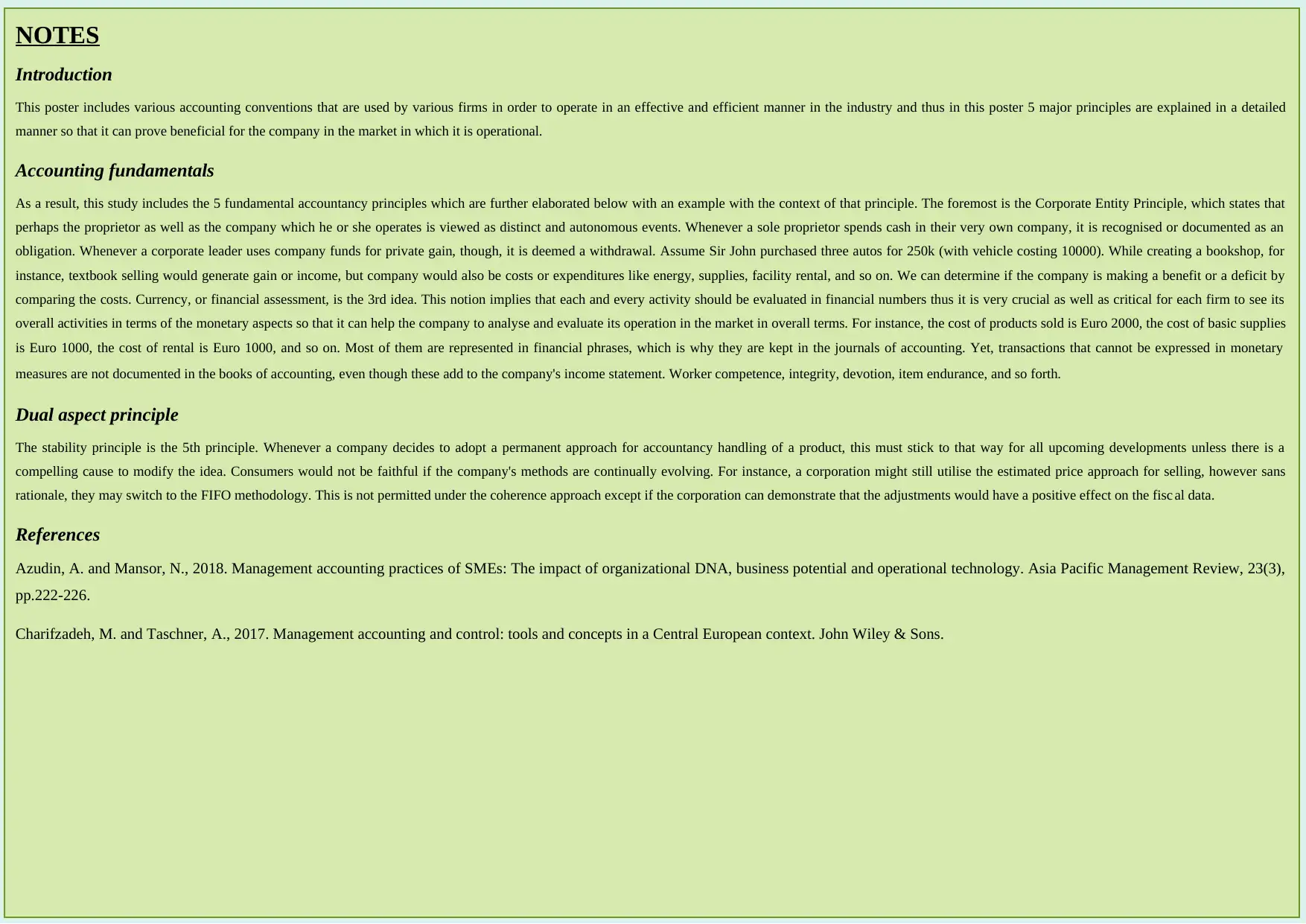
NOTES
Introduction
This poster includes various accounting conventions that are used by various firms in order to operate in an effective and efficient manner in the industry and thus in this poster 5 major principles are explained in a detailed
manner so that it can prove beneficial for the company in the market in which it is operational.
Accounting fundamentals
As a result, this study includes the 5 fundamental accountancy principles which are further elaborated below with an example with the context of that principle. The foremost is the Corporate Entity Principle, which states that
perhaps the proprietor as well as the company which he or she operates is viewed as distinct and autonomous events. Whenever a sole proprietor spends cash in their very own company, it is recognised or documented as an
obligation. Whenever a corporate leader uses company funds for private gain, though, it is deemed a withdrawal. Assume Sir John purchased three autos for 250k (with vehicle costing 10000). While creating a bookshop, for
instance, textbook selling would generate gain or income, but company would also be costs or expenditures like energy, supplies, facility rental, and so on. We can determine if the company is making a benefit or a deficit by
comparing the costs. Currency, or financial assessment, is the 3rd idea. This notion implies that each and every activity should be evaluated in financial numbers thus it is very crucial as well as critical for each firm to see its
overall activities in terms of the monetary aspects so that it can help the company to analyse and evaluate its operation in the market in overall terms. For instance, the cost of products sold is Euro 2000, the cost of basic supplies
is Euro 1000, the cost of rental is Euro 1000, and so on. Most of them are represented in financial phrases, which is why they are kept in the journals of accounting. Yet, transactions that cannot be expressed in monetary
measures are not documented in the books of accounting, even though these add to the company's income statement. Worker competence, integrity, devotion, item endurance, and so forth.
Dual aspect principle
The stability principle is the 5th principle. Whenever a company decides to adopt a permanent approach for accountancy handling of a product, this must stick to that way for all upcoming developments unless there is a
compelling cause to modify the idea. Consumers would not be faithful if the company's methods are continually evolving. For instance, a corporation might still utilise the estimated price approach for selling, however sans
rationale, they may switch to the FIFO methodology. This is not permitted under the coherence approach except if the corporation can demonstrate that the adjustments would have a positive effect on the fisc al data.
References
Azudin, A. and Mansor, N., 2018. Management accounting practices of SMEs: The impact of organizational DNA, business potential and operational technology. Asia Pacific Management Review, 23(3),
pp.222-226.
Charifzadeh, M. and Taschner, A., 2017. Management accounting and control: tools and concepts in a Central European context. John Wiley & Sons.
chevron_up_icon
1 out of 2
circle_padding
hide_on_mobile
zoom_out_icon
[object Object]