Analysis of Accounting Standards and CSR in Developing Countries

Verified

Added on  2023/01/19

|9
|1824
|78
Report
AI Summary
This report provides an analysis of corporate social responsibility (CSR), examining its importance in modern business strategies, especially in developing countries. The report focuses on how firm size and profitability influence CSR disclosures, and it also explores the impact of board diversity on these disclosures. The introduction sets the stage by defining CSR and its role in balancing economic, environmental, and social aspects. The discussion delves into the specific context of developing countries like Bangladesh, highlighting the shift towards industrialization and the associated ethical, social, and environmental concerns. The report analyzes the current CSR practices in Bangladesh, noting the descriptive nature of disclosures and the influence of corporate governance attributes. Furthermore, the report discusses the impact of board diversity, including board size, independence, and gender, on CSR disclosures, emphasizing the role of diverse boards in improving decision-making and strategy. The report concludes by summarizing the key findings, emphasizing the significance of CSR in protecting stakeholder interests and promoting the success and diversity of organizations.
Document Page
Running Head: ACCOUNTING STANDARDS AND THEORY
ACCOUNTING STANDARDS AND THEORY
Name of the Student
Name of the University
Author Note
tabler-icon-diamond-filled.svg

Paraphrase This Document

Need a fresh take? Get an instant paraphrase of this document with our AI Paraphraser
Document Page
1ACCOUNTING STANDARDS AND THEORY
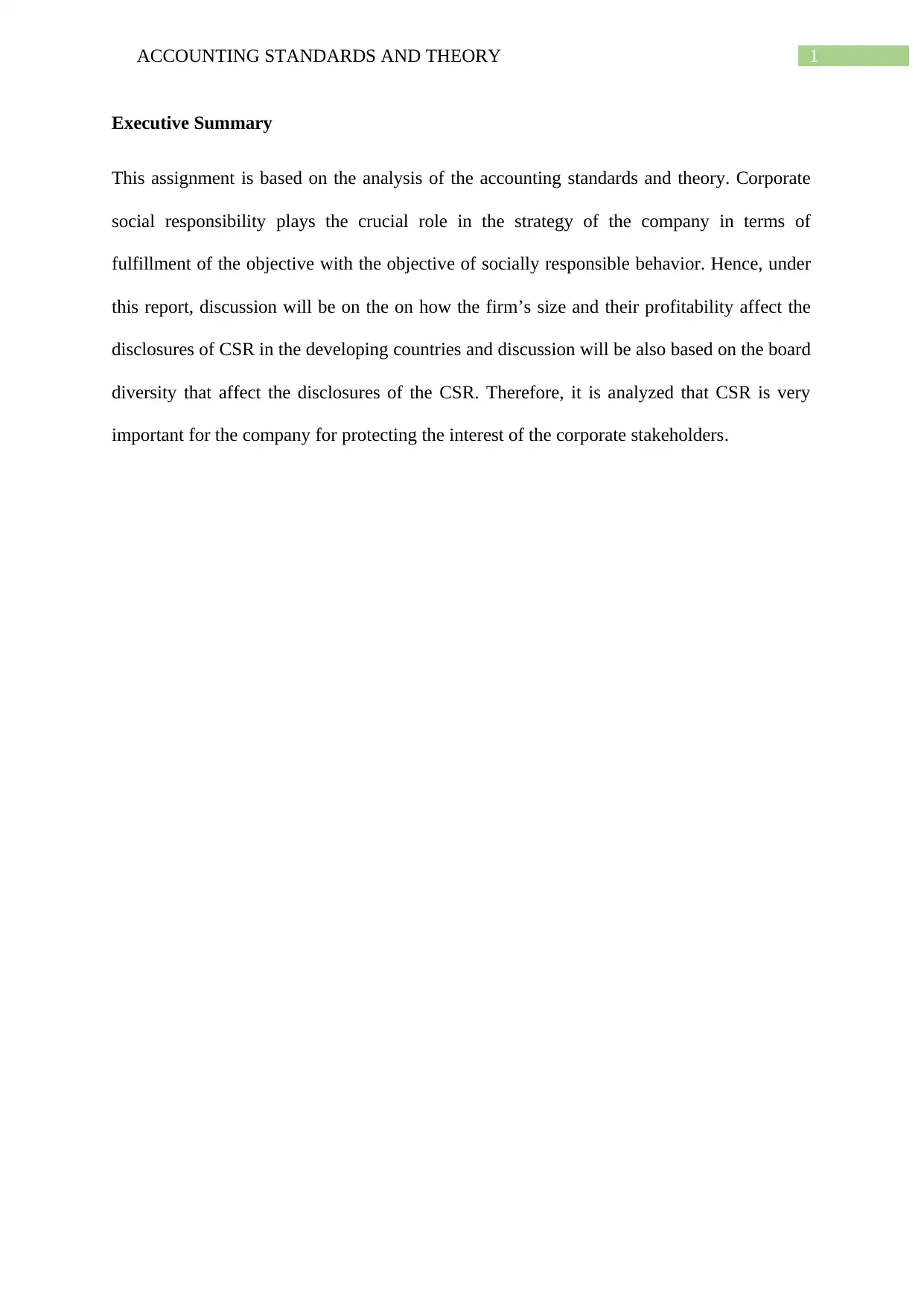
Executive Summary
This assignment is based on the analysis of the accounting standards and theory. Corporate
social responsibility plays the crucial role in the strategy of the company in terms of
fulfillment of the objective with the objective of socially responsible behavior. Hence, under
this report, discussion will be on the on how the firm’s size and their profitability affect the
disclosures of CSR in the developing countries and discussion will be also based on the board
diversity that affect the disclosures of the CSR. Therefore, it is analyzed that CSR is very
important for the company for protecting the interest of the corporate stakeholders.
Document Page
2ACCOUNTING STANDARDS AND THEORY
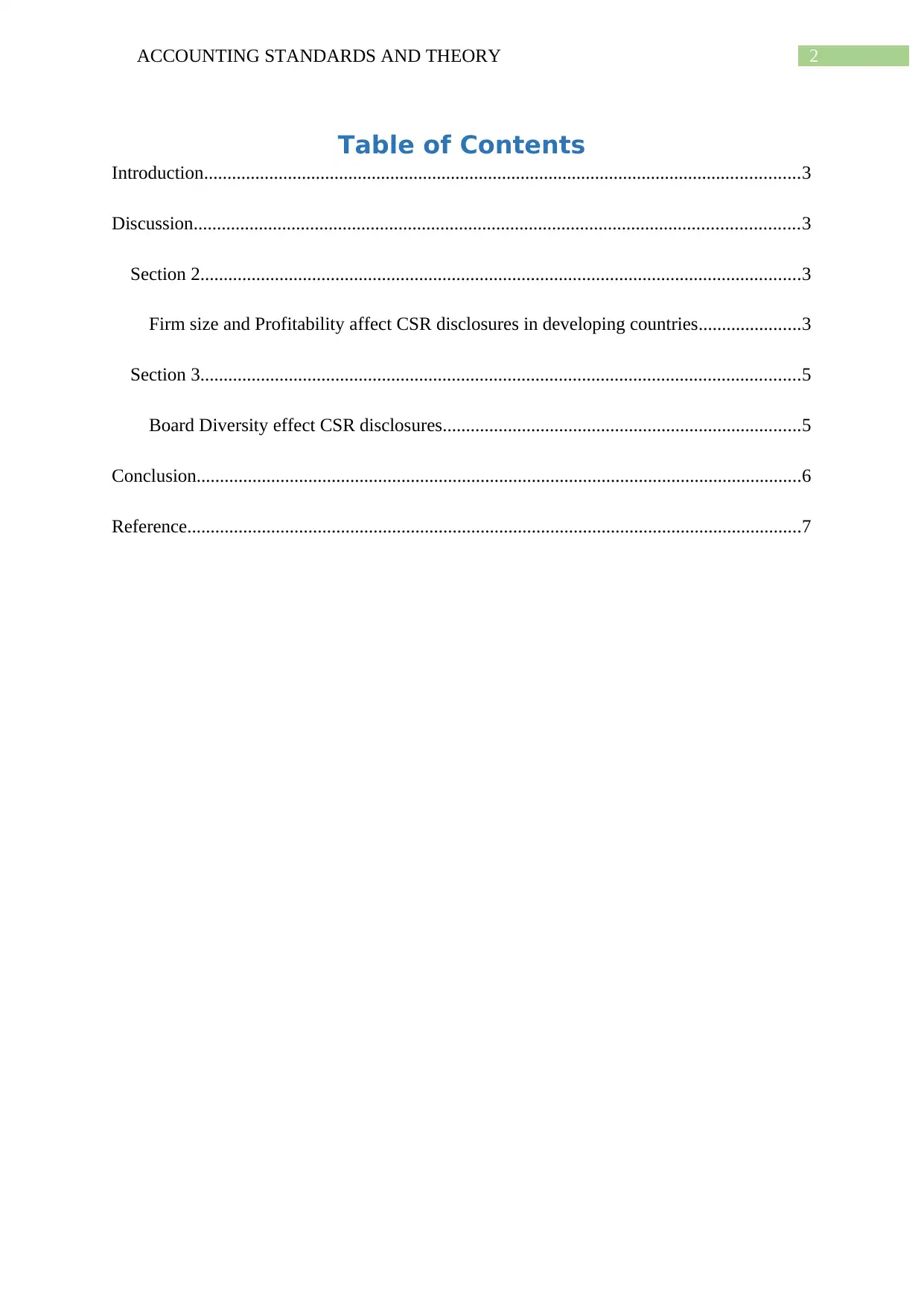
Table of Contents
Introduction................................................................................................................................3
Discussion..................................................................................................................................3
Section 2.................................................................................................................................3
Firm size and Profitability affect CSR disclosures in developing countries......................3
Section 3.................................................................................................................................5
Board Diversity effect CSR disclosures.............................................................................5
Conclusion..................................................................................................................................6
Reference....................................................................................................................................7
Document Page
3ACCOUNTING STANDARDS AND THEORY
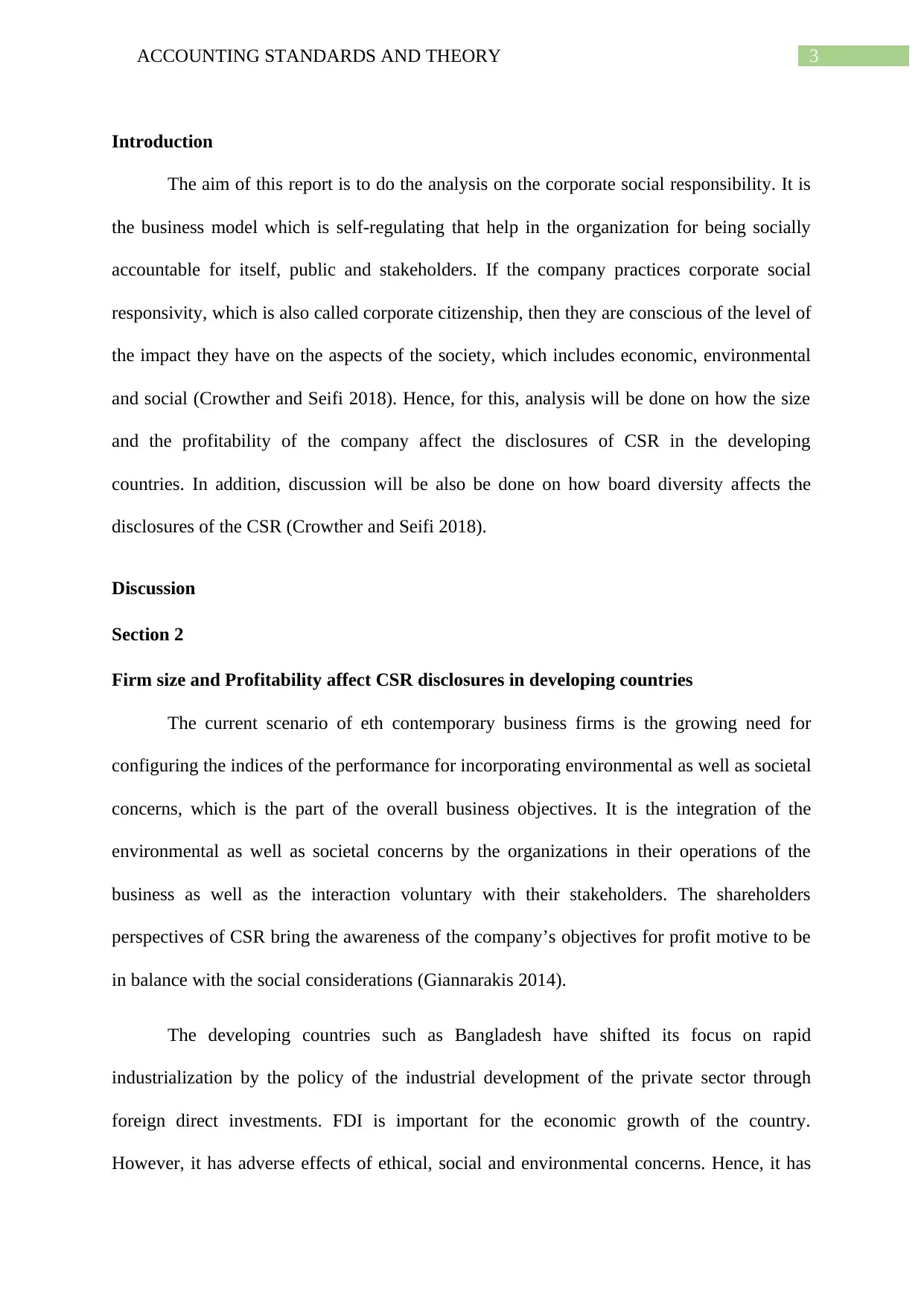
Introduction
The aim of this report is to do the analysis on the corporate social responsibility. It is
the business model which is self-regulating that help in the organization for being socially
accountable for itself, public and stakeholders. If the company practices corporate social
responsivity, which is also called corporate citizenship, then they are conscious of the level of
the impact they have on the aspects of the society, which includes economic, environmental
and social (Crowther and Seifi 2018). Hence, for this, analysis will be done on how the size
and the profitability of the company affect the disclosures of CSR in the developing
countries. In addition, discussion will be also be done on how board diversity affects the
disclosures of the CSR (Crowther and Seifi 2018).
Discussion
Section 2
Firm size and Profitability affect CSR disclosures in developing countries
The current scenario of eth contemporary business firms is the growing need for
configuring the indices of the performance for incorporating environmental as well as societal
concerns, which is the part of the overall business objectives. It is the integration of the
environmental as well as societal concerns by the organizations in their operations of the
business as well as the interaction voluntary with their stakeholders. The shareholders
perspectives of CSR bring the awareness of the company’s objectives for profit motive to be
in balance with the social considerations (Giannarakis 2014).
The developing countries such as Bangladesh have shifted its focus on rapid
industrialization by the policy of the industrial development of the private sector through
foreign direct investments. FDI is important for the economic growth of the country.
However, it has adverse effects of ethical, social and environmental concerns. Hence, it has
tabler-icon-diamond-filled.svg

Paraphrase This Document

Need a fresh take? Get an instant paraphrase of this document with our AI Paraphraser
Document Page
4ACCOUNTING STANDARDS AND THEORY
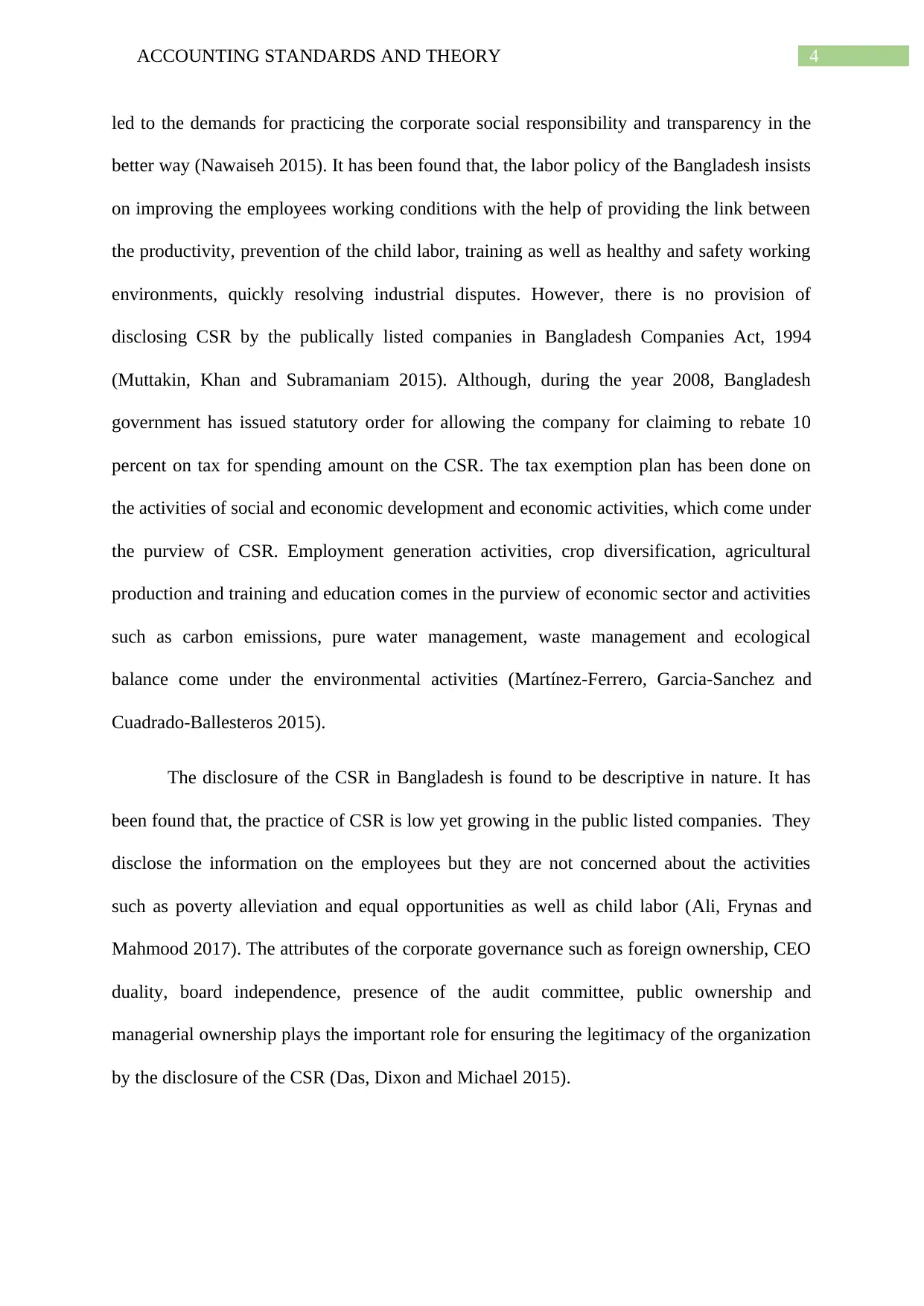
led to the demands for practicing the corporate social responsibility and transparency in the
better way (Nawaiseh 2015). It has been found that, the labor policy of the Bangladesh insists
on improving the employees working conditions with the help of providing the link between
the productivity, prevention of the child labor, training as well as healthy and safety working
environments, quickly resolving industrial disputes. However, there is no provision of
disclosing CSR by the publically listed companies in Bangladesh Companies Act, 1994
(Muttakin, Khan and Subramaniam 2015). Although, during the year 2008, Bangladesh
government has issued statutory order for allowing the company for claiming to rebate 10
percent on tax for spending amount on the CSR. The tax exemption plan has been done on
the activities of social and economic development and economic activities, which come under
the purview of CSR. Employment generation activities, crop diversification, agricultural
production and training and education comes in the purview of economic sector and activities
such as carbon emissions, pure water management, waste management and ecological
balance come under the environmental activities (Martínez‐Ferrero, Garcia‐Sanchez and
Cuadrado‐Ballesteros 2015).
The disclosure of the CSR in Bangladesh is found to be descriptive in nature. It has
been found that, the practice of CSR is low yet growing in the public listed companies. They
disclose the information on the employees but they are not concerned about the activities
such as poverty alleviation and equal opportunities as well as child labor (Ali, Frynas and
Mahmood 2017). The attributes of the corporate governance such as foreign ownership, CEO
duality, board independence, presence of the audit committee, public ownership and
managerial ownership plays the important role for ensuring the legitimacy of the organization
by the disclosure of the CSR (Das, Dixon and Michael 2015).
Document Page
5ACCOUNTING STANDARDS AND THEORY
Section 3
Board Diversity effect CSR disclosures
The diversity of the board is defined in terms of board size, board independence,
board age and board gender. The positive impact of the board diversity on the corporate
disclosures gives the opportunity to the companies for diversifying their board in accordance
with the gender type and different nationalities (Ben-Amar, Chang and McIlkenny 2017). The
composition and diversity of the board with the background, expertise, knowledge and skills
are important for improving the decision-making quality as well as strategy and policy of
CSR (Rao and Tilt 2016).
The reasons for undertaking voluntary disclosures by the organization due to
impression management, minimizing asymmetry information as well as meeting
accountability of reporting. Every company is obliged for their stakeholders, which include
their customers, suppliers, government agencies, employees and shareholders, which ranges
from maximization of profit to the services to the community and social awareness (Alotaibi,
and Hussainey 2016). However, the company survives in the environment, which is backed
by the market forces ads well as expectations of the community. Hence, with the help of CSR
disclosure and their management leadership manages to build consonance and harmony
between the actions of the organizations and values of their stakeholders (Javaid, Ali and
Khan 2016).
The Signaling theory has suggested that, companies need to provide more important
and credible information to their stakeholders by the help of success, governance and
company’s resources for reducing the information gap, which exists between stakeholders
and the company (Omran and Ramdhony 2015). The example of this disclosure includes the
announcement by the company for forecasts of quarterly management earnings and other
reports. The theory of agency suggests that the agents with the help of principals of the
Document Page
6ACCOUNTING STANDARDS AND THEORY
company aim at reducing the problems of information asymmetry by monitoring and with the
help of more disclosure (Perez 2015).
Conclusion
Hence, it is concluded from the analysis that the corporate social responsibility that it
demonstrates, the interest of the company in the wider social issues as compare to the interest
in those aspects, which effect the profit margin that attracts, many customers who shares the
value which organization shares. It has been analyzed from the analysis that the size of the
company and profitability affects the disclosures of CSR in the developing countries. Further,
discussion has been done on the impact of the board diversity on the corporate governance.
Therefore, it plays vital role in the success and diversity of the organization as a whole.
tabler-icon-diamond-filled.svg

Paraphrase This Document

Need a fresh take? Get an instant paraphrase of this document with our AI Paraphraser
Document Page
7ACCOUNTING STANDARDS AND THEORY
Reference
Ali, W., Frynas, J.G. and Mahmood, Z., 2017. Determinants of corporate social responsibility
(CSR) disclosure in developed and developing countries: A literature review. Corporate
Social Responsibility and Environmental Management, 24(4), pp.273-294.
Alotaibi, K.O. and Hussainey, K., 2016. Determinants of CSR disclosure quantity and
quality: Evidence from non-financial listed firms in Saudi Arabia. International Journal of
Disclosure and Governance, 13(4), pp.364-393.
Ben-Amar, W., Chang, M. and McIlkenny, P., 2017. Board gender diversity and corporate
response to sustainability initiatives: evidence from the Carbon Disclosure Project. Journal of
Business Ethics, 142(2), pp.369-383.
Crowther, D. and Seifi, S. eds., 2018. Redefining Corporate Social Responsibility. Emerald
Group Publishing.
Das, S., Dixon, R. and Michael, A., 2015. Corporate social responsibility reporting: a
longitudinal study of listed banking companies in Bangladesh.
Giannarakis, G., 2014. Corporate governance and financial characteristic effects on the extent
of corporate social responsibility disclosure. Social Responsibility Journal, 10(4), pp.569-
590.
Javaid Lone, E., Ali, A. and Khan, I., 2016. Corporate governance and corporate social
responsibility disclosure: Evidence from Pakistan. Corporate Governance: The international
journal of business in society, 16(5), pp.785-797.
Martínez‐Ferrero, J., Garcia‐Sanchez, I.M. and Cuadrado‐Ballesteros, B., 2015. Effect of
financial reporting quality on sustainability information disclosure. Corporate Social
Responsibility and Environmental Management, 22(1), pp.45-64.
Document Page
8ACCOUNTING STANDARDS AND THEORY
Muttakin, M.B., Khan, A. and Subramaniam, N., 2015. Firm characteristics, board diversity
and corporate social responsibility: evidence from Bangladesh. Pacific Accounting
Review, 27(3), pp.353-372.
Nawaiseh, M.E., 2015. Do Firm Size and Financial Performance Affect Corporate Social
Responsibility Disclosure: Employees' and Environmental Dimensions?. American Journal of
Applied Sciences, 12(12), p.967.
Omran, M.A. and Ramdhony, D., 2015. Theoretical perspectives on corporate social
responsibility disclosure: a critical review. International Journal of Accounting and Financial
Reporting, 5(2), pp.38-55.
Pérez, A., 2015. Corporate reputation and CSR reporting to stakeholders: Gaps in the
literature and future lines of research. Corporate Communications: An International
Journal, 20(1), pp.11-29.
Rao, K. and Tilt, C., 2016. Board composition and corporate social responsibility: The role of
diversity, gender, strategy and decision making. Journal of Business Ethics, 138(2), pp.327-
347.
chevron_up_icon
1 out of 9
circle_padding
hide_on_mobile
zoom_out_icon
[object Object]