Analysis of Current Development in Accounting Thought and Standards
VerifiedAdded on 2022/10/02
|11
|2580
|344
Report
AI Summary
This report delves into the current developments in accounting thought and standards, focusing on the conceptual framework and its advantages as claimed by standard setters. It explores the roles of fair value and historical cost methods within the AASB framework, analyzing the benefits and limitations of each approach. The report critiques Hines' perspective on the conceptual framework, arguing that it aids in achieving accounting standards implementation. It also examines how the AASB promotes fair disclosure through financial reporting, discussing valuation methods and the historical cost accounting method. The historical cost method is presented as a reliable and unbiased approach, supported by its ease of comparison for investors and its legal recognition in taxation and dividend declarations. The report concludes by highlighting the importance of these methods in providing accurate financial information and facilitating informed decision-making.

Current development in accounting
Thought
Thought

Paraphrase This Document
Need a fresh take? Get an instant paraphrase of this document with our AI Paraphraser
Contents
Introduction......................................................................................................................................3
Main body........................................................................................................................................4
Question 1....................................................................................................................................4
a)..............................................................................................................................................4
b)..............................................................................................................................................4
Question 2....................................................................................................................................7
Question 3....................................................................................................................................9
References......................................................................................................................................11
Introduction......................................................................................................................................3
Main body........................................................................................................................................4
Question 1....................................................................................................................................4
a)..............................................................................................................................................4
b)..............................................................................................................................................4
Question 2....................................................................................................................................7
Question 3....................................................................................................................................9
References......................................................................................................................................11
Introduction
The term accounting theory is considered to be one of the most important term that includes
formation of accounting related standards. An appraisal for the development of accounting
theory and practice can be done by the standard setters. There are general agreements that are
made by the accounting standard setters as this helps in formation of various policies for the
business organisations. This is seen that conceptual framework project helps in development and
improving the standards for the future so that they are able to achieve the objective of
maximising the performance (Brouard, et. al., 2017). This report is based on the performance
current development of the accounting thought and standards in the country. This report would
help in getting information about what are the advantages and benefits that are claimed by the
standard setters and what are the support that they are getting for the conceptual framework
projects. While the fair value or the historical cost would be considered for the purpose so as to
identify the AASB framework. At last historical cost accounting method would be analysed for
the purpose of the study.
The term accounting theory is considered to be one of the most important term that includes
formation of accounting related standards. An appraisal for the development of accounting
theory and practice can be done by the standard setters. There are general agreements that are
made by the accounting standard setters as this helps in formation of various policies for the
business organisations. This is seen that conceptual framework project helps in development and
improving the standards for the future so that they are able to achieve the objective of
maximising the performance (Brouard, et. al., 2017). This report is based on the performance
current development of the accounting thought and standards in the country. This report would
help in getting information about what are the advantages and benefits that are claimed by the
standard setters and what are the support that they are getting for the conceptual framework
projects. While the fair value or the historical cost would be considered for the purpose so as to
identify the AASB framework. At last historical cost accounting method would be analysed for
the purpose of the study.
⊘ This is a preview!⊘
Do you want full access?
Subscribe today to unlock all pages.

Trusted by 1+ million students worldwide
Main body
Question 1
a)
The development of the conceptual framework has been done since the early twentieth century
and for this context a disciplined setup has been considered to set up the accosting standard. The
financial accounting standard board’s conceptual framework for the accounting project was
completed in the year 1986 which cost around ten years efforts. Hence there are various
advantages which are claimed by the standard setters for advancement of framework of the
projects (Ellwood & Newberry, 2016). The group of standard setters are considered to be the
government of the country, the accounting professionals and the organisation in the different
countries gets benefited from the advancement of the conceptual framework projects. These can
be classified as below:
The conceptual framework provides a means of the communicating the key concepts to
the professional reporters and accounting professionals. These helped in getting the
guidance so as to report to the entities where no specific standard has been set by the
setters.
As this is seen that many countries has adopted the IASB conceptual framework hence
this can be said that international compatibility can be achieved between various
countries through this framework. Though this the comparison can be made at a greater
instance so as to achieve the objective of maximising the performance.
It is also seen that the issues which relates to objective of financial reporting, recognition
criteria has been made through the process of developing the conceptual framework
hence this helps the accounting standard setters who will be less politically pressured
while developing the new standards.
Also the standard setters will have the consensus on various issues which includes the
development of the accounting standard which must be fundamental and economical.
b)
As per the statement that is given by Hines this can be seen conceptual framework is considered
to be the strategic manoeuvre for the purpose of providing the standard legitimacy to standard
Question 1
a)
The development of the conceptual framework has been done since the early twentieth century
and for this context a disciplined setup has been considered to set up the accosting standard. The
financial accounting standard board’s conceptual framework for the accounting project was
completed in the year 1986 which cost around ten years efforts. Hence there are various
advantages which are claimed by the standard setters for advancement of framework of the
projects (Ellwood & Newberry, 2016). The group of standard setters are considered to be the
government of the country, the accounting professionals and the organisation in the different
countries gets benefited from the advancement of the conceptual framework projects. These can
be classified as below:
The conceptual framework provides a means of the communicating the key concepts to
the professional reporters and accounting professionals. These helped in getting the
guidance so as to report to the entities where no specific standard has been set by the
setters.
As this is seen that many countries has adopted the IASB conceptual framework hence
this can be said that international compatibility can be achieved between various
countries through this framework. Though this the comparison can be made at a greater
instance so as to achieve the objective of maximising the performance.
It is also seen that the issues which relates to objective of financial reporting, recognition
criteria has been made through the process of developing the conceptual framework
hence this helps the accounting standard setters who will be less politically pressured
while developing the new standards.
Also the standard setters will have the consensus on various issues which includes the
development of the accounting standard which must be fundamental and economical.
b)
As per the statement that is given by Hines this can be seen conceptual framework is considered
to be the strategic manoeuvre for the purpose of providing the standard legitimacy to standard
Paraphrase This Document
Need a fresh take? Get an instant paraphrase of this document with our AI Paraphraser
setters. As conceptual framework helps in setting the projections for the standards that are
framed for this purpose. This is also seen that through this the accounting standard setters are
able to achieve the objective of making the standard applicable within the globe. While the
accounting professionals as defined by Hines has threats to legitimacy which includes that they
have posed some knowledge on the foundation of the same (Feng, Cummings & Tweedie, 2017).
This has been said by Hines that accounting knowledge is residual of the political process which
is incorrect as the accounting framework is based on the knowledge of standard setters. He also
specified that the problem of auditing and financial accounting is problematic in nature. Hence
this can be considered that this statement is considered to be wrong as the conceptual framework
helps in getting the information and making consensus about how the auditing can be done so as
to achieve the objective of disclosing the correct and accurate figures to the users of the
accounts. Hines concluded that the accounting standard board was privately held body that was
making rules for the purpose of accounting standard and hence it has some of the political
influence on it. while this is considered to be wrong statement as this is seen that all the
standards that are formed are formed for the benefit of the company and the business house
which helps in the making and following the compliance and disclosure of the company’s
financial performance to the users of the account (Richardson, Dellaportas, Perera & Richardson,
2015).
This is also seen that the arbitrariness of the accounting standard and practice as stated by FASB
for undertaking the conceptual framework was to provide the coherent conceptual core which
would enable so as to set the theoretical ground for the consistent and to make the ad hoc
standards. The expansion and diversification of the accounting work which is done for
conceptual framework helps in maintaining the standard in the case of showing the financial
results of the company or tee business enterprises. While this is also specified by Hines in its
journal that accounting professionals suggest that the social legitimacy of the accountants has the
right to render various range of services which are considered to be the key which is performed
on the basis of the expertise of the professionals.
For the purpose of making the audit of the accounting record this is necessary for the person to
be capable and having the professional degree for the purpose of giving the audit statement on
the financial statement of the company (Schaltegger & Burritt, 2017). Hence this can be said that
conceptual the statement that is made by Hines are considered to be wrong and the conceptual
framed for this purpose. This is also seen that through this the accounting standard setters are
able to achieve the objective of making the standard applicable within the globe. While the
accounting professionals as defined by Hines has threats to legitimacy which includes that they
have posed some knowledge on the foundation of the same (Feng, Cummings & Tweedie, 2017).
This has been said by Hines that accounting knowledge is residual of the political process which
is incorrect as the accounting framework is based on the knowledge of standard setters. He also
specified that the problem of auditing and financial accounting is problematic in nature. Hence
this can be considered that this statement is considered to be wrong as the conceptual framework
helps in getting the information and making consensus about how the auditing can be done so as
to achieve the objective of disclosing the correct and accurate figures to the users of the
accounts. Hines concluded that the accounting standard board was privately held body that was
making rules for the purpose of accounting standard and hence it has some of the political
influence on it. while this is considered to be wrong statement as this is seen that all the
standards that are formed are formed for the benefit of the company and the business house
which helps in the making and following the compliance and disclosure of the company’s
financial performance to the users of the account (Richardson, Dellaportas, Perera & Richardson,
2015).
This is also seen that the arbitrariness of the accounting standard and practice as stated by FASB
for undertaking the conceptual framework was to provide the coherent conceptual core which
would enable so as to set the theoretical ground for the consistent and to make the ad hoc
standards. The expansion and diversification of the accounting work which is done for
conceptual framework helps in maintaining the standard in the case of showing the financial
results of the company or tee business enterprises. While this is also specified by Hines in its
journal that accounting professionals suggest that the social legitimacy of the accountants has the
right to render various range of services which are considered to be the key which is performed
on the basis of the expertise of the professionals.
For the purpose of making the audit of the accounting record this is necessary for the person to
be capable and having the professional degree for the purpose of giving the audit statement on
the financial statement of the company (Schaltegger & Burritt, 2017). Hence this can be said that
conceptual the statement that is made by Hines are considered to be wrong and the conceptual

framework in the industry helps in achieving the objective of implementing the accounting
standard in the best way.
standard in the best way.
⊘ This is a preview!⊘
Do you want full access?
Subscribe today to unlock all pages.
Trusted by 1+ million students worldwide
Question 2
The AASB has made various provision for bringing the fair disclosure and identification of the
statement of the country. It is seen that IASB conceptual framework sets out various concepts so
as to underline the preparation and the development of the financial report of the business
enterprise so that the stakeholders of the company are able to achieve the objective of getting the
true and fair view of the affairs. IASB has recommended a project so as to develop and improve
conceptual framework which has the objective to produce the principle bases financial reporting.
The objective, usefulness and the limitation of the general purpose financial reporting is set to
provide financial information about the reporting entity which is considered to be useful so as to
investors of the company that may be existing or the potential investors (Tucker & Schaltegger,
2016). Through this purpose they are able to take the decision which involves buying and selling
and holding of the equity and the debt instrument of the company. The investors of the company
demands for the financial report to be appropriate so that they are able to take the best decision
for the purpose of making reporting an disclosure requirement so as to make it most profitable.
This is seen that valuation is considered to be one of the most highly subjective matter that helps
the investors to analyse the value of the financial asset of the company and the financial
worthiness of the company. This helps the investors to take the decision so as to investment in
the company. Valuation is subject to the various method which includes the historical cost
method, intrinsic value method and notional value method. While on the other hand this can be
considered that the main purpose of doing the valuation and disclosing the asset at the cost
includes that it should identify the correct value of the asset that is available to the user of the
accounts and this can helps the company and the investors to know the correct worthiness of the
asset of the company and the market value of the company. Hence these method can be defined
as,
Historical method: the historical cost method means that the asset would be valued at the
actual price at which the transaction were made by the company. This means that the
company needs to disclose the asset of the company at the historical value. This is the
cost that is globally accepted as a measure so as to record the plant and the equipment of
the company. Hence through this the asset of the company would be shown at the
historical value which will be considered for the purpose of calculation of the
depreciation and various other statutory methods.
The AASB has made various provision for bringing the fair disclosure and identification of the
statement of the country. It is seen that IASB conceptual framework sets out various concepts so
as to underline the preparation and the development of the financial report of the business
enterprise so that the stakeholders of the company are able to achieve the objective of getting the
true and fair view of the affairs. IASB has recommended a project so as to develop and improve
conceptual framework which has the objective to produce the principle bases financial reporting.
The objective, usefulness and the limitation of the general purpose financial reporting is set to
provide financial information about the reporting entity which is considered to be useful so as to
investors of the company that may be existing or the potential investors (Tucker & Schaltegger,
2016). Through this purpose they are able to take the decision which involves buying and selling
and holding of the equity and the debt instrument of the company. The investors of the company
demands for the financial report to be appropriate so that they are able to take the best decision
for the purpose of making reporting an disclosure requirement so as to make it most profitable.
This is seen that valuation is considered to be one of the most highly subjective matter that helps
the investors to analyse the value of the financial asset of the company and the financial
worthiness of the company. This helps the investors to take the decision so as to investment in
the company. Valuation is subject to the various method which includes the historical cost
method, intrinsic value method and notional value method. While on the other hand this can be
considered that the main purpose of doing the valuation and disclosing the asset at the cost
includes that it should identify the correct value of the asset that is available to the user of the
accounts and this can helps the company and the investors to know the correct worthiness of the
asset of the company and the market value of the company. Hence these method can be defined
as,
Historical method: the historical cost method means that the asset would be valued at the
actual price at which the transaction were made by the company. This means that the
company needs to disclose the asset of the company at the historical value. This is the
cost that is globally accepted as a measure so as to record the plant and the equipment of
the company. Hence through this the asset of the company would be shown at the
historical value which will be considered for the purpose of calculation of the
depreciation and various other statutory methods.
Paraphrase This Document
Need a fresh take? Get an instant paraphrase of this document with our AI Paraphraser
Fair value method: This is considered as the method where the actual value of the asset of
the company are considered for the purpose of the disclosure and hence helps in giving
the most desirable value of asset of the company. The method is mostly use for the assets
such as intangibles, inventories. This is seen that fair value is considered be highly
dependent on the demand, availability, perishability of the asset of the company. Here the
professional individuals are taken into the consideration so as to value the assets of the
company.
Hence this is seen that the business enterprise should use the fair value method for the purpose of
making the valuation of the share. This is also considered that business enterprises should check
and consider that the method once followed should be consistent and it should not be changed at
the regular intervals. Hence through this investors has the particular mind set for the purpose of
analysing the value of the asset and the value of the company.
the company are considered for the purpose of the disclosure and hence helps in giving
the most desirable value of asset of the company. The method is mostly use for the assets
such as intangibles, inventories. This is seen that fair value is considered be highly
dependent on the demand, availability, perishability of the asset of the company. Here the
professional individuals are taken into the consideration so as to value the assets of the
company.
Hence this is seen that the business enterprise should use the fair value method for the purpose of
making the valuation of the share. This is also considered that business enterprises should check
and consider that the method once followed should be consistent and it should not be changed at
the regular intervals. Hence through this investors has the particular mind set for the purpose of
analysing the value of the asset and the value of the company.
Question 3
The term historical cost accounting is considered to be the conventional cost accounting method
that is used by the accounting professionals so as to maximise disclosure of the value of the
assets of the company. This is seen that in this method the transaction that are appearing in the
balance sheet of the company and the profit and loss account reflects the historical cost of the
assets of the company. Historical cost is based on the realisation of principles which is required
for the recognition of the revenue when it has been realised for this purpose.
This is seen that the historical cost accounting used by most of the accountant and business
enterprise as the accounting data under this is considered to be free from the biasness. These are
considered to be reliable by the investors as this provides the true value of the company and its
affairs. Here this also helps in complying with the minimum extent to which the accounts of the
company may be affected due to the personal judgements of those which are prepared by them.
This helps in preparing the data that are less disputable by the alternative accounting systems.
Users generally likes the data that are based on the historical cost method and the hence the
supports the method as this is easy for them to compare and achieve the objective of making the
decision for investing in the company. while the defined that has been for the historical cost
accounting method is that they are only legally recognised accounting system that are accepted
as the basis for the purpose of the taxation, dividend declaration and defining legal capital and
various other forms.
While sterling, chambers, Edward and Bell all recognised the method of accounting where the
market value of the asset are considered to be taken in the preference. This is seen that they have
made various explanation on why this method is important for the purpose of recording the value
of the asset of the company on the market value. Cost current accounting method is considered to
be the method that is based on the enterprise going concern which is continuously replacing the
asset of the company. This method is considered to be good as this helps in providing current
value and the actual value of the asset of the company and the market value of the business of the
company. While the continuous contemporary accounting is considered to be the method which
prescribes that the purchasing power of the money is not constant but is changing constantly.
Hence this method recognise that the assets of the company should be valued at the realizable
value of the asset if this is sent at the current business condition. Also the CPPA method provides
The term historical cost accounting is considered to be the conventional cost accounting method
that is used by the accounting professionals so as to maximise disclosure of the value of the
assets of the company. This is seen that in this method the transaction that are appearing in the
balance sheet of the company and the profit and loss account reflects the historical cost of the
assets of the company. Historical cost is based on the realisation of principles which is required
for the recognition of the revenue when it has been realised for this purpose.
This is seen that the historical cost accounting used by most of the accountant and business
enterprise as the accounting data under this is considered to be free from the biasness. These are
considered to be reliable by the investors as this provides the true value of the company and its
affairs. Here this also helps in complying with the minimum extent to which the accounts of the
company may be affected due to the personal judgements of those which are prepared by them.
This helps in preparing the data that are less disputable by the alternative accounting systems.
Users generally likes the data that are based on the historical cost method and the hence the
supports the method as this is easy for them to compare and achieve the objective of making the
decision for investing in the company. while the defined that has been for the historical cost
accounting method is that they are only legally recognised accounting system that are accepted
as the basis for the purpose of the taxation, dividend declaration and defining legal capital and
various other forms.
While sterling, chambers, Edward and Bell all recognised the method of accounting where the
market value of the asset are considered to be taken in the preference. This is seen that they have
made various explanation on why this method is important for the purpose of recording the value
of the asset of the company on the market value. Cost current accounting method is considered to
be the method that is based on the enterprise going concern which is continuously replacing the
asset of the company. This method is considered to be good as this helps in providing current
value and the actual value of the asset of the company and the market value of the business of the
company. While the continuous contemporary accounting is considered to be the method which
prescribes that the purchasing power of the money is not constant but is changing constantly.
Hence this method recognise that the assets of the company should be valued at the realizable
value of the asset if this is sent at the current business condition. Also the CPPA method provides
⊘ This is a preview!⊘
Do you want full access?
Subscribe today to unlock all pages.
Trusted by 1+ million students worldwide
that the asset of the company should be valued at the current purchasing power which is
considered to be one of the most important and best aspect of the company (Hines, 1989).
Therefore this can be considered that all the accounting professionals and researcher desired that
the valuation of the asset must be done at the fair market value but there steps has not gained the
positive value as against the historical cost method as this is more widely recognised by the
users.
considered to be one of the most important and best aspect of the company (Hines, 1989).
Therefore this can be considered that all the accounting professionals and researcher desired that
the valuation of the asset must be done at the fair market value but there steps has not gained the
positive value as against the historical cost method as this is more widely recognised by the
users.
Paraphrase This Document
Need a fresh take? Get an instant paraphrase of this document with our AI Paraphraser
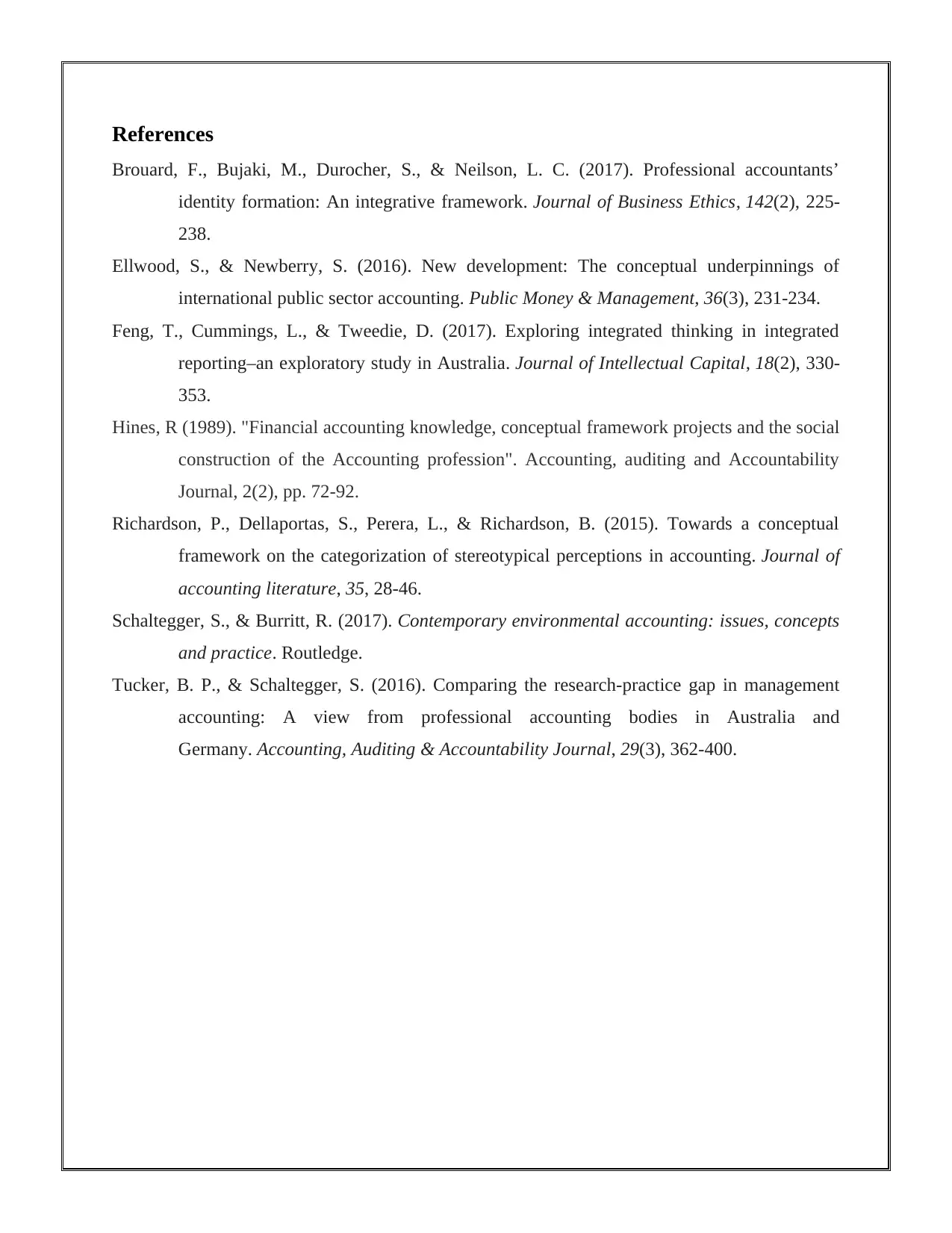
References
Brouard, F., Bujaki, M., Durocher, S., & Neilson, L. C. (2017). Professional accountants’
identity formation: An integrative framework. Journal of Business Ethics, 142(2), 225-
238.
Ellwood, S., & Newberry, S. (2016). New development: The conceptual underpinnings of
international public sector accounting. Public Money & Management, 36(3), 231-234.
Feng, T., Cummings, L., & Tweedie, D. (2017). Exploring integrated thinking in integrated
reporting–an exploratory study in Australia. Journal of Intellectual Capital, 18(2), 330-
353.
Hines, R (1989). "Financial accounting knowledge, conceptual framework projects and the social
construction of the Accounting profession". Accounting, auditing and Accountability
Journal, 2(2), pp. 72-92.
Richardson, P., Dellaportas, S., Perera, L., & Richardson, B. (2015). Towards a conceptual
framework on the categorization of stereotypical perceptions in accounting. Journal of
accounting literature, 35, 28-46.
Schaltegger, S., & Burritt, R. (2017). Contemporary environmental accounting: issues, concepts
and practice. Routledge.
Tucker, B. P., & Schaltegger, S. (2016). Comparing the research-practice gap in management
accounting: A view from professional accounting bodies in Australia and
Germany. Accounting, Auditing & Accountability Journal, 29(3), 362-400.
Brouard, F., Bujaki, M., Durocher, S., & Neilson, L. C. (2017). Professional accountants’
identity formation: An integrative framework. Journal of Business Ethics, 142(2), 225-
238.
Ellwood, S., & Newberry, S. (2016). New development: The conceptual underpinnings of
international public sector accounting. Public Money & Management, 36(3), 231-234.
Feng, T., Cummings, L., & Tweedie, D. (2017). Exploring integrated thinking in integrated
reporting–an exploratory study in Australia. Journal of Intellectual Capital, 18(2), 330-
353.
Hines, R (1989). "Financial accounting knowledge, conceptual framework projects and the social
construction of the Accounting profession". Accounting, auditing and Accountability
Journal, 2(2), pp. 72-92.
Richardson, P., Dellaportas, S., Perera, L., & Richardson, B. (2015). Towards a conceptual
framework on the categorization of stereotypical perceptions in accounting. Journal of
accounting literature, 35, 28-46.
Schaltegger, S., & Burritt, R. (2017). Contemporary environmental accounting: issues, concepts
and practice. Routledge.
Tucker, B. P., & Schaltegger, S. (2016). Comparing the research-practice gap in management
accounting: A view from professional accounting bodies in Australia and
Germany. Accounting, Auditing & Accountability Journal, 29(3), 362-400.

1 out of 11


Related Documents


Your All-in-One AI-Powered Toolkit for Academic Success.
+13062052269
info@desklib.com
Available 24*7 on WhatsApp / Email
![[object Object]](/_next/static/media/star-bottom.7253800d.svg)
Unlock your academic potential
Copyright © 2020–2026 A2Z Services. All Rights Reserved. Developed and managed by ZUCOL.