Accounting Fundamentals: Financial Reporting and Analysis Assignment
VerifiedAdded on 2023/01/10
|13
|3280
|30
Homework Assignment
AI Summary
This document presents a comprehensive solution to an accounting fundamentals assignment. It begins with journal entries for Sandrolia Limited, followed by an updated trial balance and the preparation of profit and loss account and statement of financial position. The assignment then proceeds with similar tasks for Ricardo Limited, including journal entries, trial balance, and financial statement preparation. The solution includes an analysis of the relevance of financial information for various users, such as investors, management, and government entities. Finally, it provides a comparison and contrast of liquidity and profitability, explaining their significance in financial analysis. The document covers key aspects of financial accounting including recording transactions, preparing financial statements, and understanding key financial concepts.

Accounting Fundamentals

Paraphrase This Document
Need a fresh take? Get an instant paraphrase of this document with our AI Paraphraser
Contents
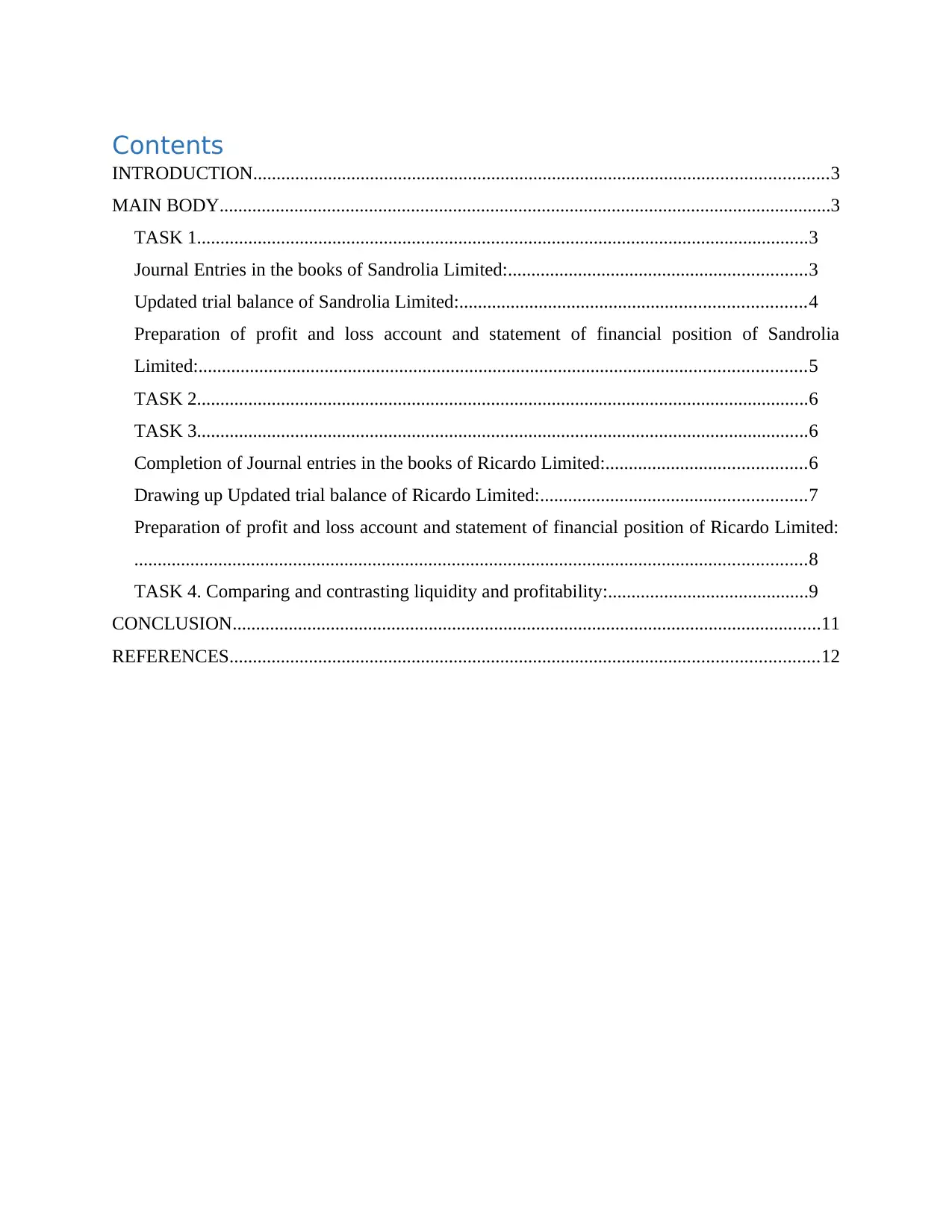
INTRODUCTION...........................................................................................................................3
MAIN BODY...................................................................................................................................3
TASK 1...................................................................................................................................3
Journal Entries in the books of Sandrolia Limited:................................................................3
Updated trial balance of Sandrolia Limited:..........................................................................4
Preparation of profit and loss account and statement of financial position of Sandrolia
Limited:..................................................................................................................................5
TASK 2...................................................................................................................................6
TASK 3...................................................................................................................................6
Completion of Journal entries in the books of Ricardo Limited:...........................................6
Drawing up Updated trial balance of Ricardo Limited:.........................................................7
Preparation of profit and loss account and statement of financial position of Ricardo Limited:
................................................................................................................................................8
TASK 4. Comparing and contrasting liquidity and profitability:...........................................9
CONCLUSION..............................................................................................................................11
REFERENCES..............................................................................................................................12
INTRODUCTION...........................................................................................................................3
MAIN BODY...................................................................................................................................3
TASK 1...................................................................................................................................3
Journal Entries in the books of Sandrolia Limited:................................................................3
Updated trial balance of Sandrolia Limited:..........................................................................4
Preparation of profit and loss account and statement of financial position of Sandrolia
Limited:..................................................................................................................................5
TASK 2...................................................................................................................................6
TASK 3...................................................................................................................................6
Completion of Journal entries in the books of Ricardo Limited:...........................................6
Drawing up Updated trial balance of Ricardo Limited:.........................................................7
Preparation of profit and loss account and statement of financial position of Ricardo Limited:
................................................................................................................................................8
TASK 4. Comparing and contrasting liquidity and profitability:...........................................9
CONCLUSION..............................................................................................................................11
REFERENCES..............................................................................................................................12
INTRODUCTION
The current era is age of trading and business. Following globalization, liberalization, and
outsourcing, from day to day business becomes rising and being dynamic as well. An
organisation, for long time, can't remember all dealings and financial events. Hence, keeping a
registered record of any and all commercial transactions with each day becomes important, this
leads to accounting growth. Accounting relates to process which helps to document, sum up,
monitor and evaluate financial transaction related information (Ogneva, Piotroski and
Zakolyukina, 2019). The study covers critical aspects of accounting with help of different tasks
which also includes practical sum of recoding transactions, preparing accounts and finalisation of
annual accounts like profit and loss statement, financial position statement etc. Further it
discusses about principle objects of financial reporting and way to attain transparent as well as
uniform accounting. Moreover, study critically evaluates difference between liquidity and
profitability.
MAIN BODY
TASK 1.
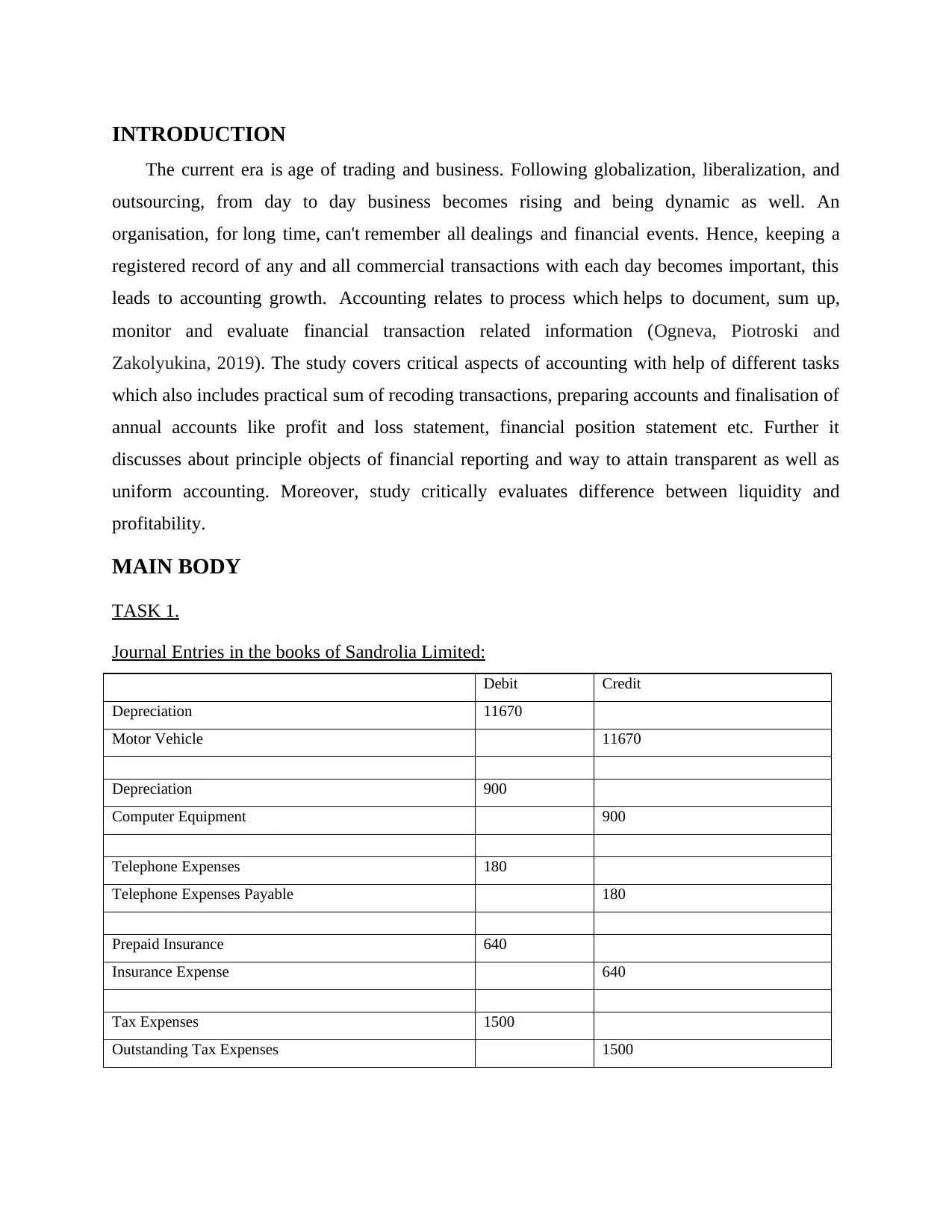
Journal Entries in the books of Sandrolia Limited:
Debit Credit
Depreciation 11670
Motor Vehicle 11670
Depreciation 900
Computer Equipment 900
Telephone Expenses 180
Telephone Expenses Payable 180
Prepaid Insurance 640
Insurance Expense 640
Tax Expenses 1500
Outstanding Tax Expenses 1500
The current era is age of trading and business. Following globalization, liberalization, and
outsourcing, from day to day business becomes rising and being dynamic as well. An
organisation, for long time, can't remember all dealings and financial events. Hence, keeping a
registered record of any and all commercial transactions with each day becomes important, this
leads to accounting growth. Accounting relates to process which helps to document, sum up,
monitor and evaluate financial transaction related information (Ogneva, Piotroski and
Zakolyukina, 2019). The study covers critical aspects of accounting with help of different tasks
which also includes practical sum of recoding transactions, preparing accounts and finalisation of
annual accounts like profit and loss statement, financial position statement etc. Further it
discusses about principle objects of financial reporting and way to attain transparent as well as
uniform accounting. Moreover, study critically evaluates difference between liquidity and
profitability.
MAIN BODY
TASK 1.
Journal Entries in the books of Sandrolia Limited:
Debit Credit
Depreciation 11670
Motor Vehicle 11670
Depreciation 900
Computer Equipment 900
Telephone Expenses 180
Telephone Expenses Payable 180
Prepaid Insurance 640
Insurance Expense 640
Tax Expenses 1500
Outstanding Tax Expenses 1500
⊘ This is a preview!⊘
Do you want full access?
Subscribe today to unlock all pages.

Trusted by 1+ million students worldwide
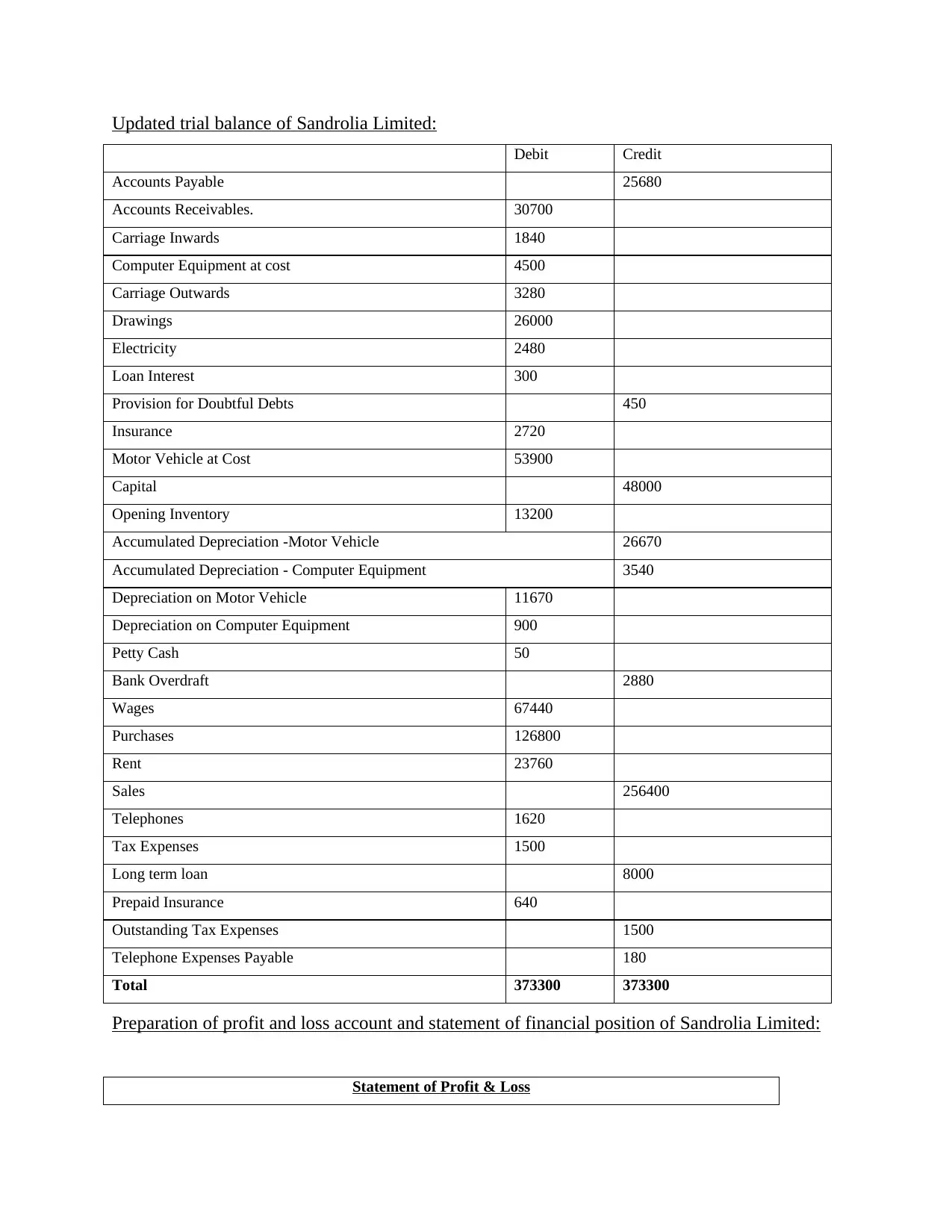
Updated trial balance of Sandrolia Limited:
Debit Credit
Accounts Payable 25680
Accounts Receivables. 30700
Carriage Inwards 1840
Computer Equipment at cost 4500
Carriage Outwards 3280
Drawings 26000
Electricity 2480
Loan Interest 300
Provision for Doubtful Debts 450
Insurance 2720
Motor Vehicle at Cost 53900
Capital 48000
Opening Inventory 13200
Accumulated Depreciation -Motor Vehicle 26670
Accumulated Depreciation - Computer Equipment 3540
Depreciation on Motor Vehicle 11670
Depreciation on Computer Equipment 900
Petty Cash 50
Bank Overdraft 2880
Wages 67440
Purchases 126800
Rent 23760
Sales 256400
Telephones 1620
Tax Expenses 1500
Long term loan 8000
Prepaid Insurance 640
Outstanding Tax Expenses 1500
Telephone Expenses Payable 180
Total 373300 373300
Preparation of profit and loss account and statement of financial position of Sandrolia Limited:
Statement of Profit & Loss
Debit Credit
Accounts Payable 25680
Accounts Receivables. 30700
Carriage Inwards 1840
Computer Equipment at cost 4500
Carriage Outwards 3280
Drawings 26000
Electricity 2480
Loan Interest 300
Provision for Doubtful Debts 450
Insurance 2720
Motor Vehicle at Cost 53900
Capital 48000
Opening Inventory 13200
Accumulated Depreciation -Motor Vehicle 26670
Accumulated Depreciation - Computer Equipment 3540
Depreciation on Motor Vehicle 11670
Depreciation on Computer Equipment 900
Petty Cash 50
Bank Overdraft 2880
Wages 67440
Purchases 126800
Rent 23760
Sales 256400
Telephones 1620
Tax Expenses 1500
Long term loan 8000
Prepaid Insurance 640
Outstanding Tax Expenses 1500
Telephone Expenses Payable 180
Total 373300 373300
Preparation of profit and loss account and statement of financial position of Sandrolia Limited:
Statement of Profit & Loss
Paraphrase This Document
Need a fresh take? Get an instant paraphrase of this document with our AI Paraphraser
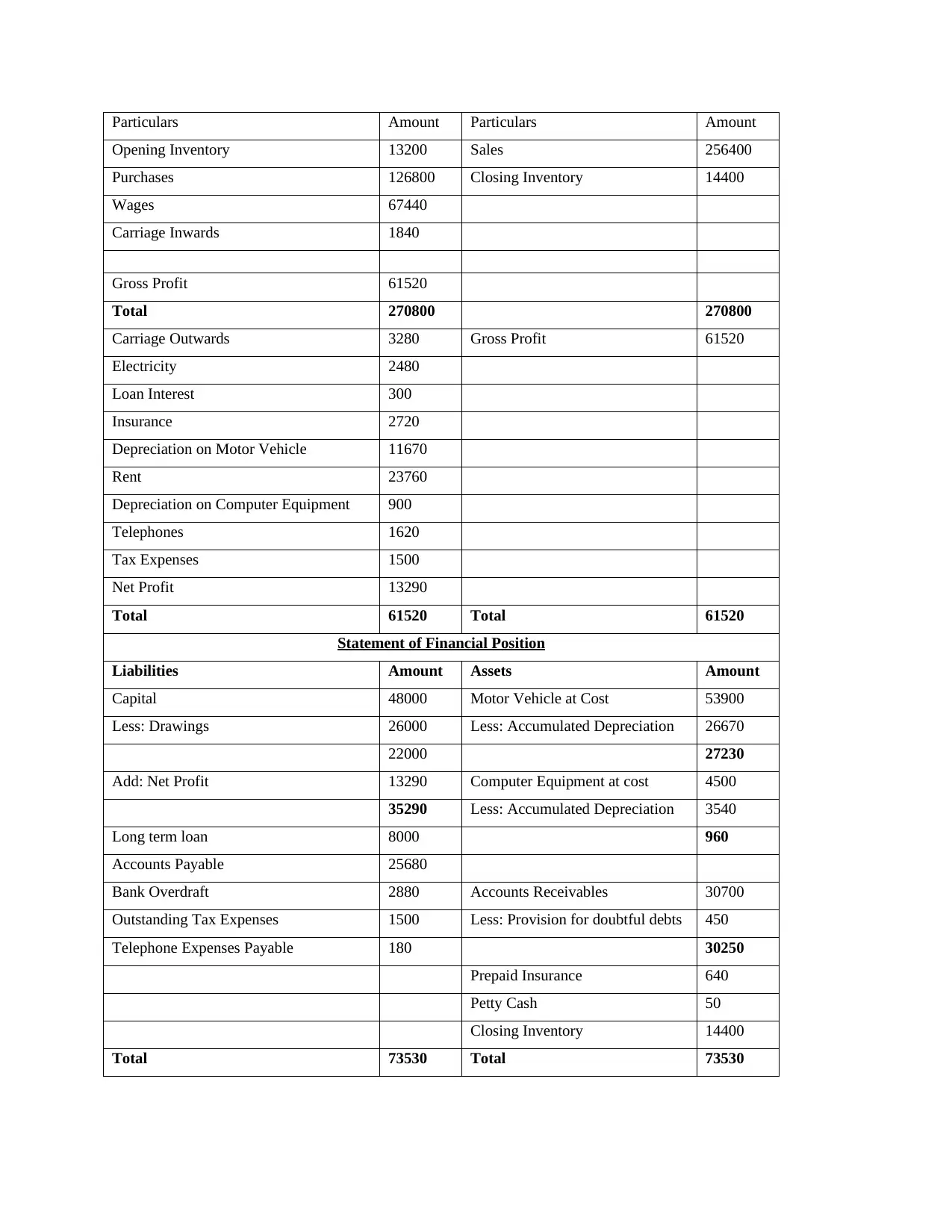
Particulars Amount Particulars Amount
Opening Inventory 13200 Sales 256400
Purchases 126800 Closing Inventory 14400
Wages 67440
Carriage Inwards 1840
Gross Profit 61520
Total 270800 270800
Carriage Outwards 3280 Gross Profit 61520
Electricity 2480
Loan Interest 300
Insurance 2720
Depreciation on Motor Vehicle 11670
Rent 23760
Depreciation on Computer Equipment 900
Telephones 1620
Tax Expenses 1500
Net Profit 13290
Total 61520 Total 61520
Statement of Financial Position
Liabilities Amount Assets Amount
Capital 48000 Motor Vehicle at Cost 53900
Less: Drawings 26000 Less: Accumulated Depreciation 26670
22000 27230
Add: Net Profit 13290 Computer Equipment at cost 4500
35290 Less: Accumulated Depreciation 3540
Long term loan 8000 960
Accounts Payable 25680
Bank Overdraft 2880 Accounts Receivables 30700
Outstanding Tax Expenses 1500 Less: Provision for doubtful debts 450
Telephone Expenses Payable 180 30250
Prepaid Insurance 640
Petty Cash 50
Closing Inventory 14400
Total 73530 Total 73530
Opening Inventory 13200 Sales 256400
Purchases 126800 Closing Inventory 14400
Wages 67440
Carriage Inwards 1840
Gross Profit 61520
Total 270800 270800
Carriage Outwards 3280 Gross Profit 61520
Electricity 2480
Loan Interest 300
Insurance 2720
Depreciation on Motor Vehicle 11670
Rent 23760
Depreciation on Computer Equipment 900
Telephones 1620
Tax Expenses 1500
Net Profit 13290
Total 61520 Total 61520
Statement of Financial Position
Liabilities Amount Assets Amount
Capital 48000 Motor Vehicle at Cost 53900
Less: Drawings 26000 Less: Accumulated Depreciation 26670
22000 27230
Add: Net Profit 13290 Computer Equipment at cost 4500
35290 Less: Accumulated Depreciation 3540
Long term loan 8000 960
Accounts Payable 25680
Bank Overdraft 2880 Accounts Receivables 30700
Outstanding Tax Expenses 1500 Less: Provision for doubtful debts 450
Telephone Expenses Payable 180 30250
Prepaid Insurance 640
Petty Cash 50
Closing Inventory 14400
Total 73530 Total 73530
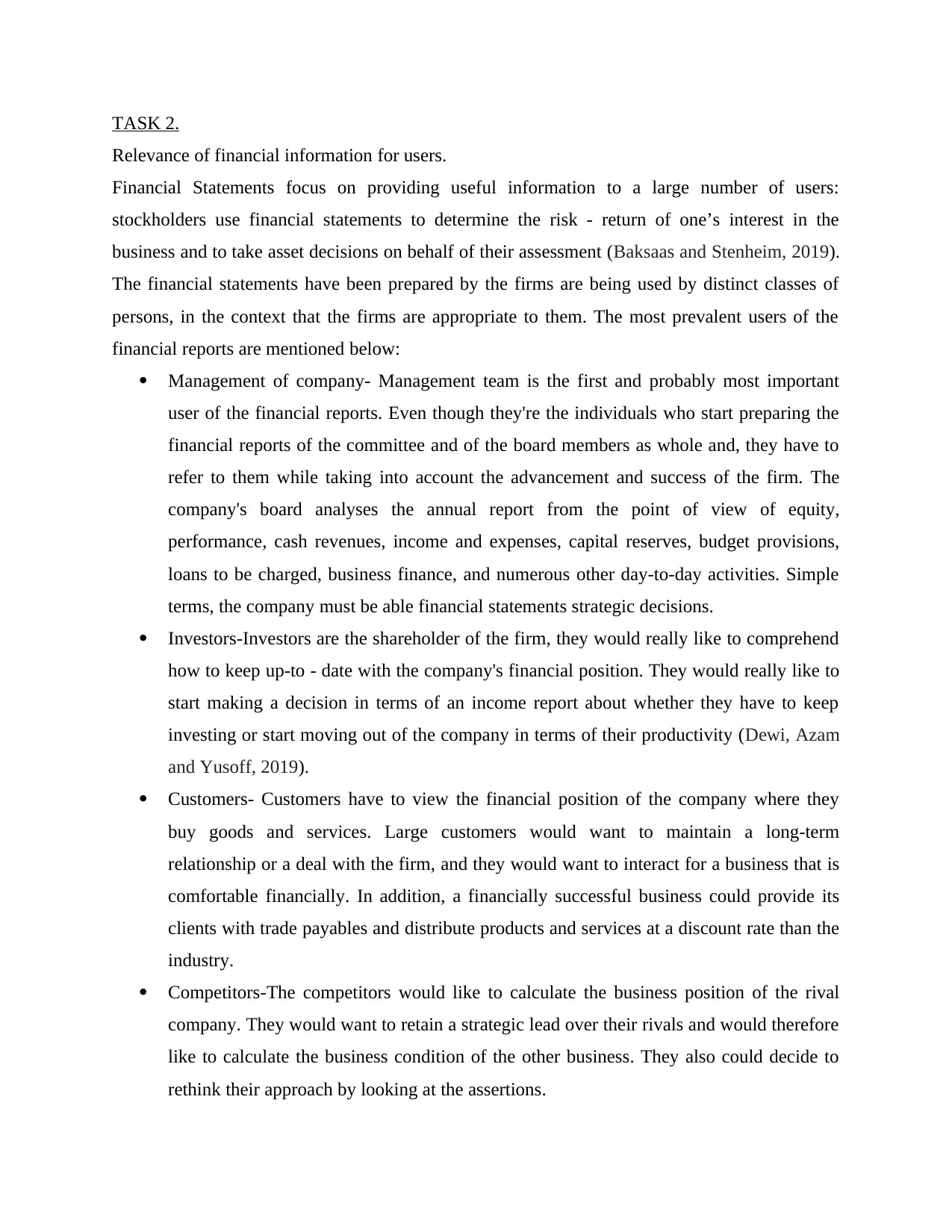
TASK 2.
Relevance of financial information for users.
Financial Statements focus on providing useful information to a large number of users:
stockholders use financial statements to determine the risk - return of one’s interest in the
business and to take asset decisions on behalf of their assessment (Baksaas and Stenheim, 2019).
The financial statements have been prepared by the firms are being used by distinct classes of
persons, in the context that the firms are appropriate to them. The most prevalent users of the
financial reports are mentioned below:
Management of company- Management team is the first and probably most important
user of the financial reports. Even though they're the individuals who start preparing the
financial reports of the committee and of the board members as whole and, they have to
refer to them while taking into account the advancement and success of the firm. The
company's board analyses the annual report from the point of view of equity,
performance, cash revenues, income and expenses, capital reserves, budget provisions,
loans to be charged, business finance, and numerous other day-to-day activities. Simple
terms, the company must be able financial statements strategic decisions.
Investors-Investors are the shareholder of the firm, they would really like to comprehend
how to keep up-to - date with the company's financial position. They would really like to
start making a decision in terms of an income report about whether they have to keep
investing or start moving out of the company in terms of their productivity (Dewi, Azam
and Yusoff, 2019).
Customers- Customers have to view the financial position of the company where they
buy goods and services. Large customers would want to maintain a long-term
relationship or a deal with the firm, and they would want to interact for a business that is
comfortable financially. In addition, a financially successful business could provide its
clients with trade payables and distribute products and services at a discount rate than the
industry.
Competitors-The competitors would like to calculate the business position of the rival
company. They would want to retain a strategic lead over their rivals and would therefore
like to calculate the business condition of the other business. They also could decide to
rethink their approach by looking at the assertions.
Relevance of financial information for users.
Financial Statements focus on providing useful information to a large number of users:
stockholders use financial statements to determine the risk - return of one’s interest in the
business and to take asset decisions on behalf of their assessment (Baksaas and Stenheim, 2019).
The financial statements have been prepared by the firms are being used by distinct classes of
persons, in the context that the firms are appropriate to them. The most prevalent users of the
financial reports are mentioned below:
Management of company- Management team is the first and probably most important
user of the financial reports. Even though they're the individuals who start preparing the
financial reports of the committee and of the board members as whole and, they have to
refer to them while taking into account the advancement and success of the firm. The
company's board analyses the annual report from the point of view of equity,
performance, cash revenues, income and expenses, capital reserves, budget provisions,
loans to be charged, business finance, and numerous other day-to-day activities. Simple
terms, the company must be able financial statements strategic decisions.
Investors-Investors are the shareholder of the firm, they would really like to comprehend
how to keep up-to - date with the company's financial position. They would really like to
start making a decision in terms of an income report about whether they have to keep
investing or start moving out of the company in terms of their productivity (Dewi, Azam
and Yusoff, 2019).
Customers- Customers have to view the financial position of the company where they
buy goods and services. Large customers would want to maintain a long-term
relationship or a deal with the firm, and they would want to interact for a business that is
comfortable financially. In addition, a financially successful business could provide its
clients with trade payables and distribute products and services at a discount rate than the
industry.
Competitors-The competitors would like to calculate the business position of the rival
company. They would want to retain a strategic lead over their rivals and would therefore
like to calculate the business condition of the other business. They also could decide to
rethink their approach by looking at the assertions.
⊘ This is a preview!⊘
Do you want full access?
Subscribe today to unlock all pages.
Trusted by 1+ million students worldwide
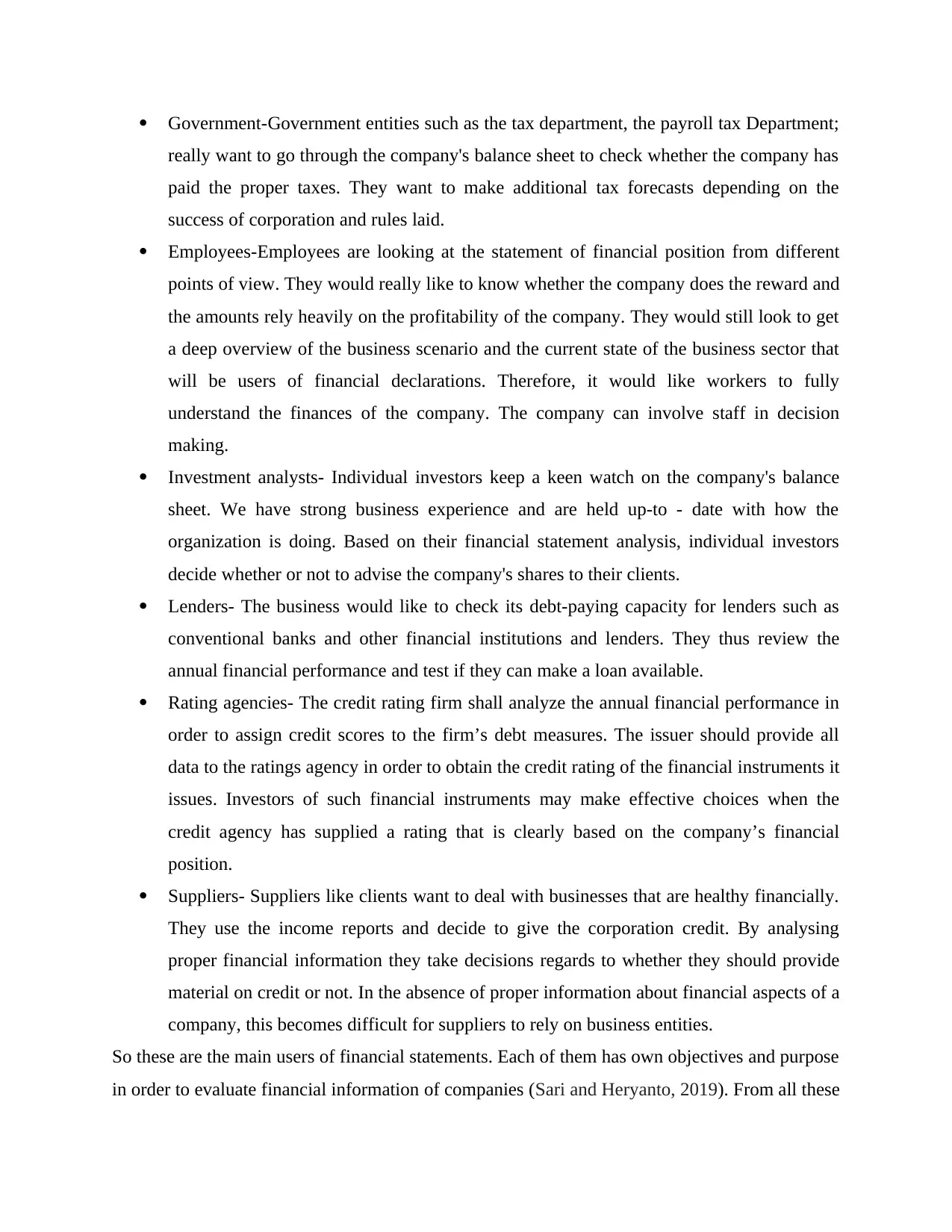
Government-Government entities such as the tax department, the payroll tax Department;
really want to go through the company's balance sheet to check whether the company has
paid the proper taxes. They want to make additional tax forecasts depending on the
success of corporation and rules laid.
Employees-Employees are looking at the statement of financial position from different
points of view. They would really like to know whether the company does the reward and
the amounts rely heavily on the profitability of the company. They would still look to get
a deep overview of the business scenario and the current state of the business sector that
will be users of financial declarations. Therefore, it would like workers to fully
understand the finances of the company. The company can involve staff in decision
making.
Investment analysts- Individual investors keep a keen watch on the company's balance
sheet. We have strong business experience and are held up-to - date with how the
organization is doing. Based on their financial statement analysis, individual investors
decide whether or not to advise the company's shares to their clients.
Lenders- The business would like to check its debt-paying capacity for lenders such as
conventional banks and other financial institutions and lenders. They thus review the
annual financial performance and test if they can make a loan available.
Rating agencies- The credit rating firm shall analyze the annual financial performance in
order to assign credit scores to the firm’s debt measures. The issuer should provide all
data to the ratings agency in order to obtain the credit rating of the financial instruments it
issues. Investors of such financial instruments may make effective choices when the
credit agency has supplied a rating that is clearly based on the company’s financial
position.
Suppliers- Suppliers like clients want to deal with businesses that are healthy financially.
They use the income reports and decide to give the corporation credit. By analysing
proper financial information they take decisions regards to whether they should provide
material on credit or not. In the absence of proper information about financial aspects of a
company, this becomes difficult for suppliers to rely on business entities.
So these are the main users of financial statements. Each of them has own objectives and purpose
in order to evaluate financial information of companies (Sari and Heryanto, 2019). From all these
really want to go through the company's balance sheet to check whether the company has
paid the proper taxes. They want to make additional tax forecasts depending on the
success of corporation and rules laid.
Employees-Employees are looking at the statement of financial position from different
points of view. They would really like to know whether the company does the reward and
the amounts rely heavily on the profitability of the company. They would still look to get
a deep overview of the business scenario and the current state of the business sector that
will be users of financial declarations. Therefore, it would like workers to fully
understand the finances of the company. The company can involve staff in decision
making.
Investment analysts- Individual investors keep a keen watch on the company's balance
sheet. We have strong business experience and are held up-to - date with how the
organization is doing. Based on their financial statement analysis, individual investors
decide whether or not to advise the company's shares to their clients.
Lenders- The business would like to check its debt-paying capacity for lenders such as
conventional banks and other financial institutions and lenders. They thus review the
annual financial performance and test if they can make a loan available.
Rating agencies- The credit rating firm shall analyze the annual financial performance in
order to assign credit scores to the firm’s debt measures. The issuer should provide all
data to the ratings agency in order to obtain the credit rating of the financial instruments it
issues. Investors of such financial instruments may make effective choices when the
credit agency has supplied a rating that is clearly based on the company’s financial
position.
Suppliers- Suppliers like clients want to deal with businesses that are healthy financially.
They use the income reports and decide to give the corporation credit. By analysing
proper financial information they take decisions regards to whether they should provide
material on credit or not. In the absence of proper information about financial aspects of a
company, this becomes difficult for suppliers to rely on business entities.
So these are the main users of financial statements. Each of them has own objectives and purpose
in order to evaluate financial information of companies (Sari and Heryanto, 2019). From all these
Paraphrase This Document
Need a fresh take? Get an instant paraphrase of this document with our AI Paraphraser
users of financial statements, this can be stated that management team of company is one of the
main user of financial statement. It is so because on the basis of gathered financial information
they become able to take appropriate actions.
TASK 3.
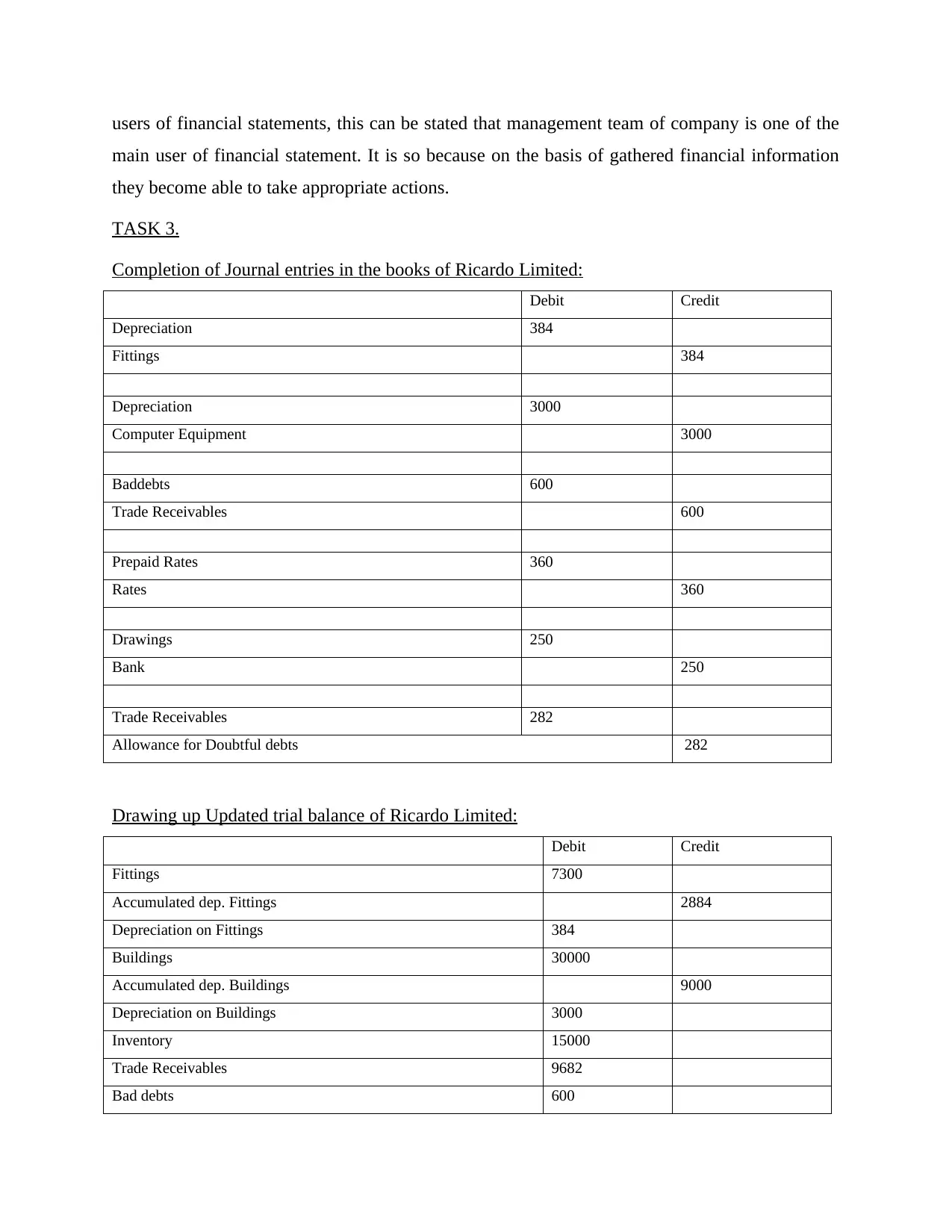
Completion of Journal entries in the books of Ricardo Limited:
Debit Credit
Depreciation 384
Fittings 384
Depreciation 3000
Computer Equipment 3000
Baddebts 600
Trade Receivables 600
Prepaid Rates 360
Rates 360
Drawings 250
Bank 250
Trade Receivables 282
Allowance for Doubtful debts 282
Drawing up Updated trial balance of Ricardo Limited:
Debit Credit
Fittings 7300
Accumulated dep. Fittings 2884
Depreciation on Fittings 384
Buildings 30000
Accumulated dep. Buildings 9000
Depreciation on Buildings 3000
Inventory 15000
Trade Receivables 9682
Bad debts 600
main user of financial statement. It is so because on the basis of gathered financial information
they become able to take appropriate actions.
TASK 3.
Completion of Journal entries in the books of Ricardo Limited:
Debit Credit
Depreciation 384
Fittings 384
Depreciation 3000
Computer Equipment 3000
Baddebts 600
Trade Receivables 600
Prepaid Rates 360
Rates 360
Drawings 250
Bank 250
Trade Receivables 282
Allowance for Doubtful debts 282
Drawing up Updated trial balance of Ricardo Limited:
Debit Credit
Fittings 7300
Accumulated dep. Fittings 2884
Depreciation on Fittings 384
Buildings 30000
Accumulated dep. Buildings 9000
Depreciation on Buildings 3000
Inventory 15000
Trade Receivables 9682
Bad debts 600
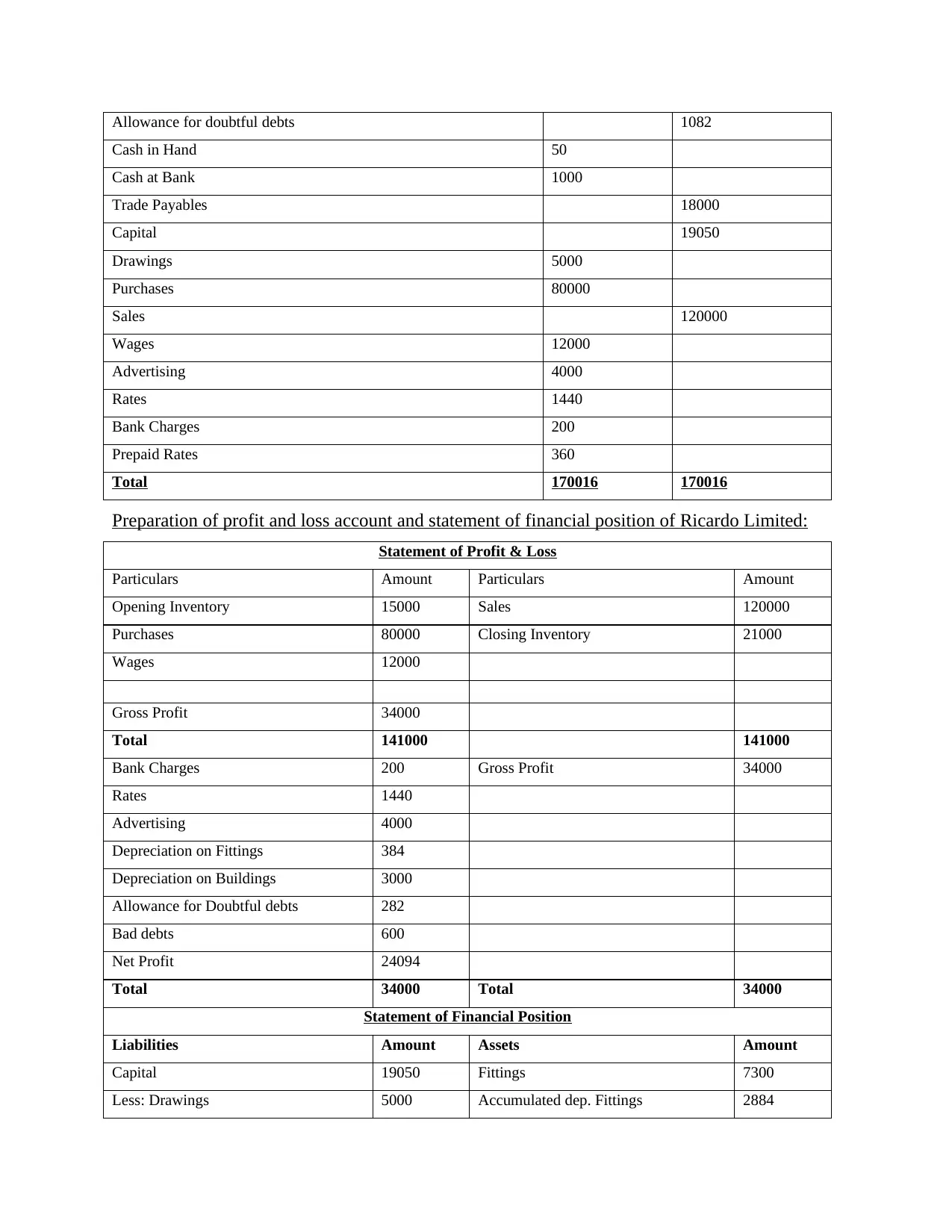
Allowance for doubtful debts 1082
Cash in Hand 50
Cash at Bank 1000
Trade Payables 18000
Capital 19050
Drawings 5000
Purchases 80000
Sales 120000
Wages 12000
Advertising 4000
Rates 1440
Bank Charges 200
Prepaid Rates 360
Total 170016 170016
Preparation of profit and loss account and statement of financial position of Ricardo Limited:
Statement of Profit & Loss
Particulars Amount Particulars Amount
Opening Inventory 15000 Sales 120000
Purchases 80000 Closing Inventory 21000
Wages 12000
Gross Profit 34000
Total 141000 141000
Bank Charges 200 Gross Profit 34000
Rates 1440
Advertising 4000
Depreciation on Fittings 384
Depreciation on Buildings 3000
Allowance for Doubtful debts 282
Bad debts 600
Net Profit 24094
Total 34000 Total 34000
Statement of Financial Position
Liabilities Amount Assets Amount
Capital 19050 Fittings 7300
Less: Drawings 5000 Accumulated dep. Fittings 2884
Cash in Hand 50
Cash at Bank 1000
Trade Payables 18000
Capital 19050
Drawings 5000
Purchases 80000
Sales 120000
Wages 12000
Advertising 4000
Rates 1440
Bank Charges 200
Prepaid Rates 360
Total 170016 170016
Preparation of profit and loss account and statement of financial position of Ricardo Limited:
Statement of Profit & Loss
Particulars Amount Particulars Amount
Opening Inventory 15000 Sales 120000
Purchases 80000 Closing Inventory 21000
Wages 12000
Gross Profit 34000
Total 141000 141000
Bank Charges 200 Gross Profit 34000
Rates 1440
Advertising 4000
Depreciation on Fittings 384
Depreciation on Buildings 3000
Allowance for Doubtful debts 282
Bad debts 600
Net Profit 24094
Total 34000 Total 34000
Statement of Financial Position
Liabilities Amount Assets Amount
Capital 19050 Fittings 7300
Less: Drawings 5000 Accumulated dep. Fittings 2884
⊘ This is a preview!⊘
Do you want full access?
Subscribe today to unlock all pages.
Trusted by 1+ million students worldwide
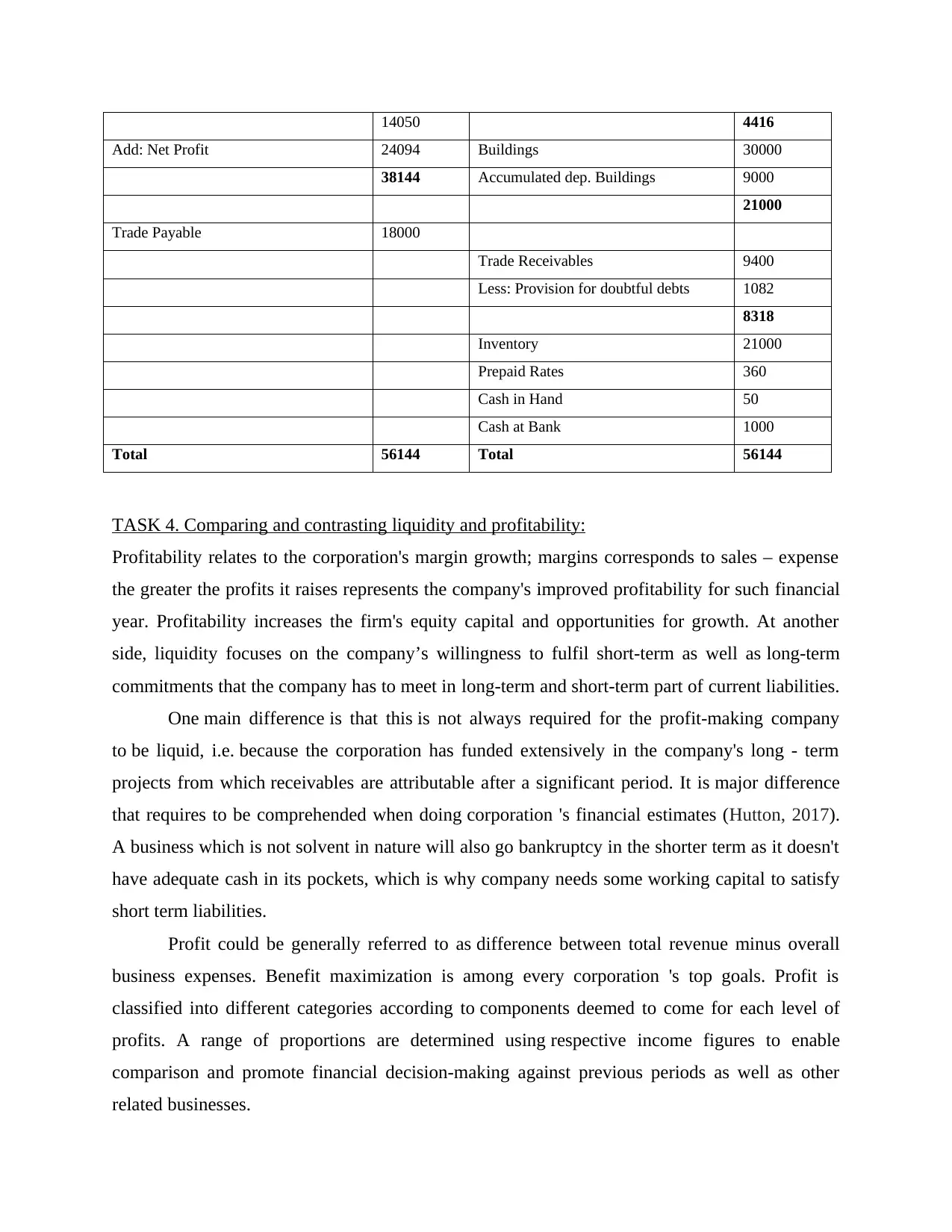
14050 4416
Add: Net Profit 24094 Buildings 30000
38144 Accumulated dep. Buildings 9000
21000
Trade Payable 18000
Trade Receivables 9400
Less: Provision for doubtful debts 1082
8318
Inventory 21000
Prepaid Rates 360
Cash in Hand 50
Cash at Bank 1000
Total 56144 Total 56144
TASK 4. Comparing and contrasting liquidity and profitability:
Profitability relates to the corporation's margin growth; margins corresponds to sales – expense
the greater the profits it raises represents the company's improved profitability for such financial
year. Profitability increases the firm's equity capital and opportunities for growth. At another
side, liquidity focuses on the company’s willingness to fulfil short-term as well as long-term
commitments that the company has to meet in long-term and short-term part of current liabilities.
One main difference is that this is not always required for the profit-making company
to be liquid, i.e. because the corporation has funded extensively in the company's long - term
projects from which receivables are attributable after a significant period. It is major difference
that requires to be comprehended when doing corporation 's financial estimates (Hutton, 2017).
A business which is not solvent in nature will also go bankruptcy in the shorter term as it doesn't
have adequate cash in its pockets, which is why company needs some working capital to satisfy
short term liabilities.
Profit could be generally referred to as difference between total revenue minus overall
business expenses. Benefit maximization is among every corporation 's top goals. Profit is
classified into different categories according to components deemed to come for each level of
profits. A range of proportions are determined using respective income figures to enable
comparison and promote financial decision-making against previous periods as well as other
related businesses.
Add: Net Profit 24094 Buildings 30000
38144 Accumulated dep. Buildings 9000
21000
Trade Payable 18000
Trade Receivables 9400
Less: Provision for doubtful debts 1082
8318
Inventory 21000
Prepaid Rates 360
Cash in Hand 50
Cash at Bank 1000
Total 56144 Total 56144
TASK 4. Comparing and contrasting liquidity and profitability:
Profitability relates to the corporation's margin growth; margins corresponds to sales – expense
the greater the profits it raises represents the company's improved profitability for such financial
year. Profitability increases the firm's equity capital and opportunities for growth. At another
side, liquidity focuses on the company’s willingness to fulfil short-term as well as long-term
commitments that the company has to meet in long-term and short-term part of current liabilities.
One main difference is that this is not always required for the profit-making company
to be liquid, i.e. because the corporation has funded extensively in the company's long - term
projects from which receivables are attributable after a significant period. It is major difference
that requires to be comprehended when doing corporation 's financial estimates (Hutton, 2017).
A business which is not solvent in nature will also go bankruptcy in the shorter term as it doesn't
have adequate cash in its pockets, which is why company needs some working capital to satisfy
short term liabilities.
Profit could be generally referred to as difference between total revenue minus overall
business expenses. Benefit maximization is among every corporation 's top goals. Profit is
classified into different categories according to components deemed to come for each level of
profits. A range of proportions are determined using respective income figures to enable
comparison and promote financial decision-making against previous periods as well as other
related businesses.
Paraphrase This Document
Need a fresh take? Get an instant paraphrase of this document with our AI Paraphraser
Liquidity explains how easily an asset or commodity can be purchased or sold on market,
without changing the price of asset. It is also company's supply of cash/cash equivalents. Cash
alternatives involve treasury notes, corporate debt, and other sellable short-term securities/stocks.
Liquidity is important as productivity, and in short term often even more critical. That's because
the business requires cash to operate day-to-day activities. The company cannot continue to
make profit without performing the above daily activities. Extra sources of financing, like raising
more debt, may be regarded; however, this entails greater risks and greater costs. It is therefore
necessary to be alert about the situation with respect to cash flows and to handle effectively
(Nichols, Wahlen and Wieland, 2017). A liquidity's time dimension concerns the pace at which
any asset can be transformed into cash risk component and the level of confidence at which an
asset could be turned into cash funds without loss in book value. At this view, all assets
would have degree of liquidity as well as most liquid assets implies to those assets that consist of
cash. However, liquidity implies, in firm's context, its prospective abilities to fulfil
obligations/liabilities. The Liquidity of firm, seeks to quantify the capacity of a company to meet
planned and unforeseen cash needs, increase its assets, minimize its obligations or covering any
operational losses.
Profitability is measure of corporate performance as well as being how well corporation
does over period of time but is not an indicator as to how financial-rich the corporation is then it
is impossible to tell the investor the organization 's financial position. Liquidity, but at other side,
informs us the corporation 's cash status, far more cash on balance sheet also implies poor
governance of the corporation's working capital because as corporation bears opportunity cost
of available cash that lies idle on balance sheet. A profitable corporation may not even have
sufficient liquidity since most of company's funds are engaged in project activities and a
corporation that has cash or liquidity might not have been profitable due to lack of chances to put
excess funds (Burger and Curtis, 2017).
Profitability is company's financial performance metric that is implied in income
statement as well as reported in profit and loss statement as Net profit. When this net profit
amount is unfavourable it implies the corporation will bear losses within this period. Liquidity
term is prevalent in balance sheet on current assets portion of any corporation 's balance sheet
that involves marketable financial instruments, prepaid expenses as well as stocks
(Hermuningsih, Kirana and Erawati, 2019).
without changing the price of asset. It is also company's supply of cash/cash equivalents. Cash
alternatives involve treasury notes, corporate debt, and other sellable short-term securities/stocks.
Liquidity is important as productivity, and in short term often even more critical. That's because
the business requires cash to operate day-to-day activities. The company cannot continue to
make profit without performing the above daily activities. Extra sources of financing, like raising
more debt, may be regarded; however, this entails greater risks and greater costs. It is therefore
necessary to be alert about the situation with respect to cash flows and to handle effectively
(Nichols, Wahlen and Wieland, 2017). A liquidity's time dimension concerns the pace at which
any asset can be transformed into cash risk component and the level of confidence at which an
asset could be turned into cash funds without loss in book value. At this view, all assets
would have degree of liquidity as well as most liquid assets implies to those assets that consist of
cash. However, liquidity implies, in firm's context, its prospective abilities to fulfil
obligations/liabilities. The Liquidity of firm, seeks to quantify the capacity of a company to meet
planned and unforeseen cash needs, increase its assets, minimize its obligations or covering any
operational losses.
Profitability is measure of corporate performance as well as being how well corporation
does over period of time but is not an indicator as to how financial-rich the corporation is then it
is impossible to tell the investor the organization 's financial position. Liquidity, but at other side,
informs us the corporation 's cash status, far more cash on balance sheet also implies poor
governance of the corporation's working capital because as corporation bears opportunity cost
of available cash that lies idle on balance sheet. A profitable corporation may not even have
sufficient liquidity since most of company's funds are engaged in project activities and a
corporation that has cash or liquidity might not have been profitable due to lack of chances to put
excess funds (Burger and Curtis, 2017).
Profitability is company's financial performance metric that is implied in income
statement as well as reported in profit and loss statement as Net profit. When this net profit
amount is unfavourable it implies the corporation will bear losses within this period. Liquidity
term is prevalent in balance sheet on current assets portion of any corporation 's balance sheet
that involves marketable financial instruments, prepaid expenses as well as stocks
(Hermuningsih, Kirana and Erawati, 2019).
Both Profitability versus Liquidity are critical to a corporation because it's a crucial factor
to a company. If the corporation doesn't have sufficient cash on hands, working capital
management would go for toss and the corporation would need to search for working capital debt
which would in effect raise the interest costs of any corporation. Profitability also crucial
component since the company requires to evaluate the rationale for low-profit expansion and
focusing on cost decrease as well. The distinction between liquidity and profitability is clearly
that profit is available vs. cash scarcity. Profit is principal measure for assessing a firm 's
consistency and is shareholders' priority focus. Although profit is most significant, this would not
automatically mean sustainability of business operations. In fact, a profitable corporation does
not have adequate liquidity since most of company's assets are allocated in ventures, and a
corporation that has lot of cash-funds or resources may not even be profitable since it hasn't
successfully used excess funds. Consequently, success relies on both profits and cash
management being better. Consequently, as could be seen from above, profitability vs liquidity
are not similar aspects and the corporation must retain a perfect harmony among these same two
as if the corporation concentrates too much towards profitability then this runs risk of not being
able to cover its current liabilities, staff and other parties, while on other hand when the
corporation focuses on the liquidity and then this runs risk of loss (Adekola, Samy and Knight,
2017).
CONCLUSION
Form the above study it has been articulated that Collecting, classifying and summarizing
the reported transaction is important. This is achieved by accounting process. After financial
transaction are identified, these transactions are recorded correctly in books in systematic manner
thru the fundamental accounting procedure. The predominant role of accounting herein is
to properly record all accounting and fiscal transactions entered into by the company. For
accounting purposes, the accountant holds a collection of accounts. Management is accountable
to investors regarding state of affairs of company. The activities which are being funded with
investors' capital have to be reviewed to them regularly. For this purpose, performance of full
year sent to them summarized annually by regular reports.
to a company. If the corporation doesn't have sufficient cash on hands, working capital
management would go for toss and the corporation would need to search for working capital debt
which would in effect raise the interest costs of any corporation. Profitability also crucial
component since the company requires to evaluate the rationale for low-profit expansion and
focusing on cost decrease as well. The distinction between liquidity and profitability is clearly
that profit is available vs. cash scarcity. Profit is principal measure for assessing a firm 's
consistency and is shareholders' priority focus. Although profit is most significant, this would not
automatically mean sustainability of business operations. In fact, a profitable corporation does
not have adequate liquidity since most of company's assets are allocated in ventures, and a
corporation that has lot of cash-funds or resources may not even be profitable since it hasn't
successfully used excess funds. Consequently, success relies on both profits and cash
management being better. Consequently, as could be seen from above, profitability vs liquidity
are not similar aspects and the corporation must retain a perfect harmony among these same two
as if the corporation concentrates too much towards profitability then this runs risk of not being
able to cover its current liabilities, staff and other parties, while on other hand when the
corporation focuses on the liquidity and then this runs risk of loss (Adekola, Samy and Knight,
2017).
CONCLUSION
Form the above study it has been articulated that Collecting, classifying and summarizing
the reported transaction is important. This is achieved by accounting process. After financial
transaction are identified, these transactions are recorded correctly in books in systematic manner
thru the fundamental accounting procedure. The predominant role of accounting herein is
to properly record all accounting and fiscal transactions entered into by the company. For
accounting purposes, the accountant holds a collection of accounts. Management is accountable
to investors regarding state of affairs of company. The activities which are being funded with
investors' capital have to be reviewed to them regularly. For this purpose, performance of full
year sent to them summarized annually by regular reports.
⊘ This is a preview!⊘
Do you want full access?
Subscribe today to unlock all pages.
Trusted by 1+ million students worldwide

1 out of 13


Related Documents


Your All-in-One AI-Powered Toolkit for Academic Success.
+13062052269
info@desklib.com
Available 24*7 on WhatsApp / Email
![[object Object]](/_next/static/media/star-bottom.7253800d.svg)
Unlock your academic potential
Copyright © 2020–2026 A2Z Services. All Rights Reserved. Developed and managed by ZUCOL.