Business Accounting: Break-Even Analysis and Financial Decision Making
VerifiedAdded on 2024/06/03
|13
|2739
|209
Report
AI Summary
This report provides a comprehensive analysis of key business accounting concepts. It begins with an examination of break-even analysis, demonstrating its use in justifying business project decisions with a case study of ABC Limited, a construction company. The report then explores various management costing techniques, including CVP analysis, activity-based costing, make-or-buy decisions, and variance analysis, highlighting their importance in business decision-making. Furthermore, it discusses the significance of final accounts to various stakeholders, such as owners, directors, employees, tax authorities, customers, and investors. Finally, the report evaluates the financial state of Tate and Lyle Plc, a multinational food processing company, through the application of ratio analysis techniques, including liquidity, solvency, and efficiency ratios, to assess the company's financial stability and performance. Desklib offers a wide range of solved assignments and study resources for students.
Business Accounting
1
1

Paraphrase This Document
Need a fresh take? Get an instant paraphrase of this document with our AI Paraphraser
Table of Contents
Task 1 - Know how to use break-even analysis as an aid to business planning..............................3
1.1 Use break-even analysis to justify a decision about a business project.....................................3
Task 2 - Understand costing............................................................................................................5
2.1 Evaluate a business decision using the techniques of management costing..............................5
Task 3 - Understand the significance of the final accounts of a business.......................................7
3.1 Discuss the reasons for the importance of final accounts to the stakeholders of a business.....7
Task 4 - Understand ratio analysis...................................................................................................9
4.1 Evaluate the financial state of a business through the application of the techniques of ratio
analysis............................................................................................................................................9
Reference list.................................................................................................................................13
2
Task 1 - Know how to use break-even analysis as an aid to business planning..............................3
1.1 Use break-even analysis to justify a decision about a business project.....................................3
Task 2 - Understand costing............................................................................................................5
2.1 Evaluate a business decision using the techniques of management costing..............................5
Task 3 - Understand the significance of the final accounts of a business.......................................7
3.1 Discuss the reasons for the importance of final accounts to the stakeholders of a business.....7
Task 4 - Understand ratio analysis...................................................................................................9
4.1 Evaluate the financial state of a business through the application of the techniques of ratio
analysis............................................................................................................................................9
Reference list.................................................................................................................................13
2
Task 1 - Know how to use break-even analysis as an aid to business planning
1.1 Use break-even analysis to justify a decision about a business project.
Breakeven analysis refers to the technique that is concerned with the computation and the
examination of a company’s “margin of safety” based on associated revenues and costs collected
by it (Richards, 2013). Analyzing the different price levels of a firm and its various demand
levels through the breakeven analysis, the firm is able to determine its required sales level in
order to cover all the fixed costs of the firm. The breakeven analysis assists a firm in the
determination of the point at which the revenues of a firm is equal to its costs.
Breakeven analysis plays a vital role in making decisions (Drury, 2013). The analysis is helpful
for the determination of the minimum level of sales, which should be exceeded for making
profits from any business project. It is useful for making decisions related to business projects
since the analysis facilitates effective pricing, cost management as well as profit planning. For
example, let it be considered that ABC Limited is a construction company that intends to invest
in a business project of building a new housing complex. In order to build this complex, huge
amount of investments are needed and thus needs effective decision-making as well. The
decisions of ABC Limited can be made in the following way using the breakeven analysis -
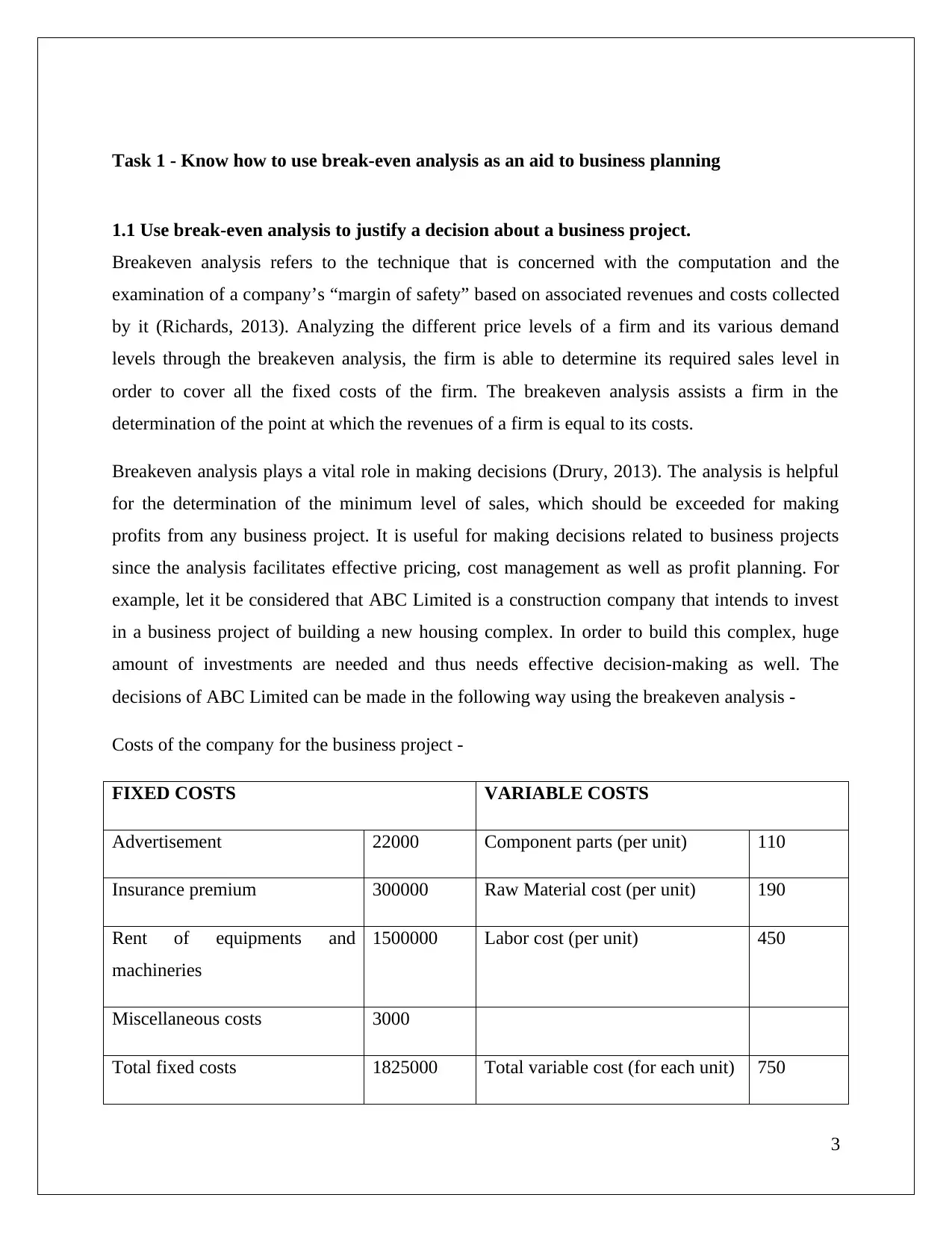
Costs of the company for the business project -
FIXED COSTS VARIABLE COSTS
Advertisement 22000 Component parts (per unit) 110
Insurance premium 300000 Raw Material cost (per unit) 190
Rent of equipments and
machineries
1500000 Labor cost (per unit) 450
Miscellaneous costs 3000
Total fixed costs 1825000 Total variable cost (for each unit) 750
3
1.1 Use break-even analysis to justify a decision about a business project.
Breakeven analysis refers to the technique that is concerned with the computation and the
examination of a company’s “margin of safety” based on associated revenues and costs collected
by it (Richards, 2013). Analyzing the different price levels of a firm and its various demand
levels through the breakeven analysis, the firm is able to determine its required sales level in
order to cover all the fixed costs of the firm. The breakeven analysis assists a firm in the
determination of the point at which the revenues of a firm is equal to its costs.
Breakeven analysis plays a vital role in making decisions (Drury, 2013). The analysis is helpful
for the determination of the minimum level of sales, which should be exceeded for making
profits from any business project. It is useful for making decisions related to business projects
since the analysis facilitates effective pricing, cost management as well as profit planning. For
example, let it be considered that ABC Limited is a construction company that intends to invest
in a business project of building a new housing complex. In order to build this complex, huge
amount of investments are needed and thus needs effective decision-making as well. The
decisions of ABC Limited can be made in the following way using the breakeven analysis -
Costs of the company for the business project -
FIXED COSTS VARIABLE COSTS
Advertisement 22000 Component parts (per unit) 110
Insurance premium 300000 Raw Material cost (per unit) 190
Rent of equipments and
machineries
1500000 Labor cost (per unit) 450
Miscellaneous costs 3000
Total fixed costs 1825000 Total variable cost (for each unit) 750
3
⊘ This is a preview!⊘
Do you want full access?
Subscribe today to unlock all pages.

Trusted by 1+ million students worldwide
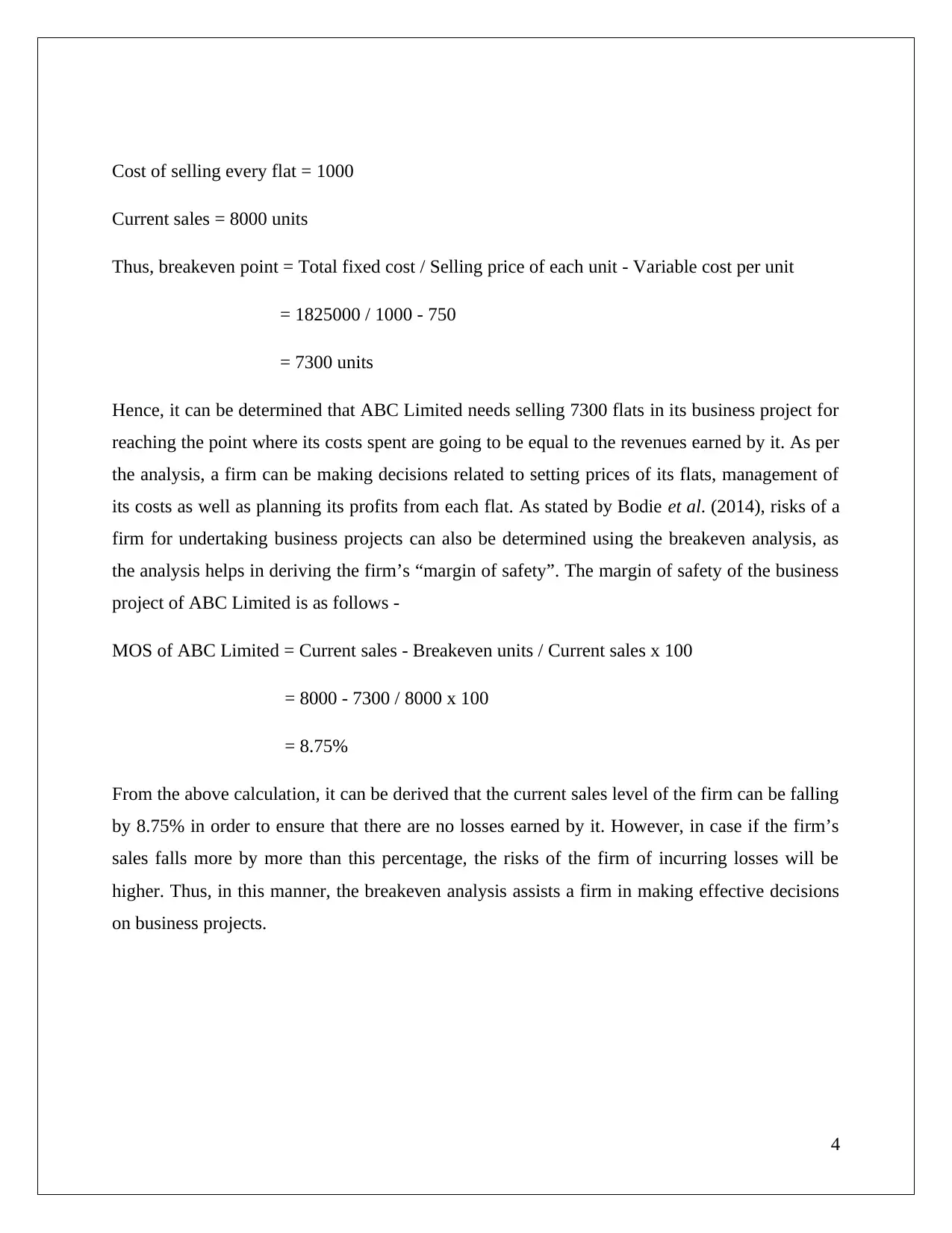
Cost of selling every flat = 1000
Current sales = 8000 units
Thus, breakeven point = Total fixed cost / Selling price of each unit - Variable cost per unit
= 1825000 / 1000 - 750
= 7300 units
Hence, it can be determined that ABC Limited needs selling 7300 flats in its business project for
reaching the point where its costs spent are going to be equal to the revenues earned by it. As per
the analysis, a firm can be making decisions related to setting prices of its flats, management of
its costs as well as planning its profits from each flat. As stated by Bodie et al. (2014), risks of a
firm for undertaking business projects can also be determined using the breakeven analysis, as
the analysis helps in deriving the firm’s “margin of safety”. The margin of safety of the business
project of ABC Limited is as follows -
MOS of ABC Limited = Current sales - Breakeven units / Current sales x 100
= 8000 - 7300 / 8000 x 100
= 8.75%
From the above calculation, it can be derived that the current sales level of the firm can be falling
by 8.75% in order to ensure that there are no losses earned by it. However, in case if the firm’s
sales falls more by more than this percentage, the risks of the firm of incurring losses will be
higher. Thus, in this manner, the breakeven analysis assists a firm in making effective decisions
on business projects.
4
Current sales = 8000 units
Thus, breakeven point = Total fixed cost / Selling price of each unit - Variable cost per unit
= 1825000 / 1000 - 750
= 7300 units
Hence, it can be determined that ABC Limited needs selling 7300 flats in its business project for
reaching the point where its costs spent are going to be equal to the revenues earned by it. As per
the analysis, a firm can be making decisions related to setting prices of its flats, management of
its costs as well as planning its profits from each flat. As stated by Bodie et al. (2014), risks of a
firm for undertaking business projects can also be determined using the breakeven analysis, as
the analysis helps in deriving the firm’s “margin of safety”. The margin of safety of the business
project of ABC Limited is as follows -
MOS of ABC Limited = Current sales - Breakeven units / Current sales x 100
= 8000 - 7300 / 8000 x 100
= 8.75%
From the above calculation, it can be derived that the current sales level of the firm can be falling
by 8.75% in order to ensure that there are no losses earned by it. However, in case if the firm’s
sales falls more by more than this percentage, the risks of the firm of incurring losses will be
higher. Thus, in this manner, the breakeven analysis assists a firm in making effective decisions
on business projects.
4
Paraphrase This Document
Need a fresh take? Get an instant paraphrase of this document with our AI Paraphraser
Task 2 - Understand costing
2.1 Evaluate a business decision using the techniques of management costing.
There are various important decisions, which are needed to be made in a business. One of the
most significant techniques that help a business in making decisions is management costing. The
following are the different techniques of management costing, which helps a business in
evaluating business decisions -
CVP analysis - According to Santos Almada et al. (2016), the CVP (cost volume profit)
analysis, is useful for the determination of the impact on the net earnings and operating
income of a company due to the changes in the volume produced and costs incurred by it.
This technique helps a business in making smart and cost-effective decisions of the
business. It is most helpful in making various short-term decisions in a firm due to the
detailed analysis of the costs, profits and volume of the business.
Activity based costing - The activity based costing, also called the ABC, refers to the
management costing technique that is concerned with the identification of the wide range
of activities performed in a business along with assignment of the costs spent in the
business in order to complete the activities (Stefano and Casarotto Filho, 2013). The
ABC technique is useful for making decisions on the costs of a business. It assists all
businesses in making decisions related to costs of production, what to be produced, the
quantity to be produced, the costs spent for production, etc.
Make or buy decision - As stated by Narasimhan (2017), the make or buy decision refers
to the technique of management costing, which is concerned with the selection between
the in-house production of a business and the purchase of finished inventories for sale
from any external supplier. This technique is useful in businesses for making decisions on
purchasing finished goods or conducting the entire process of production in the business.
Variance analysis - As stated by Levy (2015), the variance analysis technique involves
the quantitative investigation of the variances in the desired, forecasted and budgeted
outcomes of a business with the actual outcomes. This analysis helps a business in
5
2.1 Evaluate a business decision using the techniques of management costing.
There are various important decisions, which are needed to be made in a business. One of the
most significant techniques that help a business in making decisions is management costing. The
following are the different techniques of management costing, which helps a business in
evaluating business decisions -
CVP analysis - According to Santos Almada et al. (2016), the CVP (cost volume profit)
analysis, is useful for the determination of the impact on the net earnings and operating
income of a company due to the changes in the volume produced and costs incurred by it.
This technique helps a business in making smart and cost-effective decisions of the
business. It is most helpful in making various short-term decisions in a firm due to the
detailed analysis of the costs, profits and volume of the business.
Activity based costing - The activity based costing, also called the ABC, refers to the
management costing technique that is concerned with the identification of the wide range
of activities performed in a business along with assignment of the costs spent in the
business in order to complete the activities (Stefano and Casarotto Filho, 2013). The
ABC technique is useful for making decisions on the costs of a business. It assists all
businesses in making decisions related to costs of production, what to be produced, the
quantity to be produced, the costs spent for production, etc.
Make or buy decision - As stated by Narasimhan (2017), the make or buy decision refers
to the technique of management costing, which is concerned with the selection between
the in-house production of a business and the purchase of finished inventories for sale
from any external supplier. This technique is useful in businesses for making decisions on
purchasing finished goods or conducting the entire process of production in the business.
Variance analysis - As stated by Levy (2015), the variance analysis technique involves
the quantitative investigation of the variances in the desired, forecasted and budgeted
outcomes of a business with the actual outcomes. This analysis helps a business in
5
making decisions on how the adverse or unfavorable variances determined in the
performance of a business can be overcome.
In addition to the techniques of management costing mentioned above, various other techniques,
for example, inventory management, budgeting, JIT (just in time), enterprise cost management,
etc. also help a business in making efficient decisions in different ways (Potts and Ankrah,
2014).
6
performance of a business can be overcome.
In addition to the techniques of management costing mentioned above, various other techniques,
for example, inventory management, budgeting, JIT (just in time), enterprise cost management,
etc. also help a business in making efficient decisions in different ways (Potts and Ankrah,
2014).
6
⊘ This is a preview!⊘
Do you want full access?
Subscribe today to unlock all pages.
Trusted by 1+ million students worldwide
Task 3 - Understand the significance of the final accounts of a business
3.1 Discuss the reasons for the importance of final accounts to the stakeholders of a
business
Final accounts of a company are the financial statements and accounts prepared in the company
in order to portray the financial state and performance of the company during a particular period
(Burrows, 2016). Final accounts are important, as it gives a clear image of the liquidity,
profitability, etc. of a company to all its stakeholders (Lawrence and Weber, 2014). The
decisions to be made by the stakeholders of a company are dependent on the final accounts of the
company. As stated by Mitchell et al. (2015), importance of financial to a business’s
stakeholders is as follows -
The owners of a company use final accounts in order to analyze the effect of their
personal drawings over the business. They also use final accounts for making decisions
on a company’s projects, to determine the sources of funds of the company, etc.
The directors and managers of a company use final accounts to make various decision s
and analyze the company’s invest opportunities, annual bonuses, long-term financial
stability, etc.
The employees of a company use the information from final accounts in order to decide
whether they will be continuing working in the company or not, as final accounts help
them in analyzing their security of working in the company.
The tax authorities and governments use the final accounts in order to analyze the correct
payment of their taxes.
The customers of a business analyze the dependability of the business through analyzing
the business’s final accounts through which they promote the business and maintain its
loyalty.
A business’s rivals use final accounts in order to compare their own financial
performance with the financial performance of the business. Final accounts also help
other businesses in analyzing their chances of mergers, joint ventures or partnership with
the business.
7
3.1 Discuss the reasons for the importance of final accounts to the stakeholders of a
business
Final accounts of a company are the financial statements and accounts prepared in the company
in order to portray the financial state and performance of the company during a particular period
(Burrows, 2016). Final accounts are important, as it gives a clear image of the liquidity,
profitability, etc. of a company to all its stakeholders (Lawrence and Weber, 2014). The
decisions to be made by the stakeholders of a company are dependent on the final accounts of the
company. As stated by Mitchell et al. (2015), importance of financial to a business’s
stakeholders is as follows -
The owners of a company use final accounts in order to analyze the effect of their
personal drawings over the business. They also use final accounts for making decisions
on a company’s projects, to determine the sources of funds of the company, etc.
The directors and managers of a company use final accounts to make various decision s
and analyze the company’s invest opportunities, annual bonuses, long-term financial
stability, etc.
The employees of a company use the information from final accounts in order to decide
whether they will be continuing working in the company or not, as final accounts help
them in analyzing their security of working in the company.
The tax authorities and governments use the final accounts in order to analyze the correct
payment of their taxes.
The customers of a business analyze the dependability of the business through analyzing
the business’s final accounts through which they promote the business and maintain its
loyalty.
A business’s rivals use final accounts in order to compare their own financial
performance with the financial performance of the business. Final accounts also help
other businesses in analyzing their chances of mergers, joint ventures or partnership with
the business.
7
Paraphrase This Document
Need a fresh take? Get an instant paraphrase of this document with our AI Paraphraser
The suppliers of a business use final accounts for analyzing the credibility and the ability
of the business to pay its suppliers.
The shareholders of a business use final accounts for measuring their decisions on
investing in the shares of the business have been correct or not.
The investors use the final accounts of businesses for analyzing the benefits of the
investors from investing in the businesses.
The special interest groups of a business use the business’s final accounts for the
examination of whether the business performs any unethical acts or not.
8
of the business to pay its suppliers.
The shareholders of a business use final accounts for measuring their decisions on
investing in the shares of the business have been correct or not.
The investors use the final accounts of businesses for analyzing the benefits of the
investors from investing in the businesses.
The special interest groups of a business use the business’s final accounts for the
examination of whether the business performs any unethical acts or not.
8
Task 4 - Understand ratio analysis
4.1 Evaluate the financial state of a business through the application of the techniques of
ratio analysis
The quantitative analysis and investigation of the relevant information present in a company’s
financial statements is called ratio analysis (Uechi et al., 2015). The ratio analysis is useful for
the evaluation of the performance of a firm from various aspects, for example, liquidity,
profitability, efficiency, solvency, etc. The techniques of ratio analysis refers to the wide range of
financial ratios, which are computed for analyzing a firm’s financial stability and performance.
For example, the Tate and Lyle Plc is a multinational food processing company operating in UK.
The financial state of the company Tate and Lyle can be analyzed through the application of the
techniques of ratio analysis, which has been done in the portion below -
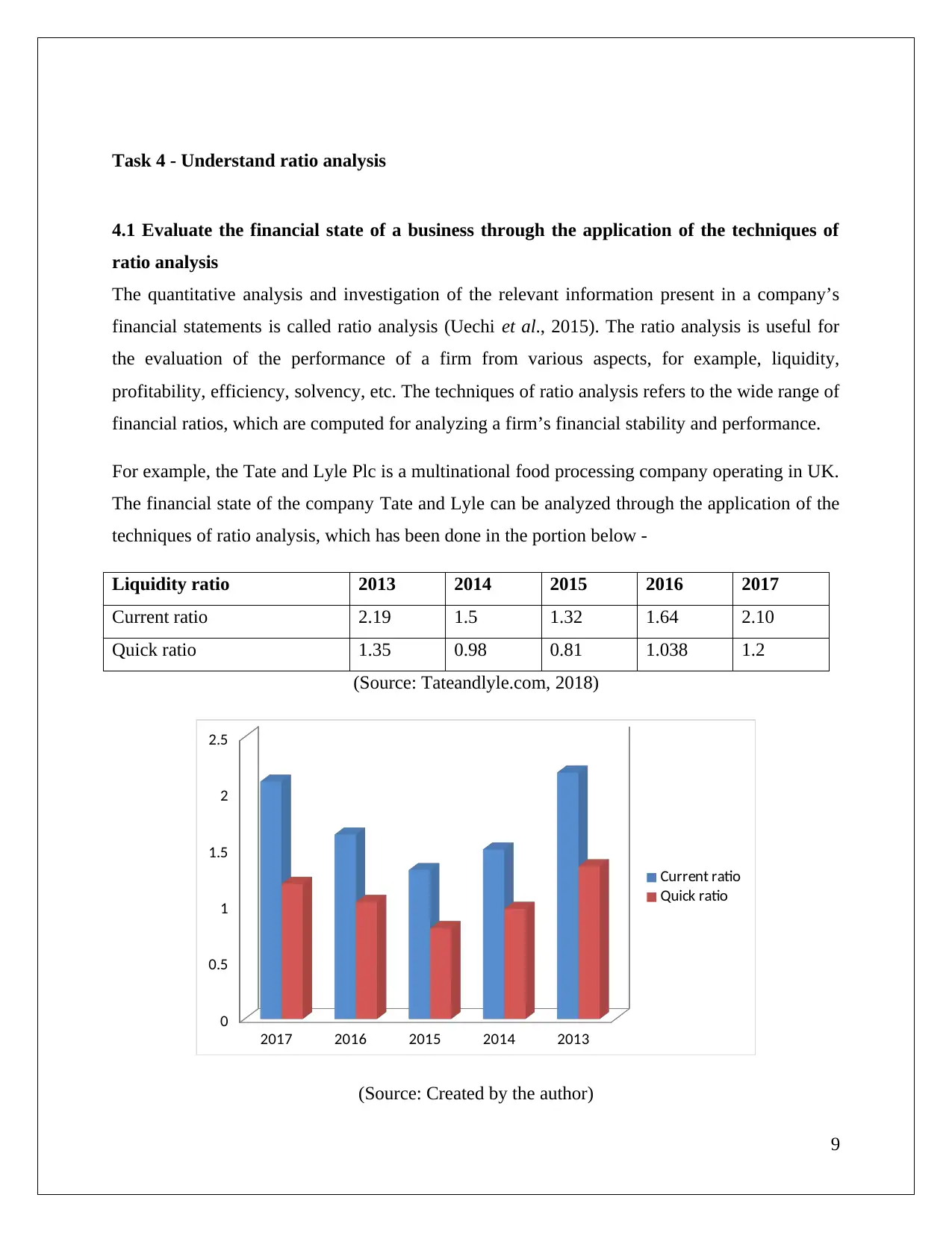
Liquidity ratio 2013 2014 2015 2016 2017
Current ratio 2.19 1.5 1.32 1.64 2.10
Quick ratio 1.35 0.98 0.81 1.038 1.2
(Source: Tateandlyle.com, 2018)
2017 2016 2015 2014 2013
0
0.5
1
1.5
2
2.5
Current ratio
Quick ratio
(Source: Created by the author)
9
4.1 Evaluate the financial state of a business through the application of the techniques of
ratio analysis
The quantitative analysis and investigation of the relevant information present in a company’s
financial statements is called ratio analysis (Uechi et al., 2015). The ratio analysis is useful for
the evaluation of the performance of a firm from various aspects, for example, liquidity,
profitability, efficiency, solvency, etc. The techniques of ratio analysis refers to the wide range of
financial ratios, which are computed for analyzing a firm’s financial stability and performance.
For example, the Tate and Lyle Plc is a multinational food processing company operating in UK.
The financial state of the company Tate and Lyle can be analyzed through the application of the
techniques of ratio analysis, which has been done in the portion below -
Liquidity ratio 2013 2014 2015 2016 2017
Current ratio 2.19 1.5 1.32 1.64 2.10
Quick ratio 1.35 0.98 0.81 1.038 1.2
(Source: Tateandlyle.com, 2018)
2017 2016 2015 2014 2013
0
0.5
1
1.5
2
2.5
Current ratio
Quick ratio
(Source: Created by the author)
9
⊘ This is a preview!⊘
Do you want full access?
Subscribe today to unlock all pages.
Trusted by 1+ million students worldwide
The above figure and table shows the current ratio and quick ratio of the company Tate and Lyle
during the last five years. From the analysis, it can be determined that the liquid position of the
company was best during the 2013, after which it can be noticed to decrease slightly. However,
an increase can be noticed during the year 2017. The current ratio of the company is quite good
while there is scope for improvement in the company’s quick ratio.
Similar to the analysis of the liquid position of the company Tate and Lyle, the solvency of the
company can also be analyzed from the application of ratio analysis techniques. The solvency
ratios of the company are as follows -
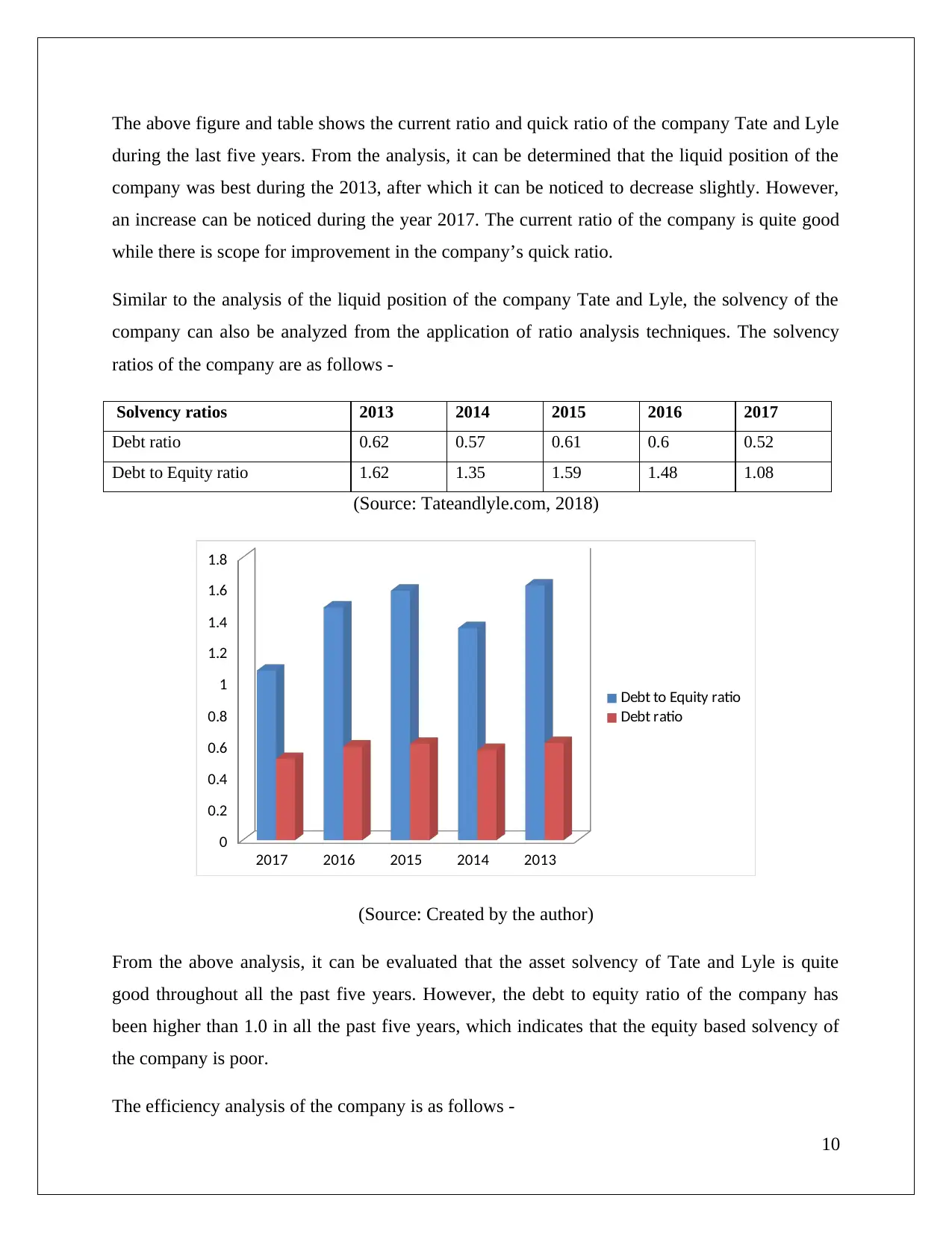
Solvency ratios 2013 2014 2015 2016 2017
Debt ratio 0.62 0.57 0.61 0.6 0.52
Debt to Equity ratio 1.62 1.35 1.59 1.48 1.08
(Source: Tateandlyle.com, 2018)
2017 2016 2015 2014 2013
0
0.2
0.4
0.6
0.8
1
1.2
1.4
1.6
1.8
Debt to Equity ratio
Debt ratio
(Source: Created by the author)
From the above analysis, it can be evaluated that the asset solvency of Tate and Lyle is quite
good throughout all the past five years. However, the debt to equity ratio of the company has
been higher than 1.0 in all the past five years, which indicates that the equity based solvency of
the company is poor.
The efficiency analysis of the company is as follows -
10
during the last five years. From the analysis, it can be determined that the liquid position of the
company was best during the 2013, after which it can be noticed to decrease slightly. However,
an increase can be noticed during the year 2017. The current ratio of the company is quite good
while there is scope for improvement in the company’s quick ratio.
Similar to the analysis of the liquid position of the company Tate and Lyle, the solvency of the
company can also be analyzed from the application of ratio analysis techniques. The solvency
ratios of the company are as follows -
Solvency ratios 2013 2014 2015 2016 2017
Debt ratio 0.62 0.57 0.61 0.6 0.52
Debt to Equity ratio 1.62 1.35 1.59 1.48 1.08
(Source: Tateandlyle.com, 2018)
2017 2016 2015 2014 2013
0
0.2
0.4
0.6
0.8
1
1.2
1.4
1.6
1.8
Debt to Equity ratio
Debt ratio
(Source: Created by the author)
From the above analysis, it can be evaluated that the asset solvency of Tate and Lyle is quite
good throughout all the past five years. However, the debt to equity ratio of the company has
been higher than 1.0 in all the past five years, which indicates that the equity based solvency of
the company is poor.
The efficiency analysis of the company is as follows -
10
Paraphrase This Document
Need a fresh take? Get an instant paraphrase of this document with our AI Paraphraser
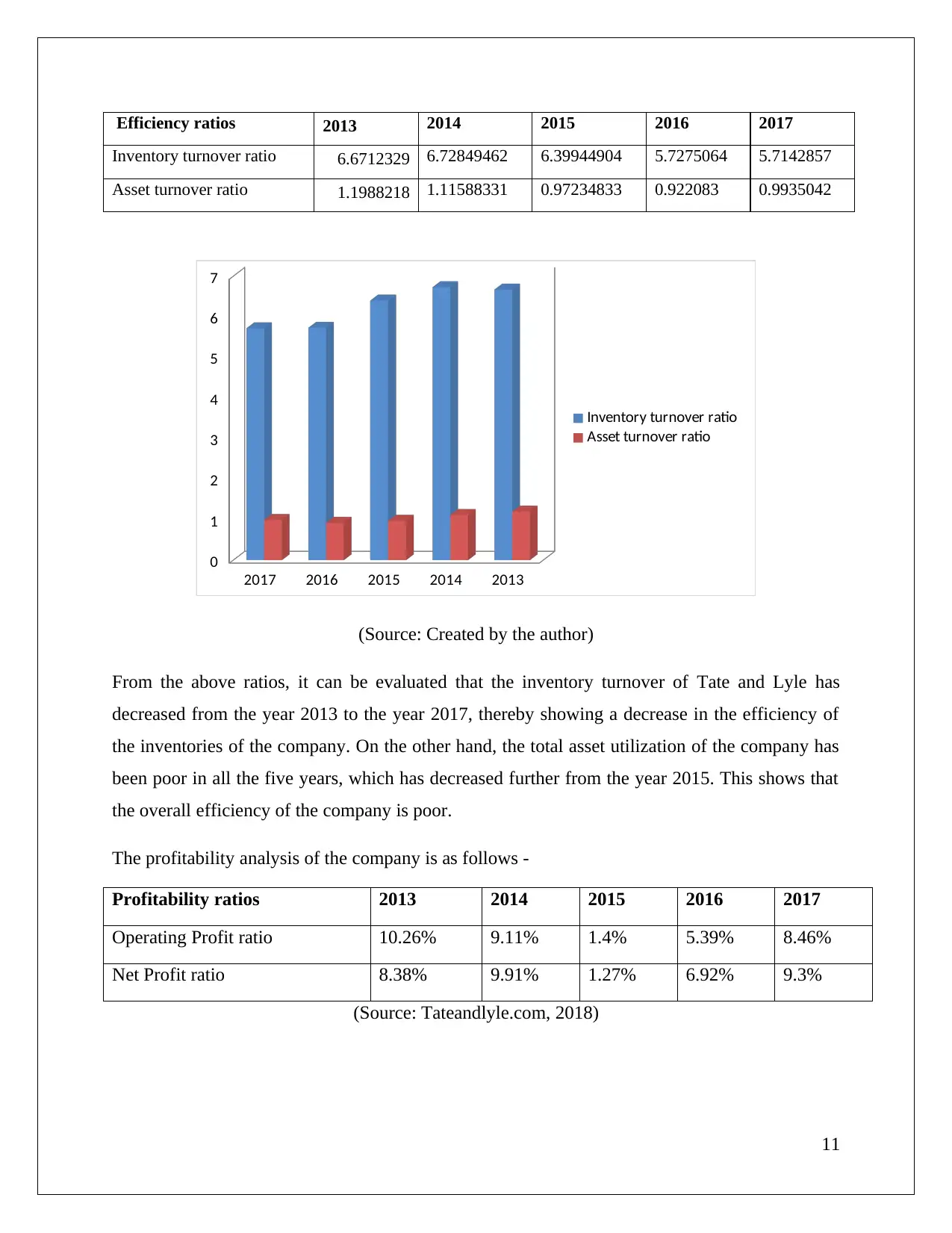
Efficiency ratios 2013 2014 2015 2016 2017
Inventory turnover ratio 6.6712329 6.72849462 6.39944904 5.7275064 5.7142857
Asset turnover ratio 1.1988218 1.11588331 0.97234833 0.922083 0.9935042
2017 2016 2015 2014 2013
0
1
2
3
4
5
6
7
Inventory turnover ratio
Asset turnover ratio
(Source: Created by the author)
From the above ratios, it can be evaluated that the inventory turnover of Tate and Lyle has
decreased from the year 2013 to the year 2017, thereby showing a decrease in the efficiency of
the inventories of the company. On the other hand, the total asset utilization of the company has
been poor in all the five years, which has decreased further from the year 2015. This shows that
the overall efficiency of the company is poor.
The profitability analysis of the company is as follows -
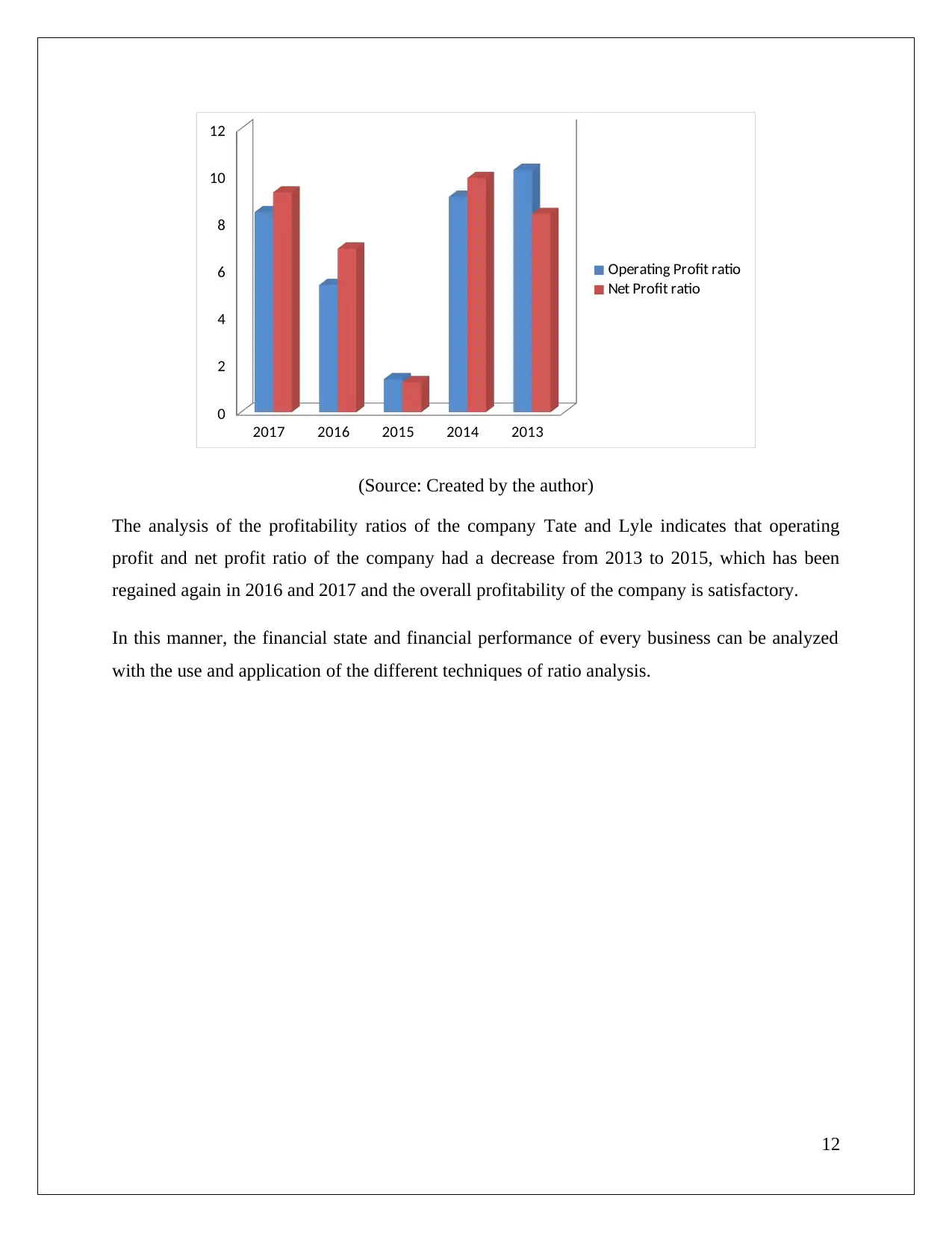
Profitability ratios 2013 2014 2015 2016 2017
Operating Profit ratio 10.26% 9.11% 1.4% 5.39% 8.46%
Net Profit ratio 8.38% 9.91% 1.27% 6.92% 9.3%
(Source: Tateandlyle.com, 2018)
11
Inventory turnover ratio 6.6712329 6.72849462 6.39944904 5.7275064 5.7142857
Asset turnover ratio 1.1988218 1.11588331 0.97234833 0.922083 0.9935042
2017 2016 2015 2014 2013
0
1
2
3
4
5
6
7
Inventory turnover ratio
Asset turnover ratio
(Source: Created by the author)
From the above ratios, it can be evaluated that the inventory turnover of Tate and Lyle has
decreased from the year 2013 to the year 2017, thereby showing a decrease in the efficiency of
the inventories of the company. On the other hand, the total asset utilization of the company has
been poor in all the five years, which has decreased further from the year 2015. This shows that
the overall efficiency of the company is poor.
The profitability analysis of the company is as follows -
Profitability ratios 2013 2014 2015 2016 2017
Operating Profit ratio 10.26% 9.11% 1.4% 5.39% 8.46%
Net Profit ratio 8.38% 9.91% 1.27% 6.92% 9.3%
(Source: Tateandlyle.com, 2018)
11
2017 2016 2015 2014 2013
0
2
4
6
8
10
12
Operating Profit ratio
Net Profit ratio
(Source: Created by the author)
The analysis of the profitability ratios of the company Tate and Lyle indicates that operating
profit and net profit ratio of the company had a decrease from 2013 to 2015, which has been
regained again in 2016 and 2017 and the overall profitability of the company is satisfactory.
In this manner, the financial state and financial performance of every business can be analyzed
with the use and application of the different techniques of ratio analysis.
12
0
2
4
6
8
10
12
Operating Profit ratio
Net Profit ratio
(Source: Created by the author)
The analysis of the profitability ratios of the company Tate and Lyle indicates that operating
profit and net profit ratio of the company had a decrease from 2013 to 2015, which has been
regained again in 2016 and 2017 and the overall profitability of the company is satisfactory.
In this manner, the financial state and financial performance of every business can be analyzed
with the use and application of the different techniques of ratio analysis.
12
⊘ This is a preview!⊘
Do you want full access?
Subscribe today to unlock all pages.
Trusted by 1+ million students worldwide

1 out of 13


Related Documents


Your All-in-One AI-Powered Toolkit for Academic Success.
+13062052269
info@desklib.com
Available 24*7 on WhatsApp / Email
![[object Object]](/_next/static/media/star-bottom.7253800d.svg)
Unlock your academic potential
Copyright © 2020–2026 A2Z Services. All Rights Reserved. Developed and managed by ZUCOL.