Accounting Report: Business Transactions and Financial Analysis

Verified

Added on  2023/01/09

|23
|4455
|92
Report
AI Summary
This report provides a detailed analysis of financial accounting principles and practices. It begins with an introduction to financial accounting and its importance, followed by two scenarios. Scenario 1 examines various types of business transactions, including sales, purchases, and payroll, and explains single and double-entry bookkeeping systems. It includes journal entries, ledger accounts, and a trial balance for Kate's business, along with financial statement analysis. Scenario 2 focuses on bank reconciliation, control accounts, and suspense accounts. The report covers the differences between financial statements and financial reports, as well as fundamental accounting principles like revenue recognition, full disclosure, prudence, matching, cost, and monetary unit principles. Finally, the report provides final accounts for Carol Andrew’s business, including a profit and loss account and balance sheet. The report concludes with a bank reconciliation analysis.
Document Page
Accounting
1
tabler-icon-diamond-filled.svg

Paraphrase This Document

Need a fresh take? Get an instant paraphrase of this document with our AI Paraphraser
Document Page
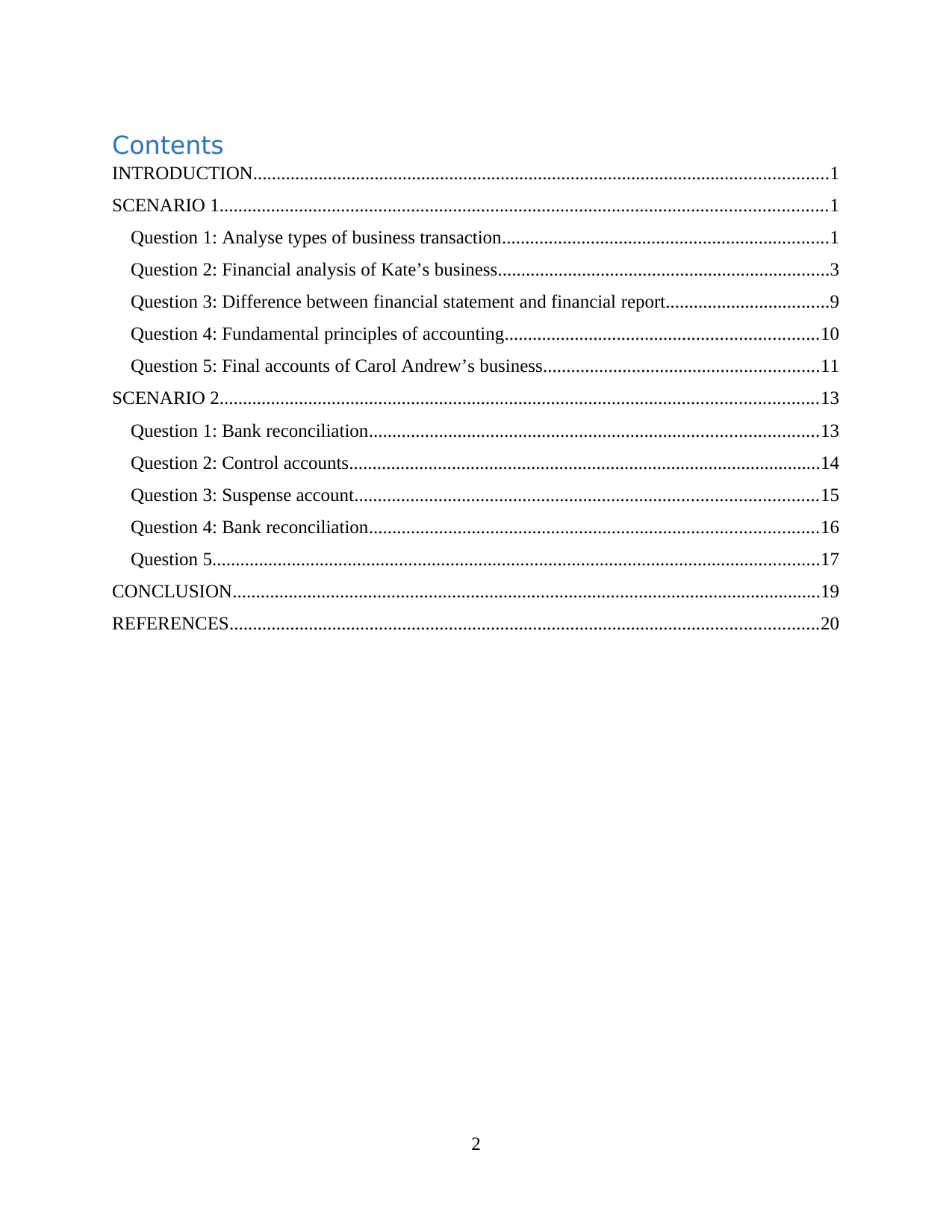
Contents
INTRODUCTION...........................................................................................................................1
SCENARIO 1..................................................................................................................................1
Question 1: Analyse types of business transaction......................................................................1
Question 2: Financial analysis of Kate’s business.......................................................................3
Question 3: Difference between financial statement and financial report...................................9
Question 4: Fundamental principles of accounting...................................................................10
Question 5: Final accounts of Carol Andrew’s business...........................................................11
SCENARIO 2................................................................................................................................13
Question 1: Bank reconciliation................................................................................................13
Question 2: Control accounts.....................................................................................................14
Question 3: Suspense account...................................................................................................15
Question 4: Bank reconciliation................................................................................................16
Question 5..................................................................................................................................17
CONCLUSION..............................................................................................................................19
REFERENCES..............................................................................................................................20
2
Document Page
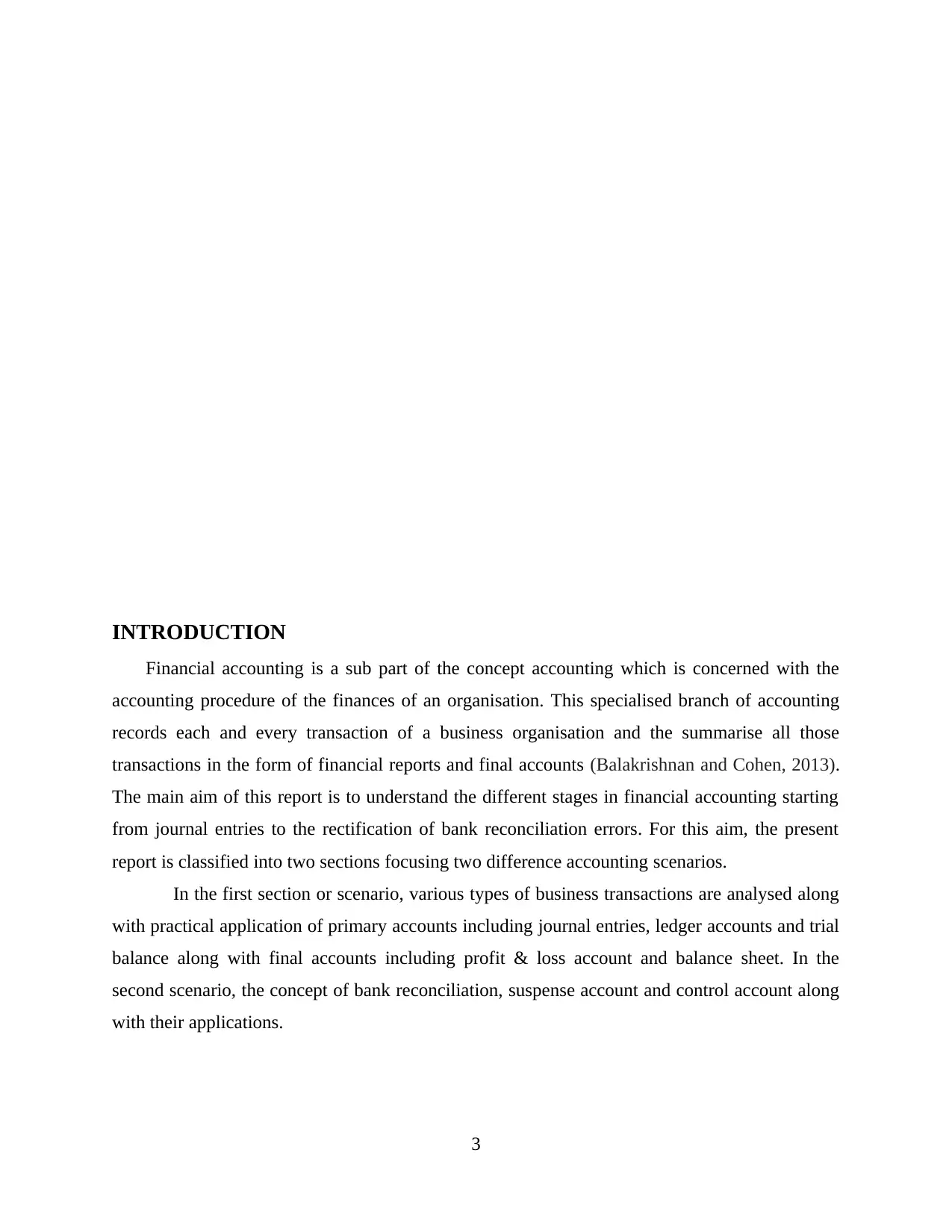
INTRODUCTION
Financial accounting is a sub part of the concept accounting which is concerned with the
accounting procedure of the finances of an organisation. This specialised branch of accounting
records each and every transaction of a business organisation and the summarise all those
transactions in the form of financial reports and final accounts (Balakrishnan and Cohen, 2013).
The main aim of this report is to understand the different stages in financial accounting starting
from journal entries to the rectification of bank reconciliation errors. For this aim, the present
report is classified into two sections focusing two difference accounting scenarios.
In the first section or scenario, various types of business transactions are analysed along
with practical application of primary accounts including journal entries, ledger accounts and trial
balance along with final accounts including profit & loss account and balance sheet. In the
second scenario, the concept of bank reconciliation, suspense account and control account along
with their applications.
3
Document Page
SCENARIO 1
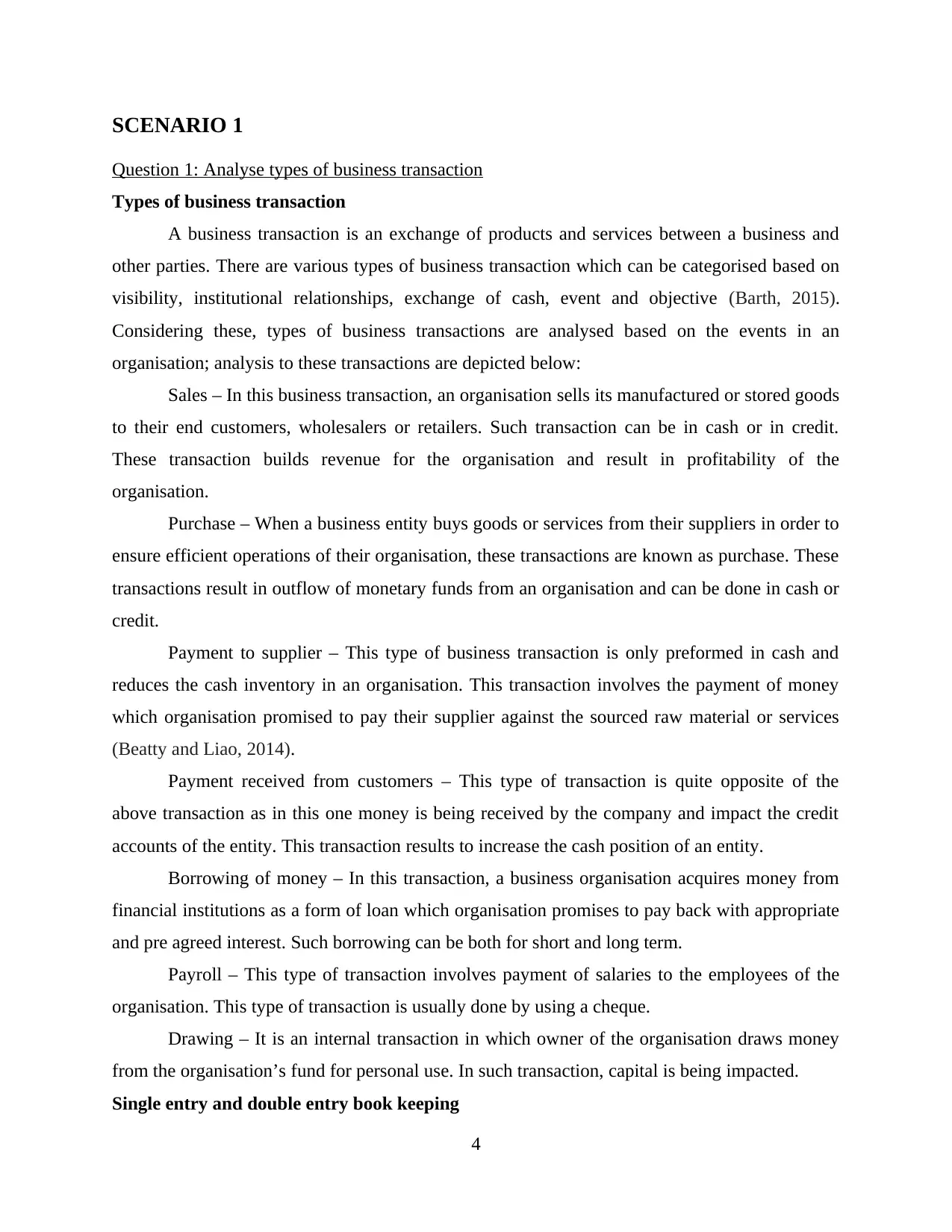
Question 1: Analyse types of business transaction
Types of business transaction
A business transaction is an exchange of products and services between a business and
other parties. There are various types of business transaction which can be categorised based on
visibility, institutional relationships, exchange of cash, event and objective (Barth, 2015).
Considering these, types of business transactions are analysed based on the events in an
organisation; analysis to these transactions are depicted below:
Sales – In this business transaction, an organisation sells its manufactured or stored goods
to their end customers, wholesalers or retailers. Such transaction can be in cash or in credit.
These transaction builds revenue for the organisation and result in profitability of the
organisation.
Purchase – When a business entity buys goods or services from their suppliers in order to
ensure efficient operations of their organisation, these transactions are known as purchase. These
transactions result in outflow of monetary funds from an organisation and can be done in cash or
credit.
Payment to supplier – This type of business transaction is only preformed in cash and
reduces the cash inventory in an organisation. This transaction involves the payment of money
which organisation promised to pay their supplier against the sourced raw material or services
(Beatty and Liao, 2014).
Payment received from customers – This type of transaction is quite opposite of the
above transaction as in this one money is being received by the company and impact the credit
accounts of the entity. This transaction results to increase the cash position of an entity.
Borrowing of money – In this transaction, a business organisation acquires money from
financial institutions as a form of loan which organisation promises to pay back with appropriate
and pre agreed interest. Such borrowing can be both for short and long term.
Payroll – This type of transaction involves payment of salaries to the employees of the
organisation. This type of transaction is usually done by using a cheque.
Drawing – It is an internal transaction in which owner of the organisation draws money
from the organisation’s fund for personal use. In such transaction, capital is being impacted.
Single entry and double entry book keeping
4
tabler-icon-diamond-filled.svg

Paraphrase This Document

Need a fresh take? Get an instant paraphrase of this document with our AI Paraphraser
Document Page
Single entry book keeping system is a way to maintain business transactions in an
organisation in which every transaction including income and expenses are recorded as one
entry. This system is usually recorded using a two column ledger in which column is for the
transactions and one is for its associated amount. This type of book keeping system is used by
usually small organisations which are not involved in much transactions.
Double entry book keeping system is a procedure according to which every entry is
recorded into two accounts out of each one of debit and one is credit. The basic agenda of double
entry system is to make sure that the balances of both the sides are equal. It is being considered
that every amount of one column impacts the amount of other column (Bushman, 2014). Instead
of two, there are three columns in this system which are transaction, debit amount and credit
amount.
Trial balance and its importance
Trial balance is developed using double entry book keepings system. Trial balance is a
statement which records balances of all ledger accounts and then entire statement is compiled
into two columns of debit and credit. An accurate and duly developed trial balance has balances
of both the sides equal.
Development of trial balance holds various points of importance for a business
transaction. The statement of trial balance is important as it provides the base for development of
income statement and balance sheet (Edwards, 2013). As this statement is developed using
double entry book keeping, it helps in analysing the arithmetical accuracy of the accounts. This
statement of trial balance is also important as it helps in rectifying the errors and helps in making
reliable decisions for the future strategies of the company.
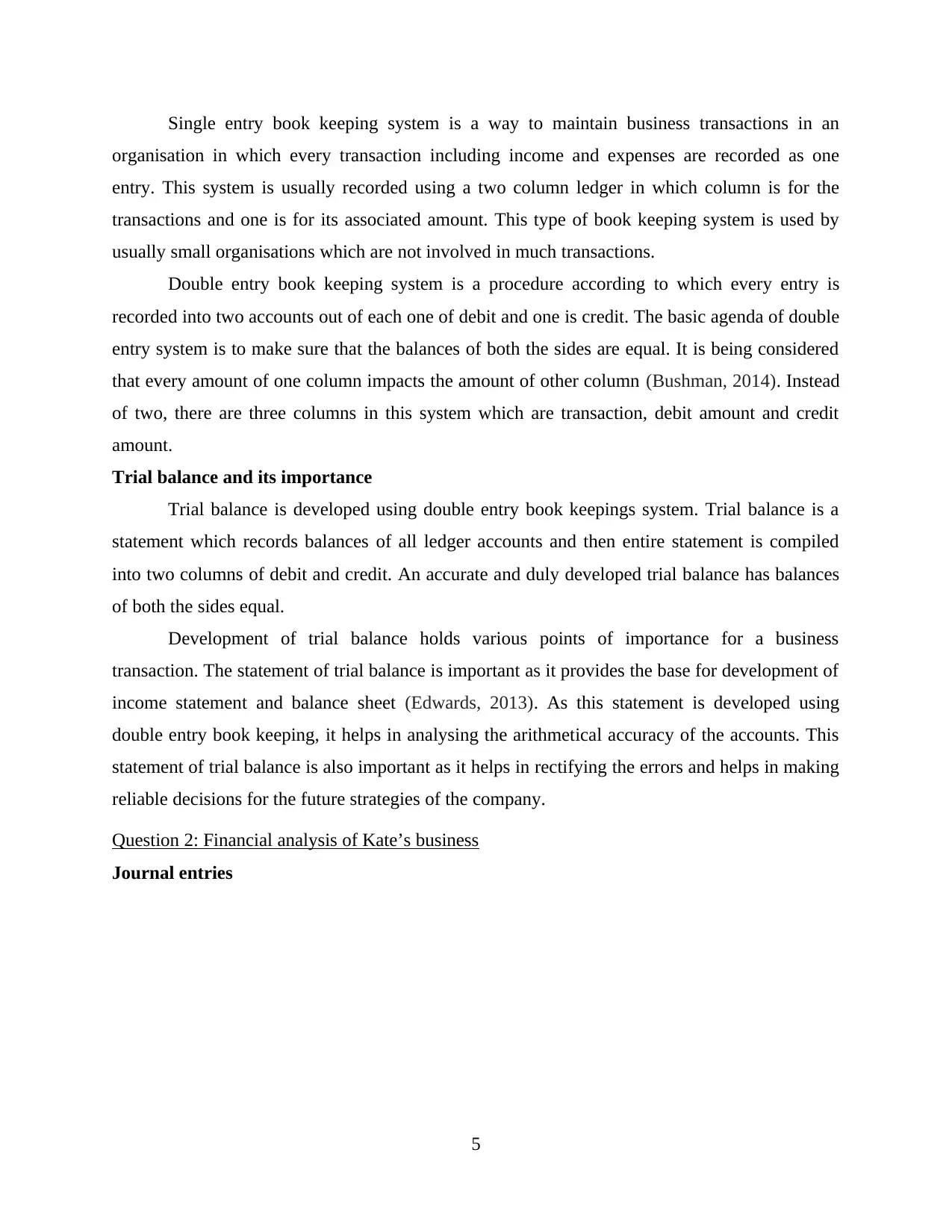
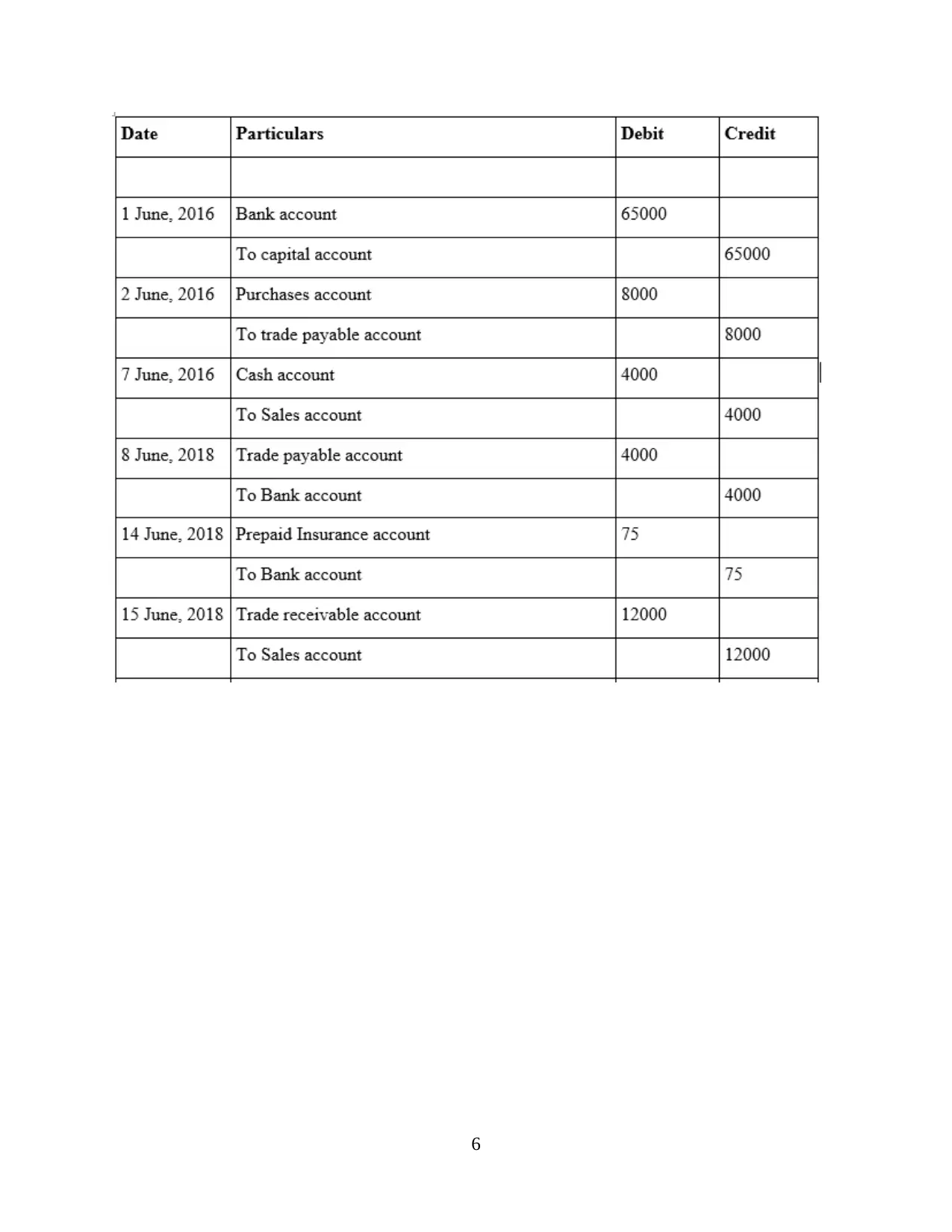
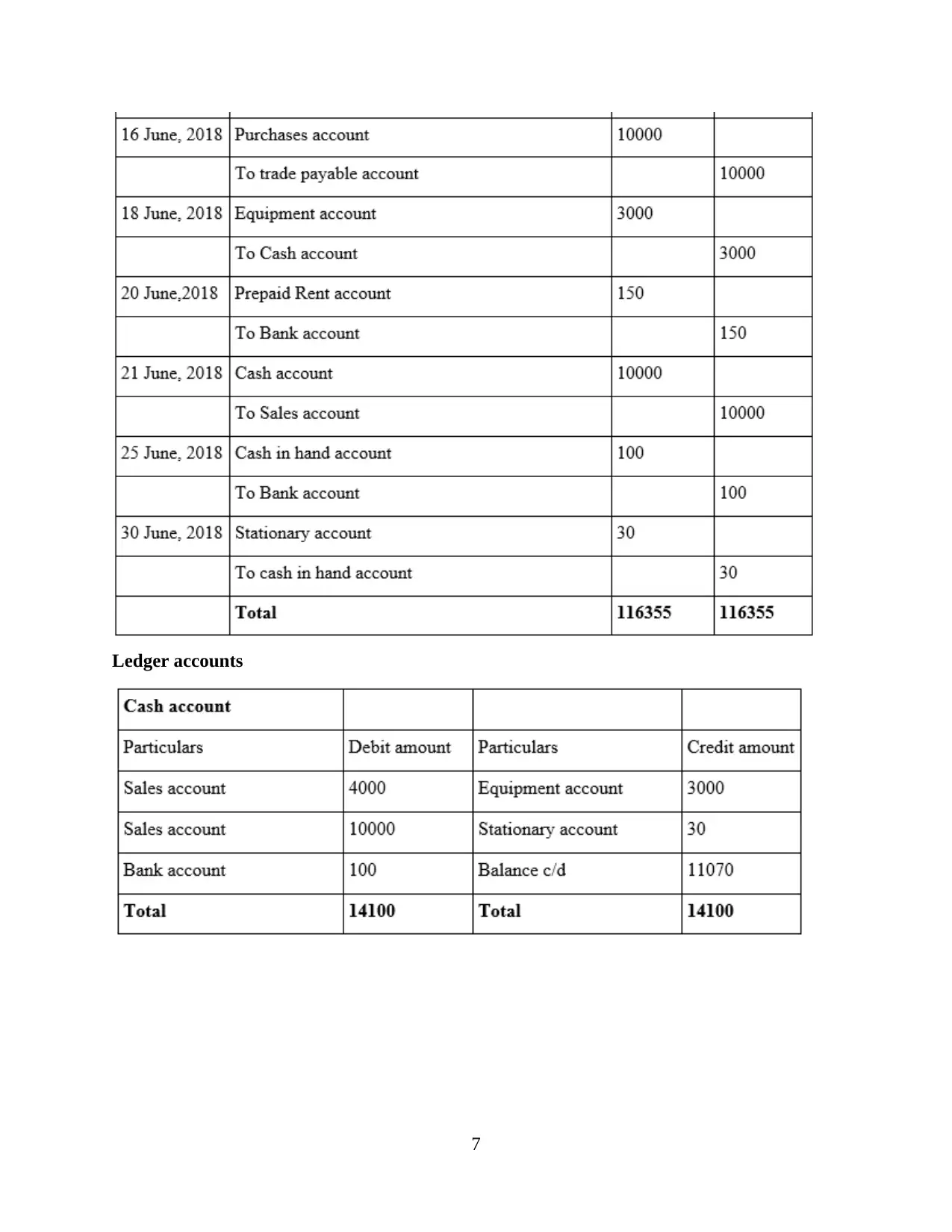
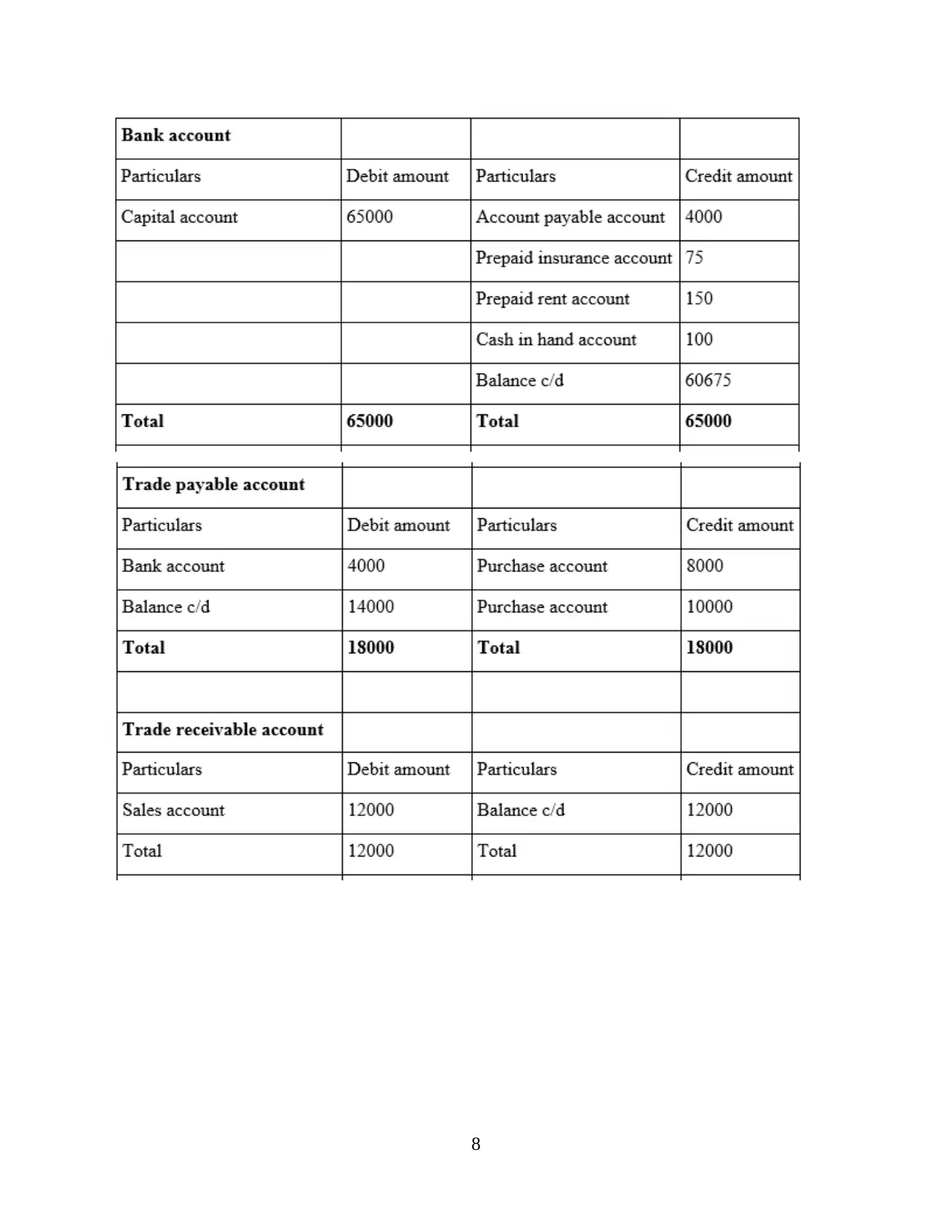
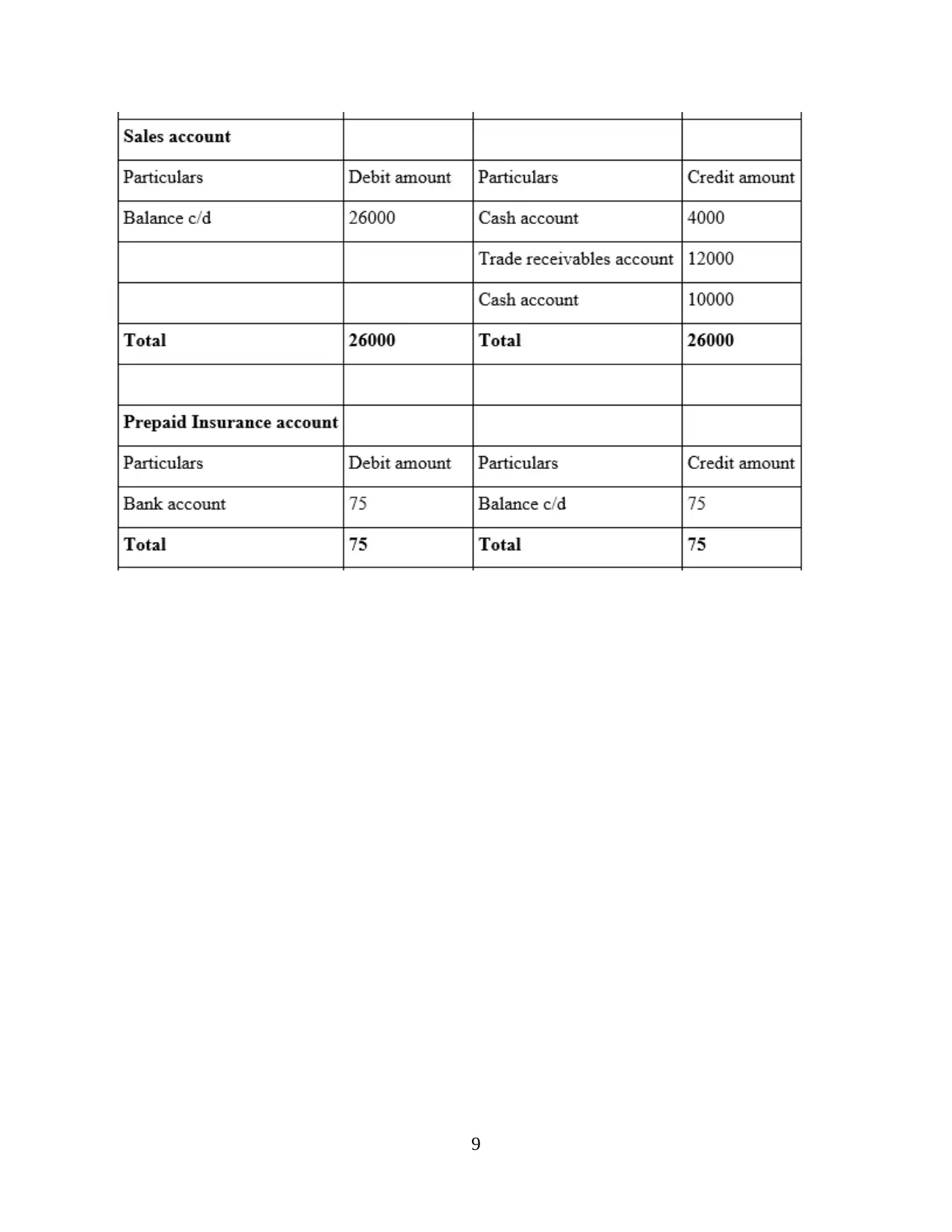
Question 2: Financial analysis of Kate’s business
Journal entries
5
Document Page
6
Document Page
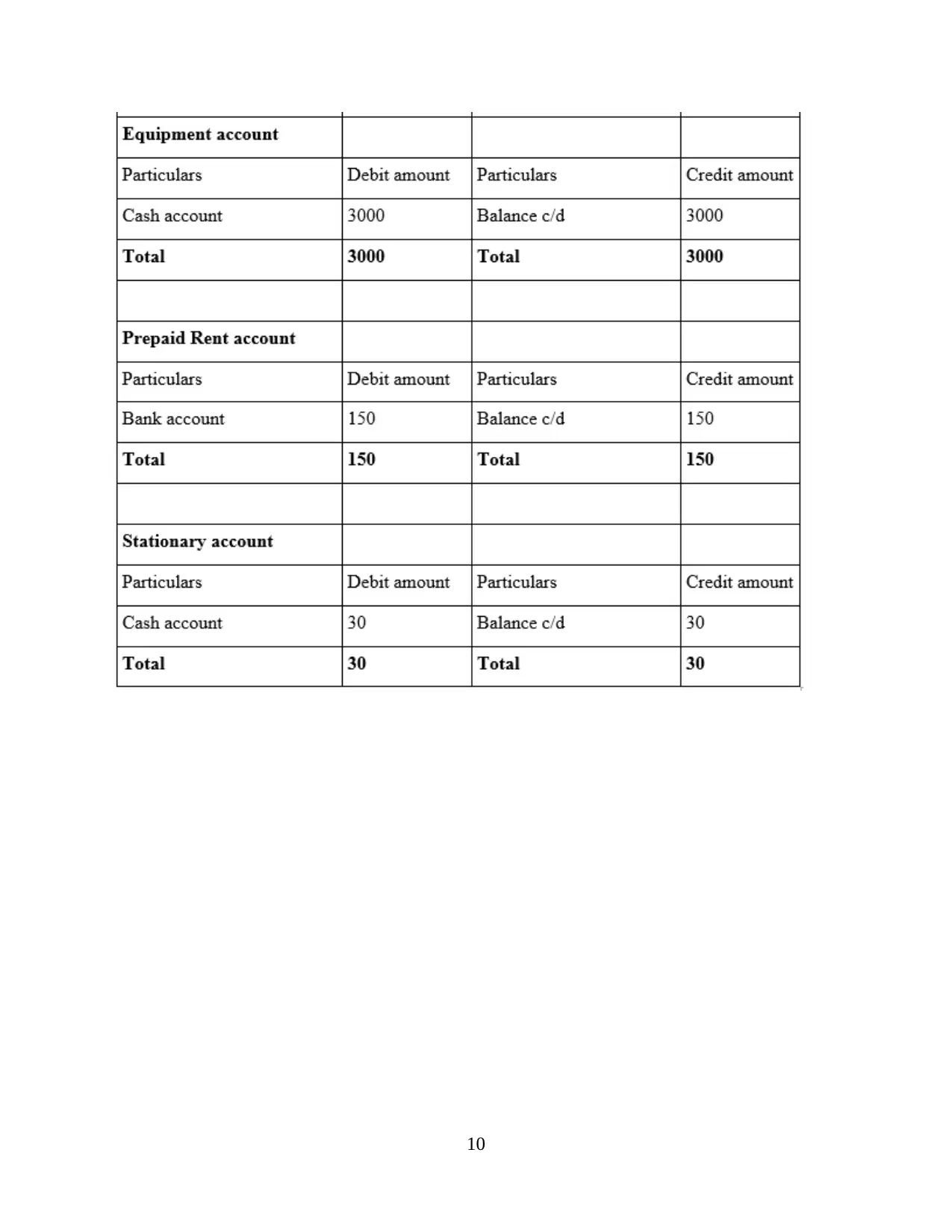
Ledger accounts
7
tabler-icon-diamond-filled.svg

Paraphrase This Document

Need a fresh take? Get an instant paraphrase of this document with our AI Paraphraser
Document Page
8
Document Page
9
Document Page
10
tabler-icon-diamond-filled.svg

Paraphrase This Document

Need a fresh take? Get an instant paraphrase of this document with our AI Paraphraser
Document Page
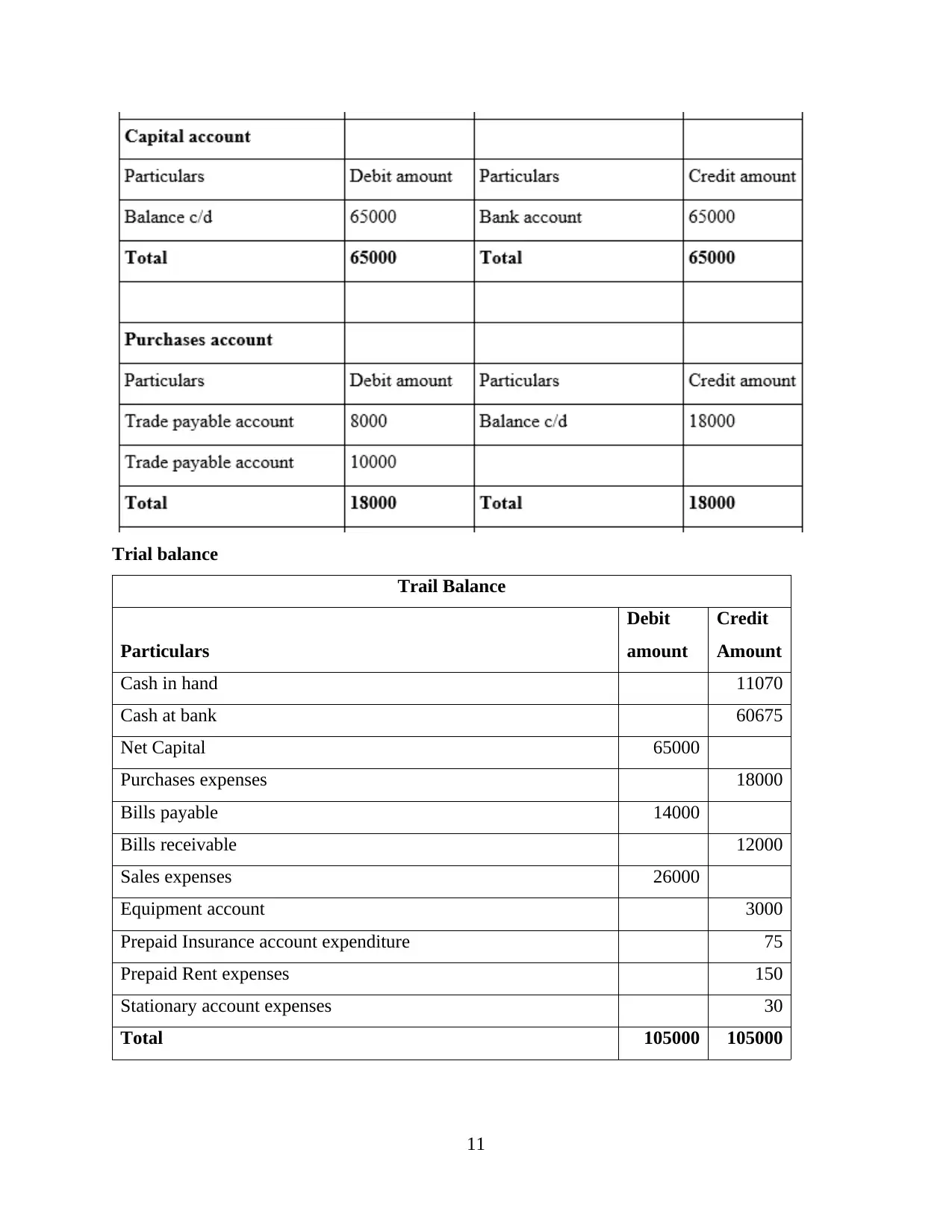
Trial balance
Trail Balance
Particulars
Debit
amount
Credit
Amount
Cash in hand 11070
Cash at bank 60675
Net Capital 65000
Purchases expenses 18000
Bills payable 14000
Bills receivable 12000
Sales expenses 26000
Equipment account 3000
Prepaid Insurance account expenditure 75
Prepaid Rent expenses 150
Stationary account expenses 30
Total 105000 105000
11
Document Page
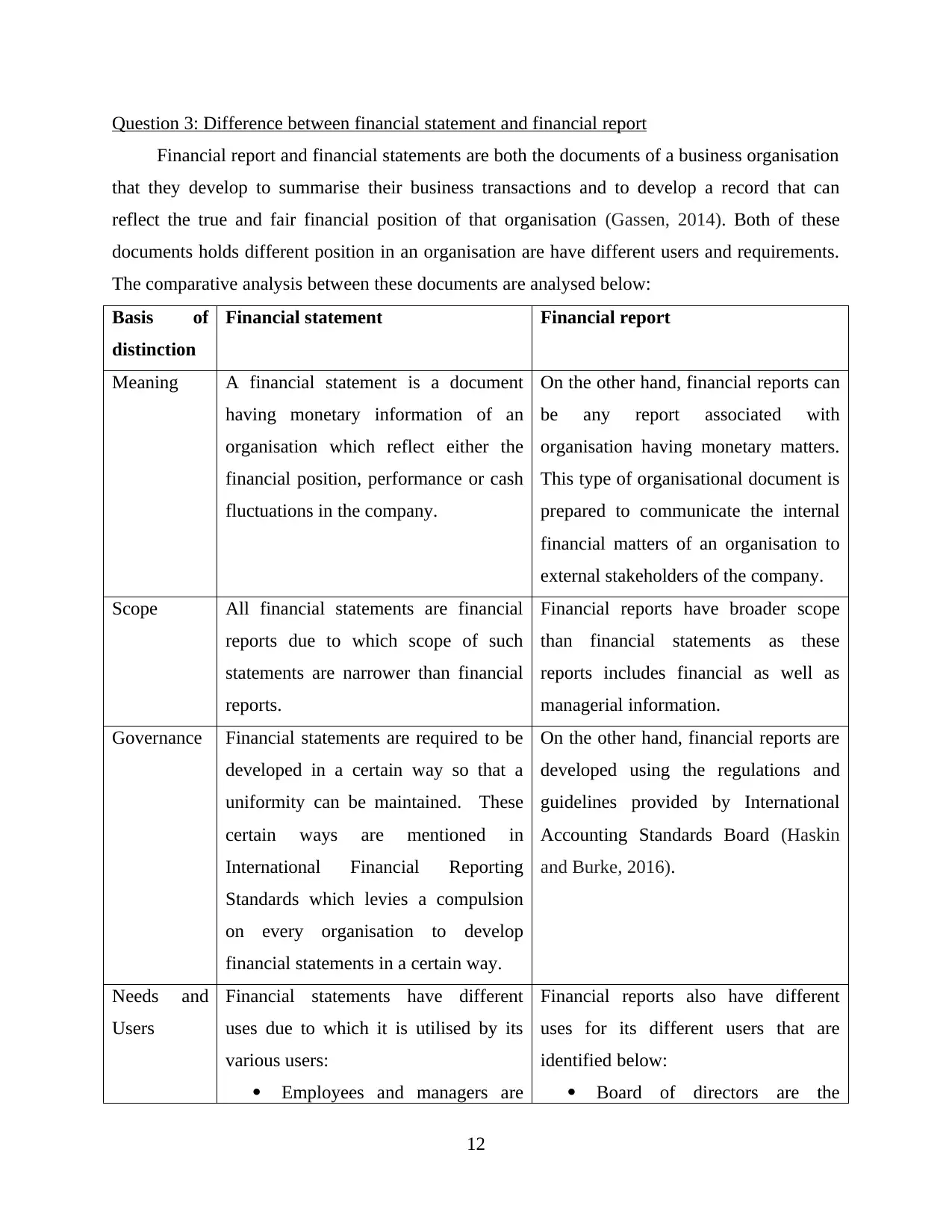
Question 3: Difference between financial statement and financial report
Financial report and financial statements are both the documents of a business organisation
that they develop to summarise their business transactions and to develop a record that can
reflect the true and fair financial position of that organisation (Gassen, 2014). Both of these
documents holds different position in an organisation are have different users and requirements.
The comparative analysis between these documents are analysed below:
Basis of
distinction
Financial statement Financial report
Meaning A financial statement is a document
having monetary information of an
organisation which reflect either the
financial position, performance or cash
fluctuations in the company.
On the other hand, financial reports can
be any report associated with
organisation having monetary matters.
This type of organisational document is
prepared to communicate the internal
financial matters of an organisation to
external stakeholders of the company.
Scope All financial statements are financial
reports due to which scope of such
statements are narrower than financial
reports.
Financial reports have broader scope
than financial statements as these
reports includes financial as well as
managerial information.
Governance Financial statements are required to be
developed in a certain way so that a
uniformity can be maintained. These
certain ways are mentioned in
International Financial Reporting
Standards which levies a compulsion
on every organisation to develop
financial statements in a certain way.
On the other hand, financial reports are
developed using the regulations and
guidelines provided by International
Accounting Standards Board (Haskin
and Burke, 2016).
Needs and
Users
Financial statements have different
uses due to which it is utilised by its
various users:
Employees and managers are
Financial reports also have different
uses for its different users that are
identified below:
Board of directors are the
12
chevron_up_icon
1 out of 23
circle_padding
hide_on_mobile
zoom_out_icon
[object Object]