Australian Accounting Standards for Forfeiture and Reissue of Shares

Verified

Added on  2023/06/11

|7
|1762
|373
Report
AI Summary
This report provides an evaluation and analysis of the accounting treatment for the forfeiture and reissue of shares by Australian corporate entities. It covers the cancellation of membership rights due to unpaid share amounts and the subsequent reissuance of these shares. The report details the conditions under which shares can be forfeited, the rights of shareholders, and the accounting procedures for reissuing shares at par, premium, or discount. It includes journal entries for various scenarios, such as the reissue of shares, the transfer of surplus amounts to the capital reserve account, and the treatment of premium amounts. The report provides a practical example to illustrate the accounting entries involved in share forfeiture and reissue, concluding that these processes must be conducted fairly and in accordance with applicable company laws to meet the requirements of both shareholders and the corporation.
Document Page
Accounting for Forfeiture and Reissue of
Share
tabler-icon-diamond-filled.svg

Paraphrase This Document

Need a fresh take? Get an instant paraphrase of this document with our AI Paraphraser
Document Page
INTRODUCTION
The present study is based on the evaluation and analysis of forfeiture and reissue of shares done
by a corporate entity in Australia. Further, the present study covers practical examples and
illustrations, supported by viable sources to provide a better understanding of same.
ACCOUNTING OF REISSUE AND FORFEITURE OF SHARES
Reissues of share- shares are forfeited if the investor fails to pay the due amount and balance
remains unpaid. While forfeiture the membership right on the share is cancelled for the
shareholder and they cannot be further obliged for paying a due amount (Pitfield, 2016). Such
unpaid shares are owned by the company, and they have right to sell those shares, and such
shares are called” reissue of share” therefore reissue of share means issue of forfeited shares.
As authority forfeitures, the shares, therefore share certificate which is allotted to the shareholder
is cancelled. The further declaration has been made by the directors to allot the forfeited shares
to new investors. At the time of reissue of shares, directors do not issue any prospectus or serve
any offer to the general public. A further amount of such shares can be asked to be paid in one or
two instalments. However, generally, whole reissue amount is asked to be paid in one instalment.
Price for reissuing the share is decided by the Board of Directors. Shares are reissued at par, at a
premium, or at a discount (Nichols, Betancourt and Scott, 2017). Generally reissued shares are
calculated on the discount basis, i.e. the amount which is less than its actual values. Discount that
is allowed while reissuing the products should be more than the amount of its forfeited shares to
ensure overall loss is compensated.
Reissue of forfeited shares is not considered as the share allotment but is merely considered as a
re-sale. A corporate entity can do reissuing of forfeited shares under the applicable provisions
given in the articles (Pitfield, 2016). Further, the forfeited shares could be reissued under
discount basis, but the discount shall not surpass the accessible amount in the account of share
forfeiture.
When there is a loss in the reissue of share, then the loss shall be placed on the debit side
of share forfeiture account. In a situation where the loss is less than the fortifying amount,
then the extra amount shall be relocated to the capital reserve account.
Document Page
In case the prices of shares which are reissued are higher than the actual amount, then the
extra amount shall be placed on the credit side of securities premium account (Borg,
2015).
If only a part of shares is reissued, then, in this case, the profit shall be relocated to the
capital reserve account.
Shares can be fortified if one of the following conditions is satisfied:
Shares are forfeited as the amount is not fully paid, or shareholder does not pay the due on
allotment or calls (Burns, 2017.At the time of forfeiture, shareholder is a restricted member of
the company. A shareholder whose share is forfeited is entitled to a full or half refund of the
amount which is paid before forfeiture.
Various outcomes-
In a situation where the company is listed on AXS or if they are permitted by operating
rules amount of refund to investors is equivalent to the amount paid by them less cost of
the reissue of shares.
Refund Amount that company has to pay back to the shareholder are recorded in a
forfeiture shares account
If a corporation is not listed on AXS and nothing is mention by the constitution about a
refund, the company has a right to hold the amount paid fewer costs of reissuing shares
(Nichols, Betancourt and Scott, 2017).
The amount that is paid to the shareholders is mentioned in forfeited share reserve.
In a situation where the reissue of the fortified shares are done on a discount basis, then the bank
account will be on the debit side by the received amount and the share capital will be credit by
the paid-up amount. The allowance of the discounted amount shall be debited in the Share
Forfeited Account. This is meant for the adjustment of the allowed discounted amount from the
fortified amount during forfeiture (Singh, 2014).
For the above illustration, the journal entry has been provided as below:
Bank A/c (the amount received on reissue) Dr.
Document Page
Share Forfeited A/c (the amount allowed as a discount) Dr.
To Share Capital A/c (paid up amount)
As described earlier that the discount amount entitled on the reissue of shares almost can be
equivalent to the forfeited amount on the same shares. In the same scenario, the share forfeited
account subsequent to the reissue of share will reflect a nil balance. However, in this scenario,
the discount amount is less than the fortifying amount, the left forfeited amount will be
considered as the profit margin of the corporation (Warren and Jones, 2018). Such profit is said
to be capital gain to the corporation, and it will be relocated to the Capital Reserve account.
Journal entries on the same are presented as below:
Share Forfeited A/c Dr
To Capital Reserve A/c
(Transfer of surplus share forfeited amount to capital reserve A/c)
In a situation where reissuing of all the forfeited shares are dine, then a nil balance will be
reflected by Share Forfeited A/c, as the entire amount present in the account after the adjustment
of allowed discounted amount on reissue that would be relocated to the capital reserve account
(Beekes, Brown and Zhang, 2015). However, in this scenario, only a portion of the forfeited
shares are reissued, and the remaining will stay as cancelled, along with that the fortified amount
on forfeited shares which are reissues will stay in the Shares Forfeited Account.
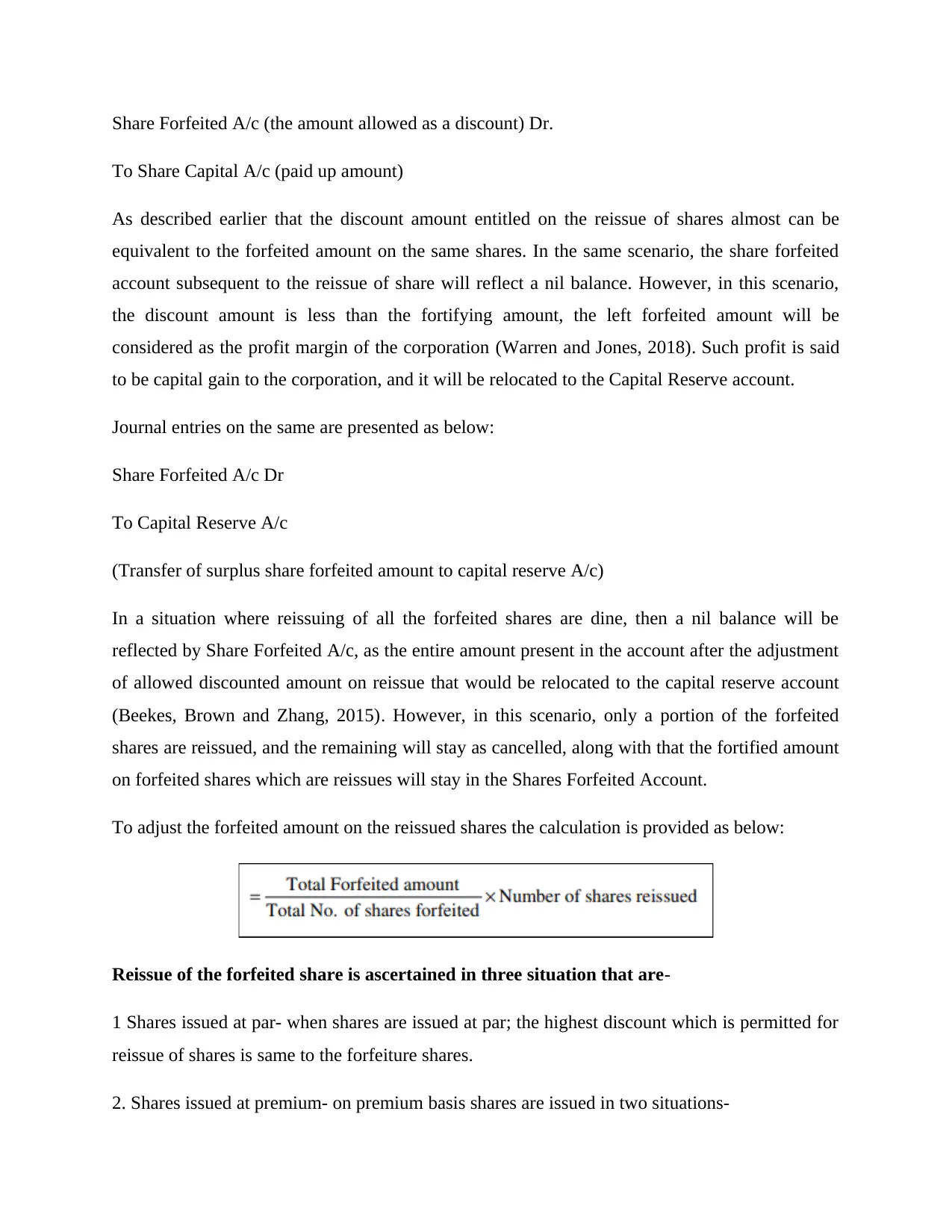
To adjust the forfeited amount on the reissued shares the calculation is provided as below:
Reissue of the forfeited share is ascertained in three situation that are-
1 Shares issued at par- when shares are issued at par; the highest discount which is permitted for
reissue of shares is same to the forfeiture shares.
2. Shares issued at premium- on premium basis shares are issued in two situations-
tabler-icon-diamond-filled.svg

Paraphrase This Document

Need a fresh take? Get an instant paraphrase of this document with our AI Paraphraser
Document Page
A. Amount of premium has not been received on forfeited shares
B. Amount of premium has been received on forfeited shares Forfeited amount is that amount
that has been received includes premium amount and if premium is not been received the
maximum discount is allowed to reissue of shares which is forfeited (Sivathaasan, 2016).
3. Shares issued at a discount- if reissued amount which is received becomes fortified amount
and if the maximum discount on the reissue of shares will be same as amount fortified plus the
amount of discount are allowed on such shares at the time of original use (Ali, 2016).
Example
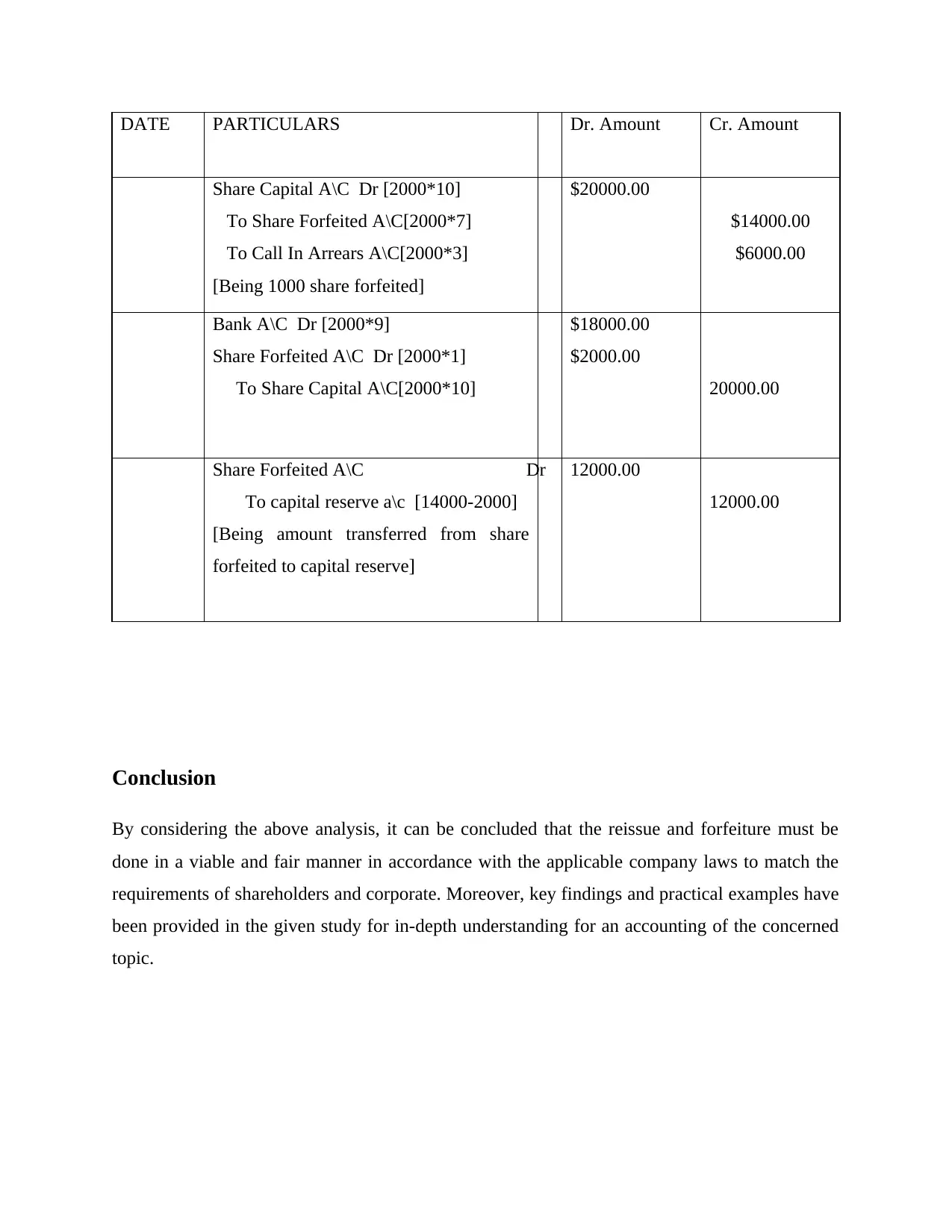
{Shares forfeited and reissues} CP company has forfeited 2000 shares of $10 each held by
Vikas.he has paid application $ 2 and allotment $ 5, but the final call has not been paid by him.
These shares were reissued at $ 9 per share fully paid up. Accounting for these entries will be as
follows:
Document Page
DATE PARTICULARS Dr. Amount Cr. Amount
Share Capital A\C Dr [2000*10]
To Share Forfeited A\C[2000*7]
To Call In Arrears A\C[2000*3]
[Being 1000 share forfeited]
$20000.00
$14000.00
$6000.00
Bank A\C Dr [2000*9]
Share Forfeited A\C Dr [2000*1]
To Share Capital A\C[2000*10]
$18000.00
$2000.00
20000.00
Share Forfeited A\C Dr
To capital reserve a\c [14000-2000]
[Being amount transferred from share
forfeited to capital reserve]
12000.00
12000.00
Conclusion
By considering the above analysis, it can be concluded that the reissue and forfeiture must be
done in a viable and fair manner in accordance with the applicable company laws to match the
requirements of shareholders and corporate. Moreover, key findings and practical examples have
been provided in the given study for in-depth understanding for an accounting of the concerned
topic.
Document Page
References
Ali, S., 2016. Corporate governance and stock liquidity in Australia: A pitch.
Beekes, W., Brown, P. and Zhang, Q., 2015. Corporate governance and the informativeness of
disclosures in Australia: A reexamination. Accounting & Finance, 55(4), pp.931-963.
Borg, D.J., 2015. The acquisition of own shares by limited liability companies.
Burns, A., 2017. Don't lose sight of losses when succession planning. Taxation in
Australia, 52(5), p.241.
Nichols, N., Betancourt, L. and Scott, I., 2017. The FASB Simplifies the Accounting for Share
Based Payments. Journal of Corporate Accounting & Finance, 28(4), pp.8-19.
Nichols, N., Betancourt, L. and Scott, I., 2017. The FASB Simplifies the Accounting for Share
Based Payments. Journal of Corporate Accounting & Finance, 28(4), pp.8-19.
Pitfield, R.R., 2016. Company Law: Made Simple. Elsevier.
Singh, R., 2014. ROLE OF SHAREHOLDERS AND DEBENTUREHOLDERS IN COMPANY
PERSPECTIVE(Doctoral dissertation, Singhania University).
Sivathaasan, N., 2016. Corporate governance and leverage in Australia: A pitch. Journal of
Accounting and Management Information Systems, 15(4), pp.819-825.
Warren, C.S. and Jones, J., 2018. Corporate financial accounting. Cengage Learning.
chevron_up_icon
1 out of 7
circle_padding
hide_on_mobile
zoom_out_icon
[object Object]