ACC1135: Analysis of Accounting Information Systems at FC Ltd.
VerifiedAdded on 2020/10/22
|11
|3283
|107
Report
AI Summary
This report analyzes the accounting information system (AIS) of Fabrik Clothing Ltd., a UK-based clothing company. It begins by defining useful information attributes such as reliability, relevance, and accuracy, providing examples relevant to the company's operations. The report then identifies threats to the revenue processing cycle, differentiating between intentional and unintentional acts, and pinpointing specific threats faced by Fabrik Clothing Ltd., such as cash theft and personnel performance issues. It explains how these threats damage the company's operations, particularly through weak internal controls and a lack of employee training. Furthermore, the report discusses threats to the existing information system, including weaknesses in the internal control environment, and suggests prevention methods. The report defines the COSO cube as a framework for internal control. The report identifies weaknesses in the company's existing internal control environment, explaining their impact on the business. The report concludes with a VAT return pivot table and final sheet of VAT returns.
ACC1135
ACCOUNTING INFORMATIONS SYSTEMS
MANAGEMENT OF FABRIK CLOTHING (FC LTD)
ACCOUNTING INFORMATIONS SYSTEMS
MANAGEMENT OF FABRIK CLOTHING (FC LTD)

Paraphrase This Document
Need a fresh take? Get an instant paraphrase of this document with our AI Paraphraser
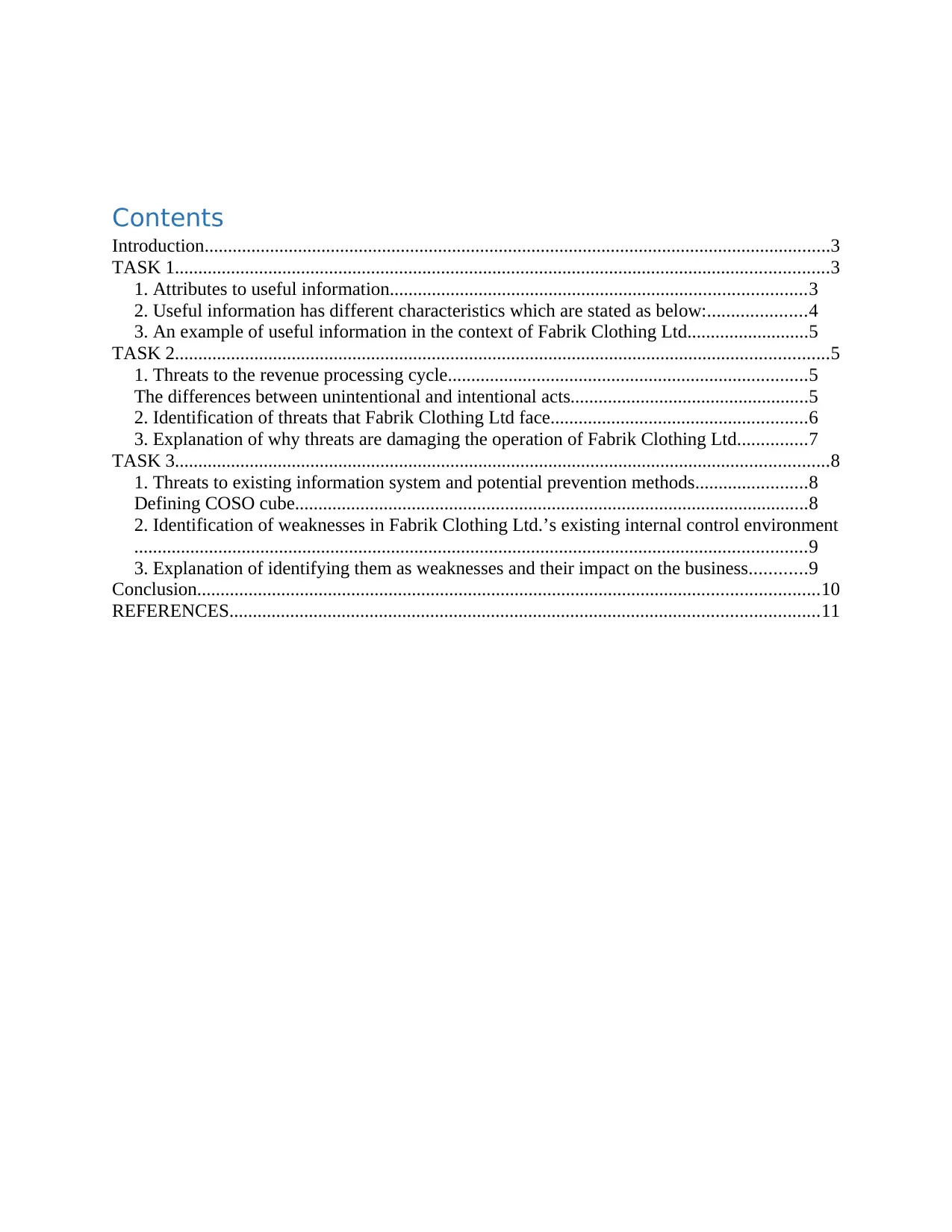
Contents
Introduction......................................................................................................................................3
TASK 1............................................................................................................................................3
1. Attributes to useful information.........................................................................................3
2. Useful information has different characteristics which are stated as below:.....................4
3. An example of useful information in the context of Fabrik Clothing Ltd..........................5
TASK 2............................................................................................................................................5
1. Threats to the revenue processing cycle.............................................................................5
The differences between unintentional and intentional acts...................................................5
2. Identification of threats that Fabrik Clothing Ltd face.......................................................6
3. Explanation of why threats are damaging the operation of Fabrik Clothing Ltd...............7
TASK 3............................................................................................................................................8
1. Threats to existing information system and potential prevention methods........................8
Defining COSO cube..............................................................................................................8
2. Identification of weaknesses in Fabrik Clothing Ltd.’s existing internal control environment
................................................................................................................................................9
3. Explanation of identifying them as weaknesses and their impact on the business............9
Conclusion.....................................................................................................................................10
REFERENCES..............................................................................................................................11
Introduction......................................................................................................................................3
TASK 1............................................................................................................................................3
1. Attributes to useful information.........................................................................................3
2. Useful information has different characteristics which are stated as below:.....................4
3. An example of useful information in the context of Fabrik Clothing Ltd..........................5
TASK 2............................................................................................................................................5
1. Threats to the revenue processing cycle.............................................................................5
The differences between unintentional and intentional acts...................................................5
2. Identification of threats that Fabrik Clothing Ltd face.......................................................6
3. Explanation of why threats are damaging the operation of Fabrik Clothing Ltd...............7
TASK 3............................................................................................................................................8
1. Threats to existing information system and potential prevention methods........................8
Defining COSO cube..............................................................................................................8
2. Identification of weaknesses in Fabrik Clothing Ltd.’s existing internal control environment
................................................................................................................................................9
3. Explanation of identifying them as weaknesses and their impact on the business............9
Conclusion.....................................................................................................................................10
REFERENCES..............................................................................................................................11
Introduction
Accounting information system is a framework or structure which used by business
organisation for multiple purposes associated with data and information such as data collecting,
storing, manipulating, processing etc. (Cañibano, 2018). This report aims to provide different
attributes of useful information that are necessary for running a business like Fabrik Clothing
Ltd. which is a UK based company established in 2015 by Susan Stimmer. To successfully run a
business, there should be proper management of data and information. In this report, different
threats to the revenue processing cycle, the threat to the existing information system and
potential prevention methods are explained. In the end, a complete VAT return pivot table is also
developed along with final sheet of VAT returns.
TASK 1
1. Attributes to useful information
Data:
Data is referred as raw, unorganised facts that needs to be processed into meaningful
information which is easily understandable and then utilised (De Mauro, Greco and Grimaldi,
2015). It can be something simple and seemingly random and useless until it is organised. It can
be any character, text, word or number which, if not put into correct context then it creates little
or nothing meaning to its evaluators. For example, when students get admission in a college, they
fill admission form. This form contains raw facts (data of student) like name, father’s name,
address of student, obtained marks, photo graph etc. This raw but diverse facts is an example of
data.
Information:
Information is referred as data formatted and processed in a manner that allows it to be
understood and utilised by human beings in some significant way (Janich, 2018). It is well-
organised, well-processed, structured and presented in a context so that it can be used for a
practical purpose and not only for theoretical purposes. The end users utilise this ‘meaningful
data’ which is known as ‘information’ for effective decision making. For example, if a manager
is told that company’s net profit has been decreased in the past month, manager may use this
information as a reason to cut financial spending for the next month. Another example, the
Accounting information system is a framework or structure which used by business
organisation for multiple purposes associated with data and information such as data collecting,
storing, manipulating, processing etc. (Cañibano, 2018). This report aims to provide different
attributes of useful information that are necessary for running a business like Fabrik Clothing
Ltd. which is a UK based company established in 2015 by Susan Stimmer. To successfully run a
business, there should be proper management of data and information. In this report, different
threats to the revenue processing cycle, the threat to the existing information system and
potential prevention methods are explained. In the end, a complete VAT return pivot table is also
developed along with final sheet of VAT returns.
TASK 1
1. Attributes to useful information
Data:
Data is referred as raw, unorganised facts that needs to be processed into meaningful
information which is easily understandable and then utilised (De Mauro, Greco and Grimaldi,
2015). It can be something simple and seemingly random and useless until it is organised. It can
be any character, text, word or number which, if not put into correct context then it creates little
or nothing meaning to its evaluators. For example, when students get admission in a college, they
fill admission form. This form contains raw facts (data of student) like name, father’s name,
address of student, obtained marks, photo graph etc. This raw but diverse facts is an example of
data.
Information:
Information is referred as data formatted and processed in a manner that allows it to be
understood and utilised by human beings in some significant way (Janich, 2018). It is well-
organised, well-processed, structured and presented in a context so that it can be used for a
practical purpose and not only for theoretical purposes. The end users utilise this ‘meaningful
data’ which is known as ‘information’ for effective decision making. For example, if a manager
is told that company’s net profit has been decreased in the past month, manager may use this
information as a reason to cut financial spending for the next month. Another example, the
⊘ This is a preview!⊘
Do you want full access?
Subscribe today to unlock all pages.

Trusted by 1+ million students worldwide
average score of a class or of the entire school is information that can be derived from the data
contained in student forms.
2. Useful information has different characteristics which are stated as below:
Useful information creates value and contains appropriate level of briefing. It is
communicated in stimulated time and is relevant for its purpose; complete enough for the
problem resolution, reliable and even targeted to the right person. Few attributes of useful
information are described below:
Reliability:
This attribute deals with the truth of information or the objectivity with which information is
presented. According to this feature, information should be gathered from a valid and trusted
source so that evaluator can be relied upon it and can evidently prove it to be correct.
For example, Accounting information is reliable if users can depend on it to represent the
economic conditions or events that it proposes to represent. In the given case, information in
financial statements must be complete, free from errors and without bias so that information
provided to Susan, (the director) should not be incomplete due to any errors. Susan should be
able to have a high degree of confidence in the information presented by her from Rachel,
Caroline and David. She should be given a total picture of the weekly and monthly reporting
business as far as possible. It is desirable that all information required for decision making is
made available to her, but it should also be reliable so that overall profitability and productivity
of the organisation can be improved.
Relevance:
This refers to the attribute which shows that how helpful the information (in this case
financial information) is for financial decision-making processes. To be relevant, accounting
information must be capable of making a difference in a decision by helping users to form
predictions about the outcomes for future events and adequately analyse past and present events.
It is information’s ability to make a difference that makes it relevant to a decision. In Fabrik
Clothing Ltd, the report or information given by her store manager and account assistant must be
able to help Susan foresee the likely financial performance and the changes in the financial
position expected. Susan should be able to know the results of the investment and the
transactions that took place and she should be able to tell whether the results of the operation
match her expectations.
contained in student forms.
2. Useful information has different characteristics which are stated as below:
Useful information creates value and contains appropriate level of briefing. It is
communicated in stimulated time and is relevant for its purpose; complete enough for the
problem resolution, reliable and even targeted to the right person. Few attributes of useful
information are described below:
Reliability:
This attribute deals with the truth of information or the objectivity with which information is
presented. According to this feature, information should be gathered from a valid and trusted
source so that evaluator can be relied upon it and can evidently prove it to be correct.
For example, Accounting information is reliable if users can depend on it to represent the
economic conditions or events that it proposes to represent. In the given case, information in
financial statements must be complete, free from errors and without bias so that information
provided to Susan, (the director) should not be incomplete due to any errors. Susan should be
able to have a high degree of confidence in the information presented by her from Rachel,
Caroline and David. She should be given a total picture of the weekly and monthly reporting
business as far as possible. It is desirable that all information required for decision making is
made available to her, but it should also be reliable so that overall profitability and productivity
of the organisation can be improved.
Relevance:
This refers to the attribute which shows that how helpful the information (in this case
financial information) is for financial decision-making processes. To be relevant, accounting
information must be capable of making a difference in a decision by helping users to form
predictions about the outcomes for future events and adequately analyse past and present events.
It is information’s ability to make a difference that makes it relevant to a decision. In Fabrik
Clothing Ltd, the report or information given by her store manager and account assistant must be
able to help Susan foresee the likely financial performance and the changes in the financial
position expected. Susan should be able to know the results of the investment and the
transactions that took place and she should be able to tell whether the results of the operation
match her expectations.
Paraphrase This Document
Need a fresh take? Get an instant paraphrase of this document with our AI Paraphraser
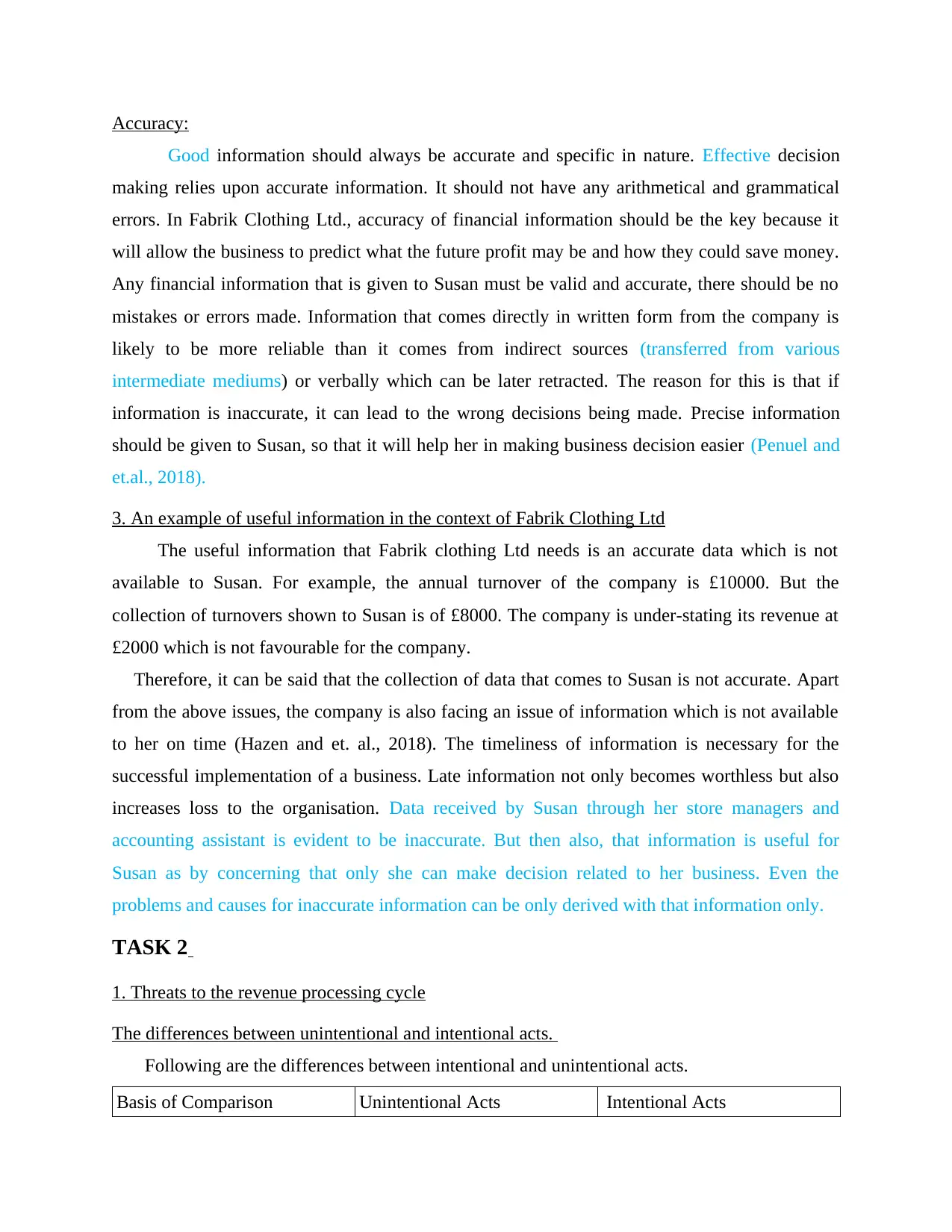
Accuracy:
Good information should always be accurate and specific in nature. Effective decision
making relies upon accurate information. It should not have any arithmetical and grammatical
errors. In Fabrik Clothing Ltd., accuracy of financial information should be the key because it
will allow the business to predict what the future profit may be and how they could save money.
Any financial information that is given to Susan must be valid and accurate, there should be no
mistakes or errors made. Information that comes directly in written form from the company is
likely to be more reliable than it comes from indirect sources (transferred from various
intermediate mediums) or verbally which can be later retracted. The reason for this is that if
information is inaccurate, it can lead to the wrong decisions being made. Precise information
should be given to Susan, so that it will help her in making business decision easier (Penuel and
et.al., 2018).
3. An example of useful information in the context of Fabrik Clothing Ltd
The useful information that Fabrik clothing Ltd needs is an accurate data which is not
available to Susan. For example, the annual turnover of the company is £10000. But the
collection of turnovers shown to Susan is of £8000. The company is under-stating its revenue at
£2000 which is not favourable for the company.
Therefore, it can be said that the collection of data that comes to Susan is not accurate. Apart
from the above issues, the company is also facing an issue of information which is not available
to her on time (Hazen and et. al., 2018). The timeliness of information is necessary for the
successful implementation of a business. Late information not only becomes worthless but also
increases loss to the organisation. Data received by Susan through her store managers and
accounting assistant is evident to be inaccurate. But then also, that information is useful for
Susan as by concerning that only she can make decision related to her business. Even the
problems and causes for inaccurate information can be only derived with that information only.
TASK 2
1. Threats to the revenue processing cycle
The differences between unintentional and intentional acts.
Following are the differences between intentional and unintentional acts.
Basis of Comparison Unintentional Acts Intentional Acts
Good information should always be accurate and specific in nature. Effective decision
making relies upon accurate information. It should not have any arithmetical and grammatical
errors. In Fabrik Clothing Ltd., accuracy of financial information should be the key because it
will allow the business to predict what the future profit may be and how they could save money.
Any financial information that is given to Susan must be valid and accurate, there should be no
mistakes or errors made. Information that comes directly in written form from the company is
likely to be more reliable than it comes from indirect sources (transferred from various
intermediate mediums) or verbally which can be later retracted. The reason for this is that if
information is inaccurate, it can lead to the wrong decisions being made. Precise information
should be given to Susan, so that it will help her in making business decision easier (Penuel and
et.al., 2018).
3. An example of useful information in the context of Fabrik Clothing Ltd
The useful information that Fabrik clothing Ltd needs is an accurate data which is not
available to Susan. For example, the annual turnover of the company is £10000. But the
collection of turnovers shown to Susan is of £8000. The company is under-stating its revenue at
£2000 which is not favourable for the company.
Therefore, it can be said that the collection of data that comes to Susan is not accurate. Apart
from the above issues, the company is also facing an issue of information which is not available
to her on time (Hazen and et. al., 2018). The timeliness of information is necessary for the
successful implementation of a business. Late information not only becomes worthless but also
increases loss to the organisation. Data received by Susan through her store managers and
accounting assistant is evident to be inaccurate. But then also, that information is useful for
Susan as by concerning that only she can make decision related to her business. Even the
problems and causes for inaccurate information can be only derived with that information only.
TASK 2
1. Threats to the revenue processing cycle
The differences between unintentional and intentional acts.
Following are the differences between intentional and unintentional acts.
Basis of Comparison Unintentional Acts Intentional Acts
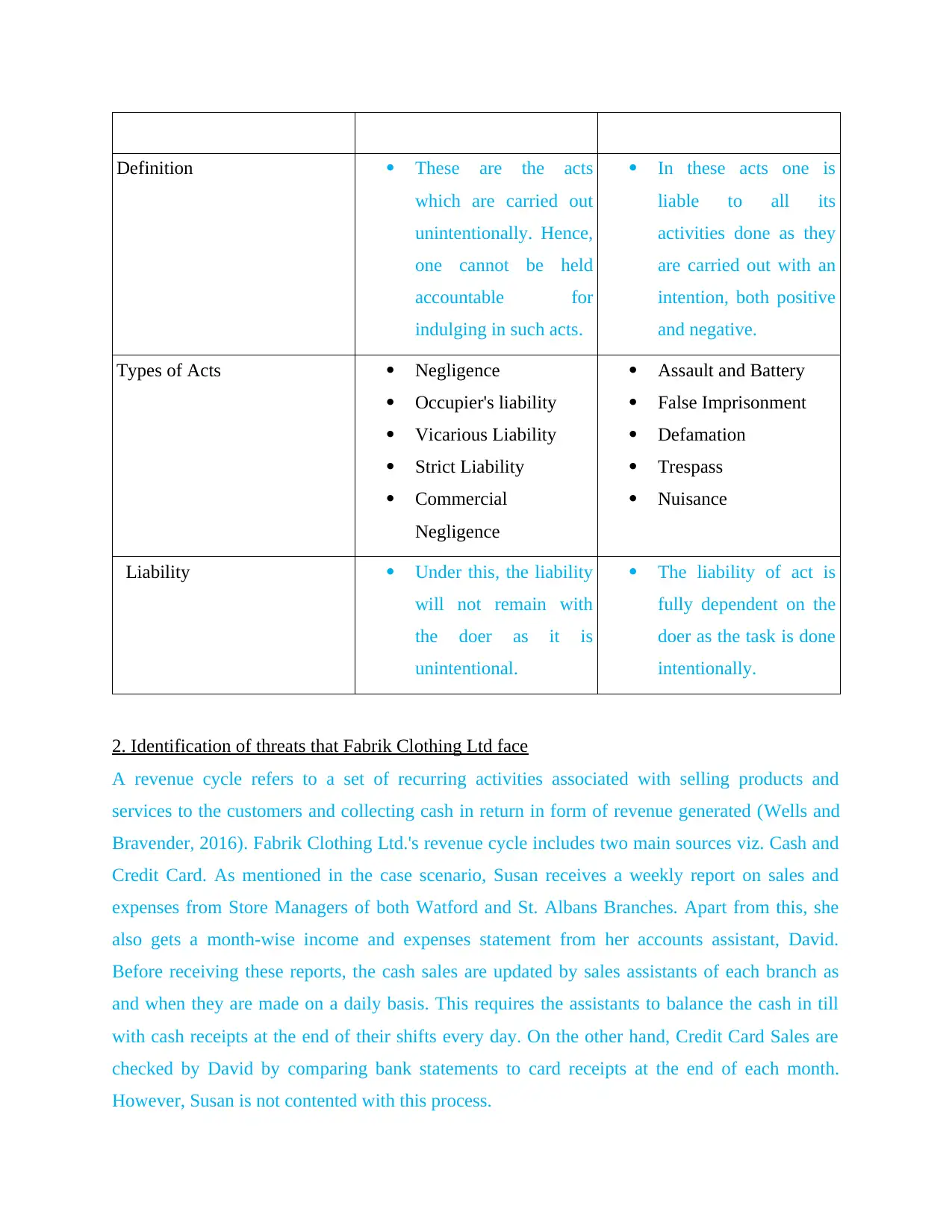
Definition These are the acts
which are carried out
unintentionally. Hence,
one cannot be held
accountable for
indulging in such acts.
In these acts one is
liable to all its
activities done as they
are carried out with an
intention, both positive
and negative.
Types of Acts Negligence
Occupier's liability
Vicarious Liability
Strict Liability
Commercial
Negligence
Assault and Battery
False Imprisonment
Defamation
Trespass
Nuisance
Liability Under this, the liability
will not remain with
the doer as it is
unintentional.
The liability of act is
fully dependent on the
doer as the task is done
intentionally.
2. Identification of threats that Fabrik Clothing Ltd face
A revenue cycle refers to a set of recurring activities associated with selling products and
services to the customers and collecting cash in return in form of revenue generated (Wells and
Bravender, 2016). Fabrik Clothing Ltd.'s revenue cycle includes two main sources viz. Cash and
Credit Card. As mentioned in the case scenario, Susan receives a weekly report on sales and
expenses from Store Managers of both Watford and St. Albans Branches. Apart from this, she
also gets a month-wise income and expenses statement from her accounts assistant, David.
Before receiving these reports, the cash sales are updated by sales assistants of each branch as
and when they are made on a daily basis. This requires the assistants to balance the cash in till
with cash receipts at the end of their shifts every day. On the other hand, Credit Card Sales are
checked by David by comparing bank statements to card receipts at the end of each month.
However, Susan is not contented with this process.
which are carried out
unintentionally. Hence,
one cannot be held
accountable for
indulging in such acts.
In these acts one is
liable to all its
activities done as they
are carried out with an
intention, both positive
and negative.
Types of Acts Negligence
Occupier's liability
Vicarious Liability
Strict Liability
Commercial
Negligence
Assault and Battery
False Imprisonment
Defamation
Trespass
Nuisance
Liability Under this, the liability
will not remain with
the doer as it is
unintentional.
The liability of act is
fully dependent on the
doer as the task is done
intentionally.
2. Identification of threats that Fabrik Clothing Ltd face
A revenue cycle refers to a set of recurring activities associated with selling products and
services to the customers and collecting cash in return in form of revenue generated (Wells and
Bravender, 2016). Fabrik Clothing Ltd.'s revenue cycle includes two main sources viz. Cash and
Credit Card. As mentioned in the case scenario, Susan receives a weekly report on sales and
expenses from Store Managers of both Watford and St. Albans Branches. Apart from this, she
also gets a month-wise income and expenses statement from her accounts assistant, David.
Before receiving these reports, the cash sales are updated by sales assistants of each branch as
and when they are made on a daily basis. This requires the assistants to balance the cash in till
with cash receipts at the end of their shifts every day. On the other hand, Credit Card Sales are
checked by David by comparing bank statements to card receipts at the end of each month.
However, Susan is not contented with this process.
⊘ This is a preview!⊘
Do you want full access?
Subscribe today to unlock all pages.
Trusted by 1+ million students worldwide
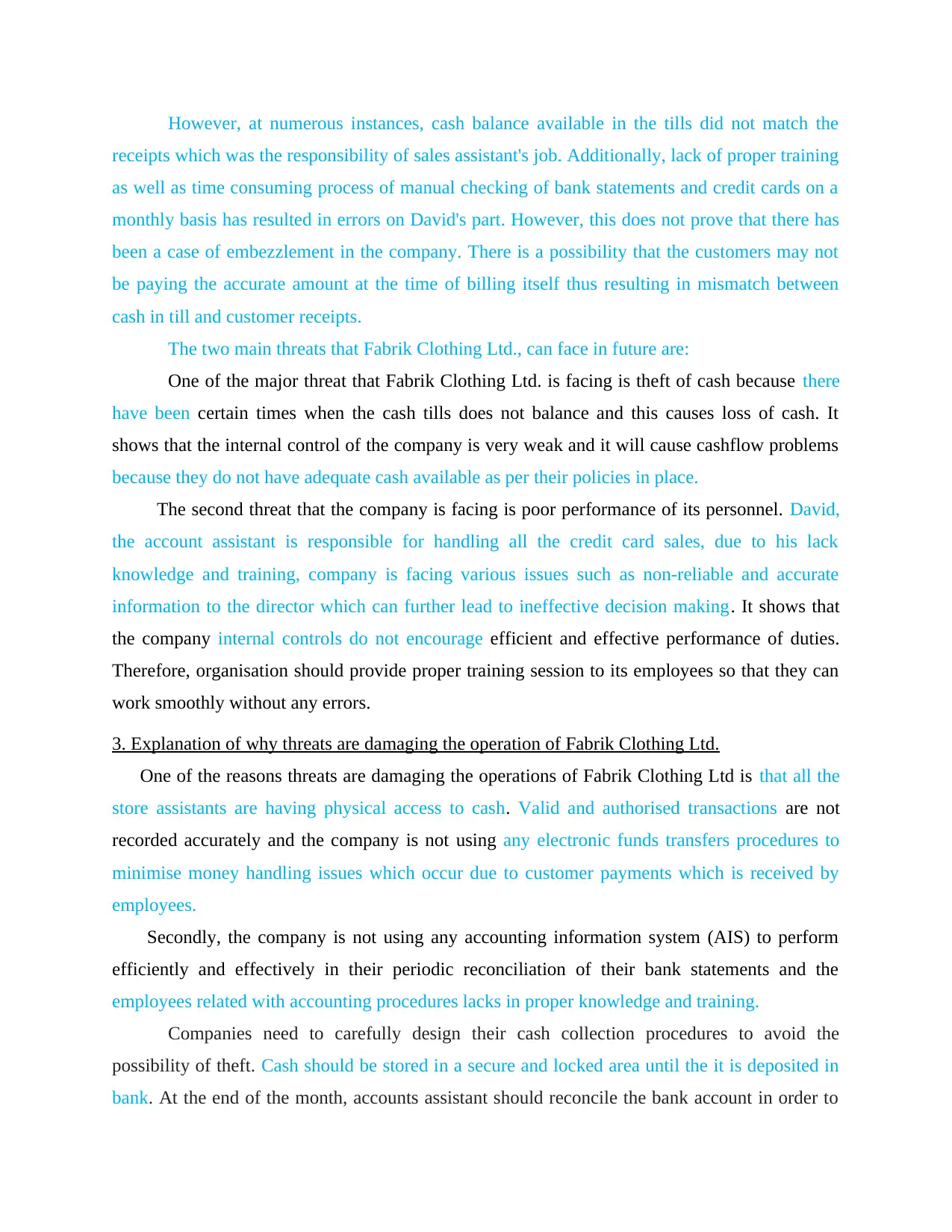
However, at numerous instances, cash balance available in the tills did not match the
receipts which was the responsibility of sales assistant's job. Additionally, lack of proper training
as well as time consuming process of manual checking of bank statements and credit cards on a
monthly basis has resulted in errors on David's part. However, this does not prove that there has
been a case of embezzlement in the company. There is a possibility that the customers may not
be paying the accurate amount at the time of billing itself thus resulting in mismatch between
cash in till and customer receipts.
The two main threats that Fabrik Clothing Ltd., can face in future are:
One of the major threat that Fabrik Clothing Ltd. is facing is theft of cash because there
have been certain times when the cash tills does not balance and this causes loss of cash. It
shows that the internal control of the company is very weak and it will cause cashflow problems
because they do not have adequate cash available as per their policies in place.
The second threat that the company is facing is poor performance of its personnel. David,
the account assistant is responsible for handling all the credit card sales, due to his lack
knowledge and training, company is facing various issues such as non-reliable and accurate
information to the director which can further lead to ineffective decision making. It shows that
the company internal controls do not encourage efficient and effective performance of duties.
Therefore, organisation should provide proper training session to its employees so that they can
work smoothly without any errors.
3. Explanation of why threats are damaging the operation of Fabrik Clothing Ltd.
One of the reasons threats are damaging the operations of Fabrik Clothing Ltd is that all the
store assistants are having physical access to cash. Valid and authorised transactions are not
recorded accurately and the company is not using any electronic funds transfers procedures to
minimise money handling issues which occur due to customer payments which is received by
employees.
Secondly, the company is not using any accounting information system (AIS) to perform
efficiently and effectively in their periodic reconciliation of their bank statements and the
employees related with accounting procedures lacks in proper knowledge and training.
Companies need to carefully design their cash collection procedures to avoid the
possibility of theft. Cash should be stored in a secure and locked area until the it is deposited in
bank. At the end of the month, accounts assistant should reconcile the bank account in order to
receipts which was the responsibility of sales assistant's job. Additionally, lack of proper training
as well as time consuming process of manual checking of bank statements and credit cards on a
monthly basis has resulted in errors on David's part. However, this does not prove that there has
been a case of embezzlement in the company. There is a possibility that the customers may not
be paying the accurate amount at the time of billing itself thus resulting in mismatch between
cash in till and customer receipts.
The two main threats that Fabrik Clothing Ltd., can face in future are:
One of the major threat that Fabrik Clothing Ltd. is facing is theft of cash because there
have been certain times when the cash tills does not balance and this causes loss of cash. It
shows that the internal control of the company is very weak and it will cause cashflow problems
because they do not have adequate cash available as per their policies in place.
The second threat that the company is facing is poor performance of its personnel. David,
the account assistant is responsible for handling all the credit card sales, due to his lack
knowledge and training, company is facing various issues such as non-reliable and accurate
information to the director which can further lead to ineffective decision making. It shows that
the company internal controls do not encourage efficient and effective performance of duties.
Therefore, organisation should provide proper training session to its employees so that they can
work smoothly without any errors.
3. Explanation of why threats are damaging the operation of Fabrik Clothing Ltd.
One of the reasons threats are damaging the operations of Fabrik Clothing Ltd is that all the
store assistants are having physical access to cash. Valid and authorised transactions are not
recorded accurately and the company is not using any electronic funds transfers procedures to
minimise money handling issues which occur due to customer payments which is received by
employees.
Secondly, the company is not using any accounting information system (AIS) to perform
efficiently and effectively in their periodic reconciliation of their bank statements and the
employees related with accounting procedures lacks in proper knowledge and training.
Companies need to carefully design their cash collection procedures to avoid the
possibility of theft. Cash should be stored in a secure and locked area until the it is deposited in
bank. At the end of the month, accounts assistant should reconcile the bank account in order to
Paraphrase This Document
Need a fresh take? Get an instant paraphrase of this document with our AI Paraphraser
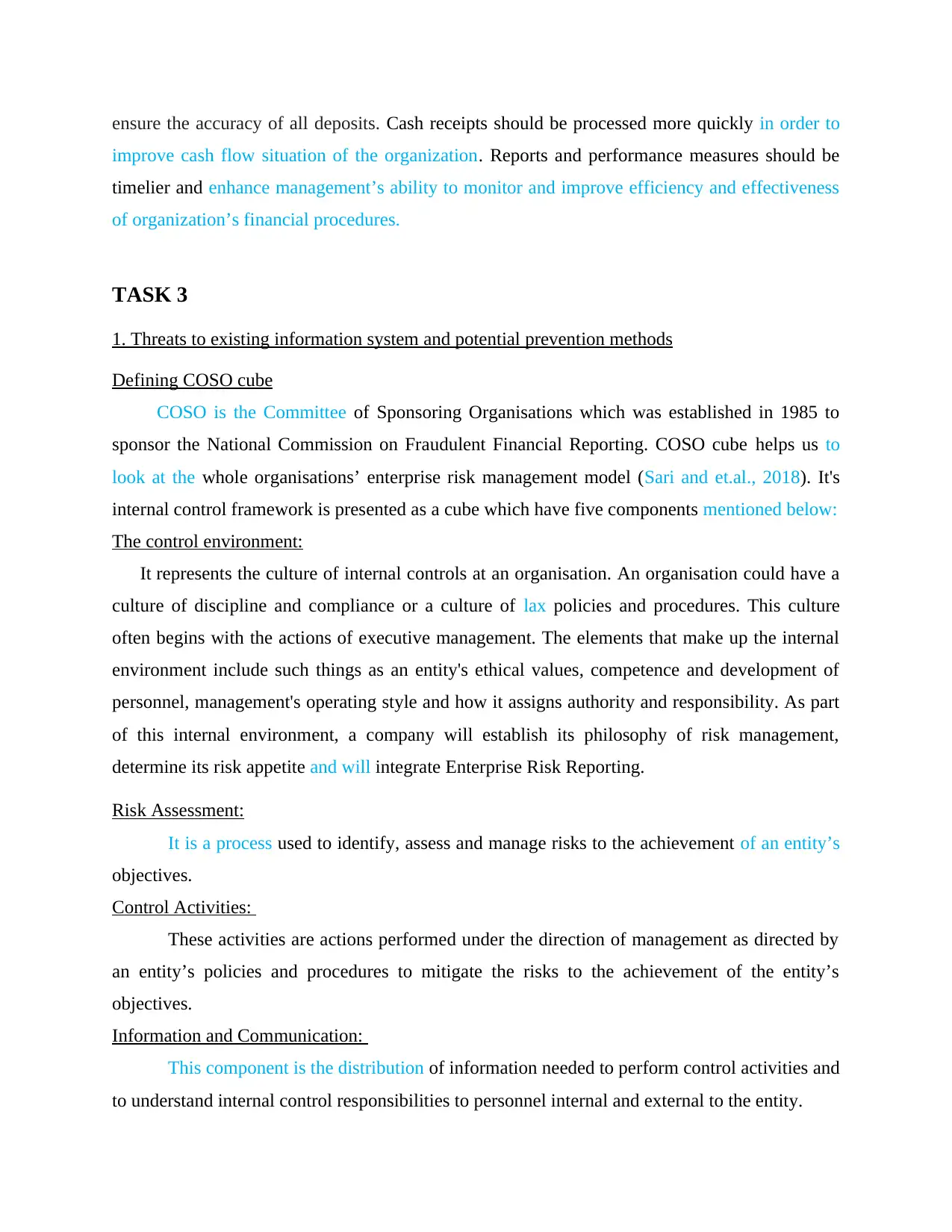
ensure the accuracy of all deposits. Cash receipts should be processed more quickly in order to
improve cash flow situation of the organization. Reports and performance measures should be
timelier and enhance management’s ability to monitor and improve efficiency and effectiveness
of organization’s financial procedures.
TASK 3
1. Threats to existing information system and potential prevention methods
Defining COSO cube
COSO is the Committee of Sponsoring Organisations which was established in 1985 to
sponsor the National Commission on Fraudulent Financial Reporting. COSO cube helps us to
look at the whole organisations’ enterprise risk management model (Sari and et.al., 2018). It's
internal control framework is presented as a cube which have five components mentioned below:
The control environment:
It represents the culture of internal controls at an organisation. An organisation could have a
culture of discipline and compliance or a culture of lax policies and procedures. This culture
often begins with the actions of executive management. The elements that make up the internal
environment include such things as an entity's ethical values, competence and development of
personnel, management's operating style and how it assigns authority and responsibility. As part
of this internal environment, a company will establish its philosophy of risk management,
determine its risk appetite and will integrate Enterprise Risk Reporting.
Risk Assessment:
It is a process used to identify, assess and manage risks to the achievement of an entity’s
objectives.
Control Activities:
These activities are actions performed under the direction of management as directed by
an entity’s policies and procedures to mitigate the risks to the achievement of the entity’s
objectives.
Information and Communication:
This component is the distribution of information needed to perform control activities and
to understand internal control responsibilities to personnel internal and external to the entity.
improve cash flow situation of the organization. Reports and performance measures should be
timelier and enhance management’s ability to monitor and improve efficiency and effectiveness
of organization’s financial procedures.
TASK 3
1. Threats to existing information system and potential prevention methods
Defining COSO cube
COSO is the Committee of Sponsoring Organisations which was established in 1985 to
sponsor the National Commission on Fraudulent Financial Reporting. COSO cube helps us to
look at the whole organisations’ enterprise risk management model (Sari and et.al., 2018). It's
internal control framework is presented as a cube which have five components mentioned below:
The control environment:
It represents the culture of internal controls at an organisation. An organisation could have a
culture of discipline and compliance or a culture of lax policies and procedures. This culture
often begins with the actions of executive management. The elements that make up the internal
environment include such things as an entity's ethical values, competence and development of
personnel, management's operating style and how it assigns authority and responsibility. As part
of this internal environment, a company will establish its philosophy of risk management,
determine its risk appetite and will integrate Enterprise Risk Reporting.
Risk Assessment:
It is a process used to identify, assess and manage risks to the achievement of an entity’s
objectives.
Control Activities:
These activities are actions performed under the direction of management as directed by
an entity’s policies and procedures to mitigate the risks to the achievement of the entity’s
objectives.
Information and Communication:
This component is the distribution of information needed to perform control activities and
to understand internal control responsibilities to personnel internal and external to the entity.
Monitoring Activities:
These activities are ongoing evaluations of the implementation and operation of the five
components of internal audit.
2. Identification of weaknesses in Fabrik Clothing Ltd.’s existing internal control environment
Lack of training, information and communication:
In Fabrik Clothing Ltd., employees should be provided with ongoing training, support and
mentoring on a regular basis, so that they can use their knowledge and skills necessary to
accomplish tasks that define the individual’s job. There should be adequate induction procedures
for new employees, so that they can carry out their assigned responsibilities effectively and
efficiently soon after being engaged by the company. Finally, keeping current policies and
procedures available to their employees and communicate other critical information in a timely
manner.
Control Activities:
Susan has ultimate responsibility and ownership of the internal control system. She sets
the tone at the top that affects the integrity and ethics and other factors that create the positive
control environment needed for the internal control system to thrive. Aside from setting, the
tone at the top, much of the day‐to‐day operation of the control system is delegated to other
senior managers in the company, under the leadership of the CEO. This shows that the
environment of company is a culture of lax policies and procedures. The organisation has to
improve this procedure as soon as possible to ensure proper controlling of organisational
activities.
3. Explanation of identifying them as weaknesses and their impact on the business
In this case, the new appointed employee feels frustrated and annoying while asking for the
return policy of company. He felt that he does not have adequate knowledge, skills and training
to perform his role. This will impact badly onto the business because when employee starts to
think themselves as non-important for the organisation they start to switch to other available
options of employment which is harmful for the company. The founder of company Susan is
reluctant to start the investigation against the stealing of till from the funds. This shows that the
company is not serious about any fraud in it. This also inculcate lax policies and procedures in
the organisation. If this weakness is not diagnosed properly by investigation, the person who did
fraud will get motivated to do even bigger frauds. This results into the loss of business.
These activities are ongoing evaluations of the implementation and operation of the five
components of internal audit.
2. Identification of weaknesses in Fabrik Clothing Ltd.’s existing internal control environment
Lack of training, information and communication:
In Fabrik Clothing Ltd., employees should be provided with ongoing training, support and
mentoring on a regular basis, so that they can use their knowledge and skills necessary to
accomplish tasks that define the individual’s job. There should be adequate induction procedures
for new employees, so that they can carry out their assigned responsibilities effectively and
efficiently soon after being engaged by the company. Finally, keeping current policies and
procedures available to their employees and communicate other critical information in a timely
manner.
Control Activities:
Susan has ultimate responsibility and ownership of the internal control system. She sets
the tone at the top that affects the integrity and ethics and other factors that create the positive
control environment needed for the internal control system to thrive. Aside from setting, the
tone at the top, much of the day‐to‐day operation of the control system is delegated to other
senior managers in the company, under the leadership of the CEO. This shows that the
environment of company is a culture of lax policies and procedures. The organisation has to
improve this procedure as soon as possible to ensure proper controlling of organisational
activities.
3. Explanation of identifying them as weaknesses and their impact on the business
In this case, the new appointed employee feels frustrated and annoying while asking for the
return policy of company. He felt that he does not have adequate knowledge, skills and training
to perform his role. This will impact badly onto the business because when employee starts to
think themselves as non-important for the organisation they start to switch to other available
options of employment which is harmful for the company. The founder of company Susan is
reluctant to start the investigation against the stealing of till from the funds. This shows that the
company is not serious about any fraud in it. This also inculcate lax policies and procedures in
the organisation. If this weakness is not diagnosed properly by investigation, the person who did
fraud will get motivated to do even bigger frauds. This results into the loss of business.
⊘ This is a preview!⊘
Do you want full access?
Subscribe today to unlock all pages.
Trusted by 1+ million students worldwide
Conclusion
From the above report, it can be concluded that data and information are the two different
aspects. The useful characteristics of information helps to identify the accurate and complete
information. In case of Fabrik Clothing Ltd., the fraud of company is still not investigated by
Susan as they felt it is wasting of money. The threats which influence the company are unbalance
of cash till, lack of training to the employees etc. COSO tube is also helpful in this report to
identify and resolve the issues related with the company. It is also observed that various
weakness such as lack of training influences this company.
From the above report, it can be concluded that data and information are the two different
aspects. The useful characteristics of information helps to identify the accurate and complete
information. In case of Fabrik Clothing Ltd., the fraud of company is still not investigated by
Susan as they felt it is wasting of money. The threats which influence the company are unbalance
of cash till, lack of training to the employees etc. COSO tube is also helpful in this report to
identify and resolve the issues related with the company. It is also observed that various
weakness such as lack of training influences this company.
Paraphrase This Document
Need a fresh take? Get an instant paraphrase of this document with our AI Paraphraser
REFERENCES
Books and Journals
Cañibano, L., 2018. Accounting and intangibles. Revista de Contabilidad-Spanish Accounting
Review, 21(1). pp.1-6.
De Mauro, A., Greco, M. and Grimaldi, M., 2015, February. What is big data? A consensual
definition and a review of key research topics. In AIP conference proceedings (Vol. 1644.
No. 1. pp. 97-104). AIP.
Janich, P., 2018. What Is Information? (Vol. 55). U of Minnesota Press.
Penuel, W. R., and et.al., 2018. What research district leaders find useful. Educational
Policy, 32(4). pp.540-568.
Wells, S. T. and Bravender, R., 2016. Improving employee engagement in the revenue
cycle. Healthcare Financial Management, 70(10). pp.36-39.
Sari, R., and et.al., 2018. October. COSO Framework for Warehouse Management Internal
Control Evaluation: Enabling Smart Warehouse Systems. In 2018 International
Conference on ICT for Smart Society (ICISS) (pp. 1-5). IEEE.
Books and Journals
Cañibano, L., 2018. Accounting and intangibles. Revista de Contabilidad-Spanish Accounting
Review, 21(1). pp.1-6.
De Mauro, A., Greco, M. and Grimaldi, M., 2015, February. What is big data? A consensual
definition and a review of key research topics. In AIP conference proceedings (Vol. 1644.
No. 1. pp. 97-104). AIP.
Janich, P., 2018. What Is Information? (Vol. 55). U of Minnesota Press.
Penuel, W. R., and et.al., 2018. What research district leaders find useful. Educational
Policy, 32(4). pp.540-568.
Wells, S. T. and Bravender, R., 2016. Improving employee engagement in the revenue
cycle. Healthcare Financial Management, 70(10). pp.36-39.
Sari, R., and et.al., 2018. October. COSO Framework for Warehouse Management Internal
Control Evaluation: Enabling Smart Warehouse Systems. In 2018 International
Conference on ICT for Smart Society (ICISS) (pp. 1-5). IEEE.

1 out of 11


Related Documents


Your All-in-One AI-Powered Toolkit for Academic Success.
+13062052269
info@desklib.com
Available 24*7 on WhatsApp / Email
![[object Object]](/_next/static/media/star-bottom.7253800d.svg)
Unlock your academic potential
Copyright © 2020–2026 A2Z Services. All Rights Reserved. Developed and managed by ZUCOL.