Financial Accounting Report: Weather and Sons & Company Performance
VerifiedAdded on 2019/12/04
|17
|4102
|162
Report
AI Summary
This report provides a comprehensive analysis of financial accounting principles and practices. It begins with an introduction to accounting, defining its role in maintaining financial records and communicating information to stakeholders. The report then delves into a practical application, focusing on Weather and Sons, where it prepares an adjusted trial balance, a comprehensive income statement, and a statement of financial position. These financial statements are crucial for understanding a company's financial health and performance. Furthermore, the report extends its analysis by comparing the financial performance of two organizations, utilizing financial ratios to assess their profitability and efficiency. The report uses tables to present the financial data, including adjusted trial balances, income statements, balance sheets, and comparison charts, offering a clear and organized presentation of the financial information and analysis. This report is a valuable resource for students studying accounting and finance, offering insights into real-world financial statement analysis and performance evaluation.
INTRODUCTION TO
ACCOUNTING
ACCOUNTING
Paraphrase This Document
Need a fresh take? Get an instant paraphrase of this document with our AI Paraphraser

TABLE OF CONTENTS
INTRODUCTION...........................................................................................................................4
TASK 1............................................................................................................................................4
1.1 Prepare adjusted trial balance................................................................................................4
1.2 Preparing comprehensive income statement..........................................................................7
1.3 Preparing Statement of financial position..............................................................................8
TASK 2..........................................................................................................................................10
2.1 Comparing the performances of two organizations.............................................................11
CONCLUSION..............................................................................................................................14
REFERENCES..............................................................................................................................15
2
INTRODUCTION...........................................................................................................................4
TASK 1............................................................................................................................................4
1.1 Prepare adjusted trial balance................................................................................................4
1.2 Preparing comprehensive income statement..........................................................................7
1.3 Preparing Statement of financial position..............................................................................8
TASK 2..........................................................................................................................................10
2.1 Comparing the performances of two organizations.............................................................11
CONCLUSION..............................................................................................................................14
REFERENCES..............................................................................................................................15
2

INDEX OF TABLES
Table 1: Adjusted trial balance........................................................................................................6
Table 2: Income statement...............................................................................................................8
Table 3: Balance sheet.....................................................................................................................9
Table 4: Comparison chart]...........................................................................................................11
3
Table 1: Adjusted trial balance........................................................................................................6
Table 2: Income statement...............................................................................................................8
Table 3: Balance sheet.....................................................................................................................9
Table 4: Comparison chart]...........................................................................................................11
3
⊘ This is a preview!⊘
Do you want full access?
Subscribe today to unlock all pages.

Trusted by 1+ million students worldwide

INTRODUCTION
Accounting is basically a tool which every organisation follows to maintain systematic
as well as comprehensive record for their financial transactions. Also accounting is a process
which improves the stigmatization, analyze and record the transactions (Christensen and et.al.,
2015). This helps the organisation to know its financial position, cash flows, profitability etc. In
other words, it can be said that accounting is a concise summary of hundreds or thousands of
financial transaction carried out by the organization. It is also regarded as the language of
business. Also accounting helps the organisation in communicating its internal information to the
investors, creditors, regulators, management etc (Ahmed, Neel and Wang, 2013). It discloses the
information about the financial records of the company. . Accnting was established s in 94 by
froman mathematics thana t is Lucioli. Further, the report will prepare adjusted trial balance as
well as comprehensive income statement to know the financial position of the Weather and Sons.
Later, it will also make comparison between two organizations in this report.
TASK 1
Accounting can be characterized into several fields which are financial accounting,
auditing, and tax accounting etc (Kim, Park and Wier, 2012). It also includes AIS that is
accounting information systems which helps in supporting various accounting as well as the
related activities. It focuses on reporting of an organization’s financial information as well as
preparation of financial statement to provide such information to the external parties. External
parties include investors, creditors etc. management accounting emphasizes on measurement,
analysis and reporting of information for internal use by the management (Baumeister and
Peersman, 2013). Bookkeeping is regarded as the recording of the financial transactions in
reports. The double entry book-keeping is the most commonly adopted system for accounting.
TASK
1.1 Prepare adjusted trial balance
Trial balance represents the closing balances of all the ledgers accounts which help
business organization in drafting other financial statements. This statement is prepared by the
firm at the end of accounting period or year (Dhaliwalv and et.al., 2012). It is the prior step of
preparing the financial statement which helps in presenting the fair view of organizational
4
Accounting is basically a tool which every organisation follows to maintain systematic
as well as comprehensive record for their financial transactions. Also accounting is a process
which improves the stigmatization, analyze and record the transactions (Christensen and et.al.,
2015). This helps the organisation to know its financial position, cash flows, profitability etc. In
other words, it can be said that accounting is a concise summary of hundreds or thousands of
financial transaction carried out by the organization. It is also regarded as the language of
business. Also accounting helps the organisation in communicating its internal information to the
investors, creditors, regulators, management etc (Ahmed, Neel and Wang, 2013). It discloses the
information about the financial records of the company. . Accnting was established s in 94 by
froman mathematics thana t is Lucioli. Further, the report will prepare adjusted trial balance as
well as comprehensive income statement to know the financial position of the Weather and Sons.
Later, it will also make comparison between two organizations in this report.
TASK 1
Accounting can be characterized into several fields which are financial accounting,
auditing, and tax accounting etc (Kim, Park and Wier, 2012). It also includes AIS that is
accounting information systems which helps in supporting various accounting as well as the
related activities. It focuses on reporting of an organization’s financial information as well as
preparation of financial statement to provide such information to the external parties. External
parties include investors, creditors etc. management accounting emphasizes on measurement,
analysis and reporting of information for internal use by the management (Baumeister and
Peersman, 2013). Bookkeeping is regarded as the recording of the financial transactions in
reports. The double entry book-keeping is the most commonly adopted system for accounting.
TASK
1.1 Prepare adjusted trial balance
Trial balance represents the closing balances of all the ledgers accounts which help
business organization in drafting other financial statements. This statement is prepared by the
firm at the end of accounting period or year (Dhaliwalv and et.al., 2012). It is the prior step of
preparing the financial statement which helps in presenting the fair view of organizational
4
Paraphrase This Document
Need a fresh take? Get an instant paraphrase of this document with our AI Paraphraser

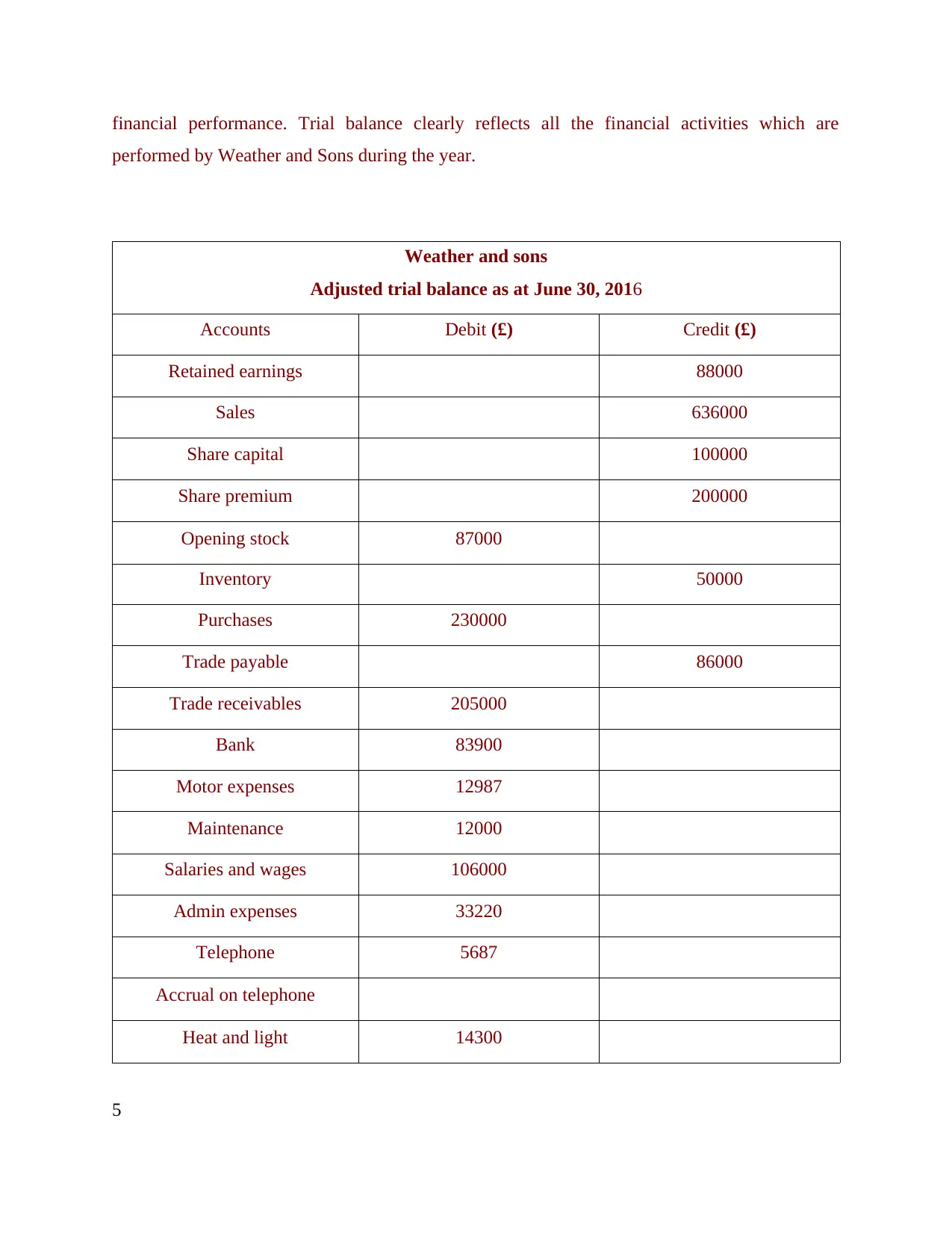
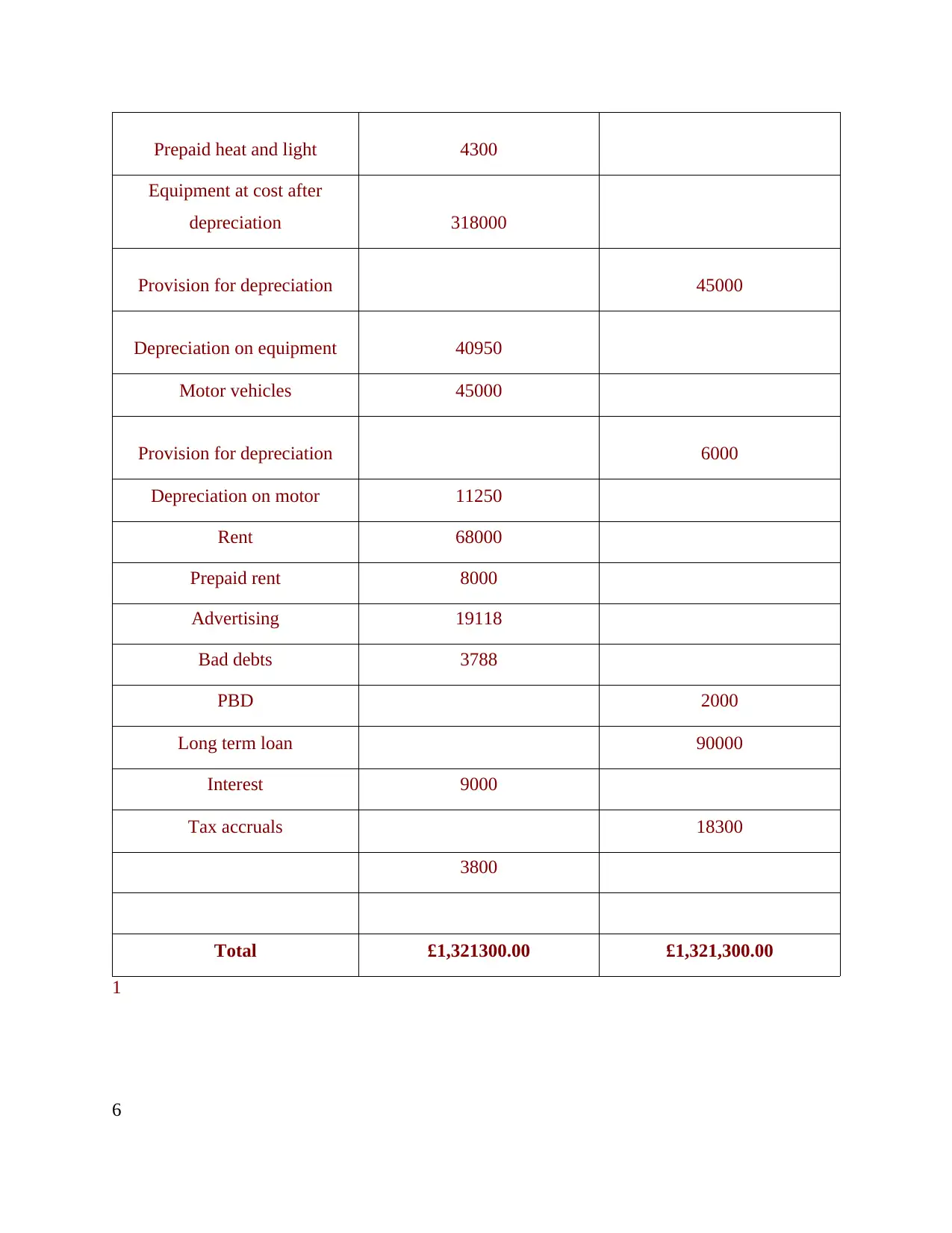
financial performance. Trial balance clearly reflects all the financial activities which are
performed by Weather and Sons during the year.
Weather and sons
Adjusted trial balance as at June 30, 2016
Accounts Debit (£) Credit (£)
Retained earnings 88000
Sales 636000
Share capital 100000
Share premium 200000
Opening stock 87000
Inventory 50000
Purchases 230000
Trade payable 86000
Trade receivables 205000
Bank 83900
Motor expenses 12987
Maintenance 12000
Salaries and wages 106000
Admin expenses 33220
Telephone 5687
Accrual on telephone
Heat and light 14300
5
performed by Weather and Sons during the year.
Weather and sons
Adjusted trial balance as at June 30, 2016
Accounts Debit (£) Credit (£)
Retained earnings 88000
Sales 636000
Share capital 100000
Share premium 200000
Opening stock 87000
Inventory 50000
Purchases 230000
Trade payable 86000
Trade receivables 205000
Bank 83900
Motor expenses 12987
Maintenance 12000
Salaries and wages 106000
Admin expenses 33220
Telephone 5687
Accrual on telephone
Heat and light 14300
5

Prepaid heat and light 4300
Equipment at cost after
depreciation 318000
Provision for depreciation 45000
Depreciation on equipment 40950
Motor vehicles 45000
Provision for depreciation 6000
Depreciation on motor 11250
Rent 68000
Prepaid rent 8000
Advertising 19118
Bad debts 3788
PBD 2000
Long term loan 90000
Interest 9000
Tax accruals 18300
3800
Total £1,321300.00 £1,321,300.00
1
6
Equipment at cost after
depreciation 318000
Provision for depreciation 45000
Depreciation on equipment 40950
Motor vehicles 45000
Provision for depreciation 6000
Depreciation on motor 11250
Rent 68000
Prepaid rent 8000
Advertising 19118
Bad debts 3788
PBD 2000
Long term loan 90000
Interest 9000
Tax accruals 18300
3800
Total £1,321300.00 £1,321,300.00
1
6
⊘ This is a preview!⊘
Do you want full access?
Subscribe today to unlock all pages.

Trusted by 1+ million students worldwide

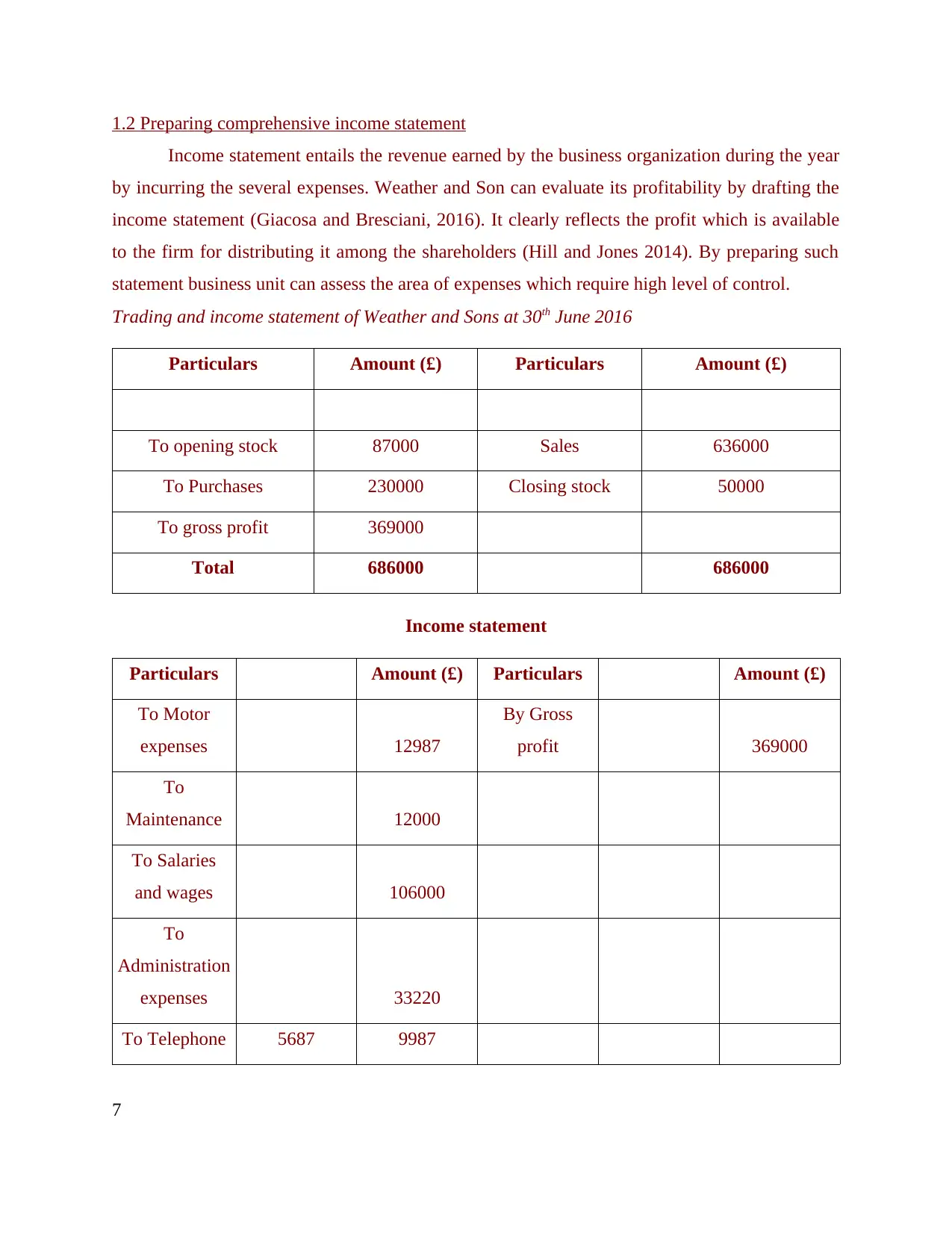
1.2 Preparing comprehensive income statement
Income statement entails the revenue earned by the business organization during the year
by incurring the several expenses. Weather and Son can evaluate its profitability by drafting the
income statement (Giacosa and Bresciani, 2016). It clearly reflects the profit which is available
to the firm for distributing it among the shareholders (Hill and Jones 2014). By preparing such
statement business unit can assess the area of expenses which require high level of control.
Trading and income statement of Weather and Sons at 30th June 2016
Particulars Amount (£) Particulars Amount (£)
To opening stock 87000 Sales 636000
To Purchases 230000 Closing stock 50000
To gross profit 369000
Total 686000 686000
Income statement
Particulars Amount (£) Particulars Amount (£)
To Motor
expenses 12987
By Gross
profit 369000
To
Maintenance 12000
To Salaries
and wages 106000
To
Administration
expenses 33220
To Telephone 5687 9987
7
Income statement entails the revenue earned by the business organization during the year
by incurring the several expenses. Weather and Son can evaluate its profitability by drafting the
income statement (Giacosa and Bresciani, 2016). It clearly reflects the profit which is available
to the firm for distributing it among the shareholders (Hill and Jones 2014). By preparing such
statement business unit can assess the area of expenses which require high level of control.
Trading and income statement of Weather and Sons at 30th June 2016
Particulars Amount (£) Particulars Amount (£)
To opening stock 87000 Sales 636000
To Purchases 230000 Closing stock 50000
To gross profit 369000
Total 686000 686000
Income statement
Particulars Amount (£) Particulars Amount (£)
To Motor
expenses 12987
By Gross
profit 369000
To
Maintenance 12000
To Salaries
and wages 106000
To
Administration
expenses 33220
To Telephone 5687 9987
7
Paraphrase This Document
Need a fresh take? Get an instant paraphrase of this document with our AI Paraphraser

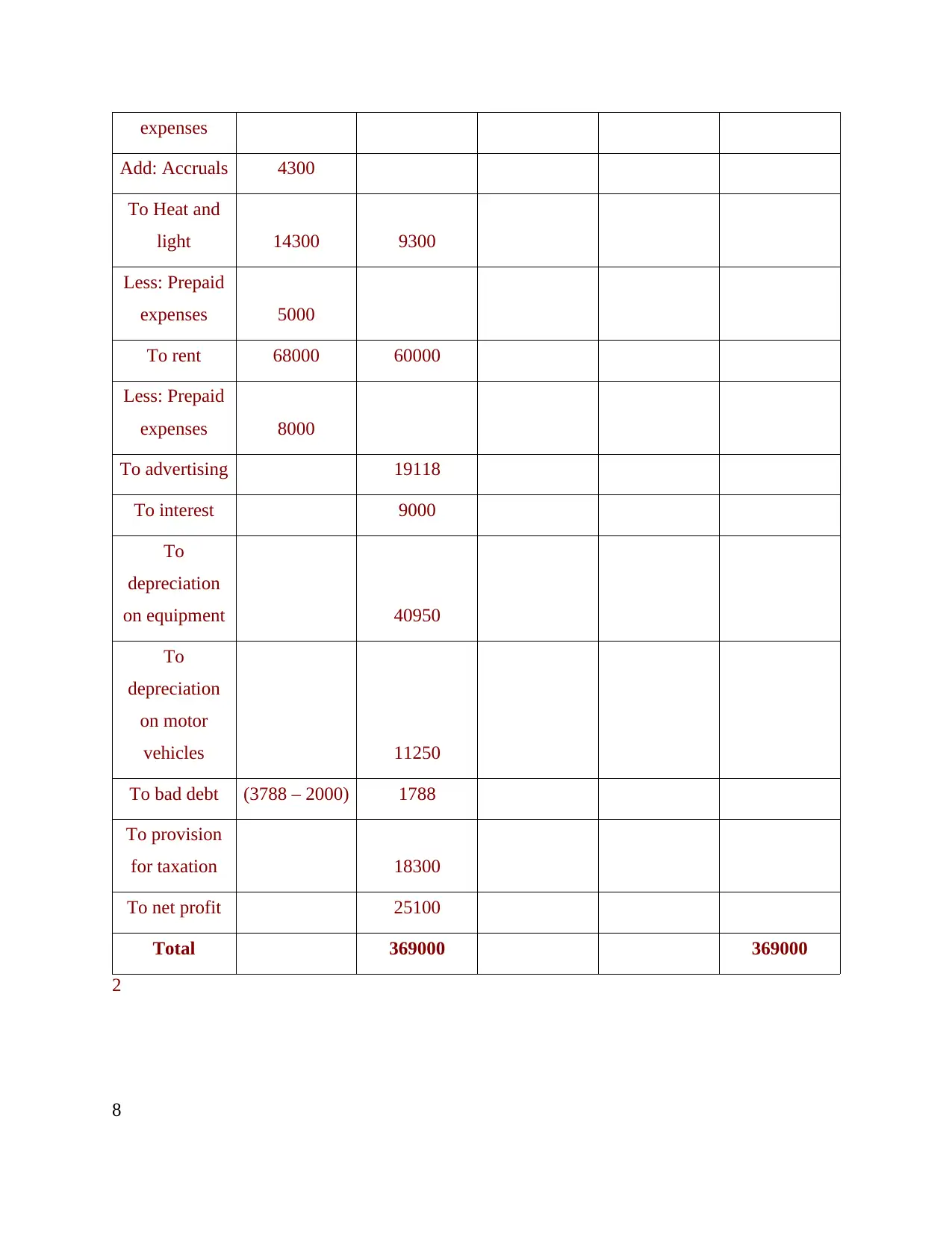
expenses
Add: Accruals 4300
To Heat and
light 14300 9300
Less: Prepaid
expenses 5000
To rent 68000 60000
Less: Prepaid
expenses 8000
To advertising 19118
To interest 9000
To
depreciation
on equipment 40950
To
depreciation
on motor
vehicles 11250
To bad debt (3788 – 2000) 1788
To provision
for taxation 18300
To net profit 25100
Total 369000 369000
2
8
Add: Accruals 4300
To Heat and
light 14300 9300
Less: Prepaid
expenses 5000
To rent 68000 60000
Less: Prepaid
expenses 8000
To advertising 19118
To interest 9000
To
depreciation
on equipment 40950
To
depreciation
on motor
vehicles 11250
To bad debt (3788 – 2000) 1788
To provision
for taxation 18300
To net profit 25100
Total 369000 369000
2
8

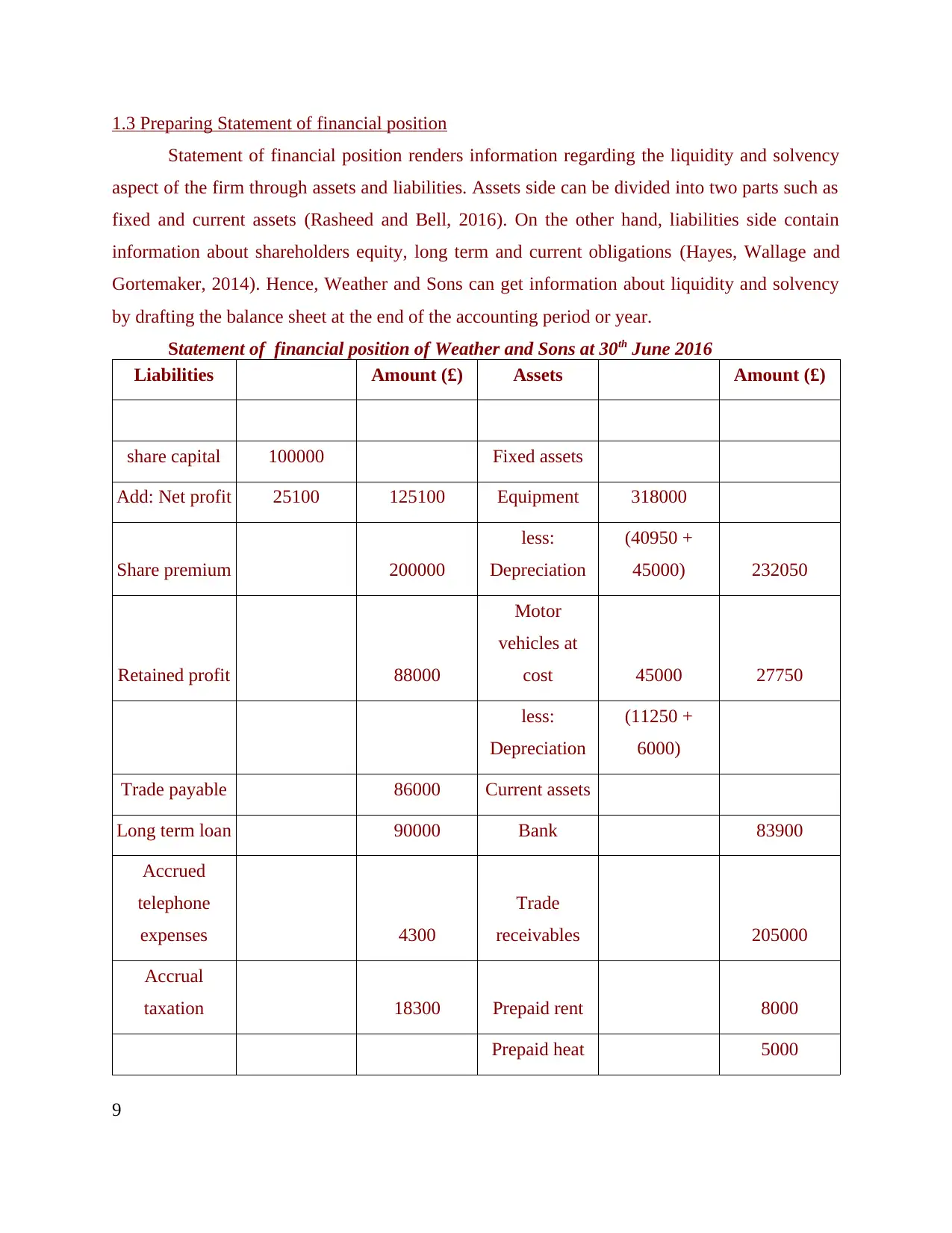
1.3 Preparing Statement of financial position
Statement of financial position renders information regarding the liquidity and solvency
aspect of the firm through assets and liabilities. Assets side can be divided into two parts such as
fixed and current assets (Rasheed and Bell, 2016). On the other hand, liabilities side contain
information about shareholders equity, long term and current obligations (Hayes, Wallage and
Gortemaker, 2014). Hence, Weather and Sons can get information about liquidity and solvency
by drafting the balance sheet at the end of the accounting period or year.
Statement of financial position of Weather and Sons at 30th June 2016
Liabilities Amount (£) Assets Amount (£)
share capital 100000 Fixed assets
Add: Net profit 25100 125100 Equipment 318000
Share premium 200000
less:
Depreciation
(40950 +
45000) 232050
Retained profit 88000
Motor
vehicles at
cost 45000 27750
less:
Depreciation
(11250 +
6000)
Trade payable 86000 Current assets
Long term loan 90000 Bank 83900
Accrued
telephone
expenses 4300
Trade
receivables 205000
Accrual
taxation 18300 Prepaid rent 8000
Prepaid heat 5000
9
Statement of financial position renders information regarding the liquidity and solvency
aspect of the firm through assets and liabilities. Assets side can be divided into two parts such as
fixed and current assets (Rasheed and Bell, 2016). On the other hand, liabilities side contain
information about shareholders equity, long term and current obligations (Hayes, Wallage and
Gortemaker, 2014). Hence, Weather and Sons can get information about liquidity and solvency
by drafting the balance sheet at the end of the accounting period or year.
Statement of financial position of Weather and Sons at 30th June 2016
Liabilities Amount (£) Assets Amount (£)
share capital 100000 Fixed assets
Add: Net profit 25100 125100 Equipment 318000
Share premium 200000
less:
Depreciation
(40950 +
45000) 232050
Retained profit 88000
Motor
vehicles at
cost 45000 27750
less:
Depreciation
(11250 +
6000)
Trade payable 86000 Current assets
Long term loan 90000 Bank 83900
Accrued
telephone
expenses 4300
Trade
receivables 205000
Accrual
taxation 18300 Prepaid rent 8000
Prepaid heat 5000
9
⊘ This is a preview!⊘
Do you want full access?
Subscribe today to unlock all pages.

Trusted by 1+ million students worldwide

and lighting
Inventory 50000
Total 611700 611700
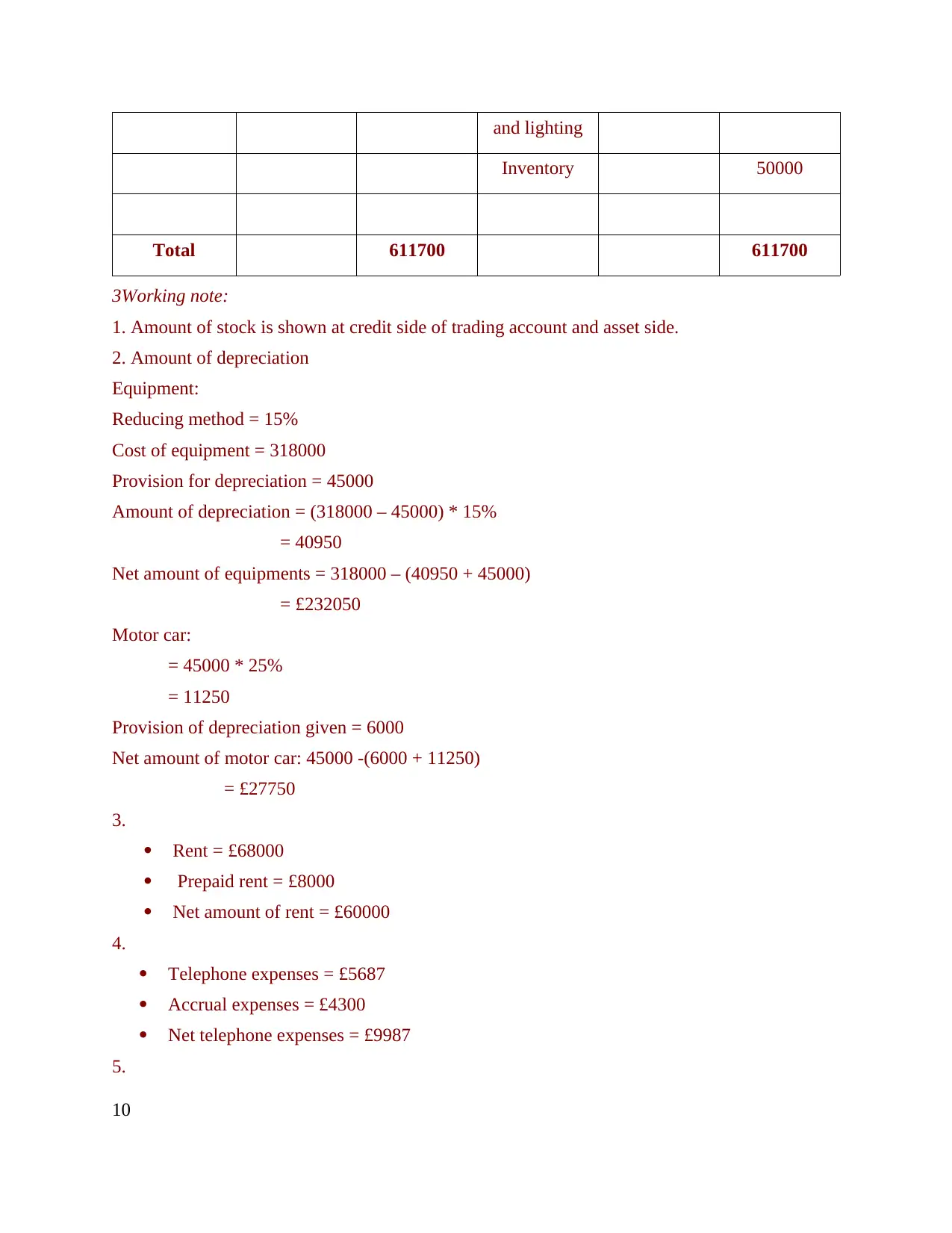
3Working note:
1. Amount of stock is shown at credit side of trading account and asset side.
2. Amount of depreciation
Equipment:
Reducing method = 15%
Cost of equipment = 318000
Provision for depreciation = 45000
Amount of depreciation = (318000 – 45000) * 15%
= 40950
Net amount of equipments = 318000 – (40950 + 45000)
= £232050
Motor car:
= 45000 * 25%
= 11250
Provision of depreciation given = 6000
Net amount of motor car: 45000 -(6000 + 11250)
= £27750
3.
Rent = £68000
Prepaid rent = £8000
Net amount of rent = £60000
4.
Telephone expenses = £5687
Accrual expenses = £4300
Net telephone expenses = £9987
5.
10
Inventory 50000
Total 611700 611700
3Working note:
1. Amount of stock is shown at credit side of trading account and asset side.
2. Amount of depreciation
Equipment:
Reducing method = 15%
Cost of equipment = 318000
Provision for depreciation = 45000
Amount of depreciation = (318000 – 45000) * 15%
= 40950
Net amount of equipments = 318000 – (40950 + 45000)
= £232050
Motor car:
= 45000 * 25%
= 11250
Provision of depreciation given = 6000
Net amount of motor car: 45000 -(6000 + 11250)
= £27750
3.
Rent = £68000
Prepaid rent = £8000
Net amount of rent = £60000
4.
Telephone expenses = £5687
Accrual expenses = £4300
Net telephone expenses = £9987
5.
10
Paraphrase This Document
Need a fresh take? Get an instant paraphrase of this document with our AI Paraphraser

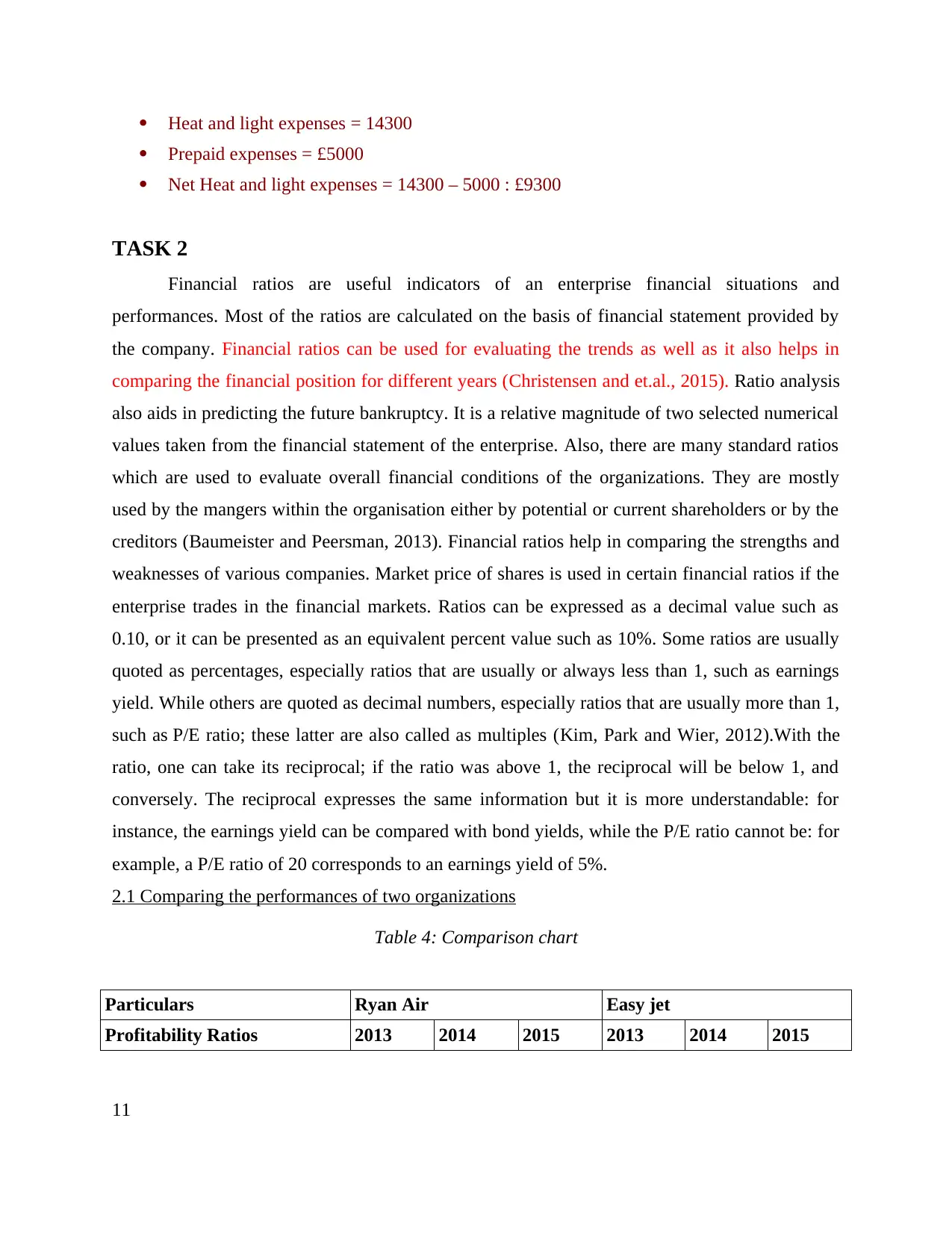
Heat and light expenses = 14300
Prepaid expenses = £5000
Net Heat and light expenses = 14300 – 5000 : £9300
TASK 2
Financial ratios are useful indicators of an enterprise financial situations and
performances. Most of the ratios are calculated on the basis of financial statement provided by
the company. Financial ratios can be used for evaluating the trends as well as it also helps in
comparing the financial position for different years (Christensen and et.al., 2015). Ratio analysis
also aids in predicting the future bankruptcy. It is a relative magnitude of two selected numerical
values taken from the financial statement of the enterprise. Also, there are many standard ratios
which are used to evaluate overall financial conditions of the organizations. They are mostly
used by the mangers within the organisation either by potential or current shareholders or by the
creditors (Baumeister and Peersman, 2013). Financial ratios help in comparing the strengths and
weaknesses of various companies. Market price of shares is used in certain financial ratios if the
enterprise trades in the financial markets. Ratios can be expressed as a decimal value such as
0.10, or it can be presented as an equivalent percent value such as 10%. Some ratios are usually
quoted as percentages, especially ratios that are usually or always less than 1, such as earnings
yield. While others are quoted as decimal numbers, especially ratios that are usually more than 1,
such as P/E ratio; these latter are also called as multiples (Kim, Park and Wier, 2012).With the
ratio, one can take its reciprocal; if the ratio was above 1, the reciprocal will be below 1, and
conversely. The reciprocal expresses the same information but it is more understandable: for
instance, the earnings yield can be compared with bond yields, while the P/E ratio cannot be: for
example, a P/E ratio of 20 corresponds to an earnings yield of 5%.
2.1 Comparing the performances of two organizations
Table 4: Comparison chart
Particulars Ryan Air Easy jet
Profitability Ratios 2013 2014 2015 2013 2014 2015
11
Prepaid expenses = £5000
Net Heat and light expenses = 14300 – 5000 : £9300
TASK 2
Financial ratios are useful indicators of an enterprise financial situations and
performances. Most of the ratios are calculated on the basis of financial statement provided by
the company. Financial ratios can be used for evaluating the trends as well as it also helps in
comparing the financial position for different years (Christensen and et.al., 2015). Ratio analysis
also aids in predicting the future bankruptcy. It is a relative magnitude of two selected numerical
values taken from the financial statement of the enterprise. Also, there are many standard ratios
which are used to evaluate overall financial conditions of the organizations. They are mostly
used by the mangers within the organisation either by potential or current shareholders or by the
creditors (Baumeister and Peersman, 2013). Financial ratios help in comparing the strengths and
weaknesses of various companies. Market price of shares is used in certain financial ratios if the
enterprise trades in the financial markets. Ratios can be expressed as a decimal value such as
0.10, or it can be presented as an equivalent percent value such as 10%. Some ratios are usually
quoted as percentages, especially ratios that are usually or always less than 1, such as earnings
yield. While others are quoted as decimal numbers, especially ratios that are usually more than 1,
such as P/E ratio; these latter are also called as multiples (Kim, Park and Wier, 2012).With the
ratio, one can take its reciprocal; if the ratio was above 1, the reciprocal will be below 1, and
conversely. The reciprocal expresses the same information but it is more understandable: for
instance, the earnings yield can be compared with bond yields, while the P/E ratio cannot be: for
example, a P/E ratio of 20 corresponds to an earnings yield of 5%.
2.1 Comparing the performances of two organizations
Table 4: Comparison chart
Particulars Ryan Air Easy jet
Profitability Ratios 2013 2014 2015 2013 2014 2015
11

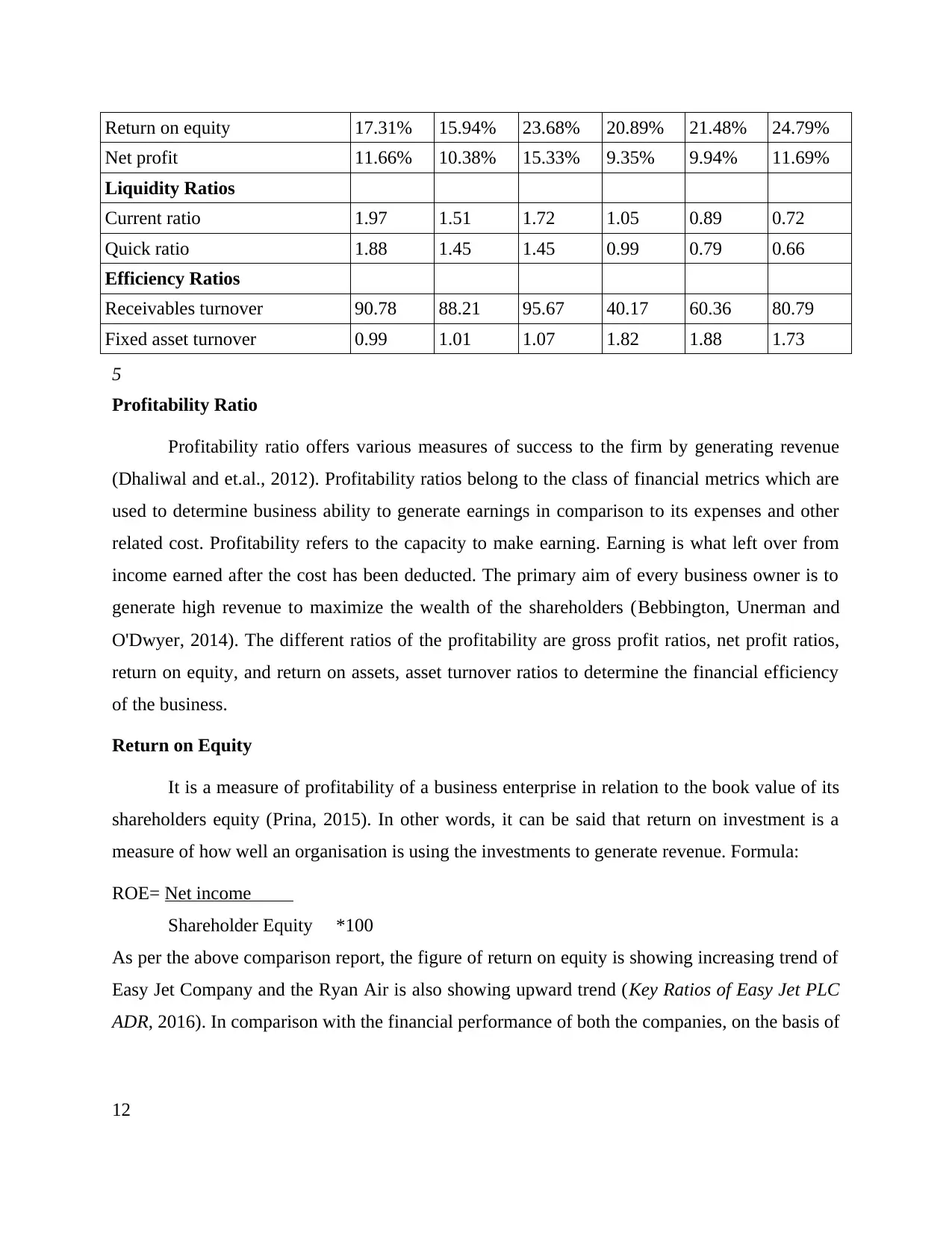
Return on equity 17.31% 15.94% 23.68% 20.89% 21.48% 24.79%
Net profit 11.66% 10.38% 15.33% 9.35% 9.94% 11.69%
Liquidity Ratios
Current ratio 1.97 1.51 1.72 1.05 0.89 0.72
Quick ratio 1.88 1.45 1.45 0.99 0.79 0.66
Efficiency Ratios
Receivables turnover 90.78 88.21 95.67 40.17 60.36 80.79
Fixed asset turnover 0.99 1.01 1.07 1.82 1.88 1.73
5
Profitability Ratio
Profitability ratio offers various measures of success to the firm by generating revenue
(Dhaliwal and et.al., 2012). Profitability ratios belong to the class of financial metrics which are
used to determine business ability to generate earnings in comparison to its expenses and other
related cost. Profitability refers to the capacity to make earning. Earning is what left over from
income earned after the cost has been deducted. The primary aim of every business owner is to
generate high revenue to maximize the wealth of the shareholders (Bebbington, Unerman and
O'Dwyer, 2014). The different ratios of the profitability are gross profit ratios, net profit ratios,
return on equity, and return on assets, asset turnover ratios to determine the financial efficiency
of the business.
Return on Equity
It is a measure of profitability of a business enterprise in relation to the book value of its
shareholders equity (Prina, 2015). In other words, it can be said that return on investment is a
measure of how well an organisation is using the investments to generate revenue. Formula:
ROE= Net income
Shareholder Equity *100
As per the above comparison report, the figure of return on equity is showing increasing trend of
Easy Jet Company and the Ryan Air is also showing upward trend (Key Ratios of Easy Jet PLC
ADR, 2016). In comparison with the financial performance of both the companies, on the basis of
12
Net profit 11.66% 10.38% 15.33% 9.35% 9.94% 11.69%
Liquidity Ratios
Current ratio 1.97 1.51 1.72 1.05 0.89 0.72
Quick ratio 1.88 1.45 1.45 0.99 0.79 0.66
Efficiency Ratios
Receivables turnover 90.78 88.21 95.67 40.17 60.36 80.79
Fixed asset turnover 0.99 1.01 1.07 1.82 1.88 1.73
5
Profitability Ratio
Profitability ratio offers various measures of success to the firm by generating revenue
(Dhaliwal and et.al., 2012). Profitability ratios belong to the class of financial metrics which are
used to determine business ability to generate earnings in comparison to its expenses and other
related cost. Profitability refers to the capacity to make earning. Earning is what left over from
income earned after the cost has been deducted. The primary aim of every business owner is to
generate high revenue to maximize the wealth of the shareholders (Bebbington, Unerman and
O'Dwyer, 2014). The different ratios of the profitability are gross profit ratios, net profit ratios,
return on equity, and return on assets, asset turnover ratios to determine the financial efficiency
of the business.
Return on Equity
It is a measure of profitability of a business enterprise in relation to the book value of its
shareholders equity (Prina, 2015). In other words, it can be said that return on investment is a
measure of how well an organisation is using the investments to generate revenue. Formula:
ROE= Net income
Shareholder Equity *100
As per the above comparison report, the figure of return on equity is showing increasing trend of
Easy Jet Company and the Ryan Air is also showing upward trend (Key Ratios of Easy Jet PLC
ADR, 2016). In comparison with the financial performance of both the companies, on the basis of
12
⊘ This is a preview!⊘
Do you want full access?
Subscribe today to unlock all pages.

Trusted by 1+ million students worldwide
1 out of 17
Related Documents
Your All-in-One AI-Powered Toolkit for Academic Success.
+13062052269
info@desklib.com
Available 24*7 on WhatsApp / Email
Unlock your academic potential
Copyright © 2020–2026 A2Z Services. All Rights Reserved. Developed and managed by ZUCOL.