University Finance Report: Analysis of Accounting Reality Construction
VerifiedAdded on 2023/06/07
|7
|1078
|147
Report
AI Summary
This finance assignment report analyzes an article by Gareth Morgan, focusing on the construction of accounting reality. The report provides a brief overview of the article, which argues that accountants often construct reality in a limited and one-sided manner, and that the concept of objectivity in accounting is largely a myth. The student critically reflects on the article from an academic perspective, discussing both its positive and negative aspects. The report also addresses whether the article changes the student's mind regarding the idea that accounting is a culture in its own right, providing supporting arguments. The report follows the assignment brief requirements, including word count, page numbering, and proper referencing using the Harvard style.
Finance Assignment
Paraphrase This Document
Need a fresh take? Get an instant paraphrase of this document with our AI Paraphraser

1
By student name
Professor
University
Date: 9th Sep, 2018.
1 | P a g e
By student name
Professor
University
Date: 9th Sep, 2018.
1 | P a g e

2
Contents
Analysis........................................................................................................................................................5
References.................................................................................................................................................10
2 | P a g e
Contents
Analysis........................................................................................................................................................5
References.................................................................................................................................................10
2 | P a g e
⊘ This is a preview!⊘
Do you want full access?
Subscribe today to unlock all pages.

Trusted by 1+ million students worldwide

3
Part One.
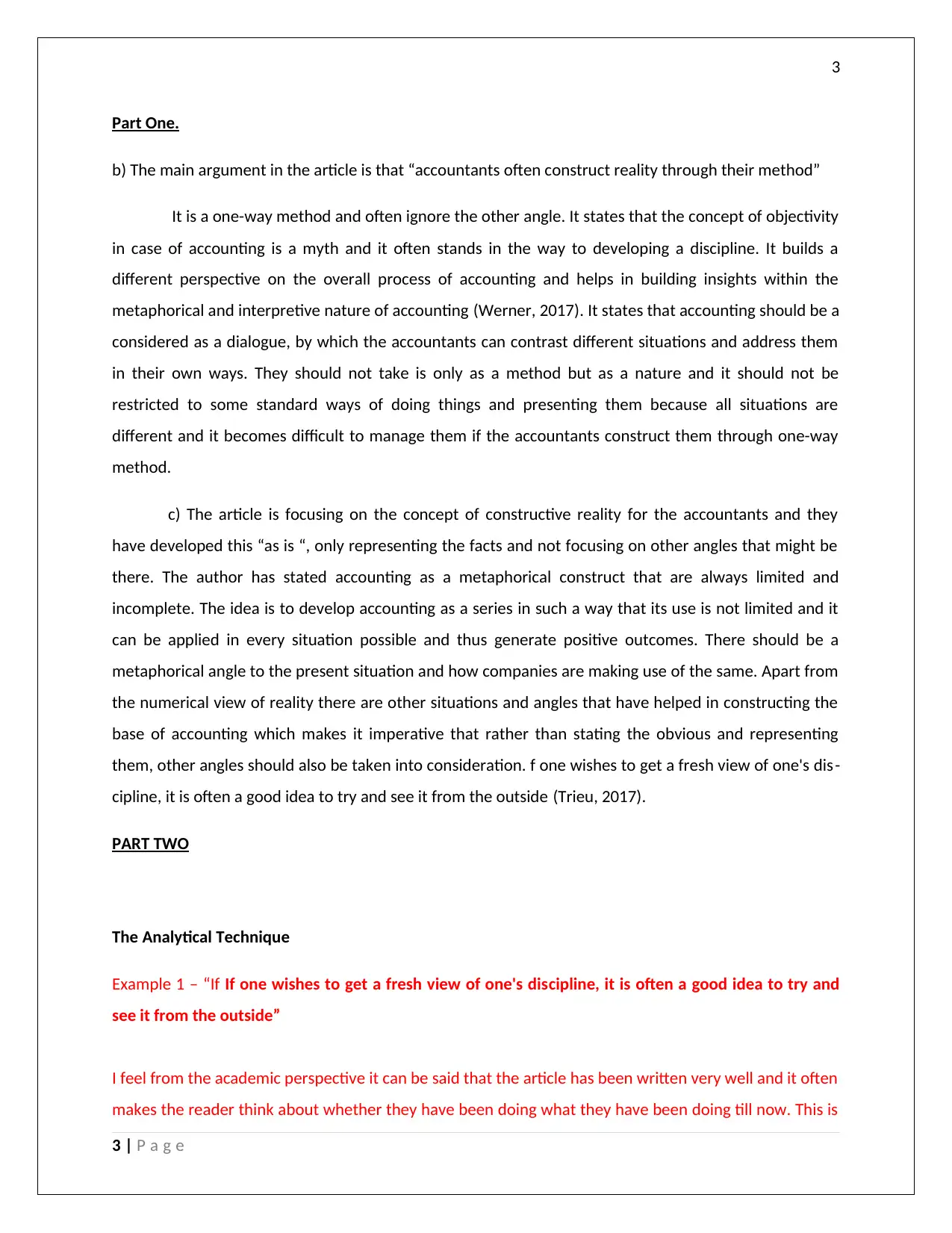
b) The main argument in the article is that “accountants often construct reality through their method”
It is a one-way method and often ignore the other angle. It states that the concept of objectivity
in case of accounting is a myth and it often stands in the way to developing a discipline. It builds a
different perspective on the overall process of accounting and helps in building insights within the
metaphorical and interpretive nature of accounting (Werner, 2017). It states that accounting should be a
considered as a dialogue, by which the accountants can contrast different situations and address them
in their own ways. They should not take is only as a method but as a nature and it should not be
restricted to some standard ways of doing things and presenting them because all situations are
different and it becomes difficult to manage them if the accountants construct them through one-way
method.
c) The article is focusing on the concept of constructive reality for the accountants and they
have developed this “as is “, only representing the facts and not focusing on other angles that might be
there. The author has stated accounting as a metaphorical construct that are always limited and
incomplete. The idea is to develop accounting as a series in such a way that its use is not limited and it
can be applied in every situation possible and thus generate positive outcomes. There should be a
metaphorical angle to the present situation and how companies are making use of the same. Apart from
the numerical view of reality there are other situations and angles that have helped in constructing the
base of accounting which makes it imperative that rather than stating the obvious and representing
them, other angles should also be taken into consideration. f one wishes to get a fresh view of one's dis -
cipline, it is often a good idea to try and see it from the outside (Trieu, 2017).
PART TWO
The Analytical Technique
Example 1 – “If If one wishes to get a fresh view of one's discipline, it is often a good idea to try and
see it from the outside”
I feel from the academic perspective it can be said that the article has been written very well and it often
makes the reader think about whether they have been doing what they have been doing till now. This is
3 | P a g e
Part One.
b) The main argument in the article is that “accountants often construct reality through their method”
It is a one-way method and often ignore the other angle. It states that the concept of objectivity
in case of accounting is a myth and it often stands in the way to developing a discipline. It builds a
different perspective on the overall process of accounting and helps in building insights within the
metaphorical and interpretive nature of accounting (Werner, 2017). It states that accounting should be a
considered as a dialogue, by which the accountants can contrast different situations and address them
in their own ways. They should not take is only as a method but as a nature and it should not be
restricted to some standard ways of doing things and presenting them because all situations are
different and it becomes difficult to manage them if the accountants construct them through one-way
method.
c) The article is focusing on the concept of constructive reality for the accountants and they
have developed this “as is “, only representing the facts and not focusing on other angles that might be
there. The author has stated accounting as a metaphorical construct that are always limited and
incomplete. The idea is to develop accounting as a series in such a way that its use is not limited and it
can be applied in every situation possible and thus generate positive outcomes. There should be a
metaphorical angle to the present situation and how companies are making use of the same. Apart from
the numerical view of reality there are other situations and angles that have helped in constructing the
base of accounting which makes it imperative that rather than stating the obvious and representing
them, other angles should also be taken into consideration. f one wishes to get a fresh view of one's dis -
cipline, it is often a good idea to try and see it from the outside (Trieu, 2017).
PART TWO
The Analytical Technique
Example 1 – “If If one wishes to get a fresh view of one's discipline, it is often a good idea to try and
see it from the outside”
I feel from the academic perspective it can be said that the article has been written very well and it often
makes the reader think about whether they have been doing what they have been doing till now. This is
3 | P a g e
Paraphrase This Document
Need a fresh take? Get an instant paraphrase of this document with our AI Paraphraser

4
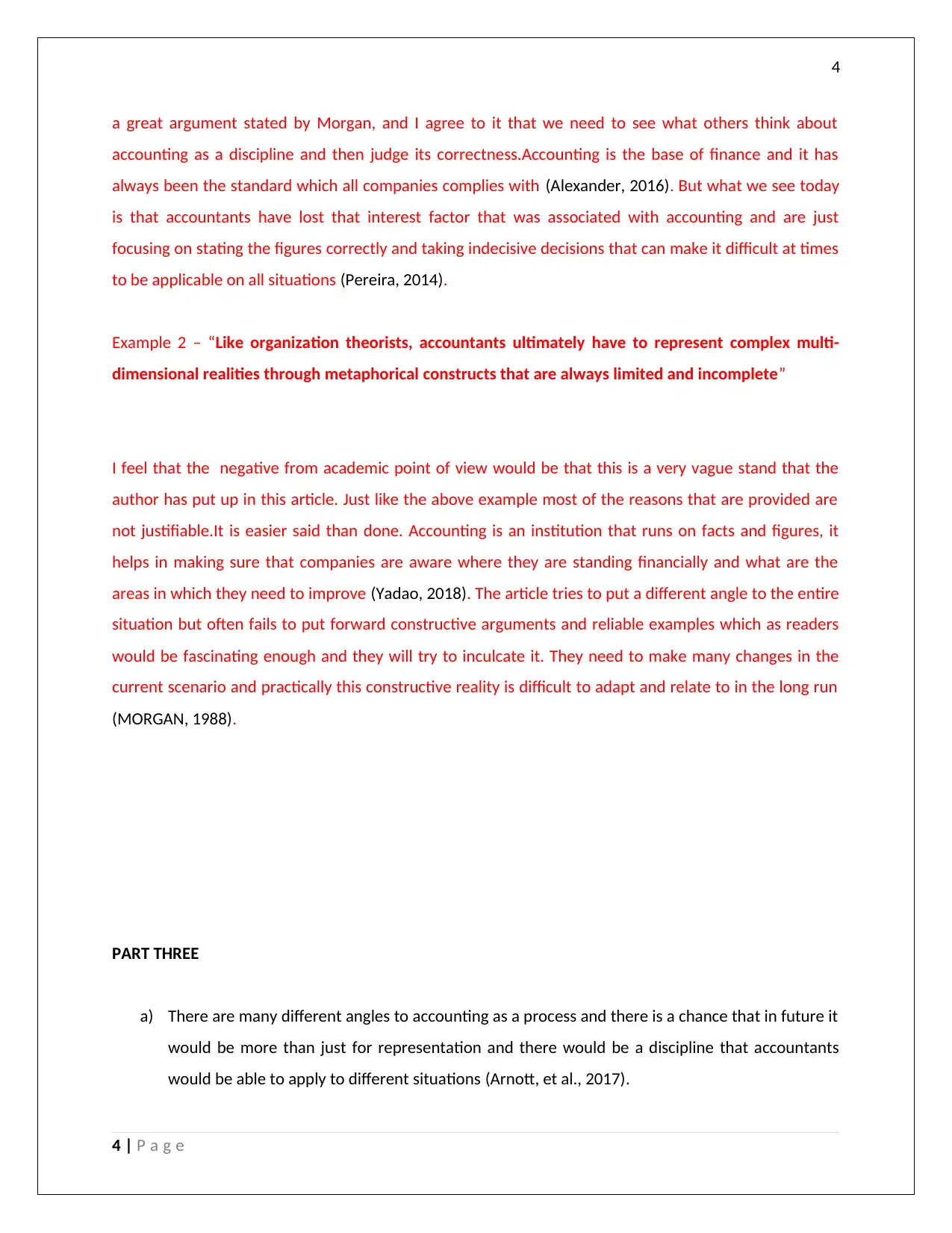
a great argument stated by Morgan, and I agree to it that we need to see what others think about
accounting as a discipline and then judge its correctness.Accounting is the base of finance and it has
always been the standard which all companies complies with (Alexander, 2016). But what we see today
is that accountants have lost that interest factor that was associated with accounting and are just
focusing on stating the figures correctly and taking indecisive decisions that can make it difficult at times
to be applicable on all situations (Pereira, 2014).
Example 2 – “Like organization theorists, accountants ultimately have to represent complex multi-
dimensional realities through metaphorical constructs that are always limited and incomplete”
I feel that the negative from academic point of view would be that this is a very vague stand that the
author has put up in this article. Just like the above example most of the reasons that are provided are
not justifiable.It is easier said than done. Accounting is an institution that runs on facts and figures, it
helps in making sure that companies are aware where they are standing financially and what are the
areas in which they need to improve (Yadao, 2018). The article tries to put a different angle to the entire
situation but often fails to put forward constructive arguments and reliable examples which as readers
would be fascinating enough and they will try to inculcate it. They need to make many changes in the
current scenario and practically this constructive reality is difficult to adapt and relate to in the long run
(MORGAN, 1988).
PART THREE
a) There are many different angles to accounting as a process and there is a chance that in future it
would be more than just for representation and there would be a discipline that accountants
would be able to apply to different situations (Arnott, et al., 2017).
4 | P a g e
a great argument stated by Morgan, and I agree to it that we need to see what others think about
accounting as a discipline and then judge its correctness.Accounting is the base of finance and it has
always been the standard which all companies complies with (Alexander, 2016). But what we see today
is that accountants have lost that interest factor that was associated with accounting and are just
focusing on stating the figures correctly and taking indecisive decisions that can make it difficult at times
to be applicable on all situations (Pereira, 2014).
Example 2 – “Like organization theorists, accountants ultimately have to represent complex multi-
dimensional realities through metaphorical constructs that are always limited and incomplete”
I feel that the negative from academic point of view would be that this is a very vague stand that the
author has put up in this article. Just like the above example most of the reasons that are provided are
not justifiable.It is easier said than done. Accounting is an institution that runs on facts and figures, it
helps in making sure that companies are aware where they are standing financially and what are the
areas in which they need to improve (Yadao, 2018). The article tries to put a different angle to the entire
situation but often fails to put forward constructive arguments and reliable examples which as readers
would be fascinating enough and they will try to inculcate it. They need to make many changes in the
current scenario and practically this constructive reality is difficult to adapt and relate to in the long run
(MORGAN, 1988).
PART THREE
a) There are many different angles to accounting as a process and there is a chance that in future it
would be more than just for representation and there would be a discipline that accountants
would be able to apply to different situations (Arnott, et al., 2017).
4 | P a g e

5
b) Morgan, has helped in developing accounting and culture to an extent but the overall
arguments that he has provided are vague and there should be more factual statements that
could be practically applied. Thus, that was a failure on part of Morgan.
one wishes to get a fresh view of one's discipline,
it is often a good idea to try and see it
from the outside.
5 | P a g e
b) Morgan, has helped in developing accounting and culture to an extent but the overall
arguments that he has provided are vague and there should be more factual statements that
could be practically applied. Thus, that was a failure on part of Morgan.
one wishes to get a fresh view of one's discipline,
it is often a good idea to try and see it
from the outside.
5 | P a g e
⊘ This is a preview!⊘
Do you want full access?
Subscribe today to unlock all pages.

Trusted by 1+ million students worldwide

6
References
Alexander, F., 2016. The Changing Face of Accountability. The Journal of Higher Education, 71(4), pp.
411-431.
Arnott, D., Lizama, F. & Song, Y., 2017. Patterns of business intelligence systems use in organizations.
Decision Support Systems, Volume 97, pp. 58-68.
MORGAN, G., 1988. ACCOUNTING AS REALITY CONSTRUCTION:TOWARDS A NEW EPISTEMOLOGY FOR
ACCOUNTING PRACTICE. Accounting, Organizations and Society, 13(5), pp. 477- 485.
Pereira, A. C. P., 2014. Analytical Processing for Forensic Analysis. s.l.:s.n.
Trieu, V., 2017. Getting value from Business Intelligence systems: A review and research agenda.
Decision Support Systems, Volume 93, pp. 111-124.
Werner, M., 2017. Financial process mining - Accounting data structure dependent control flow
inference. International Journal of Accounting Information Systems, Volume 25, pp. 57-80.
Yadao, J., 2018. Forensic accountants and big data.
6 | P a g e
References
Alexander, F., 2016. The Changing Face of Accountability. The Journal of Higher Education, 71(4), pp.
411-431.
Arnott, D., Lizama, F. & Song, Y., 2017. Patterns of business intelligence systems use in organizations.
Decision Support Systems, Volume 97, pp. 58-68.
MORGAN, G., 1988. ACCOUNTING AS REALITY CONSTRUCTION:TOWARDS A NEW EPISTEMOLOGY FOR
ACCOUNTING PRACTICE. Accounting, Organizations and Society, 13(5), pp. 477- 485.
Pereira, A. C. P., 2014. Analytical Processing for Forensic Analysis. s.l.:s.n.
Trieu, V., 2017. Getting value from Business Intelligence systems: A review and research agenda.
Decision Support Systems, Volume 93, pp. 111-124.
Werner, M., 2017. Financial process mining - Accounting data structure dependent control flow
inference. International Journal of Accounting Information Systems, Volume 25, pp. 57-80.
Yadao, J., 2018. Forensic accountants and big data.
6 | P a g e
1 out of 7
Related Documents
Your All-in-One AI-Powered Toolkit for Academic Success.
+13062052269
info@desklib.com
Available 24*7 on WhatsApp / Email
Unlock your academic potential
Copyright © 2020–2026 A2Z Services. All Rights Reserved. Developed and managed by ZUCOL.