Impact of Accounting System Changes: A Report for JB Hi-Fi Ltd CEO
VerifiedAdded on  2023/06/07
|5
|1070
|199
Report
AI Summary
This report, addressed to JB Hi-Fi CEO Richard Murray, examines the impact of removing the manual accounting function in favor of a fully computerized system. It outlines the advantages and disadvantages of both manual and computerized accounting methods, highlighting the security, flexibility, and potential for human error in manual systems, and the efficiency, accuracy, and fraud risks associated with computerized systems. The report justifies the need to retain a hybrid approach, combining manual and computerized systems to maximize cost reduction while mitigating risks. It explains the impact on the accounting cycle if the manual function were eliminated, emphasizing the potential for fraud and errors. The conclusion supports the implementation of both manual and computerized accounting for optimal data processing and financial report generation.

Management accounting
Paraphrase This Document
Need a fresh take? Get an instant paraphrase of this document with our AI Paraphraser

INTRODUCTION
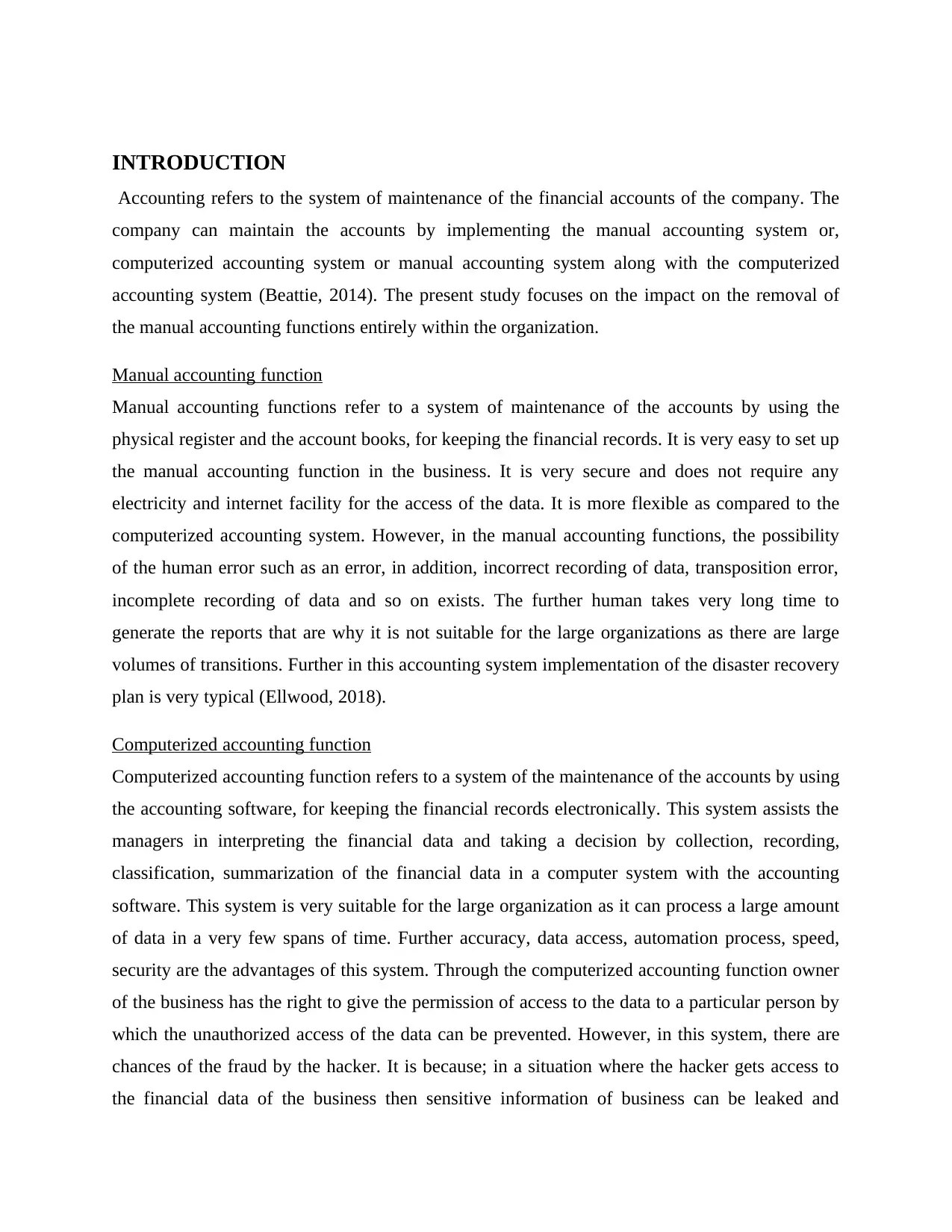
Accounting refers to the system of maintenance of the financial accounts of the company. The
company can maintain the accounts by implementing the manual accounting system or,
computerized accounting system or manual accounting system along with the computerized
accounting system (Beattie, 2014). The present study focuses on the impact on the removal of
the manual accounting functions entirely within the organization.
Manual accounting function
Manual accounting functions refer to a system of maintenance of the accounts by using the
physical register and the account books, for keeping the financial records. It is very easy to set up
the manual accounting function in the business. It is very secure and does not require any
electricity and internet facility for the access of the data. It is more flexible as compared to the
computerized accounting system. However, in the manual accounting functions, the possibility
of the human error such as an error, in addition, incorrect recording of data, transposition error,
incomplete recording of data and so on exists. The further human takes very long time to
generate the reports that are why it is not suitable for the large organizations as there are large
volumes of transitions. Further in this accounting system implementation of the disaster recovery
plan is very typical (Ellwood, 2018).
Computerized accounting function
Computerized accounting function refers to a system of the maintenance of the accounts by using
the accounting software, for keeping the financial records electronically. This system assists the
managers in interpreting the financial data and taking a decision by collection, recording,
classification, summarization of the financial data in a computer system with the accounting
software. This system is very suitable for the large organization as it can process a large amount
of data in a very few spans of time. Further accuracy, data access, automation process, speed,
security are the advantages of this system. Through the computerized accounting function owner
of the business has the right to give the permission of access to the data to a particular person by
which the unauthorized access of the data can be prevented. However, in this system, there are
chances of the fraud by the hacker. It is because; in a situation where the hacker gets access to
the financial data of the business then sensitive information of business can be leaked and
Accounting refers to the system of maintenance of the financial accounts of the company. The
company can maintain the accounts by implementing the manual accounting system or,
computerized accounting system or manual accounting system along with the computerized
accounting system (Beattie, 2014). The present study focuses on the impact on the removal of
the manual accounting functions entirely within the organization.
Manual accounting function
Manual accounting functions refer to a system of maintenance of the accounts by using the
physical register and the account books, for keeping the financial records. It is very easy to set up
the manual accounting function in the business. It is very secure and does not require any
electricity and internet facility for the access of the data. It is more flexible as compared to the
computerized accounting system. However, in the manual accounting functions, the possibility
of the human error such as an error, in addition, incorrect recording of data, transposition error,
incomplete recording of data and so on exists. The further human takes very long time to
generate the reports that are why it is not suitable for the large organizations as there are large
volumes of transitions. Further in this accounting system implementation of the disaster recovery
plan is very typical (Ellwood, 2018).
Computerized accounting function
Computerized accounting function refers to a system of the maintenance of the accounts by using
the accounting software, for keeping the financial records electronically. This system assists the
managers in interpreting the financial data and taking a decision by collection, recording,
classification, summarization of the financial data in a computer system with the accounting
software. This system is very suitable for the large organization as it can process a large amount
of data in a very few spans of time. Further accuracy, data access, automation process, speed,
security are the advantages of this system. Through the computerized accounting function owner
of the business has the right to give the permission of access to the data to a particular person by
which the unauthorized access of the data can be prevented. However, in this system, there are
chances of the fraud by the hacker. It is because; in a situation where the hacker gets access to
the financial data of the business then sensitive information of business can be leaked and

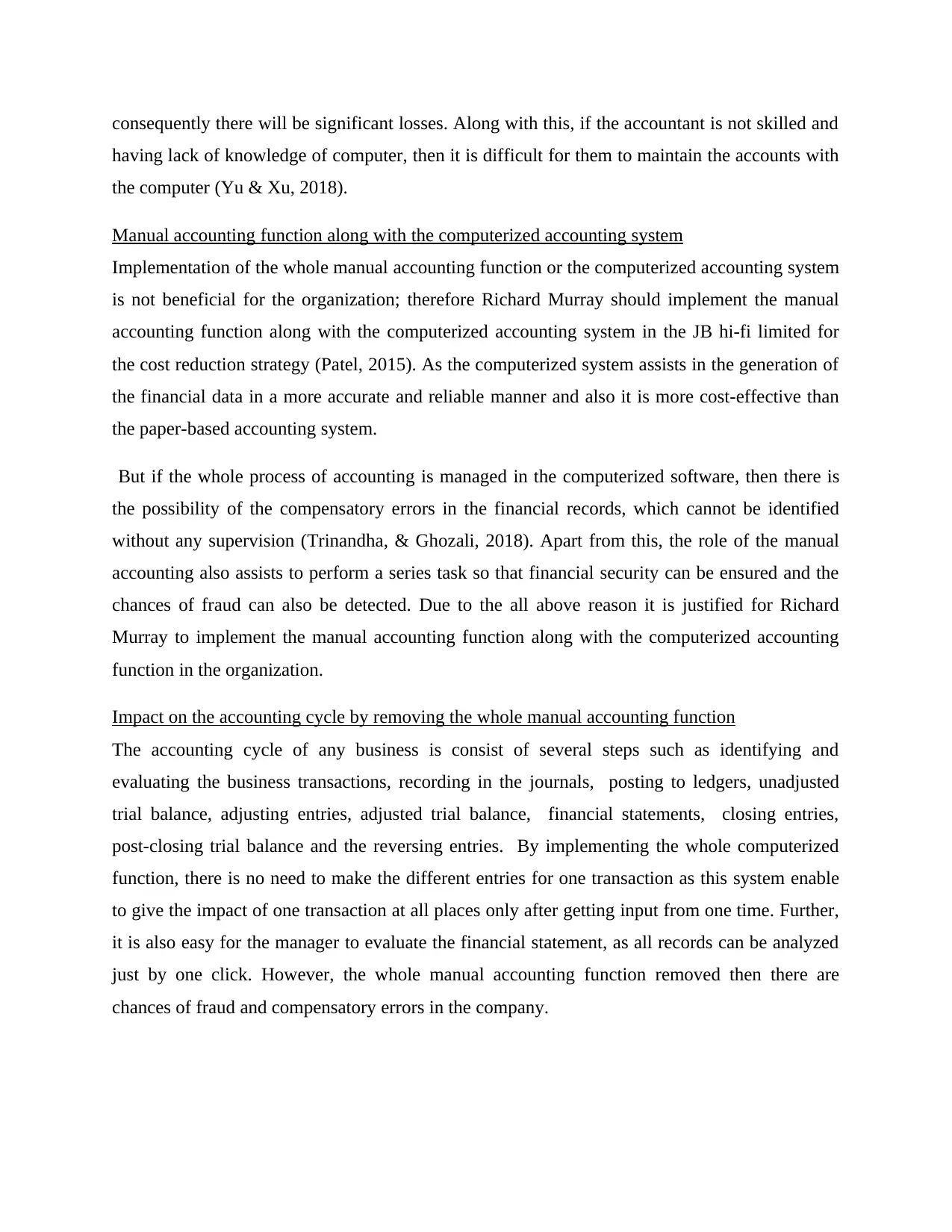
consequently there will be significant losses. Along with this, if the accountant is not skilled and
having lack of knowledge of computer, then it is difficult for them to maintain the accounts with
the computer (Yu & Xu, 2018).
Manual accounting function along with the computerized accounting system
Implementation of the whole manual accounting function or the computerized accounting system
is not beneficial for the organization; therefore Richard Murray should implement the manual
accounting function along with the computerized accounting system in the JB hi-fi limited for
the cost reduction strategy (Patel, 2015). As the computerized system assists in the generation of
the financial data in a more accurate and reliable manner and also it is more cost-effective than
the paper-based accounting system.
But if the whole process of accounting is managed in the computerized software, then there is
the possibility of the compensatory errors in the financial records, which cannot be identified
without any supervision (Trinandha, & Ghozali, 2018). Apart from this, the role of the manual
accounting also assists to perform a series task so that financial security can be ensured and the
chances of fraud can also be detected. Due to the all above reason it is justified for Richard
Murray to implement the manual accounting function along with the computerized accounting
function in the organization.
Impact on the accounting cycle by removing the whole manual accounting function
The accounting cycle of any business is consist of several steps such as identifying and
evaluating the business transactions, recording in the journals, posting to ledgers, unadjusted
trial balance, adjusting entries, adjusted trial balance, financial statements, closing entries,
post-closing trial balance and the reversing entries. By implementing the whole computerized
function, there is no need to make the different entries for one transaction as this system enable
to give the impact of one transaction at all places only after getting input from one time. Further,
it is also easy for the manager to evaluate the financial statement, as all records can be analyzed
just by one click. However, the whole manual accounting function removed then there are
chances of fraud and compensatory errors in the company.
having lack of knowledge of computer, then it is difficult for them to maintain the accounts with
the computer (Yu & Xu, 2018).
Manual accounting function along with the computerized accounting system
Implementation of the whole manual accounting function or the computerized accounting system
is not beneficial for the organization; therefore Richard Murray should implement the manual
accounting function along with the computerized accounting system in the JB hi-fi limited for
the cost reduction strategy (Patel, 2015). As the computerized system assists in the generation of
the financial data in a more accurate and reliable manner and also it is more cost-effective than
the paper-based accounting system.
But if the whole process of accounting is managed in the computerized software, then there is
the possibility of the compensatory errors in the financial records, which cannot be identified
without any supervision (Trinandha, & Ghozali, 2018). Apart from this, the role of the manual
accounting also assists to perform a series task so that financial security can be ensured and the
chances of fraud can also be detected. Due to the all above reason it is justified for Richard
Murray to implement the manual accounting function along with the computerized accounting
function in the organization.
Impact on the accounting cycle by removing the whole manual accounting function
The accounting cycle of any business is consist of several steps such as identifying and
evaluating the business transactions, recording in the journals, posting to ledgers, unadjusted
trial balance, adjusting entries, adjusted trial balance, financial statements, closing entries,
post-closing trial balance and the reversing entries. By implementing the whole computerized
function, there is no need to make the different entries for one transaction as this system enable
to give the impact of one transaction at all places only after getting input from one time. Further,
it is also easy for the manager to evaluate the financial statement, as all records can be analyzed
just by one click. However, the whole manual accounting function removed then there are
chances of fraud and compensatory errors in the company.
⊘ This is a preview!⊘
Do you want full access?
Subscribe today to unlock all pages.

Trusted by 1+ million students worldwide

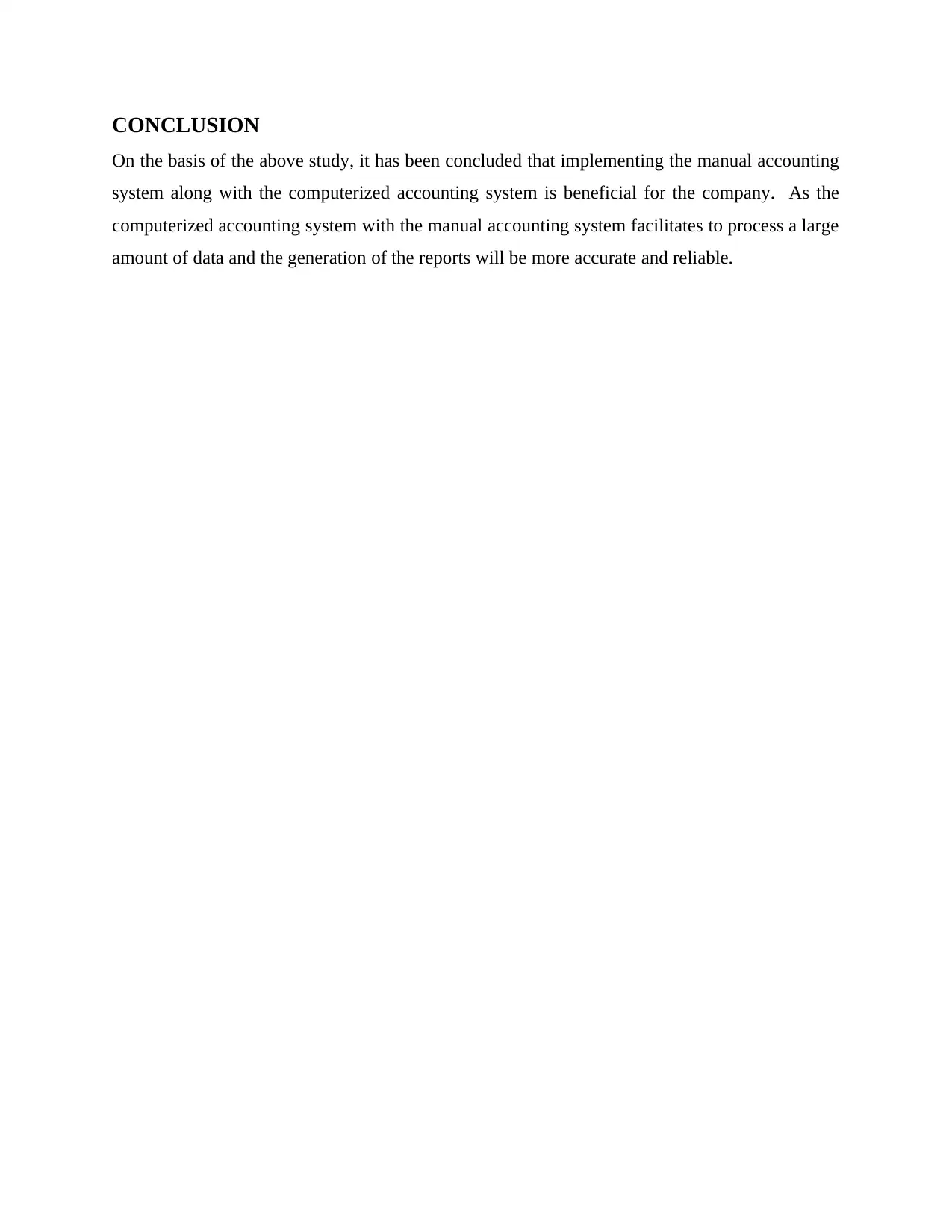
CONCLUSION
On the basis of the above study, it has been concluded that implementing the manual accounting
system along with the computerized accounting system is beneficial for the company. As the
computerized accounting system with the manual accounting system facilitates to process a large
amount of data and the generation of the reports will be more accurate and reliable.
On the basis of the above study, it has been concluded that implementing the manual accounting
system along with the computerized accounting system is beneficial for the company. As the
computerized accounting system with the manual accounting system facilitates to process a large
amount of data and the generation of the reports will be more accurate and reliable.
Paraphrase This Document
Need a fresh take? Get an instant paraphrase of this document with our AI Paraphraser

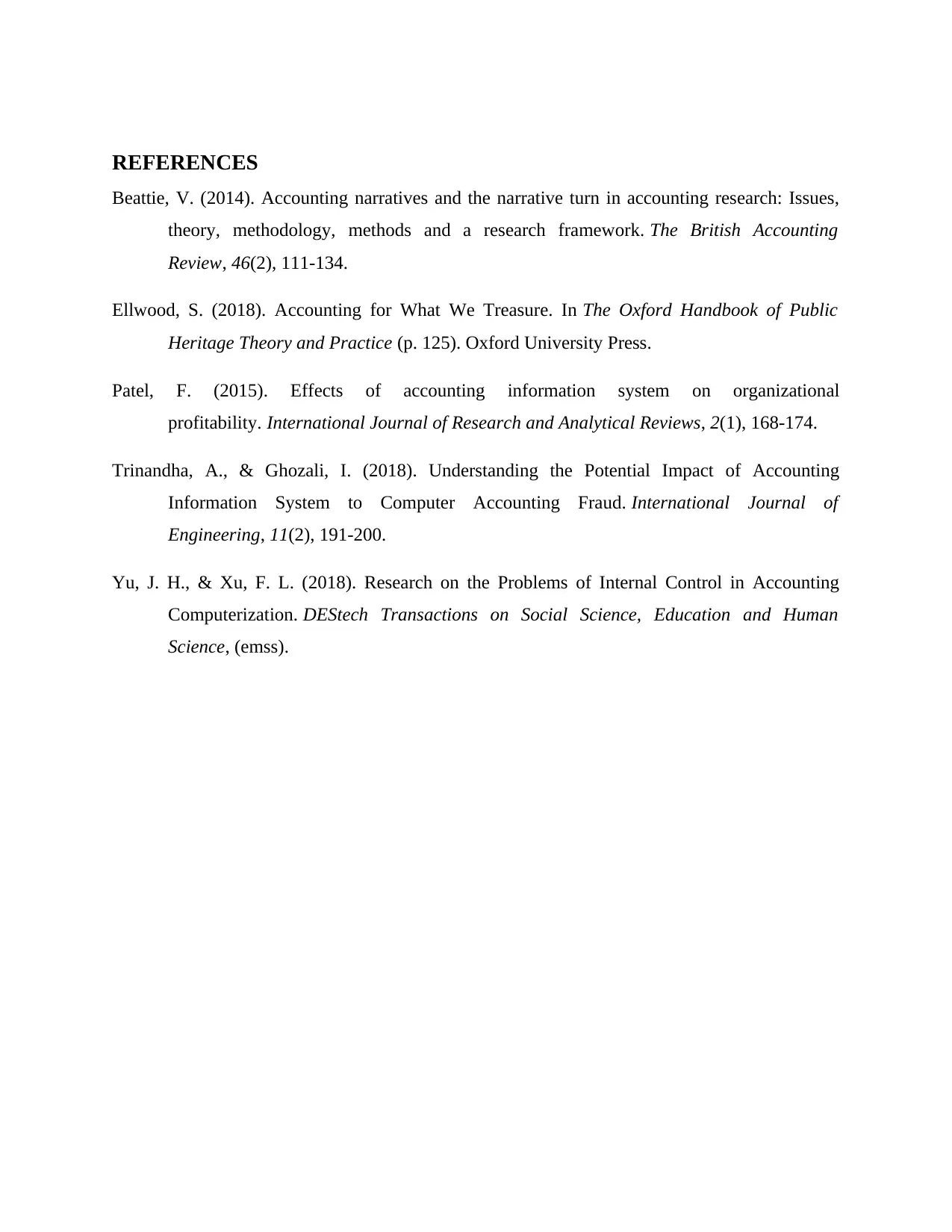
REFERENCES
Beattie, V. (2014). Accounting narratives and the narrative turn in accounting research: Issues,
theory, methodology, methods and a research framework. The British Accounting
Review, 46(2), 111-134.
Ellwood, S. (2018). Accounting for What We Treasure. In The Oxford Handbook of Public
Heritage Theory and Practice (p. 125). Oxford University Press.
Patel, F. (2015). Effects of accounting information system on organizational
profitability. International Journal of Research and Analytical Reviews, 2(1), 168-174.
Trinandha, A., & Ghozali, I. (2018). Understanding the Potential Impact of Accounting
Information System to Computer Accounting Fraud. International Journal of
Engineering, 11(2), 191-200.
Yu, J. H., & Xu, F. L. (2018). Research on the Problems of Internal Control in Accounting
Computerization. DEStech Transactions on Social Science, Education and Human
Science, (emss).
Beattie, V. (2014). Accounting narratives and the narrative turn in accounting research: Issues,
theory, methodology, methods and a research framework. The British Accounting
Review, 46(2), 111-134.
Ellwood, S. (2018). Accounting for What We Treasure. In The Oxford Handbook of Public
Heritage Theory and Practice (p. 125). Oxford University Press.
Patel, F. (2015). Effects of accounting information system on organizational
profitability. International Journal of Research and Analytical Reviews, 2(1), 168-174.
Trinandha, A., & Ghozali, I. (2018). Understanding the Potential Impact of Accounting
Information System to Computer Accounting Fraud. International Journal of
Engineering, 11(2), 191-200.
Yu, J. H., & Xu, F. L. (2018). Research on the Problems of Internal Control in Accounting
Computerization. DEStech Transactions on Social Science, Education and Human
Science, (emss).
1 out of 5
Related Documents
Your All-in-One AI-Powered Toolkit for Academic Success.
 +13062052269
info@desklib.com
Available 24*7 on WhatsApp / Email
Unlock your academic potential
Copyright © 2020–2025 A2Z Services. All Rights Reserved. Developed and managed by ZUCOL.