Accounting System and Process: Wesfarmers Financial Analysis Report

Verified

Added on  2021/06/17

|8
|1709
|32
Homework Assignment
AI Summary
This assignment explores accounting systems and processes, focusing on the application of spreadsheets in financial analysis. It defines computer spreadsheets as interactive applications for organizational analysis, emphasizing their role in data storage, formula calculations, and 'what-if' scenarios. The assignment highlights the advantages of spreadsheets, such as easy calculations and analytical processing, as well as disadvantages like deskilling and data duplication. Furthermore, the assignment includes an analysis of Wesfarmers' financial performance, examining key metrics like earnings, cash flow, return on equity, and dividend policy. It presents figures demonstrating the increase in non-current assets over the years and advises investors on the benefits of investing in Wesfarmers shares. The report concludes that Wesfarmers is a good dividend stock with strong underlying business assets.
Document Page
Running head: ACCOUTING SYSTEM AND PROCESS
Accounting System and Process
Name of the Student
Name of the University
Authors Note
Course ID
tabler-icon-diamond-filled.svg

Paraphrase This Document

Need a fresh take? Get an instant paraphrase of this document with our AI Paraphraser
Document Page
1ACCOUTING SYSTEM AND PROCESS
Table of Contents
Answer to question 6:.................................................................................................................2
Answer to Question 12:..............................................................................................................3
Answer to question 13:...............................................................................................................3
Reference List:...........................................................................................................................6
Document Page
2ACCOUTING SYSTEM AND PROCESS
Answer to question 6:
A computer spreadsheet can be defined as the interactive computer application to
perform an organizational analysis and store the data in the tabular form. Spreadsheet are
created as the computerized simulations of the paper based accounting worksheet. The
programs usually function based on the data that are entered in the cells or the table (Deo,
2017). Each cells in the spreadsheet may comprise of the either text data or the numeric data
along with the results of the formula that are used in the calculating values automatically. In
accounting the users of spreadsheet are able to adjust any form store values and monitor the
impact on the values calculated. The spreadsheet is the useful tool for what-if analysis as
several cases can be rapidly investigated without the manual computations.
Companies that are using the spreadsheet are able to track and observe the flow of
work that assist in carrying out the functional process. The unpaid invoices, open claims, and
other types of information which was earlier retained in the paper or in the manual folders.
The most common general use of the spreadsheet software is to help in creation of budget,
generate graph and charts for storing and sorting the data (Poole & Sky-McIlvain, 2014). In
the accounting process spreadsheet helps in forecasting the future performance, computing
the tax, computing the basic payroll and generating charts, computing the revenues. The
spreadsheet in the accounting process acts as providing the analytical review for the
management and help in decision making.
The spreadsheet has several advantages as spreadsheets makes calculations easy.
Business that implements spreadsheet perform financial calculations easily to understand
with explanatory notes in each line of computations. Spreadsheet provides range of
advantages to the business particularly to the business users (Fraillon et al., 2014). A business
having the set of data that are based on numerical, financial statistics or other information’s
can apply spreadsheet not only for the purpose of storing this data but also managing the data
as well. The spreadsheet provides analytical processing and presenting of data and helps in
providing complex processing in a manner that even individuals with lower technical
experience can access.
Computer spreadsheet as the tool of accounting helps in future planning in two ways.
At first the accountants can analyse and visualize the data in order to provide an insight into
business regarding the present performance and highlighting those areas for growth and
reconsiderations (Wild, 2015). Secondly spreadsheet can be used to compute the potential
impact of changing the business model. For instance, if the management uses the present
information along with probable change, namely sales variations in retail context, the
management are able to ascertain the effect of such change.
Beside the advantages of spreadsheet, it also has disadvantages as well. The abilities
of spreadsheet are deskilling. Workers are not anymore required to possess any special skills
and should compete with the inexpensive unskilled labour. Individual spreadsheets are
installed on each of the personal computers in the office that enables the users to hoard the
data and make their forecasts without the need the cooperating with the colleagues (Schipper
et al., 2017). These practices result the duplication of the data as well as the effort across the
organization. The structure of spreadsheet is such that it increases the requirement of storage
over the requirement of raw data.
On a conclusive note, the ability of the spreadsheet programs to exchange data with
the other applications improves the advantage of the spreadsheet and eliminates the
Document Page
3ACCOUTING SYSTEM AND PROCESS
disadvantages. The integration of the spreadsheet with the construction of reports, making
figure and charts have enabled easy explanation of the data (Chan et al., 2016). Integrating
the spreadsheet with database system assists in eliminating disadvantages.
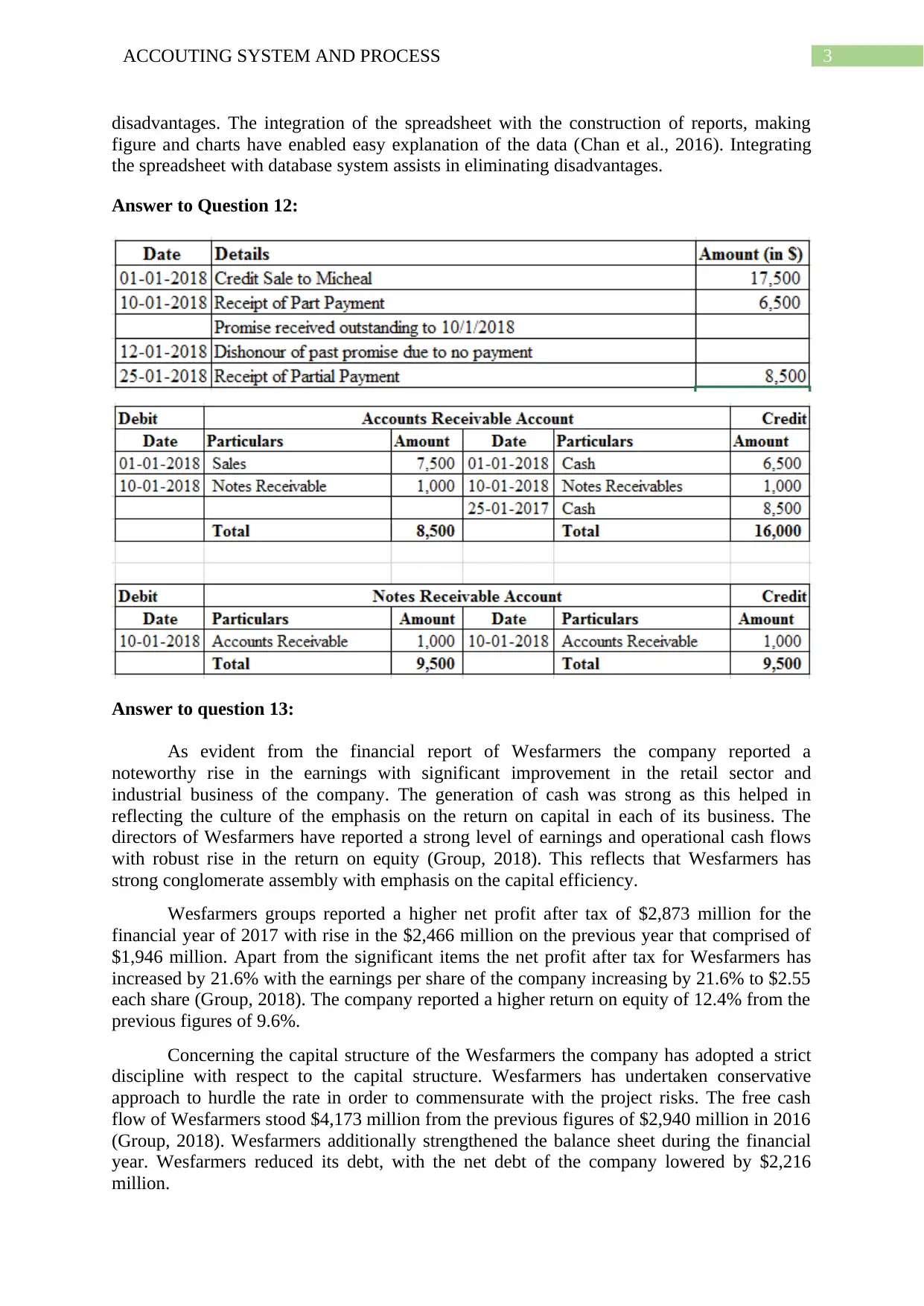
Answer to Question 12:
Answer to question 13:
As evident from the financial report of Wesfarmers the company reported a
noteworthy rise in the earnings with significant improvement in the retail sector and
industrial business of the company. The generation of cash was strong as this helped in
reflecting the culture of the emphasis on the return on capital in each of its business. The
directors of Wesfarmers have reported a strong level of earnings and operational cash flows
with robust rise in the return on equity (Group, 2018). This reflects that Wesfarmers has
strong conglomerate assembly with emphasis on the capital efficiency.
Wesfarmers groups reported a higher net profit after tax of $2,873 million for the
financial year of 2017 with rise in the $2,466 million on the previous year that comprised of
$1,946 million. Apart from the significant items the net profit after tax for Wesfarmers has
increased by 21.6% with the earnings per share of the company increasing by 21.6% to $2.55
each share (Group, 2018). The company reported a higher return on equity of 12.4% from the
previous figures of 9.6%.
Concerning the capital structure of the Wesfarmers the company has adopted a strict
discipline with respect to the capital structure. Wesfarmers has undertaken conservative
approach to hurdle the rate in order to commensurate with the project risks. The free cash
flow of Wesfarmers stood $4,173 million from the previous figures of $2,940 million in 2016
(Group, 2018). Wesfarmers additionally strengthened the balance sheet during the financial
year. Wesfarmers reduced its debt, with the net debt of the company lowered by $2,216
million.
tabler-icon-diamond-filled.svg

Paraphrase This Document

Need a fresh take? Get an instant paraphrase of this document with our AI Paraphraser
Document Page
4ACCOUTING SYSTEM AND PROCESS
Wesfarmers dividend policy takes into the account the current earnings and cash
flows that are available for the franking credits and the targeted metrics of credit (Scott,
2015). In accordance with the current year earnings and robust performance in cash flow, the
board of Wesfarmers has declared fully franked final dividend of 120 cents each share by
taking the full year ordinary dividend per share to 223 cents per share.
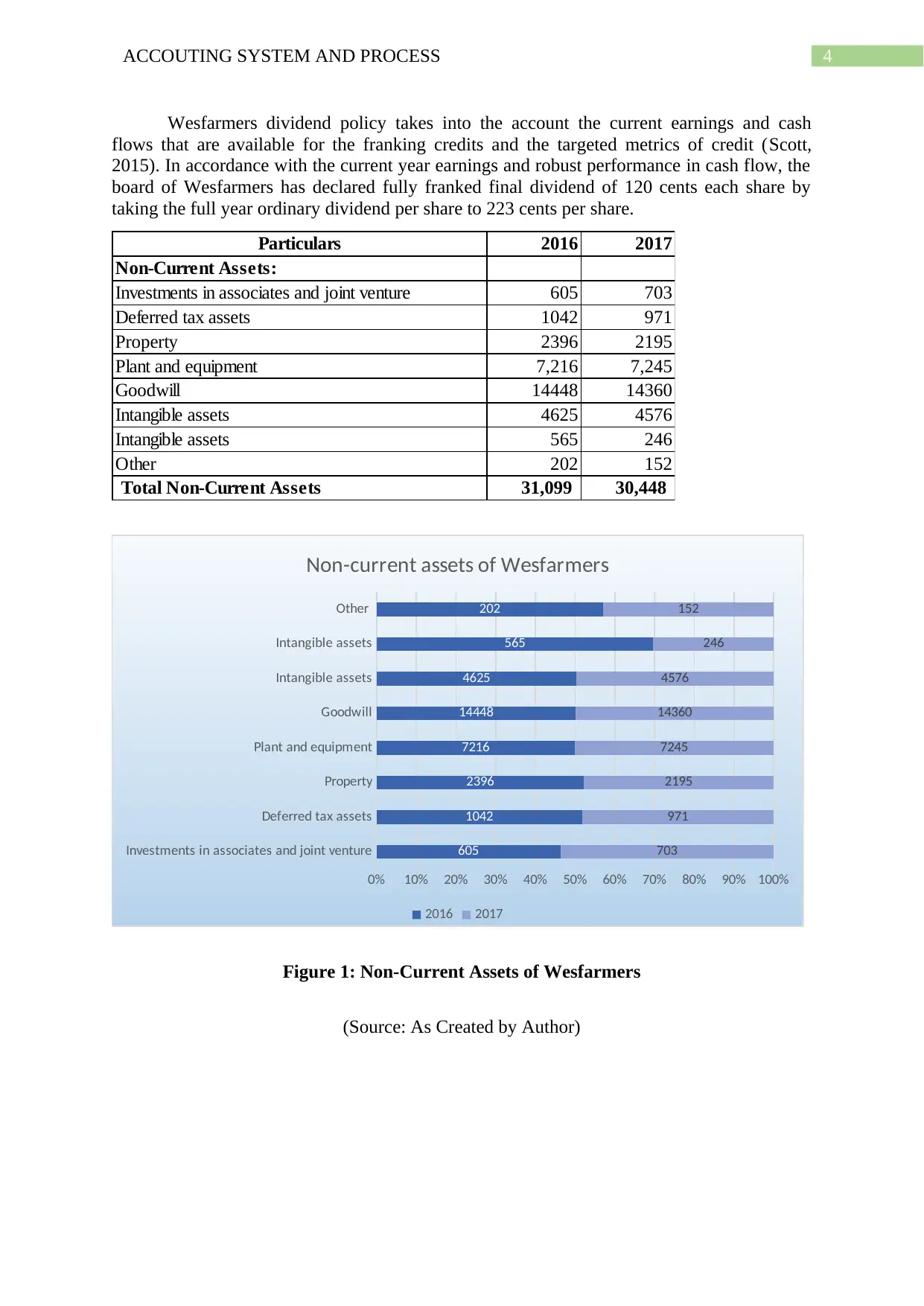
Particulars 2016 2017
Non-Current Assets:
Investments in associates and joint venture 605 703
Deferred tax assets 1042 971
Property 2396 2195
Plant and equipment 7,216 7,245
Goodwill 14448 14360
Intangible assets 4625 4576
Intangible assets 565 246
Other 202 152
Total Non-Current Assets 31,099 30,448
Investments in associates and joint venture
Deferred tax assets
Property
Plant and equipment
Goodwill
Intangible assets
Intangible assets
Other
0% 10% 20% 30% 40% 50% 60% 70% 80% 90% 100%
605
1042
2396
7216
14448
4625
565
202
703
971
2195
7245
14360
4576
246
152
Non-current assets of Wesfarmers
2016 2017
Figure 1: Non-Current Assets of Wesfarmers
(Source: As Created by Author)
Document Page
5ACCOUTING SYSTEM AND PROCESS
605; 2%1042; 3%
2396; 8%
7216; 23%
14448; 46%
4625; 15%
565; 2%202; 1%
Items of non-current assets of Wesfarmers
in 2017
Investments in associates and joint
venture
Deferred tax assets
Property
Plant and equipment
Goodwill
Intangible assets
Intangible assets
Other
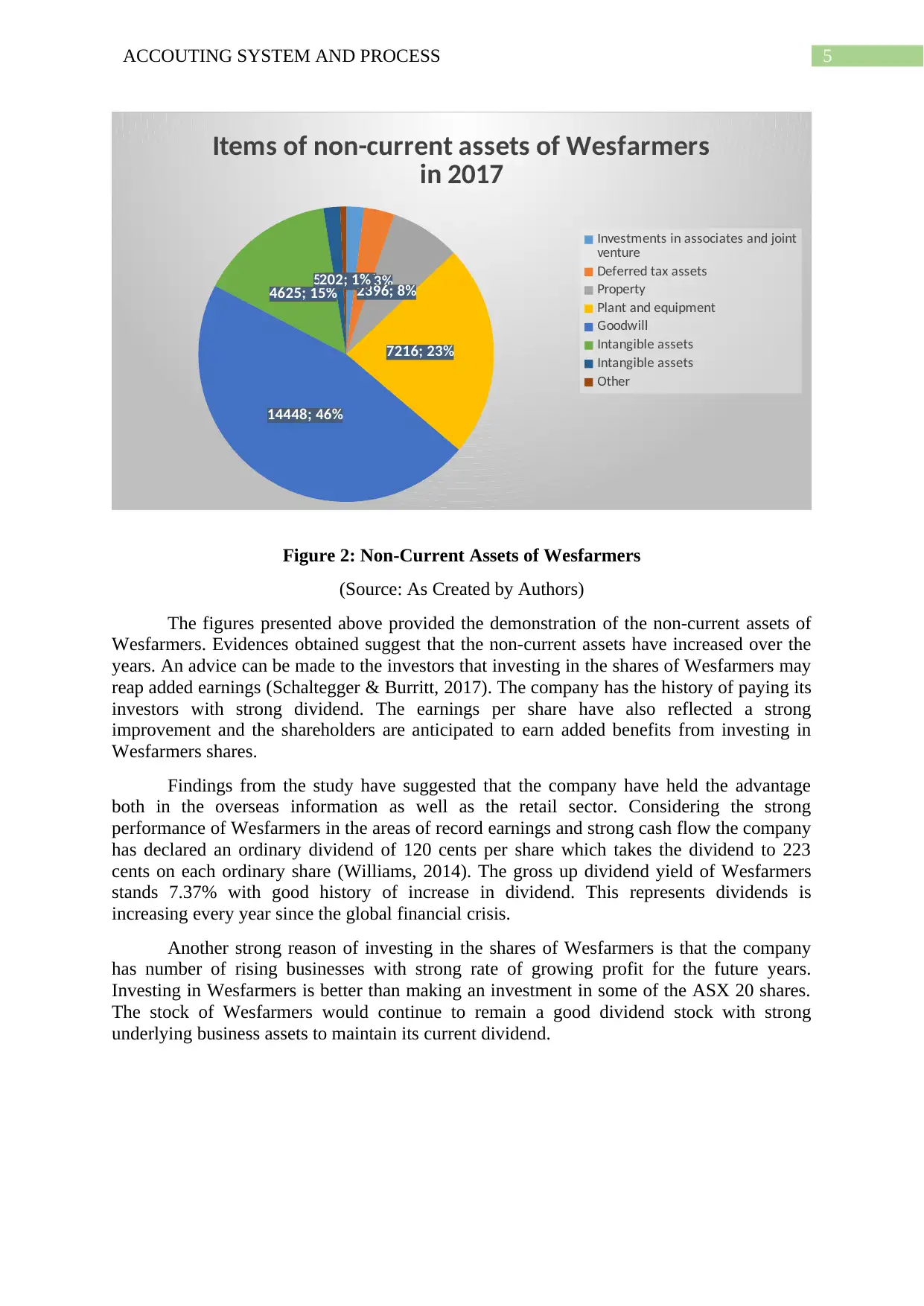
Figure 2: Non-Current Assets of Wesfarmers
(Source: As Created by Authors)
The figures presented above provided the demonstration of the non-current assets of
Wesfarmers. Evidences obtained suggest that the non-current assets have increased over the
years. An advice can be made to the investors that investing in the shares of Wesfarmers may
reap added earnings (Schaltegger & Burritt, 2017). The company has the history of paying its
investors with strong dividend. The earnings per share have also reflected a strong
improvement and the shareholders are anticipated to earn added benefits from investing in
Wesfarmers shares.
Findings from the study have suggested that the company have held the advantage
both in the overseas information as well as the retail sector. Considering the strong
performance of Wesfarmers in the areas of record earnings and strong cash flow the company
has declared an ordinary dividend of 120 cents per share which takes the dividend to 223
cents on each ordinary share (Williams, 2014). The gross up dividend yield of Wesfarmers
stands 7.37% with good history of increase in dividend. This represents dividends is
increasing every year since the global financial crisis.
Another strong reason of investing in the shares of Wesfarmers is that the company
has number of rising businesses with strong rate of growing profit for the future years.
Investing in Wesfarmers is better than making an investment in some of the ASX 20 shares.
The stock of Wesfarmers would continue to remain a good dividend stock with strong
underlying business assets to maintain its current dividend.
Document Page
6ACCOUTING SYSTEM AND PROCESS
Reference List:
Chan, S. H., Song, Q., Rivera, L. H., & Trongmateerut, P. (2016). Using an educational
computer program to enhance student performance in financial accounting. Journal of
Accounting Education, 36, 43-64.
Deo, N. (2017). Graph theory with applications to engineering and computer science.
Courier Dover Publications.
Fraillon, J., Ainley, J., Schulz, W., Friedman, T., & Gebhardt, E. (2014). Preparing for life in
a digital age: The IEA International Computer and Information Literacy Study
international report.
Group, D. (2018). Investors. Retrieved from http://www.wesfarmers.com.au/investor-centre
Group, D. (2018). Reports. Retrieved from
http://www.wesfarmers.com.au/investor-centre/company-performance-news/reports
Macve, R. (2015). A Conceptual Framework for Financial Accounting and Reporting:
Vision, Tool, Or Threat?. Routledge.
Poole, B. J., & Sky-McIlvain, E. (2014). Education for an information age.
Schaltegger, S., & Burritt, R. (2017). Contemporary environmental accounting: issues,
concepts and practice. Routledge.
Schipper, K., Francis, J., & Weil, R. (2017). Financial Accounting: Introduction to Concepts,
Methods and Uses. Cengage Learning.
Scott, W. R. (2015). Financial accounting theory (Vol. 2, No. 0, p. 0). Prentice Hall.
Wild, J. (2015). Financial accounting fundamentals. McGraw-Hill Higher Education.
Williams, J. (2014). Financial accounting. McGraw-Hill Higher Education.
tabler-icon-diamond-filled.svg

Paraphrase This Document

Need a fresh take? Get an instant paraphrase of this document with our AI Paraphraser
Document Page
7ACCOUTING SYSTEM AND PROCESS
chevron_up_icon
1 out of 8
circle_padding
hide_on_mobile
zoom_out_icon
[object Object]