Accounting Management Report: Systems, Reports, and Costing Analysis
VerifiedAdded on 2020/07/23
|15
|4203
|34
Report
AI Summary
This report provides a comprehensive overview of accounting management, encompassing various systems, reports, and costing methods. It begins with an introduction to management accounting and its significance in organizational decision-making, exploring different accounting systems such as inventory management, job costing, and cost accounting. The report then delves into the preparation and importance of various accounting reports, including target costing, sales reports, due account reports, and budget reports. Furthermore, it examines the concepts of marginal and absorption costing, comparing their methodologies and providing examples to illustrate their applications in financial analysis. The report also addresses budgetary control tools and the solving of financial problems, offering insights into effective financial management. Overall, the report serves as a valuable resource for understanding key accounting principles and their practical applications.
ACCOUNTING
MANAGEMENT
MANAGEMENT

Paraphrase This Document
Need a fresh take? Get an instant paraphrase of this document with our AI Paraphraser
Table of Contents
INTRODUCTION...........................................................................................................................1
TASK 1............................................................................................................................................1
P1 Management accounting and its systems...............................................................................1
P2 Accounting reports.................................................................................................................3
TASK 2............................................................................................................................................4
P3 Marginal and absorption costing............................................................................................4
TASK 3............................................................................................................................................7
P4 Budgetary control tools..........................................................................................................7
P5 Solving of financial problems................................................................................................9
CONCLUSION..............................................................................................................................10
REFERENCES..............................................................................................................................11
INTRODUCTION...........................................................................................................................1
TASK 1............................................................................................................................................1
P1 Management accounting and its systems...............................................................................1
P2 Accounting reports.................................................................................................................3
TASK 2............................................................................................................................................4
P3 Marginal and absorption costing............................................................................................4
TASK 3............................................................................................................................................7
P4 Budgetary control tools..........................................................................................................7
P5 Solving of financial problems................................................................................................9
CONCLUSION..............................................................................................................................10
REFERENCES..............................................................................................................................11
INTRODUCTION
Management accounting is a process through which decision taking process of an
enterprise become easy as quality information is provided by this section. It is a continuous
process in which various reports are prepared by the different departments which include all the
quality data which can help the user in getting the complete idea about that part so that
accordingly future judgement can be taken (Zimmerman and Yahya, 2011). Documents are
prepared on weekly or monthly basis which are of great help to the internal users for ensuring
effective control at work place. Hence a timely and statistical data is received which act as a base
for the department head to take corrective decisions. Following report will discuss different
accounting systems along with the variety of reports prepared under the same. This will help user
in understanding the whole concept of accountancy along with other related concepts.
TASK 1
P1 Management accounting and its systems
This is an important function of every organisation as it helps in the balanced functioning
of different departments which are part of an entity. With this concept the process of decision
making becomes easy as with the information provided by different systems degree of right
option selection increases and therefore goal of an organisation can be achieved effectively. It is
a different tool than that of financial system as in that only the statistical data is given which only
is not of greater use (Macintosh and Quattrone, 2010). Importance of management accounting
can be better understood under the different heads in the following manner:
1. Helps in forecasting the future – It is crucial for management to take the different
investment decision by the company for which decision regarding weather the investment
should be continue needs to be taken. During this course of action evaluation of available
opinion is done that weather it is effective or not? Should it be diversified into various
areas? Management accounting system gives answerer to these questions and forecast the
coming trend so that accordingly the best option is selected.
2. Assist in production or buying decision – when any company operates in the industry it
has both the choice weather to go for manufacturing or to opt for outsourcing. The
concern system will help in evaluating the positives and negatives of each variety which
will further aid in selecting the best alternative.
1
Management accounting is a process through which decision taking process of an
enterprise become easy as quality information is provided by this section. It is a continuous
process in which various reports are prepared by the different departments which include all the
quality data which can help the user in getting the complete idea about that part so that
accordingly future judgement can be taken (Zimmerman and Yahya, 2011). Documents are
prepared on weekly or monthly basis which are of great help to the internal users for ensuring
effective control at work place. Hence a timely and statistical data is received which act as a base
for the department head to take corrective decisions. Following report will discuss different
accounting systems along with the variety of reports prepared under the same. This will help user
in understanding the whole concept of accountancy along with other related concepts.
TASK 1
P1 Management accounting and its systems
This is an important function of every organisation as it helps in the balanced functioning
of different departments which are part of an entity. With this concept the process of decision
making becomes easy as with the information provided by different systems degree of right
option selection increases and therefore goal of an organisation can be achieved effectively. It is
a different tool than that of financial system as in that only the statistical data is given which only
is not of greater use (Macintosh and Quattrone, 2010). Importance of management accounting
can be better understood under the different heads in the following manner:
1. Helps in forecasting the future – It is crucial for management to take the different
investment decision by the company for which decision regarding weather the investment
should be continue needs to be taken. During this course of action evaluation of available
opinion is done that weather it is effective or not? Should it be diversified into various
areas? Management accounting system gives answerer to these questions and forecast the
coming trend so that accordingly the best option is selected.
2. Assist in production or buying decision – when any company operates in the industry it
has both the choice weather to go for manufacturing or to opt for outsourcing. The
concern system will help in evaluating the positives and negatives of each variety which
will further aid in selecting the best alternative.
1
⊘ This is a preview!⊘
Do you want full access?
Subscribe today to unlock all pages.

Trusted by 1+ million students worldwide
3. Helps in understanding performance variances – Whenever any project is completed
it has variation from the actual result and from that of the desired one. This system helps
in minimising the negative variances and work towards maximising the positive
variations so that objectives are achieved.
4. Helps in planning – In the present competitive surroundings no task can be completed
without doing effective planning hence management accounting does this function which
helps in achieving the results with minimum deviations in it (Simons, 2013).
5. Measurement of performance – Through ting system different reports are prepared by
each department which further helps in evaluating the work done by each section. This
way process of controlling becomes more easy and hence resource are utilised to their
full capacity (Baldvinsdottir, Mitchell and Nørreklit, 2010).
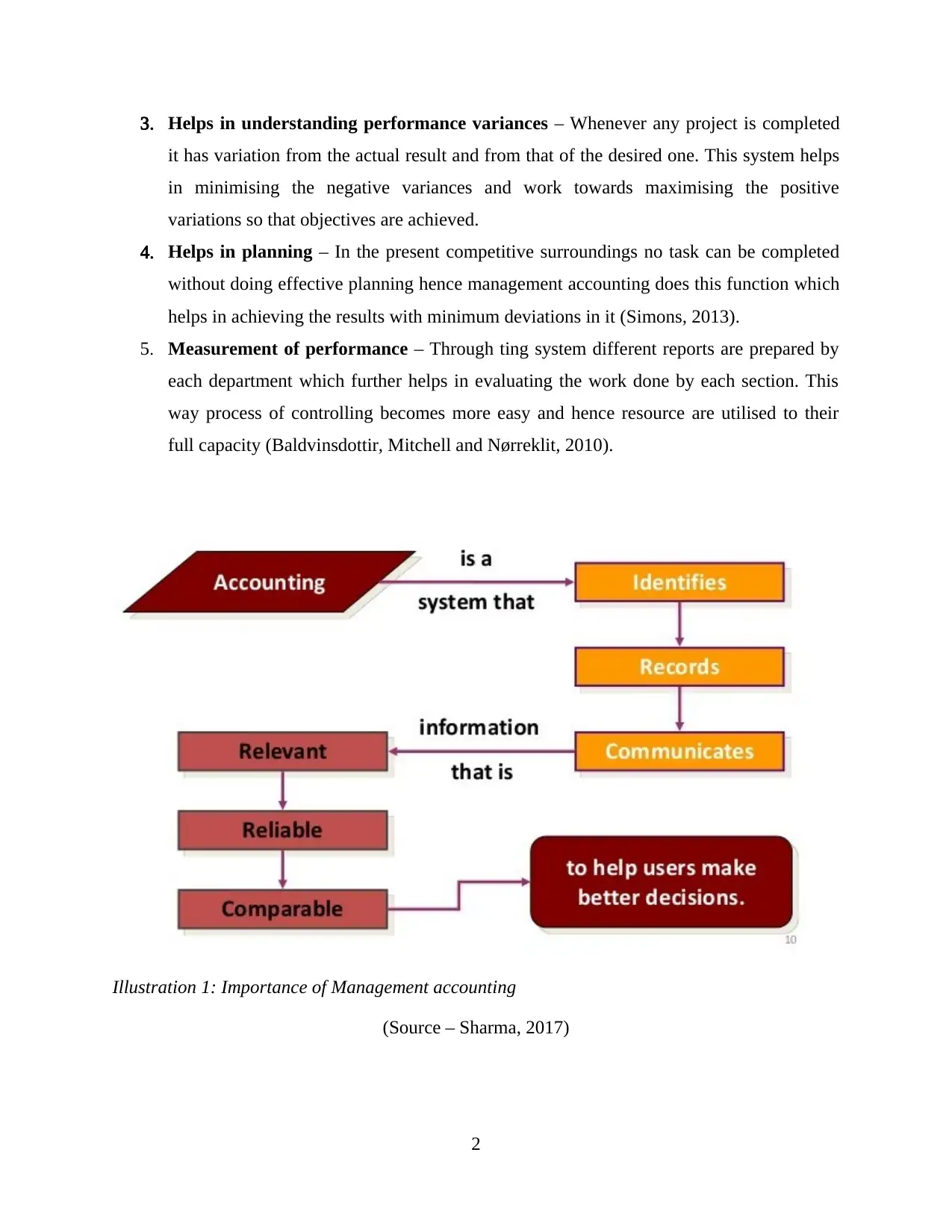
(Source – Sharma, 2017)
2
Illustration 1: Importance of Management accounting
it has variation from the actual result and from that of the desired one. This system helps
in minimising the negative variances and work towards maximising the positive
variations so that objectives are achieved.
4. Helps in planning – In the present competitive surroundings no task can be completed
without doing effective planning hence management accounting does this function which
helps in achieving the results with minimum deviations in it (Simons, 2013).
5. Measurement of performance – Through ting system different reports are prepared by
each department which further helps in evaluating the work done by each section. This
way process of controlling becomes more easy and hence resource are utilised to their
full capacity (Baldvinsdottir, Mitchell and Nørreklit, 2010).
(Source – Sharma, 2017)
2
Illustration 1: Importance of Management accounting
Paraphrase This Document
Need a fresh take? Get an instant paraphrase of this document with our AI Paraphraser
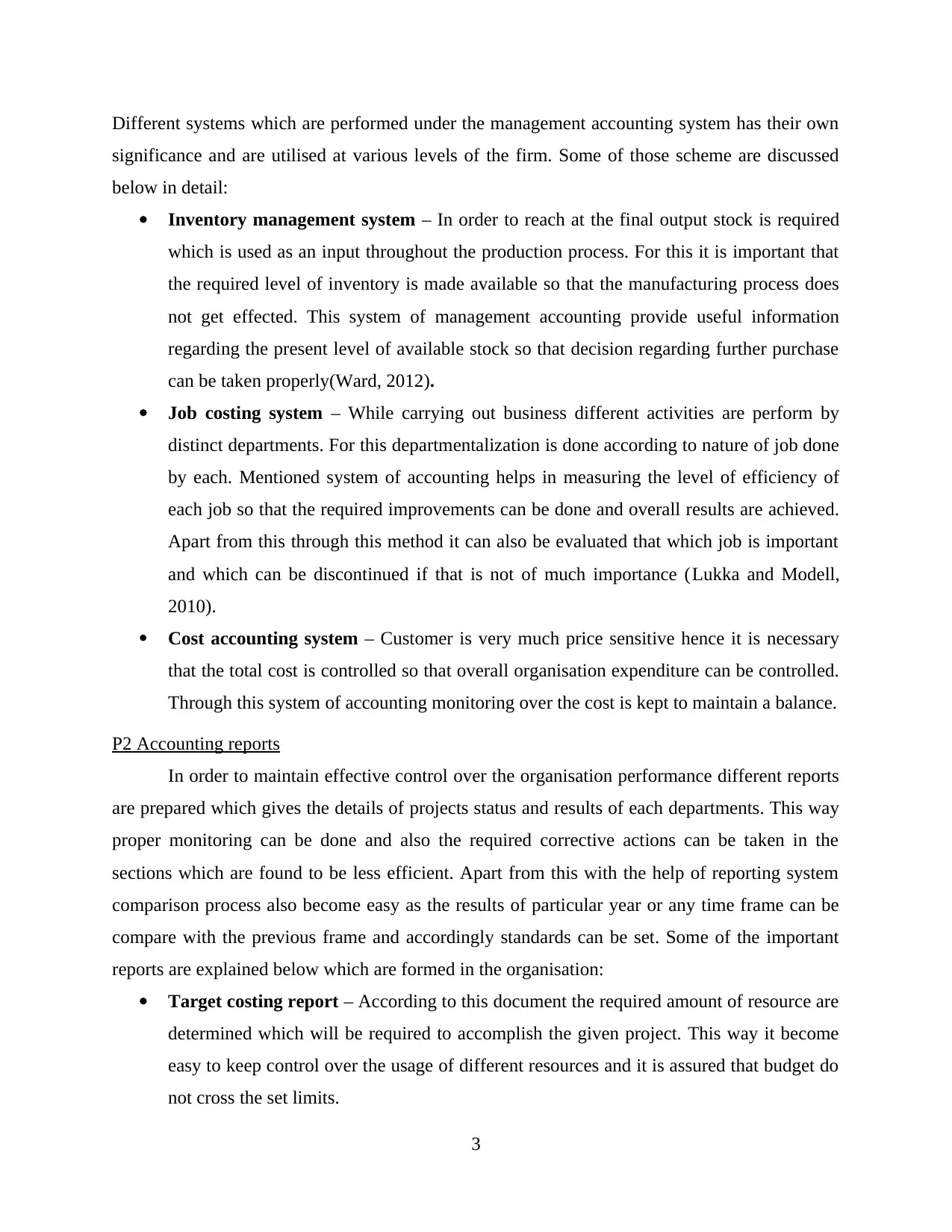
Different systems which are performed under the management accounting system has their own
significance and are utilised at various levels of the firm. Some of those scheme are discussed
below in detail:
Inventory management system – In order to reach at the final output stock is required
which is used as an input throughout the production process. For this it is important that
the required level of inventory is made available so that the manufacturing process does
not get effected. This system of management accounting provide useful information
regarding the present level of available stock so that decision regarding further purchase
can be taken properly(Ward, 2012).
Job costing system – While carrying out business different activities are perform by
distinct departments. For this departmentalization is done according to nature of job done
by each. Mentioned system of accounting helps in measuring the level of efficiency of
each job so that the required improvements can be done and overall results are achieved.
Apart from this through this method it can also be evaluated that which job is important
and which can be discontinued if that is not of much importance (Lukka and Modell,
2010).
Cost accounting system – Customer is very much price sensitive hence it is necessary
that the total cost is controlled so that overall organisation expenditure can be controlled.
Through this system of accounting monitoring over the cost is kept to maintain a balance.
P2 Accounting reports
In order to maintain effective control over the organisation performance different reports
are prepared which gives the details of projects status and results of each departments. This way
proper monitoring can be done and also the required corrective actions can be taken in the
sections which are found to be less efficient. Apart from this with the help of reporting system
comparison process also become easy as the results of particular year or any time frame can be
compare with the previous frame and accordingly standards can be set. Some of the important
reports are explained below which are formed in the organisation:
Target costing report – According to this document the required amount of resource are
determined which will be required to accomplish the given project. This way it become
easy to keep control over the usage of different resources and it is assured that budget do
not cross the set limits.
3
significance and are utilised at various levels of the firm. Some of those scheme are discussed
below in detail:
Inventory management system – In order to reach at the final output stock is required
which is used as an input throughout the production process. For this it is important that
the required level of inventory is made available so that the manufacturing process does
not get effected. This system of management accounting provide useful information
regarding the present level of available stock so that decision regarding further purchase
can be taken properly(Ward, 2012).
Job costing system – While carrying out business different activities are perform by
distinct departments. For this departmentalization is done according to nature of job done
by each. Mentioned system of accounting helps in measuring the level of efficiency of
each job so that the required improvements can be done and overall results are achieved.
Apart from this through this method it can also be evaluated that which job is important
and which can be discontinued if that is not of much importance (Lukka and Modell,
2010).
Cost accounting system – Customer is very much price sensitive hence it is necessary
that the total cost is controlled so that overall organisation expenditure can be controlled.
Through this system of accounting monitoring over the cost is kept to maintain a balance.
P2 Accounting reports
In order to maintain effective control over the organisation performance different reports
are prepared which gives the details of projects status and results of each departments. This way
proper monitoring can be done and also the required corrective actions can be taken in the
sections which are found to be less efficient. Apart from this with the help of reporting system
comparison process also become easy as the results of particular year or any time frame can be
compare with the previous frame and accordingly standards can be set. Some of the important
reports are explained below which are formed in the organisation:
Target costing report – According to this document the required amount of resource are
determined which will be required to accomplish the given project. This way it become
easy to keep control over the usage of different resources and it is assured that budget do
not cross the set limits.
3
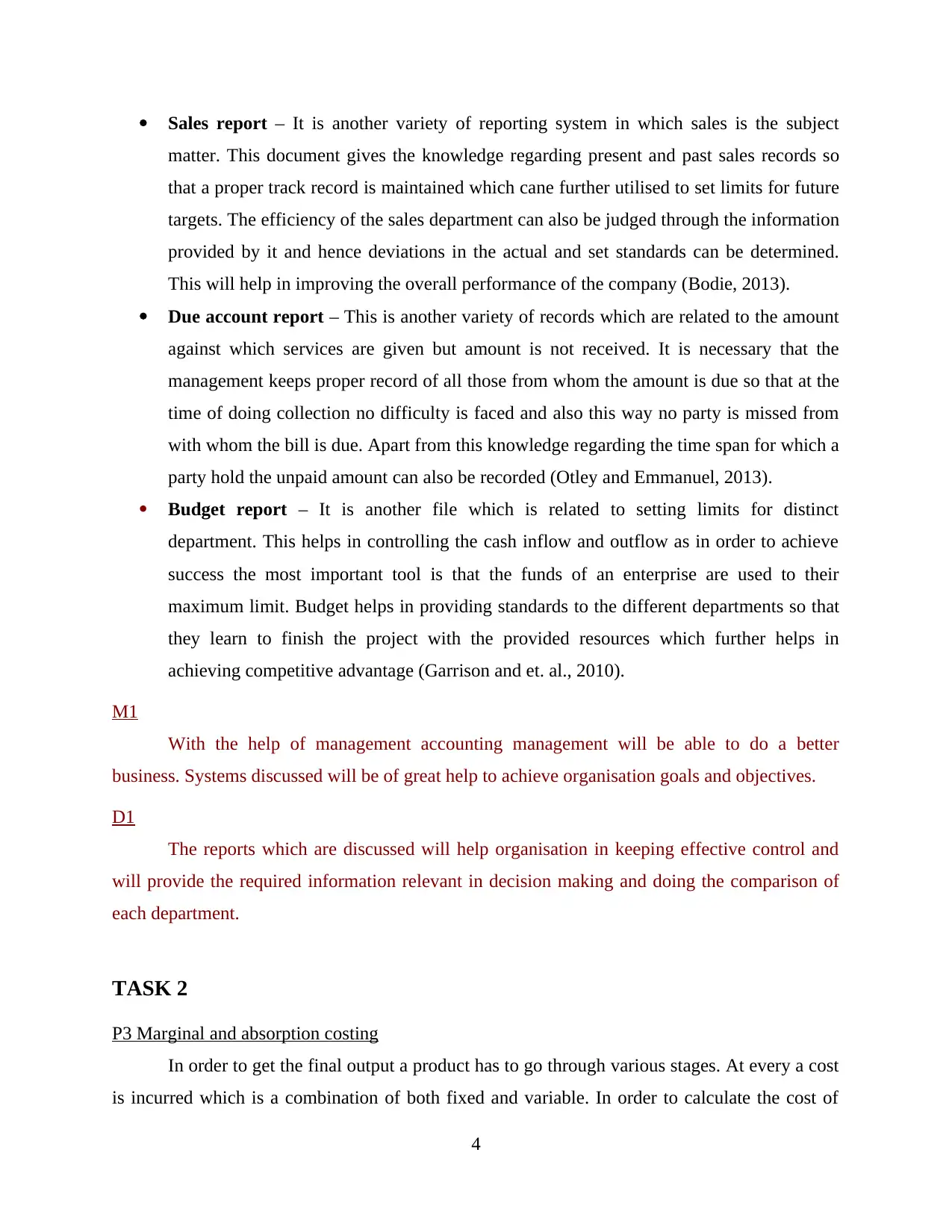
Sales report – It is another variety of reporting system in which sales is the subject
matter. This document gives the knowledge regarding present and past sales records so
that a proper track record is maintained which cane further utilised to set limits for future
targets. The efficiency of the sales department can also be judged through the information
provided by it and hence deviations in the actual and set standards can be determined.
This will help in improving the overall performance of the company (Bodie, 2013).
Due account report – This is another variety of records which are related to the amount
against which services are given but amount is not received. It is necessary that the
management keeps proper record of all those from whom the amount is due so that at the
time of doing collection no difficulty is faced and also this way no party is missed from
with whom the bill is due. Apart from this knowledge regarding the time span for which a
party hold the unpaid amount can also be recorded (Otley and Emmanuel, 2013).
Budget report – It is another file which is related to setting limits for distinct
department. This helps in controlling the cash inflow and outflow as in order to achieve
success the most important tool is that the funds of an enterprise are used to their
maximum limit. Budget helps in providing standards to the different departments so that
they learn to finish the project with the provided resources which further helps in
achieving competitive advantage (Garrison and et. al., 2010).
M1
With the help of management accounting management will be able to do a better
business. Systems discussed will be of great help to achieve organisation goals and objectives.
D1
The reports which are discussed will help organisation in keeping effective control and
will provide the required information relevant in decision making and doing the comparison of
each department.
TASK 2
P3 Marginal and absorption costing
In order to get the final output a product has to go through various stages. At every a cost
is incurred which is a combination of both fixed and variable. In order to calculate the cost of
4
matter. This document gives the knowledge regarding present and past sales records so
that a proper track record is maintained which cane further utilised to set limits for future
targets. The efficiency of the sales department can also be judged through the information
provided by it and hence deviations in the actual and set standards can be determined.
This will help in improving the overall performance of the company (Bodie, 2013).
Due account report – This is another variety of records which are related to the amount
against which services are given but amount is not received. It is necessary that the
management keeps proper record of all those from whom the amount is due so that at the
time of doing collection no difficulty is faced and also this way no party is missed from
with whom the bill is due. Apart from this knowledge regarding the time span for which a
party hold the unpaid amount can also be recorded (Otley and Emmanuel, 2013).
Budget report – It is another file which is related to setting limits for distinct
department. This helps in controlling the cash inflow and outflow as in order to achieve
success the most important tool is that the funds of an enterprise are used to their
maximum limit. Budget helps in providing standards to the different departments so that
they learn to finish the project with the provided resources which further helps in
achieving competitive advantage (Garrison and et. al., 2010).
M1
With the help of management accounting management will be able to do a better
business. Systems discussed will be of great help to achieve organisation goals and objectives.
D1
The reports which are discussed will help organisation in keeping effective control and
will provide the required information relevant in decision making and doing the comparison of
each department.
TASK 2
P3 Marginal and absorption costing
In order to get the final output a product has to go through various stages. At every a cost
is incurred which is a combination of both fixed and variable. In order to calculate the cost of
4
⊘ This is a preview!⊘
Do you want full access?
Subscribe today to unlock all pages.
Trusted by 1+ million students worldwide
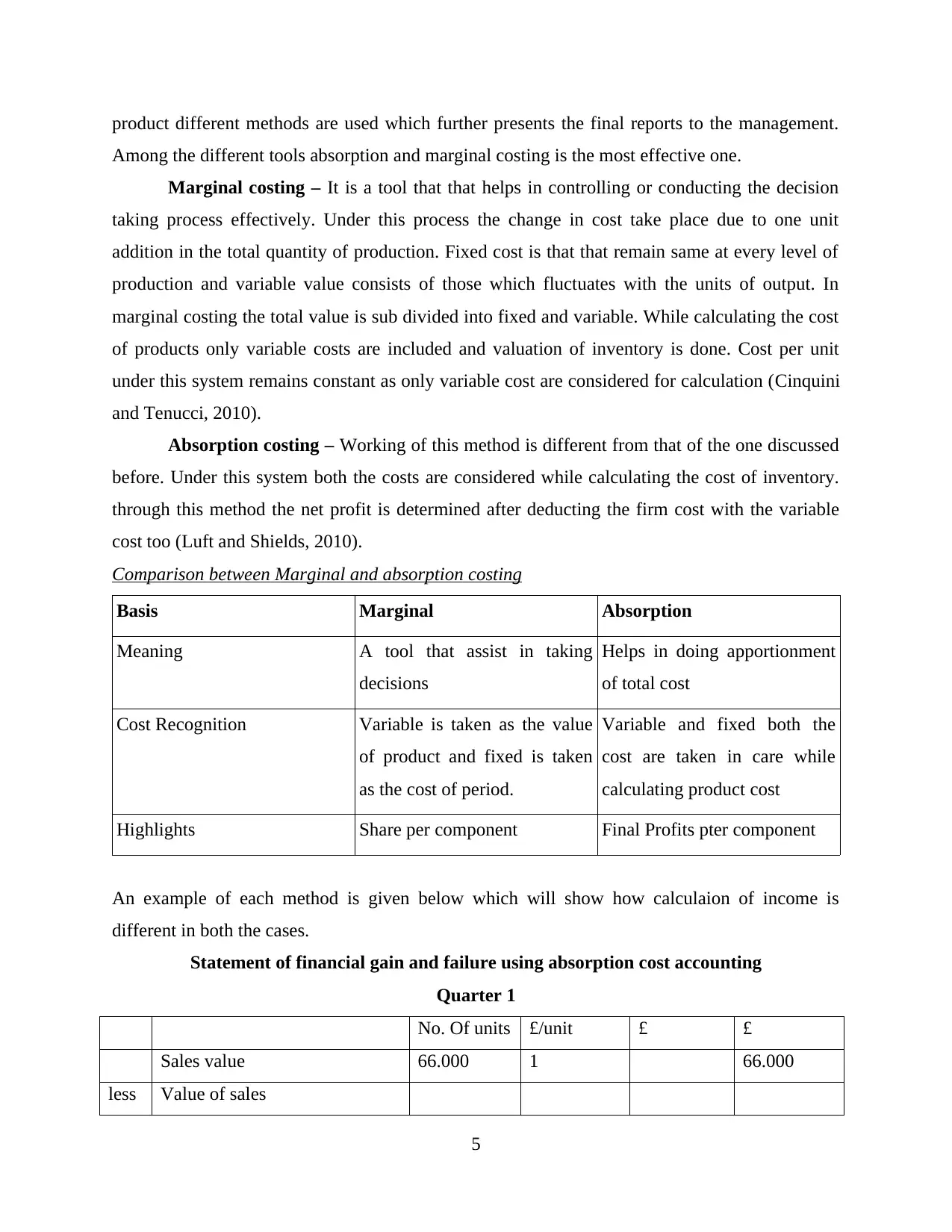
product different methods are used which further presents the final reports to the management.
Among the different tools absorption and marginal costing is the most effective one.
Marginal costing – It is a tool that that helps in controlling or conducting the decision
taking process effectively. Under this process the change in cost take place due to one unit
addition in the total quantity of production. Fixed cost is that that remain same at every level of
production and variable value consists of those which fluctuates with the units of output. In
marginal costing the total value is sub divided into fixed and variable. While calculating the cost
of products only variable costs are included and valuation of inventory is done. Cost per unit
under this system remains constant as only variable cost are considered for calculation (Cinquini
and Tenucci, 2010).
Absorption costing – Working of this method is different from that of the one discussed
before. Under this system both the costs are considered while calculating the cost of inventory.
through this method the net profit is determined after deducting the firm cost with the variable
cost too (Luft and Shields, 2010).
Comparison between Marginal and absorption costing
Basis Marginal Absorption
Meaning A tool that assist in taking
decisions
Helps in doing apportionment
of total cost
Cost Recognition Variable is taken as the value
of product and fixed is taken
as the cost of period.
Variable and fixed both the
cost are taken in care while
calculating product cost
Highlights Share per component Final Profits pter component
An example of each method is given below which will show how calculaion of income is
different in both the cases.
Statement of financial gain and failure using absorption cost accounting
Quarter 1
No. Of units £/unit £ £
Sales value 66.000 1 66.000
less Value of sales
5
Among the different tools absorption and marginal costing is the most effective one.
Marginal costing – It is a tool that that helps in controlling or conducting the decision
taking process effectively. Under this process the change in cost take place due to one unit
addition in the total quantity of production. Fixed cost is that that remain same at every level of
production and variable value consists of those which fluctuates with the units of output. In
marginal costing the total value is sub divided into fixed and variable. While calculating the cost
of products only variable costs are included and valuation of inventory is done. Cost per unit
under this system remains constant as only variable cost are considered for calculation (Cinquini
and Tenucci, 2010).
Absorption costing – Working of this method is different from that of the one discussed
before. Under this system both the costs are considered while calculating the cost of inventory.
through this method the net profit is determined after deducting the firm cost with the variable
cost too (Luft and Shields, 2010).
Comparison between Marginal and absorption costing
Basis Marginal Absorption
Meaning A tool that assist in taking
decisions
Helps in doing apportionment
of total cost
Cost Recognition Variable is taken as the value
of product and fixed is taken
as the cost of period.
Variable and fixed both the
cost are taken in care while
calculating product cost
Highlights Share per component Final Profits pter component
An example of each method is given below which will show how calculaion of income is
different in both the cases.
Statement of financial gain and failure using absorption cost accounting
Quarter 1
No. Of units £/unit £ £
Sales value 66.000 1 66.000
less Value of sales
5
Paraphrase This Document
Need a fresh take? Get an instant paraphrase of this document with our AI Paraphraser
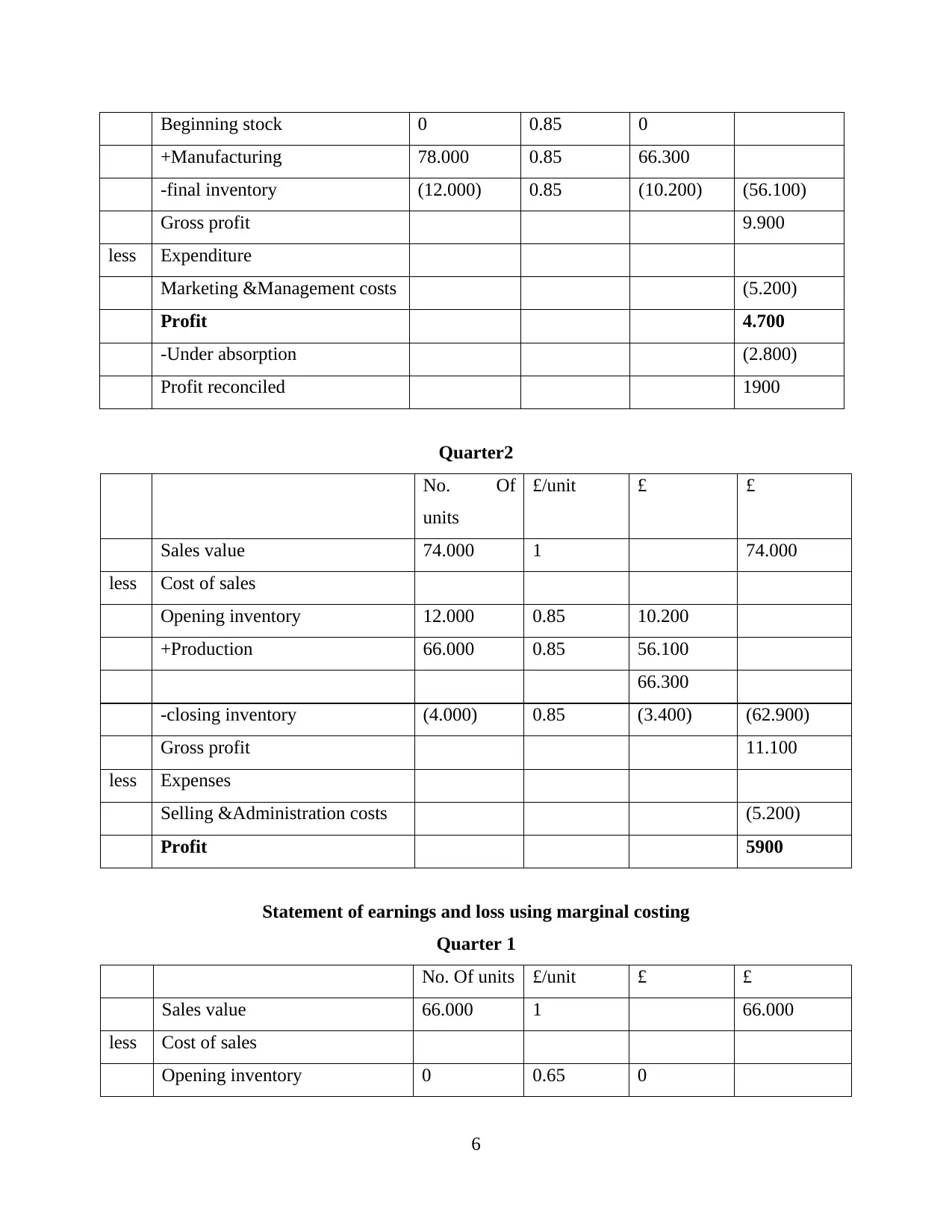
Beginning stock 0 0.85 0
+Manufacturing 78.000 0.85 66.300
-final inventory (12.000) 0.85 (10.200) (56.100)
Gross profit 9.900
less Expenditure
Marketing &Management costs (5.200)
Profit 4.700
-Under absorption (2.800)
Profit reconciled 1900
Quarter2
No. Of
units
£/unit £ £
Sales value 74.000 1 74.000
less Cost of sales
Opening inventory 12.000 0.85 10.200
+Production 66.000 0.85 56.100
66.300
-closing inventory (4.000) 0.85 (3.400) (62.900)
Gross profit 11.100
less Expenses
Selling &Administration costs (5.200)
Profit 5900
Statement of earnings and loss using marginal costing
Quarter 1
No. Of units £/unit £ £
Sales value 66.000 1 66.000
less Cost of sales
Opening inventory 0 0.65 0
6
+Manufacturing 78.000 0.85 66.300
-final inventory (12.000) 0.85 (10.200) (56.100)
Gross profit 9.900
less Expenditure
Marketing &Management costs (5.200)
Profit 4.700
-Under absorption (2.800)
Profit reconciled 1900
Quarter2
No. Of
units
£/unit £ £
Sales value 74.000 1 74.000
less Cost of sales
Opening inventory 12.000 0.85 10.200
+Production 66.000 0.85 56.100
66.300
-closing inventory (4.000) 0.85 (3.400) (62.900)
Gross profit 11.100
less Expenses
Selling &Administration costs (5.200)
Profit 5900
Statement of earnings and loss using marginal costing
Quarter 1
No. Of units £/unit £ £
Sales value 66.000 1 66.000
less Cost of sales
Opening inventory 0 0.65 0
6
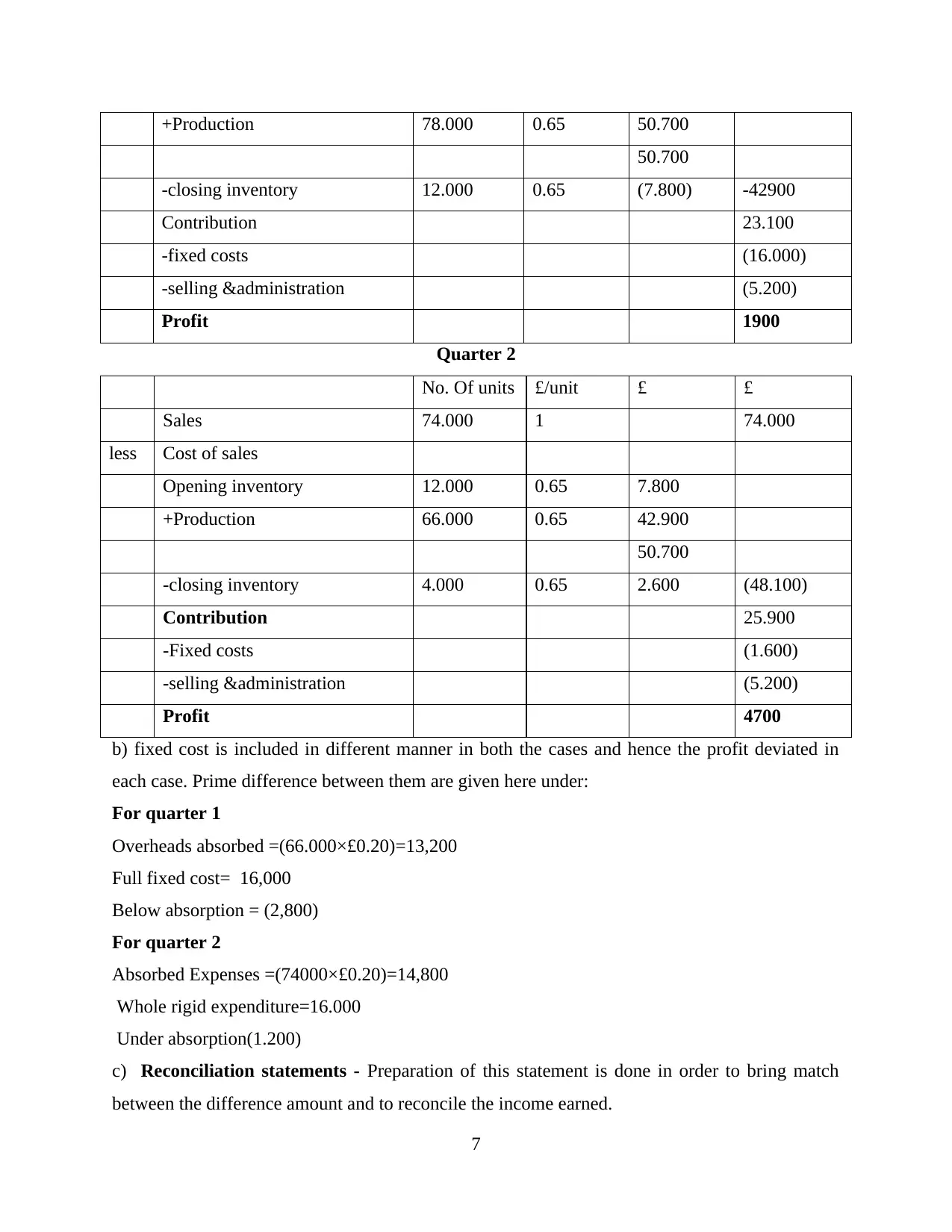
+Production 78.000 0.65 50.700
50.700
-closing inventory 12.000 0.65 (7.800) -42900
Contribution 23.100
-fixed costs (16.000)
-selling &administration (5.200)
Profit 1900
Quarter 2
No. Of units £/unit £ £
Sales 74.000 1 74.000
less Cost of sales
Opening inventory 12.000 0.65 7.800
+Production 66.000 0.65 42.900
50.700
-closing inventory 4.000 0.65 2.600 (48.100)
Contribution 25.900
-Fixed costs (1.600)
-selling &administration (5.200)
Profit 4700
b) fixed cost is included in different manner in both the cases and hence the profit deviated in
each case. Prime difference between them are given here under:
For quarter 1
Overheads absorbed =(66.000×£0.20)=13,200
Full fixed cost= 16,000
Below absorption = (2,800)
For quarter 2
Absorbed Expenses =(74000×£0.20)=14,800
Whole rigid expenditure=16.000
Under absorption(1.200)
c) Reconciliation statements - Preparation of this statement is done in order to bring match
between the difference amount and to reconcile the income earned.
7
50.700
-closing inventory 12.000 0.65 (7.800) -42900
Contribution 23.100
-fixed costs (16.000)
-selling &administration (5.200)
Profit 1900
Quarter 2
No. Of units £/unit £ £
Sales 74.000 1 74.000
less Cost of sales
Opening inventory 12.000 0.65 7.800
+Production 66.000 0.65 42.900
50.700
-closing inventory 4.000 0.65 2.600 (48.100)
Contribution 25.900
-Fixed costs (1.600)
-selling &administration (5.200)
Profit 4700
b) fixed cost is included in different manner in both the cases and hence the profit deviated in
each case. Prime difference between them are given here under:
For quarter 1
Overheads absorbed =(66.000×£0.20)=13,200
Full fixed cost= 16,000
Below absorption = (2,800)
For quarter 2
Absorbed Expenses =(74000×£0.20)=14,800
Whole rigid expenditure=16.000
Under absorption(1.200)
c) Reconciliation statements - Preparation of this statement is done in order to bring match
between the difference amount and to reconcile the income earned.
7
⊘ This is a preview!⊘
Do you want full access?
Subscribe today to unlock all pages.
Trusted by 1+ million students worldwide
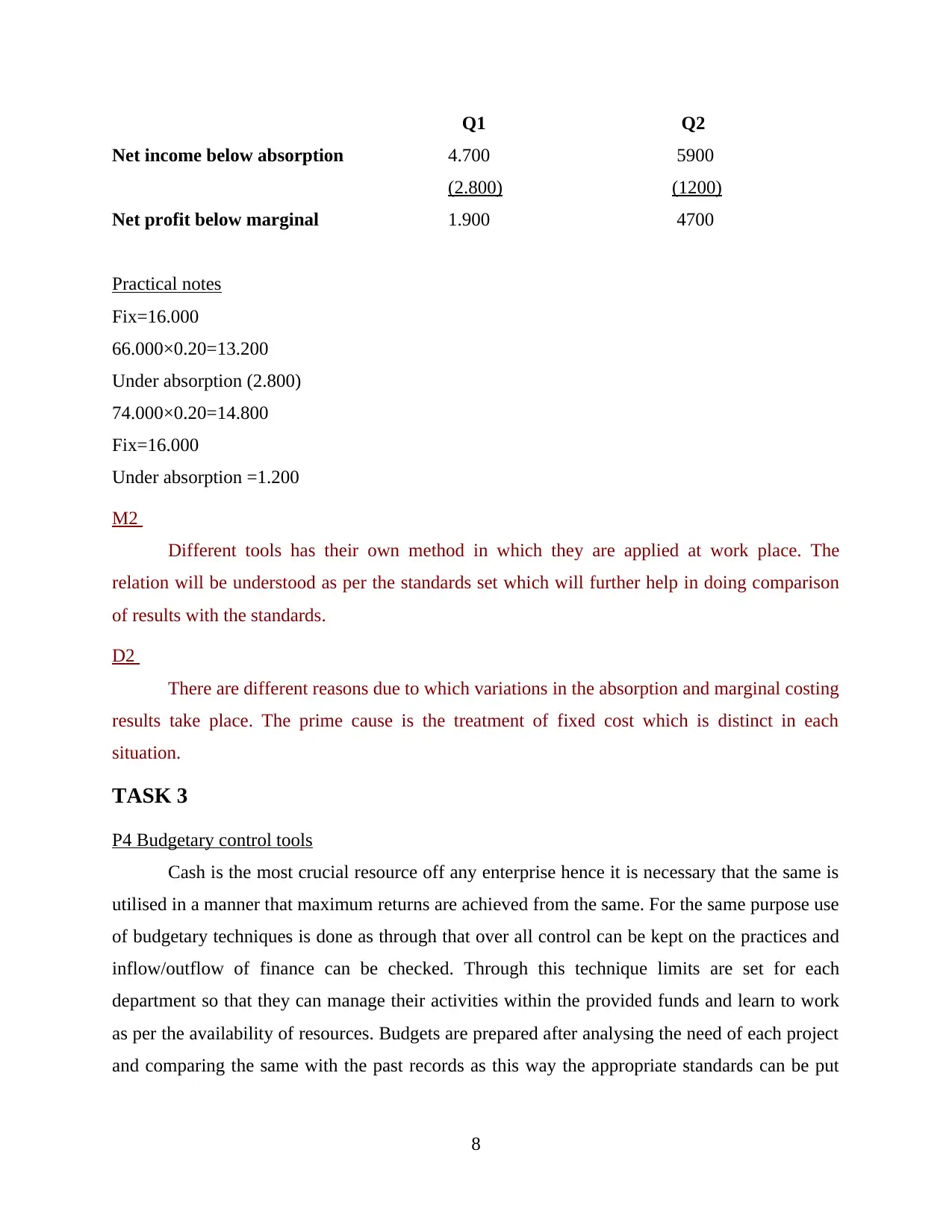
Q1 Q2
Net income below absorption 4.700 5900
(2.800) (1200)
Net profit below marginal 1.900 4700
Practical notes
Fix=16.000
66.000×0.20=13.200
Under absorption (2.800)
74.000×0.20=14.800
Fix=16.000
Under absorption =1.200
M2
Different tools has their own method in which they are applied at work place. The
relation will be understood as per the standards set which will further help in doing comparison
of results with the standards.
D2
There are different reasons due to which variations in the absorption and marginal costing
results take place. The prime cause is the treatment of fixed cost which is distinct in each
situation.
TASK 3
P4 Budgetary control tools
Cash is the most crucial resource off any enterprise hence it is necessary that the same is
utilised in a manner that maximum returns are achieved from the same. For the same purpose use
of budgetary techniques is done as through that over all control can be kept on the practices and
inflow/outflow of finance can be checked. Through this technique limits are set for each
department so that they can manage their activities within the provided funds and learn to work
as per the availability of resources. Budgets are prepared after analysing the need of each project
and comparing the same with the past records as this way the appropriate standards can be put
8
Net income below absorption 4.700 5900
(2.800) (1200)
Net profit below marginal 1.900 4700
Practical notes
Fix=16.000
66.000×0.20=13.200
Under absorption (2.800)
74.000×0.20=14.800
Fix=16.000
Under absorption =1.200
M2
Different tools has their own method in which they are applied at work place. The
relation will be understood as per the standards set which will further help in doing comparison
of results with the standards.
D2
There are different reasons due to which variations in the absorption and marginal costing
results take place. The prime cause is the treatment of fixed cost which is distinct in each
situation.
TASK 3
P4 Budgetary control tools
Cash is the most crucial resource off any enterprise hence it is necessary that the same is
utilised in a manner that maximum returns are achieved from the same. For the same purpose use
of budgetary techniques is done as through that over all control can be kept on the practices and
inflow/outflow of finance can be checked. Through this technique limits are set for each
department so that they can manage their activities within the provided funds and learn to work
as per the availability of resources. Budgets are prepared after analysing the need of each project
and comparing the same with the past records as this way the appropriate standards can be put
8
Paraphrase This Document
Need a fresh take? Get an instant paraphrase of this document with our AI Paraphraser
forward against the concern department (Scapens and Bromwich, , 2010). As per the nature,
department and scale of project distinct budgets are prepared among which the most popular are:
Master budget
Cash budget
Sales budget
Zero budget
Operating financial plan
Statics estimates
Cash flow forecast report
Each one of the tool given above has their own pros and cons as the business
environment is dynamic and budgets are prepared on the basis of predictions which can is
difficult to be correct purely. Given below is the detail of the different advantages and
disadvantages of the budgetary control technique (Giovannoni, Maraghini and Riccaboni, 2011).
Positives
1. Facilitate control - With the help of this technique effective control can be practised
over the various functions of the company as through this system limits are set against
each function. This way the whole department work in a manner that it has only the
available amount of resource to utilise and hence use it to its maximum potentiality.
2. Incorporates efficiency – When the work staff is made to work with limits they work
with greater duty as they know if the project assigned is not finished with the provided
resource than their performance will be questioned. Hence everyone work with greater
efficiency to remain free from any negative interrogation (Soin and Collier, 2013).
3. Improve communication – At the time of budget formulation, interaction between the
head authority and the concern department take place which further improves the
communication level. It is a positive move as while communicating with one another a
better relation is set at the work place which is a positive move for companies growth.
4. Improve employee morale – When the top authority prepares budgets they interact with
their subordinates and this way every individual gets a feeling of belongingness with the
company. They find themselves worth and hence feel motivated and accordingly give
their performance (DRURY, 2013).
Disadvantages / Negatives
9
department and scale of project distinct budgets are prepared among which the most popular are:
Master budget
Cash budget
Sales budget
Zero budget
Operating financial plan
Statics estimates
Cash flow forecast report
Each one of the tool given above has their own pros and cons as the business
environment is dynamic and budgets are prepared on the basis of predictions which can is
difficult to be correct purely. Given below is the detail of the different advantages and
disadvantages of the budgetary control technique (Giovannoni, Maraghini and Riccaboni, 2011).
Positives
1. Facilitate control - With the help of this technique effective control can be practised
over the various functions of the company as through this system limits are set against
each function. This way the whole department work in a manner that it has only the
available amount of resource to utilise and hence use it to its maximum potentiality.
2. Incorporates efficiency – When the work staff is made to work with limits they work
with greater duty as they know if the project assigned is not finished with the provided
resource than their performance will be questioned. Hence everyone work with greater
efficiency to remain free from any negative interrogation (Soin and Collier, 2013).
3. Improve communication – At the time of budget formulation, interaction between the
head authority and the concern department take place which further improves the
communication level. It is a positive move as while communicating with one another a
better relation is set at the work place which is a positive move for companies growth.
4. Improve employee morale – When the top authority prepares budgets they interact with
their subordinates and this way every individual gets a feeling of belongingness with the
company. They find themselves worth and hence feel motivated and accordingly give
their performance (DRURY, 2013).
Disadvantages / Negatives
9
1. Time taking activity – Although budgets has various positive effects on an organisations
it has some limitations too. In order to reach at correct planning enough time is consumed
and hence much time is wasted in case of budget failure.
2. High value procedure – In order to formulate an effective budget management has to
ensure that right person with adequate knowledge is appointed. To get such person good
cost has to be paid which makes it an expensive process cost of which is added to the
ultimate product of the company and hence the value increases.
3. Complex Operation – As various functions are performed at the work place it becomes
difficult to determine each and every aspect which needs to be considered while
formulating the particular financial limit (Li and et. al., 2012).
4. Decrease flexibility – When budgets are set by the higher authorities it reduces the
flexibility at the work place.
M3
Budgetary techniques help in solving the different issues that take place at the work
place. This concept helps in reaching to the desired level of accuracy in management.
D3
The budget system helps in achieving substantial growth in the long run. This is due to
the reason that problems can be better resolved by applying these techniques in organisation.
P5 Solving of financial problems
Various factors and elements which exist in the business environment and which gave
rise to the unnecessary issues should taken into consideration for planning future activities of a
business and to take necessary actions in order to solve them. One of the main issue which exist
in today's business environment is lack of communication. So it comes under the responsibility
of managers to ensure effective and proper communication at various level of firms so that
enterprise can formulate effective policies for the business. By this coordination and cooperation
can be maintain among various operations. It is very necessary that all the required information
should be made available to the managers so that loopholes can be avoided in the process of
business. In this way business can be conducted in an effective manner and strategies can be
implemented in short duration of time and proper functioning of business can be ensured.
Main techniques which are involved in this are stated below:
10
it has some limitations too. In order to reach at correct planning enough time is consumed
and hence much time is wasted in case of budget failure.
2. High value procedure – In order to formulate an effective budget management has to
ensure that right person with adequate knowledge is appointed. To get such person good
cost has to be paid which makes it an expensive process cost of which is added to the
ultimate product of the company and hence the value increases.
3. Complex Operation – As various functions are performed at the work place it becomes
difficult to determine each and every aspect which needs to be considered while
formulating the particular financial limit (Li and et. al., 2012).
4. Decrease flexibility – When budgets are set by the higher authorities it reduces the
flexibility at the work place.
M3
Budgetary techniques help in solving the different issues that take place at the work
place. This concept helps in reaching to the desired level of accuracy in management.
D3
The budget system helps in achieving substantial growth in the long run. This is due to
the reason that problems can be better resolved by applying these techniques in organisation.
P5 Solving of financial problems
Various factors and elements which exist in the business environment and which gave
rise to the unnecessary issues should taken into consideration for planning future activities of a
business and to take necessary actions in order to solve them. One of the main issue which exist
in today's business environment is lack of communication. So it comes under the responsibility
of managers to ensure effective and proper communication at various level of firms so that
enterprise can formulate effective policies for the business. By this coordination and cooperation
can be maintain among various operations. It is very necessary that all the required information
should be made available to the managers so that loopholes can be avoided in the process of
business. In this way business can be conducted in an effective manner and strategies can be
implemented in short duration of time and proper functioning of business can be ensured.
Main techniques which are involved in this are stated below:
10
⊘ This is a preview!⊘
Do you want full access?
Subscribe today to unlock all pages.
Trusted by 1+ million students worldwide

1 out of 15


Related Documents


Your All-in-One AI-Powered Toolkit for Academic Success.
+13062052269
info@desklib.com
Available 24*7 on WhatsApp / Email
![[object Object]](/_next/static/media/star-bottom.7253800d.svg)
Unlock your academic potential
Copyright © 2020–2026 A2Z Services. All Rights Reserved. Developed and managed by ZUCOL.