Taxation Report: University Taxation and Financial Reporting Analysis
VerifiedAdded on  2020/04/15
|14
|2639
|35
Report
AI Summary
This report provides a comprehensive analysis of taxation and its relationship with accounting and financial performance. It begins by differentiating between accounting and taxation, emphasizing their interconnectedness, especially through corporate tax and income tax. The report covers asset and liability valuation methods, the significance of accounting in controlling fiscal aspects like VAT and tax deductions, and the integration of accounting and taxation in business software. It also discusses the challenges of aligning accounting and tax results, including permanent and temporary differences, and the importance of various tax receipts. Furthermore, the report addresses the taxation of income tax, highlighting issues related to tax base calculation, and explores significant issues in financial performance, such as differential rates and tax discounts. The report includes recommendations for tax financial reports, emphasizing transparency and fairness, and suggests modernizing tax language. It also delves into goodwill accounting, analyzing its recognition, measurement, and reporting. The report concludes with a discussion of financial business recommendations, focusing on the impact of taxes on cash flow and the importance of Goods and Services Tax (GST). It also covers the structure and formats of reports, including the roles of management, external auditors, and the Audit Committee, along with a sample balance sheet and GST calculation worksheet.

1
Taxation
Name:
Course
Professor’s name
University name
City, State
Date of submission
Taxation
Name:
Course
Professor’s name
University name
City, State
Date of submission
Paraphrase This Document
Need a fresh take? Get an instant paraphrase of this document with our AI Paraphraser

2
TASK 1
Introduction
Accounting and taxation
Accounting and taxation have been considered two disciplines differentiated by the fact of
belonging to different fields of knowledge. This has meant that they have been normally
considered as two independent studies in the training plans, even not forming part of them in the
training of those who have finally been dedicated to advisory management (Engdahl, 2011).
Conversion and consolidation procedure
The problem is that this distance is not true, but quite the opposite. In business they need each
other to the point where one may not make sense without the other. Although there are many
aspects that unite them, the main link between both is found in the corporate tax. The corporate
tax is effectively a tax and is subject to tax regulations, specifically now regulated by law but we
should not forget that it is also an accounting expense and therefore is also regulated by
regulations trade (Holtzman and Sinnett, 2009). In fact, fiscally it is known as corporation tax
and accounting as income tax, when we are really referring to the same tax.
Asset and liability valuation
When valuing assets and liabilities, the organization uses various methods. The following
methods are used ; there is the discounted cash flow methods, the net asset value methods and
the guideline companies method.
TASK 1
Introduction
Accounting and taxation
Accounting and taxation have been considered two disciplines differentiated by the fact of
belonging to different fields of knowledge. This has meant that they have been normally
considered as two independent studies in the training plans, even not forming part of them in the
training of those who have finally been dedicated to advisory management (Engdahl, 2011).
Conversion and consolidation procedure
The problem is that this distance is not true, but quite the opposite. In business they need each
other to the point where one may not make sense without the other. Although there are many
aspects that unite them, the main link between both is found in the corporate tax. The corporate
tax is effectively a tax and is subject to tax regulations, specifically now regulated by law but we
should not forget that it is also an accounting expense and therefore is also regulated by
regulations trade (Holtzman and Sinnett, 2009). In fact, fiscally it is known as corporation tax
and accounting as income tax, when we are really referring to the same tax.
Asset and liability valuation
When valuing assets and liabilities, the organization uses various methods. The following
methods are used ; there is the discounted cash flow methods, the net asset value methods and
the guideline companies method.

3
However, in the business world, the relationship goes much further. If we understand the
accounting not only as an information tool but as a working tool, we will see that its good
running will allow us to control many fiscal aspects such as the quarterly VAT settlements, or
the control of the withheld and practiced retentions, or the control of non-deductible expenses, or
deductible depreciation, etc . In fact, the computer programs that allow us to manage the
company are increasingly integrated by presenting packages where accounting, taxation or
warehouse management or personnel are totally linked (Bloom, 2013).
Calculated liabilities in tax
Returning to corporation tax, it is true that many years ago the accountant's job was focused on
keeping the books that would allow him to prepare the financial statements and little was
concerned with "helping" the person who was responsible for filing taxes. This had to perform
VAT management or corporate tax calculation practically independently of the accounting
information. This approach is increasing but even today there are still a series of differences
between the two results that are perhaps insurmountable giving rise to what are known as
permanent and temporary differences.
Identified relevant receipt
There are various receipts in tax accounting. The sales receipts, income tax receipts and vouchers
in an organization that helps in tax purposes. Our experience with the tax advisory master has
shown us that in Master programs in tax matters, accounting is not only necessary but it is
essential, so we will always include it as the first module to be carried out by the student so that
serve as a basis at the time you have to study the fiscal part. If we add business and labor law
concepts to the accounting and tax side, we form a group that makes the student an expert in all
However, in the business world, the relationship goes much further. If we understand the
accounting not only as an information tool but as a working tool, we will see that its good
running will allow us to control many fiscal aspects such as the quarterly VAT settlements, or
the control of the withheld and practiced retentions, or the control of non-deductible expenses, or
deductible depreciation, etc . In fact, the computer programs that allow us to manage the
company are increasingly integrated by presenting packages where accounting, taxation or
warehouse management or personnel are totally linked (Bloom, 2013).
Calculated liabilities in tax
Returning to corporation tax, it is true that many years ago the accountant's job was focused on
keeping the books that would allow him to prepare the financial statements and little was
concerned with "helping" the person who was responsible for filing taxes. This had to perform
VAT management or corporate tax calculation practically independently of the accounting
information. This approach is increasing but even today there are still a series of differences
between the two results that are perhaps insurmountable giving rise to what are known as
permanent and temporary differences.
Identified relevant receipt
There are various receipts in tax accounting. The sales receipts, income tax receipts and vouchers
in an organization that helps in tax purposes. Our experience with the tax advisory master has
shown us that in Master programs in tax matters, accounting is not only necessary but it is
essential, so we will always include it as the first module to be carried out by the student so that
serve as a basis at the time you have to study the fiscal part. If we add business and labor law
concepts to the accounting and tax side, we form a group that makes the student an expert in all
⊘ This is a preview!⊘
Do you want full access?
Subscribe today to unlock all pages.

Trusted by 1+ million students worldwide

4
business knowledge and gives the maximum benefit of the Master (Harrington, Nunes and
Roland, 2010).
Taxation of income tax
This contradicts one of the universal principles in the taxation of income tax, which is included
in our Tax Statute. This consists in that the taxable income, the one from which the taxes are
calculated, must have as reference ordinary or extraordinary income obtained in the taxable year,
which are likely to produce a net increase in the taxpayer's equity at the time of collection.
Consequently, from the income received, the costs and deductions linked to this income must be
subtracted and the tax base obtained, which should not be different from the companies' profits,
as reflected in their accounting information.
Therefore, there is an absolute divorce between business and tax accounting, since one of the
revenues and expenses that must be recorded to reflect their financial situation, and another of
those accepted by the tax authority. This process of "fiscal cleansing", as the technicians call it,
introduces important distortions in the tax system (Harrington, Nunes and Roland, 2010).
Significant issues in financial perfomance
Apart from the fact that there are differential rates and tax discounts, as a result of which many
incomes are susceptible to increase the patrimony, they are exempt, and many expenses that
diminish the profits are not recognized. Among the costs incurred by companies that are not
accepted tax, although they effectively reduce the patrimony, they include the sales tax paid;
business knowledge and gives the maximum benefit of the Master (Harrington, Nunes and
Roland, 2010).
Taxation of income tax
This contradicts one of the universal principles in the taxation of income tax, which is included
in our Tax Statute. This consists in that the taxable income, the one from which the taxes are
calculated, must have as reference ordinary or extraordinary income obtained in the taxable year,
which are likely to produce a net increase in the taxpayer's equity at the time of collection.
Consequently, from the income received, the costs and deductions linked to this income must be
subtracted and the tax base obtained, which should not be different from the companies' profits,
as reflected in their accounting information.
Therefore, there is an absolute divorce between business and tax accounting, since one of the
revenues and expenses that must be recorded to reflect their financial situation, and another of
those accepted by the tax authority. This process of "fiscal cleansing", as the technicians call it,
introduces important distortions in the tax system (Harrington, Nunes and Roland, 2010).
Significant issues in financial perfomance
Apart from the fact that there are differential rates and tax discounts, as a result of which many
incomes are susceptible to increase the patrimony, they are exempt, and many expenses that
diminish the profits are not recognized. Among the costs incurred by companies that are not
accepted tax, although they effectively reduce the patrimony, they include the sales tax paid;
Paraphrase This Document
Need a fresh take? Get an instant paraphrase of this document with our AI Paraphraser

5
50% of the value paid for the tax on financial transactions (or four per thousand) and the losses
suffered in the sale of shares.
In turn, the law allows deductions to be treated as deductions that do not diminish the patrimony:
investments in reforestation plantations and 40% of the investment in real, productive fixed
assets for companies that have signed legal stability contracts, which covers this deduction,
repealed for the rest of companies in 2010 (Harrington, Nunes and Roland, 2010).
Recommendations in tax financial reports
The transparency and fairness of the tax system requires that there be no unjustified exemptions
to income, that all expenses and costs incurred and recognized in accounting standards can be
deducted, and that they are not treated as deductions for events that do not meet the accounting
definition.
Statutory and Structural Requirements In Tax Reforms
On the other hand, the next reform should be used to modernize the tax language. It is not
justified that at this point we continue talking about gross and net assets. By accounting
definition, equity is always net of liabilities with third parties other than shareholders. Nor is it
justified to denominate "liquid income" as the result of subtracting deductions from income.
Liquidity, in financial terms, has to do with the ease of selling assets (Ecker, n.d.).
Hopefully these points will be examined by the Commission of Experts for the tax modernization
designated by the National Government.
TASK 2
50% of the value paid for the tax on financial transactions (or four per thousand) and the losses
suffered in the sale of shares.
In turn, the law allows deductions to be treated as deductions that do not diminish the patrimony:
investments in reforestation plantations and 40% of the investment in real, productive fixed
assets for companies that have signed legal stability contracts, which covers this deduction,
repealed for the rest of companies in 2010 (Harrington, Nunes and Roland, 2010).
Recommendations in tax financial reports
The transparency and fairness of the tax system requires that there be no unjustified exemptions
to income, that all expenses and costs incurred and recognized in accounting standards can be
deducted, and that they are not treated as deductions for events that do not meet the accounting
definition.
Statutory and Structural Requirements In Tax Reforms
On the other hand, the next reform should be used to modernize the tax language. It is not
justified that at this point we continue talking about gross and net assets. By accounting
definition, equity is always net of liabilities with third parties other than shareholders. Nor is it
justified to denominate "liquid income" as the result of subtracting deductions from income.
Liquidity, in financial terms, has to do with the ease of selling assets (Ecker, n.d.).
Hopefully these points will be examined by the Commission of Experts for the tax modernization
designated by the National Government.
TASK 2

6
Goodwill Accounting
In Good Will of Accounting Summary: In the business, the price of the business is treated as the
recognition of Goodwill, measurement and registration, but the goodwill of business has not
been confirmed. How to provide complete information about the goodwill, recognition,
measurement and reporting of various goodwill, there is still a lot of controversy. Based on the
analysis of goodwill and goodwill accounting connotation old debate on the proposal of goodwill
accounting in development (Alexander and Britton, 2005).
As a result of the above, despite the fact that the general rate of taxation of companies is, in
principle, 34% (25% of income and 9% of income tax for equity, not counting the surtax created
to the latter imposed by law), the effective tax rate, that is, the relationship between the tax paid
and the accounting profits obtained, can have a huge variation. Some people calculate the
effective tax rate by 53%, but companies appear paying taxes of 5%, while others register 70%.
This situation contradicts one of the basic principles of a good tax system: that of horizontal
equity, which states that equal income should correspond to equal taxation (Elliott and Elliott,
2006)
Financial business recommendations
Incorrect payments and un reconciled cash flows
Goodwill Accounting
In Good Will of Accounting Summary: In the business, the price of the business is treated as the
recognition of Goodwill, measurement and registration, but the goodwill of business has not
been confirmed. How to provide complete information about the goodwill, recognition,
measurement and reporting of various goodwill, there is still a lot of controversy. Based on the
analysis of goodwill and goodwill accounting connotation old debate on the proposal of goodwill
accounting in development (Alexander and Britton, 2005).
As a result of the above, despite the fact that the general rate of taxation of companies is, in
principle, 34% (25% of income and 9% of income tax for equity, not counting the surtax created
to the latter imposed by law), the effective tax rate, that is, the relationship between the tax paid
and the accounting profits obtained, can have a huge variation. Some people calculate the
effective tax rate by 53%, but companies appear paying taxes of 5%, while others register 70%.
This situation contradicts one of the basic principles of a good tax system: that of horizontal
equity, which states that equal income should correspond to equal taxation (Elliott and Elliott,
2006)
Financial business recommendations
Incorrect payments and un reconciled cash flows
⊘ This is a preview!⊘
Do you want full access?
Subscribe today to unlock all pages.

Trusted by 1+ million students worldwide

7
An important element that we must take into account when building the cash flow of our
company and evaluate it, is the incidence that taxes can have on this and on the results of the net
present value and the internal rate of return.
In the evaluation of the companys we usually take into account two types of taxes:
Those with a fixed sum, such as the income or profit tax, which are only a fixed percentage of
the estimated result of the company for each of the periods of its useful life. As an example,
suppose that we have estimated the financial statements of a company whose duration is 4 years
and that the tax contribution that must be met in this hypothetical economy for the generation of
income is 30%, given this information we obtain the following table (Bloom, 2013).
Since the taxes represent a cash outflow in each of the periods they should be incorporated with a
negative sign to the cash flow, so in period 1 we would have an outlay of 45, in two one of 75
and in 3 and 4 one of 120 monetary units or in a more graphic way:
Every time we buy a product or hire a service for the company we must pay a percentage for
VAT that is retained by the seller, in the same way every time our company sells some good or
service we retain a quantity of money from the buyer for the same reason. In the first case we are
generating a balance in favor that we must deduct from the amount that we have retained for our
sales at the time of reporting and paying before the Treasury.Let's now remove the amounts
corresponding to the tax to calculate your cash flow or cash (Bloom, 2013).
Our experience with the tax advisory master has shown us that in Master programs in tax
matters, accounting is not only necessary but it is essential, so we will always include it as the
first module to be carried out by the student so that serve as a basis at the time you have to study
An important element that we must take into account when building the cash flow of our
company and evaluate it, is the incidence that taxes can have on this and on the results of the net
present value and the internal rate of return.
In the evaluation of the companys we usually take into account two types of taxes:
Those with a fixed sum, such as the income or profit tax, which are only a fixed percentage of
the estimated result of the company for each of the periods of its useful life. As an example,
suppose that we have estimated the financial statements of a company whose duration is 4 years
and that the tax contribution that must be met in this hypothetical economy for the generation of
income is 30%, given this information we obtain the following table (Bloom, 2013).
Since the taxes represent a cash outflow in each of the periods they should be incorporated with a
negative sign to the cash flow, so in period 1 we would have an outlay of 45, in two one of 75
and in 3 and 4 one of 120 monetary units or in a more graphic way:
Every time we buy a product or hire a service for the company we must pay a percentage for
VAT that is retained by the seller, in the same way every time our company sells some good or
service we retain a quantity of money from the buyer for the same reason. In the first case we are
generating a balance in favor that we must deduct from the amount that we have retained for our
sales at the time of reporting and paying before the Treasury.Let's now remove the amounts
corresponding to the tax to calculate your cash flow or cash (Bloom, 2013).
Our experience with the tax advisory master has shown us that in Master programs in tax
matters, accounting is not only necessary but it is essential, so we will always include it as the
first module to be carried out by the student so that serve as a basis at the time you have to study
Paraphrase This Document
Need a fresh take? Get an instant paraphrase of this document with our AI Paraphraser

8
the fiscal part. If we add business and labor law concepts to the accounting and tax side, we form
a group that makes the student an expert in all business knowledge and gives the maximum
benefit of the Master.
Goods and Services tax
Goods and Services Tax or GST (Tax on goods and services) of 10% on almost all articles
(Melville, 2013). The GST is included in the price charged. Some items such as food, most
educational and medical services, licensed child care centers, and nursing home services are
exempt from GST.
Structure and formats of reports
It is the responsibility of the management of the Company to prepare financial statements in
accordance with GAAPS and the external auditor auditing checks the financial statements. The
responsibility of the Audit Committee is to review and supervise. The Committee does not
provide any guarantee as experts or any other special guarantee on such financial statements with
respect to compliance with laws, regulations, or generally accepted accounting principles. The
Committee has the sole and direct responsibility and authority to resolve any discrepancy
between the management and the external auditor in relation to the financial statements for tax
purposes (Elliott and Elliott, 2006).
The management and external auditors have the obligation to report on a timely basis written to
the Committee the existence of discrepant matters in relation to the financial statements. After
becoming aware, the Board may request face-to-face meetings with the parts that it considers
the fiscal part. If we add business and labor law concepts to the accounting and tax side, we form
a group that makes the student an expert in all business knowledge and gives the maximum
benefit of the Master.
Goods and Services tax
Goods and Services Tax or GST (Tax on goods and services) of 10% on almost all articles
(Melville, 2013). The GST is included in the price charged. Some items such as food, most
educational and medical services, licensed child care centers, and nursing home services are
exempt from GST.
Structure and formats of reports
It is the responsibility of the management of the Company to prepare financial statements in
accordance with GAAPS and the external auditor auditing checks the financial statements. The
responsibility of the Audit Committee is to review and supervise. The Committee does not
provide any guarantee as experts or any other special guarantee on such financial statements with
respect to compliance with laws, regulations, or generally accepted accounting principles. The
Committee has the sole and direct responsibility and authority to resolve any discrepancy
between the management and the external auditor in relation to the financial statements for tax
purposes (Elliott and Elliott, 2006).
The management and external auditors have the obligation to report on a timely basis written to
the Committee the existence of discrepant matters in relation to the financial statements. After
becoming aware, the Board may request face-to-face meetings with the parts that it considers

9
convenient. Also, to be a subject that requires specific knowledge may be made hiring
professionals and / or technicians specialists. The final decision of the Committee must be
communicated to the external auditor and management, with the due anticipation to the issuance
of the financial statements, to then leave
.Nothing contained in the present procedure will alter the responsibilities or duties to the
Company, which has the external auditor, who will render an account in last resort to the
Committee, in accordance with the accounting, statutory or another type (Elliott and Elliott,
2006).
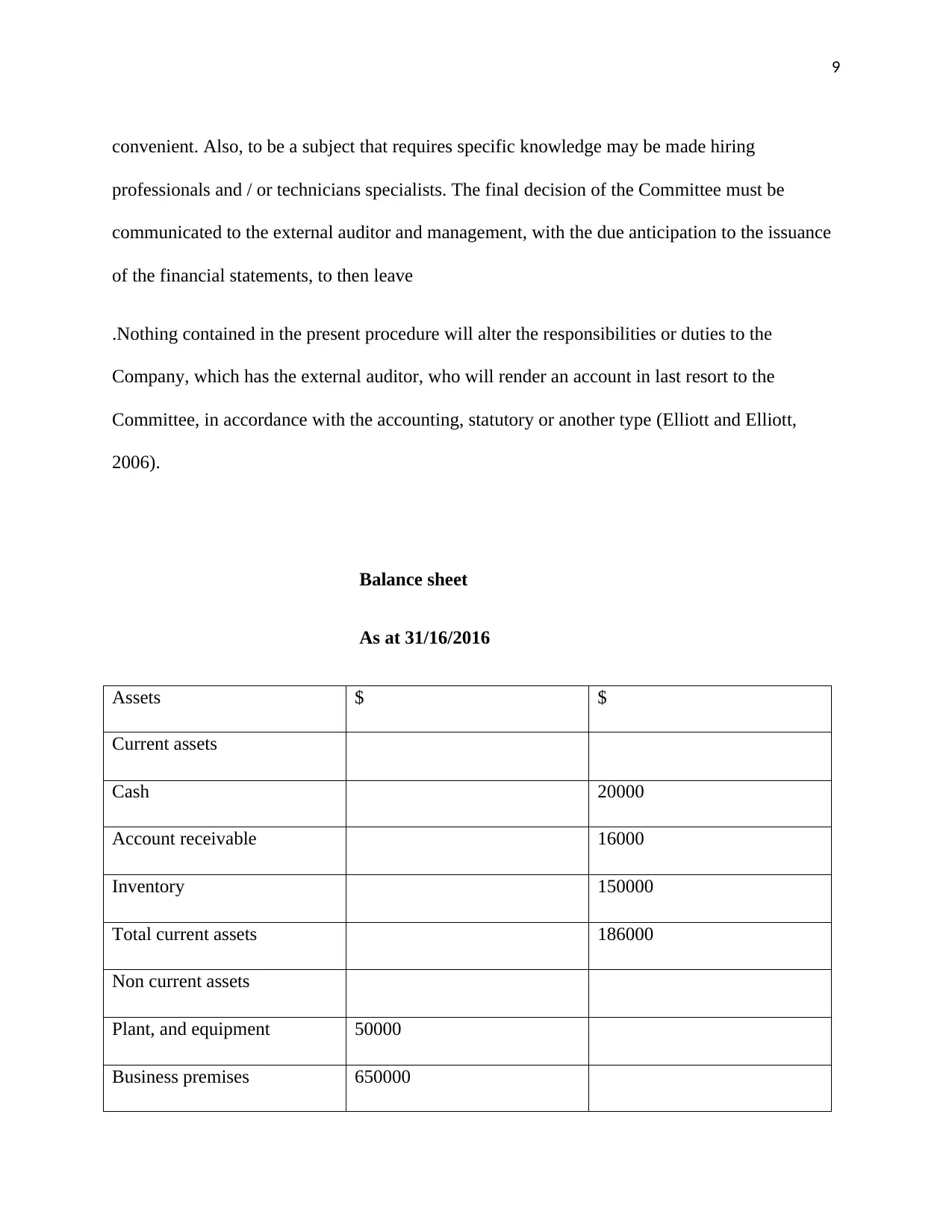
Balance sheet
As at 31/16/2016
Assets $ $
Current assets
Cash 20000
Account receivable 16000
Inventory 150000
Total current assets 186000
Non current assets
Plant, and equipment 50000
Business premises 650000
convenient. Also, to be a subject that requires specific knowledge may be made hiring
professionals and / or technicians specialists. The final decision of the Committee must be
communicated to the external auditor and management, with the due anticipation to the issuance
of the financial statements, to then leave
.Nothing contained in the present procedure will alter the responsibilities or duties to the
Company, which has the external auditor, who will render an account in last resort to the
Committee, in accordance with the accounting, statutory or another type (Elliott and Elliott,
2006).
Balance sheet
As at 31/16/2016
Assets $ $
Current assets
Cash 20000
Account receivable 16000
Inventory 150000
Total current assets 186000
Non current assets
Plant, and equipment 50000
Business premises 650000
⊘ This is a preview!⊘
Do you want full access?
Subscribe today to unlock all pages.

Trusted by 1+ million students worldwide

10
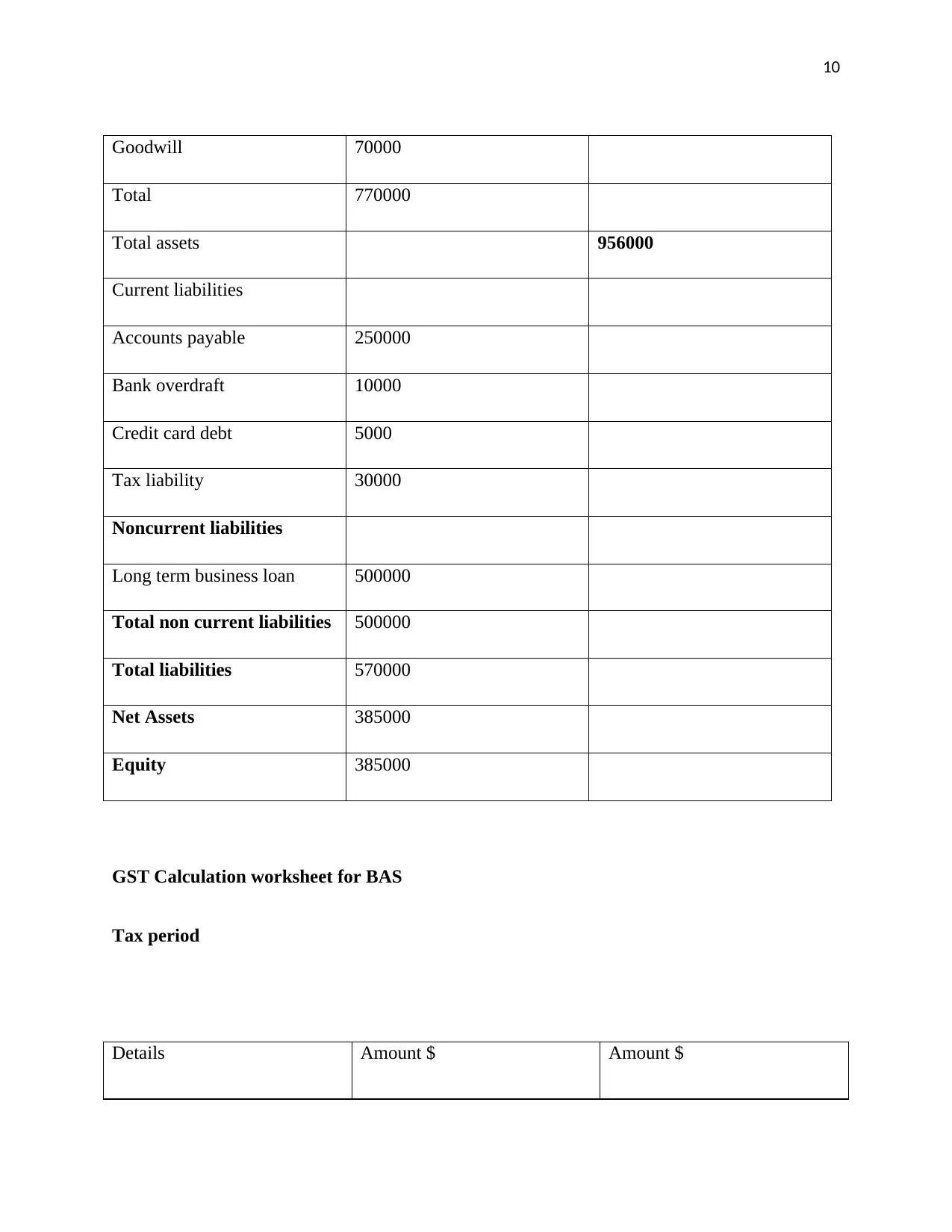
Goodwill 70000
Total 770000
Total assets 956000
Current liabilities
Accounts payable 250000
Bank overdraft 10000
Credit card debt 5000
Tax liability 30000
Noncurrent liabilities
Long term business loan 500000
Total non current liabilities 500000
Total liabilities 570000
Net Assets 385000
Equity 385000
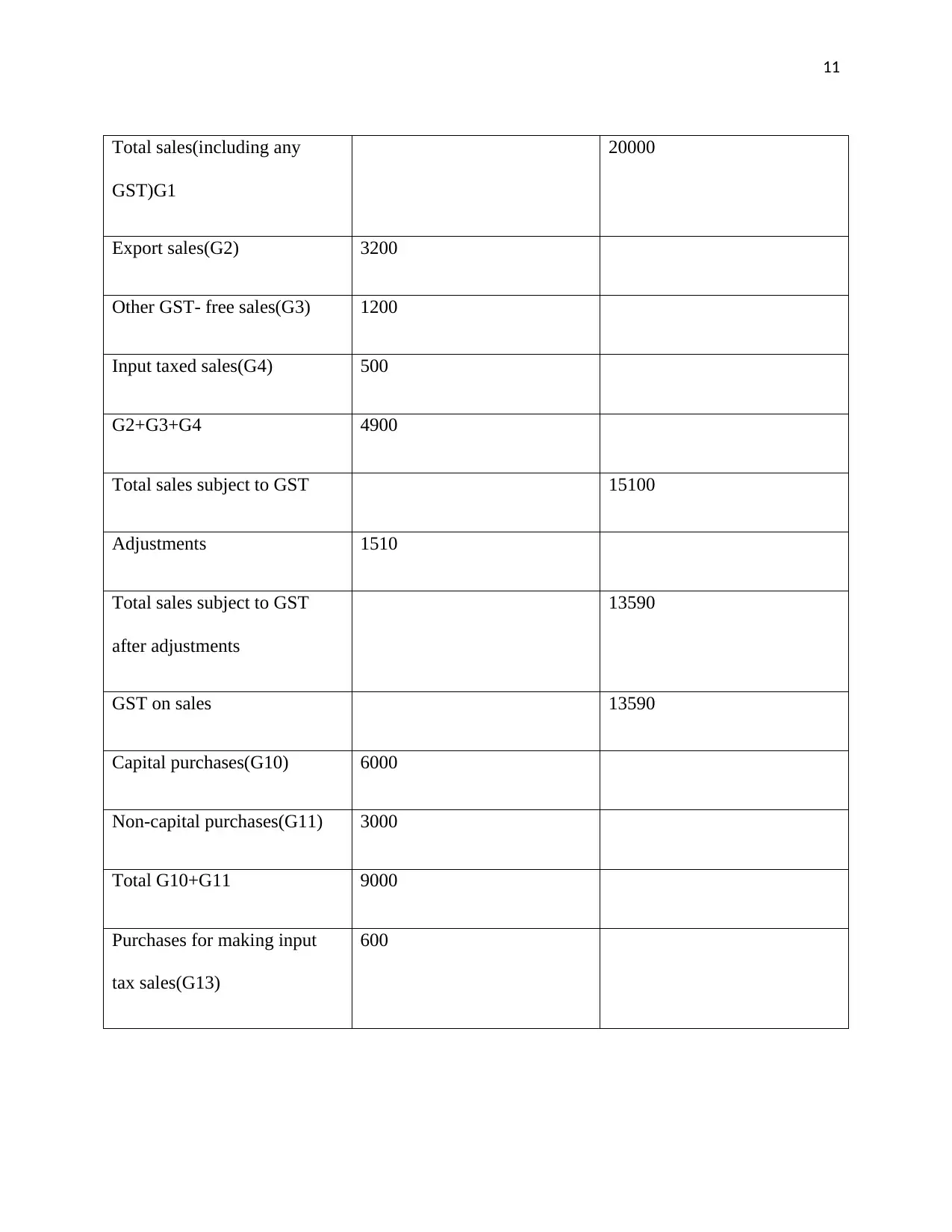
GST Calculation worksheet for BAS
Tax period
Details Amount $ Amount $
Goodwill 70000
Total 770000
Total assets 956000
Current liabilities
Accounts payable 250000
Bank overdraft 10000
Credit card debt 5000
Tax liability 30000
Noncurrent liabilities
Long term business loan 500000
Total non current liabilities 500000
Total liabilities 570000
Net Assets 385000
Equity 385000
GST Calculation worksheet for BAS
Tax period
Details Amount $ Amount $
Paraphrase This Document
Need a fresh take? Get an instant paraphrase of this document with our AI Paraphraser

11
Total sales(including any
GST)G1
20000
Export sales(G2) 3200
Other GST- free sales(G3) 1200
Input taxed sales(G4) 500
G2+G3+G4 4900
Total sales subject to GST 15100
Adjustments 1510
Total sales subject to GST
after adjustments
13590
GST on sales 13590
Capital purchases(G10) 6000
Non-capital purchases(G11) 3000
Total G10+G11 9000
Purchases for making input
tax sales(G13)
600
Total sales(including any
GST)G1
20000
Export sales(G2) 3200
Other GST- free sales(G3) 1200
Input taxed sales(G4) 500
G2+G3+G4 4900
Total sales subject to GST 15100
Adjustments 1510
Total sales subject to GST
after adjustments
13590
GST on sales 13590
Capital purchases(G10) 6000
Non-capital purchases(G11) 3000
Total G10+G11 9000
Purchases for making input
tax sales(G13)
600

12
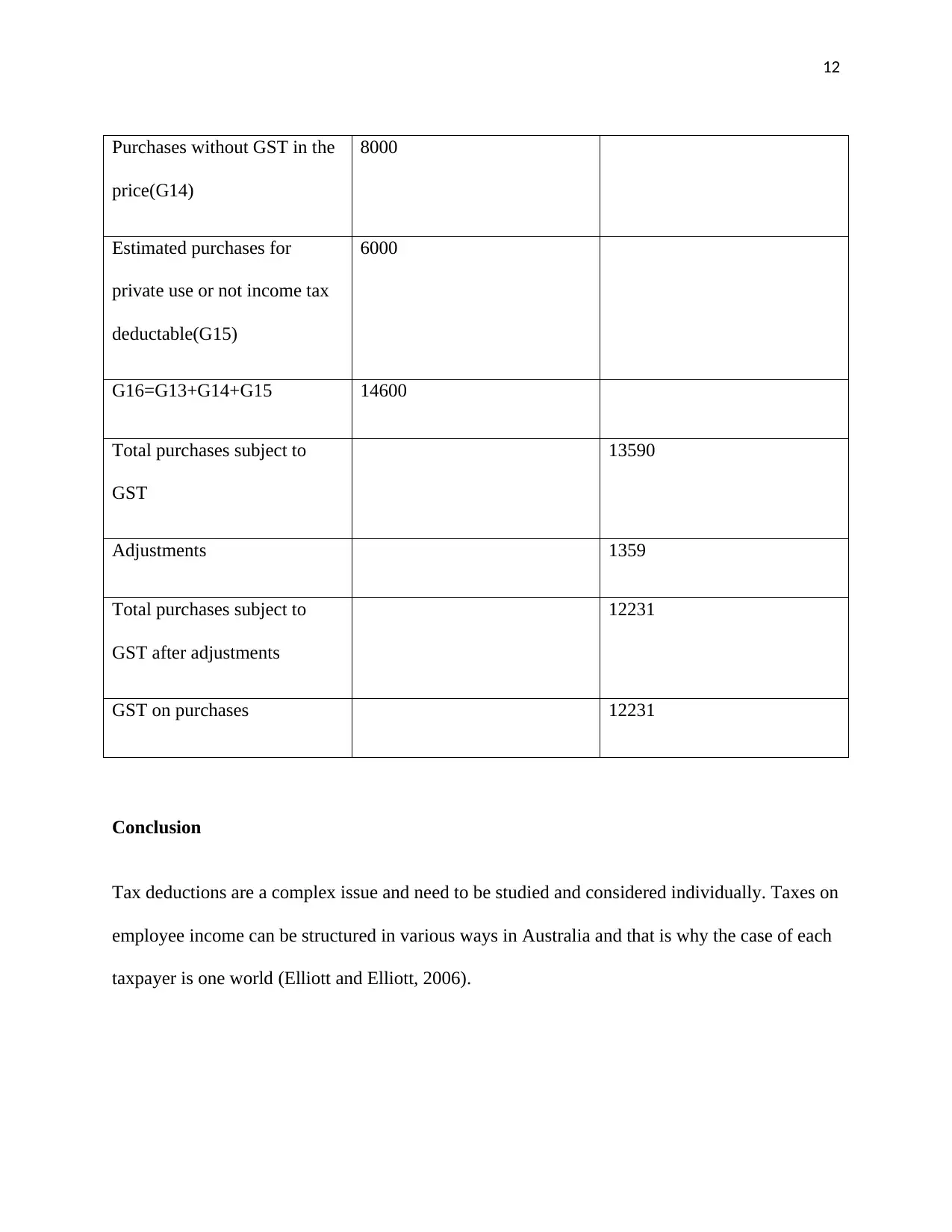
Purchases without GST in the
price(G14)
8000
Estimated purchases for
private use or not income tax
deductable(G15)
6000
G16=G13+G14+G15 14600
Total purchases subject to
GST
13590
Adjustments 1359
Total purchases subject to
GST after adjustments
12231
GST on purchases 12231
Conclusion
Tax deductions are a complex issue and need to be studied and considered individually. Taxes on
employee income can be structured in various ways in Australia and that is why the case of each
taxpayer is one world (Elliott and Elliott, 2006).
Purchases without GST in the
price(G14)
8000
Estimated purchases for
private use or not income tax
deductable(G15)
6000
G16=G13+G14+G15 14600
Total purchases subject to
GST
13590
Adjustments 1359
Total purchases subject to
GST after adjustments
12231
GST on purchases 12231
Conclusion
Tax deductions are a complex issue and need to be studied and considered individually. Taxes on
employee income can be structured in various ways in Australia and that is why the case of each
taxpayer is one world (Elliott and Elliott, 2006).
⊘ This is a preview!⊘
Do you want full access?
Subscribe today to unlock all pages.

Trusted by 1+ million students worldwide
1 out of 14
Related Documents
Your All-in-One AI-Powered Toolkit for Academic Success.
 +13062052269
info@desklib.com
Available 24*7 on WhatsApp / Email
Unlock your academic potential
Copyright © 2020–2025 A2Z Services. All Rights Reserved. Developed and managed by ZUCOL.