Accounting Theory Homework: Financial Reporting and Standards

Verified

Added on  2023/02/01

|5
|1237
|81
Homework Assignment
AI Summary
This document presents a comprehensive solution to an accounting theory homework assignment. It addresses key concepts such as the role of financial markets in providing financial information, the importance of Generally Accepted Accounting Principles (GAAP), and the application of the cost-benefit criterion in financial reporting. The solution also explores the Financial Accounting Standards Board (FASB) and its role in setting accounting standards, the significance of representational faithfulness in accounting measurements, and the application of measurement attributes. Furthermore, the assignment covers topics like asset definition, revenue recognition according to IFRS 15, and the classification of items in other comprehensive income. The answers are supported by references to academic literature, providing a solid foundation for understanding the concepts discussed.
Document Page
Accounting Theory 1
Accounting Theory
tabler-icon-diamond-filled.svg

Paraphrase This Document

Need a fresh take? Get an instant paraphrase of this document with our AI Paraphraser
Document Page
Accounting Theory 2
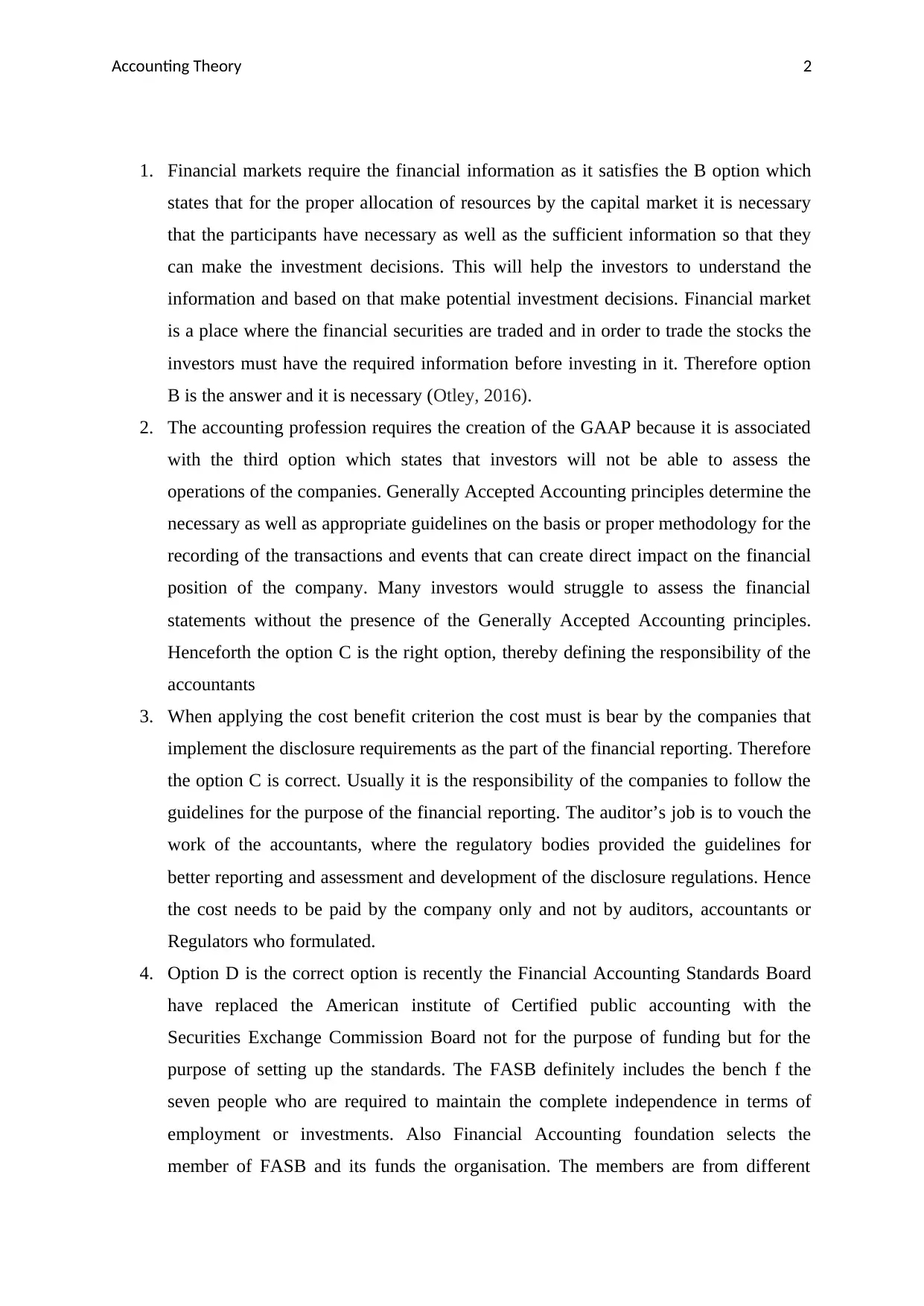
1. Financial markets require the financial information as it satisfies the B option which
states that for the proper allocation of resources by the capital market it is necessary
that the participants have necessary as well as the sufficient information so that they
can make the investment decisions. This will help the investors to understand the
information and based on that make potential investment decisions. Financial market
is a place where the financial securities are traded and in order to trade the stocks the
investors must have the required information before investing in it. Therefore option
B is the answer and it is necessary (Otley, 2016).
2. The accounting profession requires the creation of the GAAP because it is associated
with the third option which states that investors will not be able to assess the
operations of the companies. Generally Accepted Accounting principles determine the
necessary as well as appropriate guidelines on the basis or proper methodology for the
recording of the transactions and events that can create direct impact on the financial
position of the company. Many investors would struggle to assess the financial
statements without the presence of the Generally Accepted Accounting principles.
Henceforth the option C is the right option, thereby defining the responsibility of the
accountants
3. When applying the cost benefit criterion the cost must is bear by the companies that
implement the disclosure requirements as the part of the financial reporting. Therefore
the option C is correct. Usually it is the responsibility of the companies to follow the
guidelines for the purpose of the financial reporting. The auditor’s job is to vouch the
work of the accountants, where the regulatory bodies provided the guidelines for
better reporting and assessment and development of the disclosure regulations. Hence
the cost needs to be paid by the company only and not by auditors, accountants or
Regulators who formulated.
4. Option D is the correct option is recently the Financial Accounting Standards Board
have replaced the American institute of Certified public accounting with the
Securities Exchange Commission Board not for the purpose of funding but for the
purpose of setting up the standards. The FASB definitely includes the bench f the
seven people who are required to maintain the complete independence in terms of
employment or investments. Also Financial Accounting foundation selects the
member of FASB and its funds the organisation. The members are from different
Document Page
Accounting Theory 3
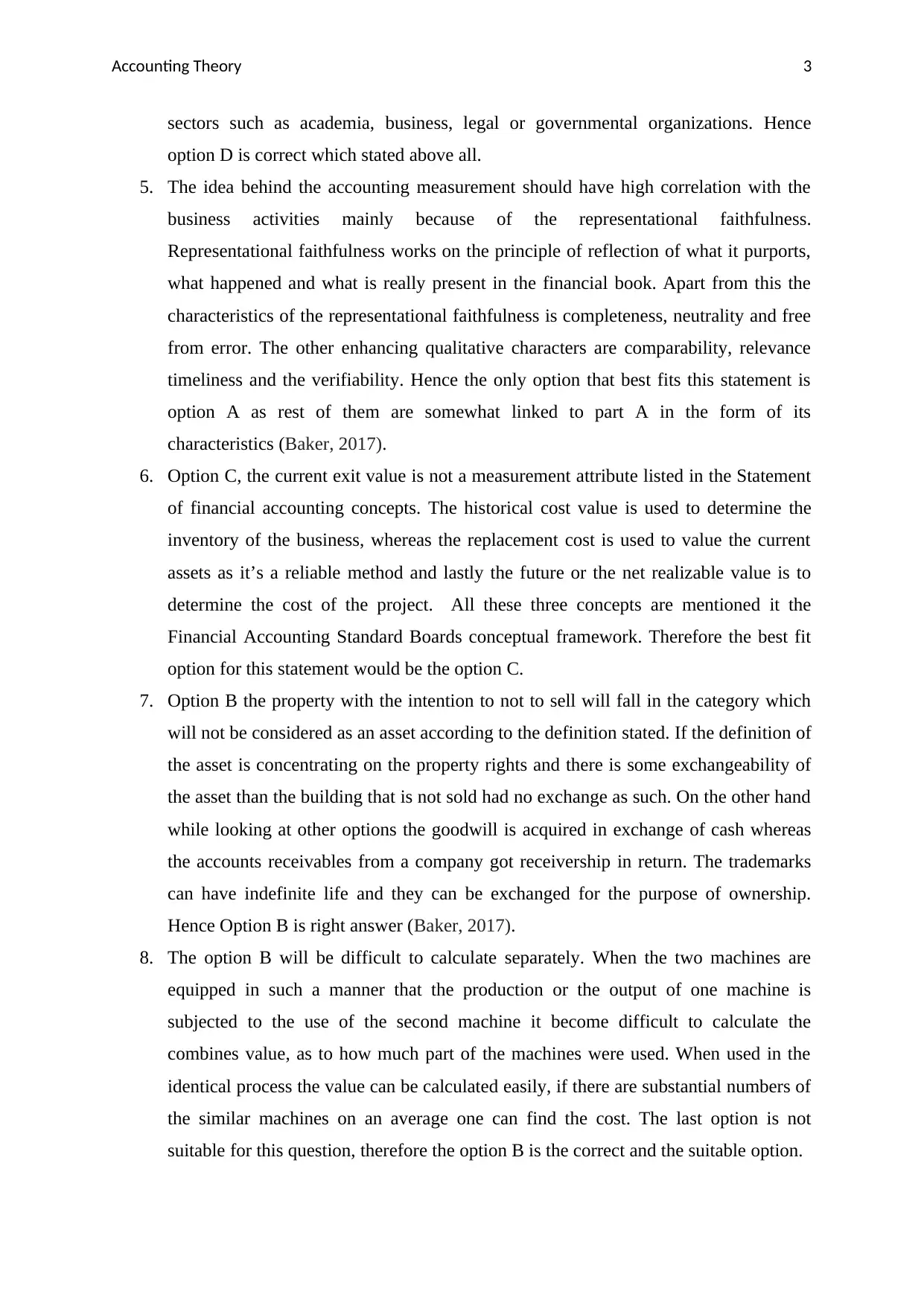
sectors such as academia, business, legal or governmental organizations. Hence
option D is correct which stated above all.
5. The idea behind the accounting measurement should have high correlation with the
business activities mainly because of the representational faithfulness.
Representational faithfulness works on the principle of reflection of what it purports,
what happened and what is really present in the financial book. Apart from this the
characteristics of the representational faithfulness is completeness, neutrality and free
from error. The other enhancing qualitative characters are comparability, relevance
timeliness and the verifiability. Hence the only option that best fits this statement is
option A as rest of them are somewhat linked to part A in the form of its
characteristics (Baker, 2017).
6. Option C, the current exit value is not a measurement attribute listed in the Statement
of financial accounting concepts. The historical cost value is used to determine the
inventory of the business, whereas the replacement cost is used to value the current
assets as it’s a reliable method and lastly the future or the net realizable value is to
determine the cost of the project. All these three concepts are mentioned it the
Financial Accounting Standard Boards conceptual framework. Therefore the best fit
option for this statement would be the option C.
7. Option B the property with the intention to not to sell will fall in the category which
will not be considered as an asset according to the definition stated. If the definition of
the asset is concentrating on the property rights and there is some exchangeability of
the asset than the building that is not sold had no exchange as such. On the other hand
while looking at other options the goodwill is acquired in exchange of cash whereas
the accounts receivables from a company got receivership in return. The trademarks
can have indefinite life and they can be exchanged for the purpose of ownership.
Hence Option B is right answer (Baker, 2017).
8. The option B will be difficult to calculate separately. When the two machines are
equipped in such a manner that the production or the output of one machine is
subjected to the use of the second machine it become difficult to calculate the
combines value, as to how much part of the machines were used. When used in the
identical process the value can be calculated easily, if there are substantial numbers of
the similar machines on an average one can find the cost. The last option is not
suitable for this question, therefore the option B is the correct and the suitable option.
Document Page
Accounting Theory 4
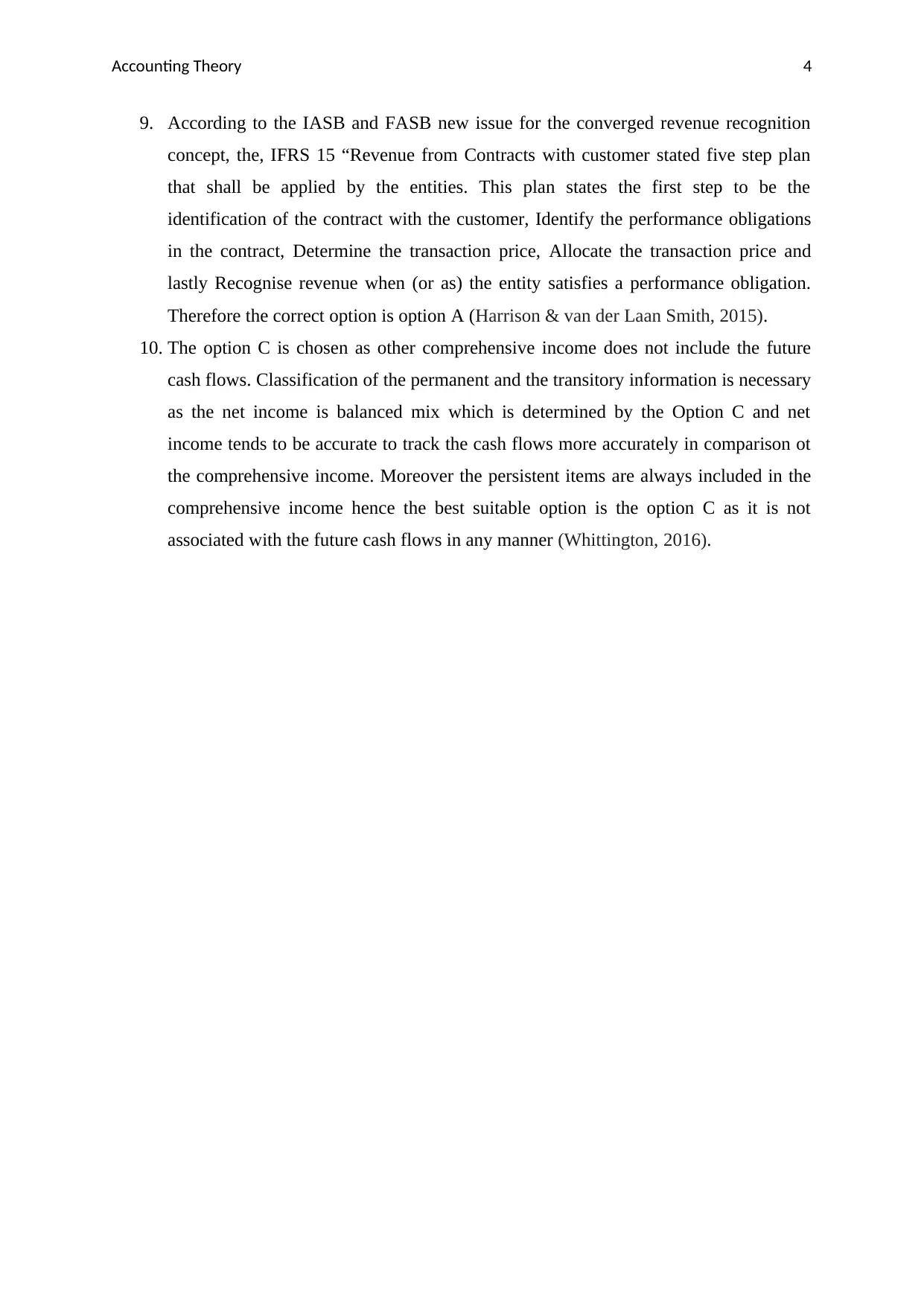
9. According to the IASB and FASB new issue for the converged revenue recognition
concept, the, IFRS 15 “Revenue from Contracts with customer stated five step plan
that shall be applied by the entities. This plan states the first step to be the
identification of the contract with the customer, Identify the performance obligations
in the contract, Determine the transaction price, Allocate the transaction price and
lastly Recognise revenue when (or as) the entity satisfies a performance obligation.
Therefore the correct option is option A (Harrison & van der Laan Smith, 2015).
10. The option C is chosen as other comprehensive income does not include the future
cash flows. Classification of the permanent and the transitory information is necessary
as the net income is balanced mix which is determined by the Option C and net
income tends to be accurate to track the cash flows more accurately in comparison ot
the comprehensive income. Moreover the persistent items are always included in the
comprehensive income hence the best suitable option is the option C as it is not
associated with the future cash flows in any manner (Whittington, 2016).
tabler-icon-diamond-filled.svg

Paraphrase This Document

Need a fresh take? Get an instant paraphrase of this document with our AI Paraphraser
Document Page
Accounting Theory 5
References
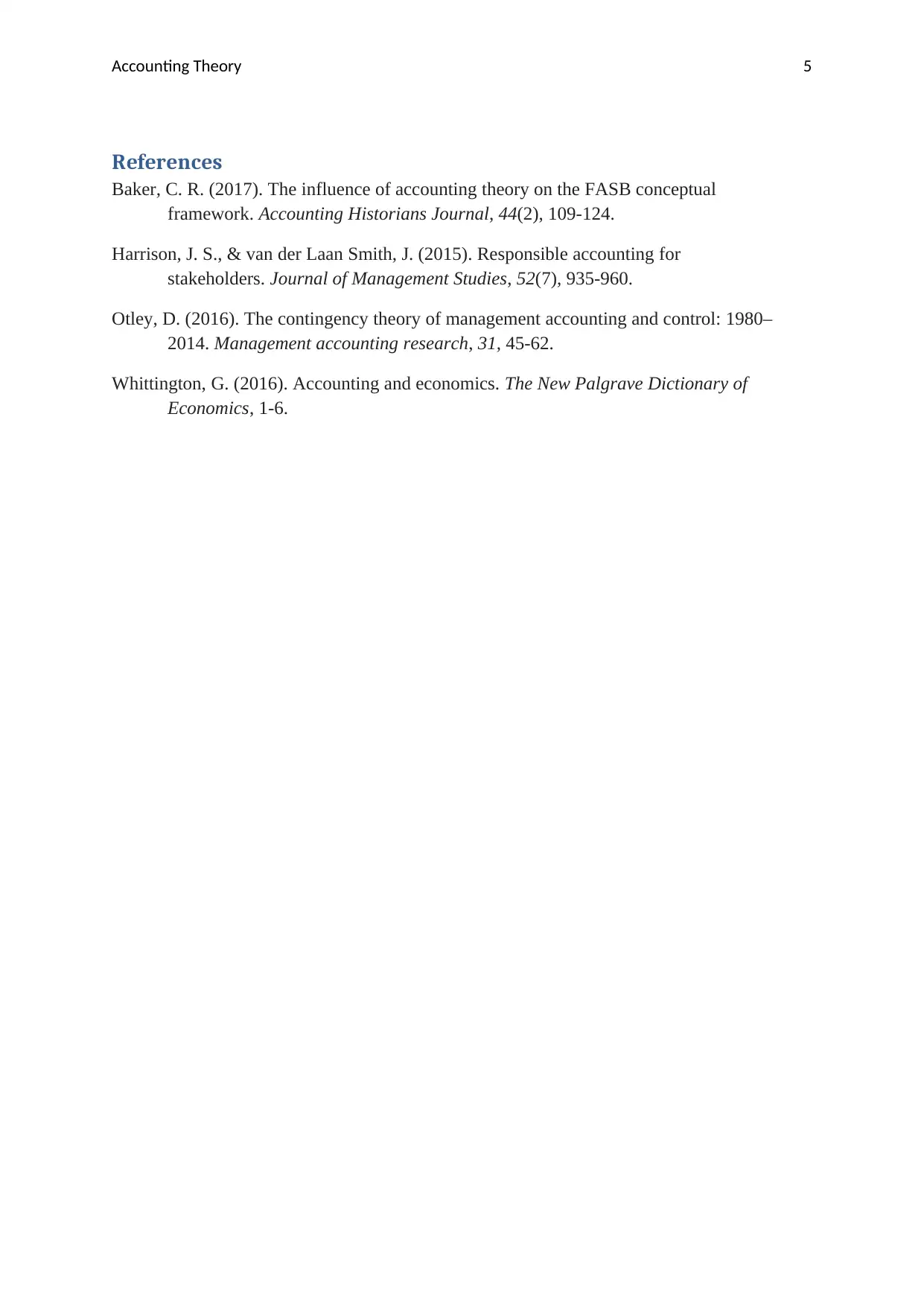
Baker, C. R. (2017). The influence of accounting theory on the FASB conceptual
framework. Accounting Historians Journal, 44(2), 109-124.
Harrison, J. S., & van der Laan Smith, J. (2015). Responsible accounting for
stakeholders. Journal of Management Studies, 52(7), 935-960.
Otley, D. (2016). The contingency theory of management accounting and control: 1980–
2014. Management accounting research, 31, 45-62.
Whittington, G. (2016). Accounting and economics. The New Palgrave Dictionary of
Economics, 1-6.
chevron_up_icon
1 out of 5
circle_padding
hide_on_mobile
zoom_out_icon
[object Object]