ACC307 Accounting Theory Assignment: Fair Value and Mixed Attributes
VerifiedAdded on 2022/08/26
|16
|4046
|10
Report
AI Summary
This report addresses key concepts in accounting theory, including the differences between principle-based and rules-based accounting standards (IFRS vs. GAAP), their respective advantages and disadvantages, and a comparative analysis. The report then delves into the fair value measurement model, as defined by IFRS 13, and its application, advantages, and disadvantages. It examines relevant standards such as FASB 159 and IAS 39. Furthermore, the report analyzes the mixed-attribute financial reporting model, discussing its use, the perspectives of banking federations and the CFA Institute, and arguments for and against its implementation. The report concludes with a discussion of how these models impact financial reporting and the valuation of assets and liabilities, providing a comprehensive overview of these critical accounting topics.
Running Head: ACCOUNTING
ACCOUNTING
Name of the Student
Name of the University
Author Note
ACCOUNTING
Name of the Student
Name of the University
Author Note

Paraphrase This Document
Need a fresh take? Get an instant paraphrase of this document with our AI Paraphraser

1
ACCOUNTING
Table of Contents
Theoretical Question..................................................................................................................2
Case Study..................................................................................................................................5
Fair value measurement model..............................................................................................5
Mixed-attribute financial reporting Model.............................................................................8
References................................................................................................................................12
ACCOUNTING
Table of Contents
Theoretical Question..................................................................................................................2
Case Study..................................................................................................................................5
Fair value measurement model..............................................................................................5
Mixed-attribute financial reporting Model.............................................................................8
References................................................................................................................................12
2
ACCOUNTING
Theoretical Question
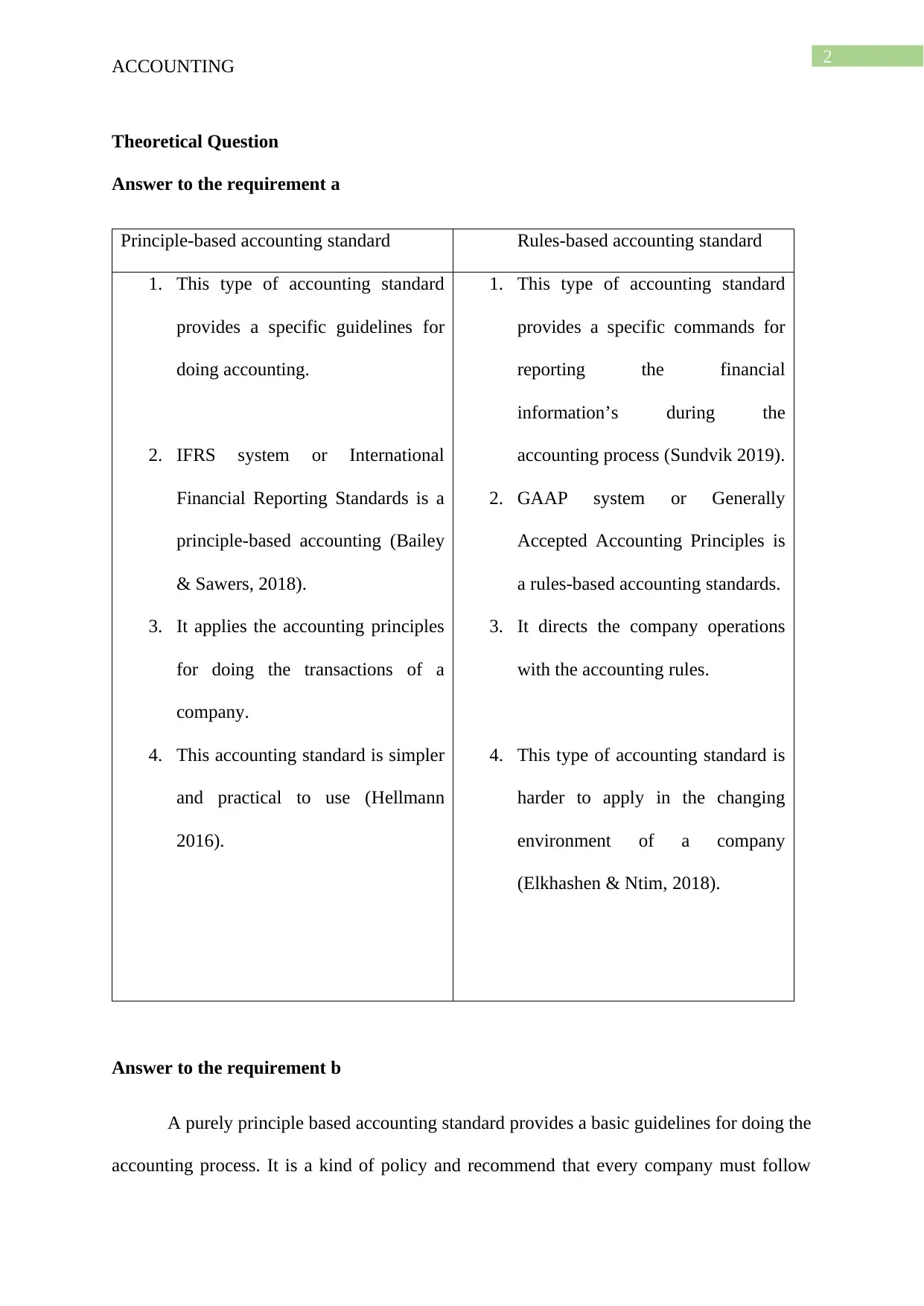
Answer to the requirement a
Principle-based accounting standard Rules-based accounting standard
1. This type of accounting standard
provides a specific guidelines for
doing accounting.
2. IFRS system or International
Financial Reporting Standards is a
principle-based accounting (Bailey
& Sawers, 2018).
3. It applies the accounting principles
for doing the transactions of a
company.
4. This accounting standard is simpler
and practical to use (Hellmann
2016).
1. This type of accounting standard
provides a specific commands for
reporting the financial
information’s during the
accounting process (Sundvik 2019).
2. GAAP system or Generally
Accepted Accounting Principles is
a rules-based accounting standards.
3. It directs the company operations
with the accounting rules.
4. This type of accounting standard is
harder to apply in the changing
environment of a company
(Elkhashen & Ntim, 2018).
Answer to the requirement b
A purely principle based accounting standard provides a basic guidelines for doing the
accounting process. It is a kind of policy and recommend that every company must follow
ACCOUNTING
Theoretical Question
Answer to the requirement a
Principle-based accounting standard Rules-based accounting standard
1. This type of accounting standard
provides a specific guidelines for
doing accounting.
2. IFRS system or International
Financial Reporting Standards is a
principle-based accounting (Bailey
& Sawers, 2018).
3. It applies the accounting principles
for doing the transactions of a
company.
4. This accounting standard is simpler
and practical to use (Hellmann
2016).
1. This type of accounting standard
provides a specific commands for
reporting the financial
information’s during the
accounting process (Sundvik 2019).
2. GAAP system or Generally
Accepted Accounting Principles is
a rules-based accounting standards.
3. It directs the company operations
with the accounting rules.
4. This type of accounting standard is
harder to apply in the changing
environment of a company
(Elkhashen & Ntim, 2018).
Answer to the requirement b
A purely principle based accounting standard provides a basic guidelines for doing the
accounting process. It is a kind of policy and recommend that every company must follow
⊘ This is a preview!⊘
Do you want full access?
Subscribe today to unlock all pages.

Trusted by 1+ million students worldwide
3
ACCOUNTING
these principles. Since, IFRS is a principle based accounting system. But still it is not used by
all the countries. A nearby of 120 countries uses this accounting standard across the world.
Hence, IFRS is not purely a principle based accounting standard. GAAP or generally
Accepted Accounting Principles is a rule-based accounting standard (Penno, 2019). A pure
rule based accounting system is defined as, the company following this type of accounting
system must follow the rules and regulations and should not be deviated from the rules.
GAAP is not a pure rule based accounting system. It is also considered as principles based
because it includes basic guidelines for the accountants. These guidelines include regularity,
prudence, continuity, sincerity and good faith. If the accountant’s does not follow these rules,
then they will not pay any penalties. Therefore, it is not a pure-rule based accounting systems.
In pure-rules based accounting system the commands are needed to be followed, and
accountants will have to pay for the penalties for not following the rules. The accounting
standard forces the bookkeepers to follow the rules during reporting the financial
information. Therefore, it can be seen that, any single set of accounting standards is not
purely a principles-based or rules-based accounting standard.
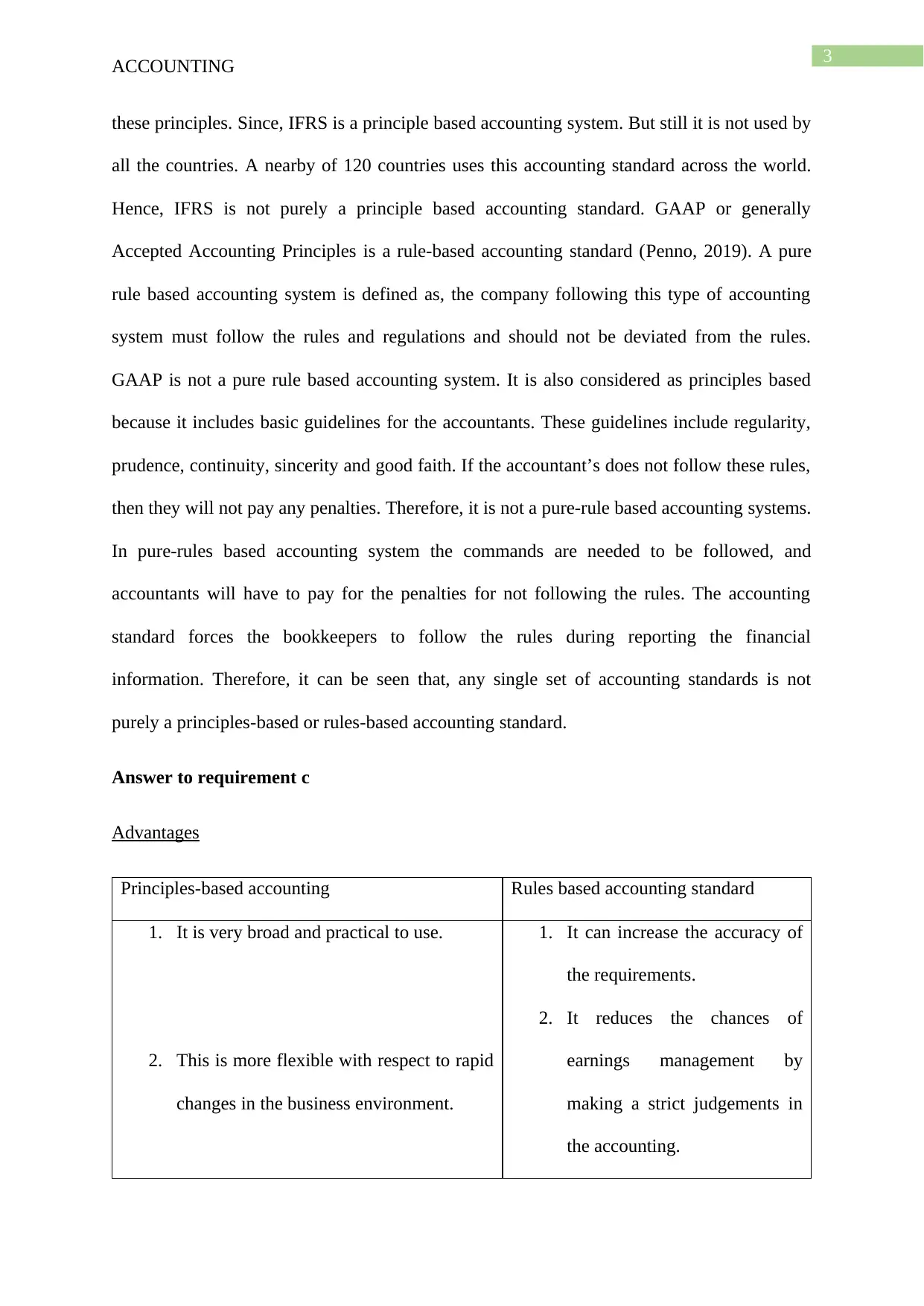
Answer to requirement c
Advantages
Principles-based accounting Rules based accounting standard
1. It is very broad and practical to use.
2. This is more flexible with respect to rapid
changes in the business environment.
1. It can increase the accuracy of
the requirements.
2. It reduces the chances of
earnings management by
making a strict judgements in
the accounting.
ACCOUNTING
these principles. Since, IFRS is a principle based accounting system. But still it is not used by
all the countries. A nearby of 120 countries uses this accounting standard across the world.
Hence, IFRS is not purely a principle based accounting standard. GAAP or generally
Accepted Accounting Principles is a rule-based accounting standard (Penno, 2019). A pure
rule based accounting system is defined as, the company following this type of accounting
system must follow the rules and regulations and should not be deviated from the rules.
GAAP is not a pure rule based accounting system. It is also considered as principles based
because it includes basic guidelines for the accountants. These guidelines include regularity,
prudence, continuity, sincerity and good faith. If the accountant’s does not follow these rules,
then they will not pay any penalties. Therefore, it is not a pure-rule based accounting systems.
In pure-rules based accounting system the commands are needed to be followed, and
accountants will have to pay for the penalties for not following the rules. The accounting
standard forces the bookkeepers to follow the rules during reporting the financial
information. Therefore, it can be seen that, any single set of accounting standards is not
purely a principles-based or rules-based accounting standard.
Answer to requirement c
Advantages
Principles-based accounting Rules based accounting standard
1. It is very broad and practical to use.
2. This is more flexible with respect to rapid
changes in the business environment.
1. It can increase the accuracy of
the requirements.
2. It reduces the chances of
earnings management by
making a strict judgements in
the accounting.
Paraphrase This Document
Need a fresh take? Get an instant paraphrase of this document with our AI Paraphraser
4
ACCOUNTING
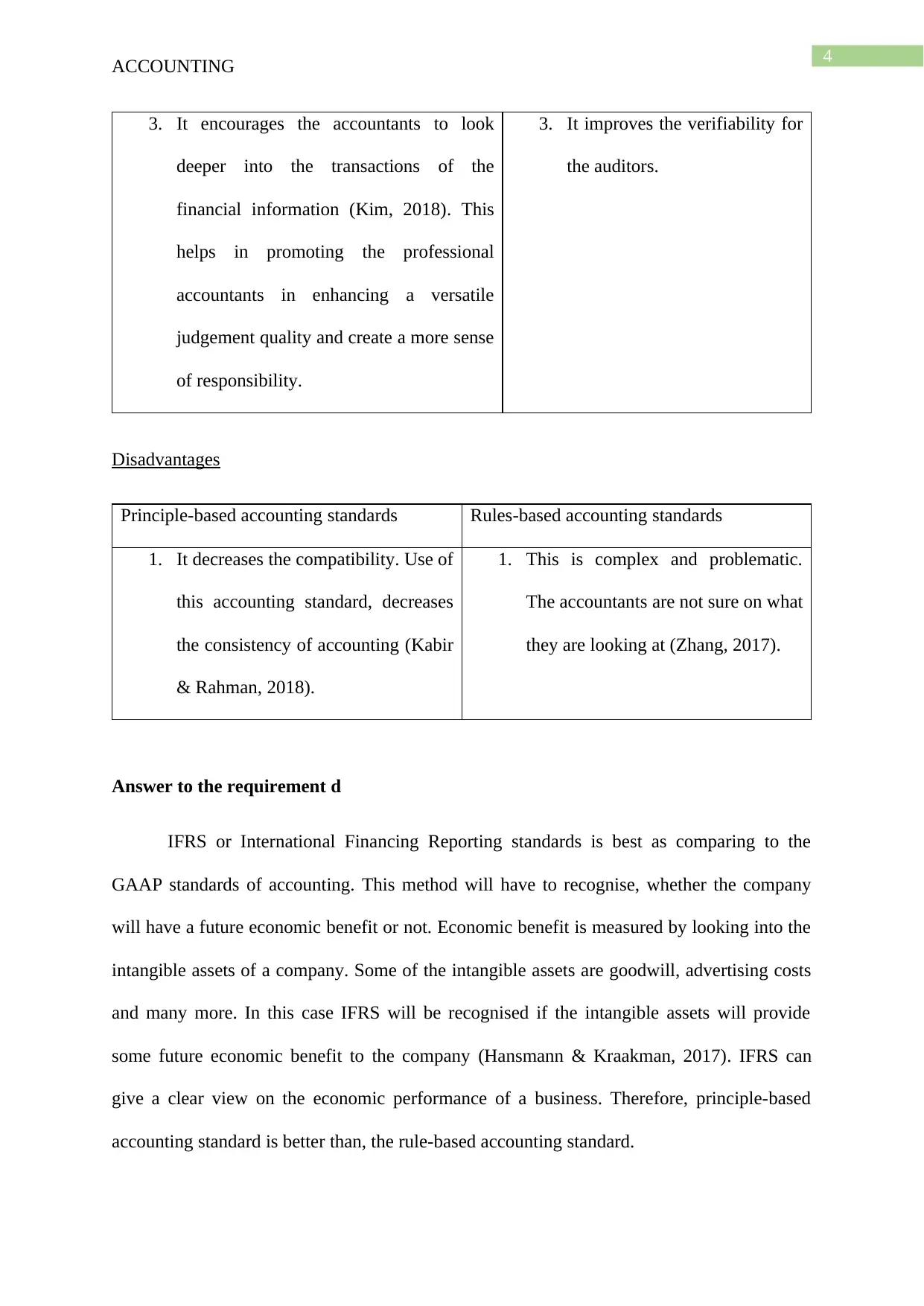
3. It encourages the accountants to look
deeper into the transactions of the
financial information (Kim, 2018). This
helps in promoting the professional
accountants in enhancing a versatile
judgement quality and create a more sense
of responsibility.
3. It improves the verifiability for
the auditors.
Disadvantages
Principle-based accounting standards Rules-based accounting standards
1. It decreases the compatibility. Use of
this accounting standard, decreases
the consistency of accounting (Kabir
& Rahman, 2018).
1. This is complex and problematic.
The accountants are not sure on what
they are looking at (Zhang, 2017).
Answer to the requirement d
IFRS or International Financing Reporting standards is best as comparing to the
GAAP standards of accounting. This method will have to recognise, whether the company
will have a future economic benefit or not. Economic benefit is measured by looking into the
intangible assets of a company. Some of the intangible assets are goodwill, advertising costs
and many more. In this case IFRS will be recognised if the intangible assets will provide
some future economic benefit to the company (Hansmann & Kraakman, 2017). IFRS can
give a clear view on the economic performance of a business. Therefore, principle-based
accounting standard is better than, the rule-based accounting standard.
ACCOUNTING
3. It encourages the accountants to look
deeper into the transactions of the
financial information (Kim, 2018). This
helps in promoting the professional
accountants in enhancing a versatile
judgement quality and create a more sense
of responsibility.
3. It improves the verifiability for
the auditors.
Disadvantages
Principle-based accounting standards Rules-based accounting standards
1. It decreases the compatibility. Use of
this accounting standard, decreases
the consistency of accounting (Kabir
& Rahman, 2018).
1. This is complex and problematic.
The accountants are not sure on what
they are looking at (Zhang, 2017).
Answer to the requirement d
IFRS or International Financing Reporting standards is best as comparing to the
GAAP standards of accounting. This method will have to recognise, whether the company
will have a future economic benefit or not. Economic benefit is measured by looking into the
intangible assets of a company. Some of the intangible assets are goodwill, advertising costs
and many more. In this case IFRS will be recognised if the intangible assets will provide
some future economic benefit to the company (Hansmann & Kraakman, 2017). IFRS can
give a clear view on the economic performance of a business. Therefore, principle-based
accounting standard is better than, the rule-based accounting standard.
5
ACCOUNTING
Case Study
In this article, the International banking federation have supported the mixed attribute
measurement model, but the CFA Institute in the opposite side, have gone against to this
model.
Fair value measurement model
IFRS 13, Fair value Measured was issued in the year 2011. In this model, all guidance
related to IAS and IFRS that is superseded. The main goal of IFRS 13 is to define the fair
value, to set out all the frameworks needed for measuring the fair value, and to disclosure the
afir value measured. It tells how to set a assets fair value, instead of when to set the fair value
(Barker & Schulte, 2017).
According to the international accounting standard setters proposed by the United
States, fair value measurement is suitable for those fiscal instruments that are involved in
trading purpose. Fair value of an asset is the selling price of the asset, agreed at the time of
contract. The fair value is a market basis measurement, not an entity based. Fair value
represents the real worth of various assets and the liabilities. A company must consider the
following things for determining the fair value.
Determine the particular asset or liability for which the fair value is to be calculated.
Only non-financial assets can be used.
Principal market is more advantage market for an asset and liability. It has greater
volumes of asset and liability. The most advantage market is that performs maximum sell and
minimum the amount of sell.
A fair value measurements model provides some guidance to the existing standards
of accounting (Zamora-Ramirez & Morales, 2018). The various standard related to fair value
measurement model are:
ACCOUNTING
Case Study
In this article, the International banking federation have supported the mixed attribute
measurement model, but the CFA Institute in the opposite side, have gone against to this
model.
Fair value measurement model
IFRS 13, Fair value Measured was issued in the year 2011. In this model, all guidance
related to IAS and IFRS that is superseded. The main goal of IFRS 13 is to define the fair
value, to set out all the frameworks needed for measuring the fair value, and to disclosure the
afir value measured. It tells how to set a assets fair value, instead of when to set the fair value
(Barker & Schulte, 2017).
According to the international accounting standard setters proposed by the United
States, fair value measurement is suitable for those fiscal instruments that are involved in
trading purpose. Fair value of an asset is the selling price of the asset, agreed at the time of
contract. The fair value is a market basis measurement, not an entity based. Fair value
represents the real worth of various assets and the liabilities. A company must consider the
following things for determining the fair value.
Determine the particular asset or liability for which the fair value is to be calculated.
Only non-financial assets can be used.
Principal market is more advantage market for an asset and liability. It has greater
volumes of asset and liability. The most advantage market is that performs maximum sell and
minimum the amount of sell.
A fair value measurements model provides some guidance to the existing standards
of accounting (Zamora-Ramirez & Morales, 2018). The various standard related to fair value
measurement model are:
⊘ This is a preview!⊘
Do you want full access?
Subscribe today to unlock all pages.
Trusted by 1+ million students worldwide
6
ACCOUNTING
Financial accounting standard board of FASB 159, helps to measure the fair value of
any instrument at its fair value. The main goal of this accounting standards is, to
reduce the earnings management without applying any hedging accounting practices.
FASB 159 can be applied in all type of entities both the profit and non-profit
organisations.
International Accounting Standards Board of IAS 39 is subjected to that accounting
policy, which helps to recognise and measure the financial assets, liabilities and other
financial contracts whether to purchase or sell the financial items. The principles will
help to recognise the financial instruments. According to this accounting standard, a
financial instrument will be recognised when the entity will become a party to the
contract with the financial instrument (Gebhardt, 2016). The contract is termed to be
expired, when the entity removes its liability from the balance sheet, when it transfers
the assets and the ownerships. In this accounting standard, the financial asset is
measured at its fair value. Some of the assets is also measured at its fair value.
According to FAS 17 of the financial accounting standard, the assets and liability of a
company should be measured at its fair value. This is the original price that is
received when the asset is sold during the transfer of liability. FAS 17 have classified
the assets and liabilities into three categories:
(a) The securities that are traded and quoted on daily basis.
(b) The financial instruments that have some observable prices but are not quoted on
daily basis.
(c) The instruments that donot have any observable prices and are calculated based on
certain assumptions.
IFRS 13 of fair value measurement states that a business entity uses various
assumptions for executing the fair value. One of the assumption is that, the market
ACCOUNTING
Financial accounting standard board of FASB 159, helps to measure the fair value of
any instrument at its fair value. The main goal of this accounting standards is, to
reduce the earnings management without applying any hedging accounting practices.
FASB 159 can be applied in all type of entities both the profit and non-profit
organisations.
International Accounting Standards Board of IAS 39 is subjected to that accounting
policy, which helps to recognise and measure the financial assets, liabilities and other
financial contracts whether to purchase or sell the financial items. The principles will
help to recognise the financial instruments. According to this accounting standard, a
financial instrument will be recognised when the entity will become a party to the
contract with the financial instrument (Gebhardt, 2016). The contract is termed to be
expired, when the entity removes its liability from the balance sheet, when it transfers
the assets and the ownerships. In this accounting standard, the financial asset is
measured at its fair value. Some of the assets is also measured at its fair value.
According to FAS 17 of the financial accounting standard, the assets and liability of a
company should be measured at its fair value. This is the original price that is
received when the asset is sold during the transfer of liability. FAS 17 have classified
the assets and liabilities into three categories:
(a) The securities that are traded and quoted on daily basis.
(b) The financial instruments that have some observable prices but are not quoted on
daily basis.
(c) The instruments that donot have any observable prices and are calculated based on
certain assumptions.
IFRS 13 of fair value measurement states that a business entity uses various
assumptions for executing the fair value. One of the assumption is that, the market
Paraphrase This Document
Need a fresh take? Get an instant paraphrase of this document with our AI Paraphraser
7
ACCOUNTING
participants must use their best monetary interest in executing the fair value of assets or
liability. The price of assets must be on the basis of orderly transactions (Sundgren, Maki &
Somoza-Lopez, 018). This type of transactions happens when there is adequate market
exposure & traded frequently in the market and the participants are not forced to do the
transactions. Orderly transactions are done, if there is highest and best use of market
transactions. The transactions must be legally permitted and financial feasible in the market.
The Principle state by IFRS 13, for applying the fair value of liabilities and own
equity instruments are:
The entity must assume the transfer as the non-settlement of the liability or the equity
instrument. This means that, the buyer of the liabilities will still have to fulfil the
obligations and the liabilities continue after the transfer. The quoted price of the asset
is used to measure the fair value of the asset (Martín, Felipe & Garcia Osma, 2018). If
there is no quoted price, then the valuation techniques like present value of costs is
used to find the exact fair value of the assets or liabilities.
The fair value of liability should reflect the risk of non-performance. It includes the
own credit risk of the business entity. No adjustment is included. The fair value of the
liability is paid on demand.
The fair value of an assets can be measured on entity based, if an entity holds the
commercial assets and liabilities with an offsetting positions. If a business entity holds the
assets and liabilities in the same foreign currencies, then the foreign exchange gain from
assets can be offset with the foreign exchange gain of liabilities or vice-versa. In such fair
value of the assets or liabilities depend on, the price to sell it on net long position or the price
to transfer the liabilities at the net short position. For this kind of fair value transactions, the
company must have a risk management strategy. So, basically, the fair value of the asset is
ACCOUNTING
participants must use their best monetary interest in executing the fair value of assets or
liability. The price of assets must be on the basis of orderly transactions (Sundgren, Maki &
Somoza-Lopez, 018). This type of transactions happens when there is adequate market
exposure & traded frequently in the market and the participants are not forced to do the
transactions. Orderly transactions are done, if there is highest and best use of market
transactions. The transactions must be legally permitted and financial feasible in the market.
The Principle state by IFRS 13, for applying the fair value of liabilities and own
equity instruments are:
The entity must assume the transfer as the non-settlement of the liability or the equity
instrument. This means that, the buyer of the liabilities will still have to fulfil the
obligations and the liabilities continue after the transfer. The quoted price of the asset
is used to measure the fair value of the asset (Martín, Felipe & Garcia Osma, 2018). If
there is no quoted price, then the valuation techniques like present value of costs is
used to find the exact fair value of the assets or liabilities.
The fair value of liability should reflect the risk of non-performance. It includes the
own credit risk of the business entity. No adjustment is included. The fair value of the
liability is paid on demand.
The fair value of an assets can be measured on entity based, if an entity holds the
commercial assets and liabilities with an offsetting positions. If a business entity holds the
assets and liabilities in the same foreign currencies, then the foreign exchange gain from
assets can be offset with the foreign exchange gain of liabilities or vice-versa. In such fair
value of the assets or liabilities depend on, the price to sell it on net long position or the price
to transfer the liabilities at the net short position. For this kind of fair value transactions, the
company must have a risk management strategy. So, basically, the fair value of the asset is
8
ACCOUNTING
the selling price of the asset during the transactions (Raji, Kazem & Mohammed, 2019). It is
also considered as the exit price of the asset during the market transactions. Therefore, an
entity must use appropriate valuation techniques for measuring the fair value of an assets.
This can be done on the basis of market approach method, cost approaches including the
depreciation and the income approach.
Advantage- The fair value measurement model, it provides an accurate estimation of
the assets and liability. The value of this assets determine the market price.
Disadvantage- The value of the assets is done on the basis of estimated fair market
prices. There can be a change in the assets and the liabilities.
But, according to the bankers, the fair value measurements is not essential for the non-
financial assets like land, vehicles, equipments and buildings.
Mixed-attribute financial reporting Model
According to the bankers, this model will be best suitable for doing a strict valuation
of the financial instruments. This model uses both the fair value and the historical cost. The
bankers have given an example of loan to understand this concept (Roychowdhury, Shroff &
Verdi, 2019). The lender provides a loan to receive interest from the borrower. In such cases,
the expected cash flows from the loan is already known during the contract. The assets and
liabilities are recorded as the amortised cost. If the fair value measurement model is
considered, then the expected cash flows from the loan amount cannot be easily predicted.
In this type of measurement basis, the valuation of assets and liabilities is done under
both the International Financial Reporting Standard and Generally Accepted Accounting
Principles. According to International Banking Federation, this model is best for the true
value representation of the entity (Kusnadi et al., 2016). This model will simplify the
complexity in valuation of the assets and liabilities of the real life companies. The main
ACCOUNTING
the selling price of the asset during the transactions (Raji, Kazem & Mohammed, 2019). It is
also considered as the exit price of the asset during the market transactions. Therefore, an
entity must use appropriate valuation techniques for measuring the fair value of an assets.
This can be done on the basis of market approach method, cost approaches including the
depreciation and the income approach.
Advantage- The fair value measurement model, it provides an accurate estimation of
the assets and liability. The value of this assets determine the market price.
Disadvantage- The value of the assets is done on the basis of estimated fair market
prices. There can be a change in the assets and the liabilities.
But, according to the bankers, the fair value measurements is not essential for the non-
financial assets like land, vehicles, equipments and buildings.
Mixed-attribute financial reporting Model
According to the bankers, this model will be best suitable for doing a strict valuation
of the financial instruments. This model uses both the fair value and the historical cost. The
bankers have given an example of loan to understand this concept (Roychowdhury, Shroff &
Verdi, 2019). The lender provides a loan to receive interest from the borrower. In such cases,
the expected cash flows from the loan is already known during the contract. The assets and
liabilities are recorded as the amortised cost. If the fair value measurement model is
considered, then the expected cash flows from the loan amount cannot be easily predicted.
In this type of measurement basis, the valuation of assets and liabilities is done under
both the International Financial Reporting Standard and Generally Accepted Accounting
Principles. According to International Banking Federation, this model is best for the true
value representation of the entity (Kusnadi et al., 2016). This model will simplify the
complexity in valuation of the assets and liabilities of the real life companies. The main
⊘ This is a preview!⊘
Do you want full access?
Subscribe today to unlock all pages.
Trusted by 1+ million students worldwide
9
ACCOUNTING
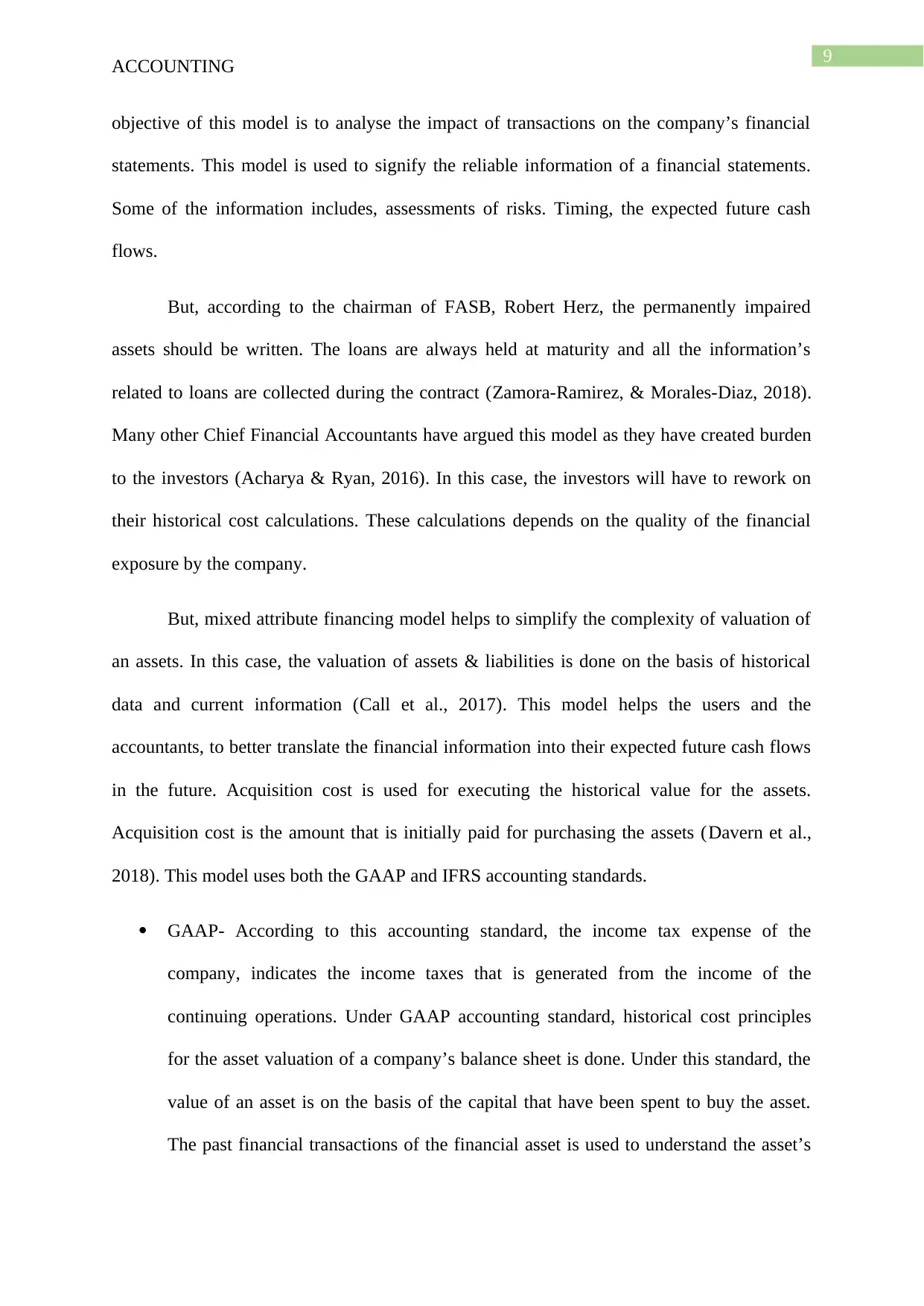
objective of this model is to analyse the impact of transactions on the company’s financial
statements. This model is used to signify the reliable information of a financial statements.
Some of the information includes, assessments of risks. Timing, the expected future cash
flows.
But, according to the chairman of FASB, Robert Herz, the permanently impaired
assets should be written. The loans are always held at maturity and all the information’s
related to loans are collected during the contract (Zamora-Ramirez, & Morales-Diaz, 2018).
Many other Chief Financial Accountants have argued this model as they have created burden
to the investors (Acharya & Ryan, 2016). In this case, the investors will have to rework on
their historical cost calculations. These calculations depends on the quality of the financial
exposure by the company.
But, mixed attribute financing model helps to simplify the complexity of valuation of
an assets. In this case, the valuation of assets & liabilities is done on the basis of historical
data and current information (Call et al., 2017). This model helps the users and the
accountants, to better translate the financial information into their expected future cash flows
in the future. Acquisition cost is used for executing the historical value for the assets.
Acquisition cost is the amount that is initially paid for purchasing the assets (Davern et al.,
2018). This model uses both the GAAP and IFRS accounting standards.
GAAP- According to this accounting standard, the income tax expense of the
company, indicates the income taxes that is generated from the income of the
continuing operations. Under GAAP accounting standard, historical cost principles
for the asset valuation of a company’s balance sheet is done. Under this standard, the
value of an asset is on the basis of the capital that have been spent to buy the asset.
The past financial transactions of the financial asset is used to understand the asset’s
ACCOUNTING
objective of this model is to analyse the impact of transactions on the company’s financial
statements. This model is used to signify the reliable information of a financial statements.
Some of the information includes, assessments of risks. Timing, the expected future cash
flows.
But, according to the chairman of FASB, Robert Herz, the permanently impaired
assets should be written. The loans are always held at maturity and all the information’s
related to loans are collected during the contract (Zamora-Ramirez, & Morales-Diaz, 2018).
Many other Chief Financial Accountants have argued this model as they have created burden
to the investors (Acharya & Ryan, 2016). In this case, the investors will have to rework on
their historical cost calculations. These calculations depends on the quality of the financial
exposure by the company.
But, mixed attribute financing model helps to simplify the complexity of valuation of
an assets. In this case, the valuation of assets & liabilities is done on the basis of historical
data and current information (Call et al., 2017). This model helps the users and the
accountants, to better translate the financial information into their expected future cash flows
in the future. Acquisition cost is used for executing the historical value for the assets.
Acquisition cost is the amount that is initially paid for purchasing the assets (Davern et al.,
2018). This model uses both the GAAP and IFRS accounting standards.
GAAP- According to this accounting standard, the income tax expense of the
company, indicates the income taxes that is generated from the income of the
continuing operations. Under GAAP accounting standard, historical cost principles
for the asset valuation of a company’s balance sheet is done. Under this standard, the
value of an asset is on the basis of the capital that have been spent to buy the asset.
The past financial transactions of the financial asset is used to understand the asset’s
Paraphrase This Document
Need a fresh take? Get an instant paraphrase of this document with our AI Paraphraser
10
ACCOUNTING
fair value. It is a very conservative method, which is considered as reliable and easy
for the measurement. But, the main disadvantage of this type of value measurement is
that, the historical cost value may be irrelevant at certain circumstances.
IFRS- According to this accounting standard, the exceptional items should be
separately disclosed in their financial statement. This standard is followed by all the
companies across the globe. IFRS stands are known as International Financial
Reporting Standard (IFRS). The objective is to make the company’s financial
information’s, and other accounts easy understandable in all the companies present
internationally. These standards are followed by the companies doing business
internationally.
In this model, most of the financial elements are recorded at their cash flow value, on
the basis of date of their transactions. Hence, this is an historical cost of that financial
elements.
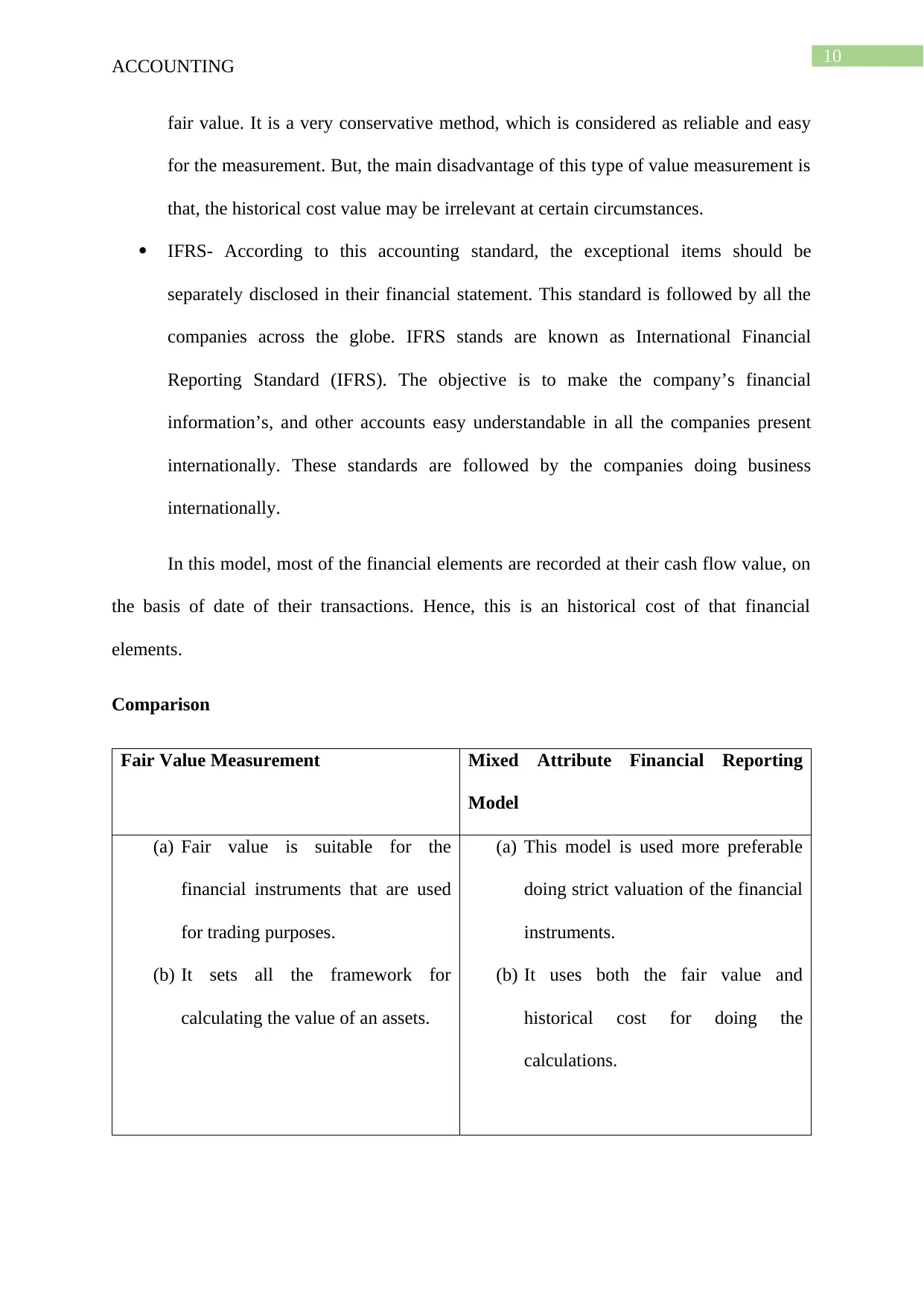
Comparison
Fair Value Measurement Mixed Attribute Financial Reporting
Model
(a) Fair value is suitable for the
financial instruments that are used
for trading purposes.
(b) It sets all the framework for
calculating the value of an assets.
(a) This model is used more preferable
doing strict valuation of the financial
instruments.
(b) It uses both the fair value and
historical cost for doing the
calculations.
ACCOUNTING
fair value. It is a very conservative method, which is considered as reliable and easy
for the measurement. But, the main disadvantage of this type of value measurement is
that, the historical cost value may be irrelevant at certain circumstances.
IFRS- According to this accounting standard, the exceptional items should be
separately disclosed in their financial statement. This standard is followed by all the
companies across the globe. IFRS stands are known as International Financial
Reporting Standard (IFRS). The objective is to make the company’s financial
information’s, and other accounts easy understandable in all the companies present
internationally. These standards are followed by the companies doing business
internationally.
In this model, most of the financial elements are recorded at their cash flow value, on
the basis of date of their transactions. Hence, this is an historical cost of that financial
elements.
Comparison
Fair Value Measurement Mixed Attribute Financial Reporting
Model
(a) Fair value is suitable for the
financial instruments that are used
for trading purposes.
(b) It sets all the framework for
calculating the value of an assets.
(a) This model is used more preferable
doing strict valuation of the financial
instruments.
(b) It uses both the fair value and
historical cost for doing the
calculations.
11
ACCOUNTING
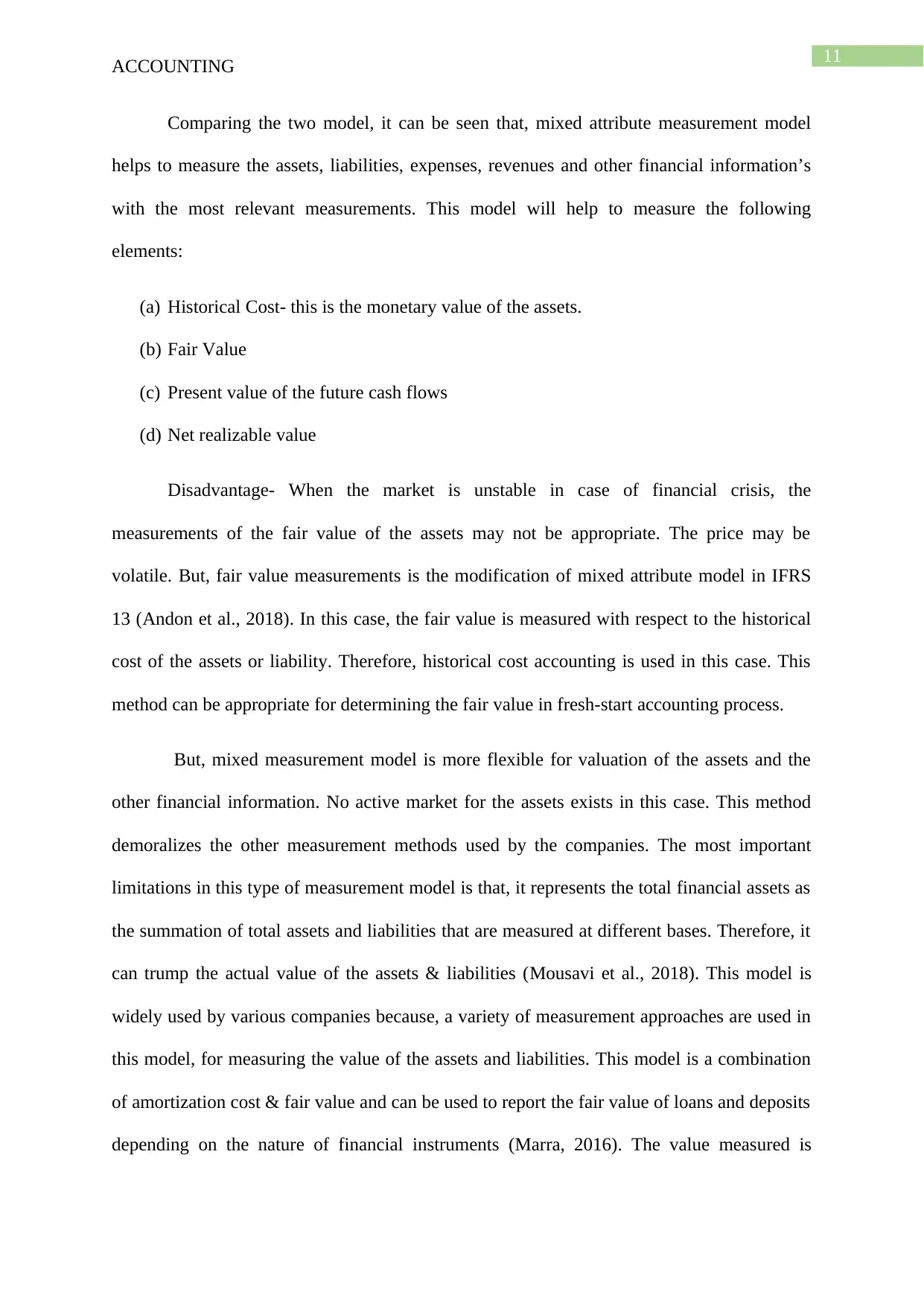
Comparing the two model, it can be seen that, mixed attribute measurement model
helps to measure the assets, liabilities, expenses, revenues and other financial information’s
with the most relevant measurements. This model will help to measure the following
elements:
(a) Historical Cost- this is the monetary value of the assets.
(b) Fair Value
(c) Present value of the future cash flows
(d) Net realizable value
Disadvantage- When the market is unstable in case of financial crisis, the
measurements of the fair value of the assets may not be appropriate. The price may be
volatile. But, fair value measurements is the modification of mixed attribute model in IFRS
13 (Andon et al., 2018). In this case, the fair value is measured with respect to the historical
cost of the assets or liability. Therefore, historical cost accounting is used in this case. This
method can be appropriate for determining the fair value in fresh-start accounting process.
But, mixed measurement model is more flexible for valuation of the assets and the
other financial information. No active market for the assets exists in this case. This method
demoralizes the other measurement methods used by the companies. The most important
limitations in this type of measurement model is that, it represents the total financial assets as
the summation of total assets and liabilities that are measured at different bases. Therefore, it
can trump the actual value of the assets & liabilities (Mousavi et al., 2018). This model is
widely used by various companies because, a variety of measurement approaches are used in
this model, for measuring the value of the assets and liabilities. This model is a combination
of amortization cost & fair value and can be used to report the fair value of loans and deposits
depending on the nature of financial instruments (Marra, 2016). The value measured is
ACCOUNTING
Comparing the two model, it can be seen that, mixed attribute measurement model
helps to measure the assets, liabilities, expenses, revenues and other financial information’s
with the most relevant measurements. This model will help to measure the following
elements:
(a) Historical Cost- this is the monetary value of the assets.
(b) Fair Value
(c) Present value of the future cash flows
(d) Net realizable value
Disadvantage- When the market is unstable in case of financial crisis, the
measurements of the fair value of the assets may not be appropriate. The price may be
volatile. But, fair value measurements is the modification of mixed attribute model in IFRS
13 (Andon et al., 2018). In this case, the fair value is measured with respect to the historical
cost of the assets or liability. Therefore, historical cost accounting is used in this case. This
method can be appropriate for determining the fair value in fresh-start accounting process.
But, mixed measurement model is more flexible for valuation of the assets and the
other financial information. No active market for the assets exists in this case. This method
demoralizes the other measurement methods used by the companies. The most important
limitations in this type of measurement model is that, it represents the total financial assets as
the summation of total assets and liabilities that are measured at different bases. Therefore, it
can trump the actual value of the assets & liabilities (Mousavi et al., 2018). This model is
widely used by various companies because, a variety of measurement approaches are used in
this model, for measuring the value of the assets and liabilities. This model is a combination
of amortization cost & fair value and can be used to report the fair value of loans and deposits
depending on the nature of financial instruments (Marra, 2016). The value measured is
⊘ This is a preview!⊘
Do you want full access?
Subscribe today to unlock all pages.
Trusted by 1+ million students worldwide

1 out of 16


Related Documents


Your All-in-One AI-Powered Toolkit for Academic Success.
+13062052269
info@desklib.com
Available 24*7 on WhatsApp / Email
![[object Object]](/_next/static/media/star-bottom.7253800d.svg)
Unlock your academic potential
Copyright © 2020–2026 A2Z Services. All Rights Reserved. Developed and managed by ZUCOL.