ACCT20074 Contemporary Accounting Theory: Practical Report
VerifiedAdded on 2023/03/31
|13
|4008
|282
Report
AI Summary
This report examines the conceptual framework for financial reporting and integrated reporting practices, with a focus on their development, benefits, and limitations. Part A reviews the history and development of the conceptual framework, discusses concerns from the Australian accounting profession and academics, and illustrates its application by Oil Search Limited. Part B compares Sustainability Reporting Guidelines and the International Integrated Reporting Framework, assesses the rigor and applicability of conventional accounting, and presents an index for evaluating integrated reports. It also compares the reporting practices of Oil Search Limited with those of Exxaro Resources Ltd, a South African company, against the developed index, highlighting the practical implications and differences in their approaches to integrated reporting. The report uses the annual reports of Oil Search Ltd. and Exxaro Resources Ltd. to highlight how these two topics find its use practically.
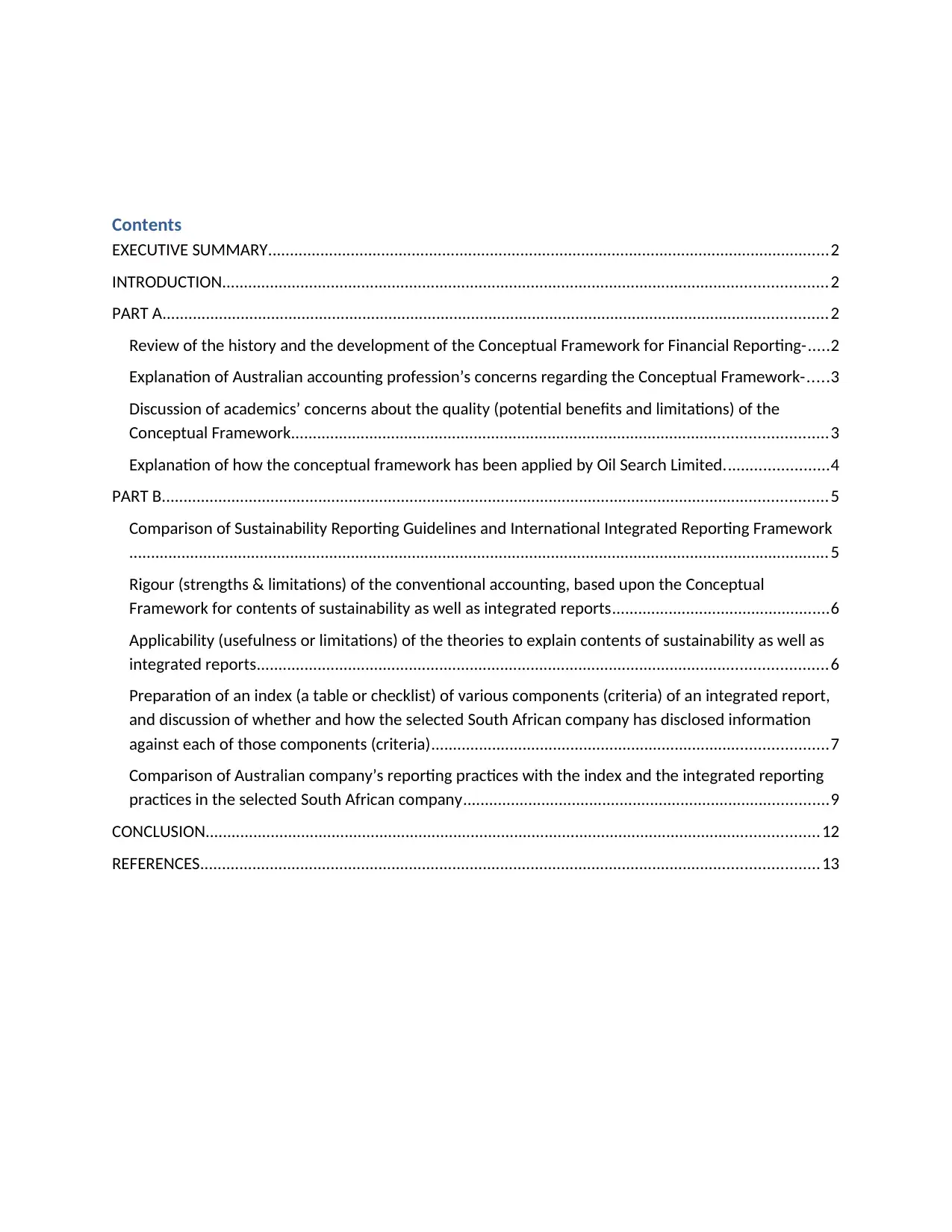
Contents
EXECUTIVE SUMMARY.................................................................................................................................2
INTRODUCTION...........................................................................................................................................2
PART A.........................................................................................................................................................2
Review of the history and the development of the Conceptual Framework for Financial Reporting-.....2
Explanation of Australian accounting profession’s concerns regarding the Conceptual Framework-.....3
Discussion of academics’ concerns about the quality (potential benefits and limitations) of the
Conceptual Framework...........................................................................................................................3
Explanation of how the conceptual framework has been applied by Oil Search Limited........................4
PART B.........................................................................................................................................................5
Comparison of Sustainability Reporting Guidelines and International Integrated Reporting Framework
.................................................................................................................................................................5
Rigour (strengths & limitations) of the conventional accounting, based upon the Conceptual
Framework for contents of sustainability as well as integrated reports..................................................6
Applicability (usefulness or limitations) of the theories to explain contents of sustainability as well as
integrated reports...................................................................................................................................6
Preparation of an index (a table or checklist) of various components (criteria) of an integrated report,
and discussion of whether and how the selected South African company has disclosed information
against each of those components (criteria)...........................................................................................7
Comparison of Australian company’s reporting practices with the index and the integrated reporting
practices in the selected South African company....................................................................................9
CONCLUSION.............................................................................................................................................12
REFERENCES..............................................................................................................................................13
EXECUTIVE SUMMARY.................................................................................................................................2
INTRODUCTION...........................................................................................................................................2
PART A.........................................................................................................................................................2
Review of the history and the development of the Conceptual Framework for Financial Reporting-.....2
Explanation of Australian accounting profession’s concerns regarding the Conceptual Framework-.....3
Discussion of academics’ concerns about the quality (potential benefits and limitations) of the
Conceptual Framework...........................................................................................................................3
Explanation of how the conceptual framework has been applied by Oil Search Limited........................4
PART B.........................................................................................................................................................5
Comparison of Sustainability Reporting Guidelines and International Integrated Reporting Framework
.................................................................................................................................................................5
Rigour (strengths & limitations) of the conventional accounting, based upon the Conceptual
Framework for contents of sustainability as well as integrated reports..................................................6
Applicability (usefulness or limitations) of the theories to explain contents of sustainability as well as
integrated reports...................................................................................................................................6
Preparation of an index (a table or checklist) of various components (criteria) of an integrated report,
and discussion of whether and how the selected South African company has disclosed information
against each of those components (criteria)...........................................................................................7
Comparison of Australian company’s reporting practices with the index and the integrated reporting
practices in the selected South African company....................................................................................9
CONCLUSION.............................................................................................................................................12
REFERENCES..............................................................................................................................................13

Paraphrase This Document
Need a fresh take? Get an instant paraphrase of this document with our AI Paraphraser
EXECUTIVE SUMMARY
A conceptual framework is a multi-variation and background conceptual model. It can be
enforced where an overall effect is required in various categories of work. It is used to
differentiate thematically and to arrange theories. Robust theoretical frameworks catch
something actual and do so in a manner which can be easily recalled and implemented.
Integrated reporting (IR) in big business interaction is a "method which leads to interaction,
most noticeably an" embedded study "on creating value over period. An integrated report is a
descriptive interaction on how the approach, accountability, quality and perspective of an
organization translate to value creation over the short, medium and long term."
INTRODUCTION
This paper deals with discussion on conceptual framework and Integrated reporting on how
they work, what are their drawbacks and can they be useful. An Australian Company called Oil
Research Ltd. and a South African Company called Exxaro Resources Ltd. annual report has
been used to highlight how these two topics find its use practically.
PART A
Review of the history and the development of the Conceptual Framework for Financial
Reporting-
In several European nations, the main function of financial reporting has traditionally been
distinct from the role of financial market roles in certain nations. This is since there hasn't been
any such heavy dependence on openly elevated finance in Europe historically. Alternatively,
finance has often been given by a restricted number of investors (such as banking institutions)
who have been ready to explicitly state the concrete information they wished to obtain from
the entity because of their' proximity' to the organization (with these information becoming
integrated into' specific purpose financial reports').With the growing globalism of enterprises as
well as financial markets, moreover, the position of financial reporting conducted by large
businesses across all European nations has now been generally concentrated on financial data
regulations for financial markets, with the result that provisions have created over a significant
period of time in financial markets controlled economies (with a large number of competing
stocks).While financial accounting exercise can be traced many centuries, financial accounting
legislation usually started in the twentieth century in many other capital-market-dominated
nations (like the United States, the United Kingdom, Ireland, Australia and Canada). Mainly this
lack of transparency in the early stages could have been based on the fact that there was
A conceptual framework is a multi-variation and background conceptual model. It can be
enforced where an overall effect is required in various categories of work. It is used to
differentiate thematically and to arrange theories. Robust theoretical frameworks catch
something actual and do so in a manner which can be easily recalled and implemented.
Integrated reporting (IR) in big business interaction is a "method which leads to interaction,
most noticeably an" embedded study "on creating value over period. An integrated report is a
descriptive interaction on how the approach, accountability, quality and perspective of an
organization translate to value creation over the short, medium and long term."
INTRODUCTION
This paper deals with discussion on conceptual framework and Integrated reporting on how
they work, what are their drawbacks and can they be useful. An Australian Company called Oil
Research Ltd. and a South African Company called Exxaro Resources Ltd. annual report has
been used to highlight how these two topics find its use practically.
PART A
Review of the history and the development of the Conceptual Framework for Financial
Reporting-
In several European nations, the main function of financial reporting has traditionally been
distinct from the role of financial market roles in certain nations. This is since there hasn't been
any such heavy dependence on openly elevated finance in Europe historically. Alternatively,
finance has often been given by a restricted number of investors (such as banking institutions)
who have been ready to explicitly state the concrete information they wished to obtain from
the entity because of their' proximity' to the organization (with these information becoming
integrated into' specific purpose financial reports').With the growing globalism of enterprises as
well as financial markets, moreover, the position of financial reporting conducted by large
businesses across all European nations has now been generally concentrated on financial data
regulations for financial markets, with the result that provisions have created over a significant
period of time in financial markets controlled economies (with a large number of competing
stocks).While financial accounting exercise can be traced many centuries, financial accounting
legislation usually started in the twentieth century in many other capital-market-dominated
nations (like the United States, the United Kingdom, Ireland, Australia and Canada). Mainly this
lack of transparency in the early stages could have been based on the fact that there was
restricted segregation between the ownership and control of businesses and, as such, many
accounting structures were intended to provide the proprietor / supervisor with data. In several
nations, the degree of freedom among owners and management has doubled in the 20th
century.There was an enhanced propensity to legislate financial reporting declarations with
such an excessive estrangement.
Explanation of Australian accounting profession’s concerns regarding the Conceptual
Framework-
Dean and Clarke characterize several issues pertaining to comprehending why this has been
troublesome to create conceptual frameworks at national scale. They recommend that present
conceptual framework initiatives have pursued to create an accounting structure predicated on
a law, instead of concentrating on ideas that transcend normal, daily trade.IASB's initial model
was released in 1989 and, in the meantime, has not been significantly modified. Calibration
notions are an area not enclosed by the present IASB. The Identification Rubric Falters to
offerany advice onthe Calibration Issue, which is basic to accounting. Gerboth references from
Popper:“ In science, we must be cautious that perhaps the statements we make should never
depend on the meaning of our terms. Even if the examples show, we never try to walk or target
any reasoning on any data from the logic. That's why we have so little difficulty with our
aspects. We're not overburdening them. We are ascribing as little weight as feasible to them”
One of the goals of the theoretical framework is to direct the administrator's regular practice.
However, an administrative solipsism characterizes the current CF. For example; data
characteristics such as dependability are indicated in FASB Remark No 2, based on the success
of other attributes such as conceptual loyalty, objectivity, and veracity. These characteristics, in
turn, however, rely on other data qualities which are not empirically validated.
Discussion of academics’ concerns about the quality (potential benefits and limitations) of the
Conceptual Framework
The advantages of a moral framework involve creating notions in organized frames that make
financial accounting and reporting compatible and practical ; augmented functionality of
globally compatible norms through such accuracy ; economic accounting growth ; and improved
interaction as a whole (Sterling 1982). Creating standards with the assistance of a theoretical
framework is made easier and more price-effective as the fundamentals are already being
mentioned and formed (FASB 1980). These concepts can be introduced in cases where there
are no applicable accounting standards or other rules and where improprieties may occur as to
which initiatives to use in specific cases. Strategy from the theoretical framework already
formed will endure very little condemnation (Mosso 1998).
Though, on the drawback, the theoretical model can be too narrow in scope and its values with
its immense reliance on different parameters. Therefore, when generating financial reports, it
accounting structures were intended to provide the proprietor / supervisor with data. In several
nations, the degree of freedom among owners and management has doubled in the 20th
century.There was an enhanced propensity to legislate financial reporting declarations with
such an excessive estrangement.
Explanation of Australian accounting profession’s concerns regarding the Conceptual
Framework-
Dean and Clarke characterize several issues pertaining to comprehending why this has been
troublesome to create conceptual frameworks at national scale. They recommend that present
conceptual framework initiatives have pursued to create an accounting structure predicated on
a law, instead of concentrating on ideas that transcend normal, daily trade.IASB's initial model
was released in 1989 and, in the meantime, has not been significantly modified. Calibration
notions are an area not enclosed by the present IASB. The Identification Rubric Falters to
offerany advice onthe Calibration Issue, which is basic to accounting. Gerboth references from
Popper:“ In science, we must be cautious that perhaps the statements we make should never
depend on the meaning of our terms. Even if the examples show, we never try to walk or target
any reasoning on any data from the logic. That's why we have so little difficulty with our
aspects. We're not overburdening them. We are ascribing as little weight as feasible to them”
One of the goals of the theoretical framework is to direct the administrator's regular practice.
However, an administrative solipsism characterizes the current CF. For example; data
characteristics such as dependability are indicated in FASB Remark No 2, based on the success
of other attributes such as conceptual loyalty, objectivity, and veracity. These characteristics, in
turn, however, rely on other data qualities which are not empirically validated.
Discussion of academics’ concerns about the quality (potential benefits and limitations) of the
Conceptual Framework
The advantages of a moral framework involve creating notions in organized frames that make
financial accounting and reporting compatible and practical ; augmented functionality of
globally compatible norms through such accuracy ; economic accounting growth ; and improved
interaction as a whole (Sterling 1982). Creating standards with the assistance of a theoretical
framework is made easier and more price-effective as the fundamentals are already being
mentioned and formed (FASB 1980). These concepts can be introduced in cases where there
are no applicable accounting standards or other rules and where improprieties may occur as to
which initiatives to use in specific cases. Strategy from the theoretical framework already
formed will endure very little condemnation (Mosso 1998).
Though, on the drawback, the theoretical model can be too narrow in scope and its values with
its immense reliance on different parameters. Therefore, when generating financial reports, it
⊘ This is a preview!⊘
Do you want full access?
Subscribe today to unlock all pages.

Trusted by 1+ million students worldwide
can be of little assistance and may lead to the formation of accounting standards that are
academically rigorous, conceptual and forgery-prone. In reality, these norms can also render
the clause of financial data very complicated for both financial report filers and users (Sterling
1982). Notions may be genuine and polished, but the effectiveness of financial statements
could be watered down with the technical complexity of knowledge. (BROMWICH, MACVE &
SUNDER, 2010)
Explanation of how the conceptual framework has been applied by Oil Search Limited.
On seeing the annual report of Oil Search Limited for the year 2017, we find that they
have strictly followed conceptual framework to present their financial statements. The
usual method for identifying elements in the financial statements is to determine- assets,
liabilities, income and expenses. For determining income we study the statements of
comprehensive income for the year ended on 31st December 2017 which turns out to be
A$ 302,580,000 whereas statement of financial position give us the other details which
includes assets and liabilities. The statements prepared by the company are in
accordance with International Financial Reporting Standards. They discuss about the
new Standards adopted as well as the ones which are still to implement. They have
prepared statement of changes in equity which shows a fall when compared to previous
year for parent company but rise for consolidated part. Cash flow statement has been
prepared which shows the cash and cash equivalents for the year end. Statement of
financial position gives us the idea about sum total of assets, liabilities as well as equities.
The comprehensive income gives us the detail of income or loss.
The Financial Statements of Oil Search Ltd. has been prepared in accordance with IFRS,
IFRIC interpretations and PNG Companies Act, 1997. They have been prepared under
historical cost convention. They adopted Amendments to IAS 7 Statement of cash flows
on 1st January, 2017. However there are few accounting standards which they have
decided to adopt from next financial year. Recognition of revenue is when risk and
rewards of ownership is transferred to the customer, consideration recovery is probable,
the associated costs and possible return of goods can be reliably estimated, there is no
continuing management involvement with the goods, and the amount of revenue can be
measured reliably. Borrowing costs get recognition in the statements of comprehensive
income in the period when they are incurred. Inventory costs are valued at the lower of
cost or net realizable value. The tax payable or receivable is based on taxable profit for
the year. Depreciation on plant and machinery is calculated on straight line basis.
Impairment of assets is strictly monitored.
All financial assets and financial liabilities are recognized at fair value of consideration
paid or received, net of transaction costs as appropriate and thus carried out at
amortized cost. They manage their capital with a view of going concern policy while
taking care of maximization of return for shareholders through optimization of debt and
equity balances. Credit risk management has been introduced at all the levels to mitigate
losses which arise due to failure of borrower to pay any kind of debt.Apart from this they
have also used Commodity Price risk management in order to avoid being limited by
exposure of fluctuating oil prices. Financial and Capital risk arises on a regular basis for
academically rigorous, conceptual and forgery-prone. In reality, these norms can also render
the clause of financial data very complicated for both financial report filers and users (Sterling
1982). Notions may be genuine and polished, but the effectiveness of financial statements
could be watered down with the technical complexity of knowledge. (BROMWICH, MACVE &
SUNDER, 2010)
Explanation of how the conceptual framework has been applied by Oil Search Limited.
On seeing the annual report of Oil Search Limited for the year 2017, we find that they
have strictly followed conceptual framework to present their financial statements. The
usual method for identifying elements in the financial statements is to determine- assets,
liabilities, income and expenses. For determining income we study the statements of
comprehensive income for the year ended on 31st December 2017 which turns out to be
A$ 302,580,000 whereas statement of financial position give us the other details which
includes assets and liabilities. The statements prepared by the company are in
accordance with International Financial Reporting Standards. They discuss about the
new Standards adopted as well as the ones which are still to implement. They have
prepared statement of changes in equity which shows a fall when compared to previous
year for parent company but rise for consolidated part. Cash flow statement has been
prepared which shows the cash and cash equivalents for the year end. Statement of
financial position gives us the idea about sum total of assets, liabilities as well as equities.
The comprehensive income gives us the detail of income or loss.
The Financial Statements of Oil Search Ltd. has been prepared in accordance with IFRS,
IFRIC interpretations and PNG Companies Act, 1997. They have been prepared under
historical cost convention. They adopted Amendments to IAS 7 Statement of cash flows
on 1st January, 2017. However there are few accounting standards which they have
decided to adopt from next financial year. Recognition of revenue is when risk and
rewards of ownership is transferred to the customer, consideration recovery is probable,
the associated costs and possible return of goods can be reliably estimated, there is no
continuing management involvement with the goods, and the amount of revenue can be
measured reliably. Borrowing costs get recognition in the statements of comprehensive
income in the period when they are incurred. Inventory costs are valued at the lower of
cost or net realizable value. The tax payable or receivable is based on taxable profit for
the year. Depreciation on plant and machinery is calculated on straight line basis.
Impairment of assets is strictly monitored.
All financial assets and financial liabilities are recognized at fair value of consideration
paid or received, net of transaction costs as appropriate and thus carried out at
amortized cost. They manage their capital with a view of going concern policy while
taking care of maximization of return for shareholders through optimization of debt and
equity balances. Credit risk management has been introduced at all the levels to mitigate
losses which arise due to failure of borrower to pay any kind of debt.Apart from this they
have also used Commodity Price risk management in order to avoid being limited by
exposure of fluctuating oil prices. Financial and Capital risk arises on a regular basis for
Paraphrase This Document
Need a fresh take? Get an instant paraphrase of this document with our AI Paraphraser
which respective management is available. Risk is borne only if the company is assured of
continuous cash inflow to meet future financial requirements. Share Plan has been
restricted in order to retain key management and valuable employees as well as to
compulsorily defer a portion of handful of participant’s short term incentive reward.
Performance rights plan is established as well since 2004 where chosen employees are
granted over ordinary shares of the company. The Organization's senior management
group evaluates the Organization's performance of the company and its sections mainly
in terms of pre-interest and tax income and capital spending on expansion and
assessment assets, oil and gas assets, and land, plant and equipment. The Faction
calculates the future costs of eliminating and preserving oil and gas production services,
wells, refineries and linked resources when the assets are set up. Administrators
frequently assesses decisions, forecasts and assumptions based on past experience and
other variables in implementing the Group's accounting initiatives, such as expectations
of future occurrences that may affect the Group. On the grounds of the most present set
of circumstances accessible to administrators, all decisions, projections and arguments
made are considered appropriate.
PART B
Comparison of Sustainability Reporting Guidelines and International Integrated Reporting
Framework
The GRI Standards are the first worldwide sustainability reporting norms. They have a compact,
interconnected framework and offer the best worldwide reporting methods for a scope of
economic, social and environmental effects. Purpose of sustainable reporting is to provide all
the shareholders with a well-defined image of an entity’s performance in order to improve their
knowledge about the organization as well as their assessment capabilities whereas, integrated
reporting presents report in an integrated way on how an institute creates value over time
according to the business model. Guiding Principles of sustainability reporting are Obligation,
Identification, Openness, Integration, Consistency, Impartiality, Independence of private
entities, Accumulation accounting principle, Caution, Comparability, Understandability,
Vividness and Cleverness, and others. On the other side, integrated reporting concepts are
Tactical Emphasis and Upcoming Alignment, Data Interconnection, Stakeholder Relationships,
Subjectivity, Concision, Dependability and Comprehensiveness, Accuracy and Robustness. In
aspects of motive, both findings strive to satisfy the needs of separate users in order to improve
public sector oversight and accountability. (BUSCO, 2016) Their primary shareholders and the
material given, however, differ.Sustainability report and integrated report apply to a wide
variety of shareholders (financiers, residents, clients, workers, society, organizations, and so
continuous cash inflow to meet future financial requirements. Share Plan has been
restricted in order to retain key management and valuable employees as well as to
compulsorily defer a portion of handful of participant’s short term incentive reward.
Performance rights plan is established as well since 2004 where chosen employees are
granted over ordinary shares of the company. The Organization's senior management
group evaluates the Organization's performance of the company and its sections mainly
in terms of pre-interest and tax income and capital spending on expansion and
assessment assets, oil and gas assets, and land, plant and equipment. The Faction
calculates the future costs of eliminating and preserving oil and gas production services,
wells, refineries and linked resources when the assets are set up. Administrators
frequently assesses decisions, forecasts and assumptions based on past experience and
other variables in implementing the Group's accounting initiatives, such as expectations
of future occurrences that may affect the Group. On the grounds of the most present set
of circumstances accessible to administrators, all decisions, projections and arguments
made are considered appropriate.
PART B
Comparison of Sustainability Reporting Guidelines and International Integrated Reporting
Framework
The GRI Standards are the first worldwide sustainability reporting norms. They have a compact,
interconnected framework and offer the best worldwide reporting methods for a scope of
economic, social and environmental effects. Purpose of sustainable reporting is to provide all
the shareholders with a well-defined image of an entity’s performance in order to improve their
knowledge about the organization as well as their assessment capabilities whereas, integrated
reporting presents report in an integrated way on how an institute creates value over time
according to the business model. Guiding Principles of sustainability reporting are Obligation,
Identification, Openness, Integration, Consistency, Impartiality, Independence of private
entities, Accumulation accounting principle, Caution, Comparability, Understandability,
Vividness and Cleverness, and others. On the other side, integrated reporting concepts are
Tactical Emphasis and Upcoming Alignment, Data Interconnection, Stakeholder Relationships,
Subjectivity, Concision, Dependability and Comprehensiveness, Accuracy and Robustness. In
aspects of motive, both findings strive to satisfy the needs of separate users in order to improve
public sector oversight and accountability. (BUSCO, 2016) Their primary shareholders and the
material given, however, differ.Sustainability report and integrated report apply to a wide
variety of shareholders (financiers, residents, clients, workers, society, organizations, and so
on.) and publish financial and non-financial data in various ways: first as a separate report to
the financial statement, second as a single embedded report.
Rigour (strengths & limitations) of the conventional accounting, based upon the Conceptual
Framework for contents of sustainability as well as integrated reports
Accountancy enables financial reports users to make better business decisions. However,
when setting policy, it is important to note the constraints of accounting and financial
reporting.
Accounting concepts like IFRS allow financial reports filers to use accounting measures that
truly reflect their institutions ' conditions.
While an extent of versatility is essential to portray a specific individual's accurate
information, the use of a multitude of accounting measures between separate entities
negatively affects the degree of standardization between financial statements.The use by
organizations working in different economic regions of different accounting structures (e.g.
IFRS, US GAAP) also introduces similar issues when trying to compare their financial
statements. The issue is solved by the expanding use of IFRS and the method of integration
between prominent accounting bodies to reach a single set of international standards.In the
preparation of financial reports, accounting involves the use of calculations where accurate
amounts cannot be defined. Projections are extremely subjective and thus lack precision
since they entail the use of foresight by leadership to decide the values included in the
financial reports. Where projections are not premised on accurate and provable info,
accounting information may be less accurate. Using professional judgment by financial
reports filers is essential in implementing accounting initiatives in a way that is consistent
with a corporation's transactions' financial reality. However, disparities will always be
unavoidable in translating the accounting standards criteria and implementing them to
realistic situations. The higher the use of assessment engaged, the more debatable would
tend to be the annual reports.
Applicability (usefulness or limitations) of the theories to explain contents of sustainability as
well as integrated reports
Several parallels can be noted among presenting on Corporate Social Responsibility (CSR) and
integrated reporting. Gray, Kouhy and Lavers (1995, p. 49) observed that CSR reporting is a) not
purposeful or governed, b) deemed to be related to stagnating instead of instant profits, and c)
linked to size of the company, sector, ownership country and many other inclinations. Looking
at the features of the "accredited investor" businesses in the Integrated Reporting Pilot
Program (IIRC, 2013b), we can believe that some organizational features common to CSR and
incorporated reporting may occur.The hypotheses of political and social economy are widely
the financial statement, second as a single embedded report.
Rigour (strengths & limitations) of the conventional accounting, based upon the Conceptual
Framework for contents of sustainability as well as integrated reports
Accountancy enables financial reports users to make better business decisions. However,
when setting policy, it is important to note the constraints of accounting and financial
reporting.
Accounting concepts like IFRS allow financial reports filers to use accounting measures that
truly reflect their institutions ' conditions.
While an extent of versatility is essential to portray a specific individual's accurate
information, the use of a multitude of accounting measures between separate entities
negatively affects the degree of standardization between financial statements.The use by
organizations working in different economic regions of different accounting structures (e.g.
IFRS, US GAAP) also introduces similar issues when trying to compare their financial
statements. The issue is solved by the expanding use of IFRS and the method of integration
between prominent accounting bodies to reach a single set of international standards.In the
preparation of financial reports, accounting involves the use of calculations where accurate
amounts cannot be defined. Projections are extremely subjective and thus lack precision
since they entail the use of foresight by leadership to decide the values included in the
financial reports. Where projections are not premised on accurate and provable info,
accounting information may be less accurate. Using professional judgment by financial
reports filers is essential in implementing accounting initiatives in a way that is consistent
with a corporation's transactions' financial reality. However, disparities will always be
unavoidable in translating the accounting standards criteria and implementing them to
realistic situations. The higher the use of assessment engaged, the more debatable would
tend to be the annual reports.
Applicability (usefulness or limitations) of the theories to explain contents of sustainability as
well as integrated reports
Several parallels can be noted among presenting on Corporate Social Responsibility (CSR) and
integrated reporting. Gray, Kouhy and Lavers (1995, p. 49) observed that CSR reporting is a) not
purposeful or governed, b) deemed to be related to stagnating instead of instant profits, and c)
linked to size of the company, sector, ownership country and many other inclinations. Looking
at the features of the "accredited investor" businesses in the Integrated Reporting Pilot
Program (IIRC, 2013b), we can believe that some organizational features common to CSR and
incorporated reporting may occur.The hypotheses of political and social economy are widely
⊘ This is a preview!⊘
Do you want full access?
Subscribe today to unlock all pages.
Trusted by 1+ million students worldwide
used to demonstrate CSR methods and disclosure, the most prevalent is the hypothesis of
validity and the hypothesis of interested parties.The principles of shareholders concentrate on
the connection between the institution and its shareholders – individuals inspired or impacted
by the institution's operations.It is not a hierarchical organization which we discover in
embedded reporting, but rather one with disputes. In order to highlight the justifications for
this, we attempt to observe the constellation in which integrated reporting exists through the
genealogy of Integrated Value Added Statements, Value Reporting, the A4S Connected
Reporting Framework and the GRI Sustainability Reporting Index.
Preparation of an index (a table or checklist) of various components (criteria) of an integrated
report, and discussion of whether and how the selected South African company has disclosed
information against each of those components (criteria)
(IR) Definition Exxaro Resources Ltd
Does the survey provide a descriptive
interaction on how the approach,
accountability, performance and
opportunities of the entity lead to value
creation over the brief, mid to long term in
the sense of its surroundings?
no
Is the report prepared primarily for providers
of financial capital supporting their financial
capital allocation assessments?
yes
APPLICATION OF THE FRAMEWORK
Does the report fail to provide all the
information required by the framework due
to lack of availability of accurate data,
Particular provisions of legislation or
competitive damage leads to the failure to
reveal material facts or other reasons? It
does then does it:
yes
• what info is excluded: Detailed Financial Statements
• Explain the rationale for ignoring the data? Company’s policy
•Identify the efforts being made to acquire
the info and the anticipated timeline for
doing so in the scenario of information
absence?
Company can be requested to send data
manually which may take a month
GUIDING PRINCIPLES
Does their report:
Tactical emphasis and vision for the long
term: Provide perspective into the approach
of the entity and how does it connect to its
ability to produce value in the brief,
Yes
validity and the hypothesis of interested parties.The principles of shareholders concentrate on
the connection between the institution and its shareholders – individuals inspired or impacted
by the institution's operations.It is not a hierarchical organization which we discover in
embedded reporting, but rather one with disputes. In order to highlight the justifications for
this, we attempt to observe the constellation in which integrated reporting exists through the
genealogy of Integrated Value Added Statements, Value Reporting, the A4S Connected
Reporting Framework and the GRI Sustainability Reporting Index.
Preparation of an index (a table or checklist) of various components (criteria) of an integrated
report, and discussion of whether and how the selected South African company has disclosed
information against each of those components (criteria)
(IR) Definition Exxaro Resources Ltd
Does the survey provide a descriptive
interaction on how the approach,
accountability, performance and
opportunities of the entity lead to value
creation over the brief, mid to long term in
the sense of its surroundings?
no
Is the report prepared primarily for providers
of financial capital supporting their financial
capital allocation assessments?
yes
APPLICATION OF THE FRAMEWORK
Does the report fail to provide all the
information required by the framework due
to lack of availability of accurate data,
Particular provisions of legislation or
competitive damage leads to the failure to
reveal material facts or other reasons? It
does then does it:
yes
• what info is excluded: Detailed Financial Statements
• Explain the rationale for ignoring the data? Company’s policy
•Identify the efforts being made to acquire
the info and the anticipated timeline for
doing so in the scenario of information
absence?
Company can be requested to send data
manually which may take a month
GUIDING PRINCIPLES
Does their report:
Tactical emphasis and vision for the long
term: Provide perspective into the approach
of the entity and how does it connect to its
ability to produce value in the brief,
Yes
Paraphrase This Document
Need a fresh take? Get an instant paraphrase of this document with our AI Paraphraser
immediate term and its use and impacts on
resources?
Data Interconnection Indicate, as an
extensive tale of creating value, the mixture,
interrelation and reliance between the
elements that are content to the capacity of
the entity to create purchasing power?
Yes
Shareholder reactivity: Provide perspective
into the performance of the interactions
between the entity and its interested parties
and how and to what degree does the
organization comprehend, recognize and
react to their genuine concerns, ambitions
and perceptions?
yes
Rationality and concision: offering
descriptive data that is material for assessing
the capacity of the entity to generate profit
in the brief, immediate term?
yes
Accuracy and completeness: include all
material problems, both pro and con, in a
structured and content mistake-free way?
yes
Uniformity and comparability: do they
present data on a premise coherent over
period and in a manner that allows
distinction with other agencies to the degree
that it is content to the narrative of creating
value of the entity?
yes
CONTENT ELEMENTS
Does their survey function on its own as a
descriptive message that is connected to
other studies and discussions for those
interested parties that want to?
yes
Does their report disclose:
• The method of deciding the subjectivity of
the entity?
yes
• The ruling body with interconnected
monitoring supervisory duties?
yes
•The reporting boundary and how it has
been determined?
yes
• The essence and scale of the physical
exchange-offs that impact the development
of value over the years?
yes
• The reason why, provided its specific yes
resources?
Data Interconnection Indicate, as an
extensive tale of creating value, the mixture,
interrelation and reliance between the
elements that are content to the capacity of
the entity to create purchasing power?
Yes
Shareholder reactivity: Provide perspective
into the performance of the interactions
between the entity and its interested parties
and how and to what degree does the
organization comprehend, recognize and
react to their genuine concerns, ambitions
and perceptions?
yes
Rationality and concision: offering
descriptive data that is material for assessing
the capacity of the entity to generate profit
in the brief, immediate term?
yes
Accuracy and completeness: include all
material problems, both pro and con, in a
structured and content mistake-free way?
yes
Uniformity and comparability: do they
present data on a premise coherent over
period and in a manner that allows
distinction with other agencies to the degree
that it is content to the narrative of creating
value of the entity?
yes
CONTENT ELEMENTS
Does their survey function on its own as a
descriptive message that is connected to
other studies and discussions for those
interested parties that want to?
yes
Does their report disclose:
• The method of deciding the subjectivity of
the entity?
yes
• The ruling body with interconnected
monitoring supervisory duties?
yes
•The reporting boundary and how it has
been determined?
yes
• The essence and scale of the physical
exchange-offs that impact the development
of value over the years?
yes
• The reason why, provided its specific yes
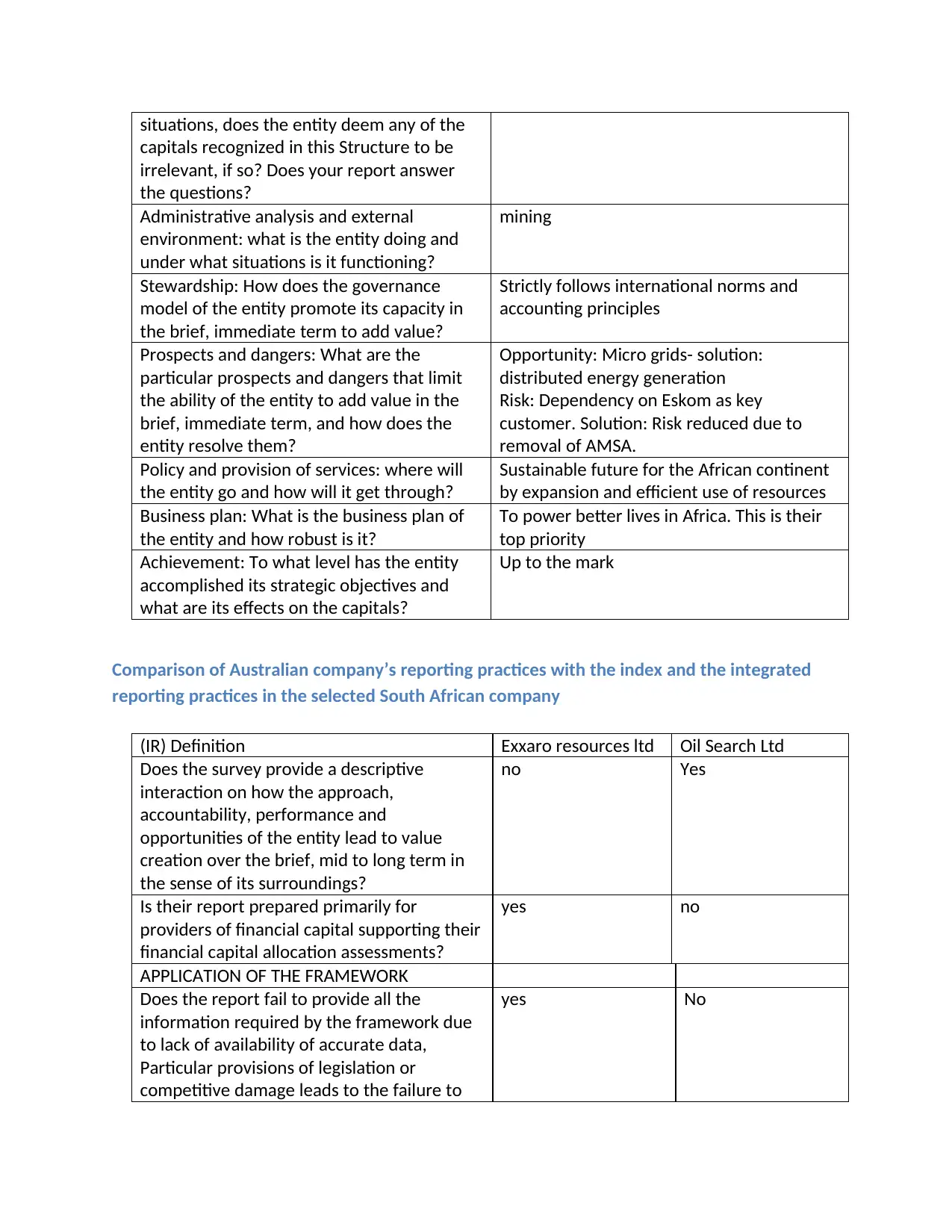
situations, does the entity deem any of the
capitals recognized in this Structure to be
irrelevant, if so? Does your report answer
the questions?
Administrative analysis and external
environment: what is the entity doing and
under what situations is it functioning?
mining
Stewardship: How does the governance
model of the entity promote its capacity in
the brief, immediate term to add value?
Strictly follows international norms and
accounting principles
Prospects and dangers: What are the
particular prospects and dangers that limit
the ability of the entity to add value in the
brief, immediate term, and how does the
entity resolve them?
Opportunity: Micro grids- solution:
distributed energy generation
Risk: Dependency on Eskom as key
customer. Solution: Risk reduced due to
removal of AMSA.
Policy and provision of services: where will
the entity go and how will it get through?
Sustainable future for the African continent
by expansion and efficient use of resources
Business plan: What is the business plan of
the entity and how robust is it?
To power better lives in Africa. This is their
top priority
Achievement: To what level has the entity
accomplished its strategic objectives and
what are its effects on the capitals?
Up to the mark
Comparison of Australian company’s reporting practices with the index and the integrated
reporting practices in the selected South African company
(IR) Definition Exxaro resources ltd Oil Search Ltd
Does the survey provide a descriptive
interaction on how the approach,
accountability, performance and
opportunities of the entity lead to value
creation over the brief, mid to long term in
the sense of its surroundings?
no Yes
Is their report prepared primarily for
providers of financial capital supporting their
financial capital allocation assessments?
yes no
APPLICATION OF THE FRAMEWORK
Does the report fail to provide all the
information required by the framework due
to lack of availability of accurate data,
Particular provisions of legislation or
competitive damage leads to the failure to
yes No
capitals recognized in this Structure to be
irrelevant, if so? Does your report answer
the questions?
Administrative analysis and external
environment: what is the entity doing and
under what situations is it functioning?
mining
Stewardship: How does the governance
model of the entity promote its capacity in
the brief, immediate term to add value?
Strictly follows international norms and
accounting principles
Prospects and dangers: What are the
particular prospects and dangers that limit
the ability of the entity to add value in the
brief, immediate term, and how does the
entity resolve them?
Opportunity: Micro grids- solution:
distributed energy generation
Risk: Dependency on Eskom as key
customer. Solution: Risk reduced due to
removal of AMSA.
Policy and provision of services: where will
the entity go and how will it get through?
Sustainable future for the African continent
by expansion and efficient use of resources
Business plan: What is the business plan of
the entity and how robust is it?
To power better lives in Africa. This is their
top priority
Achievement: To what level has the entity
accomplished its strategic objectives and
what are its effects on the capitals?
Up to the mark
Comparison of Australian company’s reporting practices with the index and the integrated
reporting practices in the selected South African company
(IR) Definition Exxaro resources ltd Oil Search Ltd
Does the survey provide a descriptive
interaction on how the approach,
accountability, performance and
opportunities of the entity lead to value
creation over the brief, mid to long term in
the sense of its surroundings?
no Yes
Is their report prepared primarily for
providers of financial capital supporting their
financial capital allocation assessments?
yes no
APPLICATION OF THE FRAMEWORK
Does the report fail to provide all the
information required by the framework due
to lack of availability of accurate data,
Particular provisions of legislation or
competitive damage leads to the failure to
yes No
⊘ This is a preview!⊘
Do you want full access?
Subscribe today to unlock all pages.
Trusted by 1+ million students worldwide
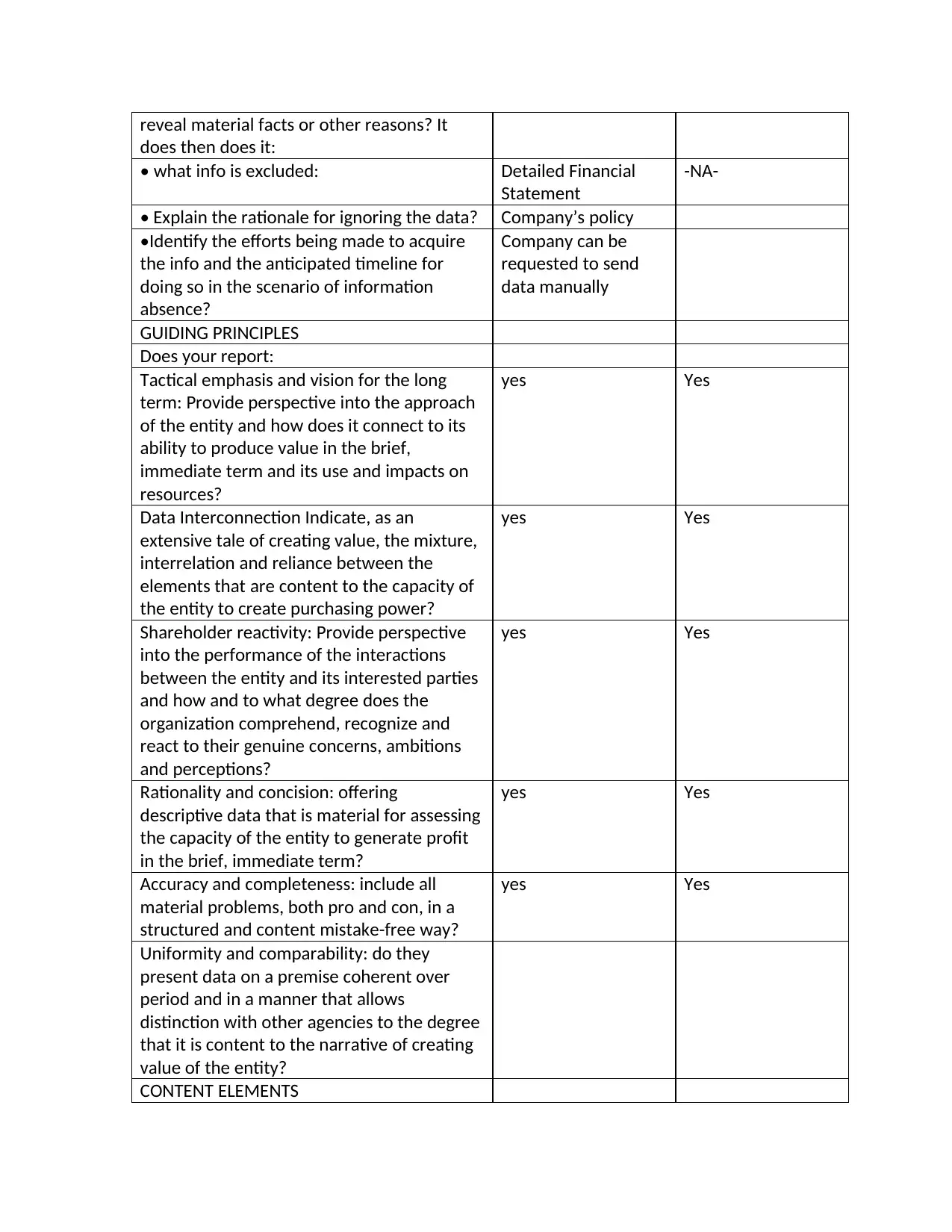
reveal material facts or other reasons? It
does then does it:
• what info is excluded: Detailed Financial
Statement
-NA-
• Explain the rationale for ignoring the data? Company’s policy
•Identify the efforts being made to acquire
the info and the anticipated timeline for
doing so in the scenario of information
absence?
Company can be
requested to send
data manually
GUIDING PRINCIPLES
Does your report:
Tactical emphasis and vision for the long
term: Provide perspective into the approach
of the entity and how does it connect to its
ability to produce value in the brief,
immediate term and its use and impacts on
resources?
yes Yes
Data Interconnection Indicate, as an
extensive tale of creating value, the mixture,
interrelation and reliance between the
elements that are content to the capacity of
the entity to create purchasing power?
yes Yes
Shareholder reactivity: Provide perspective
into the performance of the interactions
between the entity and its interested parties
and how and to what degree does the
organization comprehend, recognize and
react to their genuine concerns, ambitions
and perceptions?
yes Yes
Rationality and concision: offering
descriptive data that is material for assessing
the capacity of the entity to generate profit
in the brief, immediate term?
yes Yes
Accuracy and completeness: include all
material problems, both pro and con, in a
structured and content mistake-free way?
yes Yes
Uniformity and comparability: do they
present data on a premise coherent over
period and in a manner that allows
distinction with other agencies to the degree
that it is content to the narrative of creating
value of the entity?
CONTENT ELEMENTS
does then does it:
• what info is excluded: Detailed Financial
Statement
-NA-
• Explain the rationale for ignoring the data? Company’s policy
•Identify the efforts being made to acquire
the info and the anticipated timeline for
doing so in the scenario of information
absence?
Company can be
requested to send
data manually
GUIDING PRINCIPLES
Does your report:
Tactical emphasis and vision for the long
term: Provide perspective into the approach
of the entity and how does it connect to its
ability to produce value in the brief,
immediate term and its use and impacts on
resources?
yes Yes
Data Interconnection Indicate, as an
extensive tale of creating value, the mixture,
interrelation and reliance between the
elements that are content to the capacity of
the entity to create purchasing power?
yes Yes
Shareholder reactivity: Provide perspective
into the performance of the interactions
between the entity and its interested parties
and how and to what degree does the
organization comprehend, recognize and
react to their genuine concerns, ambitions
and perceptions?
yes Yes
Rationality and concision: offering
descriptive data that is material for assessing
the capacity of the entity to generate profit
in the brief, immediate term?
yes Yes
Accuracy and completeness: include all
material problems, both pro and con, in a
structured and content mistake-free way?
yes Yes
Uniformity and comparability: do they
present data on a premise coherent over
period and in a manner that allows
distinction with other agencies to the degree
that it is content to the narrative of creating
value of the entity?
CONTENT ELEMENTS
Paraphrase This Document
Need a fresh take? Get an instant paraphrase of this document with our AI Paraphraser
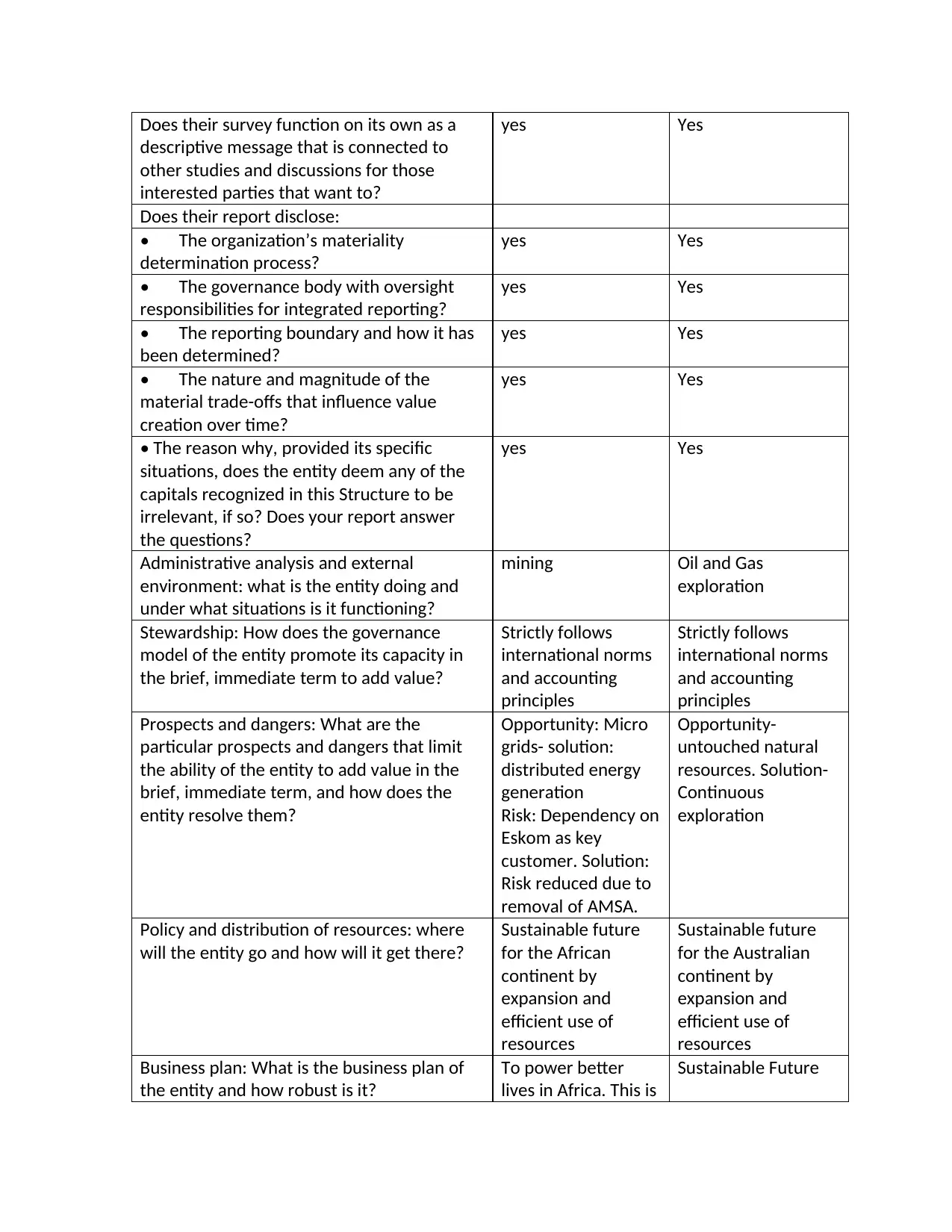
Does their survey function on its own as a
descriptive message that is connected to
other studies and discussions for those
interested parties that want to?
yes Yes
Does their report disclose:
• The organization’s materiality
determination process?
yes Yes
• The governance body with oversight
responsibilities for integrated reporting?
yes Yes
• The reporting boundary and how it has
been determined?
yes Yes
• The nature and magnitude of the
material trade-offs that influence value
creation over time?
yes Yes
• The reason why, provided its specific
situations, does the entity deem any of the
capitals recognized in this Structure to be
irrelevant, if so? Does your report answer
the questions?
yes Yes
Administrative analysis and external
environment: what is the entity doing and
under what situations is it functioning?
mining Oil and Gas
exploration
Stewardship: How does the governance
model of the entity promote its capacity in
the brief, immediate term to add value?
Strictly follows
international norms
and accounting
principles
Strictly follows
international norms
and accounting
principles
Prospects and dangers: What are the
particular prospects and dangers that limit
the ability of the entity to add value in the
brief, immediate term, and how does the
entity resolve them?
Opportunity: Micro
grids- solution:
distributed energy
generation
Risk: Dependency on
Eskom as key
customer. Solution:
Risk reduced due to
removal of AMSA.
Opportunity-
untouched natural
resources. Solution-
Continuous
exploration
Policy and distribution of resources: where
will the entity go and how will it get there?
Sustainable future
for the African
continent by
expansion and
efficient use of
resources
Sustainable future
for the Australian
continent by
expansion and
efficient use of
resources
Business plan: What is the business plan of
the entity and how robust is it?
To power better
lives in Africa. This is
Sustainable Future
descriptive message that is connected to
other studies and discussions for those
interested parties that want to?
yes Yes
Does their report disclose:
• The organization’s materiality
determination process?
yes Yes
• The governance body with oversight
responsibilities for integrated reporting?
yes Yes
• The reporting boundary and how it has
been determined?
yes Yes
• The nature and magnitude of the
material trade-offs that influence value
creation over time?
yes Yes
• The reason why, provided its specific
situations, does the entity deem any of the
capitals recognized in this Structure to be
irrelevant, if so? Does your report answer
the questions?
yes Yes
Administrative analysis and external
environment: what is the entity doing and
under what situations is it functioning?
mining Oil and Gas
exploration
Stewardship: How does the governance
model of the entity promote its capacity in
the brief, immediate term to add value?
Strictly follows
international norms
and accounting
principles
Strictly follows
international norms
and accounting
principles
Prospects and dangers: What are the
particular prospects and dangers that limit
the ability of the entity to add value in the
brief, immediate term, and how does the
entity resolve them?
Opportunity: Micro
grids- solution:
distributed energy
generation
Risk: Dependency on
Eskom as key
customer. Solution:
Risk reduced due to
removal of AMSA.
Opportunity-
untouched natural
resources. Solution-
Continuous
exploration
Policy and distribution of resources: where
will the entity go and how will it get there?
Sustainable future
for the African
continent by
expansion and
efficient use of
resources
Sustainable future
for the Australian
continent by
expansion and
efficient use of
resources
Business plan: What is the business plan of
the entity and how robust is it?
To power better
lives in Africa. This is
Sustainable Future
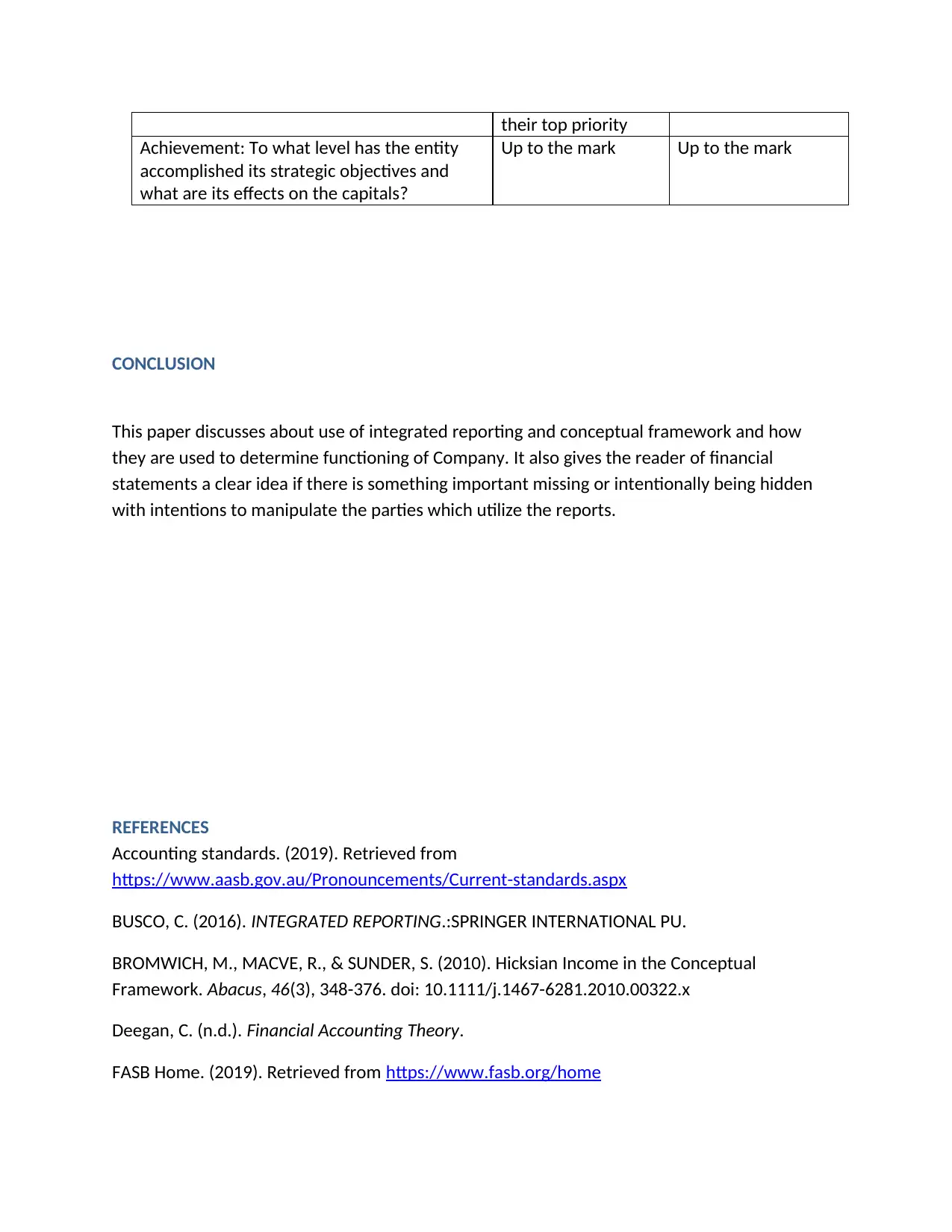
their top priority
Achievement: To what level has the entity
accomplished its strategic objectives and
what are its effects on the capitals?
Up to the mark Up to the mark
CONCLUSION
This paper discusses about use of integrated reporting and conceptual framework and how
they are used to determine functioning of Company. It also gives the reader of financial
statements a clear idea if there is something important missing or intentionally being hidden
with intentions to manipulate the parties which utilize the reports.
REFERENCES
Accounting standards. (2019). Retrieved from
https://www.aasb.gov.au/Pronouncements/Current-standards.aspx
BUSCO, C. (2016). INTEGRATED REPORTING.:SPRINGER INTERNATIONAL PU.
BROMWICH, M., MACVE, R., & SUNDER, S. (2010). Hicksian Income in the Conceptual
Framework. Abacus, 46(3), 348-376. doi: 10.1111/j.1467-6281.2010.00322.x
Deegan, C. (n.d.). Financial Accounting Theory.
FASB Home. (2019). Retrieved from https://www.fasb.org/home
Achievement: To what level has the entity
accomplished its strategic objectives and
what are its effects on the capitals?
Up to the mark Up to the mark
CONCLUSION
This paper discusses about use of integrated reporting and conceptual framework and how
they are used to determine functioning of Company. It also gives the reader of financial
statements a clear idea if there is something important missing or intentionally being hidden
with intentions to manipulate the parties which utilize the reports.
REFERENCES
Accounting standards. (2019). Retrieved from
https://www.aasb.gov.au/Pronouncements/Current-standards.aspx
BUSCO, C. (2016). INTEGRATED REPORTING.:SPRINGER INTERNATIONAL PU.
BROMWICH, M., MACVE, R., & SUNDER, S. (2010). Hicksian Income in the Conceptual
Framework. Abacus, 46(3), 348-376. doi: 10.1111/j.1467-6281.2010.00322.x
Deegan, C. (n.d.). Financial Accounting Theory.
FASB Home. (2019). Retrieved from https://www.fasb.org/home
⊘ This is a preview!⊘
Do you want full access?
Subscribe today to unlock all pages.
Trusted by 1+ million students worldwide

1 out of 13


Related Documents


Your All-in-One AI-Powered Toolkit for Academic Success.
+13062052269
info@desklib.com
Available 24*7 on WhatsApp / Email
![[object Object]](/_next/static/media/star-bottom.7253800d.svg)
Unlock your academic potential
Copyright © 2020–2026 A2Z Services. All Rights Reserved. Developed and managed by ZUCOL.