Mohawk College COMM-AS401: Action Movies and Student Behavior Study
VerifiedAdded on 2023/04/12
|18
|2790
|81
Homework Assignment
AI Summary
This research assignment, conducted at Mohawk College for the COMM-AS401 course, investigates the hypothesis that watching action movies increases the tendency of violence among students. The study, based on a survey of 10 respondents, examines the correlation between exposure to violent media and aggressive behavior. The methodology includes a questionnaire with closed-ended, open-ended, and multiple-choice questions, analyzed using SPSS software. The findings, presented through tables and charts, indicate a perceived link between action movies and increased aggression, with the majority of respondents agreeing that such movies can negatively impact students. The research also explores factors like the portrayal of violence, weapons, and drugs in movies, as well as the potential for depression among students. The limitations of the study include a small sample size and the use of a random sampling method. The research concludes that action movies have a notable influence on student behavior, suggesting a need for further investigation with larger, more representative samples.
Running head: APPLIED RESEARCH
Mohawk College of Applied Arts and Technology
COMM-AS401-02
Hypothesis Assignment
Submitted to:-Shaun Iles
Submitted by:- Kamal Deep Kaur
Mohawk College of Applied Arts and Technology
COMM-AS401-02
Hypothesis Assignment
Submitted to:-Shaun Iles
Submitted by:- Kamal Deep Kaur

Paraphrase This Document
Need a fresh take? Get an instant paraphrase of this document with our AI Paraphraser
2
APPLIED BUSINESS RESEARCH
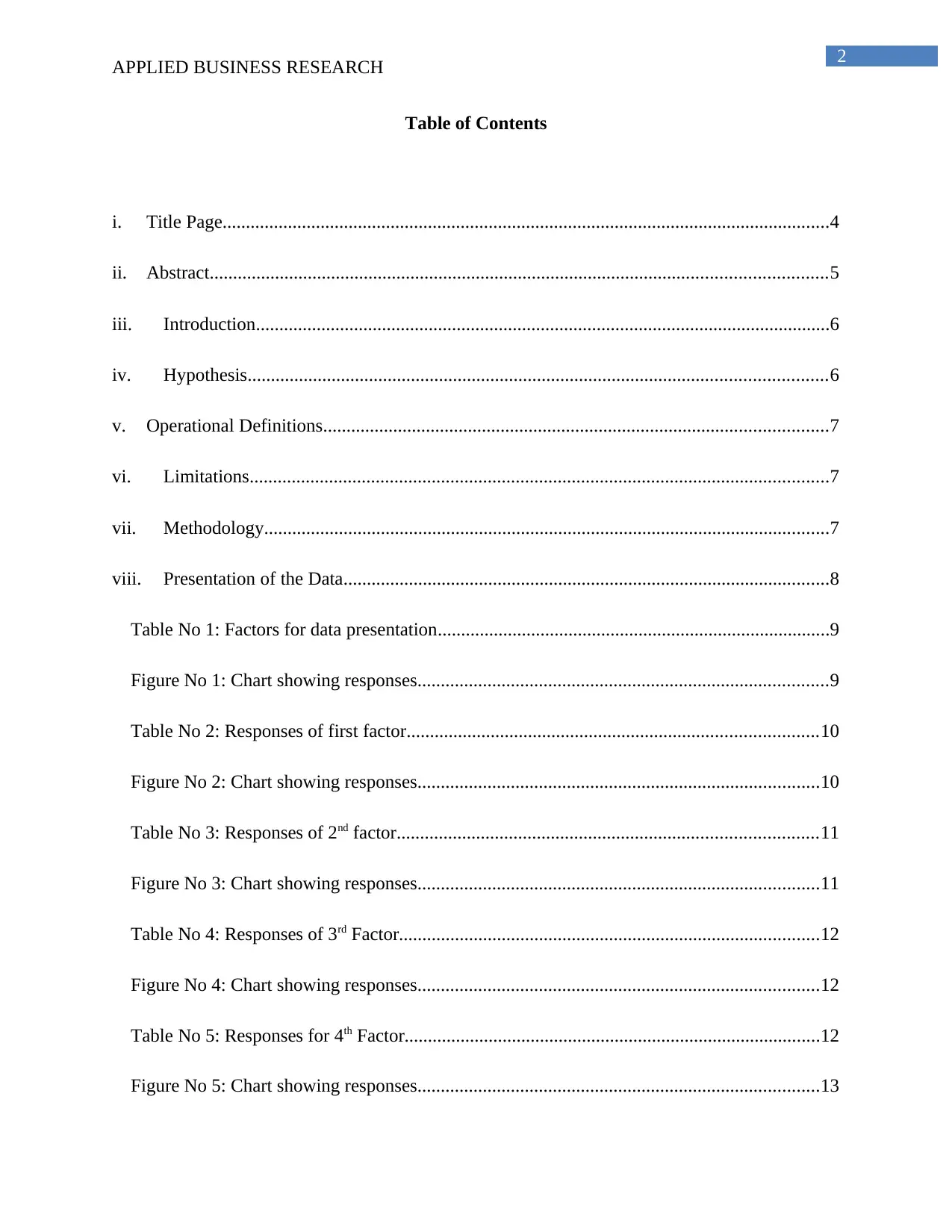
Table of Contents
i. Title Page..................................................................................................................................4
ii. Abstract....................................................................................................................................5
iii. Introduction...........................................................................................................................6
iv. Hypothesis............................................................................................................................6
v. Operational Definitions............................................................................................................7
vi. Limitations............................................................................................................................7
vii. Methodology.........................................................................................................................7
viii. Presentation of the Data........................................................................................................8
Table No 1: Factors for data presentation....................................................................................9
Figure No 1: Chart showing responses........................................................................................9
Table No 2: Responses of first factor........................................................................................10
Figure No 2: Chart showing responses......................................................................................10
Table No 3: Responses of 2nd factor..........................................................................................11
Figure No 3: Chart showing responses......................................................................................11
Table No 4: Responses of 3rd Factor..........................................................................................12
Figure No 4: Chart showing responses......................................................................................12
Table No 5: Responses for 4th Factor.........................................................................................12
Figure No 5: Chart showing responses......................................................................................13
APPLIED BUSINESS RESEARCH
Table of Contents
i. Title Page..................................................................................................................................4
ii. Abstract....................................................................................................................................5
iii. Introduction...........................................................................................................................6
iv. Hypothesis............................................................................................................................6
v. Operational Definitions............................................................................................................7
vi. Limitations............................................................................................................................7
vii. Methodology.........................................................................................................................7
viii. Presentation of the Data........................................................................................................8
Table No 1: Factors for data presentation....................................................................................9
Figure No 1: Chart showing responses........................................................................................9
Table No 2: Responses of first factor........................................................................................10
Figure No 2: Chart showing responses......................................................................................10
Table No 3: Responses of 2nd factor..........................................................................................11
Figure No 3: Chart showing responses......................................................................................11
Table No 4: Responses of 3rd Factor..........................................................................................12
Figure No 4: Chart showing responses......................................................................................12
Table No 5: Responses for 4th Factor.........................................................................................12
Figure No 5: Chart showing responses......................................................................................13
3
APPLIED BUSINESS RESEARCH
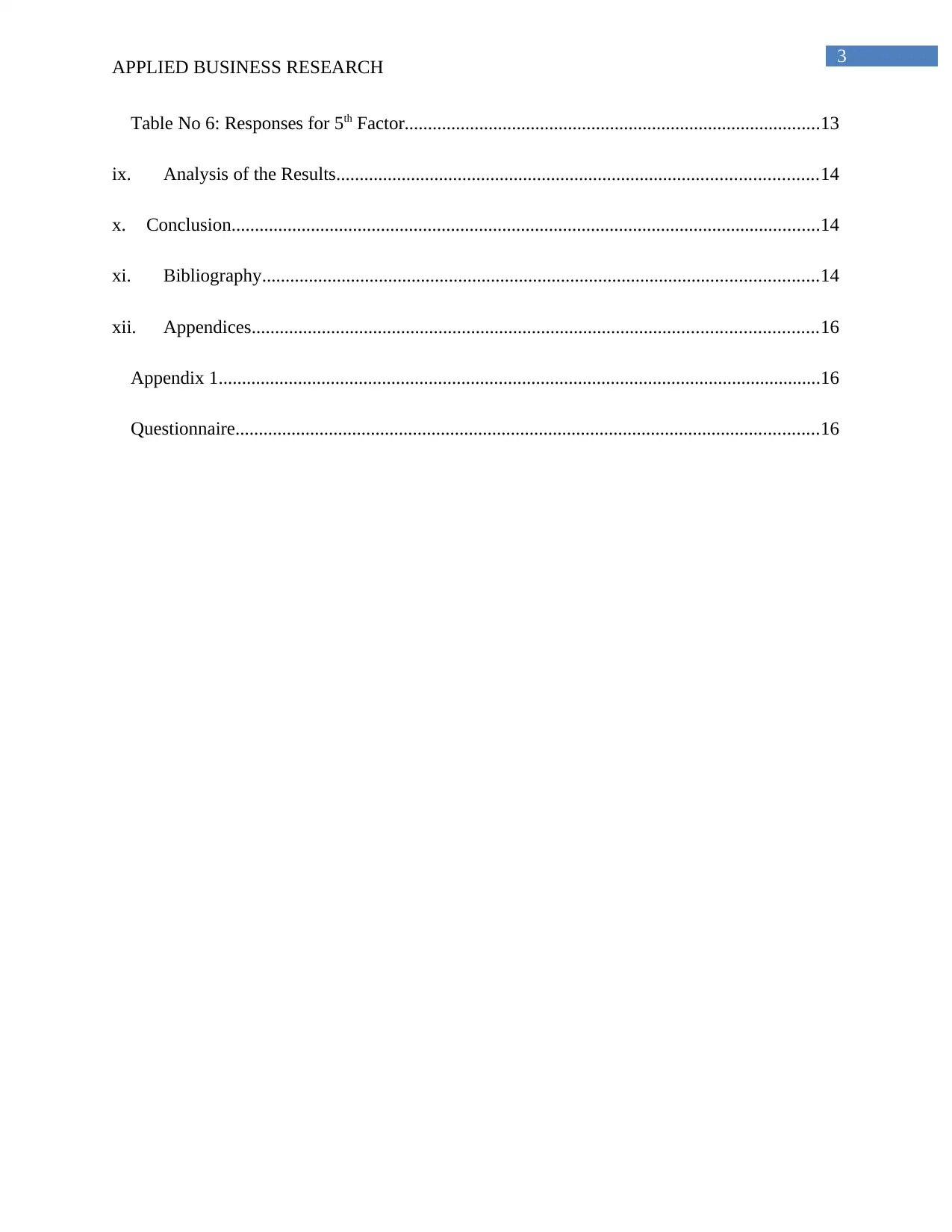
Table No 6: Responses for 5th Factor.........................................................................................13
ix. Analysis of the Results.......................................................................................................14
x. Conclusion..............................................................................................................................14
xi. Bibliography.......................................................................................................................14
xii. Appendices.........................................................................................................................16
Appendix 1.................................................................................................................................16
Questionnaire.............................................................................................................................16
APPLIED BUSINESS RESEARCH
Table No 6: Responses for 5th Factor.........................................................................................13
ix. Analysis of the Results.......................................................................................................14
x. Conclusion..............................................................................................................................14
xi. Bibliography.......................................................................................................................14
xii. Appendices.........................................................................................................................16
Appendix 1.................................................................................................................................16
Questionnaire.............................................................................................................................16
⊘ This is a preview!⊘
Do you want full access?
Subscribe today to unlock all pages.

Trusted by 1+ million students worldwide

4
APPLIED BUSINESS RESEARCH
i. Title Page
The title of the following research is as follows;
“whether action movies increase the tendency of violence among the students or not”.
APPLIED BUSINESS RESEARCH
i. Title Page
The title of the following research is as follows;
“whether action movies increase the tendency of violence among the students or not”.
Paraphrase This Document
Need a fresh take? Get an instant paraphrase of this document with our AI Paraphraser
5
APPLIED BUSINESS RESEARCH
ii. Abstract
The aim of the following study is to investigate on whether watching violent action movies can
lead to the increase of aggressive and violent behavior among the children. The study consisted
of 10 respondents who responded to the different types of the question. The sampling population
was investigated on the basis of their experience of studying the behavior of the children after
watching action movies. The analysis was done by using the SPSS co-relation analysis. The
analysis of the study found out that the violent action movies were responsible for aggressive and
violent behavior among the children. The research has shown the different methods that have
been used to find out the results of the research.
APPLIED BUSINESS RESEARCH
ii. Abstract
The aim of the following study is to investigate on whether watching violent action movies can
lead to the increase of aggressive and violent behavior among the children. The study consisted
of 10 respondents who responded to the different types of the question. The sampling population
was investigated on the basis of their experience of studying the behavior of the children after
watching action movies. The analysis was done by using the SPSS co-relation analysis. The
analysis of the study found out that the violent action movies were responsible for aggressive and
violent behavior among the children. The research has shown the different methods that have
been used to find out the results of the research.
6
APPLIED BUSINESS RESEARCH
iii. Introduction
Aggression in children is one of the most common problems in the world that generally
needs a lot of attention. The globalization in the world has led to the creation of a large number
of different media channels that has made the world confined in a single click. Televisions,
Internet, Computer and many other such advanced inventions have changed the way and lifestyle
of the people. Though these advancements have been a boon for the common people and have
helped people to reach new heights in scientific innovations, the inventions have equally been
harmful especially for the children. Television and its impacts on the children have been the
main topic of discussion in this particular research. The action movies that are displayed in the
televisions can be said to be one of the most harmful elements that has caused a negative impact
upon the children. These movies have had an effect on their minds and have made the children
more aggressive and violent in nature. Sometimes the impact has been so large that it has led to
serious issues of injury and even fatality amongst the children. The research here has studied on
“whether action movies increase the tendency of violence among the students or not”.
iv. Hypothesis
The Hypothesis of the following report is;
“Watching Action Movies increase the tendency of violence among students”
The independent variable in this particular case is “Watching Action Movies” whereas
the dependent variable in this particular case is the “students”. The hypothesis has been
developed by focusing on the components of the research that has not been answered.
The theory that was chosen for the research is commonly related to the functionalist
theory of research. Different researches have proved that the effect of media violence on the
children is moderated by the different kinds of situational perspectives. Student learns many
things by observing characters in movies and start acting like ways. Some time they create
violence which is against to society. In this way they start affect the society. This is also
predicted that he already aggressive child who watches or plays a lot of violence movies may
APPLIED BUSINESS RESEARCH
iii. Introduction
Aggression in children is one of the most common problems in the world that generally
needs a lot of attention. The globalization in the world has led to the creation of a large number
of different media channels that has made the world confined in a single click. Televisions,
Internet, Computer and many other such advanced inventions have changed the way and lifestyle
of the people. Though these advancements have been a boon for the common people and have
helped people to reach new heights in scientific innovations, the inventions have equally been
harmful especially for the children. Television and its impacts on the children have been the
main topic of discussion in this particular research. The action movies that are displayed in the
televisions can be said to be one of the most harmful elements that has caused a negative impact
upon the children. These movies have had an effect on their minds and have made the children
more aggressive and violent in nature. Sometimes the impact has been so large that it has led to
serious issues of injury and even fatality amongst the children. The research here has studied on
“whether action movies increase the tendency of violence among the students or not”.
iv. Hypothesis
The Hypothesis of the following report is;
“Watching Action Movies increase the tendency of violence among students”
The independent variable in this particular case is “Watching Action Movies” whereas
the dependent variable in this particular case is the “students”. The hypothesis has been
developed by focusing on the components of the research that has not been answered.
The theory that was chosen for the research is commonly related to the functionalist
theory of research. Different researches have proved that the effect of media violence on the
children is moderated by the different kinds of situational perspectives. Student learns many
things by observing characters in movies and start acting like ways. Some time they create
violence which is against to society. In this way they start affect the society. This is also
predicted that he already aggressive child who watches or plays a lot of violence movies may
⊘ This is a preview!⊘
Do you want full access?
Subscribe today to unlock all pages.
Trusted by 1+ million students worldwide
7
APPLIED BUSINESS RESEARCH
become most aggressive young adult and they will start doing work which will be against
society.
v. Operational Definitions
The study has selected both the dependent as well as the independent variable. The
independent variable in this particular case is “Watching Action Movies” whereas the dependent
variable in this particular case is the “students”. The watching of the action movies here
implements watching specifically movies involving action and heavy aggressiveness. As said
earlier, students are the ones who have a sharp liking towards these movies as because they relate
the character of the movies especially the heroes of the movies and try out dangerous stunts. The
watching of the action movies is selected as the independent variable in this particular case as
because the action movies forms the main perspective of the study whereas the students who
watch them becomes the dependent variable as because they are the ones over whom the
research results will be based upon. The selection of the dependent and the independent variables
are important part of the research as because they prove the hypothesis to be positive or negative.
vi. Limitations
The most prominent limitation for the following research was the limited number of
respondents. Just 10 respondents were selected for the particular research which was one of the
biggest limitations for the research. Apart from this the lack of time along with that of lack of
adequate resources can be also said to be a great limitation for the research. The lack of time and
resources forced the research formulator to limit the number of respondents. Apart from this the
random sampling method in this particular research is also one of the limitations as because
random sampling method leads to the selection of different people who may or may not take an
active interest on answering the questions or maybe reluctant to research on the topic before
answering the questions.
vii. Methodology
An assessment of the feelings of a particular population towards a particular brand,
product or company can be defined as the attitudinal survey. The attitudinal survey has been
used in the following case as because it can be used to study the demographics of the responses
APPLIED BUSINESS RESEARCH
become most aggressive young adult and they will start doing work which will be against
society.
v. Operational Definitions
The study has selected both the dependent as well as the independent variable. The
independent variable in this particular case is “Watching Action Movies” whereas the dependent
variable in this particular case is the “students”. The watching of the action movies here
implements watching specifically movies involving action and heavy aggressiveness. As said
earlier, students are the ones who have a sharp liking towards these movies as because they relate
the character of the movies especially the heroes of the movies and try out dangerous stunts. The
watching of the action movies is selected as the independent variable in this particular case as
because the action movies forms the main perspective of the study whereas the students who
watch them becomes the dependent variable as because they are the ones over whom the
research results will be based upon. The selection of the dependent and the independent variables
are important part of the research as because they prove the hypothesis to be positive or negative.
vi. Limitations
The most prominent limitation for the following research was the limited number of
respondents. Just 10 respondents were selected for the particular research which was one of the
biggest limitations for the research. Apart from this the lack of time along with that of lack of
adequate resources can be also said to be a great limitation for the research. The lack of time and
resources forced the research formulator to limit the number of respondents. Apart from this the
random sampling method in this particular research is also one of the limitations as because
random sampling method leads to the selection of different people who may or may not take an
active interest on answering the questions or maybe reluctant to research on the topic before
answering the questions.
vii. Methodology
An assessment of the feelings of a particular population towards a particular brand,
product or company can be defined as the attitudinal survey. The attitudinal survey has been
used in the following case as because it can be used to study the demographics of the responses
Paraphrase This Document
Need a fresh take? Get an instant paraphrase of this document with our AI Paraphraser
8
APPLIED BUSINESS RESEARCH
and thus provides one of the best responses that show the actual results that relates to the
aggressive behavior of the children after watching action cinemas in television. The
questionnaire was totally prepared by the researcher and the questionnaire included all the
different perspectives that were needed to get a proper and effective response for the analysis of
the research on the negative impact of television on the children.
The questionnaire was designed with all types of questions that included closed ended,
open ended as well as multiple choice questions. The questions were designed in such a manner
that it related to the different kinds of perspectives of the aggressive behavior of the students
after watching action movies.
The random sampling method was selected as the basis of sampling in this particular
study. The lack of ample time and adequate resources was the reason for the choice of the
random sampling method. The number of respondents was limited to 10 and the sample was
selected from within a group of normal people. The sample was not representative in nature.
The respondents were approached and provided with a sheet of 25 same questions and they were
provided the options for each of the questions. The responses were then collected on hand and
then analyzed. The ordinal scale of measurement was used in this particular research as it
provides the nature of information that is attached with the values of the responses. The data was
analyzed through SPSS software and a number of graphs were used to find out the results of the
research.
viii. Presentation of the Data
The presentation of the data along has been done by considering a number of crucial
responses that have been shown below:
APPLIED BUSINESS RESEARCH
and thus provides one of the best responses that show the actual results that relates to the
aggressive behavior of the children after watching action cinemas in television. The
questionnaire was totally prepared by the researcher and the questionnaire included all the
different perspectives that were needed to get a proper and effective response for the analysis of
the research on the negative impact of television on the children.
The questionnaire was designed with all types of questions that included closed ended,
open ended as well as multiple choice questions. The questions were designed in such a manner
that it related to the different kinds of perspectives of the aggressive behavior of the students
after watching action movies.
The random sampling method was selected as the basis of sampling in this particular
study. The lack of ample time and adequate resources was the reason for the choice of the
random sampling method. The number of respondents was limited to 10 and the sample was
selected from within a group of normal people. The sample was not representative in nature.
The respondents were approached and provided with a sheet of 25 same questions and they were
provided the options for each of the questions. The responses were then collected on hand and
then analyzed. The ordinal scale of measurement was used in this particular research as it
provides the nature of information that is attached with the values of the responses. The data was
analyzed through SPSS software and a number of graphs were used to find out the results of the
research.
viii. Presentation of the Data
The presentation of the data along has been done by considering a number of crucial
responses that have been shown below:
9
APPLIED BUSINESS RESEARCH
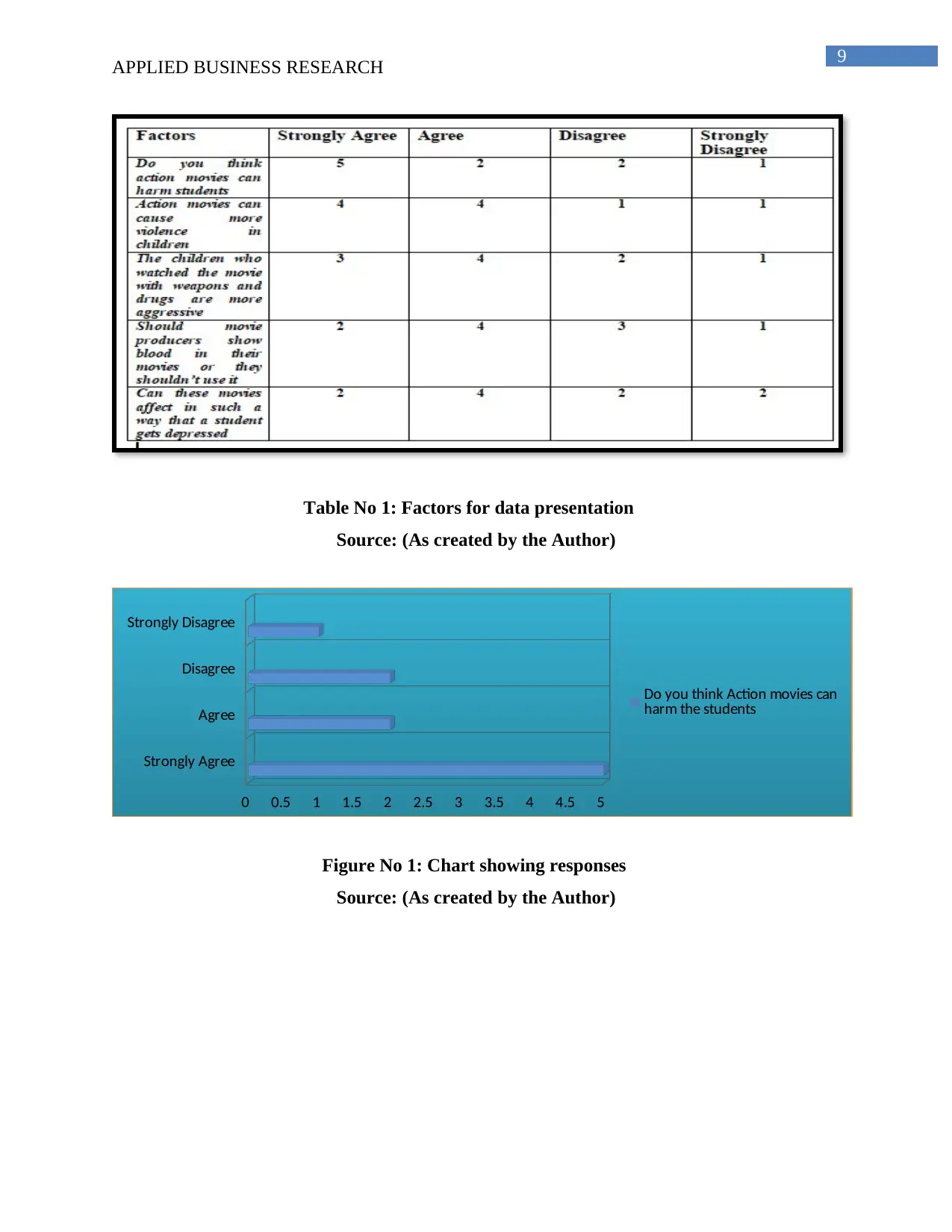
Table No 1: Factors for data presentation
Source: (As created by the Author)
Strongly Agree
Agree
Disagree
Strongly Disagree
0 0.5 1 1.5 2 2.5 3 3.5 4 4.5 5
Do you think Action movies can
harm the students
Figure No 1: Chart showing responses
Source: (As created by the Author)
APPLIED BUSINESS RESEARCH
Table No 1: Factors for data presentation
Source: (As created by the Author)
Strongly Agree
Agree
Disagree
Strongly Disagree
0 0.5 1 1.5 2 2.5 3 3.5 4 4.5 5
Do you think Action movies can
harm the students
Figure No 1: Chart showing responses
Source: (As created by the Author)
⊘ This is a preview!⊘
Do you want full access?
Subscribe today to unlock all pages.
Trusted by 1+ million students worldwide
10
APPLIED BUSINESS RESEARCH
Do you think Action movies can harm the students
Strongly Agree 5
Agree 2
Disagree 2
Strongly Disagree 1
Strongly Agree- (n=5), Agree-(n=2), Disagree- (n=2), Strongly Disagree- (n=1),
N=10
Table No 2: Responses of first factor
Source: (As created by the Author)
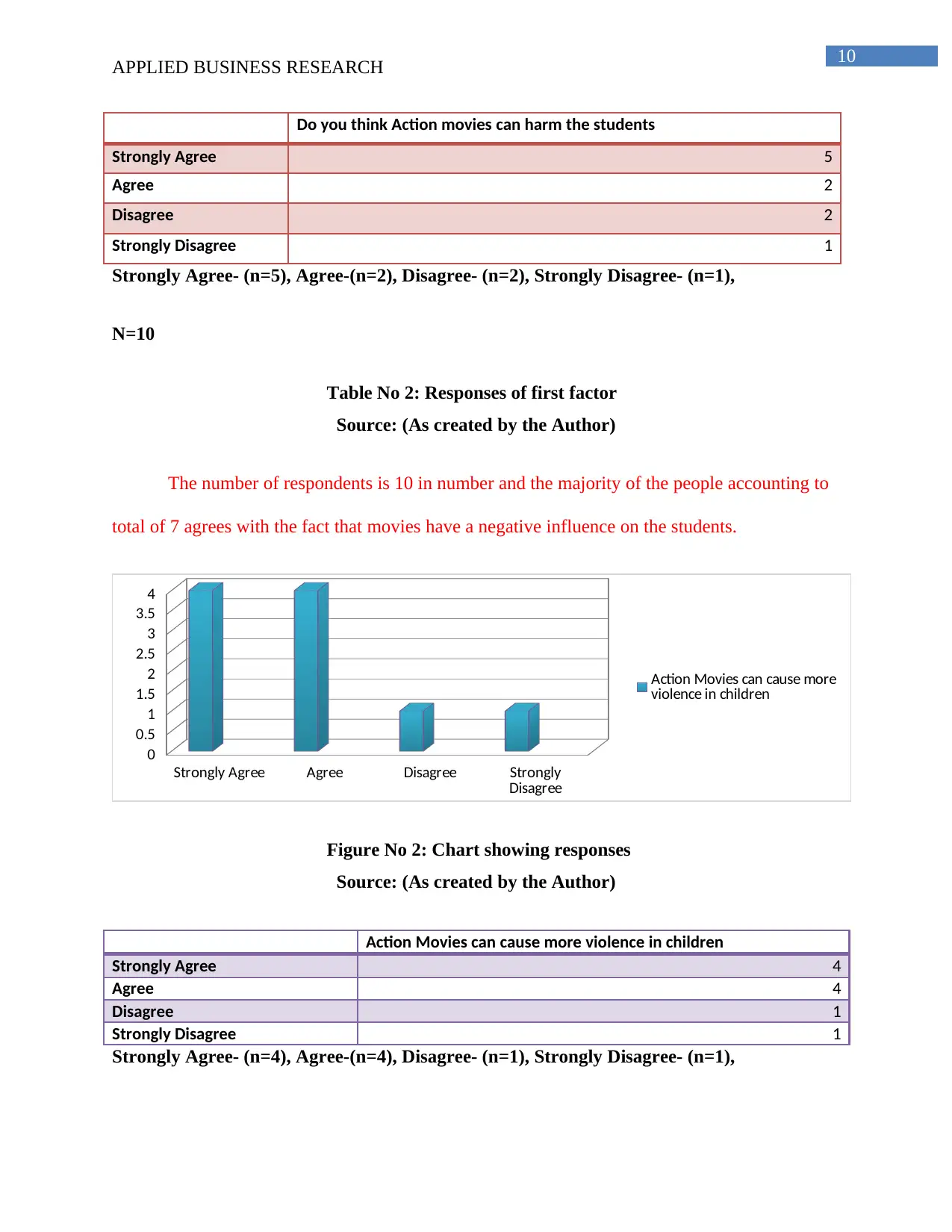
The number of respondents is 10 in number and the majority of the people accounting to
total of 7 agrees with the fact that movies have a negative influence on the students.
Strongly Agree Agree Disagree Strongly
Disagree
0
0.5
1
1.5
2
2.5
3
3.5
4
Action Movies can cause more
violence in children
Figure No 2: Chart showing responses
Source: (As created by the Author)
Action Movies can cause more violence in children
Strongly Agree 4
Agree 4
Disagree 1
Strongly Disagree 1
Strongly Agree- (n=4), Agree-(n=4), Disagree- (n=1), Strongly Disagree- (n=1),
APPLIED BUSINESS RESEARCH
Do you think Action movies can harm the students
Strongly Agree 5
Agree 2
Disagree 2
Strongly Disagree 1
Strongly Agree- (n=5), Agree-(n=2), Disagree- (n=2), Strongly Disagree- (n=1),
N=10
Table No 2: Responses of first factor
Source: (As created by the Author)
The number of respondents is 10 in number and the majority of the people accounting to
total of 7 agrees with the fact that movies have a negative influence on the students.
Strongly Agree Agree Disagree Strongly
Disagree
0
0.5
1
1.5
2
2.5
3
3.5
4
Action Movies can cause more
violence in children
Figure No 2: Chart showing responses
Source: (As created by the Author)
Action Movies can cause more violence in children
Strongly Agree 4
Agree 4
Disagree 1
Strongly Disagree 1
Strongly Agree- (n=4), Agree-(n=4), Disagree- (n=1), Strongly Disagree- (n=1),
Paraphrase This Document
Need a fresh take? Get an instant paraphrase of this document with our AI Paraphraser
11
APPLIED BUSINESS RESEARCH
N=10
Table No 3: Responses of 2nd factor
Source: (As created by the Author)
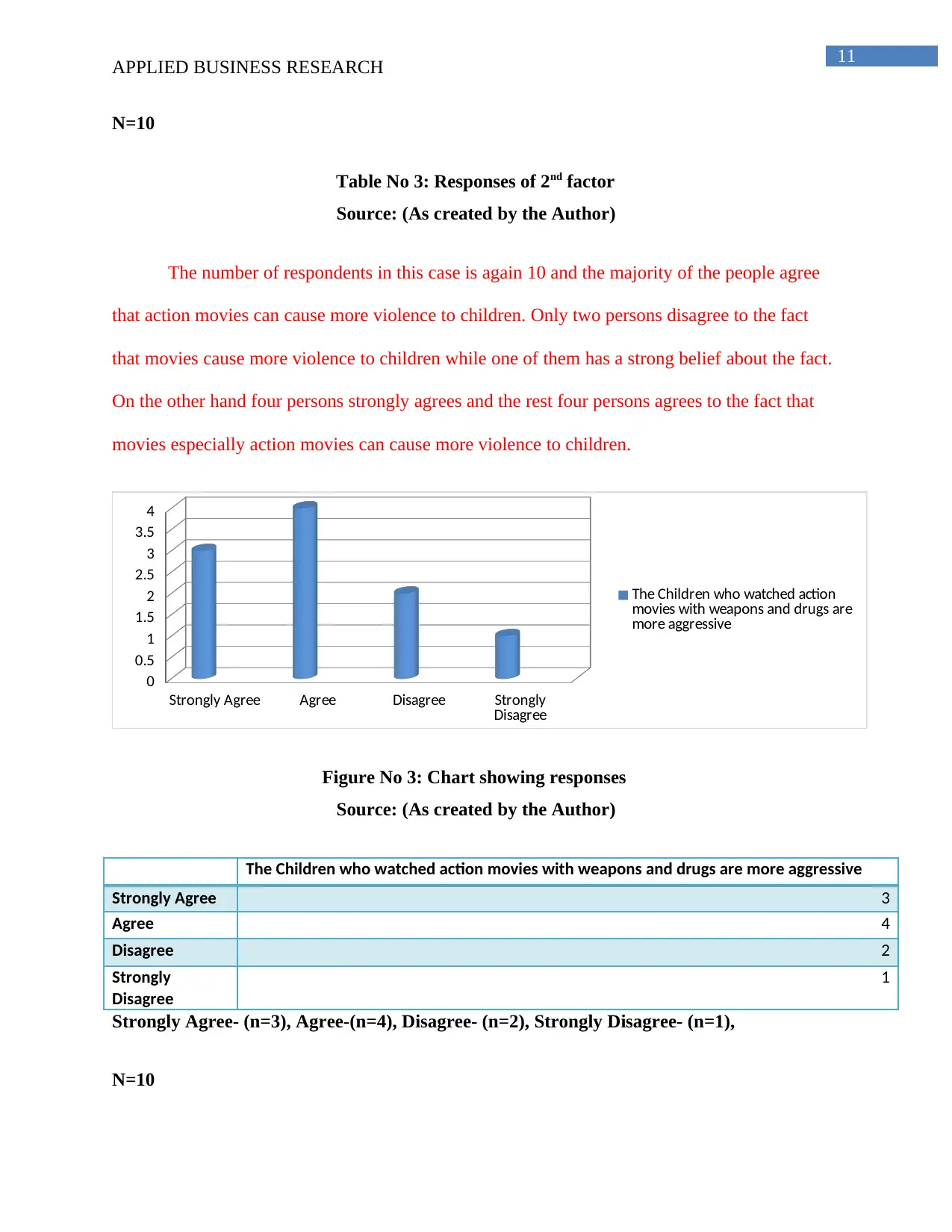
The number of respondents in this case is again 10 and the majority of the people agree
that action movies can cause more violence to children. Only two persons disagree to the fact
that movies cause more violence to children while one of them has a strong belief about the fact.
On the other hand four persons strongly agrees and the rest four persons agrees to the fact that
movies especially action movies can cause more violence to children.
Strongly Agree Agree Disagree Strongly
Disagree
0
0.5
1
1.5
2
2.5
3
3.5
4
The Children who watched action
movies with weapons and drugs are
more aggressive
Figure No 3: Chart showing responses
Source: (As created by the Author)
The Children who watched action movies with weapons and drugs are more aggressive
Strongly Agree 3
Agree 4
Disagree 2
Strongly
Disagree
1
Strongly Agree- (n=3), Agree-(n=4), Disagree- (n=2), Strongly Disagree- (n=1),
N=10
APPLIED BUSINESS RESEARCH
N=10
Table No 3: Responses of 2nd factor
Source: (As created by the Author)
The number of respondents in this case is again 10 and the majority of the people agree
that action movies can cause more violence to children. Only two persons disagree to the fact
that movies cause more violence to children while one of them has a strong belief about the fact.
On the other hand four persons strongly agrees and the rest four persons agrees to the fact that
movies especially action movies can cause more violence to children.
Strongly Agree Agree Disagree Strongly
Disagree
0
0.5
1
1.5
2
2.5
3
3.5
4
The Children who watched action
movies with weapons and drugs are
more aggressive
Figure No 3: Chart showing responses
Source: (As created by the Author)
The Children who watched action movies with weapons and drugs are more aggressive
Strongly Agree 3
Agree 4
Disagree 2
Strongly
Disagree
1
Strongly Agree- (n=3), Agree-(n=4), Disagree- (n=2), Strongly Disagree- (n=1),
N=10
12
APPLIED BUSINESS RESEARCH
Table No 4: Responses of 3rd Factor
Source: (As created by the Author)
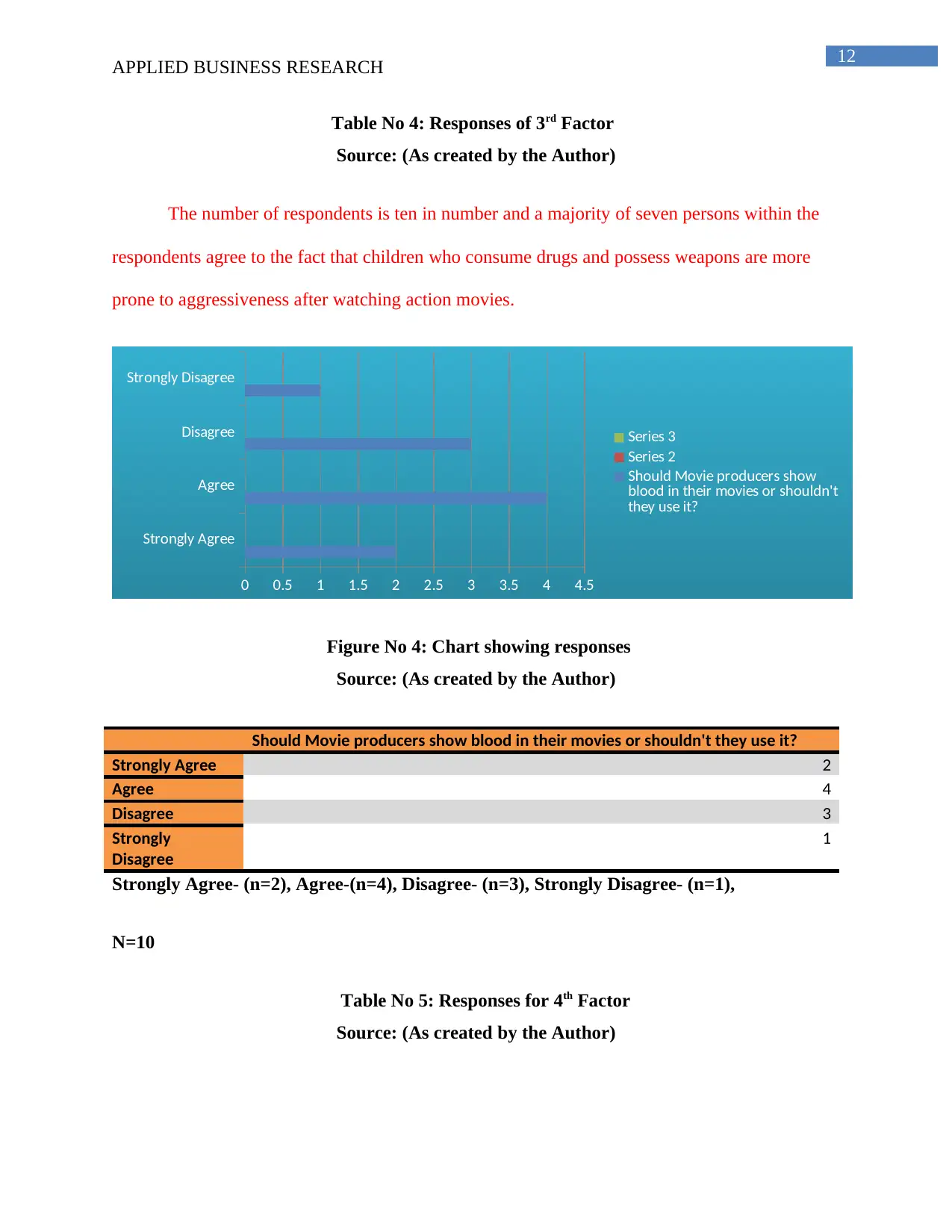
The number of respondents is ten in number and a majority of seven persons within the
respondents agree to the fact that children who consume drugs and possess weapons are more
prone to aggressiveness after watching action movies.
Strongly Agree
Agree
Disagree
Strongly Disagree
0 0.5 1 1.5 2 2.5 3 3.5 4 4.5
Series 3
Series 2
Should Movie producers show
blood in their movies or shouldn't
they use it?
Figure No 4: Chart showing responses
Source: (As created by the Author)
Should Movie producers show blood in their movies or shouldn't they use it?
Strongly Agree 2
Agree 4
Disagree 3
Strongly
Disagree
1
Strongly Agree- (n=2), Agree-(n=4), Disagree- (n=3), Strongly Disagree- (n=1),
N=10
Table No 5: Responses for 4th Factor
Source: (As created by the Author)
APPLIED BUSINESS RESEARCH
Table No 4: Responses of 3rd Factor
Source: (As created by the Author)
The number of respondents is ten in number and a majority of seven persons within the
respondents agree to the fact that children who consume drugs and possess weapons are more
prone to aggressiveness after watching action movies.
Strongly Agree
Agree
Disagree
Strongly Disagree
0 0.5 1 1.5 2 2.5 3 3.5 4 4.5
Series 3
Series 2
Should Movie producers show
blood in their movies or shouldn't
they use it?
Figure No 4: Chart showing responses
Source: (As created by the Author)
Should Movie producers show blood in their movies or shouldn't they use it?
Strongly Agree 2
Agree 4
Disagree 3
Strongly
Disagree
1
Strongly Agree- (n=2), Agree-(n=4), Disagree- (n=3), Strongly Disagree- (n=1),
N=10
Table No 5: Responses for 4th Factor
Source: (As created by the Author)
⊘ This is a preview!⊘
Do you want full access?
Subscribe today to unlock all pages.
Trusted by 1+ million students worldwide

1 out of 18


Related Documents


Your All-in-One AI-Powered Toolkit for Academic Success.
+13062052269
info@desklib.com
Available 24*7 on WhatsApp / Email
![[object Object]](/_next/static/media/star-bottom.7253800d.svg)
Unlock your academic potential
Copyright © 2020–2026 A2Z Services. All Rights Reserved. Developed and managed by ZUCOL.