HI5017 Managerial Accounting: Implementing ABC in AGL Energy Ltd
VerifiedAdded on 2023/06/11
|10
|2841
|292
Report
AI Summary
This report provides a detailed analysis of Activity Based Costing (ABC) and its potential implementation within AGL Energy Limited. It begins by explaining the general ABC model, its features, and benefits over traditional management systems. The report highlights how ABC assigns costs to activities and products, improving efficiency and service quality. It further discusses the mission and strategies of AGL Energy Limited and recommends the implementation of ABC to enhance decision-making, optimize power production, and improve overall management. The report also contrasts ABC with other management tools like Time-Driven Activity-Based Costing (TDABC) and concludes with recommendations for effective ABC implementation within AGL Energy Limited, emphasizing the importance of top management training and awareness of potential technological changes. Desklib provides access to similar solved assignments and past papers for students.
Running head: MANAGERIAL ACCOUNTING 1
Activity based costing for AGL Energy Limited Company
Student’s Name
Institution
Activity based costing for AGL Energy Limited Company
Student’s Name
Institution

Paraphrase This Document
Need a fresh take? Get an instant paraphrase of this document with our AI Paraphraser
MANAGERIAL ACCOUNTING 2
Introduction
Every company is willing to have a management system which can improve its
performance. For this reason, they always train their managerial personnel to achieve this. Some
have also decided to employ the skilled staffs. But for some companies, they have decided to in
cooperate the management tools in their system. An excellent example of the tool that is used by
many companies includes the Activity Based Costing. The ABC system is an example of a
management tool which assigns a cost to activities and the activities of the products. The system
is considered to be useful in the companies than the traditional method of the management
system (Christopher, 2016). The implementation of the ABC system improves the efficiency and
the quality of the service. Apart from the ABC management tool, there are other examples of the
systems. These include Time Drive Activity-based Costing, the Balanced Score Card method
among others. They have been considered very useful because of the reduction in the running
capital. The systems are also very useful and instrumental regarding the management decision
making . The Activity Based Costing system provides a clear cost data which can be used in the
allocation of the prices of the products. The AGL energy Limited is a good example of the
company which is willing to implement the ABC management system. The use of the ABC
system will enable the company to improve its performance (Christopher, 2016). The report,
therefore, covers some issues. Firstly, the report contains the general ABC model and its
features. Secondly, the application of the Activity Based Costing system is also discussed in the
report.
The explanation of ABC model and its features
The Activity Based Costing system is an example of the management tool where the cost
is assigned to the activity and the activity of the products. It is the improvement of the
Introduction
Every company is willing to have a management system which can improve its
performance. For this reason, they always train their managerial personnel to achieve this. Some
have also decided to employ the skilled staffs. But for some companies, they have decided to in
cooperate the management tools in their system. An excellent example of the tool that is used by
many companies includes the Activity Based Costing. The ABC system is an example of a
management tool which assigns a cost to activities and the activities of the products. The system
is considered to be useful in the companies than the traditional method of the management
system (Christopher, 2016). The implementation of the ABC system improves the efficiency and
the quality of the service. Apart from the ABC management tool, there are other examples of the
systems. These include Time Drive Activity-based Costing, the Balanced Score Card method
among others. They have been considered very useful because of the reduction in the running
capital. The systems are also very useful and instrumental regarding the management decision
making . The Activity Based Costing system provides a clear cost data which can be used in the
allocation of the prices of the products. The AGL energy Limited is a good example of the
company which is willing to implement the ABC management system. The use of the ABC
system will enable the company to improve its performance (Christopher, 2016). The report,
therefore, covers some issues. Firstly, the report contains the general ABC model and its
features. Secondly, the application of the Activity Based Costing system is also discussed in the
report.
The explanation of ABC model and its features
The Activity Based Costing system is an example of the management tool where the cost
is assigned to the activity and the activity of the products. It is the improvement of the
MANAGERIAL ACCOUNTING 3
Traditional management system. The Activity Based Costing system was started by the two
scholars namely: Kaplan and Coopers (1978). The system can recognize the relationship that
exists between the activity and the products concerning the costs. This makes it unique than the
traditional methods of management systems. In the old management system, the managers were
not able to identify the rating of the product concerning time and cost. The timing of the
manufacturing process was done manually by the managerial staffs. This could slow down the
performance of the whole process (Zang, 2011). Out of the challenges incurred, the management
of the companies such as the AGL energy limited opted for the implementation of the Activity
Based in their system.
The Activity Based Costing system is preferred to the Time Drive Activity Based Costing
because it is easy to implement. Apart from this, the system is also cheap regarding training than
the other management systems. The ABC system is used by the company to show the actual cost
of the product and even its time allocation. The system is considered reliable than the traditional
management systems. The reliability of the cost data is very helpful in producing the actual price
of the product (Dale & Plunkett, 2017). The use of the Activity Based Costing in a company
helps it to identify and classify the products regarding prices in the production process. Through
these advantages, the AGL energy limited will be able to boost its management regarding the
energy production. It will also assist in comparison and setting of the prices about the
international market. By constant application, the ABC system can be improved to form the
Time Drive Activity Based Costing system.
Features of the Activity Based Costing
Because of numerous features that are posed by the Activity Based Costing, its
application is much recommended by various companies. The AGL energy company is one of
Traditional management system. The Activity Based Costing system was started by the two
scholars namely: Kaplan and Coopers (1978). The system can recognize the relationship that
exists between the activity and the products concerning the costs. This makes it unique than the
traditional methods of management systems. In the old management system, the managers were
not able to identify the rating of the product concerning time and cost. The timing of the
manufacturing process was done manually by the managerial staffs. This could slow down the
performance of the whole process (Zang, 2011). Out of the challenges incurred, the management
of the companies such as the AGL energy limited opted for the implementation of the Activity
Based in their system.
The Activity Based Costing system is preferred to the Time Drive Activity Based Costing
because it is easy to implement. Apart from this, the system is also cheap regarding training than
the other management systems. The ABC system is used by the company to show the actual cost
of the product and even its time allocation. The system is considered reliable than the traditional
management systems. The reliability of the cost data is very helpful in producing the actual price
of the product (Dale & Plunkett, 2017). The use of the Activity Based Costing in a company
helps it to identify and classify the products regarding prices in the production process. Through
these advantages, the AGL energy limited will be able to boost its management regarding the
energy production. It will also assist in comparison and setting of the prices about the
international market. By constant application, the ABC system can be improved to form the
Time Drive Activity Based Costing system.
Features of the Activity Based Costing
Because of numerous features that are posed by the Activity Based Costing, its
application is much recommended by various companies. The AGL energy company is one of
⊘ This is a preview!⊘
Do you want full access?
Subscribe today to unlock all pages.

Trusted by 1+ million students worldwide
MANAGERIAL ACCOUNTING 4
the leading companies which is willing to have a full implementation of this new system. The
ABC system is classified into two types of costs (Tsai & Hung, 2009). These include the fixed
costs and the variable costs. All these classifications are very useful since they are used to bring
the distinction between the products and their respective price in the company. For example, The
Company uses the technique in identifying the energy generated per given hour and the amount
of it that is used for a given time (Zott & Amit, 2010).
Secondly, the ABC system has a behavior pattern related to the cost and the volume of
the products manufactured. Some of this behavior pattern including the volume of the products
produced, the products diversity, the time allocation of each activity and the respective product.
In this feature, the cost drivers are the one that dictates the changes in the pattern. All these
dictates the overhead performance of the products regarding the cost and the time allocation of
each product. These features are very important and can improve all the departments of the
company (Drury, 2013). The managers and the Chief Executive Officers should try to ensure that
system is implemented within the shortest time possible. In the beginning, the company may be
able to spend a lot because of the initial requirements. But upon the implementation, the AGL
energy company will be able to spend less in all its management levels.
The company should also get prepared for the changes that may take place upon the
implementation of the system. The companies which implement this new system is in a better
position of improving its quality and service. The system is again categorized into two important
categories. Some of these include; the short-term variables and the long-term variables. The
short-term variables mostly deal with the allocation of the products regarding the time and the
product allocation (Tse & Gong, 2009). The labor cost and the time for the full implementation
are among the attributes of the short term variables. An Activity Based Costing system
the leading companies which is willing to have a full implementation of this new system. The
ABC system is classified into two types of costs (Tsai & Hung, 2009). These include the fixed
costs and the variable costs. All these classifications are very useful since they are used to bring
the distinction between the products and their respective price in the company. For example, The
Company uses the technique in identifying the energy generated per given hour and the amount
of it that is used for a given time (Zott & Amit, 2010).
Secondly, the ABC system has a behavior pattern related to the cost and the volume of
the products manufactured. Some of this behavior pattern including the volume of the products
produced, the products diversity, the time allocation of each activity and the respective product.
In this feature, the cost drivers are the one that dictates the changes in the pattern. All these
dictates the overhead performance of the products regarding the cost and the time allocation of
each product. These features are very important and can improve all the departments of the
company (Drury, 2013). The managers and the Chief Executive Officers should try to ensure that
system is implemented within the shortest time possible. In the beginning, the company may be
able to spend a lot because of the initial requirements. But upon the implementation, the AGL
energy company will be able to spend less in all its management levels.
The company should also get prepared for the changes that may take place upon the
implementation of the system. The companies which implement this new system is in a better
position of improving its quality and service. The system is again categorized into two important
categories. Some of these include; the short-term variables and the long-term variables. The
short-term variables mostly deal with the allocation of the products regarding the time and the
product allocation (Tse & Gong, 2009). The labor cost and the time for the full implementation
are among the attributes of the short term variables. An Activity Based Costing system
Paraphrase This Document
Need a fresh take? Get an instant paraphrase of this document with our AI Paraphraser
MANAGERIAL ACCOUNTING 5
sometimes do not cater to some variables within the company. Some of these variables are
considered to be too complicated. The variables include: the constant change in salaries and the
hours assigned to the employees. For the long-term variables, the application in the product cost
and time allocation for the activity is not possible because of its complexity during the
implementation.
The client company for Activity Based Costing (ABC) implementation
The mission of the AGL Energy Limited Company
The mission of the company is to offer efficient energy and quality service to the
customers. The strategies of the company are to reach some customers regarding service delivery
and power connection to the potential customers. Out of these objectives and strategies, the top
management will be able to run the company with no challenges.
As the consultant in the management field. I have been contracted to advise the AGL
energy Limited on ways of the implementation of the Activity Based Costing system. The name
of the company is the AGL Energy Limited (Heath et.al 2012). It is one of the companies
categorized under the ASX companies in Australia. The company is well known for the
generation and offering of consultancies in the energy sector. The company operates in Australia.
It deals with the energy-related products such as electricity, gas, and oil. Apart from the power
generation, the company also operates the retail in electricity. It provides energy and electricity
to the entire customers within Australia. The AGL energy company generates power from the
following sources: hydroelectric systems, geothermal, Coal and from the green energies. To
improve its management and quality in service, the company has decided to implement the use of
the Activity Based Costing system in its management system (Goetsch & Davis,2014). This will
help it to realize the maximum power production and to know the demand of the power against
sometimes do not cater to some variables within the company. Some of these variables are
considered to be too complicated. The variables include: the constant change in salaries and the
hours assigned to the employees. For the long-term variables, the application in the product cost
and time allocation for the activity is not possible because of its complexity during the
implementation.
The client company for Activity Based Costing (ABC) implementation
The mission of the AGL Energy Limited Company
The mission of the company is to offer efficient energy and quality service to the
customers. The strategies of the company are to reach some customers regarding service delivery
and power connection to the potential customers. Out of these objectives and strategies, the top
management will be able to run the company with no challenges.
As the consultant in the management field. I have been contracted to advise the AGL
energy Limited on ways of the implementation of the Activity Based Costing system. The name
of the company is the AGL Energy Limited (Heath et.al 2012). It is one of the companies
categorized under the ASX companies in Australia. The company is well known for the
generation and offering of consultancies in the energy sector. The company operates in Australia.
It deals with the energy-related products such as electricity, gas, and oil. Apart from the power
generation, the company also operates the retail in electricity. It provides energy and electricity
to the entire customers within Australia. The AGL energy company generates power from the
following sources: hydroelectric systems, geothermal, Coal and from the green energies. To
improve its management and quality in service, the company has decided to implement the use of
the Activity Based Costing system in its management system (Goetsch & Davis,2014). This will
help it to realize the maximum power production and to know the demand of the power against
MANAGERIAL ACCOUNTING 6
the generated energy. The company operates under a wider area and generates over 10000
megawatts. Due to its size, the AGL energy company has decided to implement the use of the
ABC management system to help Essen, the management of the company.
By use of the ABC system, the top managers will be able to help them in decision
making.This will make them understand the amount of energy generated and the demand of the
same company. The ABC system will also help the company to assign different production
generators, and the time they take to complete the generation (Hoozée & Bruggeman, 2010). The
volume and speed of the water that turns the turbines can also be calculated by the use of the
ABC management system. In addition to these, the management of the entire company can be
centralized under standard program of the company. The Activity Based Costing system has a
model which can assist the managers in the pool supervision of all the projects. The availability
of the cost data will support the company to understand the number of the machines to
implement. The managers will also be able to understand the efficiency of the tools and their
expected lifetime (Dale & Plunkett, 2017).
As one of the chosen consultant, I, therefore, recommend for the implementation of the
Activity Based Costing in the entire management process of the AGL energy Limited company.
The application should run together with the company's objectives and the strategic plans of the
company. One of the most significant mission of the AGL Company is to generate efficient,
reliable energy at all the time. The company is also willing to offer quality service to their
customer ’s. By applying this new system, the company will be able to achieve all these
expectations of the company (Krutz & Vines, 2010). The company will be able to make proper
decisions in case there are a power blackout and any related breakdown that may take place on
their machines.
the generated energy. The company operates under a wider area and generates over 10000
megawatts. Due to its size, the AGL energy company has decided to implement the use of the
ABC management system to help Essen, the management of the company.
By use of the ABC system, the top managers will be able to help them in decision
making.This will make them understand the amount of energy generated and the demand of the
same company. The ABC system will also help the company to assign different production
generators, and the time they take to complete the generation (Hoozée & Bruggeman, 2010). The
volume and speed of the water that turns the turbines can also be calculated by the use of the
ABC management system. In addition to these, the management of the entire company can be
centralized under standard program of the company. The Activity Based Costing system has a
model which can assist the managers in the pool supervision of all the projects. The availability
of the cost data will support the company to understand the number of the machines to
implement. The managers will also be able to understand the efficiency of the tools and their
expected lifetime (Dale & Plunkett, 2017).
As one of the chosen consultant, I, therefore, recommend for the implementation of the
Activity Based Costing in the entire management process of the AGL energy Limited company.
The application should run together with the company's objectives and the strategic plans of the
company. One of the most significant mission of the AGL Company is to generate efficient,
reliable energy at all the time. The company is also willing to offer quality service to their
customer ’s. By applying this new system, the company will be able to achieve all these
expectations of the company (Krutz & Vines, 2010). The company will be able to make proper
decisions in case there are a power blackout and any related breakdown that may take place on
their machines.
⊘ This is a preview!⊘
Do you want full access?
Subscribe today to unlock all pages.
Trusted by 1+ million students worldwide
MANAGERIAL ACCOUNTING 7
Recommendations for the implementation of the Activity Based Costing model in
the company
For the company to ensure the effective implementation of the ABC system as a
management tool, these are the recommendations identified as necessary for the report. Firstly,
the company should be able to persuade the top management staff by advising them on the
benefits and the advantages of the Activity Based Costing system. By being aware of the benefits
and importance of the Activity Based Costing, the company shall be pure in the implementation
(Horngren, 2009).The company should also ensure that the top management is well trained on
the new program and changes which may occur. The training must be accompanied by the
unexpected changes regarding technology.
Other Management System tool apart from the Activity Based Costing
There is some management system implemented in the management system. Apart from
the Activity Based Costing, there are other types of the management tools. Some of the examples
of the method include the Time Drive Activity Based Costing (TDABC) and the Balanced Score
Card. The TDABC is an improvement of the Activity Based Costing. Apart from the cost and
time, the system is a time driven due to its unique feature (Gervais, Levant & Ducrocq, 2010). A
Time Driven Activity Based Costing is the approach that has the calculation of the product cost
and also the time allocation of the product. There is no suffering in additional cost as compared
to the ABC system. The Time Drive Activity Costing improves the value and the resource
allocation of the company. The TDABC also enhances the functionality by handling the more
complex transactions than the Activity Based Costing System. With the power of controlling the
complex functions, the TDABC can feel the changes in salary and other related products. Due to
Recommendations for the implementation of the Activity Based Costing model in
the company
For the company to ensure the effective implementation of the ABC system as a
management tool, these are the recommendations identified as necessary for the report. Firstly,
the company should be able to persuade the top management staff by advising them on the
benefits and the advantages of the Activity Based Costing system. By being aware of the benefits
and importance of the Activity Based Costing, the company shall be pure in the implementation
(Horngren, 2009).The company should also ensure that the top management is well trained on
the new program and changes which may occur. The training must be accompanied by the
unexpected changes regarding technology.
Other Management System tool apart from the Activity Based Costing
There is some management system implemented in the management system. Apart from
the Activity Based Costing, there are other types of the management tools. Some of the examples
of the method include the Time Drive Activity Based Costing (TDABC) and the Balanced Score
Card. The TDABC is an improvement of the Activity Based Costing. Apart from the cost and
time, the system is a time driven due to its unique feature (Gervais, Levant & Ducrocq, 2010). A
Time Driven Activity Based Costing is the approach that has the calculation of the product cost
and also the time allocation of the product. There is no suffering in additional cost as compared
to the ABC system. The Time Drive Activity Costing improves the value and the resource
allocation of the company. The TDABC also enhances the functionality by handling the more
complex transactions than the Activity Based Costing System. With the power of controlling the
complex functions, the TDABC can feel the changes in salary and other related products. Due to
Paraphrase This Document
Need a fresh take? Get an instant paraphrase of this document with our AI Paraphraser
MANAGERIAL ACCOUNTING 8
additional of the time driven factor, the TDABC system is suitable for logical decision making
than ABC system (Szychta, 2010). The Time Driven Activity Based Costing is also used in the
rational analysis of the cost and time. This forms part of the best tool for the analysis
Conclusions
The ABC system is one of the best management systems that should be implemented in
the management system of the companies. The AGL energy company is expected to benefit a lot
from the implementation of the ABC system. Due to the benefits mentioned in the entire report,
the top managers should be in a position to have a faster application. It is considered useful
because of its cheapness compared to the traditional method of management. The system will
also help in the quick decision making of the company. Challenges faced due to its
implementation will be solved by the use of the manuals which will later be provided. The
Activity Based Costing is accessible and affordable in its application. The quality and efficiency
of the management of the company are assured. The system can be computed in different
categories within the processes.
additional of the time driven factor, the TDABC system is suitable for logical decision making
than ABC system (Szychta, 2010). The Time Driven Activity Based Costing is also used in the
rational analysis of the cost and time. This forms part of the best tool for the analysis
Conclusions
The ABC system is one of the best management systems that should be implemented in
the management system of the companies. The AGL energy company is expected to benefit a lot
from the implementation of the ABC system. Due to the benefits mentioned in the entire report,
the top managers should be in a position to have a faster application. It is considered useful
because of its cheapness compared to the traditional method of management. The system will
also help in the quick decision making of the company. Challenges faced due to its
implementation will be solved by the use of the manuals which will later be provided. The
Activity Based Costing is accessible and affordable in its application. The quality and efficiency
of the management of the company are assured. The system can be computed in different
categories within the processes.
MANAGERIAL ACCOUNTING 9
References
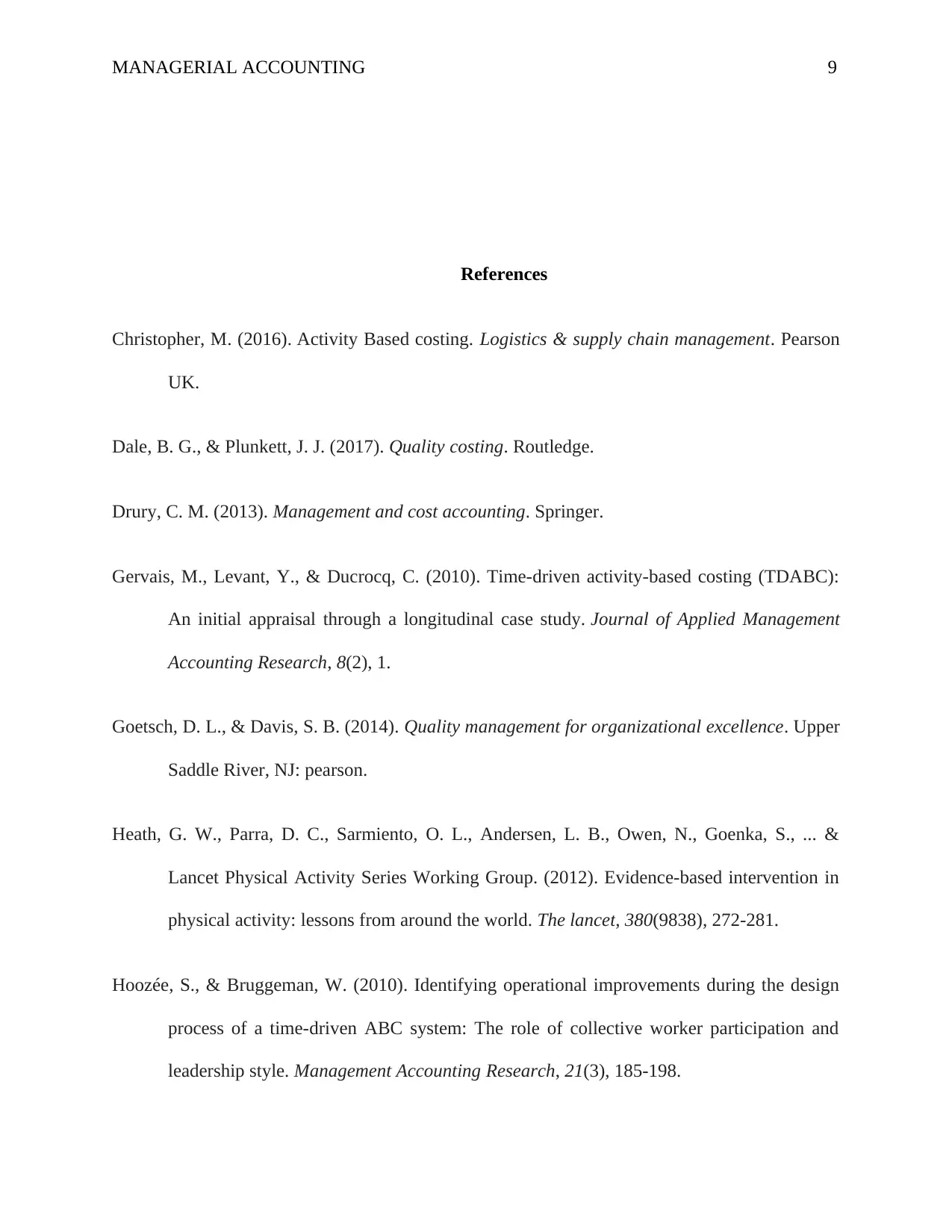
Christopher, M. (2016). Activity Based costing. Logistics & supply chain management. Pearson
UK.
Dale, B. G., & Plunkett, J. J. (2017). Quality costing. Routledge.
Drury, C. M. (2013). Management and cost accounting. Springer.
Gervais, M., Levant, Y., & Ducrocq, C. (2010). Time-driven activity-based costing (TDABC):
An initial appraisal through a longitudinal case study. Journal of Applied Management
Accounting Research, 8(2), 1.
Goetsch, D. L., & Davis, S. B. (2014). Quality management for organizational excellence. Upper
Saddle River, NJ: pearson.
Heath, G. W., Parra, D. C., Sarmiento, O. L., Andersen, L. B., Owen, N., Goenka, S., ... &
Lancet Physical Activity Series Working Group. (2012). Evidence-based intervention in
physical activity: lessons from around the world. The lancet, 380(9838), 272-281.
Hoozée, S., & Bruggeman, W. (2010). Identifying operational improvements during the design
process of a time-driven ABC system: The role of collective worker participation and
leadership style. Management Accounting Research, 21(3), 185-198.
References
Christopher, M. (2016). Activity Based costing. Logistics & supply chain management. Pearson
UK.
Dale, B. G., & Plunkett, J. J. (2017). Quality costing. Routledge.
Drury, C. M. (2013). Management and cost accounting. Springer.
Gervais, M., Levant, Y., & Ducrocq, C. (2010). Time-driven activity-based costing (TDABC):
An initial appraisal through a longitudinal case study. Journal of Applied Management
Accounting Research, 8(2), 1.
Goetsch, D. L., & Davis, S. B. (2014). Quality management for organizational excellence. Upper
Saddle River, NJ: pearson.
Heath, G. W., Parra, D. C., Sarmiento, O. L., Andersen, L. B., Owen, N., Goenka, S., ... &
Lancet Physical Activity Series Working Group. (2012). Evidence-based intervention in
physical activity: lessons from around the world. The lancet, 380(9838), 272-281.
Hoozée, S., & Bruggeman, W. (2010). Identifying operational improvements during the design
process of a time-driven ABC system: The role of collective worker participation and
leadership style. Management Accounting Research, 21(3), 185-198.
⊘ This is a preview!⊘
Do you want full access?
Subscribe today to unlock all pages.
Trusted by 1+ million students worldwide
MANAGERIAL ACCOUNTING
10
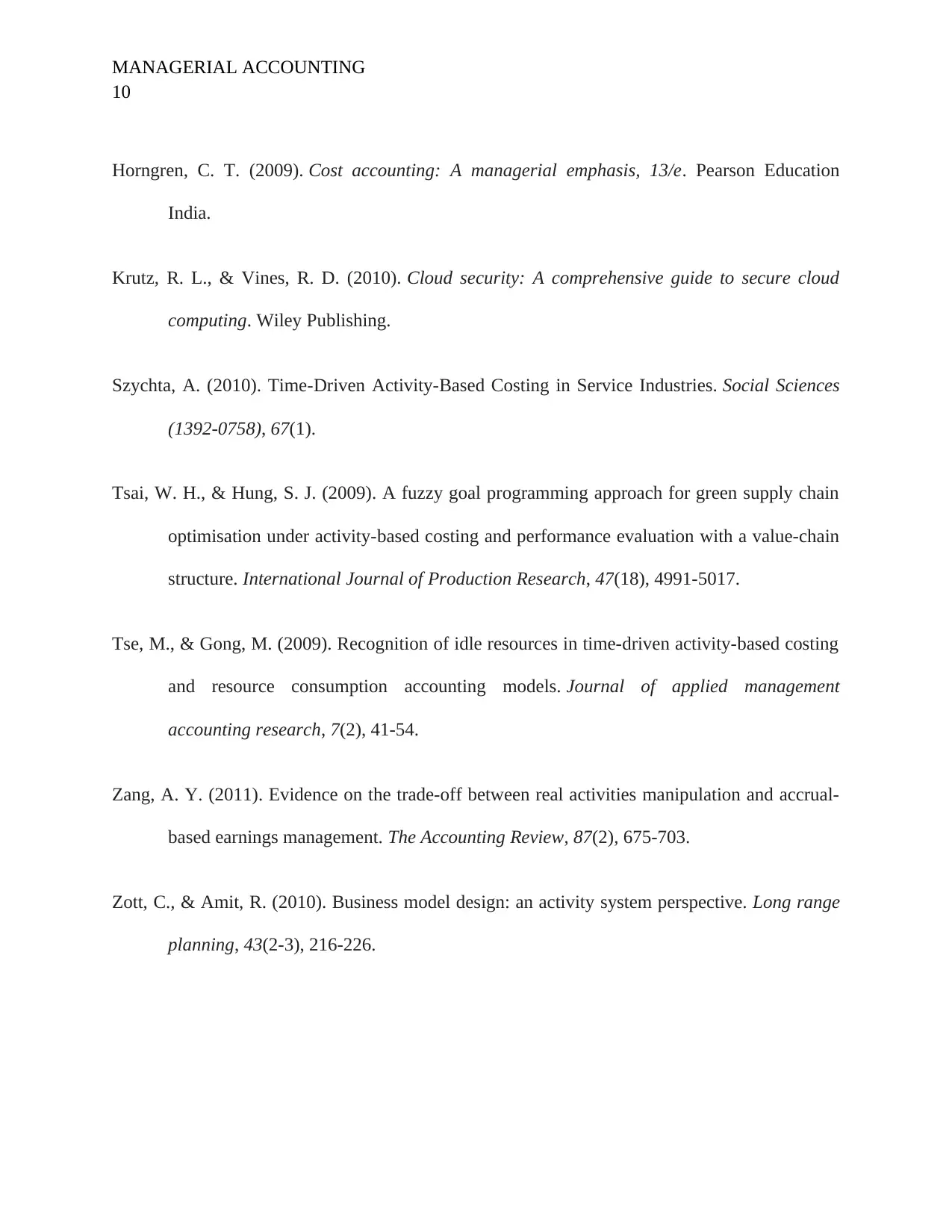
Horngren, C. T. (2009). Cost accounting: A managerial emphasis, 13/e. Pearson Education
India.
Krutz, R. L., & Vines, R. D. (2010). Cloud security: A comprehensive guide to secure cloud
computing. Wiley Publishing.
Szychta, A. (2010). Time-Driven Activity-Based Costing in Service Industries. Social Sciences
(1392-0758), 67(1).
Tsai, W. H., & Hung, S. J. (2009). A fuzzy goal programming approach for green supply chain
optimisation under activity-based costing and performance evaluation with a value-chain
structure. International Journal of Production Research, 47(18), 4991-5017.
Tse, M., & Gong, M. (2009). Recognition of idle resources in time-driven activity-based costing
and resource consumption accounting models. Journal of applied management
accounting research, 7(2), 41-54.
Zang, A. Y. (2011). Evidence on the trade-off between real activities manipulation and accrual-
based earnings management. The Accounting Review, 87(2), 675-703.
Zott, C., & Amit, R. (2010). Business model design: an activity system perspective. Long range
planning, 43(2-3), 216-226.
10
Horngren, C. T. (2009). Cost accounting: A managerial emphasis, 13/e. Pearson Education
India.
Krutz, R. L., & Vines, R. D. (2010). Cloud security: A comprehensive guide to secure cloud
computing. Wiley Publishing.
Szychta, A. (2010). Time-Driven Activity-Based Costing in Service Industries. Social Sciences
(1392-0758), 67(1).
Tsai, W. H., & Hung, S. J. (2009). A fuzzy goal programming approach for green supply chain
optimisation under activity-based costing and performance evaluation with a value-chain
structure. International Journal of Production Research, 47(18), 4991-5017.
Tse, M., & Gong, M. (2009). Recognition of idle resources in time-driven activity-based costing
and resource consumption accounting models. Journal of applied management
accounting research, 7(2), 41-54.
Zang, A. Y. (2011). Evidence on the trade-off between real activities manipulation and accrual-
based earnings management. The Accounting Review, 87(2), 675-703.
Zott, C., & Amit, R. (2010). Business model design: an activity system perspective. Long range
planning, 43(2-3), 216-226.

1 out of 10


Related Documents


Your All-in-One AI-Powered Toolkit for Academic Success.
+13062052269
info@desklib.com
Available 24*7 on WhatsApp / Email
![[object Object]](/_next/static/media/star-bottom.7253800d.svg)
Unlock your academic potential
Copyright © 2020–2026 A2Z Services. All Rights Reserved. Developed and managed by ZUCOL.