Activity Based Costing Report: Calculation and Limitations Analysis
VerifiedAdded on 2023/05/31
|7
|1419
|367
Report
AI Summary
This report provides a detailed examination of Activity Based Costing (ABC) as a method for allocating costs to products, services, and activities within a manufacturing company. It begins by contrasting ABC with traditional cost accounting methods, highlighting the limitations of the latter that led to the development of ABC. The report explains the ABC methodology, including the identification of activity pools, estimation of costs, allocation of costs to activity cost pools, and the determination of activity cost driver rates. Two examples are provided to illustrate the application of ABC, demonstrating how costs are assigned based on the activities demanded by different products. The report also discusses the benefits of ABC, such as providing accurate cost information and enhancing understanding of cost drivers. However, it also acknowledges limitations, including the high implementation cost, adaptability issues for smaller companies, potential for under or over costing, and the difficulty in identifying all activities influencing overhead costs. The report concludes with a reflection on the use of ABC calculations for decision-making purposes, emphasizing the accuracy and clarity of the method in reflecting true costs and providing a deeper understanding of cost allocation.
Accounting and Finance-Activity Based Costing 1
ACCOUNTING AND FINANCE-ACTIVITY BASED COSTING
by (Student’s Name)
Professor’s Name
Institution
Location of Institution
Course
Date
ACCOUNTING AND FINANCE-ACTIVITY BASED COSTING
by (Student’s Name)
Professor’s Name
Institution
Location of Institution
Course
Date
Paraphrase This Document
Need a fresh take? Get an instant paraphrase of this document with our AI Paraphraser

Accounting and Finance-Activity Based Costing 2
Accounting and Finance
There are typically numerous methods used in the calculation of different costs related to
a product, activity or service in a manufacturing company. The key examples of such techniques
used for estimation of costs include, the traditional cost accounting method and activity-based
costing. Each of the methods has certain benefits and limitations and this indicates the distinction
existing between them. The failure by the traditional cost accounting method has led to the
development and application of the activity-based costing method in the allocation of various
costs to products and activities. The technique which was used for the allocation of costs in this
paper is the activity-based costing and more details on the method are as discussed below.
Activity Based Costing Methodology
In the above methodology of allocation of cost, the overhead cost of manufacturing was
assigned to the various products in a logical manner. The activity-based costing method allocates
costs of various activities to products that demand such activities and leaving the others (Frazier,
2014 p.1920).
The process of Activity Based Costing
The main focus of the activity-based costing is on the cost drivers which are typically those
activities which result in an increase in the costs which are to be assigned to particular products.
The steps involved in activity-based costing entails the following as indicated below (Dong, Liu,
and Lin, 2014 p.50);
Identification of the activity pools and relevant activities
Estimation of costs related to different cost objects and activities
Allocation of the costs to various activity cost pools
Estimation of rates of activity cost drivers
Accounting and Finance
There are typically numerous methods used in the calculation of different costs related to
a product, activity or service in a manufacturing company. The key examples of such techniques
used for estimation of costs include, the traditional cost accounting method and activity-based
costing. Each of the methods has certain benefits and limitations and this indicates the distinction
existing between them. The failure by the traditional cost accounting method has led to the
development and application of the activity-based costing method in the allocation of various
costs to products and activities. The technique which was used for the allocation of costs in this
paper is the activity-based costing and more details on the method are as discussed below.
Activity Based Costing Methodology
In the above methodology of allocation of cost, the overhead cost of manufacturing was
assigned to the various products in a logical manner. The activity-based costing method allocates
costs of various activities to products that demand such activities and leaving the others (Frazier,
2014 p.1920).
The process of Activity Based Costing
The main focus of the activity-based costing is on the cost drivers which are typically those
activities which result in an increase in the costs which are to be assigned to particular products.
The steps involved in activity-based costing entails the following as indicated below (Dong, Liu,
and Lin, 2014 p.50);
Identification of the activity pools and relevant activities
Estimation of costs related to different cost objects and activities
Allocation of the costs to various activity cost pools
Estimation of rates of activity cost drivers

Accounting and Finance-Activity Based Costing 3
Allocation of costs of activity to cost objects
Preparation of cost reports
Example 1
Where two products are manufactured by the same firm
A low volume product A required various activities such as additional testing, numerous
machines set up since it was ordered in smaller quantities and special engineering. The other
product B was a high volume product did not need much attention and this was because there
were no certain special activities. To calculate the cost involved in the manufacturing process,
each of the activities was allocated a particular cost. For product A, the cost of special
engineering, machine set up and additional testing were all estimated. After the estimation of
each of the costs associated with the activities, they are then assigned to the particular products
which demanded the activities. However, for product B, the only cost which will be allocated to
the product will be that of machine set up activity and this is because it is the only activity
demanded by the product.
Example 2
Activity Based Costing Using Two Activities
Company X has an annual manufacturing cost estimated to be $2,000,000.The cost is
used in setting up of the machines used in production. In the year, it is expected that the company
will carry out about 400 machine set ups. The batch size is assumed to vary considerably while
setup efforts are the same (Weygandt, Kimmel and Kieso, 2015 p.9). Each of the set up cost
$500.In the activity-based costing, the annual manufacturing overhead cost is considered to be
the batch level cost.
Allocation of costs of activity to cost objects
Preparation of cost reports
Example 1
Where two products are manufactured by the same firm
A low volume product A required various activities such as additional testing, numerous
machines set up since it was ordered in smaller quantities and special engineering. The other
product B was a high volume product did not need much attention and this was because there
were no certain special activities. To calculate the cost involved in the manufacturing process,
each of the activities was allocated a particular cost. For product A, the cost of special
engineering, machine set up and additional testing were all estimated. After the estimation of
each of the costs associated with the activities, they are then assigned to the particular products
which demanded the activities. However, for product B, the only cost which will be allocated to
the product will be that of machine set up activity and this is because it is the only activity
demanded by the product.
Example 2
Activity Based Costing Using Two Activities
Company X has an annual manufacturing cost estimated to be $2,000,000.The cost is
used in setting up of the machines used in production. In the year, it is expected that the company
will carry out about 400 machine set ups. The batch size is assumed to vary considerably while
setup efforts are the same (Weygandt, Kimmel and Kieso, 2015 p.9). Each of the set up cost
$500.In the activity-based costing, the annual manufacturing overhead cost is considered to be
the batch level cost.
⊘ This is a preview!⊘
Do you want full access?
Subscribe today to unlock all pages.

Trusted by 1+ million students worldwide

Accounting and Finance-Activity Based Costing 4
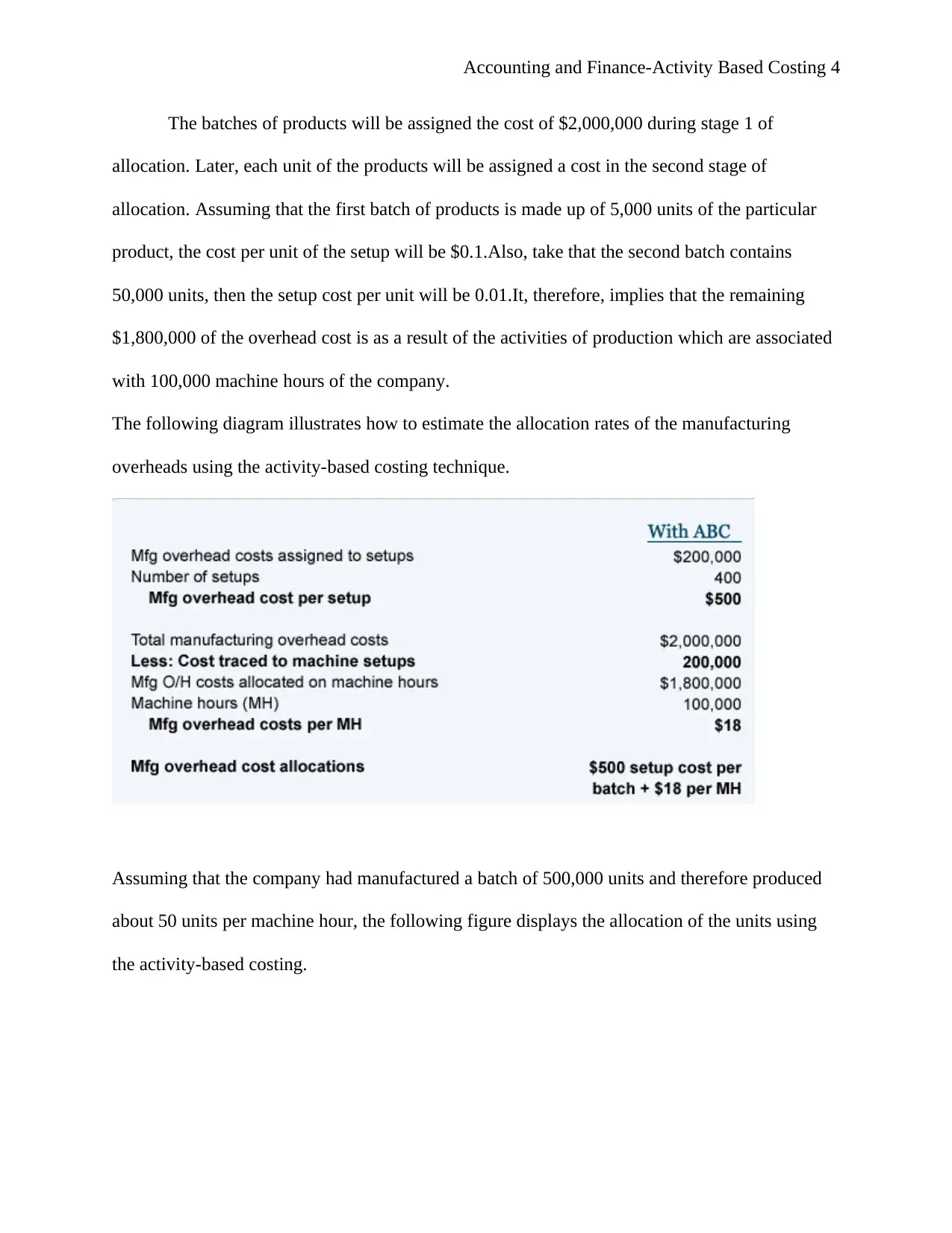
The batches of products will be assigned the cost of $2,000,000 during stage 1 of
allocation. Later, each unit of the products will be assigned a cost in the second stage of
allocation. Assuming that the first batch of products is made up of 5,000 units of the particular
product, the cost per unit of the setup will be $0.1.Also, take that the second batch contains
50,000 units, then the setup cost per unit will be 0.01.It, therefore, implies that the remaining
$1,800,000 of the overhead cost is as a result of the activities of production which are associated
with 100,000 machine hours of the company.
The following diagram illustrates how to estimate the allocation rates of the manufacturing
overheads using the activity-based costing technique.
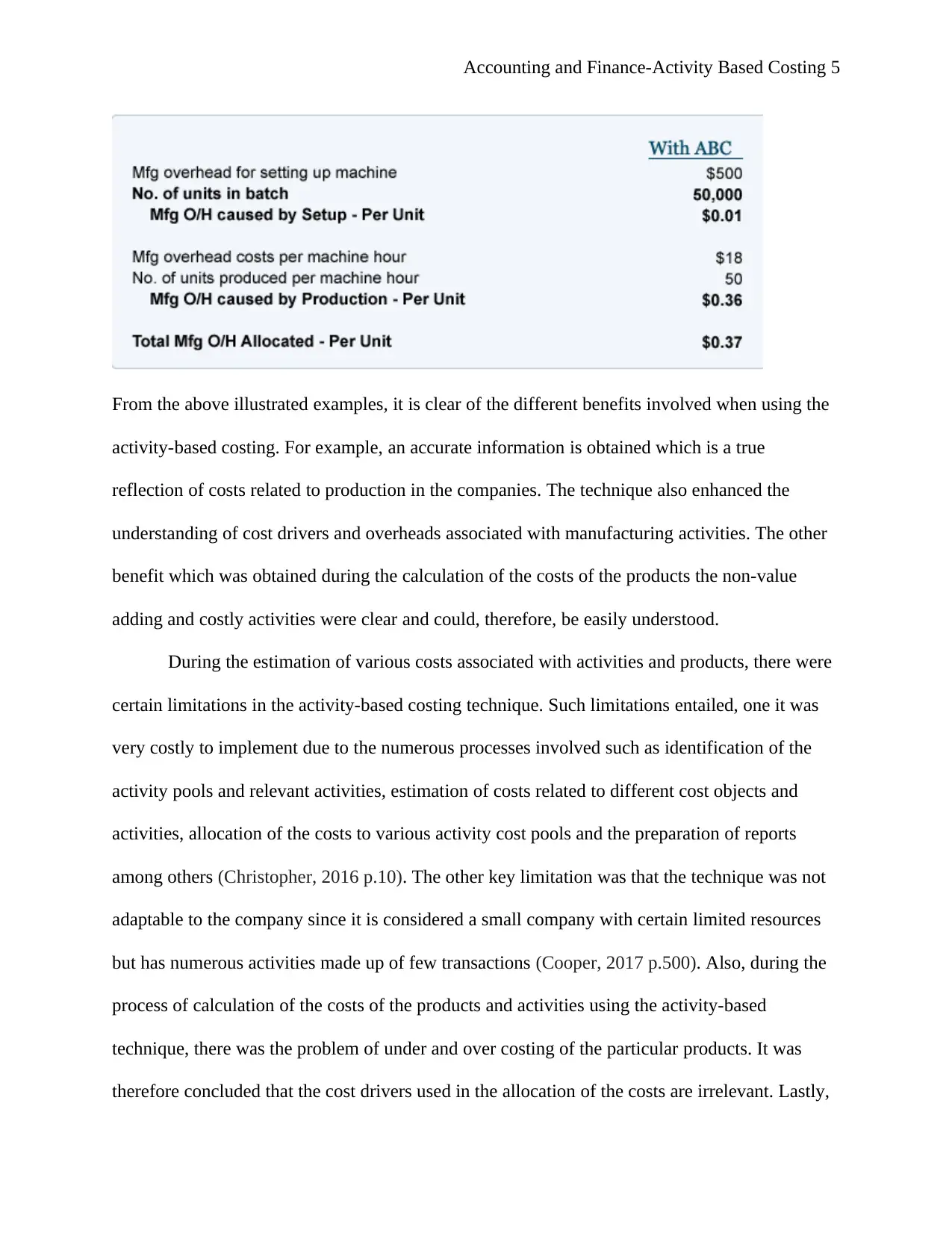
Assuming that the company had manufactured a batch of 500,000 units and therefore produced
about 50 units per machine hour, the following figure displays the allocation of the units using
the activity-based costing.
The batches of products will be assigned the cost of $2,000,000 during stage 1 of
allocation. Later, each unit of the products will be assigned a cost in the second stage of
allocation. Assuming that the first batch of products is made up of 5,000 units of the particular
product, the cost per unit of the setup will be $0.1.Also, take that the second batch contains
50,000 units, then the setup cost per unit will be 0.01.It, therefore, implies that the remaining
$1,800,000 of the overhead cost is as a result of the activities of production which are associated
with 100,000 machine hours of the company.
The following diagram illustrates how to estimate the allocation rates of the manufacturing
overheads using the activity-based costing technique.
Assuming that the company had manufactured a batch of 500,000 units and therefore produced
about 50 units per machine hour, the following figure displays the allocation of the units using
the activity-based costing.
Paraphrase This Document
Need a fresh take? Get an instant paraphrase of this document with our AI Paraphraser

Accounting and Finance-Activity Based Costing 5
From the above illustrated examples, it is clear of the different benefits involved when using the
activity-based costing. For example, an accurate information is obtained which is a true
reflection of costs related to production in the companies. The technique also enhanced the
understanding of cost drivers and overheads associated with manufacturing activities. The other
benefit which was obtained during the calculation of the costs of the products the non-value
adding and costly activities were clear and could, therefore, be easily understood.
During the estimation of various costs associated with activities and products, there were
certain limitations in the activity-based costing technique. Such limitations entailed, one it was
very costly to implement due to the numerous processes involved such as identification of the
activity pools and relevant activities, estimation of costs related to different cost objects and
activities, allocation of the costs to various activity cost pools and the preparation of reports
among others (Christopher, 2016 p.10). The other key limitation was that the technique was not
adaptable to the company since it is considered a small company with certain limited resources
but has numerous activities made up of few transactions (Cooper, 2017 p.500). Also, during the
process of calculation of the costs of the products and activities using the activity-based
technique, there was the problem of under and over costing of the particular products. It was
therefore concluded that the cost drivers used in the allocation of the costs are irrelevant. Lastly,
From the above illustrated examples, it is clear of the different benefits involved when using the
activity-based costing. For example, an accurate information is obtained which is a true
reflection of costs related to production in the companies. The technique also enhanced the
understanding of cost drivers and overheads associated with manufacturing activities. The other
benefit which was obtained during the calculation of the costs of the products the non-value
adding and costly activities were clear and could, therefore, be easily understood.
During the estimation of various costs associated with activities and products, there were
certain limitations in the activity-based costing technique. Such limitations entailed, one it was
very costly to implement due to the numerous processes involved such as identification of the
activity pools and relevant activities, estimation of costs related to different cost objects and
activities, allocation of the costs to various activity cost pools and the preparation of reports
among others (Christopher, 2016 p.10). The other key limitation was that the technique was not
adaptable to the company since it is considered a small company with certain limited resources
but has numerous activities made up of few transactions (Cooper, 2017 p.500). Also, during the
process of calculation of the costs of the products and activities using the activity-based
technique, there was the problem of under and over costing of the particular products. It was
therefore concluded that the cost drivers used in the allocation of the costs are irrelevant. Lastly,

Accounting and Finance-Activity Based Costing 6
there was a difficulty in the identification of the overall activities of the company which had an
influence on the overhead costs used in the production of various products (Dale and Plunkett,
2017 p.48).
Based on the estimations for the company which had been made, I would be happy to
apply such calculations of the activity-based costing for decision making purposes. The above
aspect is attributed to the fact that the calculations are accurate and clear, hence reflect a true
view of the costs associated with a variety of activities in the company (Bennett and James, 2017
p.100). Also, using the method, it has emerged that there are cost drivers and rates used in the
allocation of costs and this has therefore provided a deeper understanding of allocation of the
overhead cost of the company (Kaplan and Atkinson, 2015 p.100).
there was a difficulty in the identification of the overall activities of the company which had an
influence on the overhead costs used in the production of various products (Dale and Plunkett,
2017 p.48).
Based on the estimations for the company which had been made, I would be happy to
apply such calculations of the activity-based costing for decision making purposes. The above
aspect is attributed to the fact that the calculations are accurate and clear, hence reflect a true
view of the costs associated with a variety of activities in the company (Bennett and James, 2017
p.100). Also, using the method, it has emerged that there are cost drivers and rates used in the
allocation of costs and this has therefore provided a deeper understanding of allocation of the
overhead cost of the company (Kaplan and Atkinson, 2015 p.100).
⊘ This is a preview!⊘
Do you want full access?
Subscribe today to unlock all pages.

Trusted by 1+ million students worldwide

Accounting and Finance-Activity Based Costing 7
References
Bennett, M. and James, P., 2017. The Green bottom line: environmental accounting for
management: current practice and future trends. Routledge.
Christopher, M., 2016. Logistics & supply chain management. Pearson UK.
Cooper, R., 2017. Target costing and value engineering. Routledge.
Dale, B.G. and Plunkett, J.J., 2017. Quality costing. Routledge.
Dong, J., Liu, C. and Lin, Z., 2014. Charging infrastructure planning for promoting battery
electric vehicles: An activity-based approach using multiday travel data. Transportation
Research Part C: Emerging Technologies, 38, pp.44-55.
Frazier, W.E., 2014. Metal additive manufacturing: a review. Journal of Materials Engineering
and Performance, 23(6), pp.1917-1928.
Kaplan, R.S. and Atkinson, A.A., 2015. Advanced management accounting. PHI Learning.
Weygandt, J.J., Kimmel, P.D. and Kieso, D.E., 2015. Financial & managerial accounting. John
Wiley & Sons.
References
Bennett, M. and James, P., 2017. The Green bottom line: environmental accounting for
management: current practice and future trends. Routledge.
Christopher, M., 2016. Logistics & supply chain management. Pearson UK.
Cooper, R., 2017. Target costing and value engineering. Routledge.
Dale, B.G. and Plunkett, J.J., 2017. Quality costing. Routledge.
Dong, J., Liu, C. and Lin, Z., 2014. Charging infrastructure planning for promoting battery
electric vehicles: An activity-based approach using multiday travel data. Transportation
Research Part C: Emerging Technologies, 38, pp.44-55.
Frazier, W.E., 2014. Metal additive manufacturing: a review. Journal of Materials Engineering
and Performance, 23(6), pp.1917-1928.
Kaplan, R.S. and Atkinson, A.A., 2015. Advanced management accounting. PHI Learning.
Weygandt, J.J., Kimmel, P.D. and Kieso, D.E., 2015. Financial & managerial accounting. John
Wiley & Sons.
1 out of 7
Related Documents
Your All-in-One AI-Powered Toolkit for Academic Success.
+13062052269
info@desklib.com
Available 24*7 on WhatsApp / Email
Unlock your academic potential
Copyright © 2020–2025 A2Z Services. All Rights Reserved. Developed and managed by ZUCOL.