Activity Based Costing Implementation for TILT Renewables Limited
VerifiedAdded on 2021/05/27
|16
|3267
|279
Report
AI Summary
This report provides a comprehensive analysis of Activity Based Costing (ABC) and its potential implementation within TILT Renewables Limited. The paper begins with an executive summary outlining the benefits of ABC, including improved cost allocation, product pricing, and strategic decision-making. It then introduces the concept of ABC, detailing its features and contrasting it with traditional costing methods, followed by a diagram showcasing the ABC process. The report examines how ABC aligns with TILT Renewables' mission, objectives, and corporate strategies, particularly in the context of the renewable energy sector. It offers recommendations for successful ABC implementation, emphasizing employee training and management support. Finally, the report suggests Just-in-Time inventory system as a complementary tool, providing a holistic approach to enhance the organization's efficiency and reduce costs.

Activity Based Costing 1
ACTIVITY BASED COSTING
By (Student’s Name)
Professor’s Name
College
Course
Date
ACTIVITY BASED COSTING
By (Student’s Name)
Professor’s Name
College
Course
Date

Paraphrase This Document
Need a fresh take? Get an instant paraphrase of this document with our AI Paraphraser
Activity Based Costing 2
ACTIVITY BASED COSTING
Table of Contents
Executive summary.....................................................................................................................................3
Introduction.................................................................................................................................................3
Description of Activity based costing and its features.................................................................................4
Description of how Activity based costing supports the current strategies and goals of the organization. 5
The mission and objectives of the TILT Renewables Limited...................................................................5
Corporate strategy of the TILT Renewable Limited.................................................................................6
How Activity based costing can help TILT Renewables Limited to attain its strategies............................6
Recommendation about the implementation of Activity Based Costing in the organization......................7
The management tool apart from Activity based costing that is more appropriate to TILT Renewables
Limited.........................................................................................................................................................8
Conclusion...................................................................................................................................................9
References.................................................................................................................................................10
ACTIVITY BASED COSTING
Table of Contents
Executive summary.....................................................................................................................................3
Introduction.................................................................................................................................................3
Description of Activity based costing and its features.................................................................................4
Description of how Activity based costing supports the current strategies and goals of the organization. 5
The mission and objectives of the TILT Renewables Limited...................................................................5
Corporate strategy of the TILT Renewable Limited.................................................................................6
How Activity based costing can help TILT Renewables Limited to attain its strategies............................6
Recommendation about the implementation of Activity Based Costing in the organization......................7
The management tool apart from Activity based costing that is more appropriate to TILT Renewables
Limited.........................................................................................................................................................8
Conclusion...................................................................................................................................................9
References.................................................................................................................................................10
Activity Based Costing 3
Executive Summary
This paper discusses how Activity-based costing can help the accounting information of
the management in TILT Renewables Limited. The control of The TILT Renewable Limited
should apply the use of the sophisticated cost information that can make them quick decisions in
the organisation. Given the high rate of competition in the industry and the need to reduce the
costs, the management of TILT Renewable Limited needs to implement ABC system (Anguita et
al. 2012). This type of the model will help the administration to allocate various costs of the
administration to the services and products that the organisation provides. The main advantages
that the ABC system will contribute to the management at TILT Renewable Limited are as
follows: It will enable the administration to identify costs provided by various departments of the
organisation as well as efficient use of services that are more costly. The product managers will
also make use of the information that relates to cost to design products more cost-effectively.
Cost information will also improve product pricing in the organisation (Amid, Ghodsypour and
O’Brien 2011). Activity-based costing system can also help the management in fixing the prices
of most of their products (setting selling prices). The implementation process of the model to the
organisation requires proper planning before and after the implementation process. The
management should also teach all the employees on how the Model will function. The teaching
process will enable every employee to understand the implementation process of the model.
Activity Based Costing can provide solutions to the problems that the organisations are facing
(Pinto 2010).
Executive Summary
This paper discusses how Activity-based costing can help the accounting information of
the management in TILT Renewables Limited. The control of The TILT Renewable Limited
should apply the use of the sophisticated cost information that can make them quick decisions in
the organisation. Given the high rate of competition in the industry and the need to reduce the
costs, the management of TILT Renewable Limited needs to implement ABC system (Anguita et
al. 2012). This type of the model will help the administration to allocate various costs of the
administration to the services and products that the organisation provides. The main advantages
that the ABC system will contribute to the management at TILT Renewable Limited are as
follows: It will enable the administration to identify costs provided by various departments of the
organisation as well as efficient use of services that are more costly. The product managers will
also make use of the information that relates to cost to design products more cost-effectively.
Cost information will also improve product pricing in the organisation (Amid, Ghodsypour and
O’Brien 2011). Activity-based costing system can also help the management in fixing the prices
of most of their products (setting selling prices). The implementation process of the model to the
organisation requires proper planning before and after the implementation process. The
management should also teach all the employees on how the Model will function. The teaching
process will enable every employee to understand the implementation process of the model.
Activity Based Costing can provide solutions to the problems that the organisations are facing
(Pinto 2010).
⊘ This is a preview!⊘
Do you want full access?
Subscribe today to unlock all pages.

Trusted by 1+ million students worldwide
Activity Based Costing 4
Introduction
The paper discusses how the management can apply the ABC system to improve the
performance of the TILT Renewables Limited. The company is well known in the provision
of the energy generation, and it also tries to be the leading owner, developer as well as the
manager of the production of the renewable energy in both New Zealand and Australia.
Over the past few years, the TLT has reduced its level of return; this is due to the problem
in financial leverage which in turn impact Return on equity which then affects the overall
profits of the Company. The organisation can only improve the performance by
implementing Activity Based Costing system. To help explained how ABC could enhance
the performance of the TILT Renewable Limited; the paper is divided into sections with
each part illustrating the Activity-based costing method. The paper explains Activity-based
costing system as well as its features; also, it also discusses the benefits that are associated
with the model in the TILT Renewables Limited. It also describes how activity-based
costing supports the current strategies and goals of the institution and then provides a
recommendation that should be put in place to ensure effective implementation of the ABC
system (Lin et al. 2017). Lastly, the paper proposes the alternative accounting tool that is
appropriate for TILT Renewables Limited.
Description of Activity-based costing and its features
Introduction
The paper discusses how the management can apply the ABC system to improve the
performance of the TILT Renewables Limited. The company is well known in the provision
of the energy generation, and it also tries to be the leading owner, developer as well as the
manager of the production of the renewable energy in both New Zealand and Australia.
Over the past few years, the TLT has reduced its level of return; this is due to the problem
in financial leverage which in turn impact Return on equity which then affects the overall
profits of the Company. The organisation can only improve the performance by
implementing Activity Based Costing system. To help explained how ABC could enhance
the performance of the TILT Renewable Limited; the paper is divided into sections with
each part illustrating the Activity-based costing method. The paper explains Activity-based
costing system as well as its features; also, it also discusses the benefits that are associated
with the model in the TILT Renewables Limited. It also describes how activity-based
costing supports the current strategies and goals of the institution and then provides a
recommendation that should be put in place to ensure effective implementation of the ABC
system (Lin et al. 2017). Lastly, the paper proposes the alternative accounting tool that is
appropriate for TILT Renewables Limited.
Description of Activity-based costing and its features
Paraphrase This Document
Need a fresh take? Get an instant paraphrase of this document with our AI Paraphraser
Activity Based Costing 5
ABC system is accounting tool that helps in assigning the organization’s overhead to
those specific items that uses it. The model assists in identification of activities in the
institution and then apportions each cost of every activity with all the resources to all
services and products according to how each have been used. Usually, the model allocates
more overhead (indirect cost) into direct cost than the Traditional Costing method. It is
also an approach to the monitoring and costing of activities that involves finding the
consumption of resources as well as costing the final output. ABC was developed to provide
solution to the problems that are related to traditional cost management. The system can
be used as a method of reducing the costs of the overhead (Verhagen, Bermell, van and
Curran 2012). The model performs well in a complex environment, that contains many
products and machines, as well as tangled processes that cannot be sorted out efficiently
(Tavana, Yazdani and Caprio 2017). ABC model cannot efficiently perform well in a
streamlined environment that is made up of production processes that are abbreviated
(Nguyen and Aiello 2013). This model is mostly applied in the manufacturing companies
because it improves the consistency of cost data. This can make the Company to easily
classify all the costs that are incurred as well as producing exact expenses during the
production process. The model is performing its function by arranging the machines for
designing products, production, and distributing operating devices or finished goods
(DRURY 2013). The activity-based costing enhances costing process in the organisation in
three Main ways. The first way is that it increases the actual total of the costs pool that is
being used to accumulate overhead costs. Instead of assembling all expenses that are
associated with the production in one basin, it apportions costs by activity. It also helps in
creating bases for allocating overhead costs to those items. Lastly, Activity-based costing
ABC system is accounting tool that helps in assigning the organization’s overhead to
those specific items that uses it. The model assists in identification of activities in the
institution and then apportions each cost of every activity with all the resources to all
services and products according to how each have been used. Usually, the model allocates
more overhead (indirect cost) into direct cost than the Traditional Costing method. It is
also an approach to the monitoring and costing of activities that involves finding the
consumption of resources as well as costing the final output. ABC was developed to provide
solution to the problems that are related to traditional cost management. The system can
be used as a method of reducing the costs of the overhead (Verhagen, Bermell, van and
Curran 2012). The model performs well in a complex environment, that contains many
products and machines, as well as tangled processes that cannot be sorted out efficiently
(Tavana, Yazdani and Caprio 2017). ABC model cannot efficiently perform well in a
streamlined environment that is made up of production processes that are abbreviated
(Nguyen and Aiello 2013). This model is mostly applied in the manufacturing companies
because it improves the consistency of cost data. This can make the Company to easily
classify all the costs that are incurred as well as producing exact expenses during the
production process. The model is performing its function by arranging the machines for
designing products, production, and distributing operating devices or finished goods
(DRURY 2013). The activity-based costing enhances costing process in the organisation in
three Main ways. The first way is that it increases the actual total of the costs pool that is
being used to accumulate overhead costs. Instead of assembling all expenses that are
associated with the production in one basin, it apportions costs by activity. It also helps in
creating bases for allocating overhead costs to those items. Lastly, Activity-based costing
Activity Based Costing 6
changes the nature of different indirect costs; hence this enables different values to be
easily traced to the activities (Aggarwal and Xia 2014).
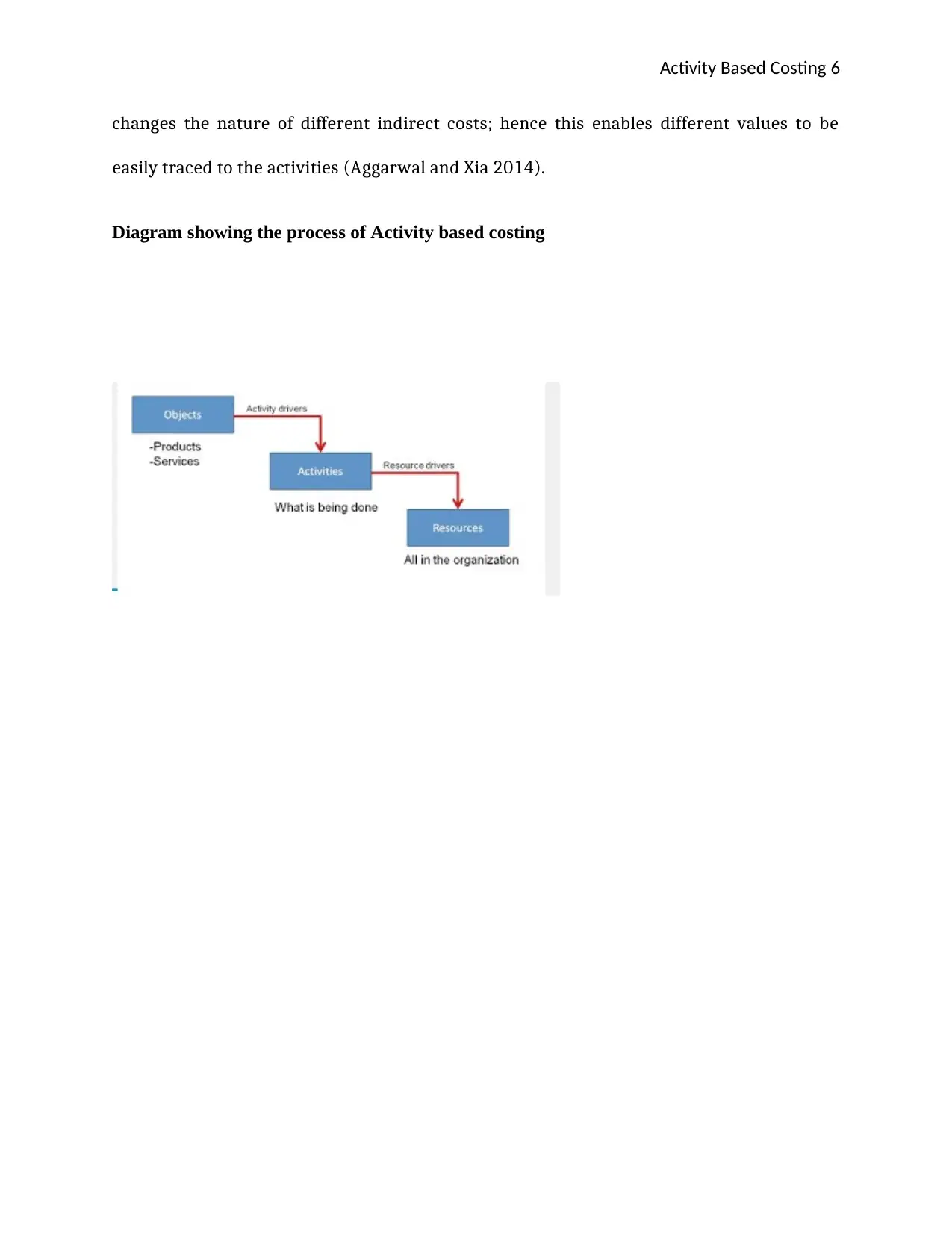
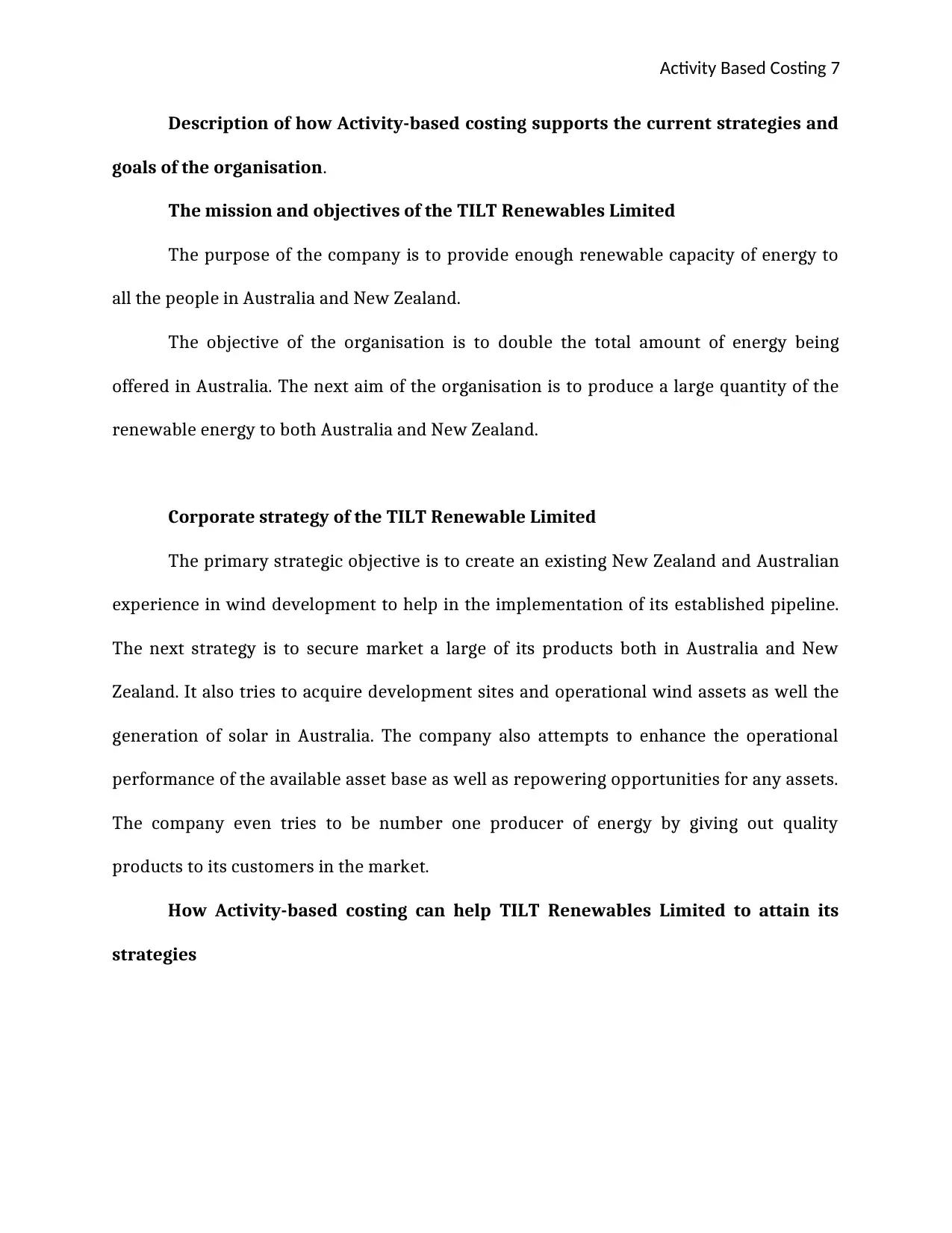
Diagram showing the process of Activity based costing
changes the nature of different indirect costs; hence this enables different values to be
easily traced to the activities (Aggarwal and Xia 2014).
Diagram showing the process of Activity based costing
⊘ This is a preview!⊘
Do you want full access?
Subscribe today to unlock all pages.
Trusted by 1+ million students worldwide
Activity Based Costing 7
Description of how Activity-based costing supports the current strategies and
goals of the organisation.
The mission and objectives of the TILT Renewables Limited
The purpose of the company is to provide enough renewable capacity of energy to
all the people in Australia and New Zealand.
The objective of the organisation is to double the total amount of energy being
offered in Australia. The next aim of the organisation is to produce a large quantity of the
renewable energy to both Australia and New Zealand.
Corporate strategy of the TILT Renewable Limited
The primary strategic objective is to create an existing New Zealand and Australian
experience in wind development to help in the implementation of its established pipeline.
The next strategy is to secure market a large of its products both in Australia and New
Zealand. It also tries to acquire development sites and operational wind assets as well the
generation of solar in Australia. The company also attempts to enhance the operational
performance of the available asset base as well as repowering opportunities for any assets.
The company even tries to be number one producer of energy by giving out quality
products to its customers in the market.
How Activity-based costing can help TILT Renewables Limited to attain its
strategies
Description of how Activity-based costing supports the current strategies and
goals of the organisation.
The mission and objectives of the TILT Renewables Limited
The purpose of the company is to provide enough renewable capacity of energy to
all the people in Australia and New Zealand.
The objective of the organisation is to double the total amount of energy being
offered in Australia. The next aim of the organisation is to produce a large quantity of the
renewable energy to both Australia and New Zealand.
Corporate strategy of the TILT Renewable Limited
The primary strategic objective is to create an existing New Zealand and Australian
experience in wind development to help in the implementation of its established pipeline.
The next strategy is to secure market a large of its products both in Australia and New
Zealand. It also tries to acquire development sites and operational wind assets as well the
generation of solar in Australia. The company also attempts to enhance the operational
performance of the available asset base as well as repowering opportunities for any assets.
The company even tries to be number one producer of energy by giving out quality
products to its customers in the market.
How Activity-based costing can help TILT Renewables Limited to attain its
strategies
Paraphrase This Document
Need a fresh take? Get an instant paraphrase of this document with our AI Paraphraser
Activity Based Costing 8
Activity-based costing will add value to the company when it uses it as the source of
information for improving and managing the business. It will provide the organisation with
a valuable tool probably the most powerful tool that will enhance the performance of the
organisation. The model will provide the methods and ways of improving the profitability
of the organisation (Taticchi, Tonelli and Cagnazzo 2010). When the management
combined other alternatives accounting tools such as just-in-time, BPR, total quality
management and financial management system must be used together with the ABC
system for TILT Company to, improve business performance (Ding, Zhou and Akinci 2014).
The management will attain the strategies put in place since it will be able to identify how
different costs of activities are being consumed as well as understanding the composition
of their output. With the use of the model, the Company will respond very first with the
changing business environment that requires quick responsive to the expectation of the
customers. The Company will be able to provide appropriate products to its Customers that
are in Australia and other parts of the world. Activity-based costing will also enable the
strategic management decisions, for example, product mix and pricing (Shander et al.
2010). The accuracy of the of the cost of output will help the Managers to come up with
better decisions on process improvements, customer mix, product design and market
segment. The company will be capable of determining accurate measurements of its
performance with the intention of finding out departments within the organization that
needs still needs improvements for the better performance of all the Organization. The
model will help the organization to find out accurate costs and then developed ways of how
to control those costs to ensure that there is improvement in the organization
(Chiadamrong 2017).
Activity-based costing will add value to the company when it uses it as the source of
information for improving and managing the business. It will provide the organisation with
a valuable tool probably the most powerful tool that will enhance the performance of the
organisation. The model will provide the methods and ways of improving the profitability
of the organisation (Taticchi, Tonelli and Cagnazzo 2010). When the management
combined other alternatives accounting tools such as just-in-time, BPR, total quality
management and financial management system must be used together with the ABC
system for TILT Company to, improve business performance (Ding, Zhou and Akinci 2014).
The management will attain the strategies put in place since it will be able to identify how
different costs of activities are being consumed as well as understanding the composition
of their output. With the use of the model, the Company will respond very first with the
changing business environment that requires quick responsive to the expectation of the
customers. The Company will be able to provide appropriate products to its Customers that
are in Australia and other parts of the world. Activity-based costing will also enable the
strategic management decisions, for example, product mix and pricing (Shander et al.
2010). The accuracy of the of the cost of output will help the Managers to come up with
better decisions on process improvements, customer mix, product design and market
segment. The company will be capable of determining accurate measurements of its
performance with the intention of finding out departments within the organization that
needs still needs improvements for the better performance of all the Organization. The
model will help the organization to find out accurate costs and then developed ways of how
to control those costs to ensure that there is improvement in the organization
(Chiadamrong 2017).
Activity Based Costing 9
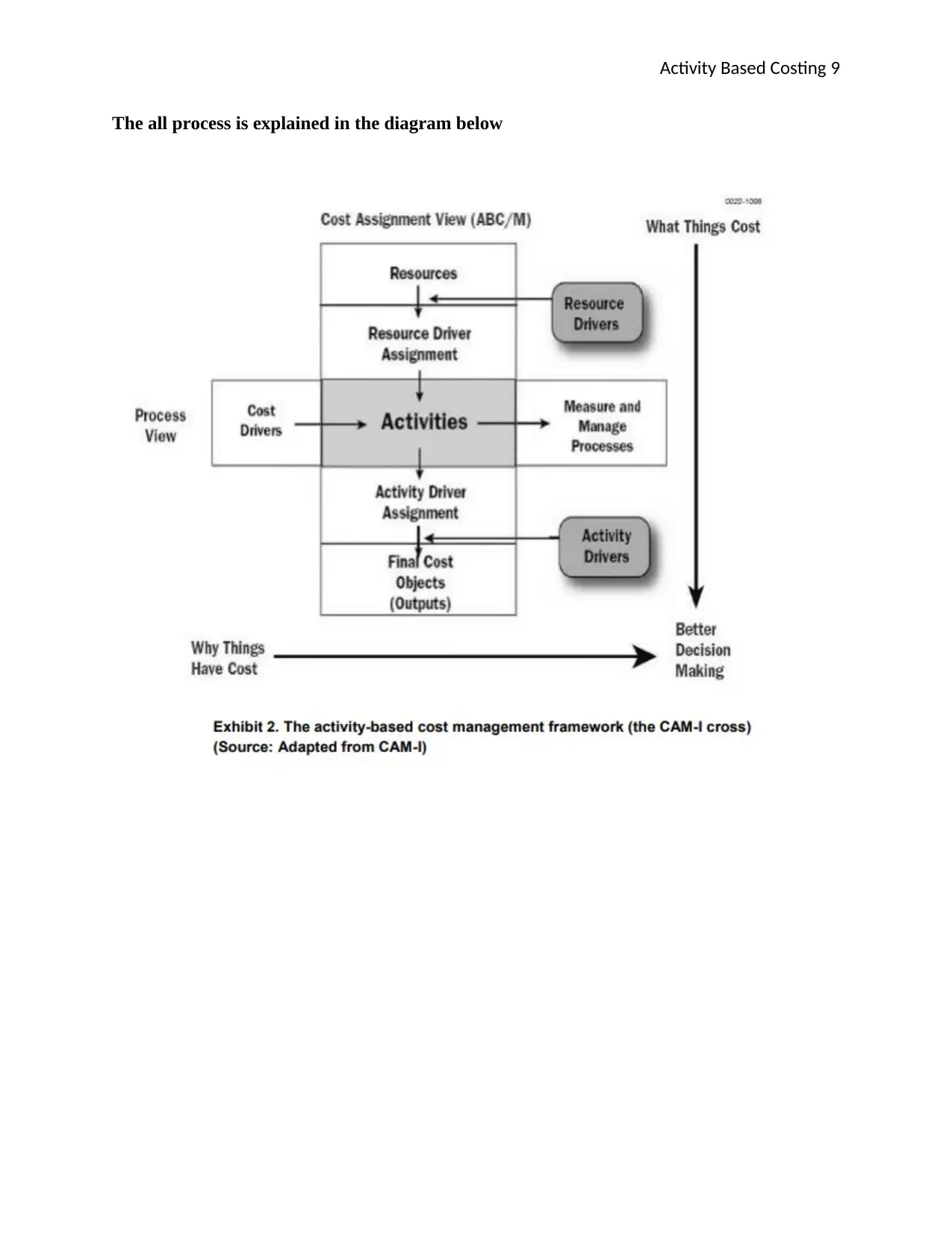
The all process is explained in the diagram below
The all process is explained in the diagram below
⊘ This is a preview!⊘
Do you want full access?
Subscribe today to unlock all pages.
Trusted by 1+ million students worldwide
Activity Based Costing 10
Recommendation about the implementation of Activity Based Costing in the
organisation
Training of all the employees and the general manager is the essential factor as the
training process will assist the employees to have a good understanding of how Activity-
based costing system varies from the existing accounting cost being used by the
organisation or from the traditional accounting costs (Garrison, Noreen, Brewer and
McGowan 2010). The employees should also be given training on the processes, goals and
benefits of the Activity-based costing implementation. This remains important since it
improves the confidence as well as helping them to a positive outlook concerning
implementation process. TILT Renewables Limited should allocate enough funds to
facilitate the training process of all the employees who have to gain the knowledge and
skills about the Activity-based costing implementation. The training process should not be
made up of the measurements and review procedures but should also include methods of
solving problems for example effect and causes analysis. The analysis will assist in
identification of the correlation between different costs in the organisation.
Recommendation about the implementation of Activity Based Costing in the
organisation
Training of all the employees and the general manager is the essential factor as the
training process will assist the employees to have a good understanding of how Activity-
based costing system varies from the existing accounting cost being used by the
organisation or from the traditional accounting costs (Garrison, Noreen, Brewer and
McGowan 2010). The employees should also be given training on the processes, goals and
benefits of the Activity-based costing implementation. This remains important since it
improves the confidence as well as helping them to a positive outlook concerning
implementation process. TILT Renewables Limited should allocate enough funds to
facilitate the training process of all the employees who have to gain the knowledge and
skills about the Activity-based costing implementation. The training process should not be
made up of the measurements and review procedures but should also include methods of
solving problems for example effect and causes analysis. The analysis will assist in
identification of the correlation between different costs in the organisation.
Paraphrase This Document
Need a fresh take? Get an instant paraphrase of this document with our AI Paraphraser
Activity Based Costing 11
Active support of the management is vital in the effective implementation of
Activity-based costing (ABC) system. The administration should provide means of
application and enough resources that can facilitate all process of ABC implementation. The
resources mainly include the commitment and time of the accountants, operating
employees, top management, external consultant and software. The implementation
process also consume a lot of time. The amount of time take to fully complete all the stages
of the ABC system will depend on the size of the organization. TILT Renewable Limited is a
large organization hence it will take a lot of time for the implementation process to be
completed. One of the most essential factors that will lead to the success of the ABC system
is having enough employees in the organization. Other resources, for example custom-
made or commercial software as well as external consultants are not so essential to the
effective implementation of the ABC (Dale and Plunkett 2017). The management should
also offer enough support to staff to ensure smooth implementation of the Activity-based
costing into the organisation. The support may be in the form of monetary or advice. They
should respond to the need of any employee in the organisation by giving them the
necessary relating to the Activity-based costing. This is because the employees are the
cornerstones of any successful organization. Therefore, the management should respond to
their problems for smooth implementation of the model
The management tool apart from Activity-based costing that is more appropriate to
TILT Renewables Limited
Active support of the management is vital in the effective implementation of
Activity-based costing (ABC) system. The administration should provide means of
application and enough resources that can facilitate all process of ABC implementation. The
resources mainly include the commitment and time of the accountants, operating
employees, top management, external consultant and software. The implementation
process also consume a lot of time. The amount of time take to fully complete all the stages
of the ABC system will depend on the size of the organization. TILT Renewable Limited is a
large organization hence it will take a lot of time for the implementation process to be
completed. One of the most essential factors that will lead to the success of the ABC system
is having enough employees in the organization. Other resources, for example custom-
made or commercial software as well as external consultants are not so essential to the
effective implementation of the ABC (Dale and Plunkett 2017). The management should
also offer enough support to staff to ensure smooth implementation of the Activity-based
costing into the organisation. The support may be in the form of monetary or advice. They
should respond to the need of any employee in the organisation by giving them the
necessary relating to the Activity-based costing. This is because the employees are the
cornerstones of any successful organization. Therefore, the management should respond to
their problems for smooth implementation of the model
The management tool apart from Activity-based costing that is more appropriate to
TILT Renewables Limited
Activity Based Costing 12
TILT Renewable Limited should adopt the use of the Just-in-time inventory system
to assist in the improvements of the efficiency of the organisation as well as reducing the
costs. The system will require the Tilt Renewable Limited to purchase the products when
there is a demand in the market (Lange et al. 2011). It will enable the organization to
establish a correlation with sellers to ensure that products reach the organization in time
for the preparation according to the needs of the customers. It will also ensure that
production is made according to the orders of the customers and this will help to eliminate
wastage. This model will not allow TILT Company to store or generate excess products. It
will also require the management and other members of the organization to work as a team
with the aim of delivering according to the goals of the organization. It will enable the
administration to find simple solutions for any problems that the organisation might
encounter in the future. Just-in-time will also allow all the members of the organisation to
concentrate only on the tasks that every member performs. It also motivates every worker
to analyze the processes and then provide suggestions that can improve the performance of
the organization (Chen, Hoey, Nugent, Cook and Yu 2012).
Conclusion
TILT Renewable Limited should adopt the use of the Just-in-time inventory system
to assist in the improvements of the efficiency of the organisation as well as reducing the
costs. The system will require the Tilt Renewable Limited to purchase the products when
there is a demand in the market (Lange et al. 2011). It will enable the organization to
establish a correlation with sellers to ensure that products reach the organization in time
for the preparation according to the needs of the customers. It will also ensure that
production is made according to the orders of the customers and this will help to eliminate
wastage. This model will not allow TILT Company to store or generate excess products. It
will also require the management and other members of the organization to work as a team
with the aim of delivering according to the goals of the organization. It will enable the
administration to find simple solutions for any problems that the organisation might
encounter in the future. Just-in-time will also allow all the members of the organisation to
concentrate only on the tasks that every member performs. It also motivates every worker
to analyze the processes and then provide suggestions that can improve the performance of
the organization (Chen, Hoey, Nugent, Cook and Yu 2012).
Conclusion
⊘ This is a preview!⊘
Do you want full access?
Subscribe today to unlock all pages.
Trusted by 1+ million students worldwide

1 out of 16


Related Documents


Your All-in-One AI-Powered Toolkit for Academic Success.
+13062052269
info@desklib.com
Available 24*7 on WhatsApp / Email
![[object Object]](/_next/static/media/star-bottom.7253800d.svg)
Unlock your academic potential
Copyright © 2020–2026 A2Z Services. All Rights Reserved. Developed and managed by ZUCOL.