Case Study on Acute Infective Endocarditis: Symptoms and Diagnosis
VerifiedAdded on 2021/05/03
|7
|1553
|96
Case Study
AI Summary
This case study examines a patient presenting with symptoms indicative of acute infective endocarditis. The introduction discusses potential differential diagnoses, including cold, flu, and stroke, highlighting the complexity of symptom interpretation. The case details the signs and symptoms of the condition, such as high fever, rapid heart rate, and fatigue, along with the diagnostic methods, particularly echocardiography and the modified Duke criteria. The patient's history, including a recent tooth extraction, is analyzed in relation to the development of the disease. The case study explores the causes, focusing on Staphylococcus Aureus and risk factors like intravenous drug use and poor dental hygiene. The prognosis and treatment options, including antibiotics and surgery, are discussed, along with lifestyle changes to adopt. The study concludes by emphasizing the life-threatening nature of infective endocarditis and its prevalence, along with the importance of early diagnosis and management for improved patient outcomes. References to relevant medical literature are provided.

A Case Study on Acute Infective Endocarditis
Name
Course
Date
Name
Course
Date
Paraphrase This Document
Need a fresh take? Get an instant paraphrase of this document with our AI Paraphraser

A Case Study on Acute Infective Endocarditis
Introduction
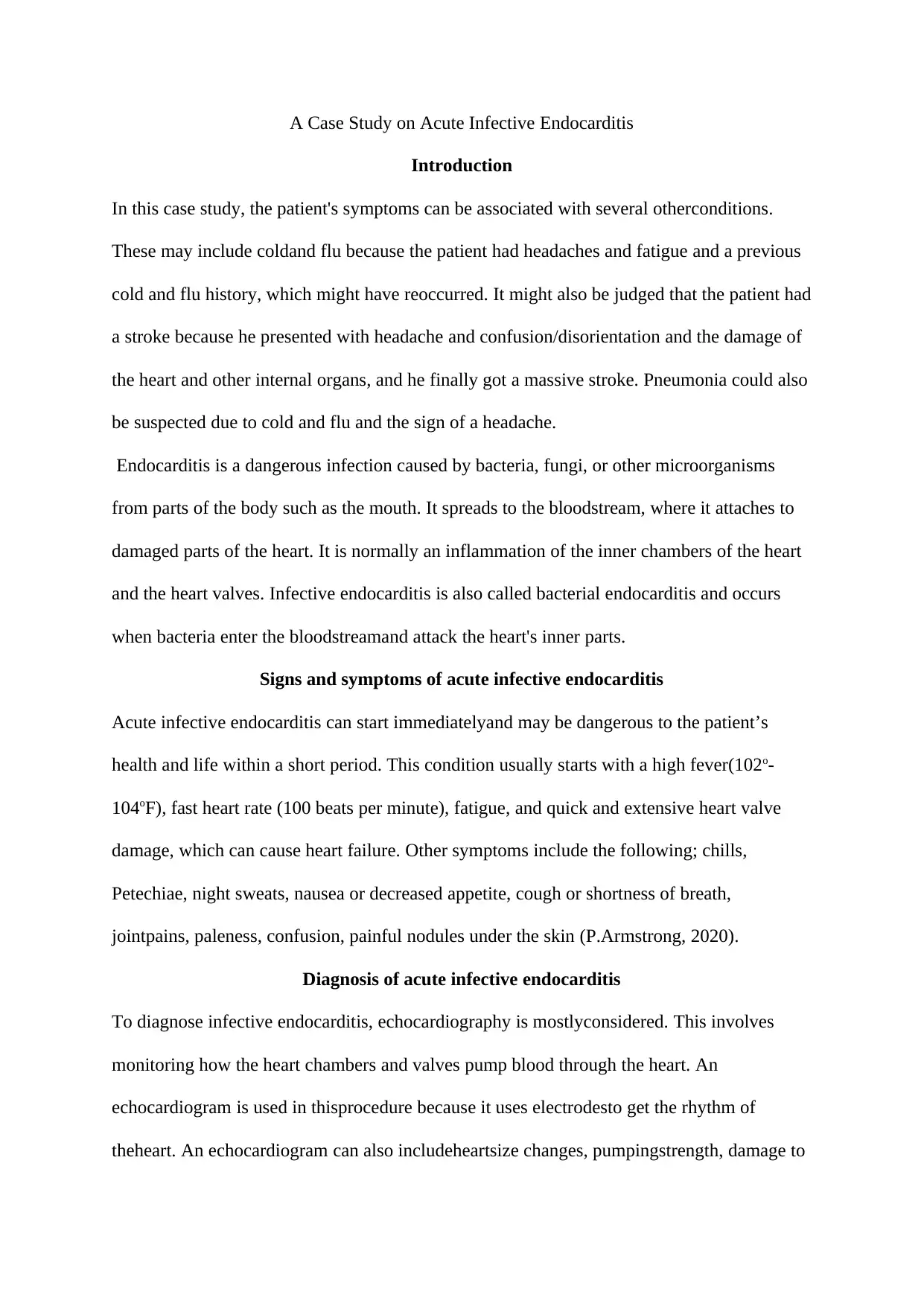
In this case study, the patient's symptoms can be associated with several otherconditions.
These may include coldand flu because the patient had headaches and fatigue and a previous
cold and flu history, which might have reoccurred. It might also be judged that the patient had
a stroke because he presented with headache and confusion/disorientation and the damage of
the heart and other internal organs, and he finally got a massive stroke. Pneumonia could also
be suspected due to cold and flu and the sign of a headache.
Endocarditis is a dangerous infection caused by bacteria, fungi, or other microorganisms
from parts of the body such as the mouth. It spreads to the bloodstream, where it attaches to
damaged parts of the heart. It is normally an inflammation of the inner chambers of the heart
and the heart valves. Infective endocarditis is also called bacterial endocarditis and occurs
when bacteria enter the bloodstreamand attack the heart's inner parts.
Signs and symptoms of acute infective endocarditis
Acute infective endocarditis can start immediatelyand may be dangerous to the patient’s
health and life within a short period. This condition usually starts with a high fever(102o-
104oF), fast heart rate (100 beats per minute), fatigue, and quick and extensive heart valve
damage, which can cause heart failure. Other symptoms include the following; chills,
Petechiae, night sweats, nausea or decreased appetite, cough or shortness of breath,
jointpains, paleness, confusion, painful nodules under the skin (P.Armstrong, 2020).
Diagnosis of acute infective endocarditis
To diagnose infective endocarditis, echocardiography is mostlyconsidered. This involves
monitoring how the heart chambers and valves pump blood through the heart. An
echocardiogram is used in thisprocedure because it uses electrodesto get the rhythm of
theheart. An echocardiogram can also includeheartsize changes, pumpingstrength, damage to
Introduction
In this case study, the patient's symptoms can be associated with several otherconditions.
These may include coldand flu because the patient had headaches and fatigue and a previous
cold and flu history, which might have reoccurred. It might also be judged that the patient had
a stroke because he presented with headache and confusion/disorientation and the damage of
the heart and other internal organs, and he finally got a massive stroke. Pneumonia could also
be suspected due to cold and flu and the sign of a headache.
Endocarditis is a dangerous infection caused by bacteria, fungi, or other microorganisms
from parts of the body such as the mouth. It spreads to the bloodstream, where it attaches to
damaged parts of the heart. It is normally an inflammation of the inner chambers of the heart
and the heart valves. Infective endocarditis is also called bacterial endocarditis and occurs
when bacteria enter the bloodstreamand attack the heart's inner parts.
Signs and symptoms of acute infective endocarditis
Acute infective endocarditis can start immediatelyand may be dangerous to the patient’s
health and life within a short period. This condition usually starts with a high fever(102o-
104oF), fast heart rate (100 beats per minute), fatigue, and quick and extensive heart valve
damage, which can cause heart failure. Other symptoms include the following; chills,
Petechiae, night sweats, nausea or decreased appetite, cough or shortness of breath,
jointpains, paleness, confusion, painful nodules under the skin (P.Armstrong, 2020).
Diagnosis of acute infective endocarditis
To diagnose infective endocarditis, echocardiography is mostlyconsidered. This involves
monitoring how the heart chambers and valves pump blood through the heart. An
echocardiogram is used in thisprocedure because it uses electrodesto get the rhythm of
theheart. An echocardiogram can also includeheartsize changes, pumpingstrength, damage to

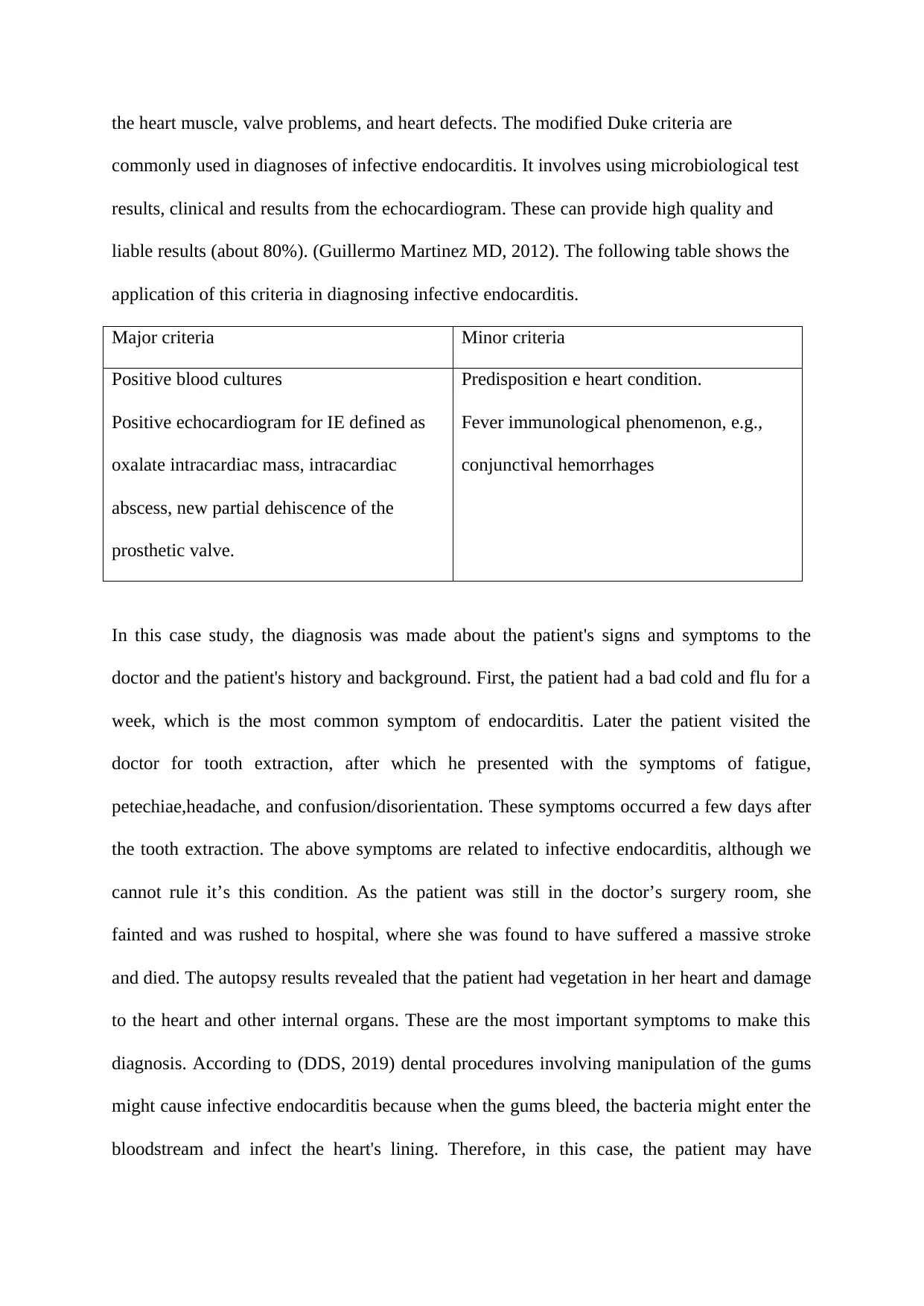
the heart muscle, valve problems, and heart defects. The modified Duke criteria are
commonly used in diagnoses of infective endocarditis. It involves using microbiological test
results, clinical and results from the echocardiogram. These can provide high quality and
liable results (about 80%). (Guillermo Martinez MD, 2012). The following table shows the
application of this criteria in diagnosing infective endocarditis.
Major criteria Minor criteria
Positive blood cultures
Positive echocardiogram for IE defined as
oxalate intracardiac mass, intracardiac
abscess, new partial dehiscence of the
prosthetic valve.
Predisposition e heart condition.
Fever immunological phenomenon, e.g.,
conjunctival hemorrhages
In this case study, the diagnosis was made about the patient's signs and symptoms to the
doctor and the patient's history and background. First, the patient had a bad cold and flu for a
week, which is the most common symptom of endocarditis. Later the patient visited the
doctor for tooth extraction, after which he presented with the symptoms of fatigue,
petechiae,headache, and confusion/disorientation. These symptoms occurred a few days after
the tooth extraction. The above symptoms are related to infective endocarditis, although we
cannot rule it’s this condition. As the patient was still in the doctor’s surgery room, she
fainted and was rushed to hospital, where she was found to have suffered a massive stroke
and died. The autopsy results revealed that the patient had vegetation in her heart and damage
to the heart and other internal organs. These are the most important symptoms to make this
diagnosis. According to (DDS, 2019) dental procedures involving manipulation of the gums
might cause infective endocarditis because when the gums bleed, the bacteria might enter the
bloodstream and infect the heart's lining. Therefore, in this case, the patient may have
commonly used in diagnoses of infective endocarditis. It involves using microbiological test
results, clinical and results from the echocardiogram. These can provide high quality and
liable results (about 80%). (Guillermo Martinez MD, 2012). The following table shows the
application of this criteria in diagnosing infective endocarditis.
Major criteria Minor criteria
Positive blood cultures
Positive echocardiogram for IE defined as
oxalate intracardiac mass, intracardiac
abscess, new partial dehiscence of the
prosthetic valve.
Predisposition e heart condition.
Fever immunological phenomenon, e.g.,
conjunctival hemorrhages
In this case study, the diagnosis was made about the patient's signs and symptoms to the
doctor and the patient's history and background. First, the patient had a bad cold and flu for a
week, which is the most common symptom of endocarditis. Later the patient visited the
doctor for tooth extraction, after which he presented with the symptoms of fatigue,
petechiae,headache, and confusion/disorientation. These symptoms occurred a few days after
the tooth extraction. The above symptoms are related to infective endocarditis, although we
cannot rule it’s this condition. As the patient was still in the doctor’s surgery room, she
fainted and was rushed to hospital, where she was found to have suffered a massive stroke
and died. The autopsy results revealed that the patient had vegetation in her heart and damage
to the heart and other internal organs. These are the most important symptoms to make this
diagnosis. According to (DDS, 2019) dental procedures involving manipulation of the gums
might cause infective endocarditis because when the gums bleed, the bacteria might enter the
bloodstream and infect the heart's lining. Therefore, in this case, the patient may have
⊘ This is a preview!⊘
Do you want full access?
Subscribe today to unlock all pages.

Trusted by 1+ million students worldwide

contracted infective endocarditis during the tooth extraction, which caused the above
symptoms. The condition caused heart damage and also responsible for the presence of
vegetation in the heart. The infective endocarditis might have affected the brain, leading to
the massive stroke that claimed the patient's life. The condition was therefore diagnosed to be
acute infective endocarditis because it developed within a short period.
Causes of acute infective endocarditis
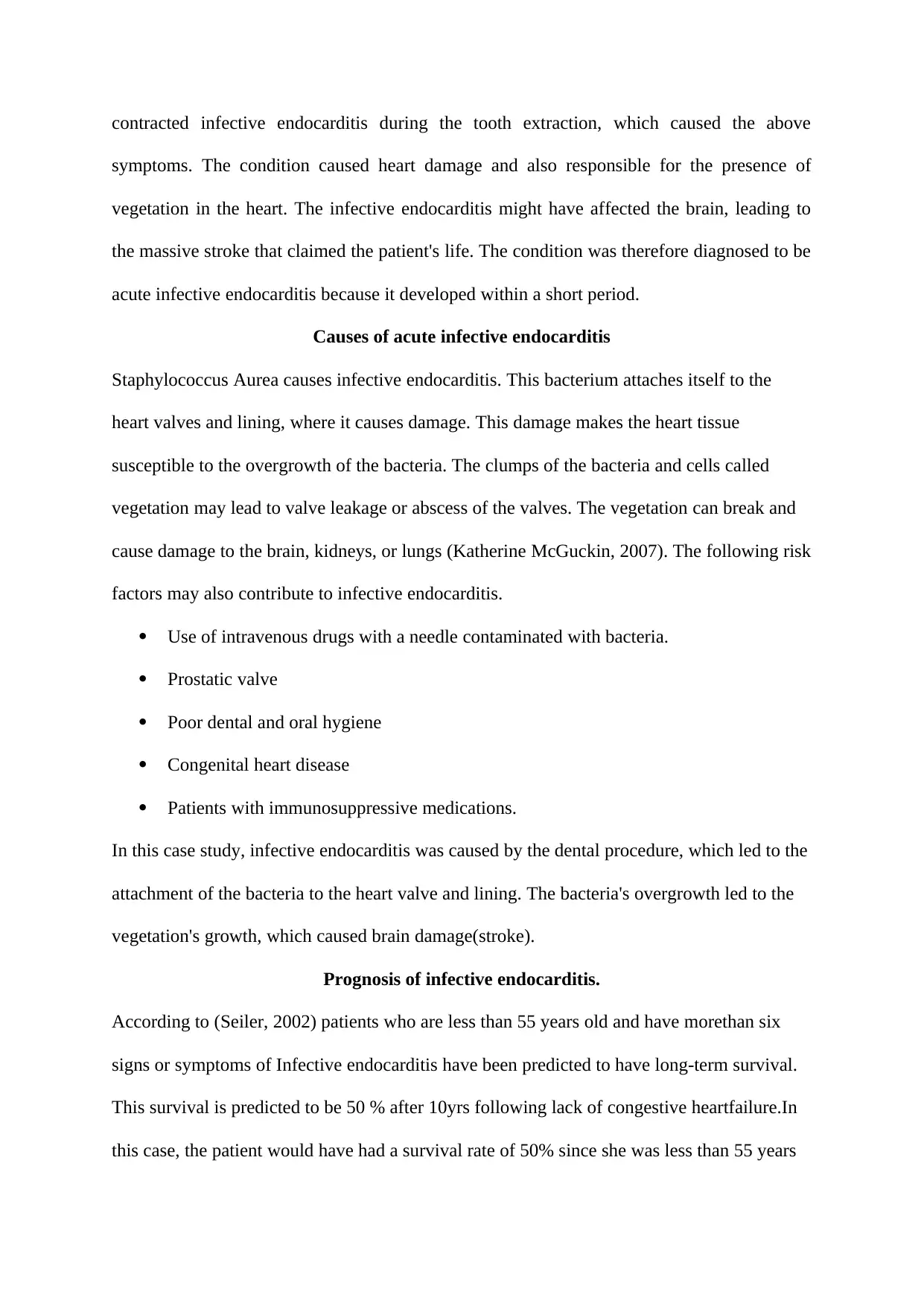
Staphylococcus Aurea causes infective endocarditis. This bacterium attaches itself to the
heart valves and lining, where it causes damage. This damage makes the heart tissue
susceptible to the overgrowth of the bacteria. The clumps of the bacteria and cells called
vegetation may lead to valve leakage or abscess of the valves. The vegetation can break and
cause damage to the brain, kidneys, or lungs (Katherine McGuckin, 2007). The following risk
factors may also contribute to infective endocarditis.
Use of intravenous drugs with a needle contaminated with bacteria.
Prostatic valve
Poor dental and oral hygiene
Congenital heart disease
Patients with immunosuppressive medications.
In this case study, infective endocarditis was caused by the dental procedure, which led to the
attachment of the bacteria to the heart valve and lining. The bacteria's overgrowth led to the
vegetation's growth, which caused brain damage(stroke).
Prognosis of infective endocarditis.
According to (Seiler, 2002) patients who are less than 55 years old and have morethan six
signs or symptoms of Infective endocarditis have been predicted to have long-term survival.
This survival is predicted to be 50 % after 10yrs following lack of congestive heartfailure.In
this case, the patient would have had a survival rate of 50% since she was less than 55 years
symptoms. The condition caused heart damage and also responsible for the presence of
vegetation in the heart. The infective endocarditis might have affected the brain, leading to
the massive stroke that claimed the patient's life. The condition was therefore diagnosed to be
acute infective endocarditis because it developed within a short period.
Causes of acute infective endocarditis
Staphylococcus Aurea causes infective endocarditis. This bacterium attaches itself to the
heart valves and lining, where it causes damage. This damage makes the heart tissue
susceptible to the overgrowth of the bacteria. The clumps of the bacteria and cells called
vegetation may lead to valve leakage or abscess of the valves. The vegetation can break and
cause damage to the brain, kidneys, or lungs (Katherine McGuckin, 2007). The following risk
factors may also contribute to infective endocarditis.
Use of intravenous drugs with a needle contaminated with bacteria.
Prostatic valve
Poor dental and oral hygiene
Congenital heart disease
Patients with immunosuppressive medications.
In this case study, infective endocarditis was caused by the dental procedure, which led to the
attachment of the bacteria to the heart valve and lining. The bacteria's overgrowth led to the
vegetation's growth, which caused brain damage(stroke).
Prognosis of infective endocarditis.
According to (Seiler, 2002) patients who are less than 55 years old and have morethan six
signs or symptoms of Infective endocarditis have been predicted to have long-term survival.
This survival is predicted to be 50 % after 10yrs following lack of congestive heartfailure.In
this case, the patient would have had a survival rate of 50% since she was less than 55 years
Paraphrase This Document
Need a fresh take? Get an instant paraphrase of this document with our AI Paraphraser

and had an early surgical treatment (tooth extraction), assuming that she did not have a
stroke.
Treatment of infective endocarditis
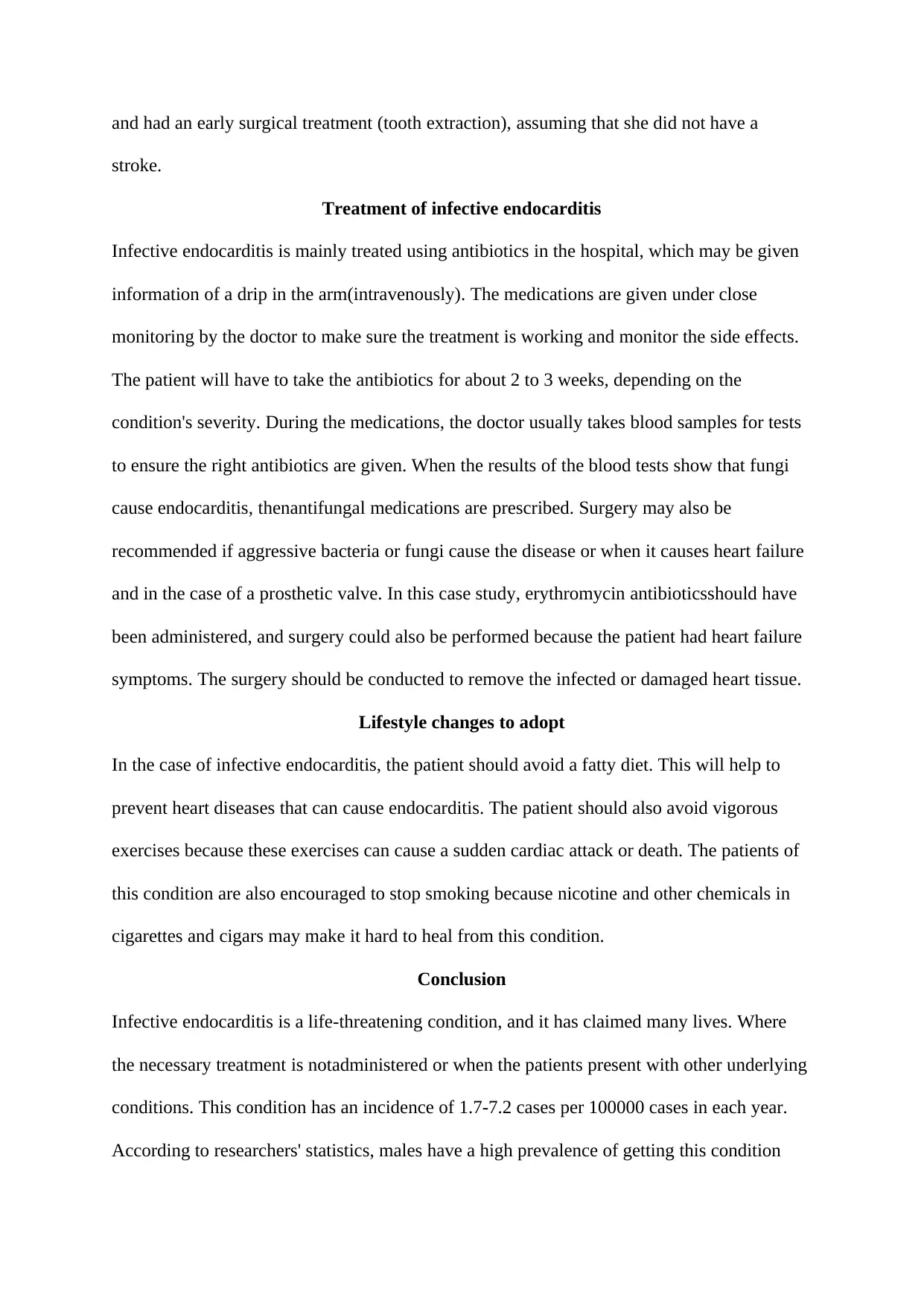
Infective endocarditis is mainly treated using antibiotics in the hospital, which may be given
information of a drip in the arm(intravenously). The medications are given under close
monitoring by the doctor to make sure the treatment is working and monitor the side effects.
The patient will have to take the antibiotics for about 2 to 3 weeks, depending on the
condition's severity. During the medications, the doctor usually takes blood samples for tests
to ensure the right antibiotics are given. When the results of the blood tests show that fungi
cause endocarditis, thenantifungal medications are prescribed. Surgery may also be
recommended if aggressive bacteria or fungi cause the disease or when it causes heart failure
and in the case of a prosthetic valve. In this case study, erythromycin antibioticsshould have
been administered, and surgery could also be performed because the patient had heart failure
symptoms. The surgery should be conducted to remove the infected or damaged heart tissue.
Lifestyle changes to adopt
In the case of infective endocarditis, the patient should avoid a fatty diet. This will help to
prevent heart diseases that can cause endocarditis. The patient should also avoid vigorous
exercises because these exercises can cause a sudden cardiac attack or death. The patients of
this condition are also encouraged to stop smoking because nicotine and other chemicals in
cigarettes and cigars may make it hard to heal from this condition.
Conclusion
Infective endocarditis is a life-threatening condition, and it has claimed many lives. Where
the necessary treatment is notadministered or when the patients present with other underlying
conditions. This condition has an incidence of 1.7-7.2 cases per 100000 cases in each year.
According to researchers' statistics, males have a high prevalence of getting this condition
stroke.
Treatment of infective endocarditis
Infective endocarditis is mainly treated using antibiotics in the hospital, which may be given
information of a drip in the arm(intravenously). The medications are given under close
monitoring by the doctor to make sure the treatment is working and monitor the side effects.
The patient will have to take the antibiotics for about 2 to 3 weeks, depending on the
condition's severity. During the medications, the doctor usually takes blood samples for tests
to ensure the right antibiotics are given. When the results of the blood tests show that fungi
cause endocarditis, thenantifungal medications are prescribed. Surgery may also be
recommended if aggressive bacteria or fungi cause the disease or when it causes heart failure
and in the case of a prosthetic valve. In this case study, erythromycin antibioticsshould have
been administered, and surgery could also be performed because the patient had heart failure
symptoms. The surgery should be conducted to remove the infected or damaged heart tissue.
Lifestyle changes to adopt
In the case of infective endocarditis, the patient should avoid a fatty diet. This will help to
prevent heart diseases that can cause endocarditis. The patient should also avoid vigorous
exercises because these exercises can cause a sudden cardiac attack or death. The patients of
this condition are also encouraged to stop smoking because nicotine and other chemicals in
cigarettes and cigars may make it hard to heal from this condition.
Conclusion
Infective endocarditis is a life-threatening condition, and it has claimed many lives. Where
the necessary treatment is notadministered or when the patients present with other underlying
conditions. This condition has an incidence of 1.7-7.2 cases per 100000 cases in each year.
According to researchers' statistics, males have a high prevalence of getting this condition

than the female with a ratio of 2:1 respectively. The most common age bracket affected by
this condition has raised from 30-40 years to 47-69 years. This condition is caused by gram-
positive bacteria (31-54%) of the infections (Guillermo Martinez MD, 2012). If it is
diagnosed, earlierpatients can have long-term survival upon the right medications and
management of the underlying conditions, if any. The patients should also observe their
lifestyles to avoid developing more complications and increase their lifespan.
this condition has raised from 30-40 years to 47-69 years. This condition is caused by gram-
positive bacteria (31-54%) of the infections (Guillermo Martinez MD, 2012). If it is
diagnosed, earlierpatients can have long-term survival upon the right medications and
management of the underlying conditions, if any. The patients should also observe their
lifestyles to avoid developing more complications and increase their lifespan.
⊘ This is a preview!⊘
Do you want full access?
Subscribe today to unlock all pages.

Trusted by 1+ million students worldwide

References
DDS, M. F., 2019. Dental Health and Endocarditis Prevention, s.l.: Web MD.
Guillermo Martinez MD, K. V. F., 2012. Infective endocarditis. Continuing education in
Anaesthesia, critical care, and pain, 12(3), pp. 134-138.
Katherine McGuckin, B. S., 2007. Infective Endocarditis, Danbury: National Organization
for Rare Disorders.
P.Armstrong, G., 2020. Infective Endocarditis. Professional cardiovascular disorders, 1(4),
p. 45.
Seiler, C., 2002. Infective endocarditis determinants of long-term outcome. Heart, 1(1), pp.
61-66.
DDS, M. F., 2019. Dental Health and Endocarditis Prevention, s.l.: Web MD.
Guillermo Martinez MD, K. V. F., 2012. Infective endocarditis. Continuing education in
Anaesthesia, critical care, and pain, 12(3), pp. 134-138.
Katherine McGuckin, B. S., 2007. Infective Endocarditis, Danbury: National Organization
for Rare Disorders.
P.Armstrong, G., 2020. Infective Endocarditis. Professional cardiovascular disorders, 1(4),
p. 45.
Seiler, C., 2002. Infective endocarditis determinants of long-term outcome. Heart, 1(1), pp.
61-66.
1 out of 7
Related Documents
Your All-in-One AI-Powered Toolkit for Academic Success.
+13062052269
info@desklib.com
Available 24*7 on WhatsApp / Email
Unlock your academic potential
Copyright © 2020–2025 A2Z Services. All Rights Reserved. Developed and managed by ZUCOL.