MGMT20144 Assessment: Business Analysis of Adani Australia

Verified

Added on  2022/10/04

|7
|1942
|17
Essay
AI Summary
This essay provides a comprehensive business case analysis of Adani Australia, focusing on its structure, governance, and environmental impact. The analysis begins with an introduction and a synopsis of the company, highlighting its operations in the energy and infrastructure sector, particularly the Carmichael coal mine. The essay delves into Adani Australia's business structure, characterized by a high level of integration and a complex corporate governance structure involving family members. It examines the environmental factors affecting the company, including greenhouse gas emissions, water management, and endangered species. The analysis also identifies key risks, such as interest rate fluctuations, labor laws, and opposition from environmental supporters. The business practices are described, including the development of the Carmichael coal mine and related infrastructure. Furthermore, the functional departments within the company, such as production, finance, and marketing, are analyzed. The essay concludes that various internal and external factors significantly influence Adani Australia's business strategy and decision-making, emphasizing the need for careful analysis of the business environment to implement efficient business decisions. References are provided at the end.

Document Page
MAnagement and business
tabler-icon-diamond-filled.svg

Paraphrase This Document

Need a fresh take? Get an instant paraphrase of this document with our AI Paraphraser
Document Page
Introduction
Over the years, the complexity in the business practices have enhanced by the virtue
of the globalised business practices, multifaceted economic and political environments, and
the use of the information and technology innovations. Because of the above mentioned,
internal and external environmental factors, the businesses are required to be increasingly
responsive in terms of the business strategies and governance structures (Ramón Oreja-
Rodríguez & Yanes-Estévez, 2010).
The following work is aimed at analysing the impact of the range of the internal and
external factors on the functioning of the business enterprises. The case study of the
organisation “Adani Australia” is chosen for the analysis. The analysis would be on the lines
of the discussion of the range of environmental factors affecting the operations of the
enterprise, together with the risks associated and evaluation of business structure of the
entity.
Analysis of the business and the corporate governance structure
The Adani Group led by Gautam Adani entered Australia in the year 2010 with the
purchase of the Greenfield Carmichael coalmine in the Galilee Basin in central Queensland.
Thus, the entity is engaged in the business of energy and infrastructure and provides range of
energy solutions.
Document Page
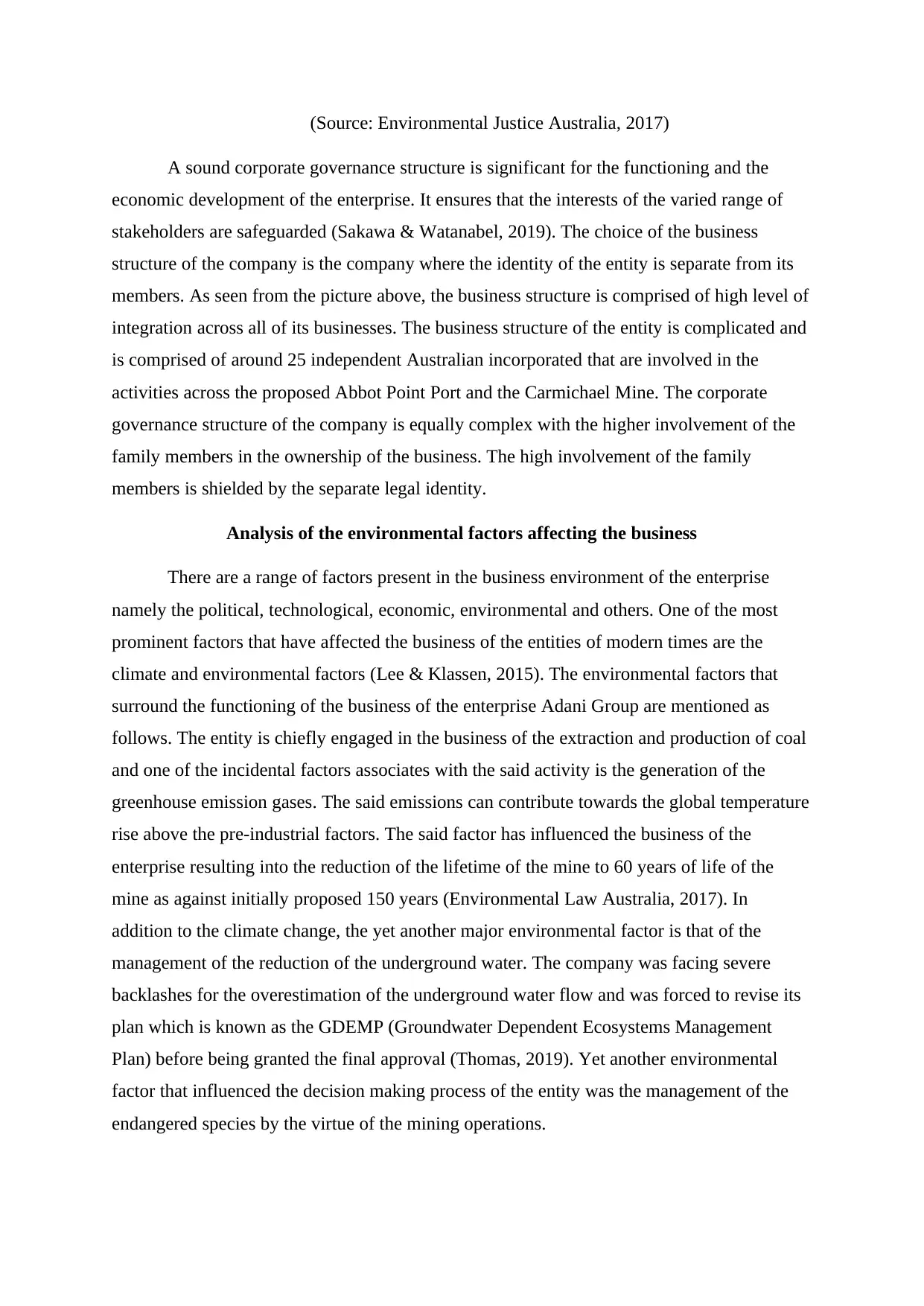
(Source: Environmental Justice Australia, 2017)
A sound corporate governance structure is significant for the functioning and the
economic development of the enterprise. It ensures that the interests of the varied range of
stakeholders are safeguarded (Sakawa & Watanabel, 2019). The choice of the business
structure of the company is the company where the identity of the entity is separate from its
members. As seen from the picture above, the business structure is comprised of high level of
integration across all of its businesses. The business structure of the entity is complicated and
is comprised of around 25 independent Australian incorporated that are involved in the
activities across the proposed Abbot Point Port and the Carmichael Mine. The corporate
governance structure of the company is equally complex with the higher involvement of the
family members in the ownership of the business. The high involvement of the family
members is shielded by the separate legal identity.
Analysis of the environmental factors affecting the business
There are a range of factors present in the business environment of the enterprise
namely the political, technological, economic, environmental and others. One of the most
prominent factors that have affected the business of the entities of modern times are the
climate and environmental factors (Lee & Klassen, 2015). The environmental factors that
surround the functioning of the business of the enterprise Adani Group are mentioned as
follows. The entity is chiefly engaged in the business of the extraction and production of coal
and one of the incidental factors associates with the said activity is the generation of the
greenhouse emission gases. The said emissions can contribute towards the global temperature
rise above the pre-industrial factors. The said factor has influenced the business of the
enterprise resulting into the reduction of the lifetime of the mine to 60 years of life of the
mine as against initially proposed 150 years (Environmental Law Australia, 2017). In
addition to the climate change, the yet another major environmental factor is that of the
management of the reduction of the underground water. The company was facing severe
backlashes for the overestimation of the underground water flow and was forced to revise its
plan which is known as the GDEMP (Groundwater Dependent Ecosystems Management
Plan) before being granted the final approval (Thomas, 2019). Yet another environmental
factor that influenced the decision making process of the entity was the management of the
endangered species by the virtue of the mining operations.
Document Page
Analysis of the risks
The modern business activities are surrounded by numerous risks owing to the
potential changes in the external environmental factors and the threats presented by the
internal environmental components. Some of the chief areas of the risk for the chosen entity
are elaborated as follows. One of the fact to be noted is that the company is based originally
out of India and hence maintains the group accounts in Rupees. In addition, the company’s
operations are highly dependent upon the exchange rates as the entities of the group are
dealing majorly in numerous foreign currencies. Hence one of the major risks of the entities
is the interest rate fluctuations. Due to wide operational and geographical expansions, the
exchange risks are significant for the business. The second major risk for the entity is posed
by the labour laws of the country Australia. It is imperative to note that the future government
can cancel the mining license of the company due to the financial and environmental risks as
well. The third major risk of the entity is the potential opposition exposure by the
environmental supporters which also restricted the financial funding for the entity. The
project is surrounded by the financial risks and the downfall can result in the falling of the
investor confidence for the entity (The Guardian, 2018). The influence of the above risks can
be easily seen in the fact that the company was long waiting for the licence of federal
approval of mining in the said region, which was granted after severe changes in the proposed
plan and after so many years of the initial investment. It is imperative for the businesses to
involve the environmental risks while planning the strategies of the businesses (Ghosal,
2015).
Analysis of the business practices
The business practices of the entity Adani Group in Australia are described as
follows. The company is working in Australia through its subsidiary company namely the
Adani Mining Pvt Ltd of the Adani Group registered in India. The organisation started its
business operations in Australia in the year 2010, by entering into an agreement with the
Australian government for the development of the country Australia's largest Carmichael coal
mine. The company Adani Australia is also engaged in the building of a railway line that
would connect the Abbot Point port to the Galilee Basin. The said construction of the railway
station is aimed at facilitating the easy transit of coal for the purpose of import. In addition to
the above, the business operations of the enterprise would include construction of thermal
tabler-icon-diamond-filled.svg

Paraphrase This Document

Need a fresh take? Get an instant paraphrase of this document with our AI Paraphraser
Document Page
coal mine which includes activities like fencing, upgrading of the bridge and roads, civil
earthworks and the water management on the site for the purpose of extraction. In the initial
stages of the project, that is after the receipt of the approval, the business activities of the
organisation would include finalisation of the contracts, mobilisation of the equipment,
recruitment of the workforce and completing inductions. As the company is operating
through its subsidiaries in number of regions, the company faces extensive backlash from the
various stakeholders because of the high involvement of the family shareholding. In addition
to the above, the business operations being majorly on lines of the natural resources, the
company faces excessive criticisms from not for profit organisations, labour groups,
environmentalists and others.
Analysis of the functional departments
The parent company has a range of business operations in the varied areas such as
coal mines, airports, road and infrastructure, defence industry, solar panel manufacturing,
edible oil industry and others. Each of the above mentioned business lines are forward and
backward integrated and thus expanding the business activities of the entity. It is imperative
to note that the ownership structure, functional department distribution plays a key role in the
management of the affairs of the enterprise. The various departments aid in filling the
important positions such as the board positions with functional experts in the respective areas
and thus facilitates coordination and integration between the activities of the enterprise
(Fraile & Fradejas, 2014). In order to manage such a comprehensive business structure, the
organisational operations of the entity Adani are divided into varied functional departments
namely the production, finance, marketing, human resources, and the logistics. The coal
sector in Australia would include the functional departments of the company to be the
mining, processing, acquisition, exploration and development of mining assets. In addition,
the company also engages in the building of the transport infrastructure which facilitates the
logistics department of the entity in terms of the cost reduction and the economies of the
scale.
Conclusion
The discussions in the previous parts aid to conclude that a range of factors contribute
towards the business strategy and the decision making of an entity. The work analysed the
various factors that contribute to the business decisions of the company Adani Australia. It
has been observed that the internal factors such as the risks and functional departments and
Document Page
the external factors such as environmental, political, and economic factors are the chief
factors that influence the business of the chosen company. In addition to the above, the work
also highlighted the business structure and the corporate governance structure of the company
to recognise it has majorly a family business. The said structures also affect the business
significantly and the choice of the business decisions is reflective of the same. Hence, t cane
be concluded that the business environment must be carefully analysed to establish and
implement efficient business decisions.
Document Page
References
Environmental Justice Australia. (2017). What governments and financiers need to know
about the Adani Group’s record overseas. Retrieved from:
https://envirojustice.org.au/sites/default/files/files/Submissions%20and%20reports/
The_Adani_Brief_by_Environmental_Justice_Australia.pdf
Environmental Law Australia (2017). Carmichael Coal (“Adani”) Mine Cases in
Queensland courts. Retrieved from: http://envlaw.com.au/carmichael-coal-mine-case/
Fraile, I. A. & Fradejas, N. (2014). Ownership Structure and Board Composition in a High
Ownership Concentration Context, European Management Journal, 32(4), 646-657.
doi.org/10.1016/j.emj.2013.10.003
Ghosal, V. (2015). Business Strategy and Firm Reorganization: Role of Changing
Environmental Standards, Sustainable Business Initiatives and Global Market
Conditions, Business Strategy and the Environment, 24(2), 123- 144.
Lee, S.-Y., & Klassen, R. D. (2015). Firms’ Response to Climate Change: The Interplay of
Business Uncertainty and Organizational Capabilities. Business Strategy and the
Environment, 25(8), 577–592. doi:10.1002/bse.1890
Ramón Oreja-Rodríguez, J., & Yanes-Estévez, V. (2010). Environmental scanning:
dynamism with rack and stack from Rasch model. Management Decision, 48(2), 260-
276.
Sakawa, H. & Watanabel, N. (2019). Family Control and Ownership Monitoring in
Stakeholder-oriented Corporate Governance. Management Decision doi:10.1108/md-
04-2018-048
The Guardian (2018). The legal clause which could allow Adani to sue Australia. Retrieved
from: theguardian.com/commentisfree/2018/dec/17/the-legal-clause-which-could-
allow-adani-to-sue-australia
Thomas, T. (2019). Adani gets go-ahead for Australian coal mine, ending 9-year wait.
Retrieved from: https://www.livemint.com/companies/news/adani-gets-go-ahead-for-
australian-coal-mine-ending-9-year-wait-1560398481310.html
chevron_up_icon
1 out of 7
circle_padding
hide_on_mobile
zoom_out_icon
[object Object]