Addis Ababa Science University: Management Functions Assignment Report
VerifiedAdded on 2022/01/20
|56
|19884
|76
Report
AI Summary
This report, submitted by Mr. Arkbom Hailu and Mr. Samuel Tekelehana, examines the four critical functions of management: Planning, Organizing, Leading, and Controlling (P-O-L-C). The report, prepared for the Addis Ababa Science and Technology University's MBA program in Industrial Management (MBAD 6011), delves into each function's characteristics, processes, and importance. The planning section covers characteristics, types of plans, and management by objective (MBO). Organizing explores the purpose, steps, and fundamentals, including division of labor, chain of command, span of control, centralization, decentralization, delegation, and departmentalization. Leading discusses leadership roles, styles, and the roles of strategist, communicator, innovator, coach, delegator, adaptor, and networker. Finally, the controlling section covers characteristics of an effective control system, various control techniques (budgetary, standard costing, financial ratio analysis, internal audit, break-even analysis, statistical control, return on investment, responsibility accounting, management audit, and PERT & CPM), and the controlling process. The report uses group discussions to emphasize key points and includes references to relevant management literature.
Addis Ababa Science and Technology University
College of Natural and Social Sciences
MBA (Industrial Management)
Modern Management Theories and Practices
(MBAD 6011)
Assignment on
Four Critical Functions of Management (P-O-L-C)
Submitted to: - Essayas Taye (BSc, MA, EMBA, PhD)
Submitted by: - Mr. Arkbom Hailu (GSR 034/13)
Mr. Samuel Tekelehana (GSR 045/13)
March 2021
College of Natural and Social Sciences
MBA (Industrial Management)
Modern Management Theories and Practices
(MBAD 6011)
Assignment on
Four Critical Functions of Management (P-O-L-C)
Submitted to: - Essayas Taye (BSc, MA, EMBA, PhD)
Submitted by: - Mr. Arkbom Hailu (GSR 034/13)
Mr. Samuel Tekelehana (GSR 045/13)
March 2021

Paraphrase This Document
Need a fresh take? Get an instant paraphrase of this document with our AI Paraphraser
Four Critical Function of Management, P-O-L-C
Modern Management Theories and Practices pg. 2
Table of Contents
1. Introduction to Management ............................................................................................................... 4
2. Planning and Plan .................................................................................................................................. 5
2.1 Characteristics or nature of planning: .......................................................................................... 7
2.2 Types of plans and planning........................................................................................................ 10
2.3 Management by Objective (MBO) .............................................................................................. 11
2.4 Activity 1 – Group Discussion ...................................................................................................... 12
3. Organizing ........................................................................................................................................... 15
3.1 Purpose of organizing ................................................................................................................. 16
3.2 Steps of organizing process......................................................................................................... 17
3.3 Fundamental of Organizing ......................................................................................................... 21
3.3.1 Division of labor/work specialization .................................................................................. 22
3.3.2 Chain of command .............................................................................................................. 24
3.3.3 Span of control/management (supervision) ....................................................................... 24
3.3.4 Centralization and decentralization .................................................................................... 25
3.3.5 Delegation of authority ....................................................................................................... 27
3.3.6 Departmentalization ........................................................................................................... 29
3.4 Group Discussion, why organizing function is important to a company. ................................... 32
4. Leading ................................................................................................................................................ 34
4.1 Leadership role ........................................................................................................................... 35
4.1.1 Strategist ............................................................................................................................. 36
4.1.2 Communicator .................................................................................................................... 36
4.1.3 Innovator ............................................................................................................................. 37
4.1.4 Coach ................................................................................................................................... 37
4.1.5 Delegator ............................................................................................................................. 37
4.1.6 Adaptor ............................................................................................................................... 37
4.1.7 Networker ........................................................................................................................... 38
4.2 Conventional leadership style ..................................................................................................... 38
4.3 Modern leadership style ............................................................................................................. 39
4.4 Group Discussion - I .................................................................................................................... 41
4.5 Group Discussion – II ................................................................................................................... 42
5. Controlling ........................................................................................................................................... 44
5.1 Characteristics of an Effective Control System ........................................................................... 46
Modern Management Theories and Practices pg. 2
Table of Contents
1. Introduction to Management ............................................................................................................... 4
2. Planning and Plan .................................................................................................................................. 5
2.1 Characteristics or nature of planning: .......................................................................................... 7
2.2 Types of plans and planning........................................................................................................ 10
2.3 Management by Objective (MBO) .............................................................................................. 11
2.4 Activity 1 – Group Discussion ...................................................................................................... 12
3. Organizing ........................................................................................................................................... 15
3.1 Purpose of organizing ................................................................................................................. 16
3.2 Steps of organizing process......................................................................................................... 17
3.3 Fundamental of Organizing ......................................................................................................... 21
3.3.1 Division of labor/work specialization .................................................................................. 22
3.3.2 Chain of command .............................................................................................................. 24
3.3.3 Span of control/management (supervision) ....................................................................... 24
3.3.4 Centralization and decentralization .................................................................................... 25
3.3.5 Delegation of authority ....................................................................................................... 27
3.3.6 Departmentalization ........................................................................................................... 29
3.4 Group Discussion, why organizing function is important to a company. ................................... 32
4. Leading ................................................................................................................................................ 34
4.1 Leadership role ........................................................................................................................... 35
4.1.1 Strategist ............................................................................................................................. 36
4.1.2 Communicator .................................................................................................................... 36
4.1.3 Innovator ............................................................................................................................. 37
4.1.4 Coach ................................................................................................................................... 37
4.1.5 Delegator ............................................................................................................................. 37
4.1.6 Adaptor ............................................................................................................................... 37
4.1.7 Networker ........................................................................................................................... 38
4.2 Conventional leadership style ..................................................................................................... 38
4.3 Modern leadership style ............................................................................................................. 39
4.4 Group Discussion - I .................................................................................................................... 41
4.5 Group Discussion – II ................................................................................................................... 42
5. Controlling ........................................................................................................................................... 44
5.1 Characteristics of an Effective Control System ........................................................................... 46
Four Critical Function of Management, P-O-L-C
Modern Management Theories and Practices pg. 3
5.1.1 Accuracy: ............................................................................................................................. 46
5.1.2 Timeliness: .......................................................................................................................... 47
5.1.3 Flexibility: ............................................................................................................................ 47
5.1.4 Acceptability: ...................................................................................................................... 47
5.1.5 Integration: ......................................................................................................................... 47
5.1.6 Economic feasibility: ........................................................................................................... 47
5.1.7 Strategic placement: ........................................................................................................... 48
5.1.8 Corrective action: ................................................................................................................ 48
5.1.9 Emphasis on exception: ...................................................................................................... 48
5.2 Types of Control Techniques in Management ............................................................................ 48
5.2.1 Budgetary Control (Traditional Practices) ........................................................................... 49
5.2.2 Standard Costing (Traditional Practices) ............................................................................. 49
5.2.3 Financial Ratio Analysis (Traditional Practices) ................................................................... 50
5.2.4 Internal Audit (Traditional Practices) .................................................................................. 50
5.2.5 Break-Even Analysis (Traditional Practices) ........................................................................ 50
5.2.6 Statistical Control (Traditional Practices) ............................................................................ 51
5.2.7 Return on Investment (Modern Techniques) ..................................................................... 51
5.2.8 Ratio Analysis (Modern Techniques) .................................................................................. 51
5.2.9 Responsibility Accounting (Modern Techniques) ............................................................... 51
5.2.10 Management Audit ............................................................................................................. 52
5.2.11 PERT & CPM ........................................................................................................................ 52
5.3 Controlling process ..................................................................................................................... 52
5.4 Group Discussion - 1 ................................................................................................................... 53
5.5 Group Discussion - II ................................................................................................................... 55
6. Reference ............................................................................................................................................ 56
Modern Management Theories and Practices pg. 3
5.1.1 Accuracy: ............................................................................................................................. 46
5.1.2 Timeliness: .......................................................................................................................... 47
5.1.3 Flexibility: ............................................................................................................................ 47
5.1.4 Acceptability: ...................................................................................................................... 47
5.1.5 Integration: ......................................................................................................................... 47
5.1.6 Economic feasibility: ........................................................................................................... 47
5.1.7 Strategic placement: ........................................................................................................... 48
5.1.8 Corrective action: ................................................................................................................ 48
5.1.9 Emphasis on exception: ...................................................................................................... 48
5.2 Types of Control Techniques in Management ............................................................................ 48
5.2.1 Budgetary Control (Traditional Practices) ........................................................................... 49
5.2.2 Standard Costing (Traditional Practices) ............................................................................. 49
5.2.3 Financial Ratio Analysis (Traditional Practices) ................................................................... 50
5.2.4 Internal Audit (Traditional Practices) .................................................................................. 50
5.2.5 Break-Even Analysis (Traditional Practices) ........................................................................ 50
5.2.6 Statistical Control (Traditional Practices) ............................................................................ 51
5.2.7 Return on Investment (Modern Techniques) ..................................................................... 51
5.2.8 Ratio Analysis (Modern Techniques) .................................................................................. 51
5.2.9 Responsibility Accounting (Modern Techniques) ............................................................... 51
5.2.10 Management Audit ............................................................................................................. 52
5.2.11 PERT & CPM ........................................................................................................................ 52
5.3 Controlling process ..................................................................................................................... 52
5.4 Group Discussion - 1 ................................................................................................................... 53
5.5 Group Discussion - II ................................................................................................................... 55
6. Reference ............................................................................................................................................ 56
⊘ This is a preview!⊘
Do you want full access?
Subscribe today to unlock all pages.

Trusted by 1+ million students worldwide
Four Critical Function of Management, P-O-L-C
Modern Management Theories and Practices pg. 4
1. Introduction to Management
Every organization, in spite of its enormity, has fully developed and implemented management
concepts that enable smooth running of activities aimed at realizing the projected vision, goals and
objectives.
The functions of management break down into four areas that take care of strategic, tactical and
operational pronouncements of an organization. Thus, management in an organization is a creative
tool of solving problems through planning, organizing, leading and controlling. In essence, the
functions of management solve a particular problem facing an organization.
Consequently, the results will provide an avenue of accomplishing the goals, objectives and
mission of the organization. The functions of management in an organization is to provide a
framework of focusing both short- and long-term views hence, foster it towards success.
Additionally, management as a decision-making process entails a premeditated vision, fixed goals,
a crafted plan, all which if executed and implemented properly, will see an organization achieve
its mission.
From in-house operations to industry, the functions of management serve to address issues
affecting a certain organization for example, effective utilization of resources, appraisal of core
competencies, evaluation of the present and prospect participants, and strategic control among
others (Himanshu, 2009, p.1).
Nevertheless, the four function of management cannot bring success into an organization minus
sound leadership from the mangers. In most cases, the manager’s style of leadership affects the
operation of an organization, positively or negatively. Thus, good managers should exhibit certain
traits and skills, which will enable an organization, achieve its mission, goals and objectives.
For example, an organization with highly skilled workers makes managers to be allowing, while
an organization with less skilled workforce mandates the manager to take a closer look on
production.
Modern Management Theories and Practices pg. 4
1. Introduction to Management
Every organization, in spite of its enormity, has fully developed and implemented management
concepts that enable smooth running of activities aimed at realizing the projected vision, goals and
objectives.
The functions of management break down into four areas that take care of strategic, tactical and
operational pronouncements of an organization. Thus, management in an organization is a creative
tool of solving problems through planning, organizing, leading and controlling. In essence, the
functions of management solve a particular problem facing an organization.
Consequently, the results will provide an avenue of accomplishing the goals, objectives and
mission of the organization. The functions of management in an organization is to provide a
framework of focusing both short- and long-term views hence, foster it towards success.
Additionally, management as a decision-making process entails a premeditated vision, fixed goals,
a crafted plan, all which if executed and implemented properly, will see an organization achieve
its mission.
From in-house operations to industry, the functions of management serve to address issues
affecting a certain organization for example, effective utilization of resources, appraisal of core
competencies, evaluation of the present and prospect participants, and strategic control among
others (Himanshu, 2009, p.1).
Nevertheless, the four function of management cannot bring success into an organization minus
sound leadership from the mangers. In most cases, the manager’s style of leadership affects the
operation of an organization, positively or negatively. Thus, good managers should exhibit certain
traits and skills, which will enable an organization, achieve its mission, goals and objectives.
For example, an organization with highly skilled workers makes managers to be allowing, while
an organization with less skilled workforce mandates the manager to take a closer look on
production.
Paraphrase This Document
Need a fresh take? Get an instant paraphrase of this document with our AI Paraphraser
Four Critical Function of Management, P-O-L-C
Modern Management Theories and Practices pg. 5
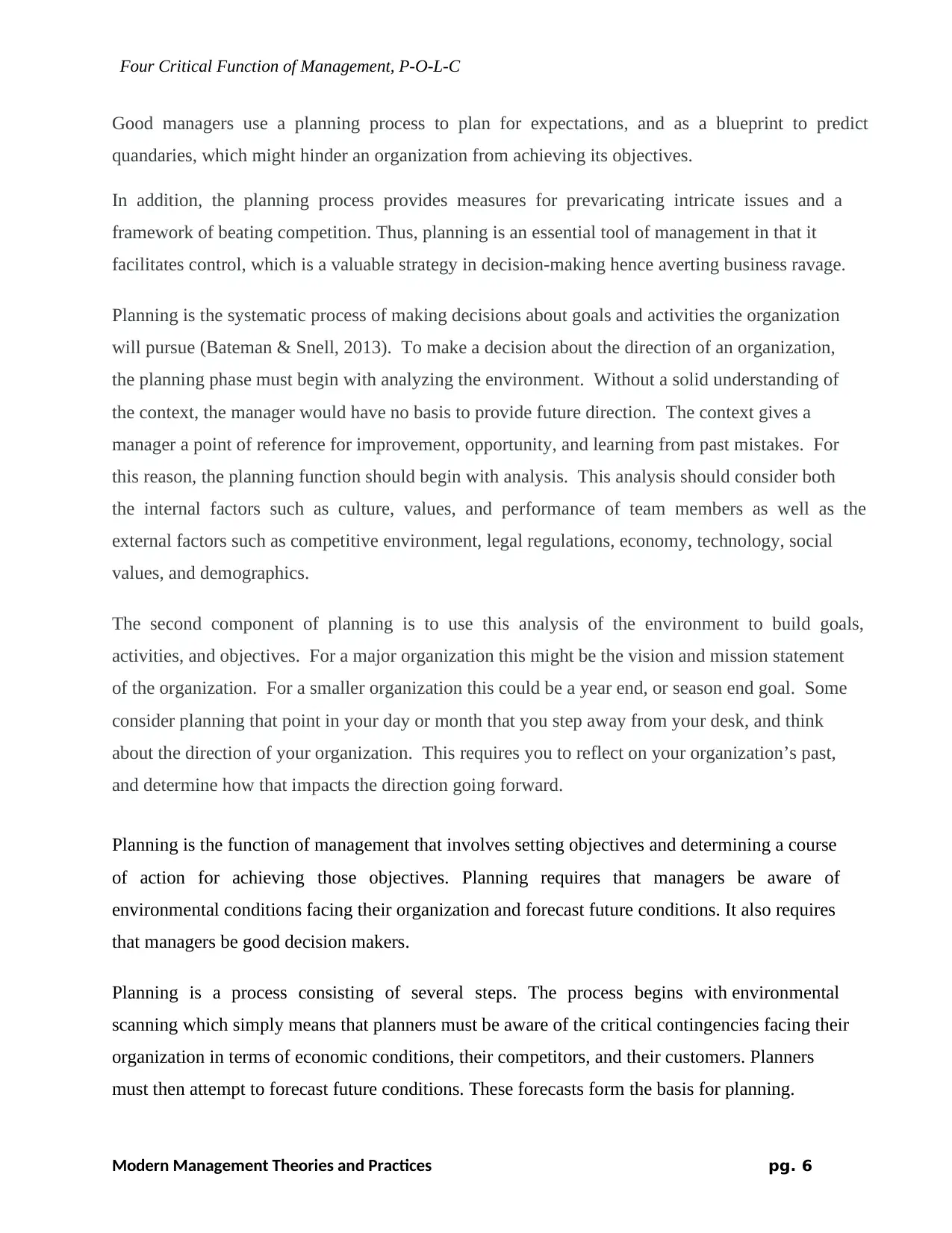
The management process by which we pursue goals includes planning, organizing, leading, and
controlling. These are “the how” a manager pursues organizational goals, and are universally
known as the four functions of management. They stem from the work of a French mining
administrator, Henri Fayol, who first identified management as a practice that could be improved
through the use of five functions – planning, organizing, commanding, coordinating, and
controlling. Since he published his work in 1916, it is decided that leading people through
motivation and incentivization works much better than telling them what to do (e.g. commanding
and coordinating). We use the term leading instead of these practices.
Thus, good managers are the ones who flex their style, train and inspire employees to work towards
the realization of vision, goals and objectives. The paper will examine the four functions of
management namely: planning, organizing, directing and controlling within an organization
(Haridimos, 2004, pp. 289-301).
Fig 1.1 The P-O-L-C Framework
2. Planning and Plan
This is the first contrivance of the four function of an organization’s management process.
Primarily, the success of an organization depends on the planning procedure. The planning
procedure is the one that determines whether a manager is successful or not. Planning provides
logical understanding on how to make decisions, which will drive an organization towards the path
of attaining its objectives.
Modern Management Theories and Practices pg. 5
The management process by which we pursue goals includes planning, organizing, leading, and
controlling. These are “the how” a manager pursues organizational goals, and are universally
known as the four functions of management. They stem from the work of a French mining
administrator, Henri Fayol, who first identified management as a practice that could be improved
through the use of five functions – planning, organizing, commanding, coordinating, and
controlling. Since he published his work in 1916, it is decided that leading people through
motivation and incentivization works much better than telling them what to do (e.g. commanding
and coordinating). We use the term leading instead of these practices.
Thus, good managers are the ones who flex their style, train and inspire employees to work towards
the realization of vision, goals and objectives. The paper will examine the four functions of
management namely: planning, organizing, directing and controlling within an organization
(Haridimos, 2004, pp. 289-301).
Fig 1.1 The P-O-L-C Framework
2. Planning and Plan
This is the first contrivance of the four function of an organization’s management process.
Primarily, the success of an organization depends on the planning procedure. The planning
procedure is the one that determines whether a manager is successful or not. Planning provides
logical understanding on how to make decisions, which will drive an organization towards the path
of attaining its objectives.
Four Critical Function of Management, P-O-L-C
Modern Management Theories and Practices pg. 6
Good managers use a planning process to plan for expectations, and as a blueprint to predict
quandaries, which might hinder an organization from achieving its objectives.
In addition, the planning process provides measures for prevaricating intricate issues and a
framework of beating competition. Thus, planning is an essential tool of management in that it
facilitates control, which is a valuable strategy in decision-making hence averting business ravage.
Planning is the systematic process of making decisions about goals and activities the organization
will pursue (Bateman & Snell, 2013). To make a decision about the direction of an organization,
the planning phase must begin with analyzing the environment. Without a solid understanding of
the context, the manager would have no basis to provide future direction. The context gives a
manager a point of reference for improvement, opportunity, and learning from past mistakes. For
this reason, the planning function should begin with analysis. This analysis should consider both
the internal factors such as culture, values, and performance of team members as well as the
external factors such as competitive environment, legal regulations, economy, technology, social
values, and demographics.
The second component of planning is to use this analysis of the environment to build goals,
activities, and objectives. For a major organization this might be the vision and mission statement
of the organization. For a smaller organization this could be a year end, or season end goal. Some
consider planning that point in your day or month that you step away from your desk, and think
about the direction of your organization. This requires you to reflect on your organization’s past,
and determine how that impacts the direction going forward.
Planning is the function of management that involves setting objectives and determining a course
of action for achieving those objectives. Planning requires that managers be aware of
environmental conditions facing their organization and forecast future conditions. It also requires
that managers be good decision makers.
Planning is a process consisting of several steps. The process begins with environmental
scanning which simply means that planners must be aware of the critical contingencies facing their
organization in terms of economic conditions, their competitors, and their customers. Planners
must then attempt to forecast future conditions. These forecasts form the basis for planning.
Modern Management Theories and Practices pg. 6
Good managers use a planning process to plan for expectations, and as a blueprint to predict
quandaries, which might hinder an organization from achieving its objectives.
In addition, the planning process provides measures for prevaricating intricate issues and a
framework of beating competition. Thus, planning is an essential tool of management in that it
facilitates control, which is a valuable strategy in decision-making hence averting business ravage.
Planning is the systematic process of making decisions about goals and activities the organization
will pursue (Bateman & Snell, 2013). To make a decision about the direction of an organization,
the planning phase must begin with analyzing the environment. Without a solid understanding of
the context, the manager would have no basis to provide future direction. The context gives a
manager a point of reference for improvement, opportunity, and learning from past mistakes. For
this reason, the planning function should begin with analysis. This analysis should consider both
the internal factors such as culture, values, and performance of team members as well as the
external factors such as competitive environment, legal regulations, economy, technology, social
values, and demographics.
The second component of planning is to use this analysis of the environment to build goals,
activities, and objectives. For a major organization this might be the vision and mission statement
of the organization. For a smaller organization this could be a year end, or season end goal. Some
consider planning that point in your day or month that you step away from your desk, and think
about the direction of your organization. This requires you to reflect on your organization’s past,
and determine how that impacts the direction going forward.
Planning is the function of management that involves setting objectives and determining a course
of action for achieving those objectives. Planning requires that managers be aware of
environmental conditions facing their organization and forecast future conditions. It also requires
that managers be good decision makers.
Planning is a process consisting of several steps. The process begins with environmental
scanning which simply means that planners must be aware of the critical contingencies facing their
organization in terms of economic conditions, their competitors, and their customers. Planners
must then attempt to forecast future conditions. These forecasts form the basis for planning.
⊘ This is a preview!⊘
Do you want full access?
Subscribe today to unlock all pages.
Trusted by 1+ million students worldwide
Four Critical Function of Management, P-O-L-C
Modern Management Theories and Practices pg. 7
Planners must establish objectives, which are statements of what needs to be achieved and when.
Planners must then identify alternative courses of action for achieving objectives. After evaluating
the various alternatives, planners must make decisions about the best courses of action for
achieving objectives. They must then formulate necessary steps and ensure effective
implementation of plans. Finally, planners must constantly evaluate the success of their plans and
take corrective action when necessary.
2.1 Characteristics or nature of planning:
Planning involves thinking and analysis of information, arriving at certain assumptions in
connection with what is likely to happen in the future and then formulating the activities required
to achieve desired results or goals or objectives. Some Characteristics of Planning are as follows:
1 - Planning is an Intellectual Process:
Planning is chiefly an intellectual process which means ‘thinking before doing’. The success of
planning depends on the manager and his ability to collect the facts which are likely to affect
planning-whether these facts are connected with the present situation or the estimated future
changings; how correctly he studies and evaluates these facts; and how correctly he takes his
decisions on their basis.
The whole process happens to be intellectual and for the successful completion of all these
activities the planner should have far-sightedness, imaginative power and decision – making
capacity.
A planner should mainly consider the following questions:
• What is to be done?
• (How is it to be done?
• When is it to be done?
• By whom is it to be done?
Taking decisions on all these questions depends on the competence of the planner. Therefore, it
can be said that planning requires thinking at every step. Hence, it can be considered as an
intellectual process.
Modern Management Theories and Practices pg. 7
Planners must establish objectives, which are statements of what needs to be achieved and when.
Planners must then identify alternative courses of action for achieving objectives. After evaluating
the various alternatives, planners must make decisions about the best courses of action for
achieving objectives. They must then formulate necessary steps and ensure effective
implementation of plans. Finally, planners must constantly evaluate the success of their plans and
take corrective action when necessary.
2.1 Characteristics or nature of planning:
Planning involves thinking and analysis of information, arriving at certain assumptions in
connection with what is likely to happen in the future and then formulating the activities required
to achieve desired results or goals or objectives. Some Characteristics of Planning are as follows:
1 - Planning is an Intellectual Process:
Planning is chiefly an intellectual process which means ‘thinking before doing’. The success of
planning depends on the manager and his ability to collect the facts which are likely to affect
planning-whether these facts are connected with the present situation or the estimated future
changings; how correctly he studies and evaluates these facts; and how correctly he takes his
decisions on their basis.
The whole process happens to be intellectual and for the successful completion of all these
activities the planner should have far-sightedness, imaginative power and decision – making
capacity.
A planner should mainly consider the following questions:
• What is to be done?
• (How is it to be done?
• When is it to be done?
• By whom is it to be done?
Taking decisions on all these questions depends on the competence of the planner. Therefore, it
can be said that planning requires thinking at every step. Hence, it can be considered as an
intellectual process.
Paraphrase This Document
Need a fresh take? Get an instant paraphrase of this document with our AI Paraphraser
Four Critical Function of Management, P-O-L-C
Modern Management Theories and Practices pg. 8
2 - Planning is Selection of the Best Alternative:
The second important characteristic of planning is the selection of the best alternative. There can
be many ways of doing a work and the planner selects the best possible alternative. Therefore, it
can be said that planning involves the selection of the best alternative and rejection of the
inappropriate ones.
3 - Planning is all Pervasive:
It will be appropriate to describe planning as ail pervasive because it operates at all the levels of
management in an enterprise. It is an important function of every manager to plan things whether
he is a managing director or simply a foreman in a factory. Some people are of the opinion that
planning is the job of only the high-level managers but it is not true.
It can, however, be admitted that the high-level managers spend more time in comparison to the
middle-level or lower-level managers in the work of planning. It is, therefore, clear that all the
managers working in an enterprise have to plan their activities.
4 - Planning is the Primary Function of Management:
Planning is the primary function of management and all other functions like organizing; staffing,
leading and controlling come later. In the absence of planning no other function of management
can be completed. Undoubtedly planning is the first function of management but it does not mean
that after planning when other functions start it is not needed.
In reality planning is required in the performance of other functions of management. Without
planning neither organization can be created, nor can staffing be done. Similarly, planning is
needed in case of leading and controlling.
5 - Planning is Forecasting:
Planning always takes into consideration the future. Under planning, on the basis of collected facts,
the future is anticipated and proper decision taken. Thus, we can say that forecasting is the essence
of planning.
Modern Management Theories and Practices pg. 8
2 - Planning is Selection of the Best Alternative:
The second important characteristic of planning is the selection of the best alternative. There can
be many ways of doing a work and the planner selects the best possible alternative. Therefore, it
can be said that planning involves the selection of the best alternative and rejection of the
inappropriate ones.
3 - Planning is all Pervasive:
It will be appropriate to describe planning as ail pervasive because it operates at all the levels of
management in an enterprise. It is an important function of every manager to plan things whether
he is a managing director or simply a foreman in a factory. Some people are of the opinion that
planning is the job of only the high-level managers but it is not true.
It can, however, be admitted that the high-level managers spend more time in comparison to the
middle-level or lower-level managers in the work of planning. It is, therefore, clear that all the
managers working in an enterprise have to plan their activities.
4 - Planning is the Primary Function of Management:
Planning is the primary function of management and all other functions like organizing; staffing,
leading and controlling come later. In the absence of planning no other function of management
can be completed. Undoubtedly planning is the first function of management but it does not mean
that after planning when other functions start it is not needed.
In reality planning is required in the performance of other functions of management. Without
planning neither organization can be created, nor can staffing be done. Similarly, planning is
needed in case of leading and controlling.
5 - Planning is Forecasting:
Planning always takes into consideration the future. Under planning, on the basis of collected facts,
the future is anticipated and proper decision taken. Thus, we can say that forecasting is the essence
of planning.
Four Critical Function of Management, P-O-L-C
Modern Management Theories and Practices pg. 9
6 - Planning is a Continuous Process:
Planning is the process which begins with the establishment of the organization and ends with the
organization. In other words, the process of planning continues so long as the organization
continues to exist. A manager starts planning before the work is started and when one work is
accomplished, planning for the other begins and this process continues. Thus, planning is a
continuous process.
7 - Planning is Flexible:
Planning involves forecasting the future which is uncertain. It is quite possible that the basis of the
forecast made by the manager or the facts on which he makes his planning undergo some changes
after sometime. In case, he finds any such thing happening, he immediately brings in changes in
his planning according to the changed facts or situations. It can thus be said that planning is a
flexible process.
8 - Planning is Goal-Oriented:
An enterprise in established with some pre-determined objectives and planning tells us how to
achieve those objectives. First of all, the objectives of the organization are determined and then
planning is made to achieve them. Therefore, it is clear that planning without some objectives is
meaningless.
9 - Planning is an Interdependent Process:
The activities of an enterprise are divided into many departments like Purchase department, Sales
department, Production department, Finance department, Personnel department, etc. All these
departments have their own separate plans which are the parts of a master plan. All the
departmental plans depend on one and other. If some change becomes necessary in the plan of a
particular department due to some reason, the plans of all other departments have to be modified
accordingly.
For example- if the sales department achieves more sales than the anticipated quantity, its plans
shall have to be modified resulting in more purchases and production to cope with the demand of
Modern Management Theories and Practices pg. 9
6 - Planning is a Continuous Process:
Planning is the process which begins with the establishment of the organization and ends with the
organization. In other words, the process of planning continues so long as the organization
continues to exist. A manager starts planning before the work is started and when one work is
accomplished, planning for the other begins and this process continues. Thus, planning is a
continuous process.
7 - Planning is Flexible:
Planning involves forecasting the future which is uncertain. It is quite possible that the basis of the
forecast made by the manager or the facts on which he makes his planning undergo some changes
after sometime. In case, he finds any such thing happening, he immediately brings in changes in
his planning according to the changed facts or situations. It can thus be said that planning is a
flexible process.
8 - Planning is Goal-Oriented:
An enterprise in established with some pre-determined objectives and planning tells us how to
achieve those objectives. First of all, the objectives of the organization are determined and then
planning is made to achieve them. Therefore, it is clear that planning without some objectives is
meaningless.
9 - Planning is an Interdependent Process:
The activities of an enterprise are divided into many departments like Purchase department, Sales
department, Production department, Finance department, Personnel department, etc. All these
departments have their own separate plans which are the parts of a master plan. All the
departmental plans depend on one and other. If some change becomes necessary in the plan of a
particular department due to some reason, the plans of all other departments have to be modified
accordingly.
For example- if the sales department achieves more sales than the anticipated quantity, its plans
shall have to be modified resulting in more purchases and production to cope with the demand of
⊘ This is a preview!⊘
Do you want full access?
Subscribe today to unlock all pages.
Trusted by 1+ million students worldwide
Four Critical Function of Management, P-O-L-C
Modern Management Theories and Practices pg. 10
the sales department. This, in turn, necessitates changes in the plans of the purchase and production
departments as well. Thus, the departmental planning depends on one and other.
10 - Planning Leads to Efficiency and Economy:
Planning makes it possible to utilise the available human and material resources in the most
favorable manner in an organization. Capital, labor, material, machinery, etc., are utilized in a
manner to produce the maximum quantity of the best quality goods with minimum cost.
11- Planning Considers Limiting Factors:
The quantity of available resources of production has to be kept in mind before planning. If a
manager ignores the limited resources, planning is bound to fail. For example- if the raw material
can be available up to a certain limit for a certain period, then the raw material will be the limited
factor. Only after its availability is decided, the other activities like production, sales, etc., can be
thought of.
12 - Planning Creates Coordination:
In any organization coordination of all the activities is necessary to run the work smoothly. With
the help of planning ‘what’, ‘why’, ‘who’, ‘where’, ‘when’, etc., of everything is clarified. Doubts
are cleared and coordination is established. Planning makes it clear as to what is to be done, why
it is being done, who will do it, where it will be done and when it will be done. On the other hand,
without planning nobody will know what is to be done and what is not to be done.
2.2 Types of plans and planning.
• Strategic planning involves analyzing competitive opportunities and threats, as well as
the strengths and weaknesses of the organization, and then determining how to position the
organization to compete effectively in their environment. Strategic planning has a long-
time frame, often three years or more. Strategic planning generally includes the entire
organization and includes formulation of objectives. Strategic planning is often based on
the organization’s mission, which is its fundamental reason for existence. An
organization’s top management most often conducts strategic planning.
Modern Management Theories and Practices pg. 10
the sales department. This, in turn, necessitates changes in the plans of the purchase and production
departments as well. Thus, the departmental planning depends on one and other.
10 - Planning Leads to Efficiency and Economy:
Planning makes it possible to utilise the available human and material resources in the most
favorable manner in an organization. Capital, labor, material, machinery, etc., are utilized in a
manner to produce the maximum quantity of the best quality goods with minimum cost.
11- Planning Considers Limiting Factors:
The quantity of available resources of production has to be kept in mind before planning. If a
manager ignores the limited resources, planning is bound to fail. For example- if the raw material
can be available up to a certain limit for a certain period, then the raw material will be the limited
factor. Only after its availability is decided, the other activities like production, sales, etc., can be
thought of.
12 - Planning Creates Coordination:
In any organization coordination of all the activities is necessary to run the work smoothly. With
the help of planning ‘what’, ‘why’, ‘who’, ‘where’, ‘when’, etc., of everything is clarified. Doubts
are cleared and coordination is established. Planning makes it clear as to what is to be done, why
it is being done, who will do it, where it will be done and when it will be done. On the other hand,
without planning nobody will know what is to be done and what is not to be done.
2.2 Types of plans and planning.
• Strategic planning involves analyzing competitive opportunities and threats, as well as
the strengths and weaknesses of the organization, and then determining how to position the
organization to compete effectively in their environment. Strategic planning has a long-
time frame, often three years or more. Strategic planning generally includes the entire
organization and includes formulation of objectives. Strategic planning is often based on
the organization’s mission, which is its fundamental reason for existence. An
organization’s top management most often conducts strategic planning.
Paraphrase This Document
Need a fresh take? Get an instant paraphrase of this document with our AI Paraphraser
Four Critical Function of Management, P-O-L-C
Modern Management Theories and Practices pg. 11
• Tactical planning is intermediate-range (one to three years) planning that is designed to
develop relatively concrete and specific means to implement the strategic plan. Middle-
level managers often engage in tactical planning.
• Operational planning generally assumes the existence of organization-wide or subunit
goals and objectives and specifies ways to achieve them. Operational planning is short-
range (less than a year) planning that is designed to develop specific action steps that
support the strategic and tactical plans.
2.3 Management by Objective (MBO)
The “Management by Objective” (MBO) approach, in the sense that it requires all managers to set
specific objectives to be achieved in the future and encourages them to continually ask what more
can be done, is offered as a partial answer to this question of organizational vitality and creativity.
As a term, “Management by Objectives” was first used by Peter Drucker in 1954. As a
management approach, it has been further developed by many management theoreticians, among
them Douglas McGregor, George Odiorne, and John Humble. Essentially, MBO is a process or
system designed for supervisory managers in which a manager and his or her subordinate sit down
and jointly set specific objectives to be accomplished within a set time frame and for which the
subordinate is then held directly responsible. All organizations exist for a purpose, and, to achieve
that purpose, top management sets goals and objectives that are common to the whole organization.
In organizations that are not using the MBO approach, most planning and objective setting to
achieve these common organizational goals is directed downward or top down approach. Plans
and objectives are passed down from one managerial level to another, and subordinates are told
what to do and what they will be held responsible for. The MBO approach injects an element of
dialogue into the process of passing plans and objectives from one organizational level to another.
The superior brings specific goals and measures for the subordinate to a meeting with this
subordinate, who also brings specific objectives and measures that he or she sees as appropriate or
contributing to better accomplishment of the job. Together they develop a group of specific goals,
measures of achievement, and time frames in which the subordinate commits himself or herself to
the accomplishment of those goals. The subordinate is then held responsible for the
accomplishment of the goals. The manager and the subordinate may have occasional progress
reviews and reevaluation meetings, but at the end of the set period of time, the subordinate is
Modern Management Theories and Practices pg. 11
• Tactical planning is intermediate-range (one to three years) planning that is designed to
develop relatively concrete and specific means to implement the strategic plan. Middle-
level managers often engage in tactical planning.
• Operational planning generally assumes the existence of organization-wide or subunit
goals and objectives and specifies ways to achieve them. Operational planning is short-
range (less than a year) planning that is designed to develop specific action steps that
support the strategic and tactical plans.
2.3 Management by Objective (MBO)
The “Management by Objective” (MBO) approach, in the sense that it requires all managers to set
specific objectives to be achieved in the future and encourages them to continually ask what more
can be done, is offered as a partial answer to this question of organizational vitality and creativity.
As a term, “Management by Objectives” was first used by Peter Drucker in 1954. As a
management approach, it has been further developed by many management theoreticians, among
them Douglas McGregor, George Odiorne, and John Humble. Essentially, MBO is a process or
system designed for supervisory managers in which a manager and his or her subordinate sit down
and jointly set specific objectives to be accomplished within a set time frame and for which the
subordinate is then held directly responsible. All organizations exist for a purpose, and, to achieve
that purpose, top management sets goals and objectives that are common to the whole organization.
In organizations that are not using the MBO approach, most planning and objective setting to
achieve these common organizational goals is directed downward or top down approach. Plans
and objectives are passed down from one managerial level to another, and subordinates are told
what to do and what they will be held responsible for. The MBO approach injects an element of
dialogue into the process of passing plans and objectives from one organizational level to another.
The superior brings specific goals and measures for the subordinate to a meeting with this
subordinate, who also brings specific objectives and measures that he or she sees as appropriate or
contributing to better accomplishment of the job. Together they develop a group of specific goals,
measures of achievement, and time frames in which the subordinate commits himself or herself to
the accomplishment of those goals. The subordinate is then held responsible for the
accomplishment of the goals. The manager and the subordinate may have occasional progress
reviews and reevaluation meetings, but at the end of the set period of time, the subordinate is
Four Critical Function of Management, P-O-L-C
Modern Management Theories and Practices pg. 12
judged on the results the he or she has achieved. He or she may be rewarded for success by
promotion or salary increases or he or she may be fired or transferred to a job that will provide
needed training or supervision. Whatever the outcome, it will be based on the accomplishment of
the goals the subordinate had some part in setting and committed himself or herself to achieving
2.4 Activity 1 – Group Discussion
You are the manager of the online game developing company. The goal of the company is to
obtain larger market shares in the industry. (The use of SMART goal setting can help managers
save time and resources by making the planning process more efficient and effective)
1) Setting company goals
2) Listing alternative ways of achieving the goals
3) Selecting best way to achieve the goals
4) Developing plans to pursue the chosen alternative
5) Putting plans into action
In the process of planning one of the critical criterial is observing the environment and this
environment might be internal or external one. The internal one will scrutinize the capacity of the
company in the finance and human resource. technologies and the penetration capacity with the
existing market. And, the external factor can include competitive environment, legal regulation,
economy, technology, social value and demographic (market segment, rural or urban place). The
planning process will systematically consider those factors to achieve the goals and activities of
the organization.
1) Company Goal
Being the leading game developing company in Ethiopia with updated software programing and
high-quality resolution
• Generate game script and story board, write code for games for a variety of formats, such
as PCs, consoles, web browsers and mobile phones.
• Employed high skilled programmer for high quality programing script and up to date video
game development
• Develop branded playable game, related with local traditional play
Modern Management Theories and Practices pg. 12
judged on the results the he or she has achieved. He or she may be rewarded for success by
promotion or salary increases or he or she may be fired or transferred to a job that will provide
needed training or supervision. Whatever the outcome, it will be based on the accomplishment of
the goals the subordinate had some part in setting and committed himself or herself to achieving
2.4 Activity 1 – Group Discussion
You are the manager of the online game developing company. The goal of the company is to
obtain larger market shares in the industry. (The use of SMART goal setting can help managers
save time and resources by making the planning process more efficient and effective)
1) Setting company goals
2) Listing alternative ways of achieving the goals
3) Selecting best way to achieve the goals
4) Developing plans to pursue the chosen alternative
5) Putting plans into action
In the process of planning one of the critical criterial is observing the environment and this
environment might be internal or external one. The internal one will scrutinize the capacity of the
company in the finance and human resource. technologies and the penetration capacity with the
existing market. And, the external factor can include competitive environment, legal regulation,
economy, technology, social value and demographic (market segment, rural or urban place). The
planning process will systematically consider those factors to achieve the goals and activities of
the organization.
1) Company Goal
Being the leading game developing company in Ethiopia with updated software programing and
high-quality resolution
• Generate game script and story board, write code for games for a variety of formats, such
as PCs, consoles, web browsers and mobile phones.
• Employed high skilled programmer for high quality programing script and up to date video
game development
• Develop branded playable game, related with local traditional play
⊘ This is a preview!⊘
Do you want full access?
Subscribe today to unlock all pages.
Trusted by 1+ million students worldwide

1 out of 56


Related Documents


Your All-in-One AI-Powered Toolkit for Academic Success.
+13062052269
info@desklib.com
Available 24*7 on WhatsApp / Email
![[object Object]](/_next/static/media/star-bottom.7253800d.svg)
Unlock your academic potential
Copyright © 2020–2026 A2Z Services. All Rights Reserved. Developed and managed by ZUCOL.