Executive Summary: Addressing Employee Turnover in Service

Verified

Added on  2023/05/28

|8
|665
|198
Presentation
AI Summary
This presentation provides an executive summary of a program designed to address employee turnover in the service industry. It highlights the issue of inadequate employee motivation and proposes solutions aligned with the mission and vision of service-based organizations. The presentation emphasizes the role of personal values in selecting and designing effective interventions, particularly in areas like remuneration and interpersonal communication. Ultimately, it argues that strong communication and interaction between employees and management are crucial for enhancing employee satisfaction and reducing turnover rates. The document includes references to support its claims. Desklib offers a platform to explore similar assignments and study resources.
Document Page
SERVICE INDUSTRY
ANALYSIS
tabler-icon-diamond-filled.svg

Paraphrase This Document

Need a fresh take? Get an instant paraphrase of this document with our AI Paraphraser
Document Page
introduction
The program is based on dynamic growth
based activities which are performed by
organizations in the service industry. The
methods which can be implemented for the
reduction of employee turnover rates in
organizations which are a part of the service
industry. The levels of employee motivation
which are required for reducing the rates of
turnover is an important part of the program
(Ahmad et al., 2014).
Document Page
About the issue and proposal
solution
The issue which has been raised based on the
program is related to the lack of proper levels
of motivation for the employees. The mission
and vision of the service based organizations
and their link with the performance of
employees is analysed as a major part of the
program. The values which are effective for the
employee satisfaction levels are analysed in the
program (Hargie, 2016).
Document Page
Ways by which personal values affect
selection and design of the program
The selection of the program and implementation of
different initiatives is based on the ways by which
they are able to affect the different initiatives is based
on the values that I have gained. The personal value
system which has been developed by me is based on
the ways by which my behaviour is guided with
respect to the implementation of proposed solutions.
The management of remuneration levels is considered
to be a major part of the entire operations (Petrovici &
Dobrescu, 2014).
tabler-icon-diamond-filled.svg

Paraphrase This Document

Need a fresh take? Get an instant paraphrase of this document with our AI Paraphraser
Document Page
Influence of personal values on
selection and design of the program
Interpersonal skills are based on the ways people are
able to communicate and further interact with people
on individual basis and with the help of groups as well.
The strong levels of interpersonal skills are considered
to be highly successful in the personal and
professional lives of people. The proper
implementation of the proposed solutions will be
based on the ways by which I am able to
communicate with the others in the organization
(Petrovici & Dobrescu, 2014).
Document Page
Conclusion
The analysis has been able to depict that the
levels of communication within an organization
is able to play a key role in the ways by which
different initiatives related to employee
satisfaction can be implemented. The levels of
interaction between the employees and
management are considered to be important
factors in order to increase the levels of
satisfaction within the organizations.
Document Page
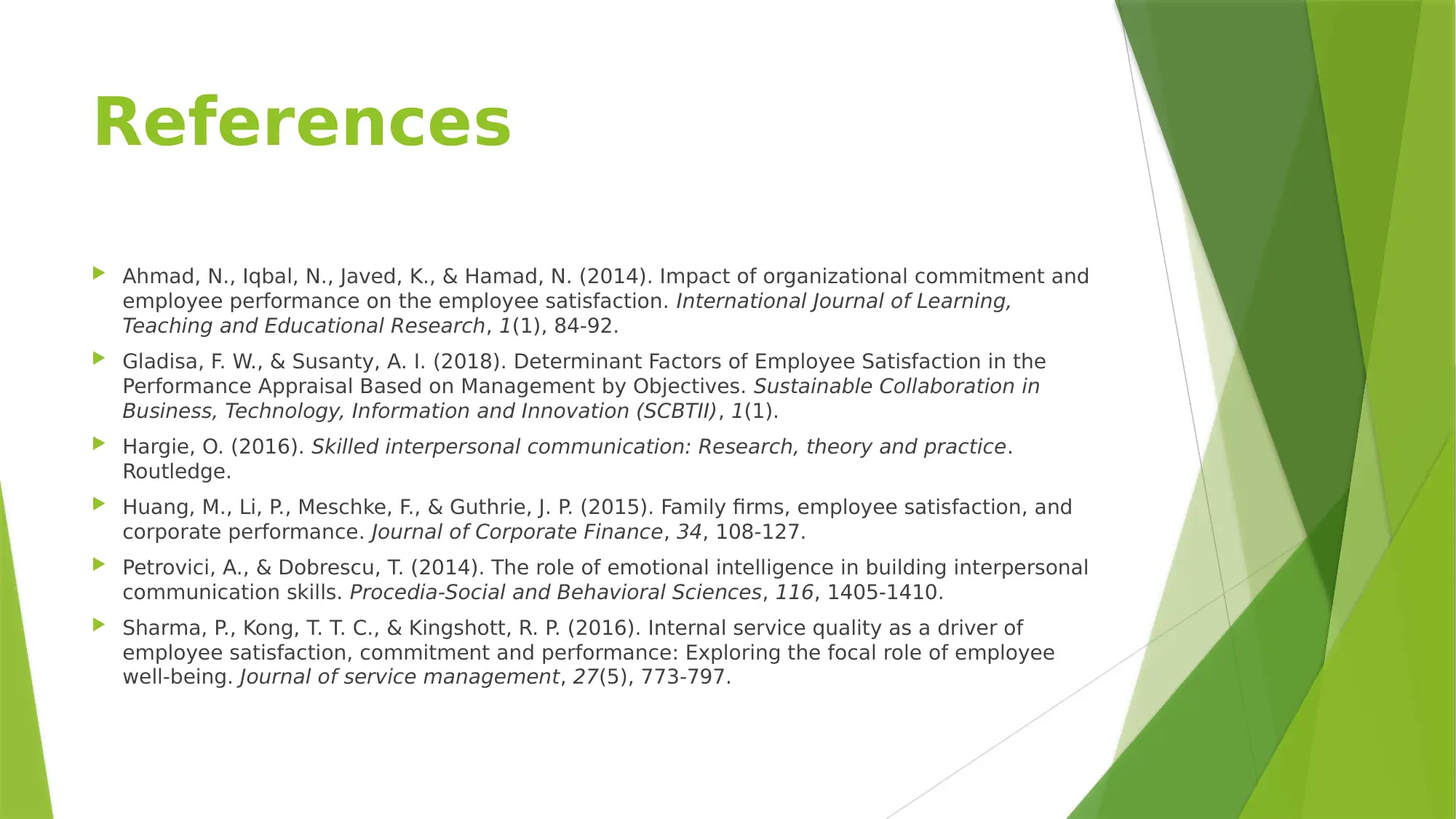
References
Ahmad, N., Iqbal, N., Javed, K., & Hamad, N. (2014). Impact of organizational commitment and
employee performance on the employee satisfaction. International Journal of Learning,
Teaching and Educational Research, 1(1), 84-92.
Gladisa, F. W., & Susanty, A. I. (2018). Determinant Factors of Employee Satisfaction in the
Performance Appraisal Based on Management by Objectives. Sustainable Collaboration in
Business, Technology, Information and Innovation (SCBTII), 1(1).
Hargie, O. (2016). Skilled interpersonal communication: Research, theory and practice.
Routledge.
Huang, M., Li, P., Meschke, F., & Guthrie, J. P. (2015). Family firms, employee satisfaction, and
corporate performance. Journal of Corporate Finance, 34, 108-127.
Petrovici, A., & Dobrescu, T. (2014). The role of emotional intelligence in building interpersonal
communication skills. Procedia-Social and Behavioral Sciences, 116, 1405-1410.
Sharma, P., Kong, T. T. C., & Kingshott, R. P. (2016). Internal service quality as a driver of
employee satisfaction, commitment and performance: Exploring the focal role of employee
well-being. Journal of service management, 27(5), 773-797.
tabler-icon-diamond-filled.svg

Paraphrase This Document

Need a fresh take? Get an instant paraphrase of this document with our AI Paraphraser
Document Page
chevron_up_icon
1 out of 8
circle_padding
hide_on_mobile
zoom_out_icon
[object Object]