Northern Adelaide Food Industry: A Case Study on Digital Innovation

Verified

Added on  2023/04/03

|4
|683
|204
Case Study
AI Summary
This case study examines the food industry in Northern Adelaide, Australia, focusing on the challenges and opportunities for digital innovation and collaboration. The region, historically reliant on agriculture, faces pressures from increased production efficiencies and regulatory standards. However, it also possesses significant potential, particularly with the Virginia Pipeline Scheme providing recycled water for irrigation. The study analyzes the current state of digital innovation among SMEs in the area, using narrative and theoretical literature reviews to identify gaps and propose recommendations for enhancing a sustainable regional innovation system. The ultimate goal is to facilitate digital innovation, improve SME collaboration, and ensure the long-term viability of the food industry in Northern Adelaide. Desklib provides access to similar case studies and solved assignments for students.
Document Page
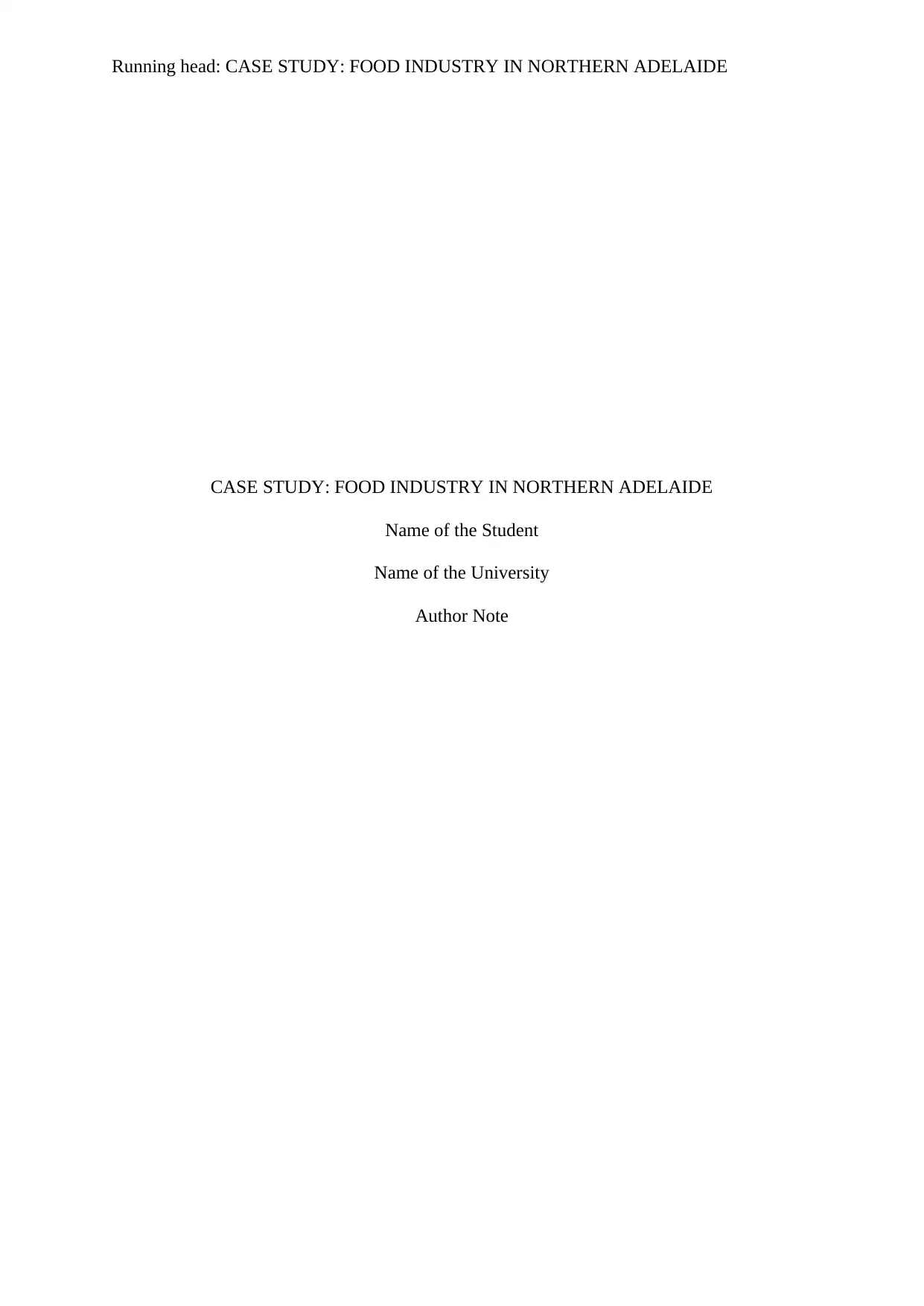
Running head: CASE STUDY: FOOD INDUSTRY IN NORTHERN ADELAIDE
CASE STUDY: FOOD INDUSTRY IN NORTHERN ADELAIDE
Name of the Student
Name of the University
Author Note
tabler-icon-diamond-filled.svg

Paraphrase This Document

Need a fresh take? Get an instant paraphrase of this document with our AI Paraphraser
Document Page
1CASE STUDY: FOOD INDUSTRY IN NORTHERN ADELAIDE
Background of the Case Study
The regional economies that relied upon agriculture have been experiencing
unparalleled alterations in the country of Australia since 100 years now. North Adelaide is no
exception in this case. The increase in the production efficiencies, increased commoditization
and integrated supply chains have observed the fall of agriculture as a prime factor of the
nations growth causing declination in the jobs based on the regional agriculture thus affecting
the food industry[1]. The local food producers in the North Adelaide plains are mostly
affected by the initiatives of the private regulatory that include the retail persons those who
are deal in supply chain and set standards along with code of practice based on the factors
such as animal welfare, food safety, environmental management, quality, labor standards
resulting in audit obligations and certification related obligations. The North Adelaide plains
have the potential in them to establish a flourishing food industry but with the rising use of
technologies and innovations there needs to some digital innovations in this particular place
that would help increase its productivity thus aiding the growth of the food industry. The
regulatory standards imposed are matter of concern for the business but it can benefit the
local producers in the long run. The basic requirement of food industry is available water
supply and in Northern Adelaide almost 95,000 mega liters of household wastewater is being
collected, stored and treated so that it becomes suitable for the purpose of irrigation and does
not affect the quality of the food crops[2]. The Virginia Pipeline Scheme deployed for this
purpose is the largest recycle water scheme in the country. In the last five years the South
Australian part consisting of North Adelaide has incorporated some digital innovations to
supplement the growth of the food industry. It has become a home to different machines
which can see through onions and apples, successfully tracking the water levels in the remote
Document Page
2CASE STUDY: FOOD INDUSTRY IN NORTHERN ADELAIDE
locations, program the robots in order to process 600 lambs per hour and hosting world’s first
greenhouse for tomatoes that is powered by the solar energy.
Project Methodology
The project methodology will be based on narrative literature review and theoretical
literature review. The narrative literature review will help critique the literature and
summarizations based on this can be deduced related to the food industry in the Northern
Adelaide. It will be used to identify the gaps in the literature focusing on the main issue that
is the food industry in the Northern Adelaide[3]. The theoretical literature review will be
applied to the case study as it will help to focus on the existing theories reacted to the food
industries in Northern Adelaide and this will be made use to recommend some new methods
that could be applied while undertaking the project[4]. The data used to analyse the issue will
be secondary in nature and thus integrative literature review will also be undertaken. In the
research methodology it will be taken care of that how the existing theories are linked to the
digital innovations and what else could be the way of approach in order to bring in rapid
growth to the food industry at Northern Adelaide.
Document Page
3CASE STUDY: FOOD INDUSTRY IN NORTHERN ADELAIDE
References
[1]. JD. Ward Can urban agriculture usefully improve food resilience? Insights from a linear
programming approach. Journal of environmental studies and sciences. 2015 Dec 1;5(4):699-
711.
[2]. B. Ridoutt, P. Sanguansri , L. Bonney, S. Crimp, G. Lewis, L. Lim-Camacho. Climate
change adaptation strategy in the food industry—insights from product carbon and water
footprints. Climate. 2016 Jun;4(2):26.
[3]. L. Singh-Peterson, S. Lieske, SJ Underhill, N Keys. Food security, remoteness and
consolidation of supermarket distribution centres: Factors contributing to food pricing
inequalities across Queensland, Australia. Australian Geographer. 2016 Jan 2;47(1):89-102.
[4]. JD Baker. The purpose, process, and methods of writing a literature review. AORN
journal. 2016 Mar 1;103(3):265-9.
chevron_up_icon
1 out of 4
circle_padding
hide_on_mobile
zoom_out_icon
[object Object]