FY028: ADHD Treatment & Causes in Children - Wellington Hospital Case
VerifiedAdded on 2023/06/11
|15
|2574
|487
Case Study
AI Summary
This case study investigates the medical treatment and causes of ADHD in children, focusing on The Wellington Hospital. It examines the rising cases of ADHD, its symptoms, diagnosis, challenges, and current treatments. The research employs a deductive approach and quantitative data collection through a survey with 35 respondents. The findings reveal insights into the perceived causes of ADHD, common symptoms, and beneficial treatments, while also highlighting barriers in treating children with ADHD. The study references existing literature to support its analysis of ADHD diagnosis, treatment challenges, and current treatment methods, aiming to provide a comprehensive understanding of the disorder in children.

FY028 Inquiry
Based Learning
1
Based Learning
1

Paraphrase This Document
Need a fresh take? Get an instant paraphrase of this document with our AI Paraphraser
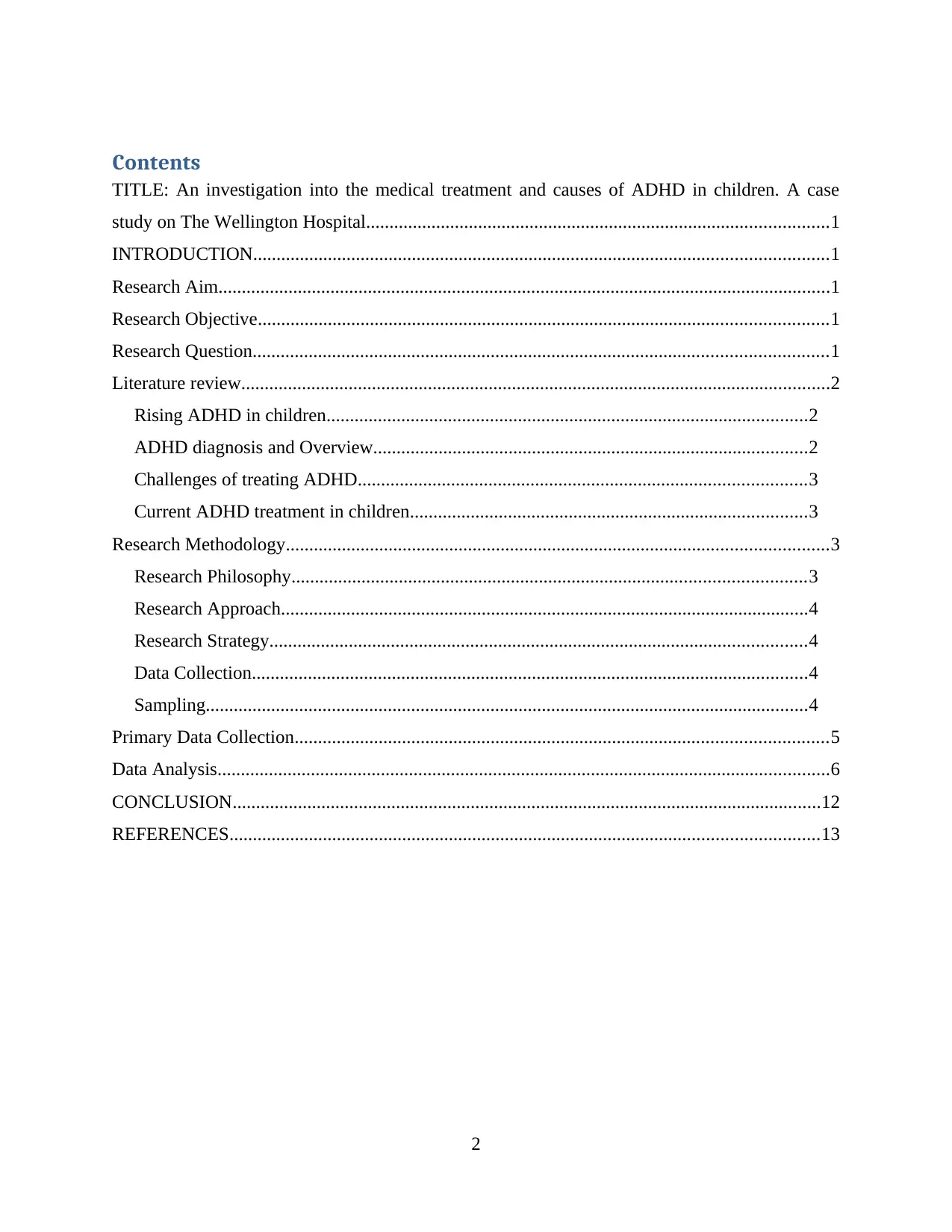
Contents
TITLE: An investigation into the medical treatment and causes of ADHD in children. A case
study on The Wellington Hospital...................................................................................................1
INTRODUCTION...........................................................................................................................1
Research Aim...................................................................................................................................1
Research Objective..........................................................................................................................1
Research Question...........................................................................................................................1
Literature review..............................................................................................................................2
Rising ADHD in children.......................................................................................................2
ADHD diagnosis and Overview.............................................................................................2
Challenges of treating ADHD................................................................................................3
Current ADHD treatment in children.....................................................................................3
Research Methodology....................................................................................................................3
Research Philosophy..............................................................................................................3
Research Approach.................................................................................................................4
Research Strategy...................................................................................................................4
Data Collection.......................................................................................................................4
Sampling.................................................................................................................................4
Primary Data Collection..................................................................................................................5
Data Analysis...................................................................................................................................6
CONCLUSION..............................................................................................................................12
REFERENCES..............................................................................................................................13
2
TITLE: An investigation into the medical treatment and causes of ADHD in children. A case
study on The Wellington Hospital...................................................................................................1
INTRODUCTION...........................................................................................................................1
Research Aim...................................................................................................................................1
Research Objective..........................................................................................................................1
Research Question...........................................................................................................................1
Literature review..............................................................................................................................2
Rising ADHD in children.......................................................................................................2
ADHD diagnosis and Overview.............................................................................................2
Challenges of treating ADHD................................................................................................3
Current ADHD treatment in children.....................................................................................3
Research Methodology....................................................................................................................3
Research Philosophy..............................................................................................................3
Research Approach.................................................................................................................4
Research Strategy...................................................................................................................4
Data Collection.......................................................................................................................4
Sampling.................................................................................................................................4
Primary Data Collection..................................................................................................................5
Data Analysis...................................................................................................................................6
CONCLUSION..............................................................................................................................12
REFERENCES..............................................................................................................................13
2
TITLE: An investigation into the medical treatment and causes of ADHD in
children. A case study on The Wellington Hospital
INTRODUCTION
ADHD which also referred to as Attention deficit hyperactivity disorder is one of the most
common neurotypical disorders during childhood. Early diagnosis of ADHD is essential for
completing full treatment of this mental illness. Cure has not been identified for completely
treating ADHD and treatment often involves helping individuals deal with the symptoms of
ADHD. This investigation looks at the rising cases of ADHD in children including its symptoms
cause’s challenges and current treatments. Appropriate research methodology is used for
completing investigation on the topic of rising ADHD in children.
Research Aim
The aim of this research is to critically analyse the cause and treatment of ADHD in
children. A case study on the Wellington Hospital.
Research Objective
To examine the cause for rising ADHD cases in children. A case study on the Wellington
Hospital.
To identify the symptoms and diagnosis for children with ADHD. A case study on the
Wellington Hospital.
To determine the challenges in treating children with ADHD . A case study on the
Wellington Hospital.
To analyse best practices in treating children with ADHD. A case study on the
Wellington Hospital.
Research Question
What are the cause for rising ADHD cases in children?
What are the symptoms and diagnosis for children with ADHD?
To determine the challenges in treating children with ADHD?
To analyse best practices in treating children with ADHD?
3
children. A case study on The Wellington Hospital
INTRODUCTION
ADHD which also referred to as Attention deficit hyperactivity disorder is one of the most
common neurotypical disorders during childhood. Early diagnosis of ADHD is essential for
completing full treatment of this mental illness. Cure has not been identified for completely
treating ADHD and treatment often involves helping individuals deal with the symptoms of
ADHD. This investigation looks at the rising cases of ADHD in children including its symptoms
cause’s challenges and current treatments. Appropriate research methodology is used for
completing investigation on the topic of rising ADHD in children.
Research Aim
The aim of this research is to critically analyse the cause and treatment of ADHD in
children. A case study on the Wellington Hospital.
Research Objective
To examine the cause for rising ADHD cases in children. A case study on the Wellington
Hospital.
To identify the symptoms and diagnosis for children with ADHD. A case study on the
Wellington Hospital.
To determine the challenges in treating children with ADHD . A case study on the
Wellington Hospital.
To analyse best practices in treating children with ADHD. A case study on the
Wellington Hospital.
Research Question
What are the cause for rising ADHD cases in children?
What are the symptoms and diagnosis for children with ADHD?
To determine the challenges in treating children with ADHD?
To analyse best practices in treating children with ADHD?
3
⊘ This is a preview!⊘
Do you want full access?
Subscribe today to unlock all pages.

Trusted by 1+ million students worldwide
Literature review
Rising ADHD in children
According to the views of Clopton (2018) The diagnosis of ADHD in children is rising
continuously.a recent study looking at ADHD diagnosis in children between the ages of four and
17 increased from 6.1% in 1997 to 1998 to 10.2% in 2015 to 2016 (ADHD Rising in the U.S.,
but Why?, 2018). This data show kisses that there is a drastic change in rising cases of ADHD
and it is becoming a common condition faced by children in the current age. Now one in 10
children are affected because of ADHD which showcases high number of patients across the
globe. Different factors such as genetics and growing climate play an important role in ADHD
diagnosis. For example the EPA points out that three out of four children with ADHD have
relatives who has also the disorder. The number of children diagnosed with ADHD will continue
to increase in further years is there is a raising awareness about the disorder among parents and
schools which prompts early stage diagnosis of children so that effective treatment can be
provided. In context of rise of ADHD in children there are different factors which contributes to
this phenomenon such as chemical imbalances brain changes or injuries habits during pregnancy
along with environmental factors. There needs to be focused of hospital organization conducting
more research about ADHD in children because it can help parents and children identify ADHD
in early stages so that appropriate action can be taken to support treatment of ADHD on a global
scale.
ADHD diagnosis and Overview
As per the views of Cassabianca and Iftikhar (2021) ADHD is a common
neurodevelopmental disorder which affects behaviour of individuals. The symptoms of ADHD
include on-going persistent patterns of inattention inability to focus hyperactivity impulsivity and
ineffective daily functioning. Children suffering from ADHD are primarily characterized by
difficulty to pay attention and focus on a task along with a tendency to be easily distracted. In
addition to this there is also characterization of extreme excessive or disruptive behaviour and
low impulse control (ADHD In Adults: Diagnosis, Treatment And More, 2022). The most
common type of ADHD is combined ADHD will combine symptoms of both inattentive and
hyper impulsive ADHD are showcased. Generally ADHD can be diagnosed by looking at the
symptoms such as losing or missing things, abrupt or impulsive behaviour, not being able to
4
Rising ADHD in children
According to the views of Clopton (2018) The diagnosis of ADHD in children is rising
continuously.a recent study looking at ADHD diagnosis in children between the ages of four and
17 increased from 6.1% in 1997 to 1998 to 10.2% in 2015 to 2016 (ADHD Rising in the U.S.,
but Why?, 2018). This data show kisses that there is a drastic change in rising cases of ADHD
and it is becoming a common condition faced by children in the current age. Now one in 10
children are affected because of ADHD which showcases high number of patients across the
globe. Different factors such as genetics and growing climate play an important role in ADHD
diagnosis. For example the EPA points out that three out of four children with ADHD have
relatives who has also the disorder. The number of children diagnosed with ADHD will continue
to increase in further years is there is a raising awareness about the disorder among parents and
schools which prompts early stage diagnosis of children so that effective treatment can be
provided. In context of rise of ADHD in children there are different factors which contributes to
this phenomenon such as chemical imbalances brain changes or injuries habits during pregnancy
along with environmental factors. There needs to be focused of hospital organization conducting
more research about ADHD in children because it can help parents and children identify ADHD
in early stages so that appropriate action can be taken to support treatment of ADHD on a global
scale.
ADHD diagnosis and Overview
As per the views of Cassabianca and Iftikhar (2021) ADHD is a common
neurodevelopmental disorder which affects behaviour of individuals. The symptoms of ADHD
include on-going persistent patterns of inattention inability to focus hyperactivity impulsivity and
ineffective daily functioning. Children suffering from ADHD are primarily characterized by
difficulty to pay attention and focus on a task along with a tendency to be easily distracted. In
addition to this there is also characterization of extreme excessive or disruptive behaviour and
low impulse control (ADHD In Adults: Diagnosis, Treatment And More, 2022). The most
common type of ADHD is combined ADHD will combine symptoms of both inattentive and
hyper impulsive ADHD are showcased. Generally ADHD can be diagnosed by looking at the
symptoms such as losing or missing things, abrupt or impulsive behaviour, not being able to
4
Paraphrase This Document
Need a fresh take? Get an instant paraphrase of this document with our AI Paraphraser
follow instruction constantly, moving from one activity to another, engaging in reckless
behaviour that might put you or others in jeopardy and then having a hard time focusing on a
conversation. The diagnosis of ADHD can also be conducted by specific tests such as C rays, lab
tests to diagnose ADHD. Apart from this theatre also psychological tests which can be conducted
by health professionals to identify it is the condition in children.
Challenges of treating ADHD
According to Boorady (2022), the primary challenge in treating ADHD in children is
associated with side effects of ADHD medication. ADHD medication side effects include the
amount the medication is given to child patient is not magically beneficial for them. In addition
to this there is also the risk of the medication being released into the child's body too slowly or
too fast or the type of medication is not effective for the child. These kinds of risks arise in
treatment of ADHD in children because there’s not enough research about ADHD in children so
that accurate dosage can be given to children to treat ADHD. Some of the common ADHD
medication side effects include sleep problems, not eating as much, growing more slowly,
headaches and stomach-aches, increased annoyance when the medication wears off, moodiness
irritability and lack of attention (Side Effects of ADHD Medication, 2022). There is a risk that
child might suffer from these problems if the ADHD is not treated effectively. These risks need
to be addressed by medical institutions in order to ensure that children with ADHD are treated
with best cares and lack of research or side effect does not affect their growth or health
negatively.
Current ADHD treatment in children
According to Silva (2022) the current treatments of ADHD include medication’s suggest
to millions and non stimulants to ensure that symptoms related to ADHD can be subdued. The
comments to millions used for ADHD treatment are methylphenidate date and amphetamine. In
addition to this non stimulant medication such as at atomoxetine and guangacine can be used if
the patients want to avoid stimulants (ADHD: Types, Symptoms, and Treatment Options, 2021).
Research Methodology
Research Philosophy
Research philosophy refers to the perspective and worldview undertaken for completing the
investigation. positivism and interpretivism are the two types of research philosophy which can
5
behaviour that might put you or others in jeopardy and then having a hard time focusing on a
conversation. The diagnosis of ADHD can also be conducted by specific tests such as C rays, lab
tests to diagnose ADHD. Apart from this theatre also psychological tests which can be conducted
by health professionals to identify it is the condition in children.
Challenges of treating ADHD
According to Boorady (2022), the primary challenge in treating ADHD in children is
associated with side effects of ADHD medication. ADHD medication side effects include the
amount the medication is given to child patient is not magically beneficial for them. In addition
to this there is also the risk of the medication being released into the child's body too slowly or
too fast or the type of medication is not effective for the child. These kinds of risks arise in
treatment of ADHD in children because there’s not enough research about ADHD in children so
that accurate dosage can be given to children to treat ADHD. Some of the common ADHD
medication side effects include sleep problems, not eating as much, growing more slowly,
headaches and stomach-aches, increased annoyance when the medication wears off, moodiness
irritability and lack of attention (Side Effects of ADHD Medication, 2022). There is a risk that
child might suffer from these problems if the ADHD is not treated effectively. These risks need
to be addressed by medical institutions in order to ensure that children with ADHD are treated
with best cares and lack of research or side effect does not affect their growth or health
negatively.
Current ADHD treatment in children
According to Silva (2022) the current treatments of ADHD include medication’s suggest
to millions and non stimulants to ensure that symptoms related to ADHD can be subdued. The
comments to millions used for ADHD treatment are methylphenidate date and amphetamine. In
addition to this non stimulant medication such as at atomoxetine and guangacine can be used if
the patients want to avoid stimulants (ADHD: Types, Symptoms, and Treatment Options, 2021).
Research Methodology
Research Philosophy
Research philosophy refers to the perspective and worldview undertaken for completing the
investigation. positivism and interpretivism are the two types of research philosophy which can
5
be selected for completing an investigation (Davies and Fisher, 2018). This research is
completed by using positivism. The justification for using positivism is that it enables
quantifying research data for measurement.
Research Approach
Research approach refers to the process of completing research which ranges from white
presuppositions too specific techniques of collecting and analysing data (Kim, 2019). The
options available for completing research are using deductive research approach or inductive
research approach. This investigation utilise is deductive research approach because it helps
understand relationship between variables which is essential for understanding the relation
between factors influencing rising cases in ADHD in children.
Research Strategy
Different research strategies can be utilised research such as survey case study research
experimental research and many more. The chosen research strategy for this investigation utilise
is survey because it is an inexpensive reserve strategy which helps collect data from primary
sources in a time saving manner.
Data Collection
Quantitative data collection and qualitative dictate collection are utilised for completing an
investigation. This research utilises quantitatively the collection to gain first turn data so that the
research reliability can be increased. The justification for using quantitative data collection
method is that it helps collect numerical data on variables related with the investigation. The
usage of numerical data makes data analysis easier and data interpretation easy to understand.
Sampling
Sampling is defined as the process of dividing a population into subset so that observations can
be taken from the population subset (Peim, 2018). Probabilistic sampling and non probabilistic
sampling can be selected for completing a research. This investigation is completed by usage of
probabilistic sampling as it reduces systematic errors and eliminates researcher bias from
affecting the sampling process.
SAMPLE SIZE: 35
Primary Data Collection
Questionnaire
6
completed by using positivism. The justification for using positivism is that it enables
quantifying research data for measurement.
Research Approach
Research approach refers to the process of completing research which ranges from white
presuppositions too specific techniques of collecting and analysing data (Kim, 2019). The
options available for completing research are using deductive research approach or inductive
research approach. This investigation utilise is deductive research approach because it helps
understand relationship between variables which is essential for understanding the relation
between factors influencing rising cases in ADHD in children.
Research Strategy
Different research strategies can be utilised research such as survey case study research
experimental research and many more. The chosen research strategy for this investigation utilise
is survey because it is an inexpensive reserve strategy which helps collect data from primary
sources in a time saving manner.
Data Collection
Quantitative data collection and qualitative dictate collection are utilised for completing an
investigation. This research utilises quantitatively the collection to gain first turn data so that the
research reliability can be increased. The justification for using quantitative data collection
method is that it helps collect numerical data on variables related with the investigation. The
usage of numerical data makes data analysis easier and data interpretation easy to understand.
Sampling
Sampling is defined as the process of dividing a population into subset so that observations can
be taken from the population subset (Peim, 2018). Probabilistic sampling and non probabilistic
sampling can be selected for completing a research. This investigation is completed by usage of
probabilistic sampling as it reduces systematic errors and eliminates researcher bias from
affecting the sampling process.
SAMPLE SIZE: 35
Primary Data Collection
Questionnaire
6
⊘ This is a preview!⊘
Do you want full access?
Subscribe today to unlock all pages.
Trusted by 1+ million students worldwide
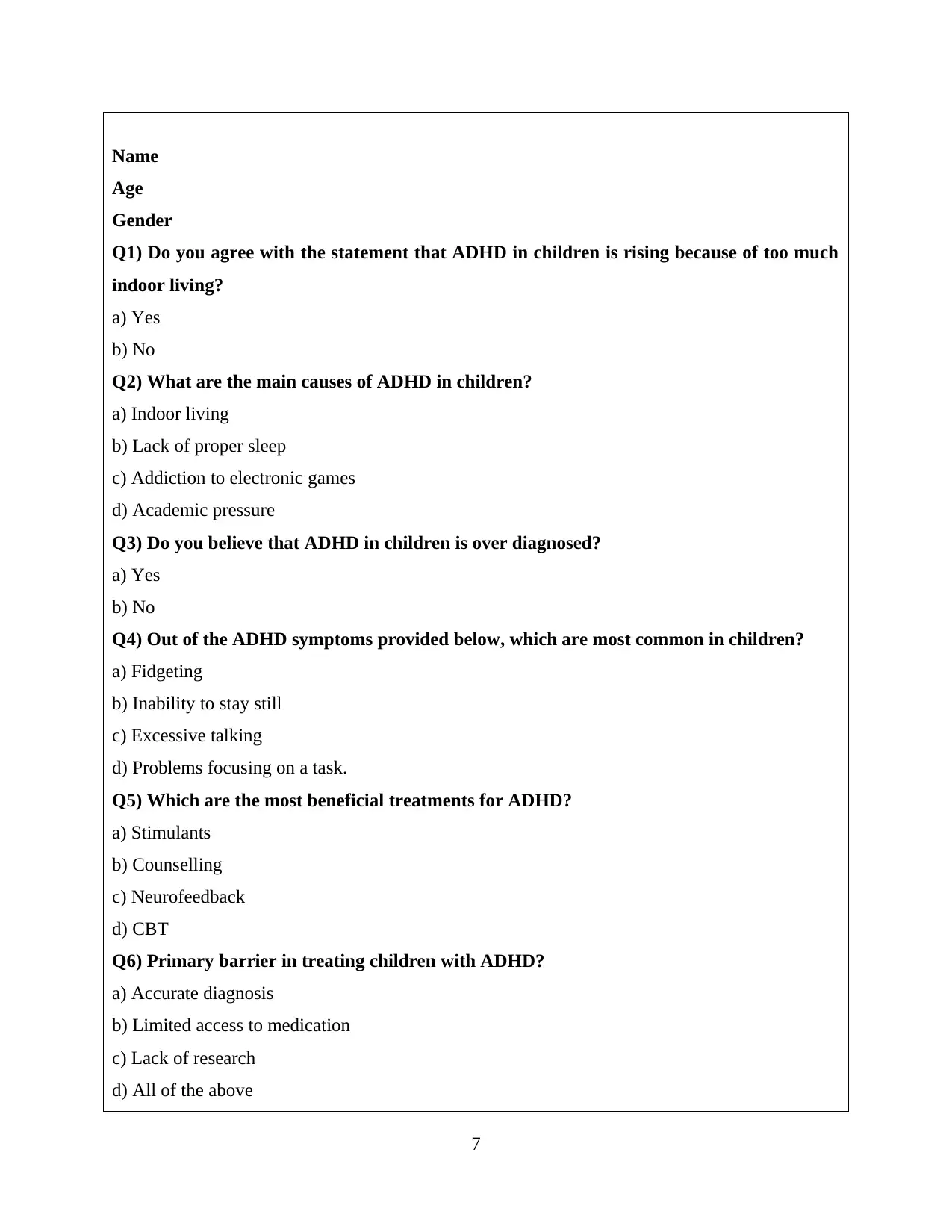
Name
Age
Gender
Q1) Do you agree with the statement that ADHD in children is rising because of too much
indoor living?
a) Yes
b) No
Q2) What are the main causes of ADHD in children?
a) Indoor living
b) Lack of proper sleep
c) Addiction to electronic games
d) Academic pressure
Q3) Do you believe that ADHD in children is over diagnosed?
a) Yes
b) No
Q4) Out of the ADHD symptoms provided below, which are most common in children?
a) Fidgeting
b) Inability to stay still
c) Excessive talking
d) Problems focusing on a task.
Q5) Which are the most beneficial treatments for ADHD?
a) Stimulants
b) Counselling
c) Neurofeedback
d) CBT
Q6) Primary barrier in treating children with ADHD?
a) Accurate diagnosis
b) Limited access to medication
c) Lack of research
d) All of the above
7
Age
Gender
Q1) Do you agree with the statement that ADHD in children is rising because of too much
indoor living?
a) Yes
b) No
Q2) What are the main causes of ADHD in children?
a) Indoor living
b) Lack of proper sleep
c) Addiction to electronic games
d) Academic pressure
Q3) Do you believe that ADHD in children is over diagnosed?
a) Yes
b) No
Q4) Out of the ADHD symptoms provided below, which are most common in children?
a) Fidgeting
b) Inability to stay still
c) Excessive talking
d) Problems focusing on a task.
Q5) Which are the most beneficial treatments for ADHD?
a) Stimulants
b) Counselling
c) Neurofeedback
d) CBT
Q6) Primary barrier in treating children with ADHD?
a) Accurate diagnosis
b) Limited access to medication
c) Lack of research
d) All of the above
7
Paraphrase This Document
Need a fresh take? Get an instant paraphrase of this document with our AI Paraphraser
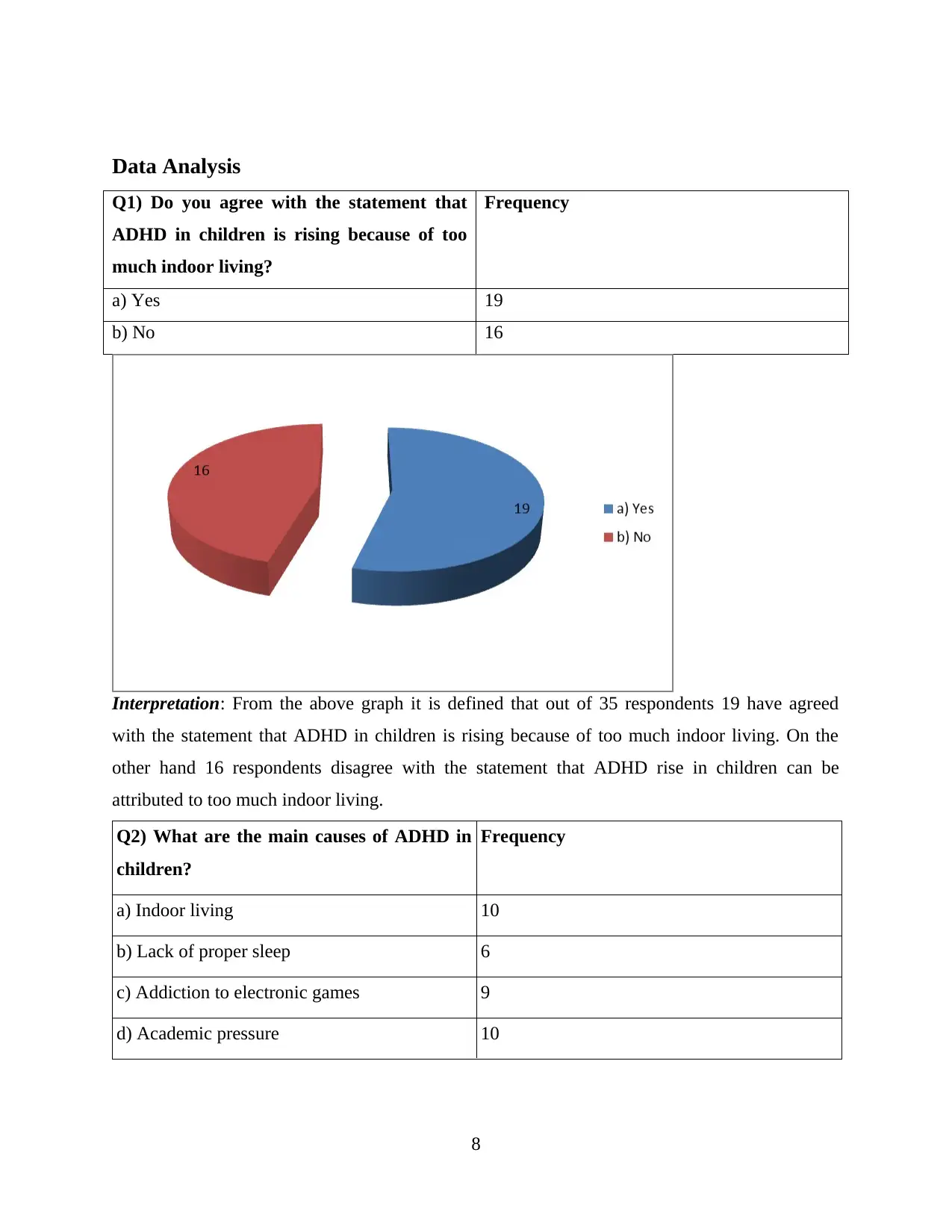
Data Analysis
Q1) Do you agree with the statement that
ADHD in children is rising because of too
much indoor living?
Frequency
a) Yes 19
b) No 16
Interpretation: From the above graph it is defined that out of 35 respondents 19 have agreed
with the statement that ADHD in children is rising because of too much indoor living. On the
other hand 16 respondents disagree with the statement that ADHD rise in children can be
attributed to too much indoor living.
Q2) What are the main causes of ADHD in
children?
Frequency
a) Indoor living 10
b) Lack of proper sleep 6
c) Addiction to electronic games 9
d) Academic pressure 10
8
Q1) Do you agree with the statement that
ADHD in children is rising because of too
much indoor living?
Frequency
a) Yes 19
b) No 16
Interpretation: From the above graph it is defined that out of 35 respondents 19 have agreed
with the statement that ADHD in children is rising because of too much indoor living. On the
other hand 16 respondents disagree with the statement that ADHD rise in children can be
attributed to too much indoor living.
Q2) What are the main causes of ADHD in
children?
Frequency
a) Indoor living 10
b) Lack of proper sleep 6
c) Addiction to electronic games 9
d) Academic pressure 10
8
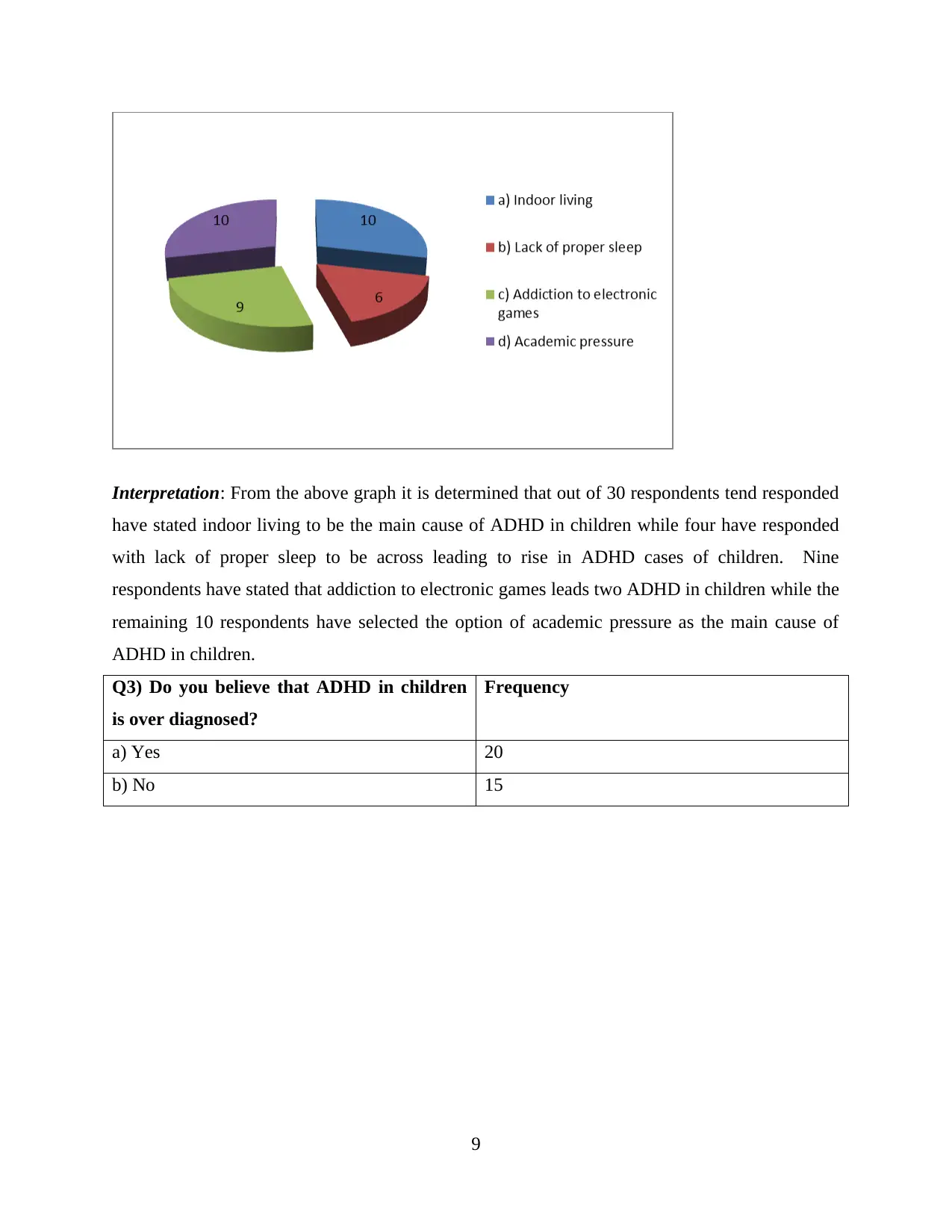
Interpretation: From the above graph it is determined that out of 30 respondents tend responded
have stated indoor living to be the main cause of ADHD in children while four have responded
with lack of proper sleep to be across leading to rise in ADHD cases of children. Nine
respondents have stated that addiction to electronic games leads two ADHD in children while the
remaining 10 respondents have selected the option of academic pressure as the main cause of
ADHD in children.
Q3) Do you believe that ADHD in children
is over diagnosed?
Frequency
a) Yes 20
b) No 15
9
have stated indoor living to be the main cause of ADHD in children while four have responded
with lack of proper sleep to be across leading to rise in ADHD cases of children. Nine
respondents have stated that addiction to electronic games leads two ADHD in children while the
remaining 10 respondents have selected the option of academic pressure as the main cause of
ADHD in children.
Q3) Do you believe that ADHD in children
is over diagnosed?
Frequency
a) Yes 20
b) No 15
9
⊘ This is a preview!⊘
Do you want full access?
Subscribe today to unlock all pages.
Trusted by 1+ million students worldwide
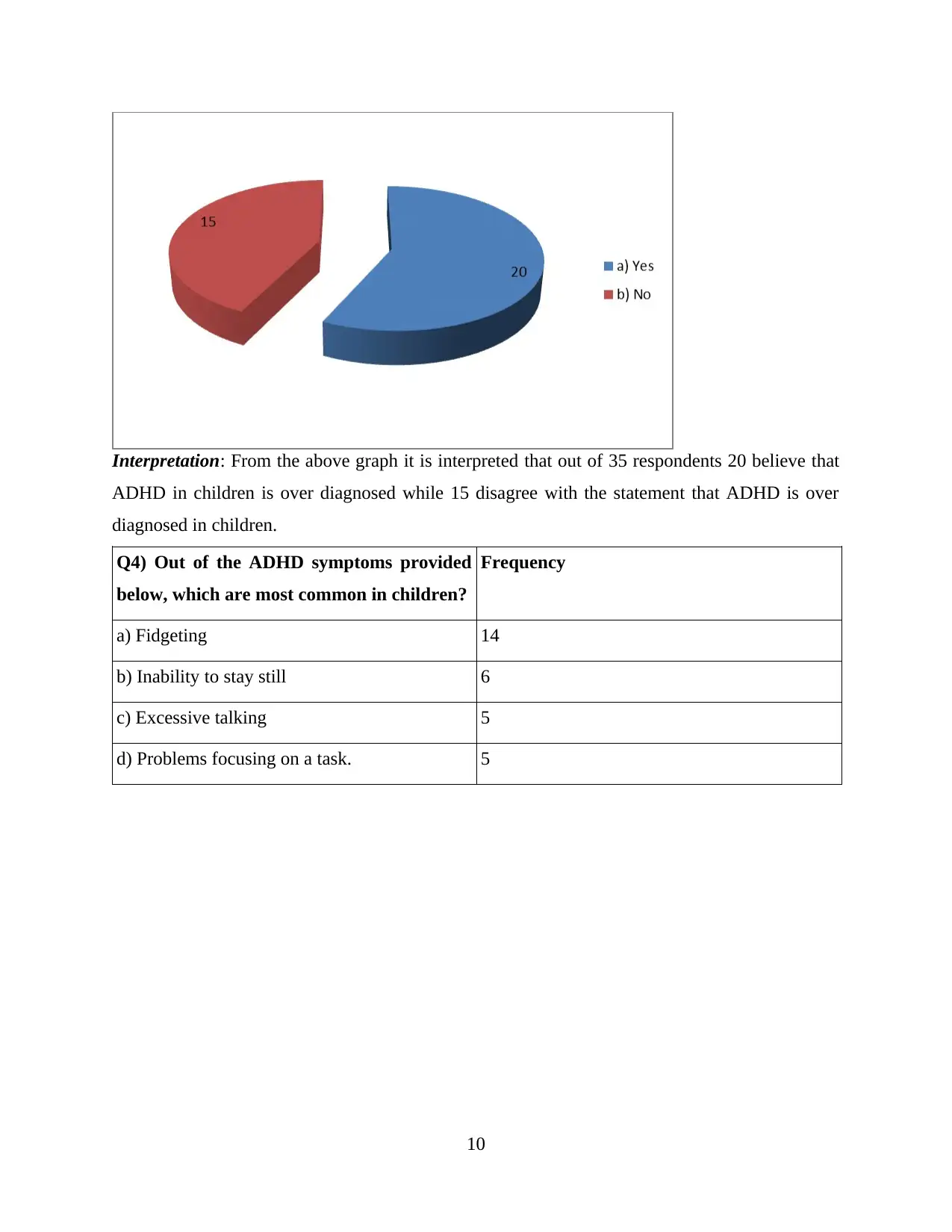
Interpretation: From the above graph it is interpreted that out of 35 respondents 20 believe that
ADHD in children is over diagnosed while 15 disagree with the statement that ADHD is over
diagnosed in children.
Q4) Out of the ADHD symptoms provided
below, which are most common in children?
Frequency
a) Fidgeting 14
b) Inability to stay still 6
c) Excessive talking 5
d) Problems focusing on a task. 5
10
ADHD in children is over diagnosed while 15 disagree with the statement that ADHD is over
diagnosed in children.
Q4) Out of the ADHD symptoms provided
below, which are most common in children?
Frequency
a) Fidgeting 14
b) Inability to stay still 6
c) Excessive talking 5
d) Problems focusing on a task. 5
10
Paraphrase This Document
Need a fresh take? Get an instant paraphrase of this document with our AI Paraphraser
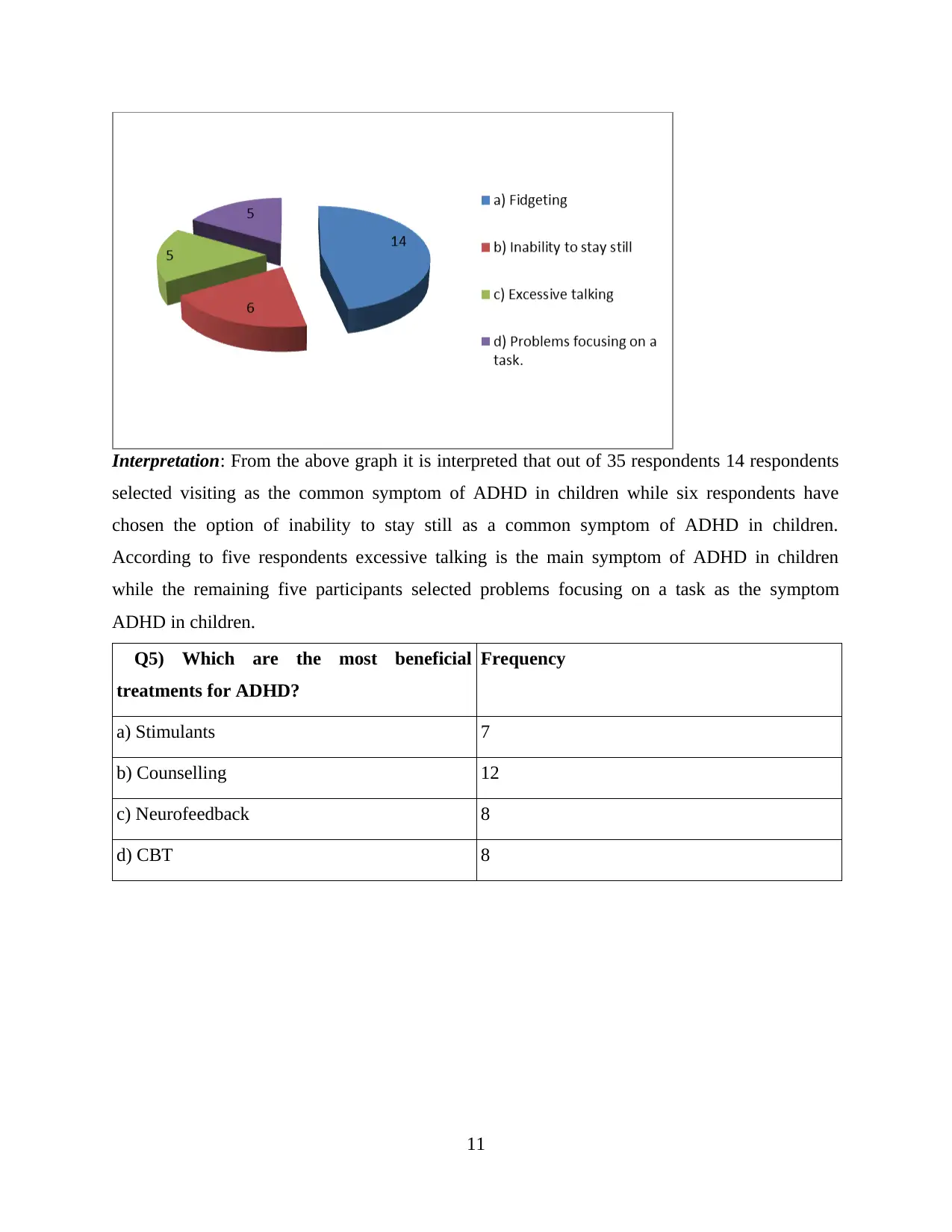
Interpretation: From the above graph it is interpreted that out of 35 respondents 14 respondents
selected visiting as the common symptom of ADHD in children while six respondents have
chosen the option of inability to stay still as a common symptom of ADHD in children.
According to five respondents excessive talking is the main symptom of ADHD in children
while the remaining five participants selected problems focusing on a task as the symptom
ADHD in children.
Q5) Which are the most beneficial
treatments for ADHD?
Frequency
a) Stimulants 7
b) Counselling 12
c) Neurofeedback 8
d) CBT 8
11
selected visiting as the common symptom of ADHD in children while six respondents have
chosen the option of inability to stay still as a common symptom of ADHD in children.
According to five respondents excessive talking is the main symptom of ADHD in children
while the remaining five participants selected problems focusing on a task as the symptom
ADHD in children.
Q5) Which are the most beneficial
treatments for ADHD?
Frequency
a) Stimulants 7
b) Counselling 12
c) Neurofeedback 8
d) CBT 8
11
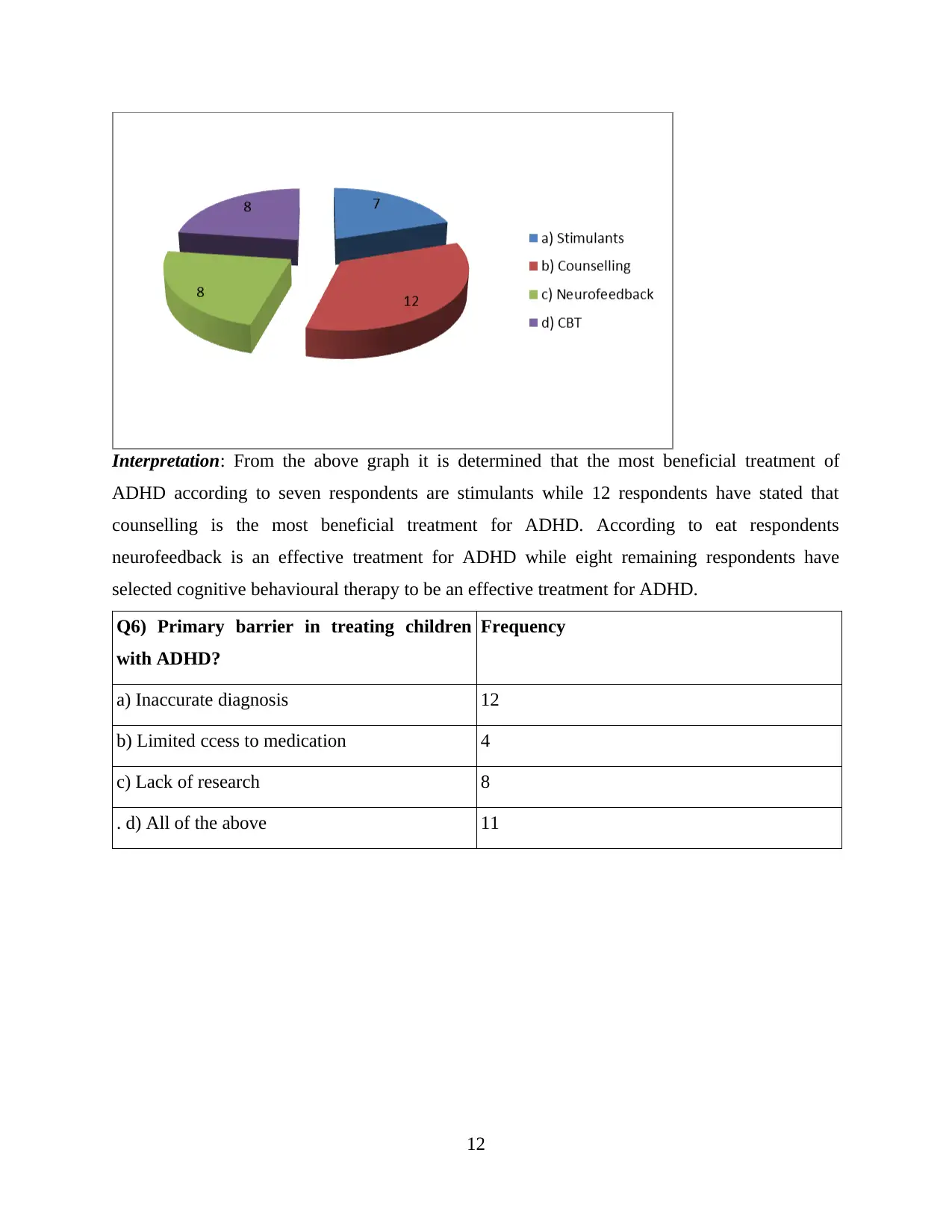
Interpretation: From the above graph it is determined that the most beneficial treatment of
ADHD according to seven respondents are stimulants while 12 respondents have stated that
counselling is the most beneficial treatment for ADHD. According to eat respondents
neurofeedback is an effective treatment for ADHD while eight remaining respondents have
selected cognitive behavioural therapy to be an effective treatment for ADHD.
Q6) Primary barrier in treating children
with ADHD?
Frequency
a) Inaccurate diagnosis 12
b) Limited ccess to medication 4
c) Lack of research 8
. d) All of the above 11
12
ADHD according to seven respondents are stimulants while 12 respondents have stated that
counselling is the most beneficial treatment for ADHD. According to eat respondents
neurofeedback is an effective treatment for ADHD while eight remaining respondents have
selected cognitive behavioural therapy to be an effective treatment for ADHD.
Q6) Primary barrier in treating children
with ADHD?
Frequency
a) Inaccurate diagnosis 12
b) Limited ccess to medication 4
c) Lack of research 8
. d) All of the above 11
12
⊘ This is a preview!⊘
Do you want full access?
Subscribe today to unlock all pages.
Trusted by 1+ million students worldwide

1 out of 15


Related Documents


Your All-in-One AI-Powered Toolkit for Academic Success.
+13062052269
info@desklib.com
Available 24*7 on WhatsApp / Email
![[object Object]](/_next/static/media/star-bottom.7253800d.svg)
Unlock your academic potential
Copyright © 2020–2026 A2Z Services. All Rights Reserved. Developed and managed by ZUCOL.