ADM80003 Six Sigma: SIPOC Chart Analysis for Buggy Fuel Tank
VerifiedAdded on 2023/06/07
|8
|1610
|201
Report
AI Summary
This report presents a Supplier-Inputs-Process-Outputs-Customers (SIPOC) chart analysis of the off-road buggy fuel tank manufacturing process. It identifies key stakeholders and critical information relevant to the manufacturing operations. The analysis details each step of the production process, from laser cutting and folding to welding, leak testing, and final inspection. The report also includes a description of each process, highlighting the materials, equipment, and quality control measures involved. The SIPOC chart focuses on suppliers, inputs, processes, outputs, and customers, providing a comprehensive overview of the factors influencing the production of buggy fuel tanks.
SIPOC Chart Analysis 1
SIPOC CHART ANALYSIS OF OFF-ROAD BUGGY FUEL TANKS
A Research Paper on Six Sigma By
Student’s Name
Name of the Professor
Institutional Affiliation
City/State
Year/Month/Day
SIPOC CHART ANALYSIS OF OFF-ROAD BUGGY FUEL TANKS
A Research Paper on Six Sigma By
Student’s Name
Name of the Professor
Institutional Affiliation
City/State
Year/Month/Day

Paraphrase This Document
Need a fresh take? Get an instant paraphrase of this document with our AI Paraphraser
SIPOC Chart Analysis 2
INTRODUCTION
This assessment paper analyses the production process of the off-road buggy based on the
provided data by evaluating a supplier-Inputs-Process-Outputs-Customers (SIPOC) Chart
Analysis so as to propose the manufacturing process of buggy tank regarding the key
stakeholders and critical information of the manufacturing operations. A SIPOC Chart Analysis
is a tool used for the purposes of identification of all relevant elements of a process improvement
project before the beginning of the project. It assists in defining a complex project that may not
well scoped and is normally implemented at the measured phase of Six Sigma.
Some of the components required during the manufacturing process of off-road buggy include
fuel outlet port, leak-proof filler cap, breather port, fuel tanks, and filler cap. The fuel system of
the off-road buggy is made of dual fuel tanks on both sides of the chassis. The fuel tank is
composed of a steel sheet of thickness 2mm with baffle plates also made of steel of thickness
1mm. The vent valve acts as a non-return for the fuel system. The baffle plates in the tank reduce
fuel splashing in the fuel tank. On both sides of the vehicle, there is mirror reflection (Badiru,
2009).
SIPOC CHART ANALYSIS
During the process of building the SIPOC Chart, a team of four individuals will start by initially
inquiring concerning the manufacturing process of the two fuel tanks of the off-road buggy. The
team can then brainstorm and prioritize the major processes out of consumers and then identify,
align, arrange, and align the most significant production to the client. The team will then finally
identify the input or information needed to carry out the processes as well as the individual
INTRODUCTION
This assessment paper analyses the production process of the off-road buggy based on the
provided data by evaluating a supplier-Inputs-Process-Outputs-Customers (SIPOC) Chart
Analysis so as to propose the manufacturing process of buggy tank regarding the key
stakeholders and critical information of the manufacturing operations. A SIPOC Chart Analysis
is a tool used for the purposes of identification of all relevant elements of a process improvement
project before the beginning of the project. It assists in defining a complex project that may not
well scoped and is normally implemented at the measured phase of Six Sigma.
Some of the components required during the manufacturing process of off-road buggy include
fuel outlet port, leak-proof filler cap, breather port, fuel tanks, and filler cap. The fuel system of
the off-road buggy is made of dual fuel tanks on both sides of the chassis. The fuel tank is
composed of a steel sheet of thickness 2mm with baffle plates also made of steel of thickness
1mm. The vent valve acts as a non-return for the fuel system. The baffle plates in the tank reduce
fuel splashing in the fuel tank. On both sides of the vehicle, there is mirror reflection (Badiru,
2009).
SIPOC CHART ANALYSIS
During the process of building the SIPOC Chart, a team of four individuals will start by initially
inquiring concerning the manufacturing process of the two fuel tanks of the off-road buggy. The
team can then brainstorm and prioritize the major processes out of consumers and then identify,
align, arrange, and align the most significant production to the client. The team will then finally
identify the input or information needed to carry out the processes as well as the individual
SIPOC Chart Analysis 3
providing the input. The following are some of the information used during the analysis of
SIPOC for the buggy tank manufacturing process:
Consumers: The consumers are those individuals who will ultimately receive the final output. It
is significant to note that the consumers should receive the product from the manufacturing
company directly and may not basically be the product consumers (George, 2013).
Output: The outputs are the final product distributed which for this instance is the two fuel tanks
of the off-road buggy.
Time estimated: The estimated time is the time taken to fully complete the processes involved
for a particular step.
Supplier: The suppliers are the organizations or individuals who provide the numerous inputs
that will ultimately be used during the off-road buggy tank manufacturing process (Gygi, 2012).
Processes: These are the numerous activities that are normally carried out to satisfy the customer
or consumer requirements who will purchase the final product from the manufacturing company.
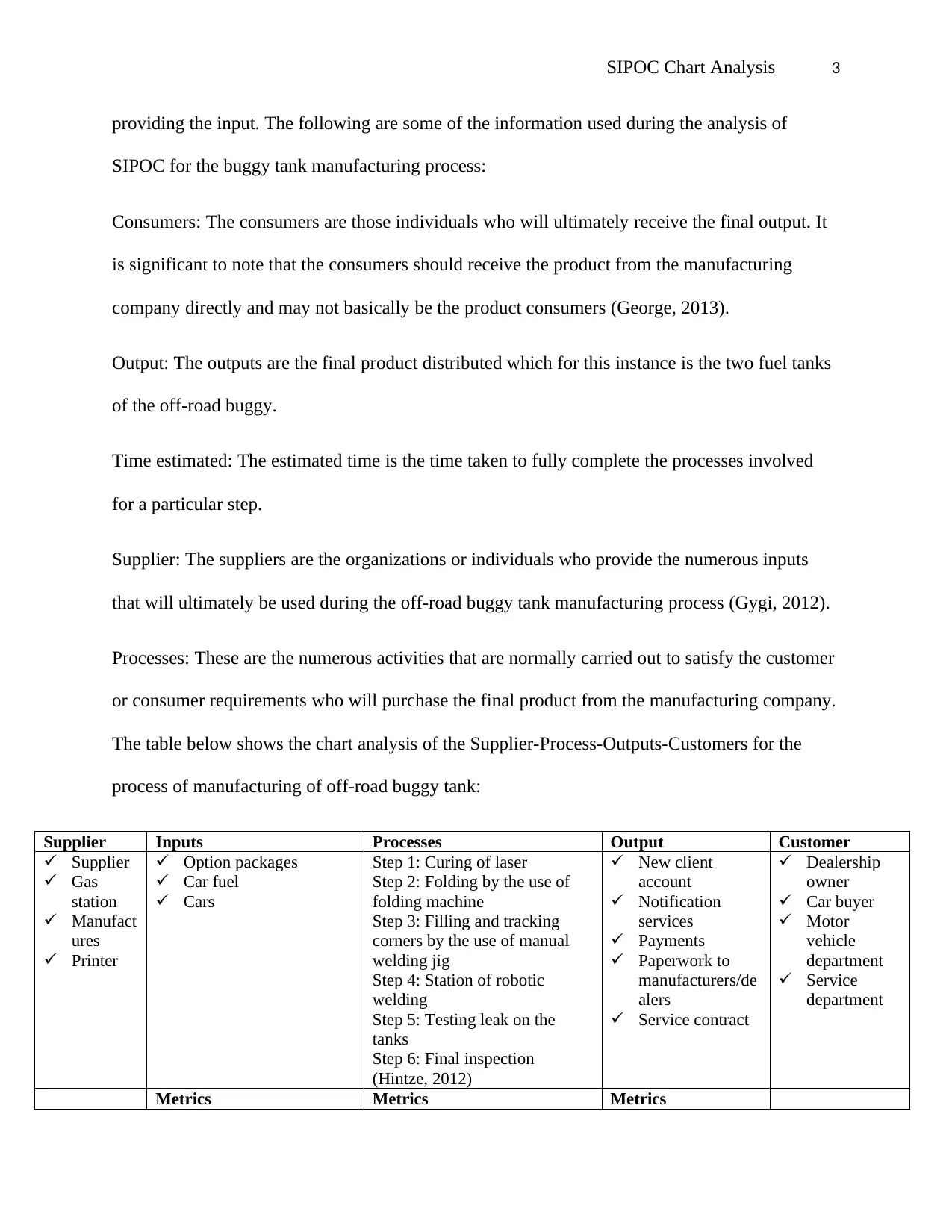
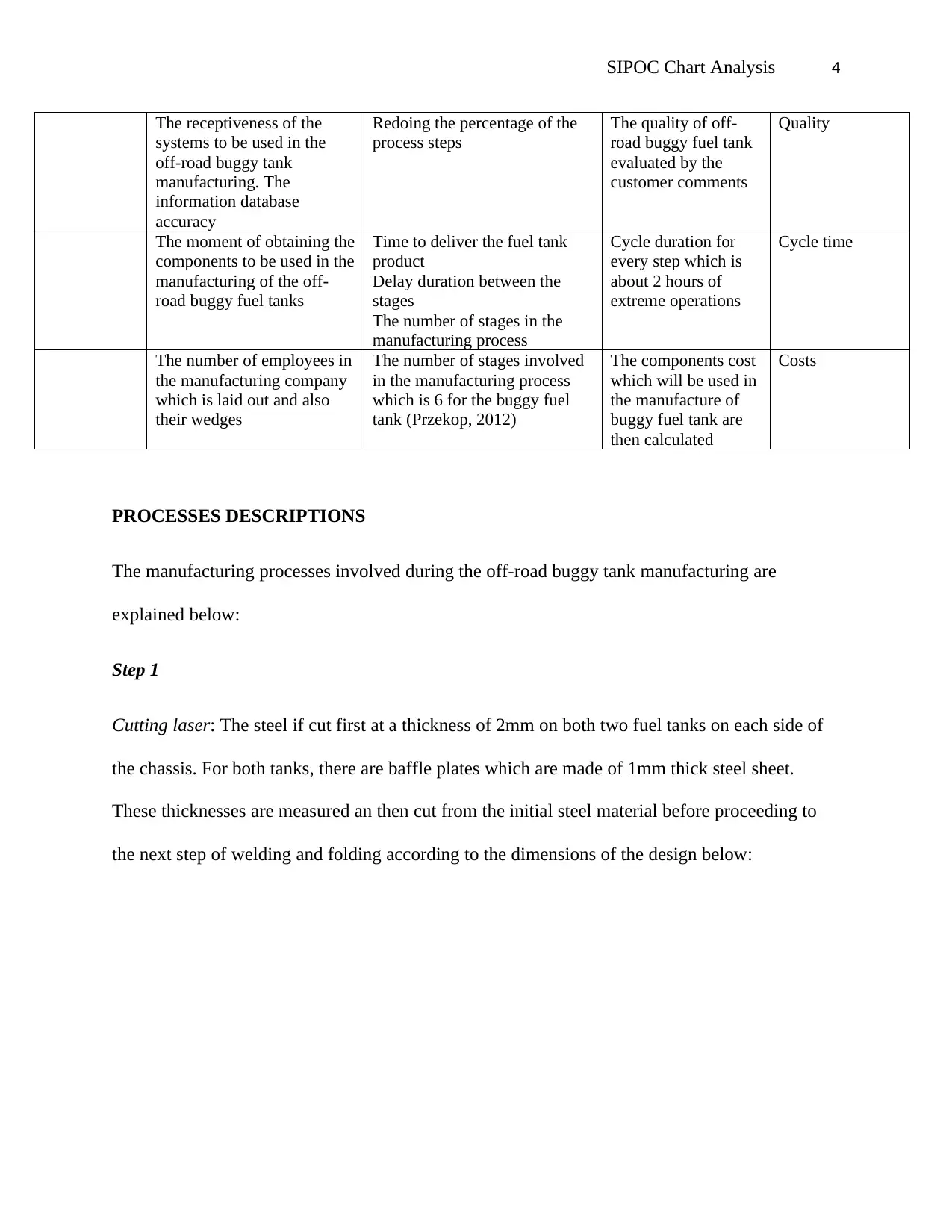
The table below shows the chart analysis of the Supplier-Process-Outputs-Customers for the
process of manufacturing of off-road buggy tank:
Supplier Inputs Processes Output Customer
Supplier
Gas
station
Manufact
ures
Printer
Option packages
Car fuel
Cars
Step 1: Curing of laser
Step 2: Folding by the use of
folding machine
Step 3: Filling and tracking
corners by the use of manual
welding jig
Step 4: Station of robotic
welding
Step 5: Testing leak on the
tanks
Step 6: Final inspection
(Hintze, 2012)
New client
account
Notification
services
Payments
Paperwork to
manufacturers/de
alers
Service contract
Dealership
owner
Car buyer
Motor
vehicle
department
Service
department
Metrics Metrics Metrics
providing the input. The following are some of the information used during the analysis of
SIPOC for the buggy tank manufacturing process:
Consumers: The consumers are those individuals who will ultimately receive the final output. It
is significant to note that the consumers should receive the product from the manufacturing
company directly and may not basically be the product consumers (George, 2013).
Output: The outputs are the final product distributed which for this instance is the two fuel tanks
of the off-road buggy.
Time estimated: The estimated time is the time taken to fully complete the processes involved
for a particular step.
Supplier: The suppliers are the organizations or individuals who provide the numerous inputs
that will ultimately be used during the off-road buggy tank manufacturing process (Gygi, 2012).
Processes: These are the numerous activities that are normally carried out to satisfy the customer
or consumer requirements who will purchase the final product from the manufacturing company.
The table below shows the chart analysis of the Supplier-Process-Outputs-Customers for the
process of manufacturing of off-road buggy tank:
Supplier Inputs Processes Output Customer
Supplier
Gas
station
Manufact
ures
Printer
Option packages
Car fuel
Cars
Step 1: Curing of laser
Step 2: Folding by the use of
folding machine
Step 3: Filling and tracking
corners by the use of manual
welding jig
Step 4: Station of robotic
welding
Step 5: Testing leak on the
tanks
Step 6: Final inspection
(Hintze, 2012)
New client
account
Notification
services
Payments
Paperwork to
manufacturers/de
alers
Service contract
Dealership
owner
Car buyer
Motor
vehicle
department
Service
department
Metrics Metrics Metrics
⊘ This is a preview!⊘
Do you want full access?
Subscribe today to unlock all pages.

Trusted by 1+ million students worldwide
SIPOC Chart Analysis 4
The receptiveness of the
systems to be used in the
off-road buggy tank
manufacturing. The
information database
accuracy
Redoing the percentage of the
process steps
The quality of off-
road buggy fuel tank
evaluated by the
customer comments
Quality
The moment of obtaining the
components to be used in the
manufacturing of the off-
road buggy fuel tanks
Time to deliver the fuel tank
product
Delay duration between the
stages
The number of stages in the
manufacturing process
Cycle duration for
every step which is
about 2 hours of
extreme operations
Cycle time
The number of employees in
the manufacturing company
which is laid out and also
their wedges
The number of stages involved
in the manufacturing process
which is 6 for the buggy fuel
tank (Przekop, 2012)
The components cost
which will be used in
the manufacture of
buggy fuel tank are
then calculated
Costs
PROCESSES DESCRIPTIONS
The manufacturing processes involved during the off-road buggy tank manufacturing are
explained below:
Step 1
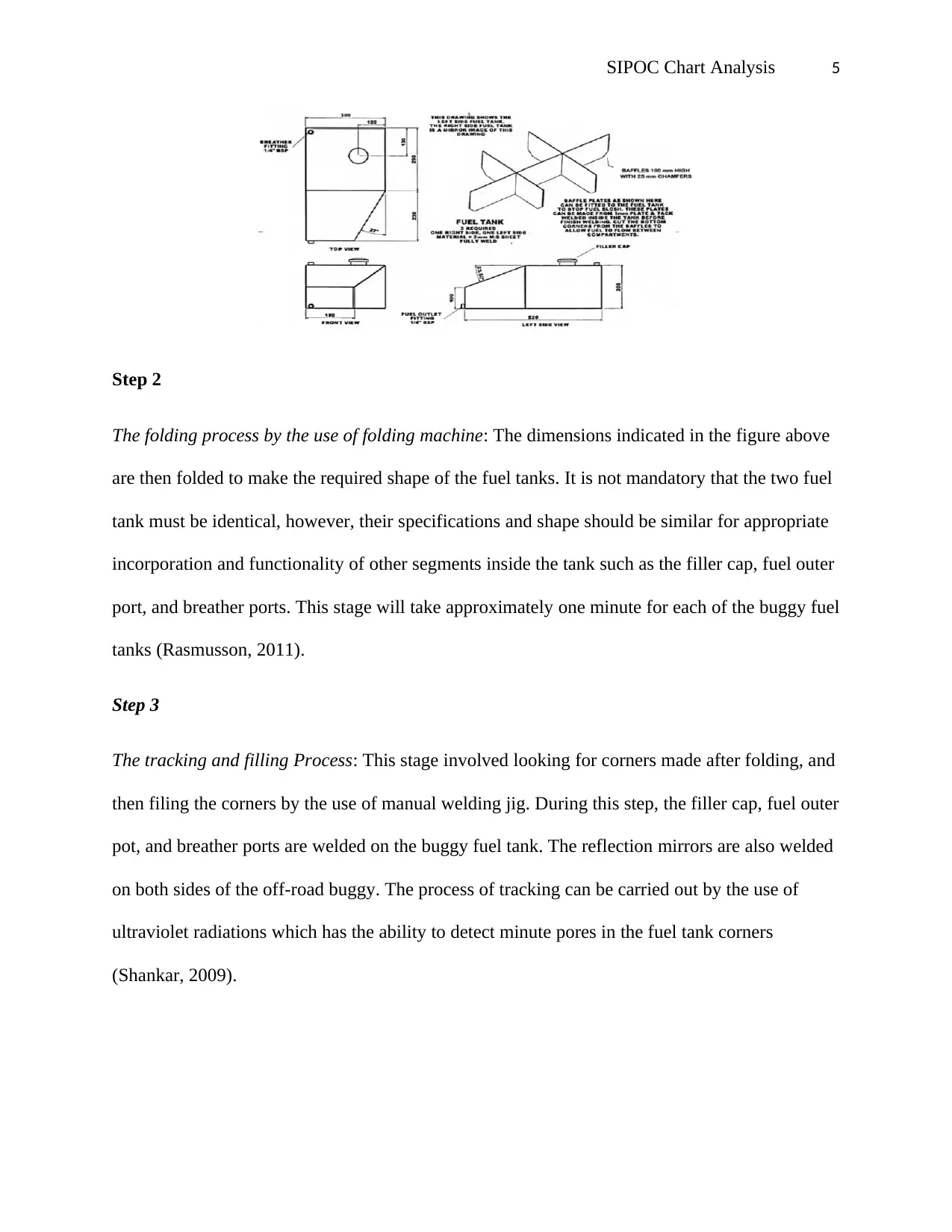
Cutting laser: The steel if cut first at a thickness of 2mm on both two fuel tanks on each side of
the chassis. For both tanks, there are baffle plates which are made of 1mm thick steel sheet.
These thicknesses are measured an then cut from the initial steel material before proceeding to
the next step of welding and folding according to the dimensions of the design below:
The receptiveness of the
systems to be used in the
off-road buggy tank
manufacturing. The
information database
accuracy
Redoing the percentage of the
process steps
The quality of off-
road buggy fuel tank
evaluated by the
customer comments
Quality
The moment of obtaining the
components to be used in the
manufacturing of the off-
road buggy fuel tanks
Time to deliver the fuel tank
product
Delay duration between the
stages
The number of stages in the
manufacturing process
Cycle duration for
every step which is
about 2 hours of
extreme operations
Cycle time
The number of employees in
the manufacturing company
which is laid out and also
their wedges
The number of stages involved
in the manufacturing process
which is 6 for the buggy fuel
tank (Przekop, 2012)
The components cost
which will be used in
the manufacture of
buggy fuel tank are
then calculated
Costs
PROCESSES DESCRIPTIONS
The manufacturing processes involved during the off-road buggy tank manufacturing are
explained below:
Step 1
Cutting laser: The steel if cut first at a thickness of 2mm on both two fuel tanks on each side of
the chassis. For both tanks, there are baffle plates which are made of 1mm thick steel sheet.
These thicknesses are measured an then cut from the initial steel material before proceeding to
the next step of welding and folding according to the dimensions of the design below:
Paraphrase This Document
Need a fresh take? Get an instant paraphrase of this document with our AI Paraphraser
SIPOC Chart Analysis 5
Step 2
The folding process by the use of folding machine: The dimensions indicated in the figure above
are then folded to make the required shape of the fuel tanks. It is not mandatory that the two fuel
tank must be identical, however, their specifications and shape should be similar for appropriate
incorporation and functionality of other segments inside the tank such as the filler cap, fuel outer
port, and breather ports. This stage will take approximately one minute for each of the buggy fuel
tanks (Rasmusson, 2011).
Step 3
The tracking and filling Process: This stage involved looking for corners made after folding, and
then filing the corners by the use of manual welding jig. During this step, the filler cap, fuel outer
pot, and breather ports are welded on the buggy fuel tank. The reflection mirrors are also welded
on both sides of the off-road buggy. The process of tracking can be carried out by the use of
ultraviolet radiations which has the ability to detect minute pores in the fuel tank corners
(Shankar, 2009).
Step 2
The folding process by the use of folding machine: The dimensions indicated in the figure above
are then folded to make the required shape of the fuel tanks. It is not mandatory that the two fuel
tank must be identical, however, their specifications and shape should be similar for appropriate
incorporation and functionality of other segments inside the tank such as the filler cap, fuel outer
port, and breather ports. This stage will take approximately one minute for each of the buggy fuel
tanks (Rasmusson, 2011).
Step 3
The tracking and filling Process: This stage involved looking for corners made after folding, and
then filing the corners by the use of manual welding jig. During this step, the filler cap, fuel outer
pot, and breather ports are welded on the buggy fuel tank. The reflection mirrors are also welded
on both sides of the off-road buggy. The process of tracking can be carried out by the use of
ultraviolet radiations which has the ability to detect minute pores in the fuel tank corners
(Shankar, 2009).
SIPOC Chart Analysis 6
Step 4
The robotics welding stations: This station of welding is used for the purposes of welding the
other elements in the buggy fuel tank such as filler cup, fuel outer pot, and breather pots for
instance when there is the manufacture of numerous bugger fuel tanks with similar dimensions
and components. This step is expected to take approximately 5 minutes for each buggy fuel tank
(Taghizadegan, 2010).
Step 5
The leaking Tests: The leaking test is performed after the ultimate completion of two fuel tanks
so as to evaluate if there are any probabilities of fuel leaking from the tanks. The process is
carried out by pouring fuel samples inside the two fuel tanks and then observe in case there is
any leakage from the fuel tanks. In case there is fuel leakage, then the tanks are returned to the
filing and tracking corners stage (George, 2013).
Step 6
The final inspection: This ultimate scrutiny is performed through testing physically of the off-
road buggy fuel tanks to evaluate in case the fuel tanks are in the position of properly function
after being assembled in the buggy. In case of production of buggy fuel tanks in large quantity
using a robotic mechanism, then the last buggy fuel tanks and the first fuel tanks to be produced
should be inspected because it is difficult to scrutinize all the buggy fuel tanks if they are many
(Hintze, 2012).
Step 4
The robotics welding stations: This station of welding is used for the purposes of welding the
other elements in the buggy fuel tank such as filler cup, fuel outer pot, and breather pots for
instance when there is the manufacture of numerous bugger fuel tanks with similar dimensions
and components. This step is expected to take approximately 5 minutes for each buggy fuel tank
(Taghizadegan, 2010).
Step 5
The leaking Tests: The leaking test is performed after the ultimate completion of two fuel tanks
so as to evaluate if there are any probabilities of fuel leaking from the tanks. The process is
carried out by pouring fuel samples inside the two fuel tanks and then observe in case there is
any leakage from the fuel tanks. In case there is fuel leakage, then the tanks are returned to the
filing and tracking corners stage (George, 2013).
Step 6
The final inspection: This ultimate scrutiny is performed through testing physically of the off-
road buggy fuel tanks to evaluate in case the fuel tanks are in the position of properly function
after being assembled in the buggy. In case of production of buggy fuel tanks in large quantity
using a robotic mechanism, then the last buggy fuel tanks and the first fuel tanks to be produced
should be inspected because it is difficult to scrutinize all the buggy fuel tanks if they are many
(Hintze, 2012).
⊘ This is a preview!⊘
Do you want full access?
Subscribe today to unlock all pages.
Trusted by 1+ million students worldwide
SIPOC Chart Analysis 7
CONCLUSION
A SIPOC Chart Analysis is a tool used for the purposes of identification of all relevant elements
of a process improvement project before the beginning of the project. The major metrics that are
considered during the SIPOC Chart Analysis include the suppliers, inputs, processes, outputs and
customers.
CONCLUSION
A SIPOC Chart Analysis is a tool used for the purposes of identification of all relevant elements
of a process improvement project before the beginning of the project. The major metrics that are
considered during the SIPOC Chart Analysis include the suppliers, inputs, processes, outputs and
customers.
Paraphrase This Document
Need a fresh take? Get an instant paraphrase of this document with our AI Paraphraser
SIPOC Chart Analysis 8
BIBLIOGRAPHY
Badiru, A., 2009. STEP Project Management: Guide for Science, Technology, and Engineering Projects.
Perth: CRC Press.
George, M., 2013. Lean Six Sigma for Service, Chapter 11 - Using DMAIC to Improve Service Processes.
Perth: McGraw Hill Professional.
Gygi, C., Williams. B., 2012. Six Sigma For Dummies. New York: John Wiley & Sons.
Hintze, M., 2012. Analysis and improvement of the setup time reduction effect, the order strategies and
the operating curves of manufacturing operations. London: GRIN Verlag.
Przekop, P., 2012. Six Sigma for Business Excellence. Melbourne: McGraw Hill Professional.
Rasmusson, D., 2011. SIPOC Picture Book: A Visual Guide to SIPOC/DMAIC Relationship. Toledo: Oriel
Incorporated.
Shankar, R., 2009. Process Improvement Using Six Sigma: A DMAIC Guide. Colorado: ASQ Quality Press.
Taghizadegan, S., 2010. Essentials of Lean Six Sigma. Michigan: Elsevier.
BIBLIOGRAPHY
Badiru, A., 2009. STEP Project Management: Guide for Science, Technology, and Engineering Projects.
Perth: CRC Press.
George, M., 2013. Lean Six Sigma for Service, Chapter 11 - Using DMAIC to Improve Service Processes.
Perth: McGraw Hill Professional.
Gygi, C., Williams. B., 2012. Six Sigma For Dummies. New York: John Wiley & Sons.
Hintze, M., 2012. Analysis and improvement of the setup time reduction effect, the order strategies and
the operating curves of manufacturing operations. London: GRIN Verlag.
Przekop, P., 2012. Six Sigma for Business Excellence. Melbourne: McGraw Hill Professional.
Rasmusson, D., 2011. SIPOC Picture Book: A Visual Guide to SIPOC/DMAIC Relationship. Toledo: Oriel
Incorporated.
Shankar, R., 2009. Process Improvement Using Six Sigma: A DMAIC Guide. Colorado: ASQ Quality Press.
Taghizadegan, S., 2010. Essentials of Lean Six Sigma. Michigan: Elsevier.

1 out of 8


Your All-in-One AI-Powered Toolkit for Academic Success.
+13062052269
info@desklib.com
Available 24*7 on WhatsApp / Email
![[object Object]](/_next/static/media/star-bottom.7253800d.svg)
Unlock your academic potential
Copyright © 2020–2025 A2Z Services. All Rights Reserved. Developed and managed by ZUCOL.