Psychology Essay: Adolescent Brain Development and Decision-Making
VerifiedAdded on  2022/10/10
|6
|1098
|143
Essay
AI Summary
This psychology essay delves into the cognitive development of adolescents, focusing on why they tend to be less logical and more emotional in their decision-making compared to adults. The essay explains this behavior through the lens of brain development, particularly the frontal cortex and the amygdala. It highlights that the frontal cortex, responsible for rational decision-making, is not fully developed during adolescence, while the amygdala, which governs emotional responses, is more active. The essay discusses how these biological factors lead to impulsive, irrational, and emotional behaviors in adolescents. It also emphasizes the importance of understanding and supporting adolescents during this developmental stage, suggesting strategies such as encouraging critical thinking and emotional control. The essay references several studies to support its claims and provides a comprehensive overview of the psychological and biological aspects of adolescent decision-making.

Running head: PSYCHOLOGY 1
Psychology
Name
Institution
Psychology
Name
Institution
Paraphrase This Document
Need a fresh take? Get an instant paraphrase of this document with our AI Paraphraser

PSYCHOLOGY 2
Why Adolescent Children may be Less Logical and more Emotional in their Decision-Making
Human growth is not spontaneous because it occurs progressively right from conception
to adulthood, through infancy, adolescence, and childhood. Growth takes many forms including
cognitive, physical, and social. In this study, we are mainly focusing on the cognitive growth of
human being particularly during adolescence. The main point of discussion is, therefore, the
process of brain development. Unlike their adult counterparts, the adolescents tend to be less
logical, but more irrational, impulsive, emotional, and illogical in their decision-making process.
We would like to dig deeper into the changes that occur in the brain of adolescents that make
them behave in a different manner as compared to the adults.
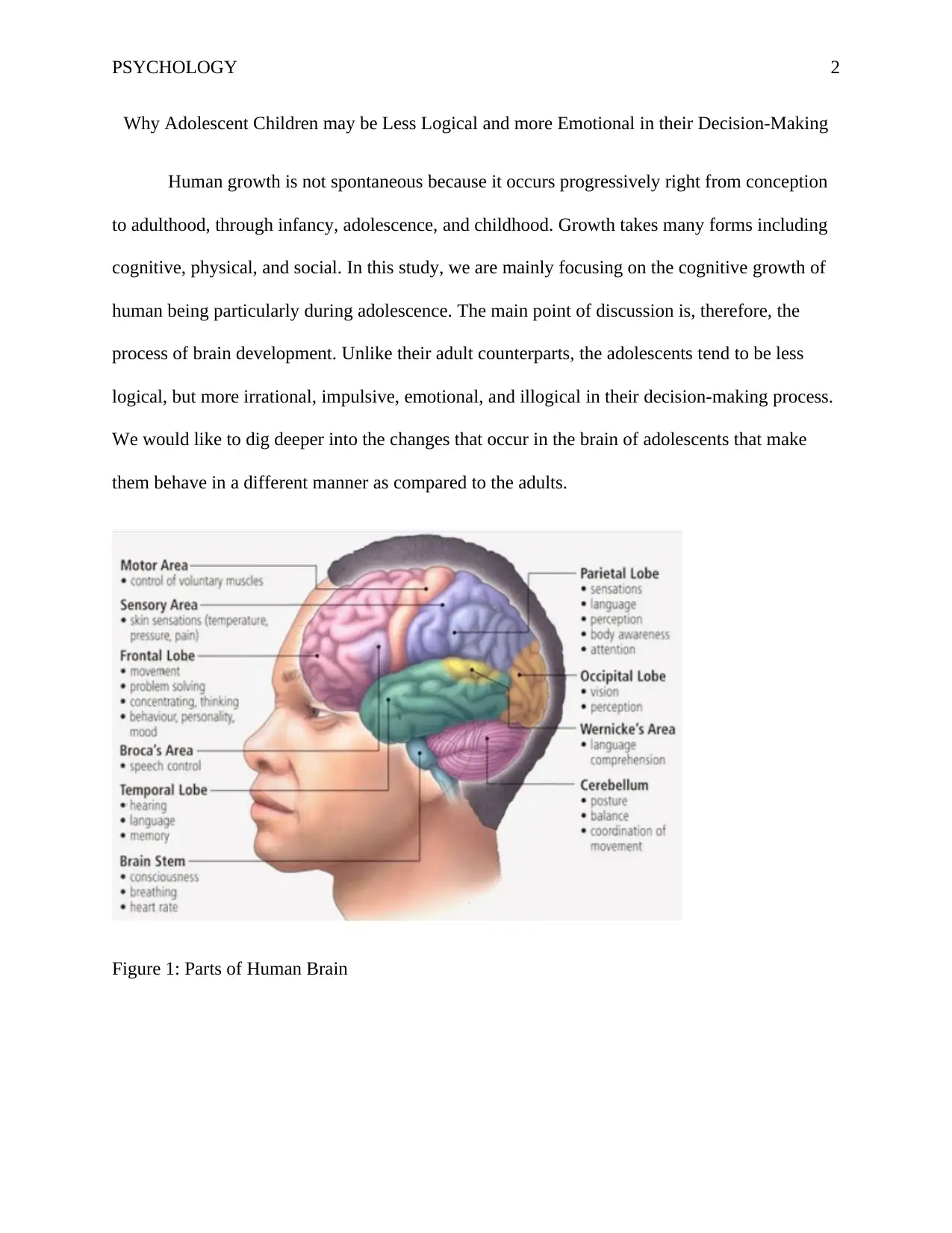
Figure 1: Parts of Human Brain
Why Adolescent Children may be Less Logical and more Emotional in their Decision-Making
Human growth is not spontaneous because it occurs progressively right from conception
to adulthood, through infancy, adolescence, and childhood. Growth takes many forms including
cognitive, physical, and social. In this study, we are mainly focusing on the cognitive growth of
human being particularly during adolescence. The main point of discussion is, therefore, the
process of brain development. Unlike their adult counterparts, the adolescents tend to be less
logical, but more irrational, impulsive, emotional, and illogical in their decision-making process.
We would like to dig deeper into the changes that occur in the brain of adolescents that make
them behave in a different manner as compared to the adults.
Figure 1: Parts of Human Brain

PSYCHOLOGY 3
The biological explanation for the reason why the adolescents tend to be less logical, but
more irrational, impulsive, emotional, and illogical in their decision-making process is that
during this stage, the brain still undergoes some development. Research has established that the
process of human brain development does not end during childhood, but continue up to early
adulthood (Fuhrmann, Knoll & Blakemore, 2015). So, it is likely to observe adolescents engage
in irrational and illogical decision-making since their brain is not fully mature. During
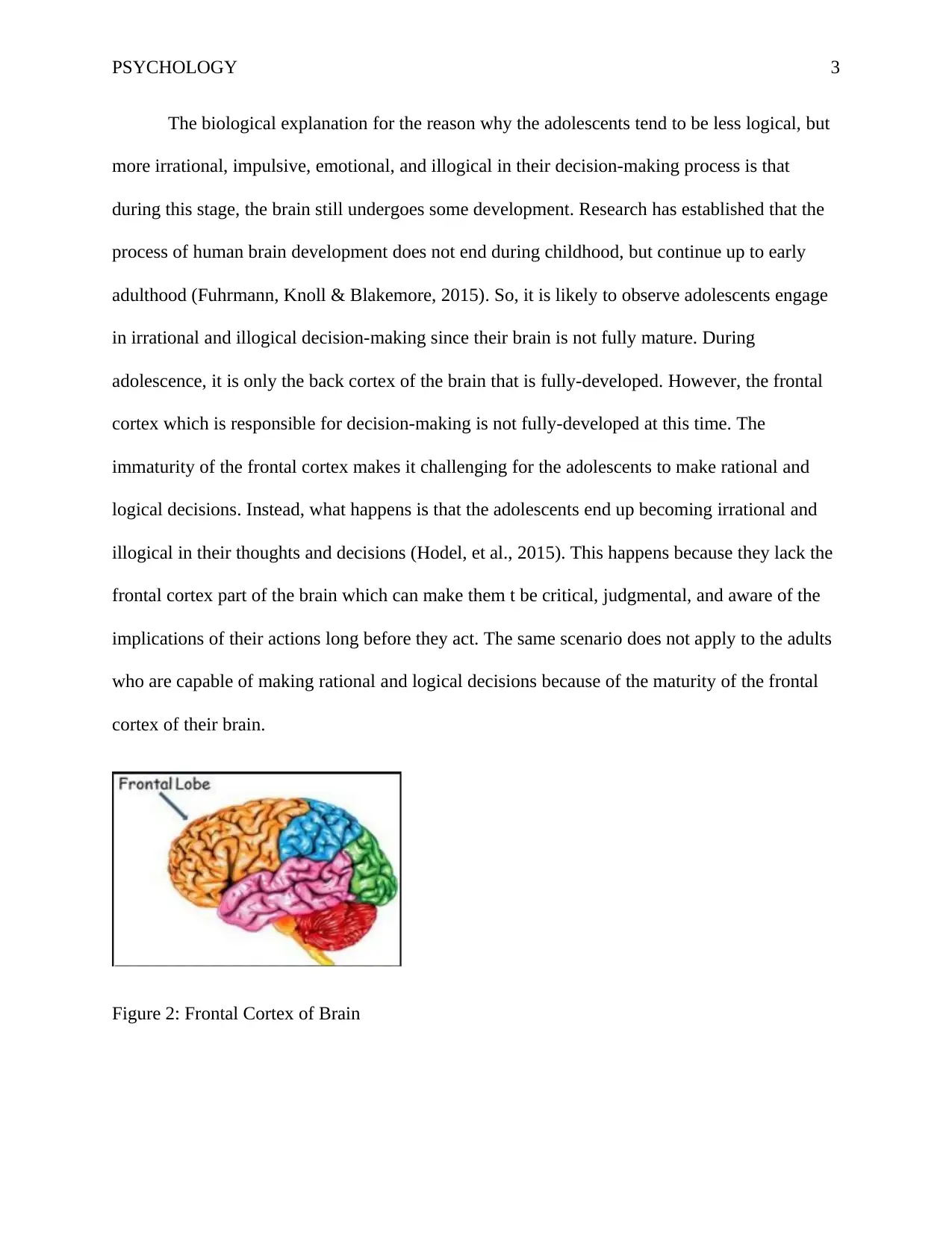
adolescence, it is only the back cortex of the brain that is fully-developed. However, the frontal
cortex which is responsible for decision-making is not fully-developed at this time. The
immaturity of the frontal cortex makes it challenging for the adolescents to make rational and
logical decisions. Instead, what happens is that the adolescents end up becoming irrational and
illogical in their thoughts and decisions (Hodel, et al., 2015). This happens because they lack the
frontal cortex part of the brain which can make them t be critical, judgmental, and aware of the
implications of their actions long before they act. The same scenario does not apply to the adults
who are capable of making rational and logical decisions because of the maturity of the frontal
cortex of their brain.
Figure 2: Frontal Cortex of Brain
The biological explanation for the reason why the adolescents tend to be less logical, but
more irrational, impulsive, emotional, and illogical in their decision-making process is that
during this stage, the brain still undergoes some development. Research has established that the
process of human brain development does not end during childhood, but continue up to early
adulthood (Fuhrmann, Knoll & Blakemore, 2015). So, it is likely to observe adolescents engage
in irrational and illogical decision-making since their brain is not fully mature. During
adolescence, it is only the back cortex of the brain that is fully-developed. However, the frontal
cortex which is responsible for decision-making is not fully-developed at this time. The
immaturity of the frontal cortex makes it challenging for the adolescents to make rational and
logical decisions. Instead, what happens is that the adolescents end up becoming irrational and
illogical in their thoughts and decisions (Hodel, et al., 2015). This happens because they lack the
frontal cortex part of the brain which can make them t be critical, judgmental, and aware of the
implications of their actions long before they act. The same scenario does not apply to the adults
who are capable of making rational and logical decisions because of the maturity of the frontal
cortex of their brain.
Figure 2: Frontal Cortex of Brain
⊘ This is a preview!⊘
Do you want full access?
Subscribe today to unlock all pages.

Trusted by 1+ million students worldwide

PSYCHOLOGY 4
It is paramount to acknowledge that the adolescents are fond of demonstrating emotional,
irritating, and impulsive behaviors whenever interacting with their peers, juniors, and seniors.
Biologically, this is attributed to the presence of amygdala (Defoe, Dubas, Figner & van Aken,
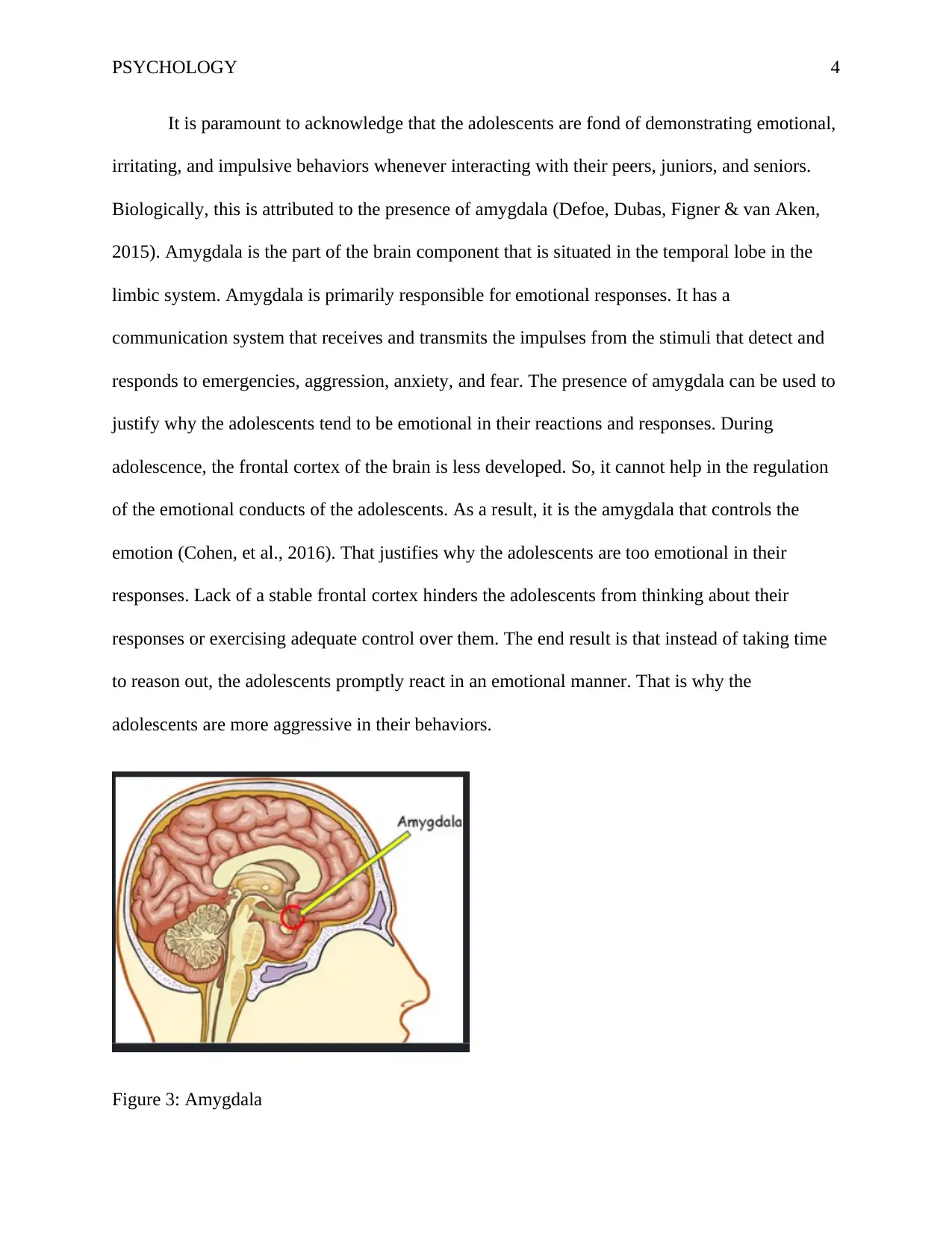
2015). Amygdala is the part of the brain component that is situated in the temporal lobe in the
limbic system. Amygdala is primarily responsible for emotional responses. It has a
communication system that receives and transmits the impulses from the stimuli that detect and
responds to emergencies, aggression, anxiety, and fear. The presence of amygdala can be used to
justify why the adolescents tend to be emotional in their reactions and responses. During
adolescence, the frontal cortex of the brain is less developed. So, it cannot help in the regulation
of the emotional conducts of the adolescents. As a result, it is the amygdala that controls the
emotion (Cohen, et al., 2016). That justifies why the adolescents are too emotional in their
responses. Lack of a stable frontal cortex hinders the adolescents from thinking about their
responses or exercising adequate control over them. The end result is that instead of taking time
to reason out, the adolescents promptly react in an emotional manner. That is why the
adolescents are more aggressive in their behaviors.
Figure 3: Amygdala
It is paramount to acknowledge that the adolescents are fond of demonstrating emotional,
irritating, and impulsive behaviors whenever interacting with their peers, juniors, and seniors.
Biologically, this is attributed to the presence of amygdala (Defoe, Dubas, Figner & van Aken,
2015). Amygdala is the part of the brain component that is situated in the temporal lobe in the
limbic system. Amygdala is primarily responsible for emotional responses. It has a
communication system that receives and transmits the impulses from the stimuli that detect and
responds to emergencies, aggression, anxiety, and fear. The presence of amygdala can be used to
justify why the adolescents tend to be emotional in their reactions and responses. During
adolescence, the frontal cortex of the brain is less developed. So, it cannot help in the regulation
of the emotional conducts of the adolescents. As a result, it is the amygdala that controls the
emotion (Cohen, et al., 2016). That justifies why the adolescents are too emotional in their
responses. Lack of a stable frontal cortex hinders the adolescents from thinking about their
responses or exercising adequate control over them. The end result is that instead of taking time
to reason out, the adolescents promptly react in an emotional manner. That is why the
adolescents are more aggressive in their behaviors.
Figure 3: Amygdala
Paraphrase This Document
Need a fresh take? Get an instant paraphrase of this document with our AI Paraphraser

PSYCHOLOGY 5
The slow rate of growth of the brain makes adolescents to behave in a different manner as
compared to the adults. Reasoning, decision-making, and emotional control are not traits that are
acquired from the environment. Rather, they are controlled by the brain. Each part of the brain be
it the frontal or back lobes has an important role to play. They also grow differently. That is why
at different stage of human growth, different traits are demonstrated. In this regard, while
growing, the adolescents are likely to act before thinking, engage in certain harmful acts, engage
in fights, misinterpret emotions, and react based on impulses. Such behaviors might be regarded
as a violation of the norm (Yeager, 2017). However, what the parents should do is not to punish,
threaten or abandon the adolescents. Instead, what needs to be done is to understand the situation
and offer the necessary support. Some of the strategies to apply reinforce critical thought and
emotional control include emphasis on healthy sleep, encouragement of critical thinking, and
positive conducts.
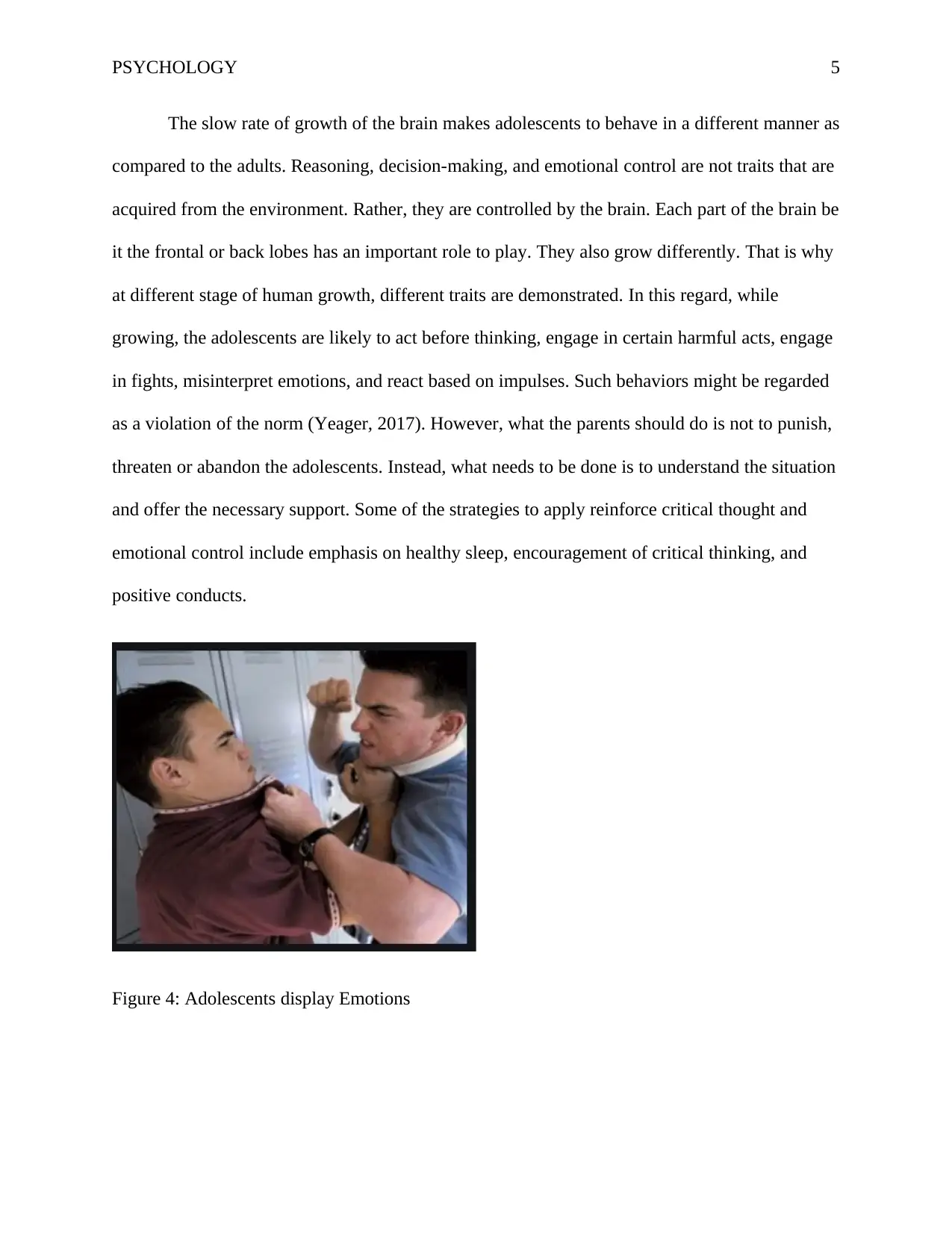
Figure 4: Adolescents display Emotions
The slow rate of growth of the brain makes adolescents to behave in a different manner as
compared to the adults. Reasoning, decision-making, and emotional control are not traits that are
acquired from the environment. Rather, they are controlled by the brain. Each part of the brain be
it the frontal or back lobes has an important role to play. They also grow differently. That is why
at different stage of human growth, different traits are demonstrated. In this regard, while
growing, the adolescents are likely to act before thinking, engage in certain harmful acts, engage
in fights, misinterpret emotions, and react based on impulses. Such behaviors might be regarded
as a violation of the norm (Yeager, 2017). However, what the parents should do is not to punish,
threaten or abandon the adolescents. Instead, what needs to be done is to understand the situation
and offer the necessary support. Some of the strategies to apply reinforce critical thought and
emotional control include emphasis on healthy sleep, encouragement of critical thinking, and
positive conducts.
Figure 4: Adolescents display Emotions

PSYCHOLOGY 6
References
Cohen, A. O., Breiner, K., Steinberg, L., Bonnie, R. J., Scott, E. S., Taylor-Thompson, K., ... &
Silverman, M. R. (2016). When is an adolescent an adult? Assessing cognitive control in
emotional and nonemotional contexts. Psychological Science, 27(4), 549-562.
Defoe, I. N., Dubas, J. S., Figner, B., & van Aken, M. A. (2015). A meta-analysis on age
differences in risky decision making: Adolescents versus children and adults.
Psychological bulletin, 141(1), 48.
Fuhrmann, D., Knoll, L. J., & Blakemore, S. J. (2015). Adolescence as a sensitive period of brain
development. Trends in cognitive sciences, 19(10), 558-566.
Hodel, A. S., Hunt, R. H., Cowell, R. A., Van Den Heuvel, S. E., Gunnar, M. R., & Thomas, K.
M. (2015). Duration of early adversity and structural brain development in post-
institutionalized adolescents. Neuroimage, 105, 112-119.
Yeager, D. S. (2017). Social and emotional learning programs for adolescents. The Future of
Children, 73-94.
References
Cohen, A. O., Breiner, K., Steinberg, L., Bonnie, R. J., Scott, E. S., Taylor-Thompson, K., ... &
Silverman, M. R. (2016). When is an adolescent an adult? Assessing cognitive control in
emotional and nonemotional contexts. Psychological Science, 27(4), 549-562.
Defoe, I. N., Dubas, J. S., Figner, B., & van Aken, M. A. (2015). A meta-analysis on age
differences in risky decision making: Adolescents versus children and adults.
Psychological bulletin, 141(1), 48.
Fuhrmann, D., Knoll, L. J., & Blakemore, S. J. (2015). Adolescence as a sensitive period of brain
development. Trends in cognitive sciences, 19(10), 558-566.
Hodel, A. S., Hunt, R. H., Cowell, R. A., Van Den Heuvel, S. E., Gunnar, M. R., & Thomas, K.
M. (2015). Duration of early adversity and structural brain development in post-
institutionalized adolescents. Neuroimage, 105, 112-119.
Yeager, D. S. (2017). Social and emotional learning programs for adolescents. The Future of
Children, 73-94.
⊘ This is a preview!⊘
Do you want full access?
Subscribe today to unlock all pages.

Trusted by 1+ million students worldwide
1 out of 6
Related Documents
Your All-in-One AI-Powered Toolkit for Academic Success.
 +13062052269
info@desklib.com
Available 24*7 on WhatsApp / Email
Unlock your academic potential
Copyright © 2020–2025 A2Z Services. All Rights Reserved. Developed and managed by ZUCOL.