Analysis of Adoptive Resource Provisioning in Cloud Computing Systems

Verified

Added on  2021/10/03

|14
|1124
|210
Report
AI Summary
This report delves into the realm of resource provisioning within cloud computing, examining techniques essential for optimizing stream applications. It begins by defining resource provisioning and its significance in ensuring guaranteed performance, quality of service (QoS), and adherence to service level agreements (SLAs). The report explores the evolution of computing, highlighting the shift towards cloud computing to address challenges like idle resource wastage. It outlines the objectives, which include identifying data storage technologies, data management techniques, programming models, and service forms within cloud computing. The core of the report focuses on resource optimization for stream applications, emphasizing the role of Multiprocessor System-on-Chip (MP-SoCs) and heterogeneous MPSoCs. It then categorizes resource provisioning types, including static, dynamic, and user self-provisioning, detailing their applications and implications. The results section discusses various resource provisioning strategies, emphasizing their impact on QoS, cost reduction, performance enhancement, and efficient resource utilization. The report concludes by recommending the standardization of cloud computing platforms to facilitate interoperability and data portability, ultimately driving future internet revolutions. The report is based on a research framework which includes introduction and background, research questions, methodology, findings, and implications.
Document Page
Adoptive Techniques for Stream
Applications
tabler-icon-diamond-filled.svg

Paraphrase This Document

Need a fresh take? Get an instant paraphrase of this document with our AI Paraphraser
Document Page
Resource provisioning in public cloud
Introduction
Resource provisioning is described as the process of selecting, deploying and run-time
management of software and hardware resource to ensure there is guaranteed
performance for applications (Yi, Li, and Li, 2015, p. 37).
Resource provisioning technique include static and dynamic each comprising its
benefits and flaws.
These resource provisioning techniques have to attain the quality of service (QoS)
parameters such as responsive time, reliability, availability, security and throughput to
avert violation of the service level agreement.
Document Page
Background
The advancement of the computer started with the mainframe until now the PC
which is convenient for use.
Nevertheless, researchers have found that due to its scattered existence makes it
problematic.
The major challenge is the idle computer resource that results in wastage of
material, electricity and ecological pollution (Sahni, and Vidyarthi, 2018, p. 7).
Consequently, due to these problems it led to the birth of cloud computing.
Document Page
Significance of the research
Cloud computing has led to high reliability, high availability and economic
efficiency through its ability to adopt distributed data storage (Fu et al., 2015, p.
411).
Cloud computing systems have the capacity to meets the requirements of
numerous clients in parallel by providing service to them simultaneously.
tabler-icon-diamond-filled.svg

Paraphrase This Document

Need a fresh take? Get an instant paraphrase of this document with our AI Paraphraser
Document Page
Objectives
To find out the technologies used for data storage by cloud computing.
To identify the techniques employed to ensure cloud computing data management.
To identify the programming models used in cloud computing.
To identify different services forms provided by cloud computing.
Document Page
Resource optimization for stream applications
Streaming applications are a significant set of embedded software which extent a range
of application domains like video/audio processing, image processing and digital signal
processing (Sun et al., 2015, p.93).
As a result of the ever-increasing computational demand and challenging real-time
constraints of streaming applications it has forced system designers to use
Multiprocessor System-on-Chip (MP-SoCs) in modern embedded systems.
Consequently, this is beneficial for parallel execution. Currently, heterogeneous MPSoCs
have become common because they have the ability to balance performance and energy
efficiency.
Document Page
Research framework outline steps
This research will include the following research steps:
Introduction and background
Research questions and framework overview
Research methodology
Study findings
Discussion of findings
Implications
tabler-icon-diamond-filled.svg

Paraphrase This Document

Need a fresh take? Get an instant paraphrase of this document with our AI Paraphraser
Document Page
Implementation
The resource provisioning types are classified according to their application needs as:
Static provisioning: This applications are suitable for predictable and commonly
demands or workloads that does not change (Nagesh, 2014, p. 397).
The consumer signs a contract with the provider for services for the provider to
prepare in advance of the beginning of service thus the consumer pays a flat rate
fee.
Document Page
Cont’
Dynamic provisioning: This application is employed in instances where the
demand by application keep on changing “dynamic provisioning”.
In the case of dynamic provision the service provider can allocate as many
resources as needed and remove they not needed (Toosi, Sinnott, and Buyya,
2018, p. 767).
User self-provisioning: In this case the consumer buy resources from the cloud
provider via a web form by creating a customer account to allow them make
online payment.
Document Page
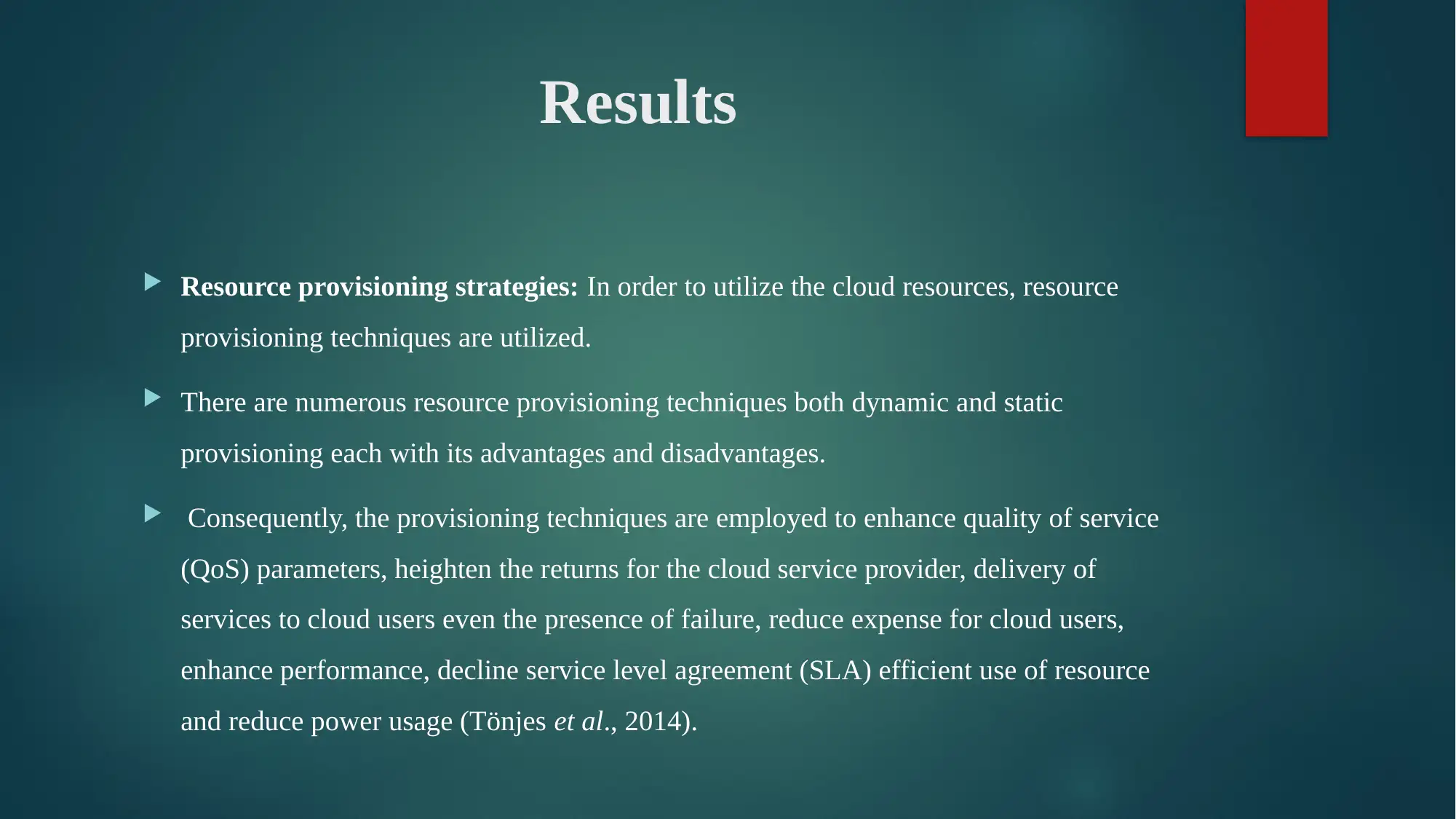
Results
Resource provisioning strategies: In order to utilize the cloud resources, resource
provisioning techniques are utilized.
There are numerous resource provisioning techniques both dynamic and static
provisioning each with its advantages and disadvantages.
Consequently, the provisioning techniques are employed to enhance quality of service
(QoS) parameters, heighten the returns for the cloud service provider, delivery of
services to cloud users even the presence of failure, reduce expense for cloud users,
enhance performance, decline service level agreement (SLA) efficient use of resource
and reduce power usage (Tönjes et al., 2014).
tabler-icon-diamond-filled.svg

Paraphrase This Document

Need a fresh take? Get an instant paraphrase of this document with our AI Paraphraser
Document Page
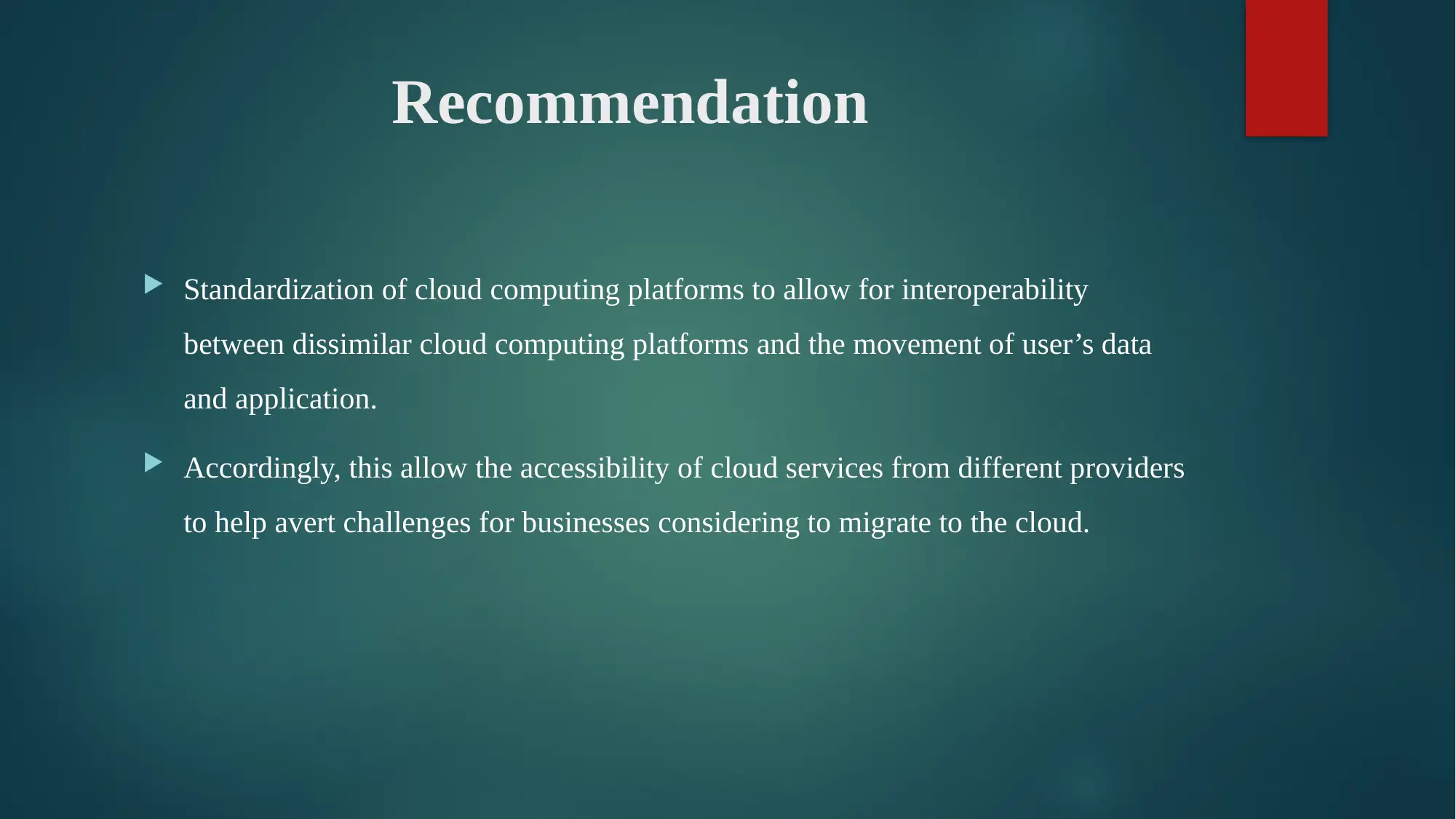
Recommendation
Standardization of cloud computing platforms to allow for interoperability
between dissimilar cloud computing platforms and the movement of user’s data
and application.
Accordingly, this allow the accessibility of cloud services from different providers
to help avert challenges for businesses considering to migrate to the cloud.
Document Page
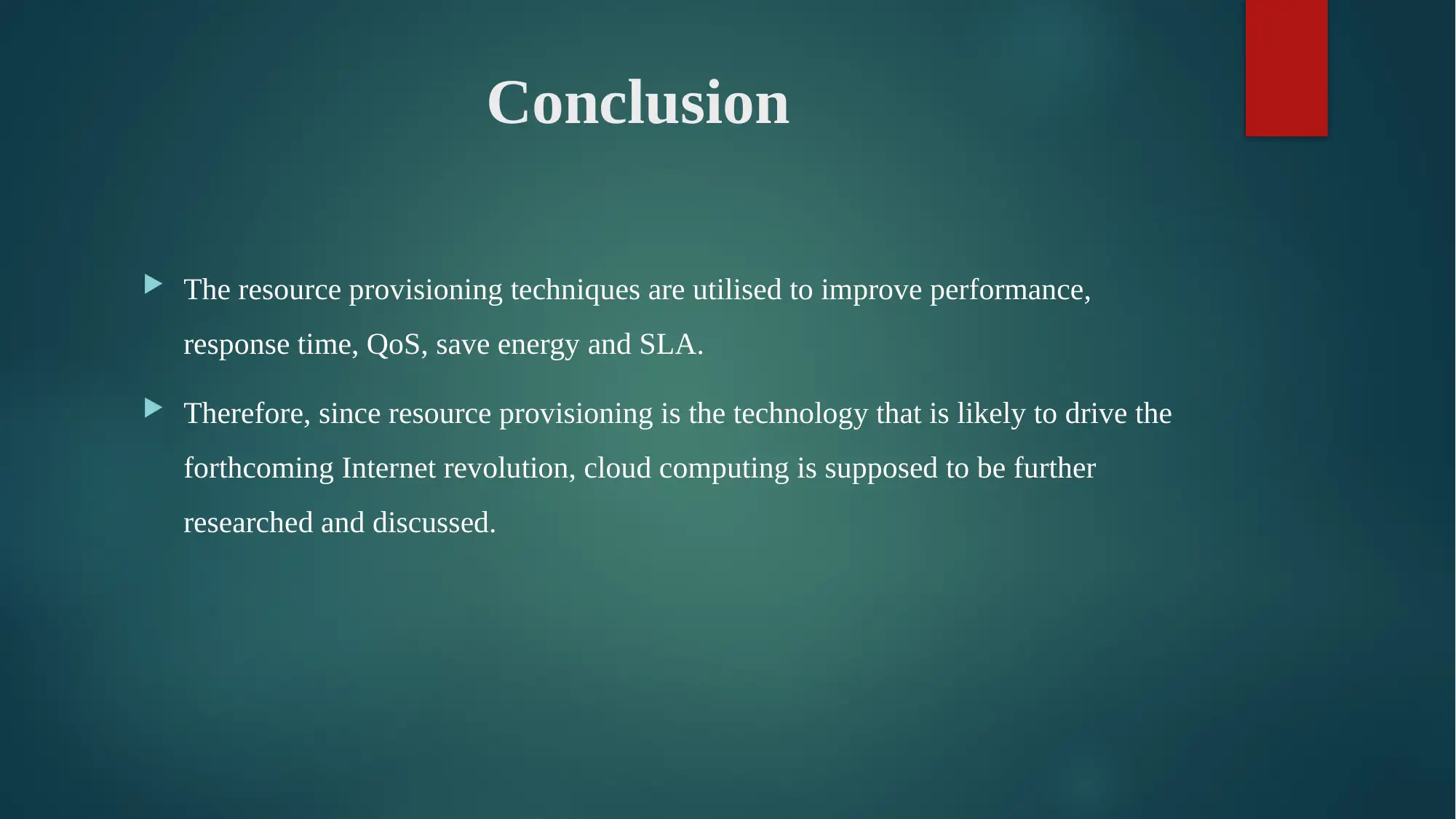
Conclusion
The resource provisioning techniques are utilised to improve performance,
response time, QoS, save energy and SLA.
Therefore, since resource provisioning is the technology that is likely to drive the
forthcoming Internet revolution, cloud computing is supposed to be further
researched and discussed.
chevron_up_icon
1 out of 14
circle_padding
hide_on_mobile
zoom_out_icon
[object Object]