Detailed Analysis of Leonardo da Vinci's 'Adoration of the Magi'

Verified

Added on  2022/08/27

|5
|1532
|15
Essay
AI Summary
This essay provides a comprehensive analysis of Leonardo da Vinci's 'Adoration of the Magi', focusing on its artistic techniques, historical context, and significance. The essay begins by introducing the painting and its importance, highlighting its innovative techniques and large scale. It then delves into the painting's composition, exploring the arrangement of figures, landscape elements, and the use of sfumato. The essay discusses the painting's themes, including the representation of the new era of Christianity and the symbolism of various elements like the palm tree. The social context of the painting is also examined, including its origins and Da Vinci's use of the technique. The essay also mentions the unfinished state of the painting and Da Vinci's influence. Overall, the essay offers a detailed overview of the painting, its artistic merit, and its place in art history, referencing various scholars and their perspectives.
Document Page
Running head: THE ADORATION OF THE MAGI - BY LEONARDO DA VINCI
The Adoration of the Magi - by Leonardo Da Vinci
Name of the student
Name of the university
Authors note
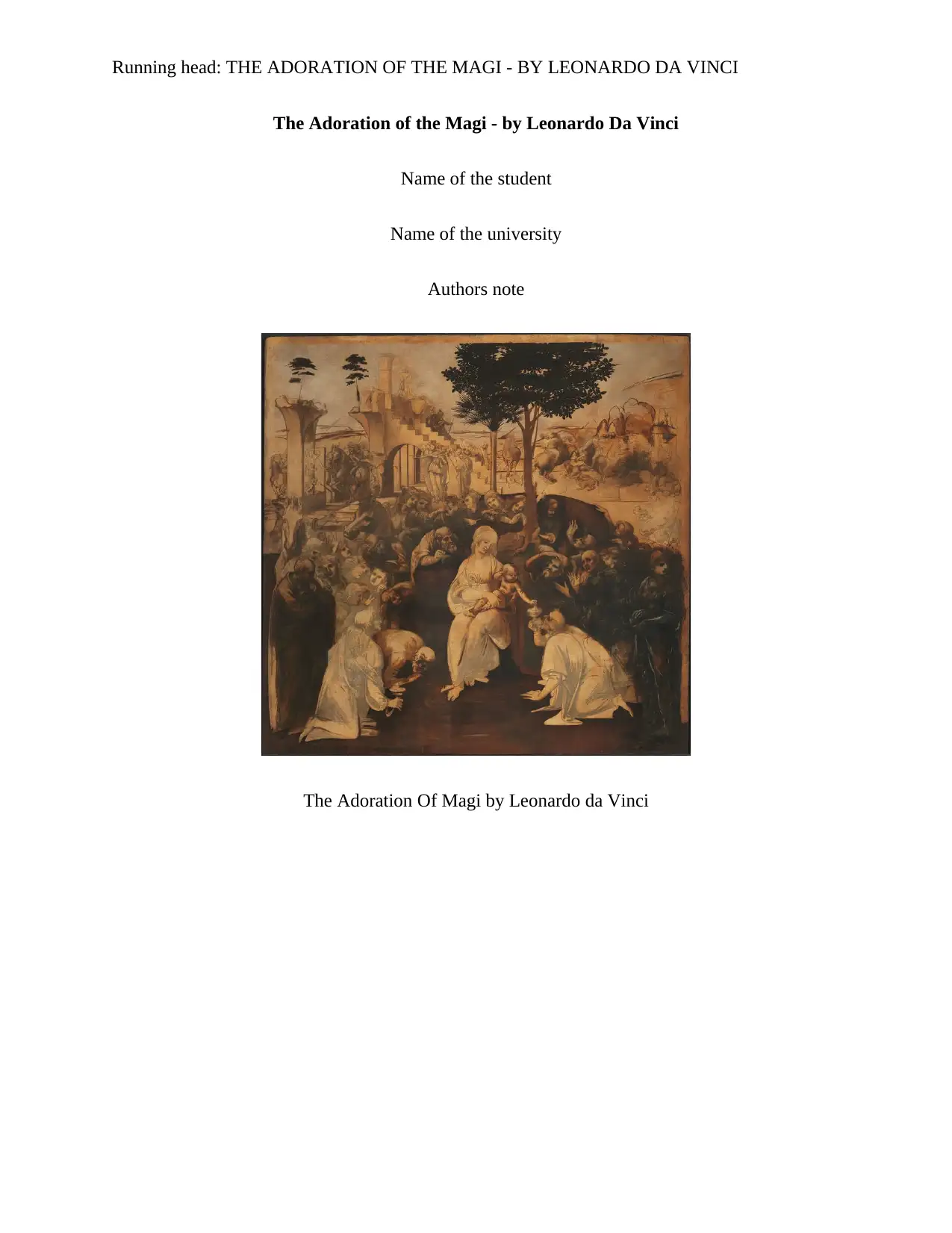
The Adoration Of Magi by Leonardo da Vinci
tabler-icon-diamond-filled.svg

Paraphrase This Document

Need a fresh take? Get an instant paraphrase of this document with our AI Paraphraser
Document Page
2
THE ADORATION OF THE MAGI - BY LEONARDO DA VINCI
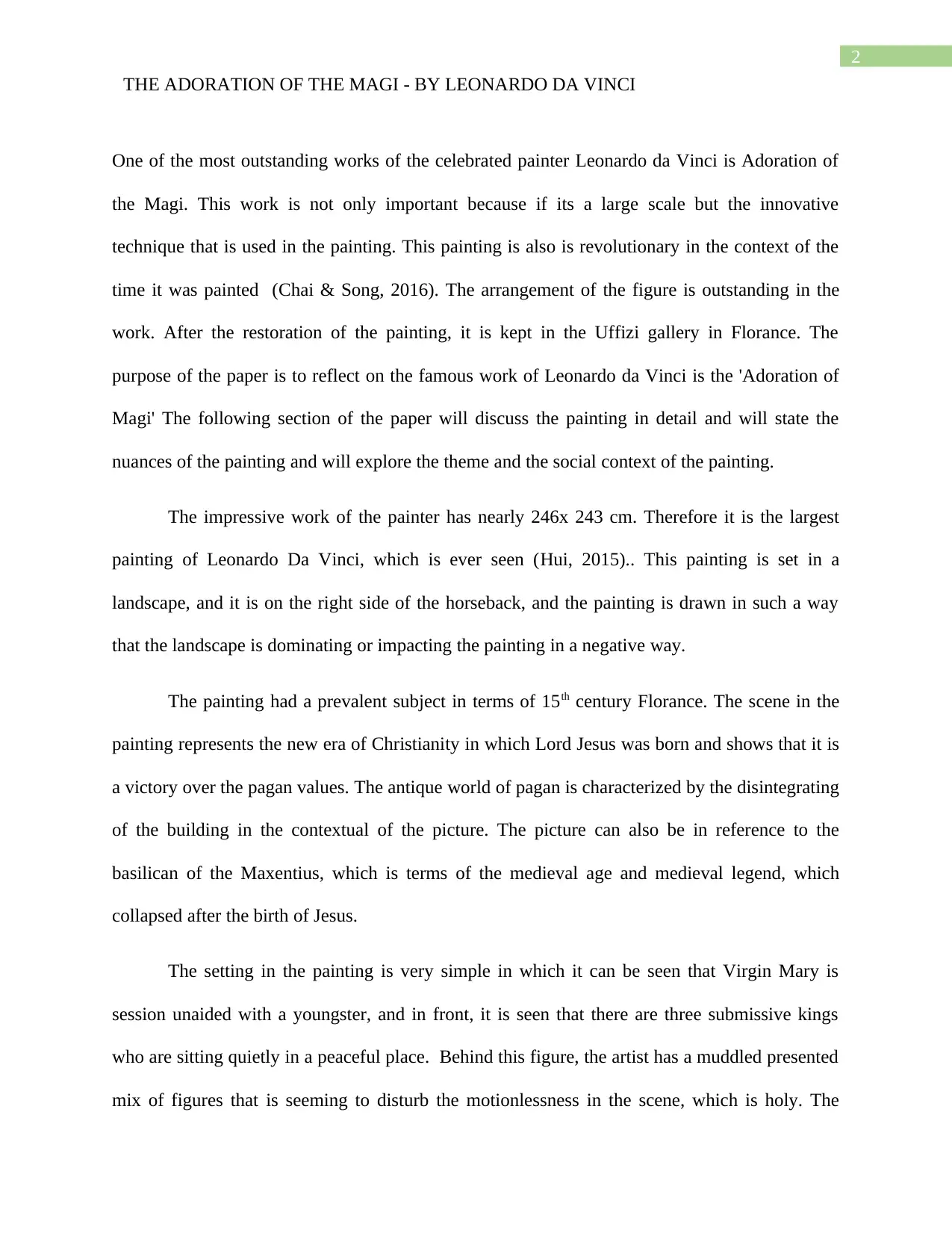
One of the most outstanding works of the celebrated painter Leonardo da Vinci is Adoration of
the Magi. This work is not only important because if its a large scale but the innovative
technique that is used in the painting. This painting is also is revolutionary in the context of the
time it was painted (Chai & Song, 2016). The arrangement of the figure is outstanding in the
work. After the restoration of the painting, it is kept in the Uffizi gallery in Florance. The
purpose of the paper is to reflect on the famous work of Leonardo da Vinci is the 'Adoration of
Magi' The following section of the paper will discuss the painting in detail and will state the
nuances of the painting and will explore the theme and the social context of the painting.
The impressive work of the painter has nearly 246x 243 cm. Therefore it is the largest
painting of Leonardo Da Vinci, which is ever seen (Hui, 2015).. This painting is set in a
landscape, and it is on the right side of the horseback, and the painting is drawn in such a way
that the landscape is dominating or impacting the painting in a negative way.
The painting had a prevalent subject in terms of 15th century Florance. The scene in the
painting represents the new era of Christianity in which Lord Jesus was born and shows that it is
a victory over the pagan values. The antique world of pagan is characterized by the disintegrating
of the building in the contextual of the picture. The picture can also be in reference to the
basilican of the Maxentius, which is terms of the medieval age and medieval legend, which
collapsed after the birth of Jesus.
The setting in the painting is very simple in which it can be seen that Virgin Mary is
session unaided with a youngster, and in front, it is seen that there are three submissive kings
who are sitting quietly in a peaceful place. Behind this figure, the artist has a muddled presented
mix of figures that is seeming to disturb the motionlessness in the scene, which is holy. The
Document Page
3
THE ADORATION OF THE MAGI - BY LEONARDO DA VINCI
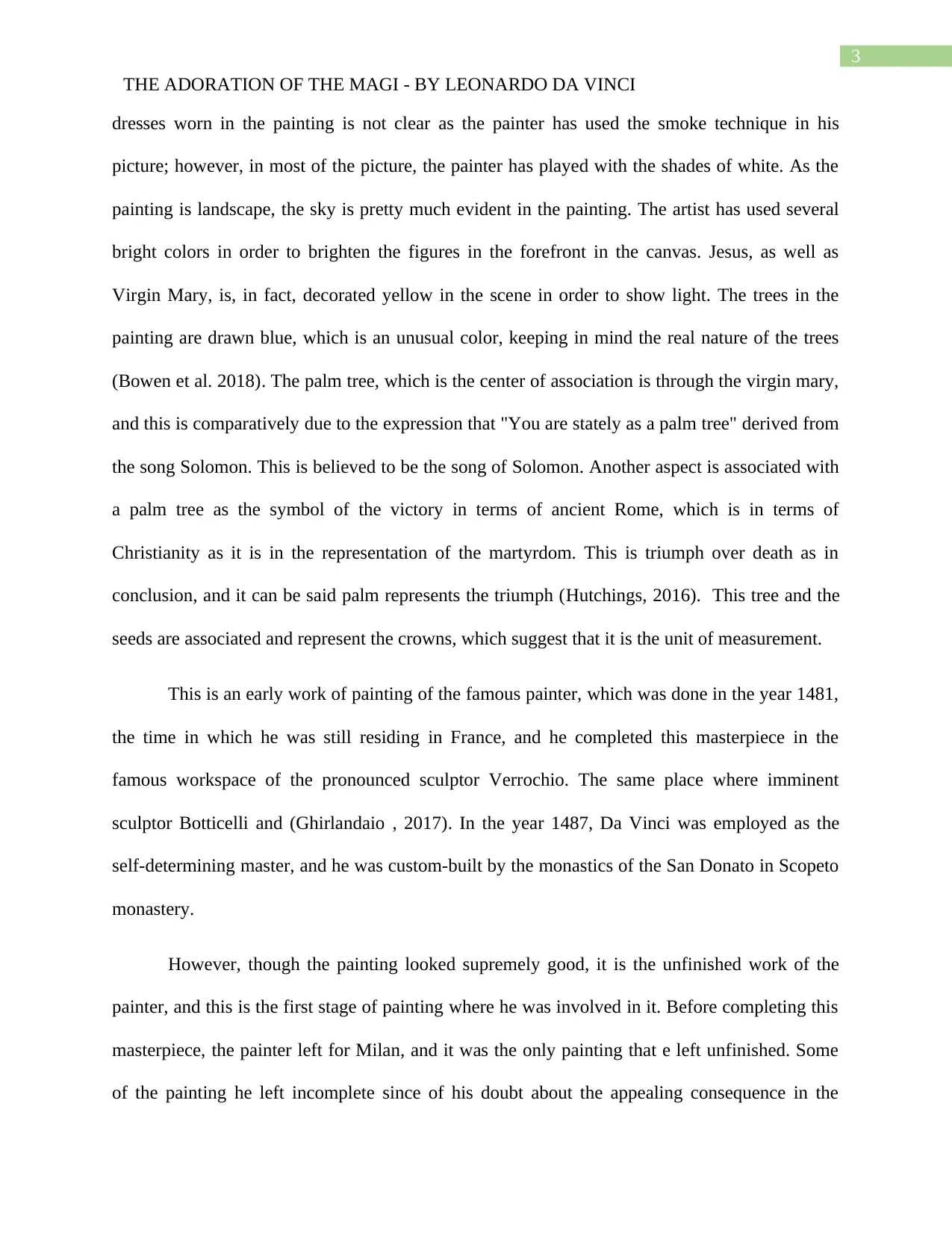
dresses worn in the painting is not clear as the painter has used the smoke technique in his
picture; however, in most of the picture, the painter has played with the shades of white. As the
painting is landscape, the sky is pretty much evident in the painting. The artist has used several
bright colors in order to brighten the figures in the forefront in the canvas. Jesus, as well as
Virgin Mary, is, in fact, decorated yellow in the scene in order to show light. The trees in the
painting are drawn blue, which is an unusual color, keeping in mind the real nature of the trees
(Bowen et al. 2018). The palm tree, which is the center of association is through the virgin mary,
and this is comparatively due to the expression that "You are stately as a palm tree" derived from
the song Solomon. This is believed to be the song of Solomon. Another aspect is associated with
a palm tree as the symbol of the victory in terms of ancient Rome, which is in terms of
Christianity as it is in the representation of the martyrdom. This is triumph over death as in
conclusion, and it can be said palm represents the triumph (Hutchings, 2016). This tree and the
seeds are associated and represent the crowns, which suggest that it is the unit of measurement.
This is an early work of painting of the famous painter, which was done in the year 1481,
the time in which he was still residing in France, and he completed this masterpiece in the
famous workspace of the pronounced sculptor Verrochio. The same place where imminent
sculptor Botticelli and (Ghirlandaio , 2017). In the year 1487, Da Vinci was employed as the
self-determining master, and he was custom-built by the monastics of the San Donato in Scopeto
monastery.
However, though the painting looked supremely good, it is the unfinished work of the
painter, and this is the first stage of painting where he was involved in it. Before completing this
masterpiece, the painter left for Milan, and it was the only painting that e left unfinished. Some
of the painting he left incomplete since of his doubt about the appealing consequence in the
Document Page
4
THE ADORATION OF THE MAGI - BY LEONARDO DA VINCI
painting while for some of other his painting his experiment with innovation in introduction of
new technique proved to be unsuccessful, one of the examples is the "Battle of Anghiari. In this
particular painting, Vinci has used a groundbreaking procedure acknowledged as sfumato
(Fiorani, 2016).. He was the first person to do this on a enormous measure. According to the
painter, sfumato is a technique that is without the application of the lines or borders in the
method of the smoke, which is far beyond the concept of the plane of focus. The word "fumo"
means "smoke." The painter is also credited for studying animal as well as human anatomy, and
this is thought to be the first part of his study and how the machine and his body has worked
(West, 2017).. He was also bright to replicate in boundless detail as this painting and drawing,
which makes the figure in the painting look real. The sense of depth is created through this effect
in the painting.
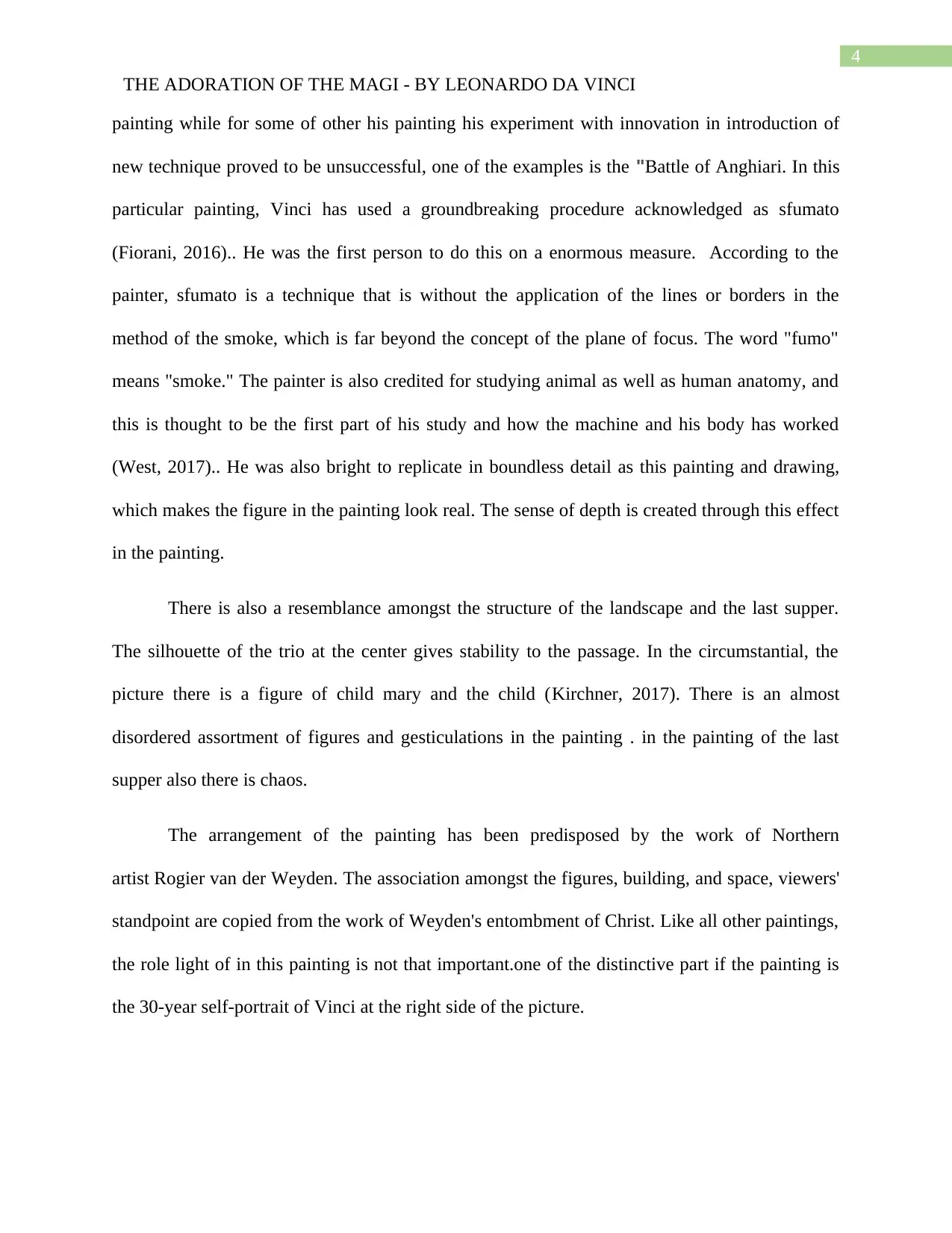
There is also a resemblance amongst the structure of the landscape and the last supper.
The silhouette of the trio at the center gives stability to the passage. In the circumstantial, the
picture there is a figure of child mary and the child (Kirchner, 2017). There is an almost
disordered assortment of figures and gesticulations in the painting . in the painting of the last
supper also there is chaos.
The arrangement of the painting has been predisposed by the work of Northern
artist Rogier van der Weyden. The association amongst the figures, building, and space, viewers'
standpoint are copied from the work of Weyden's entombment of Christ. Like all other paintings,
the role light of in this painting is not that important.one of the distinctive part if the painting is
the 30-year self-portrait of Vinci at the right side of the picture.
tabler-icon-diamond-filled.svg

Paraphrase This Document

Need a fresh take? Get an instant paraphrase of this document with our AI Paraphraser
Document Page
5
THE ADORATION OF THE MAGI - BY LEONARDO DA VINCI
References
Bowen, G., Gonzales, J., Iwanaga, J., Fisahn, C., Loukas, M., Oskouian, R. J., & Tubbs, R. S.
(2017). Leonardo da Vinci (1452–1519) and his depictions of the human spine. Child's
Nervous System, 33(12), 2067-2070.
Chai, O. H., & Song, C. H. (2016). Anatomical Achievement and Thought of Leonardo da
Vinci. Korean Journal of Physical Anthropology, 29(2), 35-46.
Fiorani, F. (2016). 10 Why Did Leonardo Not Finish the Adoration of the Magi?. In Illuminating
Leonardo (pp. 137-150). Brill.
Hui, A. (2015). The Birth of Ruins in Quattrocento Adoration Paintings. I Tatti Studies in the
Italian Renaissance, 18(2), 319-348.
Hutchings, I. M. (2016). Leonardo da Vinci׳ s studies of friction. Wear, 360, 51-66.
Kirchner, T. (2017). Between Academicism and its Critics: Leonardo da Vinci's Traité de la
Peinture and Eighteenth-Century French Art Theory. In Re-Reading Leonardo (pp. 300-
324). Routledge.
Soto-Zuniga, A. (2019). Using Non-Western Culture, Humanism, and Comparison to Explore
the Possible Patron of the Adoration of the Magi. The Undergraduate Historical Journal
at UC Merced, 5(2).
West, J. B. (2017). Leonardo da Vinci: engineer, bioengineer, anatomist, and artist. American
Journal of Physiology-Lung Cellular and Molecular Physiology, 312(3), L392-L397.
chevron_up_icon
1 out of 5
circle_padding
hide_on_mobile
zoom_out_icon
[object Object]