Analysis of Interpersonal Conflict and ADR in Marketing Firm
VerifiedAdded on 2022/11/17
|9
|1525
|405
Report
AI Summary
This report examines a case of interpersonal conflict between two marketing managers at a food manufacturing firm who are vying for a promotion. The conflict arises from their differing opinions on promotional strategies for a health drink. The report analyzes the conflict through various stages, including latent, perceived, felt, manifest, and aftermath, and explores how the managing director's bias escalated the situation. The CEO resolves the conflict using ADR tactics, specifically timeliness and good faith, and by implementing a voting system. The report discusses the importance of understanding different conflict resolution approaches and the application of ADR principles, highlighting the need for mature behavior and negotiation to achieve common goals. The study suggests that a competitive approach could be beneficial in resolving similar business conflicts, while also considering the principles of timeliness.
Running Head: Alternative Dispute Resolution
ALTERNATIVE DISPUTE RESOLUTION
Paraphrase This Document
Need a fresh take? Get an instant paraphrase of this document with our AI Paraphraser

2
Alternative Dispute Resolution
Executive summary
This report has focused on a scenario of interpersonal conflict between two marketing
managers of a firm. Both of them have argued to prove their point. It has been found that both
of them are trying to get promoted. This study has evaluated all perspectives of this scenario.
ADR principles such as timeliness and good faith have been considered here to resolve the
conflict. It has been proposed that the competitive approach to resolving business conflicts
can be taken to resolve this kind of business conflicts.
Alternative Dispute Resolution
Executive summary
This report has focused on a scenario of interpersonal conflict between two marketing
managers of a firm. Both of them have argued to prove their point. It has been found that both
of them are trying to get promoted. This study has evaluated all perspectives of this scenario.
ADR principles such as timeliness and good faith have been considered here to resolve the
conflict. It has been proposed that the competitive approach to resolving business conflicts
can be taken to resolve this kind of business conflicts.

3
Alternative Dispute Resolution
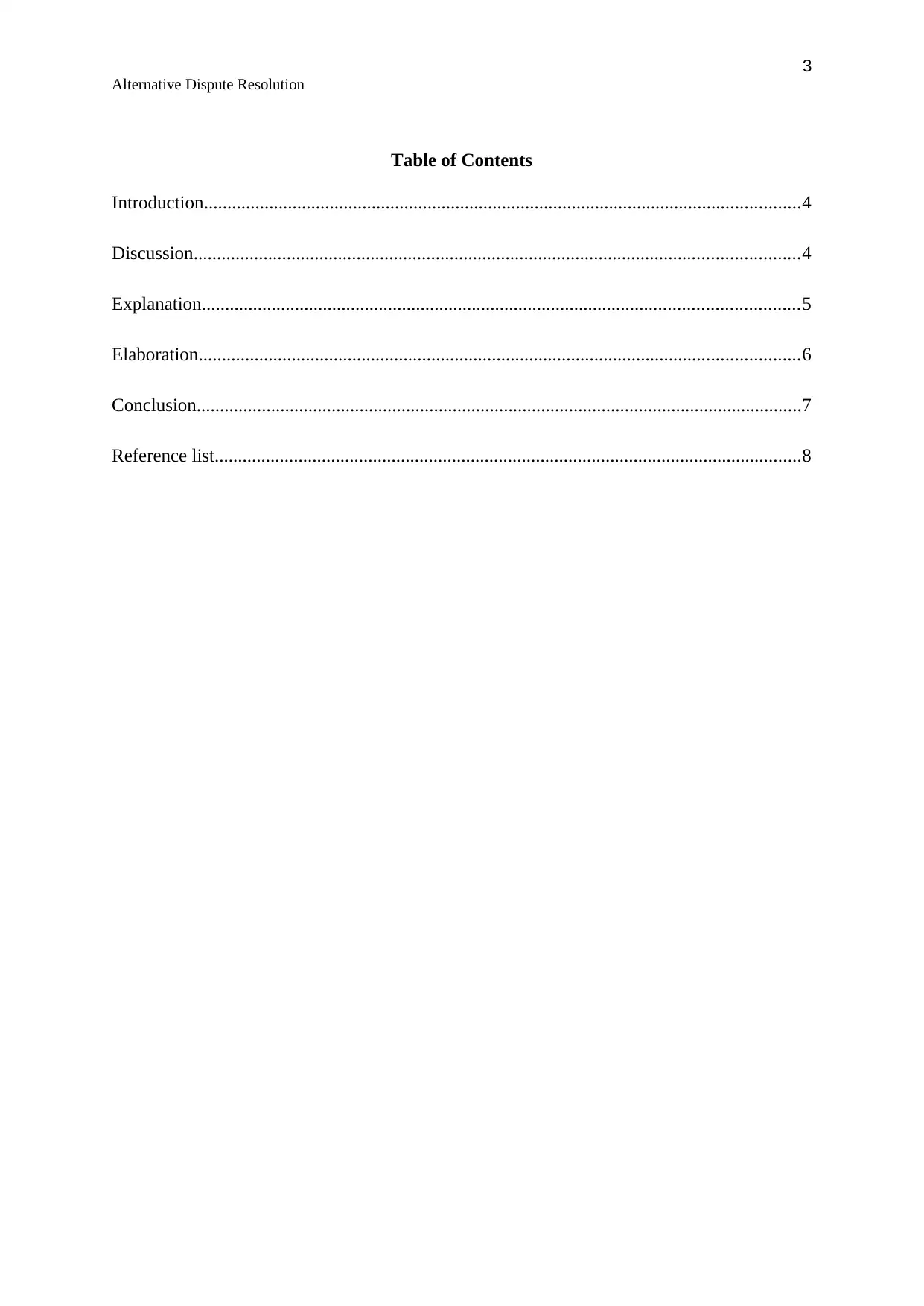
Table of Contents
Introduction................................................................................................................................4
Discussion..................................................................................................................................4
Explanation................................................................................................................................5
Elaboration.................................................................................................................................6
Conclusion..................................................................................................................................7
Reference list..............................................................................................................................8
Alternative Dispute Resolution
Table of Contents
Introduction................................................................................................................................4
Discussion..................................................................................................................................4
Explanation................................................................................................................................5
Elaboration.................................................................................................................................6
Conclusion..................................................................................................................................7
Reference list..............................................................................................................................8
⊘ This is a preview!⊘
Do you want full access?
Subscribe today to unlock all pages.

Trusted by 1+ million students worldwide

4
Alternative Dispute Resolution
Introduction
Interpersonal conflict arises when individuals interfere in other person's effort for achieving
goals. This study is focusing on the case of interpersonal conflict between two marketing
managers of a food manufacturing firm. In this case, two marketing manager has selected two
different promotional methods for a health drink. Two of the marketing managers are equally
capable and they are being considered for eligible candidate for promotion. However, as per
the vacancy in senior marketing manager post, only one of them will be selected for that
designation. Conflict has arisen due to different decision of managers regarding promotional
method of the health drink. This conflict is Tbfic as it is a simple case of interpersonal
conflict between two people.
This problem has started in the meeting with the CEO regarding selection of promotional
method for the health drink. Both of them explained their viewpoints and have justified their
decision. It has been found that both of them are accusing each other of being impractical.
There were several other employees associated with the project. The CEO of the company
has solved this conflict by asking all attendees to vote for the best one. Based on majority of
the voting, this conflict has been resolved by considering ADR tactics of timeliness and good
faith. This conflict has been catalyzed by the continuous biased support of the managing
director for one of the marketing managers.
Discussion
This incident can be described through different conflict stages. In the latent stage, both
managers argued but did not recognize that a conflict has initiated. After some days they
recognized that a conflict existed between them. This is called perceived stage, which has
increased distance between them. Then stress increased due to this interpersonal conflict that
Alternative Dispute Resolution
Introduction
Interpersonal conflict arises when individuals interfere in other person's effort for achieving
goals. This study is focusing on the case of interpersonal conflict between two marketing
managers of a food manufacturing firm. In this case, two marketing manager has selected two
different promotional methods for a health drink. Two of the marketing managers are equally
capable and they are being considered for eligible candidate for promotion. However, as per
the vacancy in senior marketing manager post, only one of them will be selected for that
designation. Conflict has arisen due to different decision of managers regarding promotional
method of the health drink. This conflict is Tbfic as it is a simple case of interpersonal
conflict between two people.
This problem has started in the meeting with the CEO regarding selection of promotional
method for the health drink. Both of them explained their viewpoints and have justified their
decision. It has been found that both of them are accusing each other of being impractical.
There were several other employees associated with the project. The CEO of the company
has solved this conflict by asking all attendees to vote for the best one. Based on majority of
the voting, this conflict has been resolved by considering ADR tactics of timeliness and good
faith. This conflict has been catalyzed by the continuous biased support of the managing
director for one of the marketing managers.
Discussion
This incident can be described through different conflict stages. In the latent stage, both
managers argued but did not recognize that a conflict has initiated. After some days they
recognized that a conflict existed between them. This is called perceived stage, which has
increased distance between them. Then stress increased due to this interpersonal conflict that
Paraphrase This Document
Need a fresh take? Get an instant paraphrase of this document with our AI Paraphraser

5
Alternative Dispute Resolution
can be identified as a felt stage. As opined by Folger, Poole & Stutman (2017), during felt
stage, stress and anxiety increases due to increased conflicts between both parties. During the
meeting with the CEO, the managers openly argued that started the manifest stage of this
conflict. However, the CEO took active steps and resolved the conflict that can be identified
as aftermath stage.
The conflict situation gets escalated when competition between two managers increased. This
can be related to stage two of conflict escalation. As stated by Webb, Coleman, Rossignac-
Milon, Tomasulo & Higgins (2017), in this stage of the conflict, competition increases to
achieve a common goal. The conflict situation between two managers escalated when
managing director of the company supported a manager in spite of solving the issue. Due to
this reason, the other manager lost hope to achieve a reasonable outcome of this problem.
This can be related to stage three of conflict escalation. In this stage related parties in conflict
fears of achieving a proper outcome or solution (Rahim, 2017). During the meeting with the
CEO, both the managers are aware that their promotional strategies are equally good but their
cognitive functioning regressed and conflict escalated. This can be related to the fourth stage
of conflict escalation where related parties are not capable of considering the feelings and
thoughts of each other (Alberstein, 2016).
Explanation
In this case, both parties proactively gathered available information to justify their points.
They have enriched their knowledge to defend their ideas. However, they could try to
understand each other's point for taking a mutual decision. Before the meeting, both of them
have tried their best to prepare him for the debate. Both these managers want to get promoted
and they are trying to draw attention of management towards them. As mentioned by
Allwood & Ahlsén (2015), different approaches taken by different parties are the main causes
Alternative Dispute Resolution
can be identified as a felt stage. As opined by Folger, Poole & Stutman (2017), during felt
stage, stress and anxiety increases due to increased conflicts between both parties. During the
meeting with the CEO, the managers openly argued that started the manifest stage of this
conflict. However, the CEO took active steps and resolved the conflict that can be identified
as aftermath stage.
The conflict situation gets escalated when competition between two managers increased. This
can be related to stage two of conflict escalation. As stated by Webb, Coleman, Rossignac-
Milon, Tomasulo & Higgins (2017), in this stage of the conflict, competition increases to
achieve a common goal. The conflict situation between two managers escalated when
managing director of the company supported a manager in spite of solving the issue. Due to
this reason, the other manager lost hope to achieve a reasonable outcome of this problem.
This can be related to stage three of conflict escalation. In this stage related parties in conflict
fears of achieving a proper outcome or solution (Rahim, 2017). During the meeting with the
CEO, both the managers are aware that their promotional strategies are equally good but their
cognitive functioning regressed and conflict escalated. This can be related to the fourth stage
of conflict escalation where related parties are not capable of considering the feelings and
thoughts of each other (Alberstein, 2016).
Explanation
In this case, both parties proactively gathered available information to justify their points.
They have enriched their knowledge to defend their ideas. However, they could try to
understand each other's point for taking a mutual decision. Before the meeting, both of them
have tried their best to prepare him for the debate. Both these managers want to get promoted
and they are trying to draw attention of management towards them. As mentioned by
Allwood & Ahlsén (2015), different approaches taken by different parties are the main causes

6
Alternative Dispute Resolution
behind interpersonal conflicts and both parties need to understand each other for achieving
common solution. During the meeting with CEO, both of the marketing managers argue with
each other's point as they wanted to defeat the other one. Both of them have shown negative
reaction to the opposite party. After the voting, majority has been considered and they both
accepted that result. They have realized that there was a competition for achieving the post of
senior manager and it has given rise to the interpersonal conflict.
They did not try to understand each other's viewpoint. Running behind the power was the
main focus of both of them. As per Maltarich, Kukenberger, Reilly & Mathieu (2018), both
parties need to think about common goal and negotiate to an extent to solve interpersonal
conflict. In this case, both marketing managers could have to behave more maturely to decide
one promotional strategy.
Elaboration
Here, the conflict has been resolved with the help of voting by meeting attendees. The CEO
has understood the situation and quickly decides for voting. ADR principle including
timeliness and good faith has been considered to resolve the issue. As stated by Overall &
McNulty (2017), timeliness principle is about solving conflict within minimum time period
and good faith principle allow to trust engaged people to make the agreement by both parties.
Collaborating approach has helped to ensure a successful outcome. Both of the parties have
believed in the majority and have accepted the outcome.
In this conflict, competing for style of conflict resolution can also be adopted. The CEO can
choose the marketing style after arranging a presentation session for the managers. There,
they can provide details of their plans and compete with each other. This can help the board
of directors to choose appropriate marketing strategy. However, principles of ADR like
timeliness cannot be maintained in this process as much time is required for presentation.
Alternative Dispute Resolution
behind interpersonal conflicts and both parties need to understand each other for achieving
common solution. During the meeting with CEO, both of the marketing managers argue with
each other's point as they wanted to defeat the other one. Both of them have shown negative
reaction to the opposite party. After the voting, majority has been considered and they both
accepted that result. They have realized that there was a competition for achieving the post of
senior manager and it has given rise to the interpersonal conflict.
They did not try to understand each other's viewpoint. Running behind the power was the
main focus of both of them. As per Maltarich, Kukenberger, Reilly & Mathieu (2018), both
parties need to think about common goal and negotiate to an extent to solve interpersonal
conflict. In this case, both marketing managers could have to behave more maturely to decide
one promotional strategy.
Elaboration
Here, the conflict has been resolved with the help of voting by meeting attendees. The CEO
has understood the situation and quickly decides for voting. ADR principle including
timeliness and good faith has been considered to resolve the issue. As stated by Overall &
McNulty (2017), timeliness principle is about solving conflict within minimum time period
and good faith principle allow to trust engaged people to make the agreement by both parties.
Collaborating approach has helped to ensure a successful outcome. Both of the parties have
believed in the majority and have accepted the outcome.
In this conflict, competing for style of conflict resolution can also be adopted. The CEO can
choose the marketing style after arranging a presentation session for the managers. There,
they can provide details of their plans and compete with each other. This can help the board
of directors to choose appropriate marketing strategy. However, principles of ADR like
timeliness cannot be maintained in this process as much time is required for presentation.
⊘ This is a preview!⊘
Do you want full access?
Subscribe today to unlock all pages.

Trusted by 1+ million students worldwide

7
Alternative Dispute Resolution
Conclusion
From the above discussion, it can be seen that conflict resolution process can be done after
analyzing different stages of conflicts. Evaluation of stages can help to gain a proper
understanding of the conflict situation. Moreover, this can help to gain probable solution to
mitigate interpersonal conflicts.
Alternative Dispute Resolution
Conclusion
From the above discussion, it can be seen that conflict resolution process can be done after
analyzing different stages of conflicts. Evaluation of stages can help to gain a proper
understanding of the conflict situation. Moreover, this can help to gain probable solution to
mitigate interpersonal conflicts.
Paraphrase This Document
Need a fresh take? Get an instant paraphrase of this document with our AI Paraphraser

8
Alternative Dispute Resolution
Reference list
Alberstein, M. (2016). The “Law of Alternatives”: Conflict Resolution as the Art of
Reconstruction. In Studies in Law, Politics, and Society, 149-180, Retrieved from:
https://www.emeraldinsight.com/doi/abs/10.1108/S1059-433720160000070012
Allwood, J., & Ahlsén, E. (2015). On Stages of Conflict Escalation. In Conflict and
Multimodal Communication (pp. 53-69). Springer, Cham. Retrieved from:
http://www.academia.edu/download/43571096/conflict_and_multimodal_communicat
ion.pdf#page=74
Folger, J., Poole, M. S., & Stutman, R. K. (2017). Working through conflict: Strategies for
relationships, groups, and organizations. UK: Routledge. Retrieved from:
https://www.taylorfrancis.com/books/9781315296296
Maltarich, M. A., Kukenberger, M., Reilly, G., & Mathieu, J. (2018). Conflict in teams:
Modeling early and late conflict states and the interactive effects of conflict processes.
Group & Organization Management, 43(1), 6-37. Retrieved from:
https://journals.sagepub.com/doi/pdf/10.1177/1059601116681127
Overall, N. C., & McNulty, J. K. (2017). What type of communication during conflict is
beneficial for intimate relationships?. Current opinion in psychology, 13, 1-5.
Retrieved from:https://www.ncbi.nlm.nih.gov/pmc/articles/PMC5181851/
Rahim, M. A. (2017). Managing conflict in organizations. UK: Routledge. Retrieved from:
http://citeseerx.ist.psu.edu/viewdoc/download?
doi=10.1.1.453.1220&rep=rep1&type=pdf#page=386
Webb, C. E., Coleman, P. T., Rossignac-Milon, M., Tomasulo, S. J., & Higgins, E. T. (2017).
Moving on or digging deeper: Regulatory mode and interpersonal conflict resolution.
Alternative Dispute Resolution
Reference list
Alberstein, M. (2016). The “Law of Alternatives”: Conflict Resolution as the Art of
Reconstruction. In Studies in Law, Politics, and Society, 149-180, Retrieved from:
https://www.emeraldinsight.com/doi/abs/10.1108/S1059-433720160000070012
Allwood, J., & Ahlsén, E. (2015). On Stages of Conflict Escalation. In Conflict and
Multimodal Communication (pp. 53-69). Springer, Cham. Retrieved from:
http://www.academia.edu/download/43571096/conflict_and_multimodal_communicat
ion.pdf#page=74
Folger, J., Poole, M. S., & Stutman, R. K. (2017). Working through conflict: Strategies for
relationships, groups, and organizations. UK: Routledge. Retrieved from:
https://www.taylorfrancis.com/books/9781315296296
Maltarich, M. A., Kukenberger, M., Reilly, G., & Mathieu, J. (2018). Conflict in teams:
Modeling early and late conflict states and the interactive effects of conflict processes.
Group & Organization Management, 43(1), 6-37. Retrieved from:
https://journals.sagepub.com/doi/pdf/10.1177/1059601116681127
Overall, N. C., & McNulty, J. K. (2017). What type of communication during conflict is
beneficial for intimate relationships?. Current opinion in psychology, 13, 1-5.
Retrieved from:https://www.ncbi.nlm.nih.gov/pmc/articles/PMC5181851/
Rahim, M. A. (2017). Managing conflict in organizations. UK: Routledge. Retrieved from:
http://citeseerx.ist.psu.edu/viewdoc/download?
doi=10.1.1.453.1220&rep=rep1&type=pdf#page=386
Webb, C. E., Coleman, P. T., Rossignac-Milon, M., Tomasulo, S. J., & Higgins, E. T. (2017).
Moving on or digging deeper: Regulatory mode and interpersonal conflict resolution.

9
Alternative Dispute Resolution
Journal of personality and social psychology, 112(4), 621. Retrieved from:
https://pdfs.semanticscholar.org/7200/ccb3da611b4e81fb85379b99c0067b6882f9.pdf
Alternative Dispute Resolution
Journal of personality and social psychology, 112(4), 621. Retrieved from:
https://pdfs.semanticscholar.org/7200/ccb3da611b4e81fb85379b99c0067b6882f9.pdf
⊘ This is a preview!⊘
Do you want full access?
Subscribe today to unlock all pages.

Trusted by 1+ million students worldwide
1 out of 9
Related Documents
Your All-in-One AI-Powered Toolkit for Academic Success.
+13062052269
info@desklib.com
Available 24*7 on WhatsApp / Email
Unlock your academic potential
Copyright © 2020–2026 A2Z Services. All Rights Reserved. Developed and managed by ZUCOL.