Report on Adropin Deficiency: Impact on Adiposity & Resistance

Verified

Added on  2023/04/23

|4
|465
|483
Report
AI Summary
This report delves into the role of adropin, a secreted peptide, in regulating glucose homeostasis and hepatic steatosis. It highlights that adropin levels are influenced by diet and metabolic status, with deficiencies potentially increasing the risk of metabolic syndrome. The study investigates the impact of adropin deficiency using knockout mice, revealing that while adropin isn't crucial for regulating food intake, it significantly affects adiposity, preventing dyslipidemia, impaired glucose tolerance, and insulin resistance. The research aims to understand how obesity, nutrition, and fasting regulate serum adropin levels and to identify if adropin deficiency alone can disrupt metabolic homeostasis, emphasizing its importance in maintaining glycemic control and exploring new avenues for treating type 2 diabetes and fatty liver disease.
Document Page
Biology of Disease
tabler-icon-diamond-filled.svg

Paraphrase This Document

Need a fresh take? Get an instant paraphrase of this document with our AI Paraphraser
Document Page
Abstract
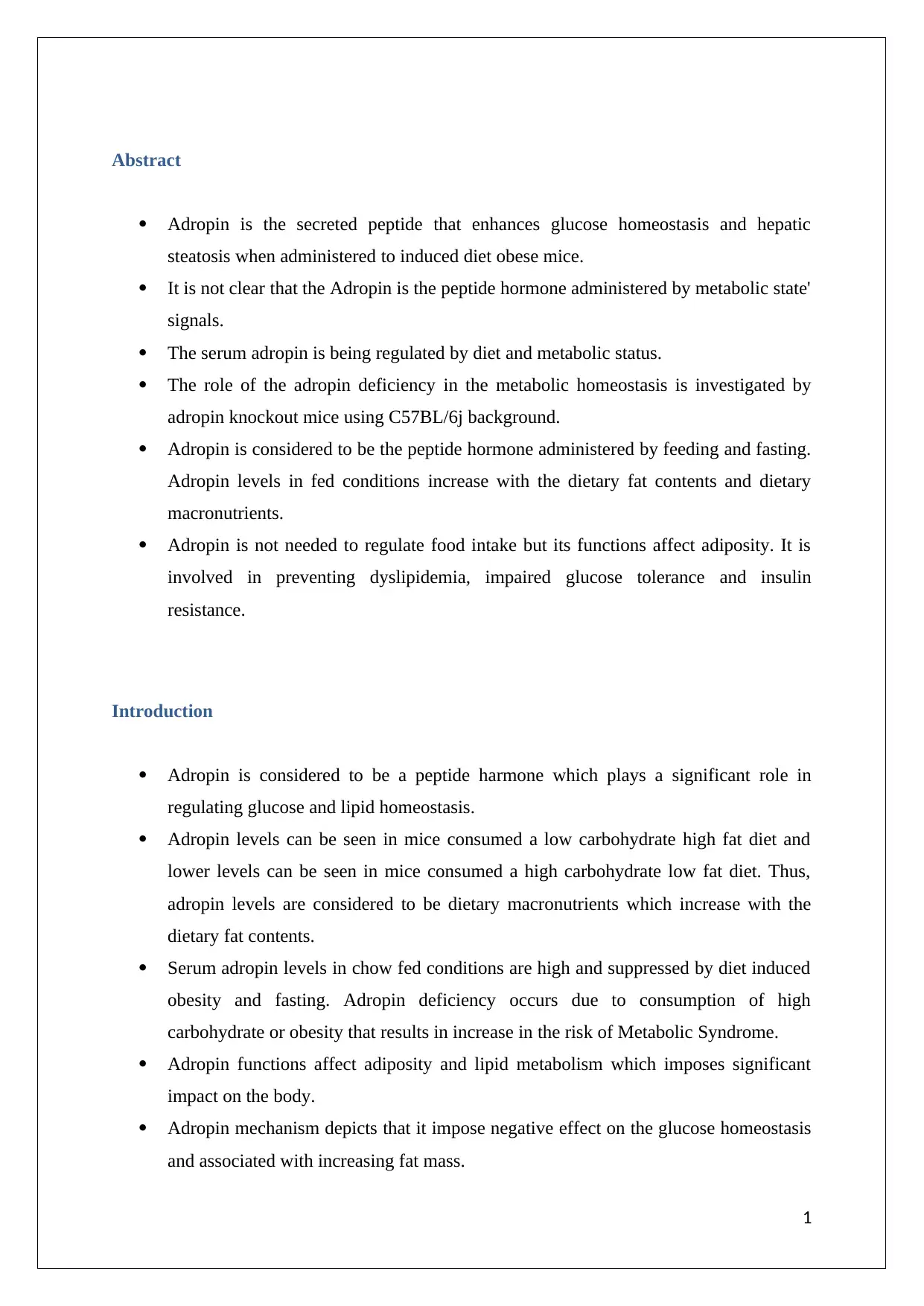
Adropin is the secreted peptide that enhances glucose homeostasis and hepatic
steatosis when administered to induced diet obese mice.
It is not clear that the Adropin is the peptide hormone administered by metabolic state'
signals.
The serum adropin is being regulated by diet and metabolic status.
The role of the adropin deficiency in the metabolic homeostasis is investigated by
adropin knockout mice using C57BL/6j background.
Adropin is considered to be the peptide hormone administered by feeding and fasting.
Adropin levels in fed conditions increase with the dietary fat contents and dietary
macronutrients.
Adropin is not needed to regulate food intake but its functions affect adiposity. It is
involved in preventing dyslipidemia, impaired glucose tolerance and insulin
resistance.
Introduction
Adropin is considered to be a peptide harmone which plays a significant role in
regulating glucose and lipid homeostasis.
Adropin levels can be seen in mice consumed a low carbohydrate high fat diet and
lower levels can be seen in mice consumed a high carbohydrate low fat diet. Thus,
adropin levels are considered to be dietary macronutrients which increase with the
dietary fat contents.
Serum adropin levels in chow fed conditions are high and suppressed by diet induced
obesity and fasting. Adropin deficiency occurs due to consumption of high
carbohydrate or obesity that results in increase in the risk of Metabolic Syndrome.
Adropin functions affect adiposity and lipid metabolism which imposes significant
impact on the body.
Adropin mechanism depicts that it impose negative effect on the glucose homeostasis
and associated with increasing fat mass.
1
Document Page
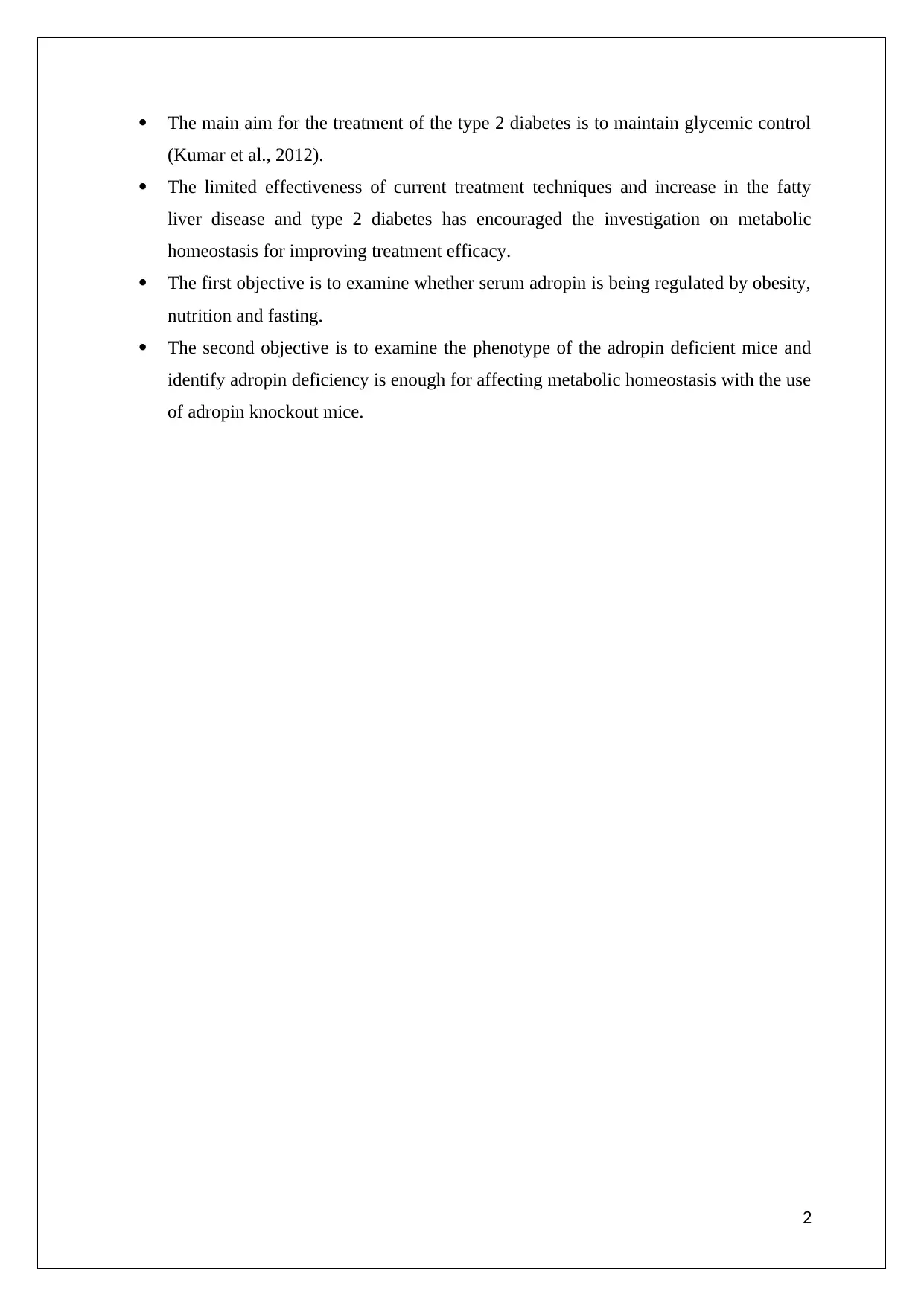
The main aim for the treatment of the type 2 diabetes is to maintain glycemic control
(Kumar et al., 2012).
The limited effectiveness of current treatment techniques and increase in the fatty
liver disease and type 2 diabetes has encouraged the investigation on metabolic
homeostasis for improving treatment efficacy.
The first objective is to examine whether serum adropin is being regulated by obesity,
nutrition and fasting.
The second objective is to examine the phenotype of the adropin deficient mice and
identify adropin deficiency is enough for affecting metabolic homeostasis with the use
of adropin knockout mice.
2
Document Page
References
Kumar, K., Zhang, J., Gao, S., Rossi, J., McGuinness, O., Halem, H., Culler, M., Mynatt, R.
and Butler, A. (2012). Adropin Deficiency Is Associated With Increased Adiposity and Insulin
Resistance. [online] www.ncbi.nlm.nih.gov. Available at:
https://www.ncbi.nlm.nih.gov/pmc/articles/PMC3905465/ [Accessed 28 Feb. 2019].
3
chevron_up_icon
1 out of 4
circle_padding
hide_on_mobile
zoom_out_icon
[object Object]