UMACTF-15-M: Advanced Corporate Reporting in Financial Strategy
VerifiedAdded on 2023/06/18
|8
|1872
|361
Report
AI Summary
This document presents solutions to questions related to advanced corporate reporting, covering topics such as consolidated statements of financial position, fair value accounting, hedge effectiveness, and the role of financial statements from the perspective of equity and debt stakeholders. It includes calculations for goodwill, non-controlling interest, and retained earnings, along with discussions on the advantages and disadvantages of fair value accounting. The report also addresses the impact of hedge effectiveness under IFRS 9 and provides insights into investment valuation and inventory consolidation. Desklib is your go-to platform for accessing a wide range of study resources, including past papers and solved assignments to support your academic journey.

ADVANCED CORPORATE
REPORTING
REPORTING

Paraphrase This Document
Need a fresh take? Get an instant paraphrase of this document with our AI Paraphraser

Table of Contents
QUESTION 1...................................................................................................................................3
QUESTION 4...................................................................................................................................4
a)..................................................................................................................................................4
b)..................................................................................................................................................5
c)..................................................................................................................................................5
Question 5........................................................................................................................................6
a) .................................................................................................................................................6
b)..................................................................................................................................................7
c)..................................................................................................................................................7
REFERENCES................................................................................................................................8
QUESTION 1...................................................................................................................................3
QUESTION 4...................................................................................................................................4
a)..................................................................................................................................................4
b)..................................................................................................................................................5
c)..................................................................................................................................................5
Question 5........................................................................................................................................6
a) .................................................................................................................................................6
b)..................................................................................................................................................7
c)..................................................................................................................................................7
REFERENCES................................................................................................................................8
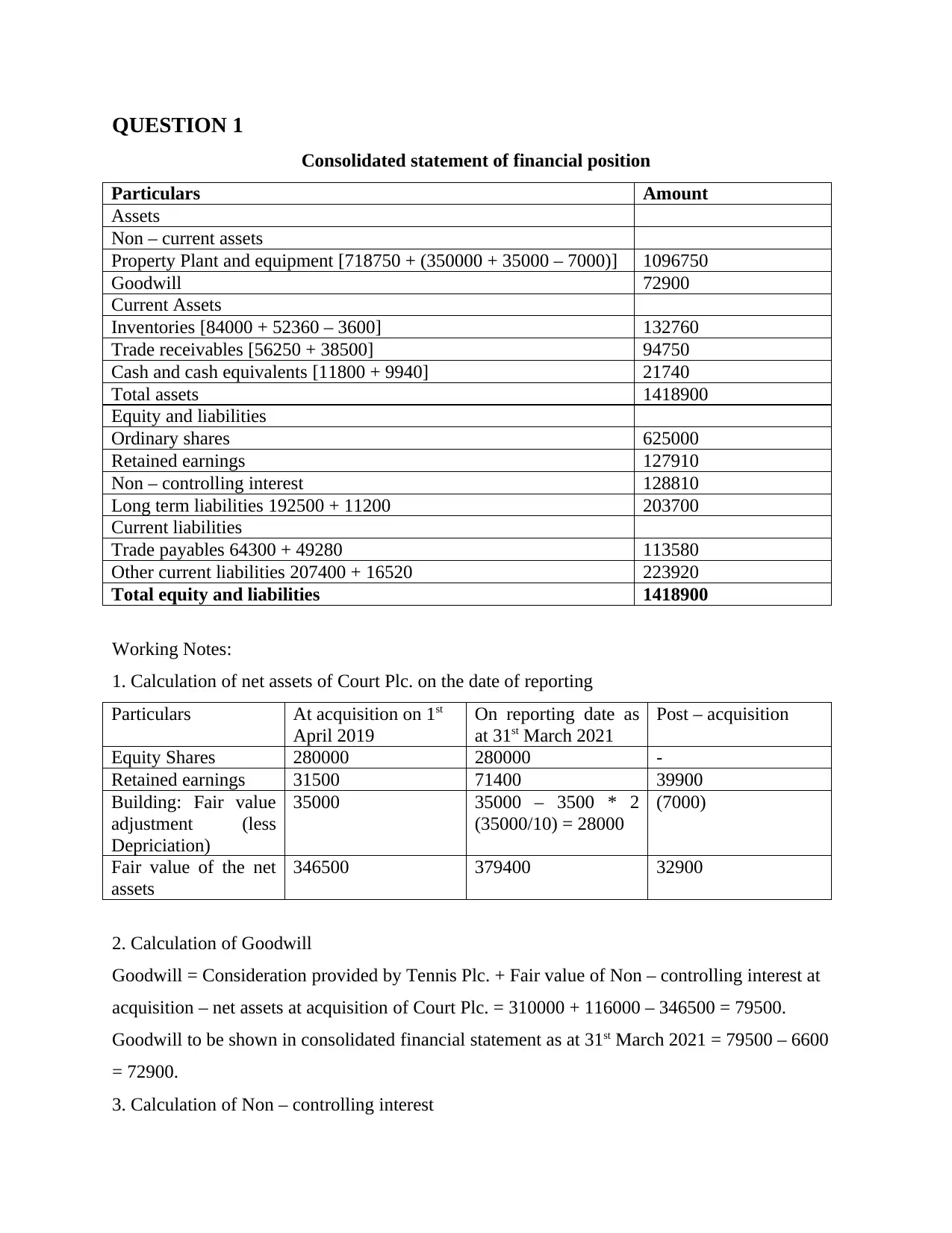
QUESTION 1
Consolidated statement of financial position
Particulars Amount
Assets
Non – current assets
Property Plant and equipment [718750 + (350000 + 35000 – 7000)] 1096750
Goodwill 72900
Current Assets
Inventories [84000 + 52360 – 3600] 132760
Trade receivables [56250 + 38500] 94750
Cash and cash equivalents [11800 + 9940] 21740
Total assets 1418900
Equity and liabilities
Ordinary shares 625000
Retained earnings 127910
Non – controlling interest 128810
Long term liabilities 192500 + 11200 203700
Current liabilities
Trade payables 64300 + 49280 113580
Other current liabilities 207400 + 16520 223920
Total equity and liabilities 1418900
Working Notes:
1. Calculation of net assets of Court Plc. on the date of reporting
Particulars At acquisition on 1st
April 2019
On reporting date as
at 31st March 2021
Post – acquisition
Equity Shares 280000 280000 -
Retained earnings 31500 71400 39900
Building: Fair value
adjustment (less
Depriciation)
35000 35000 – 3500 * 2
(35000/10) = 28000
(7000)
Fair value of the net
assets
346500 379400 32900
2. Calculation of Goodwill
Goodwill = Consideration provided by Tennis Plc. + Fair value of Non – controlling interest at
acquisition – net assets at acquisition of Court Plc. = 310000 + 116000 – 346500 = 79500.
Goodwill to be shown in consolidated financial statement as at 31st March 2021 = 79500 – 6600
= 72900.
3. Calculation of Non – controlling interest
Consolidated statement of financial position
Particulars Amount
Assets
Non – current assets
Property Plant and equipment [718750 + (350000 + 35000 – 7000)] 1096750
Goodwill 72900
Current Assets
Inventories [84000 + 52360 – 3600] 132760
Trade receivables [56250 + 38500] 94750
Cash and cash equivalents [11800 + 9940] 21740
Total assets 1418900
Equity and liabilities
Ordinary shares 625000
Retained earnings 127910
Non – controlling interest 128810
Long term liabilities 192500 + 11200 203700
Current liabilities
Trade payables 64300 + 49280 113580
Other current liabilities 207400 + 16520 223920
Total equity and liabilities 1418900
Working Notes:
1. Calculation of net assets of Court Plc. on the date of reporting
Particulars At acquisition on 1st
April 2019
On reporting date as
at 31st March 2021
Post – acquisition
Equity Shares 280000 280000 -
Retained earnings 31500 71400 39900
Building: Fair value
adjustment (less
Depriciation)
35000 35000 – 3500 * 2
(35000/10) = 28000
(7000)
Fair value of the net
assets
346500 379400 32900
2. Calculation of Goodwill
Goodwill = Consideration provided by Tennis Plc. + Fair value of Non – controlling interest at
acquisition – net assets at acquisition of Court Plc. = 310000 + 116000 – 346500 = 79500.
Goodwill to be shown in consolidated financial statement as at 31st March 2021 = 79500 – 6600
= 72900.
3. Calculation of Non – controlling interest
⊘ This is a preview!⊘
Do you want full access?
Subscribe today to unlock all pages.

Trusted by 1+ million students worldwide
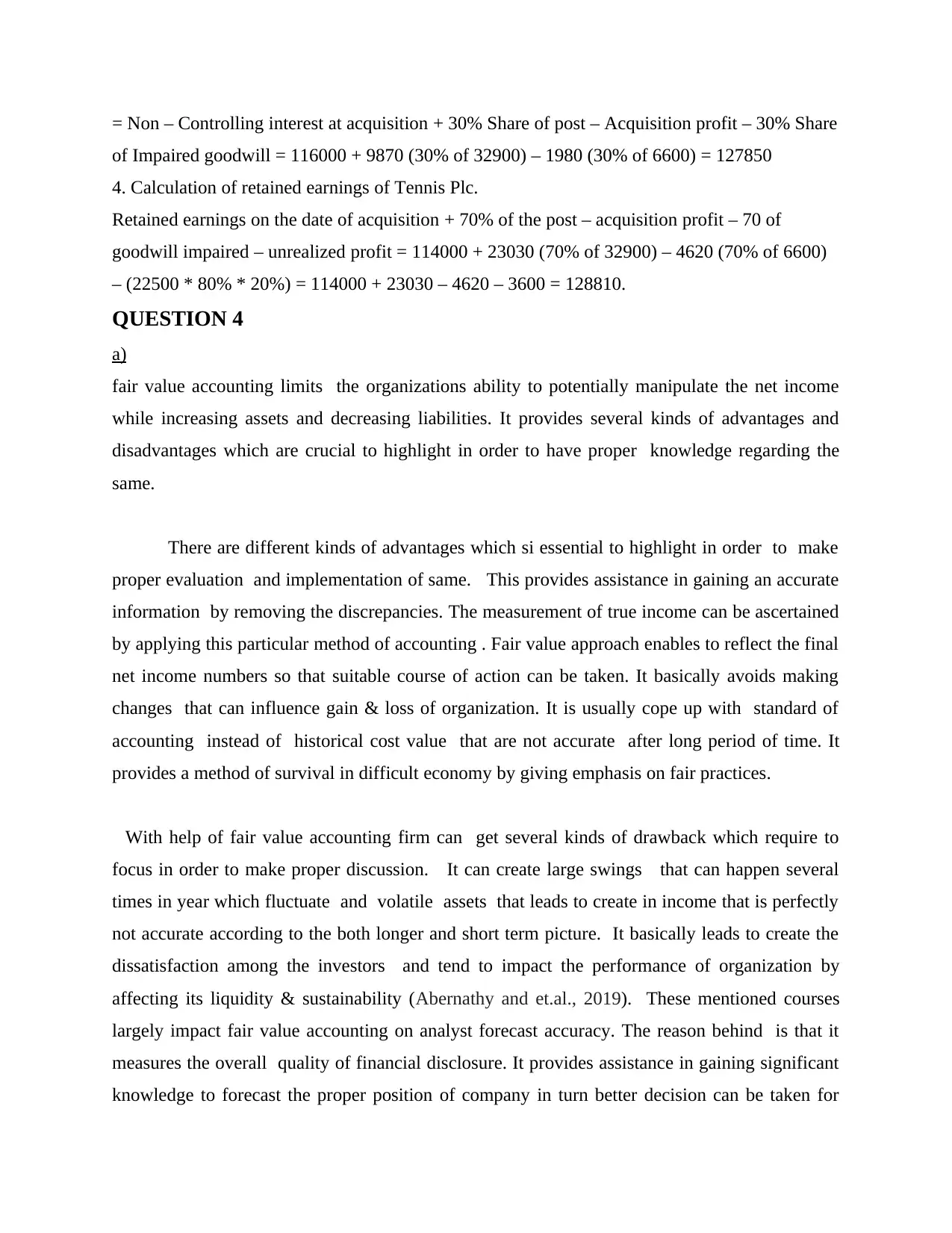
= Non – Controlling interest at acquisition + 30% Share of post – Acquisition profit – 30% Share
of Impaired goodwill = 116000 + 9870 (30% of 32900) – 1980 (30% of 6600) = 127850
4. Calculation of retained earnings of Tennis Plc.
Retained earnings on the date of acquisition + 70% of the post – acquisition profit – 70 of
goodwill impaired – unrealized profit = 114000 + 23030 (70% of 32900) – 4620 (70% of 6600)
– (22500 * 80% * 20%) = 114000 + 23030 – 4620 – 3600 = 128810.
QUESTION 4
a)
fair value accounting limits the organizations ability to potentially manipulate the net income
while increasing assets and decreasing liabilities. It provides several kinds of advantages and
disadvantages which are crucial to highlight in order to have proper knowledge regarding the
same.
There are different kinds of advantages which si essential to highlight in order to make
proper evaluation and implementation of same. This provides assistance in gaining an accurate
information by removing the discrepancies. The measurement of true income can be ascertained
by applying this particular method of accounting . Fair value approach enables to reflect the final
net income numbers so that suitable course of action can be taken. It basically avoids making
changes that can influence gain & loss of organization. It is usually cope up with standard of
accounting instead of historical cost value that are not accurate after long period of time. It
provides a method of survival in difficult economy by giving emphasis on fair practices.
With help of fair value accounting firm can get several kinds of drawback which require to
focus in order to make proper discussion. It can create large swings that can happen several
times in year which fluctuate and volatile assets that leads to create in income that is perfectly
not accurate according to the both longer and short term picture. It basically leads to create the
dissatisfaction among the investors and tend to impact the performance of organization by
affecting its liquidity & sustainability (Abernathy and et.al., 2019). These mentioned courses
largely impact fair value accounting on analyst forecast accuracy. The reason behind is that it
measures the overall quality of financial disclosure. It provides assistance in gaining significant
knowledge to forecast the proper position of company in turn better decision can be taken for
of Impaired goodwill = 116000 + 9870 (30% of 32900) – 1980 (30% of 6600) = 127850
4. Calculation of retained earnings of Tennis Plc.
Retained earnings on the date of acquisition + 70% of the post – acquisition profit – 70 of
goodwill impaired – unrealized profit = 114000 + 23030 (70% of 32900) – 4620 (70% of 6600)
– (22500 * 80% * 20%) = 114000 + 23030 – 4620 – 3600 = 128810.
QUESTION 4
a)
fair value accounting limits the organizations ability to potentially manipulate the net income
while increasing assets and decreasing liabilities. It provides several kinds of advantages and
disadvantages which are crucial to highlight in order to have proper knowledge regarding the
same.
There are different kinds of advantages which si essential to highlight in order to make
proper evaluation and implementation of same. This provides assistance in gaining an accurate
information by removing the discrepancies. The measurement of true income can be ascertained
by applying this particular method of accounting . Fair value approach enables to reflect the final
net income numbers so that suitable course of action can be taken. It basically avoids making
changes that can influence gain & loss of organization. It is usually cope up with standard of
accounting instead of historical cost value that are not accurate after long period of time. It
provides a method of survival in difficult economy by giving emphasis on fair practices.
With help of fair value accounting firm can get several kinds of drawback which require to
focus in order to make proper discussion. It can create large swings that can happen several
times in year which fluctuate and volatile assets that leads to create in income that is perfectly
not accurate according to the both longer and short term picture. It basically leads to create the
dissatisfaction among the investors and tend to impact the performance of organization by
affecting its liquidity & sustainability (Abernathy and et.al., 2019). These mentioned courses
largely impact fair value accounting on analyst forecast accuracy. The reason behind is that it
measures the overall quality of financial disclosure. It provides assistance in gaining significant
knowledge to forecast the proper position of company in turn better decision can be taken for
Paraphrase This Document
Need a fresh take? Get an instant paraphrase of this document with our AI Paraphraser
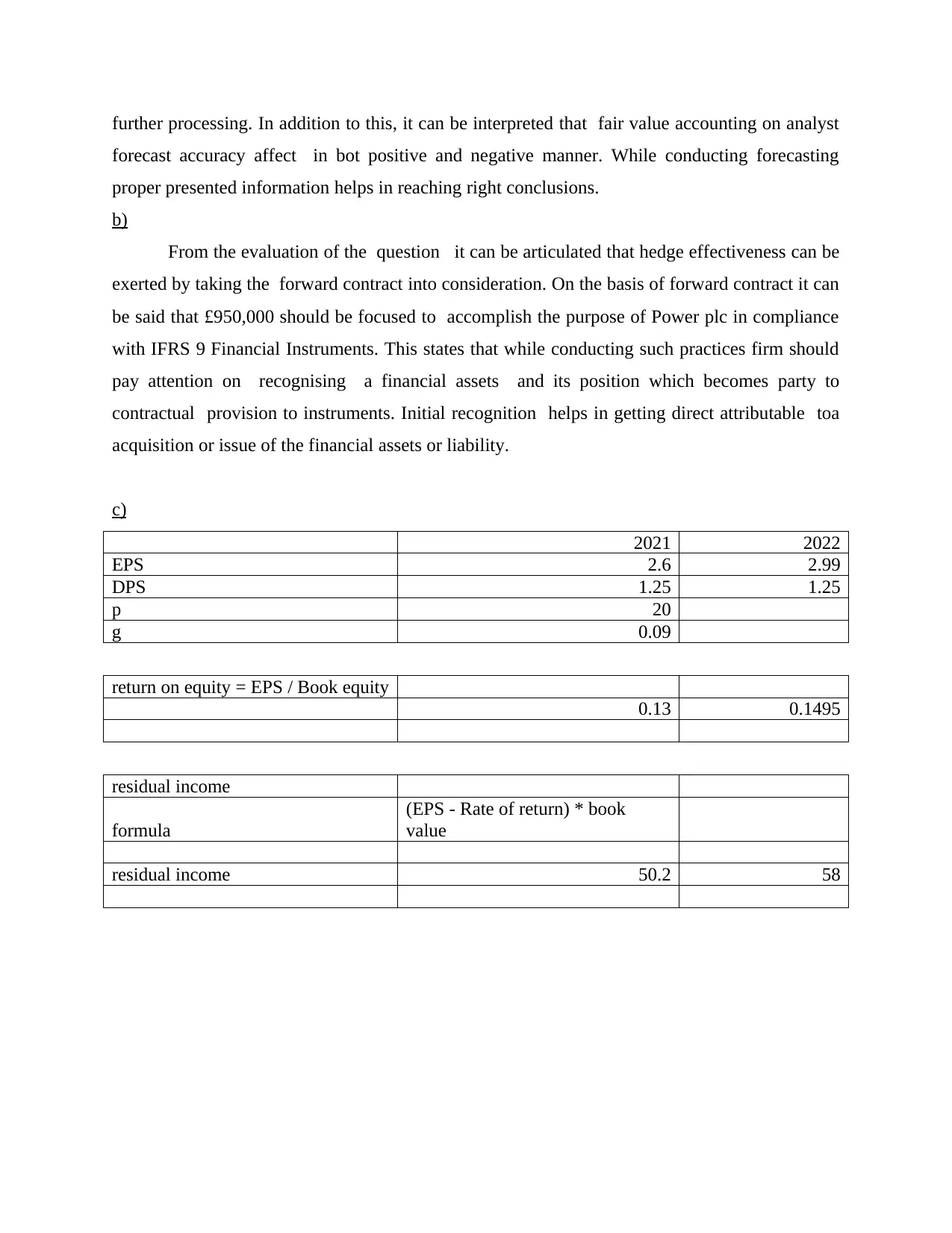
further processing. In addition to this, it can be interpreted that fair value accounting on analyst
forecast accuracy affect in bot positive and negative manner. While conducting forecasting
proper presented information helps in reaching right conclusions.
b)
From the evaluation of the question it can be articulated that hedge effectiveness can be
exerted by taking the forward contract into consideration. On the basis of forward contract it can
be said that £950,000 should be focused to accomplish the purpose of Power plc in compliance
with IFRS 9 Financial Instruments. This states that while conducting such practices firm should
pay attention on recognising a financial assets and its position which becomes party to
contractual provision to instruments. Initial recognition helps in getting direct attributable toa
acquisition or issue of the financial assets or liability.
c)
2021 2022
EPS 2.6 2.99
DPS 1.25 1.25
p 20
g 0.09
return on equity = EPS / Book equity
0.13 0.1495
residual income
formula
(EPS - Rate of return) * book
value
residual income 50.2 58
forecast accuracy affect in bot positive and negative manner. While conducting forecasting
proper presented information helps in reaching right conclusions.
b)
From the evaluation of the question it can be articulated that hedge effectiveness can be
exerted by taking the forward contract into consideration. On the basis of forward contract it can
be said that £950,000 should be focused to accomplish the purpose of Power plc in compliance
with IFRS 9 Financial Instruments. This states that while conducting such practices firm should
pay attention on recognising a financial assets and its position which becomes party to
contractual provision to instruments. Initial recognition helps in getting direct attributable toa
acquisition or issue of the financial assets or liability.
c)
2021 2022
EPS 2.6 2.99
DPS 1.25 1.25
p 20
g 0.09
return on equity = EPS / Book equity
0.13 0.1495
residual income
formula
(EPS - Rate of return) * book
value
residual income 50.2 58
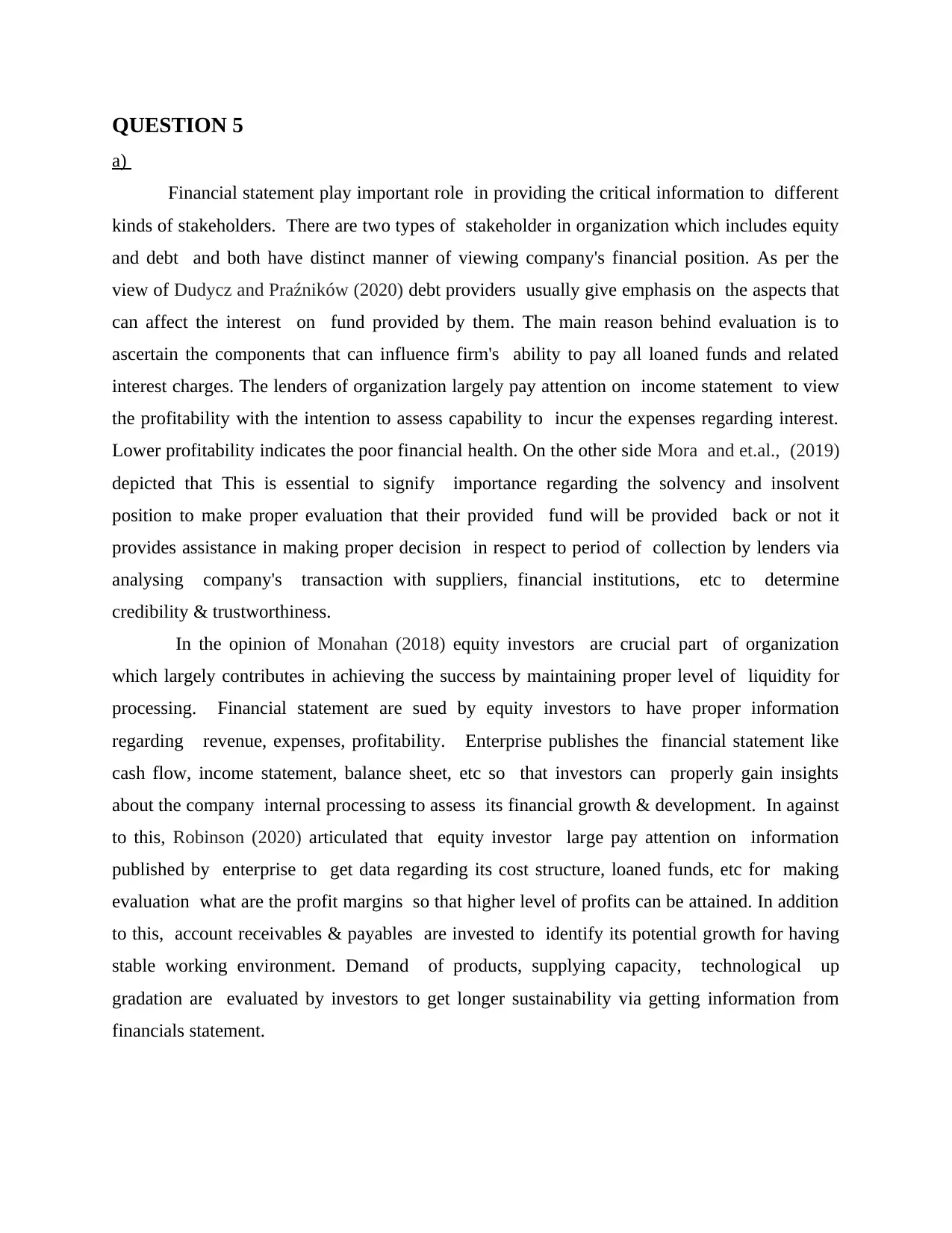
QUESTION 5
a)
Financial statement play important role in providing the critical information to different
kinds of stakeholders. There are two types of stakeholder in organization which includes equity
and debt and both have distinct manner of viewing company's financial position. As per the
view of Dudycz and Praźników (2020) debt providers usually give emphasis on the aspects that
can affect the interest on fund provided by them. The main reason behind evaluation is to
ascertain the components that can influence firm's ability to pay all loaned funds and related
interest charges. The lenders of organization largely pay attention on income statement to view
the profitability with the intention to assess capability to incur the expenses regarding interest.
Lower profitability indicates the poor financial health. On the other side Mora and et.al., (2019)
depicted that This is essential to signify importance regarding the solvency and insolvent
position to make proper evaluation that their provided fund will be provided back or not it
provides assistance in making proper decision in respect to period of collection by lenders via
analysing company's transaction with suppliers, financial institutions, etc to determine
credibility & trustworthiness.
In the opinion of Monahan (2018) equity investors are crucial part of organization
which largely contributes in achieving the success by maintaining proper level of liquidity for
processing. Financial statement are sued by equity investors to have proper information
regarding revenue, expenses, profitability. Enterprise publishes the financial statement like
cash flow, income statement, balance sheet, etc so that investors can properly gain insights
about the company internal processing to assess its financial growth & development. In against
to this, Robinson (2020) articulated that equity investor large pay attention on information
published by enterprise to get data regarding its cost structure, loaned funds, etc for making
evaluation what are the profit margins so that higher level of profits can be attained. In addition
to this, account receivables & payables are invested to identify its potential growth for having
stable working environment. Demand of products, supplying capacity, technological up
gradation are evaluated by investors to get longer sustainability via getting information from
financials statement.
a)
Financial statement play important role in providing the critical information to different
kinds of stakeholders. There are two types of stakeholder in organization which includes equity
and debt and both have distinct manner of viewing company's financial position. As per the
view of Dudycz and Praźników (2020) debt providers usually give emphasis on the aspects that
can affect the interest on fund provided by them. The main reason behind evaluation is to
ascertain the components that can influence firm's ability to pay all loaned funds and related
interest charges. The lenders of organization largely pay attention on income statement to view
the profitability with the intention to assess capability to incur the expenses regarding interest.
Lower profitability indicates the poor financial health. On the other side Mora and et.al., (2019)
depicted that This is essential to signify importance regarding the solvency and insolvent
position to make proper evaluation that their provided fund will be provided back or not it
provides assistance in making proper decision in respect to period of collection by lenders via
analysing company's transaction with suppliers, financial institutions, etc to determine
credibility & trustworthiness.
In the opinion of Monahan (2018) equity investors are crucial part of organization
which largely contributes in achieving the success by maintaining proper level of liquidity for
processing. Financial statement are sued by equity investors to have proper information
regarding revenue, expenses, profitability. Enterprise publishes the financial statement like
cash flow, income statement, balance sheet, etc so that investors can properly gain insights
about the company internal processing to assess its financial growth & development. In against
to this, Robinson (2020) articulated that equity investor large pay attention on information
published by enterprise to get data regarding its cost structure, loaned funds, etc for making
evaluation what are the profit margins so that higher level of profits can be attained. In addition
to this, account receivables & payables are invested to identify its potential growth for having
stable working environment. Demand of products, supplying capacity, technological up
gradation are evaluated by investors to get longer sustainability via getting information from
financials statement.
⊘ This is a preview!⊘
Do you want full access?
Subscribe today to unlock all pages.
Trusted by 1+ million students worldwide
b)
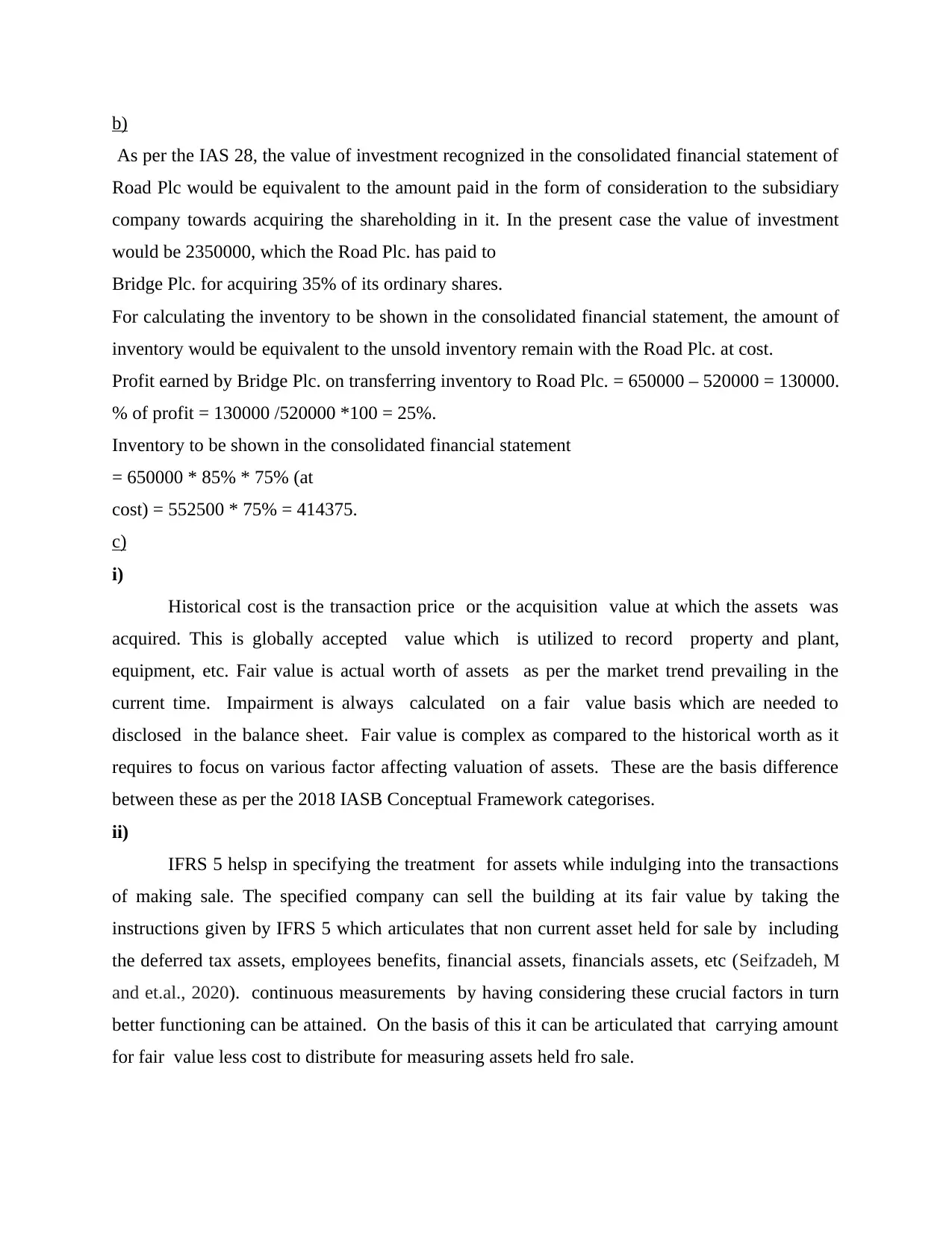
As per the IAS 28, the value of investment recognized in the consolidated financial statement of
Road Plc would be equivalent to the amount paid in the form of consideration to the subsidiary
company towards acquiring the shareholding in it. In the present case the value of investment
would be 2350000, which the Road Plc. has paid to
Bridge Plc. for acquiring 35% of its ordinary shares.
For calculating the inventory to be shown in the consolidated financial statement, the amount of
inventory would be equivalent to the unsold inventory remain with the Road Plc. at cost.
Profit earned by Bridge Plc. on transferring inventory to Road Plc. = 650000 – 520000 = 130000.
% of profit = 130000 /520000 *100 = 25%.
Inventory to be shown in the consolidated financial statement
= 650000 * 85% * 75% (at
cost) = 552500 * 75% = 414375.
c)
i)
Historical cost is the transaction price or the acquisition value at which the assets was
acquired. This is globally accepted value which is utilized to record property and plant,
equipment, etc. Fair value is actual worth of assets as per the market trend prevailing in the
current time. Impairment is always calculated on a fair value basis which are needed to
disclosed in the balance sheet. Fair value is complex as compared to the historical worth as it
requires to focus on various factor affecting valuation of assets. These are the basis difference
between these as per the 2018 IASB Conceptual Framework categorises.
ii)
IFRS 5 helsp in specifying the treatment for assets while indulging into the transactions
of making sale. The specified company can sell the building at its fair value by taking the
instructions given by IFRS 5 which articulates that non current asset held for sale by including
the deferred tax assets, employees benefits, financial assets, financials assets, etc (Seifzadeh, M
and et.al., 2020). continuous measurements by having considering these crucial factors in turn
better functioning can be attained. On the basis of this it can be articulated that carrying amount
for fair value less cost to distribute for measuring assets held fro sale.
As per the IAS 28, the value of investment recognized in the consolidated financial statement of
Road Plc would be equivalent to the amount paid in the form of consideration to the subsidiary
company towards acquiring the shareholding in it. In the present case the value of investment
would be 2350000, which the Road Plc. has paid to
Bridge Plc. for acquiring 35% of its ordinary shares.
For calculating the inventory to be shown in the consolidated financial statement, the amount of
inventory would be equivalent to the unsold inventory remain with the Road Plc. at cost.
Profit earned by Bridge Plc. on transferring inventory to Road Plc. = 650000 – 520000 = 130000.
% of profit = 130000 /520000 *100 = 25%.
Inventory to be shown in the consolidated financial statement
= 650000 * 85% * 75% (at
cost) = 552500 * 75% = 414375.
c)
i)
Historical cost is the transaction price or the acquisition value at which the assets was
acquired. This is globally accepted value which is utilized to record property and plant,
equipment, etc. Fair value is actual worth of assets as per the market trend prevailing in the
current time. Impairment is always calculated on a fair value basis which are needed to
disclosed in the balance sheet. Fair value is complex as compared to the historical worth as it
requires to focus on various factor affecting valuation of assets. These are the basis difference
between these as per the 2018 IASB Conceptual Framework categorises.
ii)
IFRS 5 helsp in specifying the treatment for assets while indulging into the transactions
of making sale. The specified company can sell the building at its fair value by taking the
instructions given by IFRS 5 which articulates that non current asset held for sale by including
the deferred tax assets, employees benefits, financial assets, financials assets, etc (Seifzadeh, M
and et.al., 2020). continuous measurements by having considering these crucial factors in turn
better functioning can be attained. On the basis of this it can be articulated that carrying amount
for fair value less cost to distribute for measuring assets held fro sale.
Paraphrase This Document
Need a fresh take? Get an instant paraphrase of this document with our AI Paraphraser
REFERENCES
Books and journals
Abernathy, J.L and et.al., 2019. Financial statement footnote readability and corporate audit
outcomes. Auditing: A Journal of Practice & Theory. 38(2). pp.1-26.
Dudycz, T. and Praźników, J., 2020. Does the mark-to-model fair value measure make assets
impairment noisy?: A literature review. Sustainability. 12(4). p.1504.
Monahan, S. J., 2018. Financial statement analysis and earnings forecasting. Foundations and
Trends® in Accounting. 12(2). pp.105-215.
Mora, A. and et.al., 2019. Fair value accounting: the eternal debate–AinE EAA Symposium,
May 2018. Accounting in Europe. 16(3). pp.237-255.
Robinson, T. R., 2020. International financial statement analysis. John Wiley & Sons.
Seifzadeh, M and et.al., 2020. The relationship between management characteristics and
financial statement readability. EuroMed Journal of Business.
Books and journals
Abernathy, J.L and et.al., 2019. Financial statement footnote readability and corporate audit
outcomes. Auditing: A Journal of Practice & Theory. 38(2). pp.1-26.
Dudycz, T. and Praźników, J., 2020. Does the mark-to-model fair value measure make assets
impairment noisy?: A literature review. Sustainability. 12(4). p.1504.
Monahan, S. J., 2018. Financial statement analysis and earnings forecasting. Foundations and
Trends® in Accounting. 12(2). pp.105-215.
Mora, A. and et.al., 2019. Fair value accounting: the eternal debate–AinE EAA Symposium,
May 2018. Accounting in Europe. 16(3). pp.237-255.
Robinson, T. R., 2020. International financial statement analysis. John Wiley & Sons.
Seifzadeh, M and et.al., 2020. The relationship between management characteristics and
financial statement readability. EuroMed Journal of Business.

1 out of 8


Related Documents


Your All-in-One AI-Powered Toolkit for Academic Success.
+13062052269
info@desklib.com
Available 24*7 on WhatsApp / Email
![[object Object]](/_next/static/media/star-bottom.7253800d.svg)
Unlock your academic potential
Copyright © 2020–2026 A2Z Services. All Rights Reserved. Developed and managed by ZUCOL.