Advanced Financial Accounting Report: Goodwill, IFRS, and NCI Analysis
VerifiedAdded on 2020/07/22
|12
|2726
|134
Report
AI Summary
This report delves into the complexities of goodwill calculation within the context of mergers and acquisitions. It begins by explaining how the nature of consideration impacts goodwill valuation, differentiating between partial and full consideration approaches. The report then provides a detailed comparison of the full and partial goodwill methods, examining their implications under IFRS 3 Business Combinations, and discussing whether the full goodwill method is mandatory. Furthermore, it clarifies the effects of selecting the full goodwill method over the proportion of net asset method. Finally, the report offers recommendations to the board of Expander regarding the appropriate accounting policy for measuring non-controlling interest at acquisition, covering valuation methods such as share price-based valuation and the Discount for Lack of Marketability (DLOM) method when applicable. The report concludes by emphasizing the importance of accurate goodwill calculation and appropriate accounting policies in financial reporting.

ADVANCED FINANCIAL
ACCOUNTING
ACCOUNTING

Paraphrase This Document
Need a fresh take? Get an instant paraphrase of this document with our AI Paraphraser
TABLE OF CONTENTS
INTRODUCTION......................................................................................................................... 3
(a)Explain how the nature of the consideration affects the calculation of goodwill.......................3
(b) Discuss whether the use of the “full goodwill” as preferred by IFRS 3 Business Combinations
is mandatory.................................................................................................................................. 4
© Explain what the effect of selecting the “full goodwill” method rather than the proportion of
net asset method would be.............................................................................................................5
(d)Advice the board of Expander as to the appropriate accounting policy to adopt in respect of
measuring non-controlling interest at acquisition..........................................................................6
CONCLUSION............................................................................................................................. 7
REFERENCES..........................................................................................................................................8
INTRODUCTION......................................................................................................................... 3
(a)Explain how the nature of the consideration affects the calculation of goodwill.......................3
(b) Discuss whether the use of the “full goodwill” as preferred by IFRS 3 Business Combinations
is mandatory.................................................................................................................................. 4
© Explain what the effect of selecting the “full goodwill” method rather than the proportion of
net asset method would be.............................................................................................................5
(d)Advice the board of Expander as to the appropriate accounting policy to adopt in respect of
measuring non-controlling interest at acquisition..........................................................................6
CONCLUSION............................................................................................................................. 7
REFERENCES..........................................................................................................................................8
INTRODUCTION
Merger and acquisition is done by most of business firms to expand their business at
rapid pace. In current time period varied small and big deals are happening in varied nations of
the world. Accounting in merger and acquisition deals become more complex. In the current
report, nature of consideration and its impact on calculation of goodwill is explained in detail. In
middle part of the report, full and partial goodwill methods are discussed in detail. Apart from
this, accounting policy that is adopted in respect to measurement of non-controlling interest are
also discussed in detail. At end of the report, conclusion section is developed in the report.
(a)Explain how the nature of the consideration affects the calculation of
goodwill
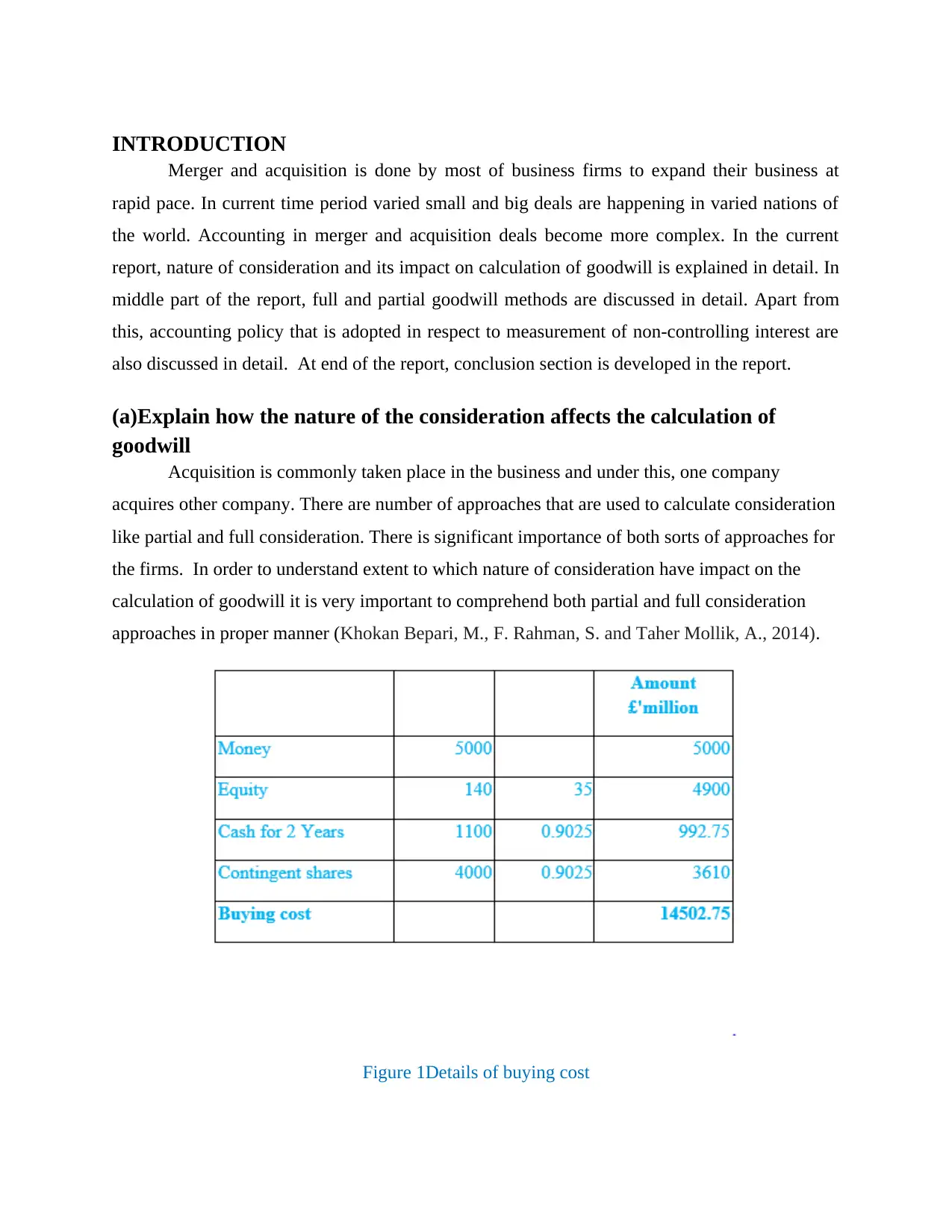
Acquisition is commonly taken place in the business and under this, one company
acquires other company. There are number of approaches that are used to calculate consideration
like partial and full consideration. There is significant importance of both sorts of approaches for
the firms. In order to understand extent to which nature of consideration have impact on the
calculation of goodwill it is very important to comprehend both partial and full consideration
approaches in proper manner (Khokan Bepari, M., F. Rahman, S. and Taher Mollik, A., 2014).
Figure 1Details of buying cost
Merger and acquisition is done by most of business firms to expand their business at
rapid pace. In current time period varied small and big deals are happening in varied nations of
the world. Accounting in merger and acquisition deals become more complex. In the current
report, nature of consideration and its impact on calculation of goodwill is explained in detail. In
middle part of the report, full and partial goodwill methods are discussed in detail. Apart from
this, accounting policy that is adopted in respect to measurement of non-controlling interest are
also discussed in detail. At end of the report, conclusion section is developed in the report.
(a)Explain how the nature of the consideration affects the calculation of
goodwill
Acquisition is commonly taken place in the business and under this, one company
acquires other company. There are number of approaches that are used to calculate consideration
like partial and full consideration. There is significant importance of both sorts of approaches for
the firms. In order to understand extent to which nature of consideration have impact on the
calculation of goodwill it is very important to comprehend both partial and full consideration
approaches in proper manner (Khokan Bepari, M., F. Rahman, S. and Taher Mollik, A., 2014).
Figure 1Details of buying cost
⊘ This is a preview!⊘
Do you want full access?
Subscribe today to unlock all pages.

Trusted by 1+ million students worldwide
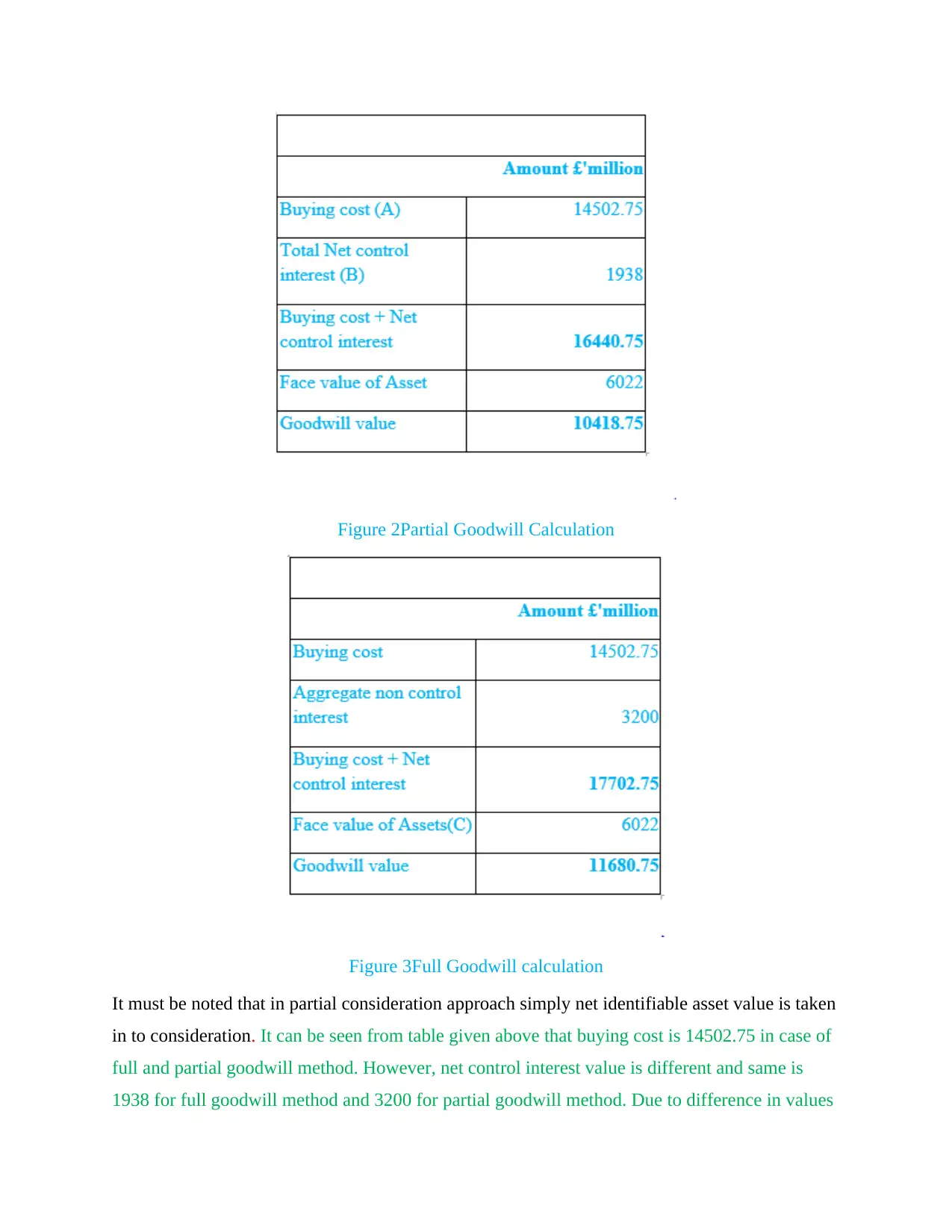
Figure 2Partial Goodwill Calculation
Figure 3Full Goodwill calculation
It must be noted that in partial consideration approach simply net identifiable asset value is taken
in to consideration. It can be seen from table given above that buying cost is 14502.75 in case of
full and partial goodwill method. However, net control interest value is different and same is
1938 for full goodwill method and 3200 for partial goodwill method. Due to difference in values
Figure 3Full Goodwill calculation
It must be noted that in partial consideration approach simply net identifiable asset value is taken
in to consideration. It can be seen from table given above that buying cost is 14502.75 in case of
full and partial goodwill method. However, net control interest value is different and same is
1938 for full goodwill method and 3200 for partial goodwill method. Due to difference in values
Paraphrase This Document
Need a fresh take? Get an instant paraphrase of this document with our AI Paraphraser
buying cost plus net control interest value is different for both as 16440 in case of full goodwill
and 17702 for partial goodwill method. Goodwill amount is increasing in case of full goodwill
method as it can be observed that value of goodwill is 11680 million and in case of partial
goodwill value is 10418 million. Total assets that firm have in its business are equal to 5 Value
for which company acquired is 280 million. It must be noted that in case of full goodwill full
amount is taken in to account not merely 70% of overall value of the company. It can be
assumed that accurate approach is followed to compute value of goodwill in the business and by
considering all values of assets and liability in proper manner goodwill is computed in partial
and full method. It can be said that goodwill value is high in case of full approach then partial.
In order to compute value of net identifiable asset simply from asset impairment asset amount is
subtracted if there is any in business. Then from computed value amount of liability is subtracted
and in this way, value of net identifiable asset is computed in this method. On other hand, in case
of full consideration method, simply book value of net identifiable asset is taken in to account
and from same if, there is any amount of impairment then it is deducted (Full goodwill method,
2017). In this way, in case of partial consideration value of net identifiable asset is computed. It
can be said that there is big difference in calculation of both partial and full consideration
approach for calculation of goodwill. It can be assumed that nature of considerations have impact
on calculation of goodwill (Bepari and Mollik, 2015). It can be observed that in partial method
only that part is considered for consideration which will be acquired by on company in another
but in full consideration entire value of Target Company is taken in to account. This is the major
difference between both approaches, which have impact on the calculation of goodwill amount.
It can be said that full goodwill and partial goodwill method both are important for the firms and
according to their requirements and way in which they intend to do acquisition, appropriate
method must be used (Johansson, Hjelström and Hellman, 2016). Hence, the firms can use it in
order to identify that if they enter in to any deal that what amount of goodwill they can observe
in balance sheet.
(b) Discuss whether the use of the “full goodwill” as preferred by IFRS 3
Business Combinations is mandatory
In the IFRS it is not mandatory to use full goodwill method for valuation of mentioned
asset. It is the preferred but is available as option to the business firms under IFRS. There are
many reasons behind this and one of them is that if by using full goodwill method entire
and 17702 for partial goodwill method. Goodwill amount is increasing in case of full goodwill
method as it can be observed that value of goodwill is 11680 million and in case of partial
goodwill value is 10418 million. Total assets that firm have in its business are equal to 5 Value
for which company acquired is 280 million. It must be noted that in case of full goodwill full
amount is taken in to account not merely 70% of overall value of the company. It can be
assumed that accurate approach is followed to compute value of goodwill in the business and by
considering all values of assets and liability in proper manner goodwill is computed in partial
and full method. It can be said that goodwill value is high in case of full approach then partial.
In order to compute value of net identifiable asset simply from asset impairment asset amount is
subtracted if there is any in business. Then from computed value amount of liability is subtracted
and in this way, value of net identifiable asset is computed in this method. On other hand, in case
of full consideration method, simply book value of net identifiable asset is taken in to account
and from same if, there is any amount of impairment then it is deducted (Full goodwill method,
2017). In this way, in case of partial consideration value of net identifiable asset is computed. It
can be said that there is big difference in calculation of both partial and full consideration
approach for calculation of goodwill. It can be assumed that nature of considerations have impact
on calculation of goodwill (Bepari and Mollik, 2015). It can be observed that in partial method
only that part is considered for consideration which will be acquired by on company in another
but in full consideration entire value of Target Company is taken in to account. This is the major
difference between both approaches, which have impact on the calculation of goodwill amount.
It can be said that full goodwill and partial goodwill method both are important for the firms and
according to their requirements and way in which they intend to do acquisition, appropriate
method must be used (Johansson, Hjelström and Hellman, 2016). Hence, the firms can use it in
order to identify that if they enter in to any deal that what amount of goodwill they can observe
in balance sheet.
(b) Discuss whether the use of the “full goodwill” as preferred by IFRS 3
Business Combinations is mandatory
In the IFRS it is not mandatory to use full goodwill method for valuation of mentioned
asset. It is the preferred but is available as option to the business firms under IFRS. There are
many reasons behind this and one of them is that if by using full goodwill method entire
calculation will be done then in that case assets will be reported at very high value in balance
sheet. In case impairment of asset happened in business then in that case assets value may
decline by high percentage. Due to all things assets value will decline at fast rate and financial
position of an organization will shrink sharply. Hence, this is the one of the main reason due to
which full goodwill method is used as optional by the business firms. There are certain factors.
Other main reason behind no considering full consideration as preferred option is that for
goodwill computation entire asset amount is taken in to account even firms does not purchase it.
This cannot be considered good by the business firm because inclusion of portion of asset for
which no amount is paid cannot be considered appropriate from any angel in the business. On
other hand, in case of partial goodwill this thing does not happened because in this case only that
portion of asset is included for which payment is made (Hatipoglu, Biba and Backaliden, 2016).
This is the reason due to which full goodwill is not considered better then partial consideration in
IFRS. Main aim of IFRS 3 is to ensure that there is transparency in recording of operations and
there is high reliability of recording of transactions in books of accounts. This is the one of the
main factor due to which full goodwill is not considered as one of the best option in the IFRS
and by business firms. These are the one of the main reasons due to which most of firms are
using partial goodwill method in their books of accounts because it give true representation of
the value of the asset that firm acquire and accurately goodwill is calculated. Moreover, if any
firm include value of goodwill on basis of full goodwill method then in that case it is assumed by
other entities like investors and peers that there is lack of transparency in firm operations. It can
be said that firms must use partial goodwill method in its business (Klimczak, Dynel and
Językowej, 2015). It is very important to ensure that peer firms and other entities like investors
are fully confident and have belief that firm accounting statements are revealing true financial
position and decisions can be taken on that basis. Hence, it can be said that partial goodwill
method is assumed better than full goodwill method because it is the more perfect approach and
ensured that all transactions will be recoded accurately in the books of accounts. It can be said
that there is huge significance of partial goodwill approach then full goodwill approach.
© Explain what the effect of selecting the “full goodwill” method rather than
the proportion of net asset method would be
Net asset in case of partial goodwill method= Value of asset-value of liability
=5-11= -6
sheet. In case impairment of asset happened in business then in that case assets value may
decline by high percentage. Due to all things assets value will decline at fast rate and financial
position of an organization will shrink sharply. Hence, this is the one of the main reason due to
which full goodwill method is used as optional by the business firms. There are certain factors.
Other main reason behind no considering full consideration as preferred option is that for
goodwill computation entire asset amount is taken in to account even firms does not purchase it.
This cannot be considered good by the business firm because inclusion of portion of asset for
which no amount is paid cannot be considered appropriate from any angel in the business. On
other hand, in case of partial goodwill this thing does not happened because in this case only that
portion of asset is included for which payment is made (Hatipoglu, Biba and Backaliden, 2016).
This is the reason due to which full goodwill is not considered better then partial consideration in
IFRS. Main aim of IFRS 3 is to ensure that there is transparency in recording of operations and
there is high reliability of recording of transactions in books of accounts. This is the one of the
main factor due to which full goodwill is not considered as one of the best option in the IFRS
and by business firms. These are the one of the main reasons due to which most of firms are
using partial goodwill method in their books of accounts because it give true representation of
the value of the asset that firm acquire and accurately goodwill is calculated. Moreover, if any
firm include value of goodwill on basis of full goodwill method then in that case it is assumed by
other entities like investors and peers that there is lack of transparency in firm operations. It can
be said that firms must use partial goodwill method in its business (Klimczak, Dynel and
Językowej, 2015). It is very important to ensure that peer firms and other entities like investors
are fully confident and have belief that firm accounting statements are revealing true financial
position and decisions can be taken on that basis. Hence, it can be said that partial goodwill
method is assumed better than full goodwill method because it is the more perfect approach and
ensured that all transactions will be recoded accurately in the books of accounts. It can be said
that there is huge significance of partial goodwill approach then full goodwill approach.
© Explain what the effect of selecting the “full goodwill” method rather than
the proportion of net asset method would be
Net asset in case of partial goodwill method= Value of asset-value of liability
=5-11= -6
⊘ This is a preview!⊘
Do you want full access?
Subscribe today to unlock all pages.
Trusted by 1+ million students worldwide
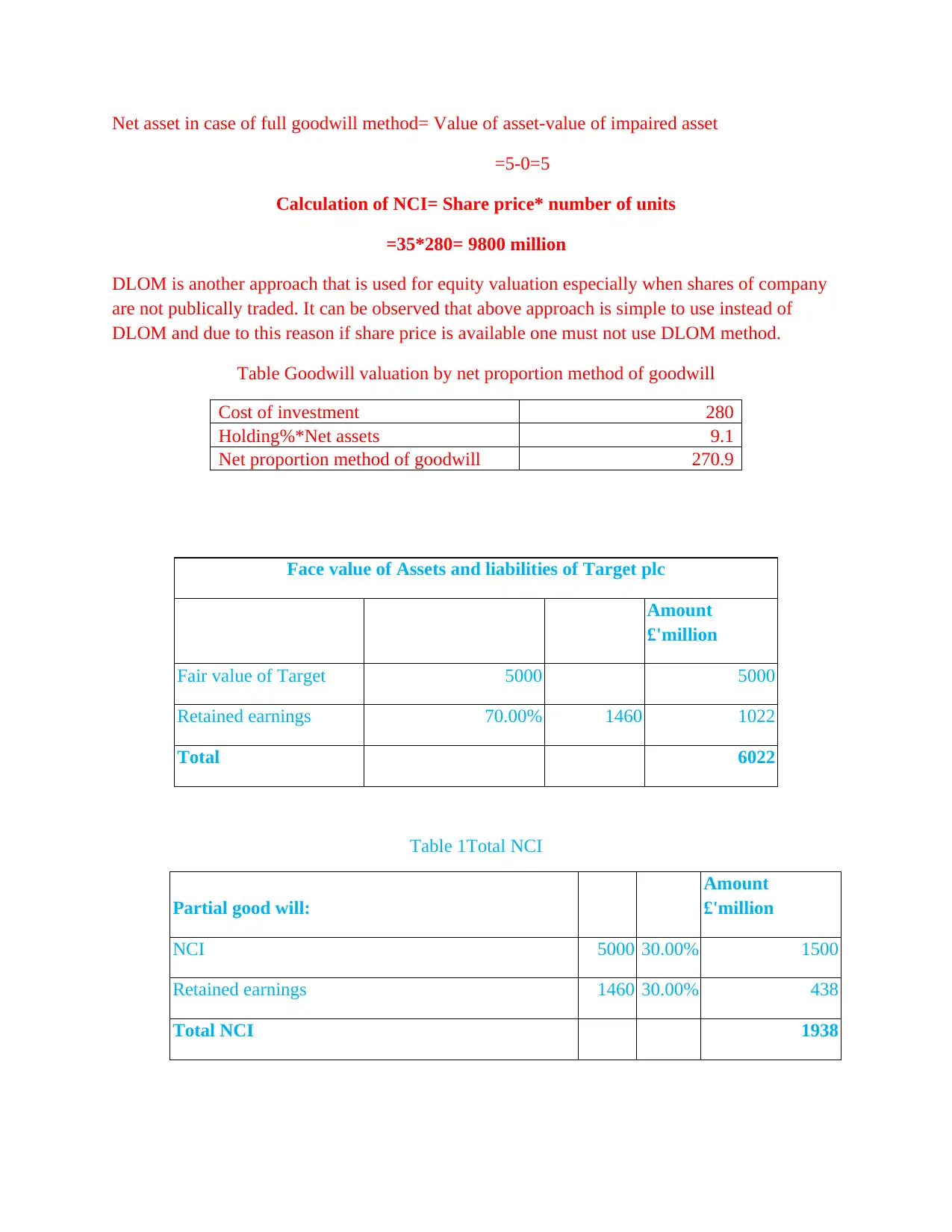
Net asset in case of full goodwill method= Value of asset-value of impaired asset
=5-0=5
Calculation of NCI= Share price* number of units
=35*280= 9800 million
DLOM is another approach that is used for equity valuation especially when shares of company
are not publically traded. It can be observed that above approach is simple to use instead of
DLOM and due to this reason if share price is available one must not use DLOM method.
Table Goodwill valuation by net proportion method of goodwill
Cost of investment 280
Holding%*Net assets 9.1
Net proportion method of goodwill 270.9
Face value of Assets and liabilities of Target plc
Amount
£'million
Fair value of Target 5000 5000
Retained earnings 70.00% 1460 1022
Total 6022
Table 1Total NCI
Partial good will:
Amount
£'million
NCI 5000 30.00% 1500
Retained earnings 1460 30.00% 438
Total NCI 1938
=5-0=5
Calculation of NCI= Share price* number of units
=35*280= 9800 million
DLOM is another approach that is used for equity valuation especially when shares of company
are not publically traded. It can be observed that above approach is simple to use instead of
DLOM and due to this reason if share price is available one must not use DLOM method.
Table Goodwill valuation by net proportion method of goodwill
Cost of investment 280
Holding%*Net assets 9.1
Net proportion method of goodwill 270.9
Face value of Assets and liabilities of Target plc
Amount
£'million
Fair value of Target 5000 5000
Retained earnings 70.00% 1460 1022
Total 6022
Table 1Total NCI
Partial good will:
Amount
£'million
NCI 5000 30.00% 1500
Retained earnings 1460 30.00% 438
Total NCI 1938
Paraphrase This Document
Need a fresh take? Get an instant paraphrase of this document with our AI Paraphraser
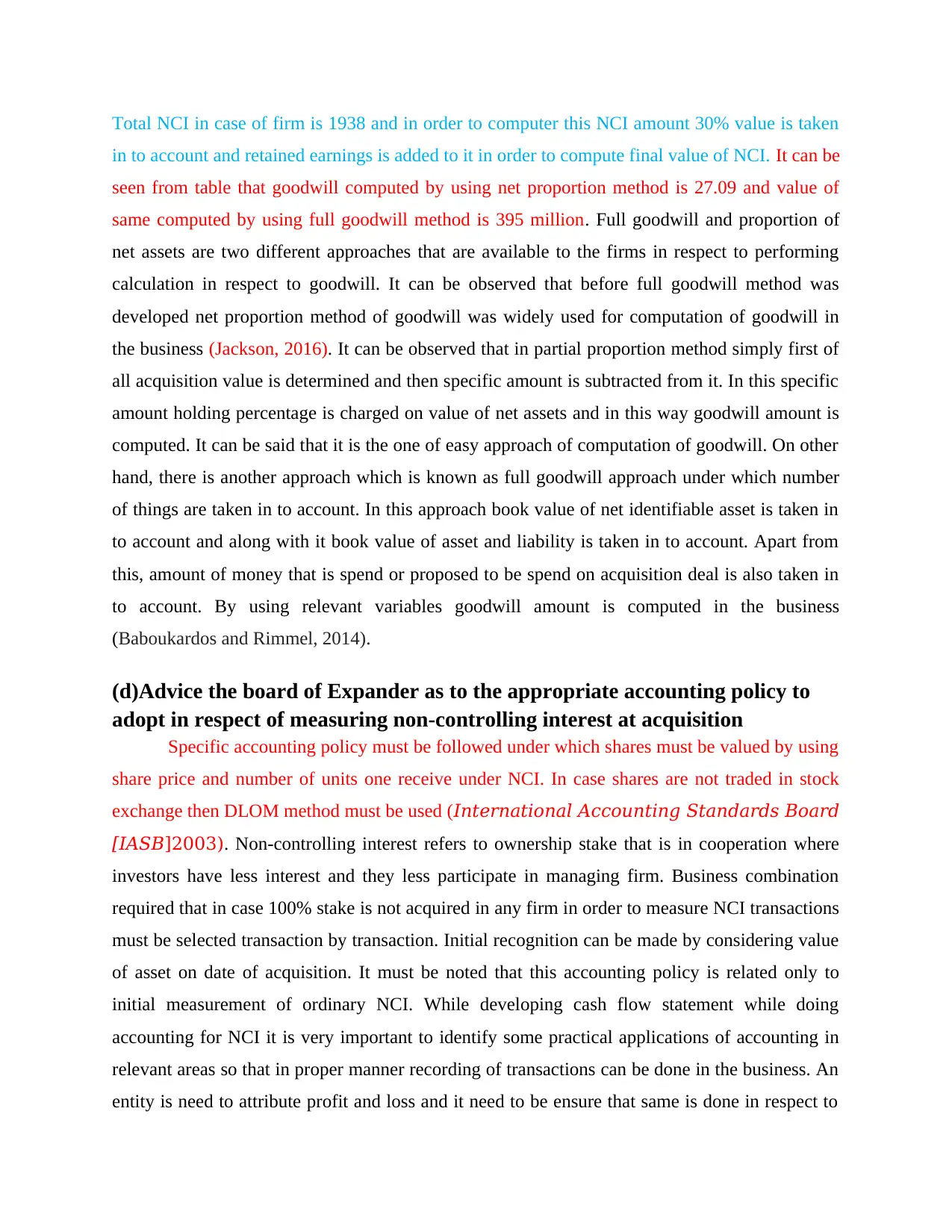
Total NCI in case of firm is 1938 and in order to computer this NCI amount 30% value is taken
in to account and retained earnings is added to it in order to compute final value of NCI. It can be
seen from table that goodwill computed by using net proportion method is 27.09 and value of
same computed by using full goodwill method is 395 million. Full goodwill and proportion of
net assets are two different approaches that are available to the firms in respect to performing
calculation in respect to goodwill. It can be observed that before full goodwill method was
developed net proportion method of goodwill was widely used for computation of goodwill in
the business (Jackson, 2016). It can be observed that in partial proportion method simply first of
all acquisition value is determined and then specific amount is subtracted from it. In this specific
amount holding percentage is charged on value of net assets and in this way goodwill amount is
computed. It can be said that it is the one of easy approach of computation of goodwill. On other
hand, there is another approach which is known as full goodwill approach under which number
of things are taken in to account. In this approach book value of net identifiable asset is taken in
to account and along with it book value of asset and liability is taken in to account. Apart from
this, amount of money that is spend or proposed to be spend on acquisition deal is also taken in
to account. By using relevant variables goodwill amount is computed in the business
(Baboukardos and Rimmel, 2014).
(d)Advice the board of Expander as to the appropriate accounting policy to
adopt in respect of measuring non-controlling interest at acquisition
Specific accounting policy must be followed under which shares must be valued by using
share price and number of units one receive under NCI. In case shares are not traded in stock
exchange then DLOM method must be used (International Accounting Standards Board
[IASB]2003). Non-controlling interest refers to ownership stake that is in cooperation where
investors have less interest and they less participate in managing firm. Business combination
required that in case 100% stake is not acquired in any firm in order to measure NCI transactions
must be selected transaction by transaction. Initial recognition can be made by considering value
of asset on date of acquisition. It must be noted that this accounting policy is related only to
initial measurement of ordinary NCI. While developing cash flow statement while doing
accounting for NCI it is very important to identify some practical applications of accounting in
relevant areas so that in proper manner recording of transactions can be done in the business. An
entity is need to attribute profit and loss and it need to be ensure that same is done in respect to
in to account and retained earnings is added to it in order to compute final value of NCI. It can be
seen from table that goodwill computed by using net proportion method is 27.09 and value of
same computed by using full goodwill method is 395 million. Full goodwill and proportion of
net assets are two different approaches that are available to the firms in respect to performing
calculation in respect to goodwill. It can be observed that before full goodwill method was
developed net proportion method of goodwill was widely used for computation of goodwill in
the business (Jackson, 2016). It can be observed that in partial proportion method simply first of
all acquisition value is determined and then specific amount is subtracted from it. In this specific
amount holding percentage is charged on value of net assets and in this way goodwill amount is
computed. It can be said that it is the one of easy approach of computation of goodwill. On other
hand, there is another approach which is known as full goodwill approach under which number
of things are taken in to account. In this approach book value of net identifiable asset is taken in
to account and along with it book value of asset and liability is taken in to account. Apart from
this, amount of money that is spend or proposed to be spend on acquisition deal is also taken in
to account. By using relevant variables goodwill amount is computed in the business
(Baboukardos and Rimmel, 2014).
(d)Advice the board of Expander as to the appropriate accounting policy to
adopt in respect of measuring non-controlling interest at acquisition
Specific accounting policy must be followed under which shares must be valued by using
share price and number of units one receive under NCI. In case shares are not traded in stock
exchange then DLOM method must be used (International Accounting Standards Board
[IASB]2003). Non-controlling interest refers to ownership stake that is in cooperation where
investors have less interest and they less participate in managing firm. Business combination
required that in case 100% stake is not acquired in any firm in order to measure NCI transactions
must be selected transaction by transaction. Initial recognition can be made by considering value
of asset on date of acquisition. It must be noted that this accounting policy is related only to
initial measurement of ordinary NCI. While developing cash flow statement while doing
accounting for NCI it is very important to identify some practical applications of accounting in
relevant areas so that in proper manner recording of transactions can be done in the business. An
entity is need to attribute profit and loss and it need to be ensure that same is done in respect to
each component of income owners of parent company and NCI. An entity required to allocate
loss that is faced by subsidiary between parent company and NCI even it ultimately result in
negative balance of NCI (Glaum, Landsman and Wyrwa, 2015). It can be said that consolidated
equity amount need to be used to compute non-controlling interest in respect to acquisition deals
rather than recorded amount of equity in the business. It can be said that relevant accounting
policy need to be used and in proper manner so that non-controlling interest can be measured in
proper manner.
CONCLUSION
On basis of above discussion it is concluded that there is significant importance of
accounting standards for the business firms because it ensured that all transactions will be
recorded accurately and in proper manner. It is also concluded that partial goodwill method is
better than full goodwill method and due to this reason it is widely adopted by IFRS and
suggested to firm to use it in practice in respect to recording of merger and acquisition deals in
the business.
loss that is faced by subsidiary between parent company and NCI even it ultimately result in
negative balance of NCI (Glaum, Landsman and Wyrwa, 2015). It can be said that consolidated
equity amount need to be used to compute non-controlling interest in respect to acquisition deals
rather than recorded amount of equity in the business. It can be said that relevant accounting
policy need to be used and in proper manner so that non-controlling interest can be measured in
proper manner.
CONCLUSION
On basis of above discussion it is concluded that there is significant importance of
accounting standards for the business firms because it ensured that all transactions will be
recorded accurately and in proper manner. It is also concluded that partial goodwill method is
better than full goodwill method and due to this reason it is widely adopted by IFRS and
suggested to firm to use it in practice in respect to recording of merger and acquisition deals in
the business.
⊘ This is a preview!⊘
Do you want full access?
Subscribe today to unlock all pages.
Trusted by 1+ million students worldwide
REFERENCES
Books and Journals
Baboukardos, D. and Rimmel, G., 2014, March. Goodwill under IFRS: Relevance and
disclosures in an unfavorable environment. In Accounting Forum (Vol. 38, No. 1, pp. 1-
17). Elsevier.
Bepari, M.K. and Mollik, A.T., 2015. Effect of audit quality and accounting and finance
backgrounds of audit committee members on firms’ compliance with IFRS for goodwill
impairment testing. Journal of Applied Accounting Research. 16(2). pp.196-220.
Glaum, M., Landsman, W.R. and Wyrwa, S., 2015. Determinants of Goodwill Impairment under
IFRS: International Evidence. Working Paper, available at: http://ssrn. com/abstract=
2608425.
Hatipoglu, S., Biba, N. and Backaliden, D., 2016. Goodwill impairment-Who cares? An event
study about IFRS 3 value creation on the Swedish stock market.
Jackson, A., 2016. The Impact of IFRS Goodwill Reporting on Financial Analysts' Equity
Valuation Judgements: Some Experimental Evidence (Digest Summary): N. Hellman, P.
Andersson & E. Fröberg, Accounting & Finance, Vol. 56, No. 1 (March 2016), 113-
157. CFA Digest. 46(8).
Johansson, S.E., Hjelström, T. and Hellman, N., 2016. Accounting for goodwill under IFRS: A
critical analysis. Journal of International Accounting, Auditing and Taxation. 27. pp.13-
25.
Khokan Bepari, M., F. Rahman, S. and Taher Mollik, A., 2014. Firms' compliance with the
disclosure requirements of IFRS for goodwill impairment testing: Effect of the global
financial crisis and other firm characteristics. Journal of Accounting & Organizational
Change. 10(1). pp.116-149.
Klimczak, K.M., Dynel, M. and Językowej, Z.P., 2015. Uncertainty in the financial statements:
the study of goodwill disclosures in Polish. J. Krasodomska, K. Świetla (red.),
Współczesne uwarunkowania sprawozdawczości i rewizji finansowej. pp.217-226.
Online
Full goodwill method, 2017. [Online]. Available through:<
https://accountingexplained.com/financial/business-combinations/full-goodwill-method>.
Books and Journals
Baboukardos, D. and Rimmel, G., 2014, March. Goodwill under IFRS: Relevance and
disclosures in an unfavorable environment. In Accounting Forum (Vol. 38, No. 1, pp. 1-
17). Elsevier.
Bepari, M.K. and Mollik, A.T., 2015. Effect of audit quality and accounting and finance
backgrounds of audit committee members on firms’ compliance with IFRS for goodwill
impairment testing. Journal of Applied Accounting Research. 16(2). pp.196-220.
Glaum, M., Landsman, W.R. and Wyrwa, S., 2015. Determinants of Goodwill Impairment under
IFRS: International Evidence. Working Paper, available at: http://ssrn. com/abstract=
2608425.
Hatipoglu, S., Biba, N. and Backaliden, D., 2016. Goodwill impairment-Who cares? An event
study about IFRS 3 value creation on the Swedish stock market.
Jackson, A., 2016. The Impact of IFRS Goodwill Reporting on Financial Analysts' Equity
Valuation Judgements: Some Experimental Evidence (Digest Summary): N. Hellman, P.
Andersson & E. Fröberg, Accounting & Finance, Vol. 56, No. 1 (March 2016), 113-
157. CFA Digest. 46(8).
Johansson, S.E., Hjelström, T. and Hellman, N., 2016. Accounting for goodwill under IFRS: A
critical analysis. Journal of International Accounting, Auditing and Taxation. 27. pp.13-
25.
Khokan Bepari, M., F. Rahman, S. and Taher Mollik, A., 2014. Firms' compliance with the
disclosure requirements of IFRS for goodwill impairment testing: Effect of the global
financial crisis and other firm characteristics. Journal of Accounting & Organizational
Change. 10(1). pp.116-149.
Klimczak, K.M., Dynel, M. and Językowej, Z.P., 2015. Uncertainty in the financial statements:
the study of goodwill disclosures in Polish. J. Krasodomska, K. Świetla (red.),
Współczesne uwarunkowania sprawozdawczości i rewizji finansowej. pp.217-226.
Online
Full goodwill method, 2017. [Online]. Available through:<
https://accountingexplained.com/financial/business-combinations/full-goodwill-method>.
Paraphrase This Document
Need a fresh take? Get an instant paraphrase of this document with our AI Paraphraser

International Accounting Standards Board [IASB]. 2003.
[PDF]. International accounting standard 2: Inventories. Available online
at http://eifrs.ifrs.org/eifrs/bnstandards/en/IAS2.pdf .
[PDF]. International accounting standard 2: Inventories. Available online
at http://eifrs.ifrs.org/eifrs/bnstandards/en/IAS2.pdf .

⊘ This is a preview!⊘
Do you want full access?
Subscribe today to unlock all pages.
Trusted by 1+ million students worldwide

1 out of 12


Related Documents


Your All-in-One AI-Powered Toolkit for Academic Success.
+13062052269
info@desklib.com
Available 24*7 on WhatsApp / Email
![[object Object]](/_next/static/media/star-bottom.7253800d.svg)
Unlock your academic potential
Copyright © 2020–2025 A2Z Services. All Rights Reserved. Developed and managed by ZUCOL.