Advanced Financial Accounting: Ramsay Healthcare and Lease Accounting
VerifiedAdded on 2021/02/20
|12
|3171
|49
Report
AI Summary
This report delves into the realm of advanced financial accounting, using Ramsay Healthcare Ltd. as a case study. It begins by explaining key accounting standards employed by the company, such as the consistency, materiality, going concern, and matching concepts. The report then provides a detailed description of the changes introduced by the new accounting standard AASB 16, particularly concerning lease accounting, and its implications for financial reporting. Furthermore, the report outlines the key disclosures made by Ramsay Healthcare regarding its accounting for leases, including the transitional provisions and the effects of transitioning from AASB 17 to AASB 16. The analysis covers issues like the impact on the income statement, the challenges of information system and data management, and the preparation of disclosures. The report highlights the practical expedients used and the choices made during the transition, offering a comprehensive view of the accounting practices and their evolution within the company. The report underscores the importance of understanding these changes for stakeholders and the financial implications of the new standards.
ADVANCED
FINANCIAL
ACCOUNTING
FINANCIAL
ACCOUNTING

Paraphrase This Document
Need a fresh take? Get an instant paraphrase of this document with our AI Paraphraser
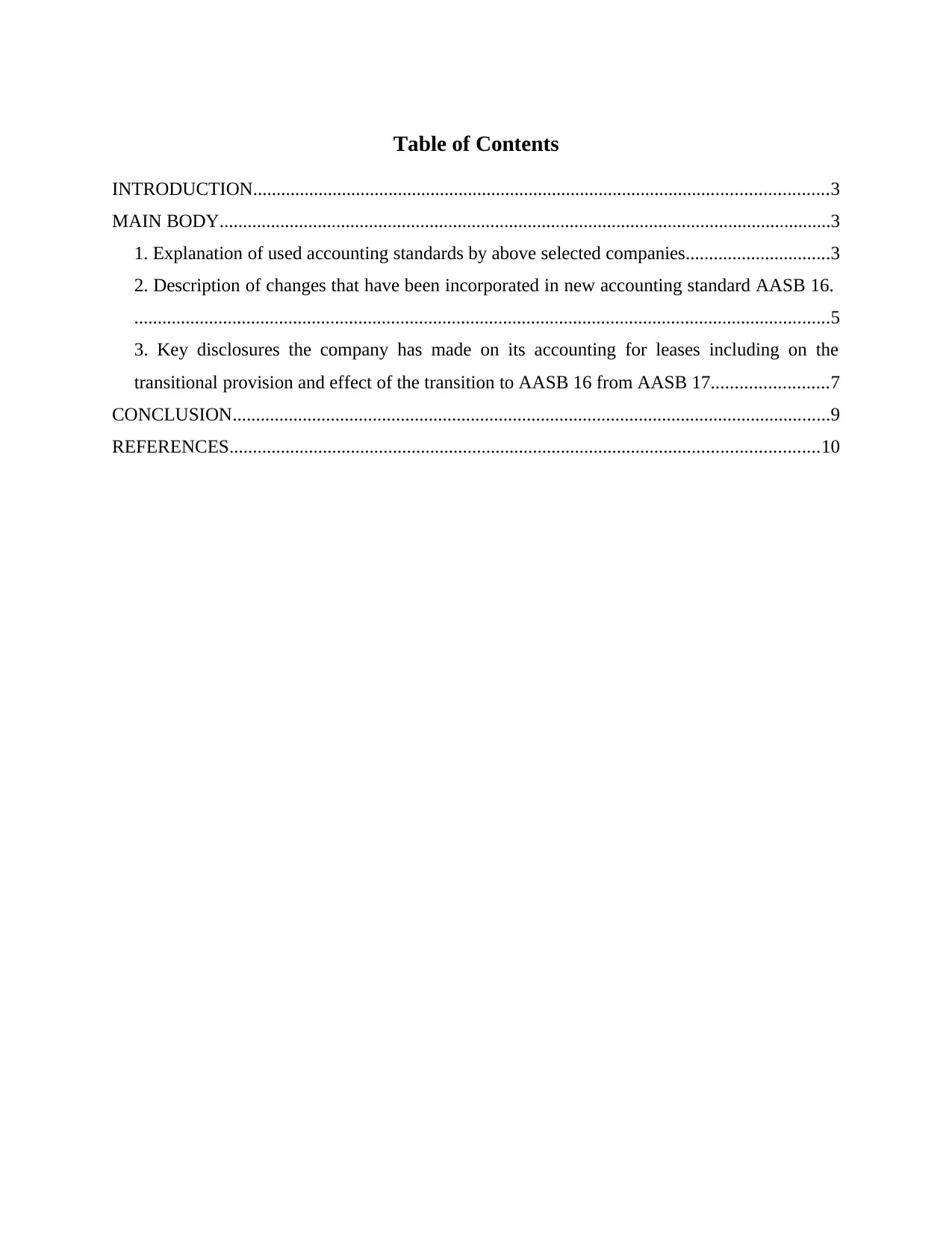
Table of Contents
INTRODUCTION...........................................................................................................................3
MAIN BODY...................................................................................................................................3
1. Explanation of used accounting standards by above selected companies...............................3
2. Description of changes that have been incorporated in new accounting standard AASB 16.
.....................................................................................................................................................5
3. Key disclosures the company has made on its accounting for leases including on the
transitional provision and effect of the transition to AASB 16 from AASB 17.........................7
CONCLUSION................................................................................................................................9
REFERENCES..............................................................................................................................10
INTRODUCTION...........................................................................................................................3
MAIN BODY...................................................................................................................................3
1. Explanation of used accounting standards by above selected companies...............................3
2. Description of changes that have been incorporated in new accounting standard AASB 16.
.....................................................................................................................................................5
3. Key disclosures the company has made on its accounting for leases including on the
transitional provision and effect of the transition to AASB 16 from AASB 17.........................7
CONCLUSION................................................................................................................................9
REFERENCES..............................................................................................................................10
INTRODUCTION
Advance financial accounting is main stream of the accounting that refers to preparation
of the financial statement and reports for the corporates such as company, banking, insurance and
other institution that deals in the particular task and activities related to business concern
(Acosta-González, Fernández-Rodríguez and Ganga, 2019). Financial accounting creates for the
internal purpose of the reporting in order to make the futuristic decision by analysing the annual
reports and related financial information. In the advance accounting, it covers the accounting
operations, patterns, merger and acquisition of the companies, forex transactions in the local
currencies. For the better understanding the concept of the advance financial accounting, it is
selected the company named as Ramsay healthcare Ltd. This particular company provide the
services related to private health care in certain country such as UK, France Malaysia that is
founded by Paul Ramsay in Sydney, Australia in 1964. This projects reports covers the certain
topic accounting standard that used in the annual reports, accounting standard for the lease
AASB 16. In addition to it also summarises the key discloser for accounting for lease and its to
the transition to AASN 16 from AASB 117 for the selected business (Openshaw, 2013).
MAIN BODY
1. Explanation of used accounting standards by above selected companies.
This is essential for companies to make their financial statements on basis of various kind
of accounting concepts. It is so because these concepts make financial statements more
accountable and relevant (Brown, and et. Al 2015). There are a wide of range of accounting
concepts that are being used by companies such as consistency, full disclosure and many more.
The above chosen company, Ramsay healthcare is using various kind of accounting concepts and
some of them are mentioned that are as follows:
Consistency concept- It may be defined as a kind of accounting concept that is linked
with the use of similar pattern of accounting in all financial years. This is very crucial for
companies because if companies will use same accounting concepts then it may become
useful for them to compare their previous year's financial performance with rest of years.
Hence, it is essential for accountants to follow this accounting concept in an effective
manner. While in the absence of this accounting concept, it may become difficult to
Advance financial accounting is main stream of the accounting that refers to preparation
of the financial statement and reports for the corporates such as company, banking, insurance and
other institution that deals in the particular task and activities related to business concern
(Acosta-González, Fernández-Rodríguez and Ganga, 2019). Financial accounting creates for the
internal purpose of the reporting in order to make the futuristic decision by analysing the annual
reports and related financial information. In the advance accounting, it covers the accounting
operations, patterns, merger and acquisition of the companies, forex transactions in the local
currencies. For the better understanding the concept of the advance financial accounting, it is
selected the company named as Ramsay healthcare Ltd. This particular company provide the
services related to private health care in certain country such as UK, France Malaysia that is
founded by Paul Ramsay in Sydney, Australia in 1964. This projects reports covers the certain
topic accounting standard that used in the annual reports, accounting standard for the lease
AASB 16. In addition to it also summarises the key discloser for accounting for lease and its to
the transition to AASN 16 from AASB 117 for the selected business (Openshaw, 2013).
MAIN BODY
1. Explanation of used accounting standards by above selected companies.
This is essential for companies to make their financial statements on basis of various kind
of accounting concepts. It is so because these concepts make financial statements more
accountable and relevant (Brown, and et. Al 2015). There are a wide of range of accounting
concepts that are being used by companies such as consistency, full disclosure and many more.
The above chosen company, Ramsay healthcare is using various kind of accounting concepts and
some of them are mentioned that are as follows:
Consistency concept- It may be defined as a kind of accounting concept that is linked
with the use of similar pattern of accounting in all financial years. This is very crucial for
companies because if companies will use same accounting concepts then it may become
useful for them to compare their previous year's financial performance with rest of years.
Hence, it is essential for accountants to follow this accounting concept in an effective
manner. While in the absence of this accounting concept, it may become difficult to
⊘ This is a preview!⊘
Do you want full access?
Subscribe today to unlock all pages.

Trusted by 1+ million students worldwide
companies to compare their actual performance as well as this may lead to certain issues
regarding to accuracy of prepared financial statements. The above chosen company,
Ramsay healthcare limited is using this concept of accounting that is helping them in
making their accounting standards more accountable and comparable with previous year's
financial performance (Bryer, 2013). For an example in both year 2017 and 2018,
company is using similar format of income statements as well as other financial
statements.
Materiality concept of accounting- This can be defined as a kind of accounting concept
which defines that in some manner, the use of accounting standards can be ignored. It is
so because if the impact of any financial transaction is lower then the implementation of
accounting concepts can be ignored (McKeen-Edwards and Porter, 2013). Herein, this is
important to know that it is not applicable on all kind of financial transactions. Such as in
the aspect of above company, Ramsay healthcare they use this accounting concept for
those financial transactions whose impact could be lower on their financial statements.
They ignored accounting concepts for those financial transaction which are doubtful and
whose amount is lower.
Going concern concept- It is a kind of accounting concept which is associated with an
assumption which is that business will run in future without any issue. In other words, it
is useful for assurance of stakeholders that in futuristic time business will complete its
plan and will consume its own assets for payment of liabilities (Owhoso, Malgwi and
Akpomi, 2014). This is also known by the continuing concern concept. In the aspect of
above Ramsay healthcare company, they are using this accounting concept in order to
assure their various kind of external stakeholders that their business will run without any
issues. As well as if any financial crises arise then they will pay from selling of their
assets. Though in above company , as per the findings of annual report of year 2017 this
can be stated that net profit is of $ 550996 as well as in year 2018, it is of $ 411214. It is
showing that company's profits are positive and indicating that they are fulfilling the
accounting concept of going concern. It is so because their business is running without
any financial crises and issue which is as per above mentioned accounting concept
(Christ and et. Al 2015).
regarding to accuracy of prepared financial statements. The above chosen company,
Ramsay healthcare limited is using this concept of accounting that is helping them in
making their accounting standards more accountable and comparable with previous year's
financial performance (Bryer, 2013). For an example in both year 2017 and 2018,
company is using similar format of income statements as well as other financial
statements.
Materiality concept of accounting- This can be defined as a kind of accounting concept
which defines that in some manner, the use of accounting standards can be ignored. It is
so because if the impact of any financial transaction is lower then the implementation of
accounting concepts can be ignored (McKeen-Edwards and Porter, 2013). Herein, this is
important to know that it is not applicable on all kind of financial transactions. Such as in
the aspect of above company, Ramsay healthcare they use this accounting concept for
those financial transactions whose impact could be lower on their financial statements.
They ignored accounting concepts for those financial transaction which are doubtful and
whose amount is lower.
Going concern concept- It is a kind of accounting concept which is associated with an
assumption which is that business will run in future without any issue. In other words, it
is useful for assurance of stakeholders that in futuristic time business will complete its
plan and will consume its own assets for payment of liabilities (Owhoso, Malgwi and
Akpomi, 2014). This is also known by the continuing concern concept. In the aspect of
above Ramsay healthcare company, they are using this accounting concept in order to
assure their various kind of external stakeholders that their business will run without any
issues. As well as if any financial crises arise then they will pay from selling of their
assets. Though in above company , as per the findings of annual report of year 2017 this
can be stated that net profit is of $ 550996 as well as in year 2018, it is of $ 411214. It is
showing that company's profits are positive and indicating that they are fulfilling the
accounting concept of going concern. It is so because their business is running without
any financial crises and issue which is as per above mentioned accounting concept
(Christ and et. Al 2015).
Paraphrase This Document
Need a fresh take? Get an instant paraphrase of this document with our AI Paraphraser
Matching concept- It may be defined as a kind of accounting concept which states that a
company's assets should be equal to its liabilities at the end of a financial year. This is so
because if it will not be equal then business entity will not be able to make payment of
their liabilities (Paterson, 2014). In addition, this accounting concept of matching defines
that all the revenues which arises should be identified in same year. The equation of this
accounting concept is as follows: Assets = Liabilities + Capital. It is also known by heart
of all accounting concepts. In the aspect of above Ramsay healthcare company, their
accountants follow this accounting concept and this can be seen from their prepared
financial statements such as balance sheet. Like in year 2017, their assets are of $
8335361 which is similar of addition of liabilities and capital. Same as in next year 2018,
this accounting concept seems to be applicable.
So these the above mentioned accounting concepts which are being used by accountants of
Ramsay healthcare company in the preparation of financial statements of year 2017 and 2018.
2. Description of changes that have been incorporated in new accounting standard AASB 16.
The new leases standard AASB 16 (Australian Accounting Standards board) will bring a
number of changes as well as challenges beyond the financial reporting process, on
organisations. This was effective from first of January, 2019 that assists organisations to bring
the majority of operational leases in their balance sheet. Now, property and equipment leases that
previously recognised in Off-Balance sheet will now be accounted as ROU asset (Right-Of-Use).
This kind of lease liability will bring more transparency about commitment of company and their
financial key metrics. It includes gearing rations, EBITDA, asset turnover and more (Collings
and Loughran, 2013). Thus, implementation of new leases standards in financial accounting, will
pose more challenges not for companies, where management need to manage the number of
impacts. It includes impairment testing, credit ratings, debt covenants and more. This will bring
significant impacts on financial statement of companies as well. As per current accounting
standard in Australia, the obligation for making future payments that comes under an operating
lease arrangement will not included on balance sheet, although the entity is committed for
respective future expenditures. Hereby, mostly stakeholders think that implementation of new
lease standard in business, will not give desired accurate reflection of true financial position of
business, because in such condition, company will not use the cost of leased assets and
company's assets should be equal to its liabilities at the end of a financial year. This is so
because if it will not be equal then business entity will not be able to make payment of
their liabilities (Paterson, 2014). In addition, this accounting concept of matching defines
that all the revenues which arises should be identified in same year. The equation of this
accounting concept is as follows: Assets = Liabilities + Capital. It is also known by heart
of all accounting concepts. In the aspect of above Ramsay healthcare company, their
accountants follow this accounting concept and this can be seen from their prepared
financial statements such as balance sheet. Like in year 2017, their assets are of $
8335361 which is similar of addition of liabilities and capital. Same as in next year 2018,
this accounting concept seems to be applicable.
So these the above mentioned accounting concepts which are being used by accountants of
Ramsay healthcare company in the preparation of financial statements of year 2017 and 2018.
2. Description of changes that have been incorporated in new accounting standard AASB 16.
The new leases standard AASB 16 (Australian Accounting Standards board) will bring a
number of changes as well as challenges beyond the financial reporting process, on
organisations. This was effective from first of January, 2019 that assists organisations to bring
the majority of operational leases in their balance sheet. Now, property and equipment leases that
previously recognised in Off-Balance sheet will now be accounted as ROU asset (Right-Of-Use).
This kind of lease liability will bring more transparency about commitment of company and their
financial key metrics. It includes gearing rations, EBITDA, asset turnover and more (Collings
and Loughran, 2013). Thus, implementation of new leases standards in financial accounting, will
pose more challenges not for companies, where management need to manage the number of
impacts. It includes impairment testing, credit ratings, debt covenants and more. This will bring
significant impacts on financial statement of companies as well. As per current accounting
standard in Australia, the obligation for making future payments that comes under an operating
lease arrangement will not included on balance sheet, although the entity is committed for
respective future expenditures. Hereby, mostly stakeholders think that implementation of new
lease standard in business, will not give desired accurate reflection of true financial position of
business, because in such condition, company will not use the cost of leased assets and
associated profits within balanced sheet. But these changes will lead to substantially enhance the
level of commercial as well as financial reporting risk that may increase the complexity and
hidden issues also. For an instance, the new standard of lease will change the current profile of
expense, where instead of being a straight line rental expense in business, now there will be more
expenditures in early years, with reduction in later years, that may impact the earnings profiles,
because right of use assets now will consider as non-current. While lease liabilities will now split
into two major forms as current and non-current, that may arise a number of issues in audited the
financial statement (DRURY, 2013). This may causes potentially large enhancement in metrics
like EBITDA i.e. Earning before tax, depreciation and amortization that is mainly used for
measuring company's operational performance. Along with this, to make large changes in
business, it will become essential for organisations to be explained properly to all associated
investors, shareholders and financiers, so that collaboration of them can be gained to implement
new standards of lease within financial statement.
Apart from it, there are some other changes in AASB 16 that are as follows:
Lessees will be needed to identify individually the expenditures of interest as per the
lease liabilities.
In addition, the lessees will be needed to remeasure lease liabilities on basis of occurred
events. For example any variation in lease term and many more.
As well as the AASB 16. needs lessees to account for all leases as per the single balance
sheet model (Rosemary Williams 2015).
Herein, the aspect of above chosen company, Ramsay healthcare the issues due to change in
AASB 16 are mentioned below which are as follows:
In the income statement, the operating cost is being replaced by “front loaded” net
interest expenditures.
Complete analysis of all contractors for establishment of how much and what kind of
information will be processed. It is a big issue for above company, because due to new
standards of lease, they are not aware of which kind of information is needed for further
procedure of lease (Han and Shen, 2015).
Another issue is related to changed Australian accounting standard board 16 is about
finding of lease modification. In other words, this is becoming difficult for above
company is that they are unable to know the changes in lease as a individually basis.
level of commercial as well as financial reporting risk that may increase the complexity and
hidden issues also. For an instance, the new standard of lease will change the current profile of
expense, where instead of being a straight line rental expense in business, now there will be more
expenditures in early years, with reduction in later years, that may impact the earnings profiles,
because right of use assets now will consider as non-current. While lease liabilities will now split
into two major forms as current and non-current, that may arise a number of issues in audited the
financial statement (DRURY, 2013). This may causes potentially large enhancement in metrics
like EBITDA i.e. Earning before tax, depreciation and amortization that is mainly used for
measuring company's operational performance. Along with this, to make large changes in
business, it will become essential for organisations to be explained properly to all associated
investors, shareholders and financiers, so that collaboration of them can be gained to implement
new standards of lease within financial statement.
Apart from it, there are some other changes in AASB 16 that are as follows:
Lessees will be needed to identify individually the expenditures of interest as per the
lease liabilities.
In addition, the lessees will be needed to remeasure lease liabilities on basis of occurred
events. For example any variation in lease term and many more.
As well as the AASB 16. needs lessees to account for all leases as per the single balance
sheet model (Rosemary Williams 2015).
Herein, the aspect of above chosen company, Ramsay healthcare the issues due to change in
AASB 16 are mentioned below which are as follows:
In the income statement, the operating cost is being replaced by “front loaded” net
interest expenditures.
Complete analysis of all contractors for establishment of how much and what kind of
information will be processed. It is a big issue for above company, because due to new
standards of lease, they are not aware of which kind of information is needed for further
procedure of lease (Han and Shen, 2015).
Another issue is related to changed Australian accounting standard board 16 is about
finding of lease modification. In other words, this is becoming difficult for above
company is that they are unable to know the changes in lease as a individually basis.
⊘ This is a preview!⊘
Do you want full access?
Subscribe today to unlock all pages.
Trusted by 1+ million students worldwide
In addition, the another issue which is faced by above Ramsay healthcare company is
regarding to information system and data management. This is so because international
financial reporting standard 16 is very obliges to companies for applying.
Issue regarding to preparation of disclosure. In broad sense, it is difficult for companies
to produce disclosure of accounts of lessor and lessee due to changes in Australian
accounting standard board 16. Same as in the aspect of above Ramsay healthcare
company, they are facing the issue of preparation of disclosure (Katzenstein and Nelson,
2013).
So these are the main issues which are being faced by above company in order to change
in Australian accounting standard board 16 of lease.
3. Key disclosures the company has made on its accounting for leases including on the
transitional provision and effect of the transition to AASB 16 from AASB 17.
The new accounting standard of lease includes various kind of new disclosure that
consists both such as transition and on going disclosure. Companies implements short-term lease
exemptions for all types of assets (Talonpoika and et. Al, 2016). The above Ramsay healthcare
company, consider that the effect of applying AASB 16 is the practical expedients on transition
that all kind of short-term exemptions for those contracts which expire in 12 months of time
period are expensed under profit and loss account. In addition the choice of transition option is
impacting to below mentioned aspect of above selected Ramsay healthcare company that is as
follows:
Opening balance sheet
Income statement
Information that is required
Cost of implementation
Below the disclosures which are needed as per IFRS 16 are as follows such as:
If an organisation implements international financial reporting standards 16 in the starting
of financial years then it discloses this fact (Lo and Yu, 2015).
As well as if an entity applies the practical expedient for lease definition then it discloses
this fact.
regarding to information system and data management. This is so because international
financial reporting standard 16 is very obliges to companies for applying.
Issue regarding to preparation of disclosure. In broad sense, it is difficult for companies
to produce disclosure of accounts of lessor and lessee due to changes in Australian
accounting standard board 16. Same as in the aspect of above Ramsay healthcare
company, they are facing the issue of preparation of disclosure (Katzenstein and Nelson,
2013).
So these are the main issues which are being faced by above company in order to change
in Australian accounting standard board 16 of lease.
3. Key disclosures the company has made on its accounting for leases including on the
transitional provision and effect of the transition to AASB 16 from AASB 17.
The new accounting standard of lease includes various kind of new disclosure that
consists both such as transition and on going disclosure. Companies implements short-term lease
exemptions for all types of assets (Talonpoika and et. Al, 2016). The above Ramsay healthcare
company, consider that the effect of applying AASB 16 is the practical expedients on transition
that all kind of short-term exemptions for those contracts which expire in 12 months of time
period are expensed under profit and loss account. In addition the choice of transition option is
impacting to below mentioned aspect of above selected Ramsay healthcare company that is as
follows:
Opening balance sheet
Income statement
Information that is required
Cost of implementation
Below the disclosures which are needed as per IFRS 16 are as follows such as:
If an organisation implements international financial reporting standards 16 in the starting
of financial years then it discloses this fact (Lo and Yu, 2015).
As well as if an entity applies the practical expedient for lease definition then it discloses
this fact.
Paraphrase This Document
Need a fresh take? Get an instant paraphrase of this document with our AI Paraphraser
Eventually, the role of transition option is too crucial because of following reasons which are as
follows such as:
In Ramsay healthcare company's chosen transition approach will impact on followings-
The data which is needed to implement as per new standards.
The cost, resources and timeline for organisations' applied project.
Impact on company's profit and profit trends.
As well as carrying amount of all kind of assets and liabilities. Hence, the net assets-
when companies apply first the new standards (Macve, 2015).
In addition the most of transition options consists a trade off between the cost of implementation
and comparability of resulted financial information on the basis of transition.
follows such as:
In Ramsay healthcare company's chosen transition approach will impact on followings-
The data which is needed to implement as per new standards.
The cost, resources and timeline for organisations' applied project.
Impact on company's profit and profit trends.
As well as carrying amount of all kind of assets and liabilities. Hence, the net assets-
when companies apply first the new standards (Macve, 2015).
In addition the most of transition options consists a trade off between the cost of implementation
and comparability of resulted financial information on the basis of transition.
CONCLUSION
From the above report it is articulated that advance financial accounting play a important
role in the business concern in order to making the decision related to future by using the
analysed financial data and information from the annual reports and statements. Accounting
standard provides more accurate and reliable data in the manual reports and financial statement
so the investor or user of the financial reporting and various statement. Annual report of the
business consist of income statement, balance sheet other disclosure of the financial statement .
In further to this report summarised the accounting standard for the lease as per its provision and
effect of this particular topic in the books of accounts. It also disclose the accounting for lease in
AASB 16. All the standard and discloser provided by the company may influence the user or
investor of the company.
From the above report it is articulated that advance financial accounting play a important
role in the business concern in order to making the decision related to future by using the
analysed financial data and information from the annual reports and statements. Accounting
standard provides more accurate and reliable data in the manual reports and financial statement
so the investor or user of the financial reporting and various statement. Annual report of the
business consist of income statement, balance sheet other disclosure of the financial statement .
In further to this report summarised the accounting standard for the lease as per its provision and
effect of this particular topic in the books of accounts. It also disclose the accounting for lease in
AASB 16. All the standard and discloser provided by the company may influence the user or
investor of the company.
⊘ This is a preview!⊘
Do you want full access?
Subscribe today to unlock all pages.
Trusted by 1+ million students worldwide
REFERENCES
Books and Journals:
Acosta-González, E., Fernández-Rodríguez, F. and Ganga, H., 2019. Predicting corporate
financial failure using macroeconomic variables and accounting data. Computational
Economics. 53(1). pp.227-257.
Brown, J., Dillard, J., Hopper, T., Atkins, J., Atkins, B.C., Thomson, I. and Maroun, W., 2015.
“Good” news from nowhere: imagining utopian sustainable accounting. Accounting,
Auditing & Accountability Journal.
Bryer, R., 2013. Americanism and financial accounting theory–Part 2: The ‘modern business
enterprise’, America's transition to capitalism, and the genesis of management
accounting. Critical Perspectives on Accounting. 24(4-5). pp.273-318.
Christ, M.H., Masli, A., Sharp, N.Y. and Wood, D.A., 2015. Rotational internal audit programs
and financial reporting quality: Do compensating controls help?. Accounting,
Organizations and Society. 44. pp.37-59.
Collings, S. and Loughran, M., 2013. Financial Accounting For Dummies-UK. John Wiley &
Sons.
DRURY, C.M., 2013. Management and cost accounting. Springer.
Han, J. and Shen, Y., 2015. Financial development and total factor productivity growth:
Evidence from China. Emerging Markets Finance and Trade. 51(sup1). pp.S261-S274.
Katzenstein, P.J. and Nelson, S.C., 2013. Reading the right signals and reading the signals right:
IPE and the financial crisis of 2008. Review of International Political Economy. 20(5).
pp.1101-1131.
Lo, A.Y. and Yu, X., 2015. Climate for business: opportunities for financial institutions and
sustainable development in the Chinese carbon market. Sustainable Development, 23(6),
pp.369-380.
Macve, R., 2015. A Conceptual Framework for Financial Accounting and Reporting: Vision,
Tool, Or Threat?. Routledge.
McKeen-Edwards, H. and Porter, T., 2013. Transnational Financial Associations and the
Governance of Global Finance: Assembling Wealth and Power. Routledge.
Openshaw, K., 2013. Cost and financial accounting in forestry: a practical manual. Elsevier.
Owhoso, V., Malgwi, C.A. and Akpomi, M., 2014. Does Participation in a Computer-Based
Learning Program in Introductory Financial Accounting Course Lead to Choosing
Accounting as a Major?. Journal of Education for Business. 89(7). pp.367-372.
Paterson, M.A., 2014. Healthcare Finance and Financial Management: Essentials for Advanced
Practice Nurses and Interdisciplinary Care Teams. DEStech Publications, Inc.
Rosemary Williams DBA, C.P.A., 2015. Accountability, transparency and citizen engagement in
government financial reporting. The Journal of Government Financial Management.
64(1). p.40.
Talonpoika, A.M., Kärri, T., Pirttilä, M. and Monto, S., 2016. Defined strategies for financial
working capital management. International Journal of Managerial Finance. 12(3).
pp.277-294.
Tschopp, D. and Huefner, R.J., 2015. Comparing the evolution of CSR reporting to that of
financial reporting. Journal of Business Ethics. 127(3). pp.565-577.
(Acosta-González, Fernández-Rodríguez and Ganga, 2019)(Brown, and et. Al 2015)(Bryer,
2013)(Christ and et. Al 2015)(Collings and Loughran, 2013)(DRURY, 2013)(Han and
Books and Journals:
Acosta-González, E., Fernández-Rodríguez, F. and Ganga, H., 2019. Predicting corporate
financial failure using macroeconomic variables and accounting data. Computational
Economics. 53(1). pp.227-257.
Brown, J., Dillard, J., Hopper, T., Atkins, J., Atkins, B.C., Thomson, I. and Maroun, W., 2015.
“Good” news from nowhere: imagining utopian sustainable accounting. Accounting,
Auditing & Accountability Journal.
Bryer, R., 2013. Americanism and financial accounting theory–Part 2: The ‘modern business
enterprise’, America's transition to capitalism, and the genesis of management
accounting. Critical Perspectives on Accounting. 24(4-5). pp.273-318.
Christ, M.H., Masli, A., Sharp, N.Y. and Wood, D.A., 2015. Rotational internal audit programs
and financial reporting quality: Do compensating controls help?. Accounting,
Organizations and Society. 44. pp.37-59.
Collings, S. and Loughran, M., 2013. Financial Accounting For Dummies-UK. John Wiley &
Sons.
DRURY, C.M., 2013. Management and cost accounting. Springer.
Han, J. and Shen, Y., 2015. Financial development and total factor productivity growth:
Evidence from China. Emerging Markets Finance and Trade. 51(sup1). pp.S261-S274.
Katzenstein, P.J. and Nelson, S.C., 2013. Reading the right signals and reading the signals right:
IPE and the financial crisis of 2008. Review of International Political Economy. 20(5).
pp.1101-1131.
Lo, A.Y. and Yu, X., 2015. Climate for business: opportunities for financial institutions and
sustainable development in the Chinese carbon market. Sustainable Development, 23(6),
pp.369-380.
Macve, R., 2015. A Conceptual Framework for Financial Accounting and Reporting: Vision,
Tool, Or Threat?. Routledge.
McKeen-Edwards, H. and Porter, T., 2013. Transnational Financial Associations and the
Governance of Global Finance: Assembling Wealth and Power. Routledge.
Openshaw, K., 2013. Cost and financial accounting in forestry: a practical manual. Elsevier.
Owhoso, V., Malgwi, C.A. and Akpomi, M., 2014. Does Participation in a Computer-Based
Learning Program in Introductory Financial Accounting Course Lead to Choosing
Accounting as a Major?. Journal of Education for Business. 89(7). pp.367-372.
Paterson, M.A., 2014. Healthcare Finance and Financial Management: Essentials for Advanced
Practice Nurses and Interdisciplinary Care Teams. DEStech Publications, Inc.
Rosemary Williams DBA, C.P.A., 2015. Accountability, transparency and citizen engagement in
government financial reporting. The Journal of Government Financial Management.
64(1). p.40.
Talonpoika, A.M., Kärri, T., Pirttilä, M. and Monto, S., 2016. Defined strategies for financial
working capital management. International Journal of Managerial Finance. 12(3).
pp.277-294.
Tschopp, D. and Huefner, R.J., 2015. Comparing the evolution of CSR reporting to that of
financial reporting. Journal of Business Ethics. 127(3). pp.565-577.
(Acosta-González, Fernández-Rodríguez and Ganga, 2019)(Brown, and et. Al 2015)(Bryer,
2013)(Christ and et. Al 2015)(Collings and Loughran, 2013)(DRURY, 2013)(Han and
Paraphrase This Document
Need a fresh take? Get an instant paraphrase of this document with our AI Paraphraser
Shen, 2015)*(Katzenstein and Nelson, 2013)(Lo and Yu, 2015)(Macve, 2015)(McKeen-
Edwards and Porter, 2013)(Openshaw, 2013)(Owhoso, Malgwi and Akpomi, 2014)
(Paterson, 2014)(Rosemary Williams 2015)(Talonpoika and et. Al, 2016)(Tschopp, and
Huefner,2015)
Edwards and Porter, 2013)(Openshaw, 2013)(Owhoso, Malgwi and Akpomi, 2014)
(Paterson, 2014)(Rosemary Williams 2015)(Talonpoika and et. Al, 2016)(Tschopp, and
Huefner,2015)

⊘ This is a preview!⊘
Do you want full access?
Subscribe today to unlock all pages.
Trusted by 1+ million students worldwide

1 out of 12


Related Documents


Your All-in-One AI-Powered Toolkit for Academic Success.
+13062052269
info@desklib.com
Available 24*7 on WhatsApp / Email
![[object Object]](/_next/static/media/star-bottom.7253800d.svg)
Unlock your academic potential
Copyright © 2020–2026 A2Z Services. All Rights Reserved. Developed and managed by ZUCOL.