Advanced Management Accounting Report: Explorer Boats, UK, Analysis
VerifiedAdded on 2021/02/21
|12
|3818
|73
Report
AI Summary
This report provides a comprehensive analysis of advanced management accounting principles, focusing on their application within the context of Explorer Boats, a UK-based boat manufacturing SME. The report begins with an introduction to the field, highlighting its role in providing financial information to various stakeholders, including internal stakeholders such as employees, management, and board of directors, as well as external stakeholders such as investors, creditors, the government, and society. The report then delves into the practical application of microeconomic techniques, such as cost analysis, cost-volume-profit analysis, and cost variance analysis, to assess the impact of microeconomic factors on the business. Furthermore, the report examines the concept and importance of variance analysis, including the use of actual and standard costs to control and correct variances. Finally, the report considers how changes in the business environment impact management accounting processes, offering insights into how companies can adapt to these changes. The report uses Kaplan and Atkinson's advanced management accounting principles and provides a practical framework for understanding and applying these concepts in a real-world business setting.
Advance Management
Accounting
Accounting

Paraphrase This Document
Need a fresh take? Get an instant paraphrase of this document with our AI Paraphraser
Table of Contents
INTRODUCTION...........................................................................................................................3
TASK...............................................................................................................................................3
Overview of company:.................................................................................................................3
P1. Analyse the purpose for developing and presenting financial information:..........................3
TASK 2............................................................................................................................................6
P2. Use of different accounting microeconomic techniques:......................................................6
TASK 3............................................................................................................................................7
P3. Concept of variance analysis in its importance:....................................................................7
P4. Actual and standard costs to control and correct variances:..................................................8
TASK 4..........................................................................................................................................11
P5. Changing business environment's impacts on management accounting:............................11
CONCLUSION..............................................................................................................................12
REFERENCES..............................................................................................................................13
Kaplan, R. S. and Atkinson, A. A., 2015. Advanced management accounting. PHI Learning.....13
INTRODUCTION...........................................................................................................................3
TASK...............................................................................................................................................3
Overview of company:.................................................................................................................3
P1. Analyse the purpose for developing and presenting financial information:..........................3
TASK 2............................................................................................................................................6
P2. Use of different accounting microeconomic techniques:......................................................6
TASK 3............................................................................................................................................7
P3. Concept of variance analysis in its importance:....................................................................7
P4. Actual and standard costs to control and correct variances:..................................................8
TASK 4..........................................................................................................................................11
P5. Changing business environment's impacts on management accounting:............................11
CONCLUSION..............................................................................................................................12
REFERENCES..............................................................................................................................13
Kaplan, R. S. and Atkinson, A. A., 2015. Advanced management accounting. PHI Learning.....13
INTRODUCTION
Advanced management accounting relates to more advanced concepts, techniques and
methods which are organised around an action plan allow to focus on allocating problems and
identifies challenges. Moreover, its also deals with solving such challenges and issues. It is more
wide field of accounting, finance and management as it covers highly challenging tasks and
provides techniques to resolve them efficiently. Yearly fiscal budgets is proposed by companies
with help of management accounting tools and methods, which determines the ways of future
action plan, frameworks and strategies. It aims to present business information for managerial
tasks and assisting stakeholder (Kaplan and Atkinson, 2015). Study provide a discussion on
motive of presentation and framing of fiscal information and effective application of techniques
of management accounting in context of Explorer Boats, UK's Boat manufacturing company. It
is SME enjoying profitability and wants to make expansion in business. The study also analyse
the possible ways a change in factors of business environment affects adopted management
accounting processes.
TASK
Overview of company:
Explorer Boats is UK's small and medium enterprise. Company is manufacturer of boats
and iconic Turbojet. Company has unique range of boats and it also provides services of
customisation of boats as per customers specifications. It designs interior of boats and
manufactures different essential parts. Company known for manufacturing of affordable boats in
UK. It focus on making boats within customer's budget. It is moving forward in industry by
providing quality products.
P1. Analyse the purpose for developing and presenting financial information:
In current competitive business environment, every corporate putting their efforts to
increase the number of investors by attracting them. To bring new investments in business
companies presents their annual accounts and financial information. Investors using such
information decides what about holding and making investments. Developing information is
crucial element in management accounting as it provides basis for systematic presentation of
information. Organisational processes are designed by managerial personnel to ensure that
efficacious information is generated from such processes. Stakeholder are core user of that
Advanced management accounting relates to more advanced concepts, techniques and
methods which are organised around an action plan allow to focus on allocating problems and
identifies challenges. Moreover, its also deals with solving such challenges and issues. It is more
wide field of accounting, finance and management as it covers highly challenging tasks and
provides techniques to resolve them efficiently. Yearly fiscal budgets is proposed by companies
with help of management accounting tools and methods, which determines the ways of future
action plan, frameworks and strategies. It aims to present business information for managerial
tasks and assisting stakeholder (Kaplan and Atkinson, 2015). Study provide a discussion on
motive of presentation and framing of fiscal information and effective application of techniques
of management accounting in context of Explorer Boats, UK's Boat manufacturing company. It
is SME enjoying profitability and wants to make expansion in business. The study also analyse
the possible ways a change in factors of business environment affects adopted management
accounting processes.
TASK
Overview of company:
Explorer Boats is UK's small and medium enterprise. Company is manufacturer of boats
and iconic Turbojet. Company has unique range of boats and it also provides services of
customisation of boats as per customers specifications. It designs interior of boats and
manufactures different essential parts. Company known for manufacturing of affordable boats in
UK. It focus on making boats within customer's budget. It is moving forward in industry by
providing quality products.
P1. Analyse the purpose for developing and presenting financial information:
In current competitive business environment, every corporate putting their efforts to
increase the number of investors by attracting them. To bring new investments in business
companies presents their annual accounts and financial information. Investors using such
information decides what about holding and making investments. Developing information is
crucial element in management accounting as it provides basis for systematic presentation of
information. Organisational processes are designed by managerial personnel to ensure that
efficacious information is generated from such processes. Stakeholder are core user of that
⊘ This is a preview!⊘
Do you want full access?
Subscribe today to unlock all pages.

Trusted by 1+ million students worldwide
financial information. Following is discussion on main aim of presenting and developing fiscal
information in perspective of different stakeholders as follows:
For internal stakeholder: Internal stakeholders are referred as the people who are internal
to an organisation. They are the first one's who gets affected by any thing wrong happening in
the company. Internal stakeholders in any typical company consists majorly of employees, board
of directors, management and internal departments working as a single function. All these
stakeholders need to be satisfied with evident financial information so that they have some base
to uphold their stakes satisfactorily (Al-Dhubaibi and Abdullah, 2016). The need for financial
information for individual stakeholder arises because:
Employees: They are the backbone of any organisation. They toil every day to make the
organisation a successful identity. They seek financial information of the company to keep
themselves secured of their compensation, their bonus, incentives and the stability of their job. It
the company is doing bad; it will affect their life as well by non payment of salary or may be
retrenchment in some cases.
Management : They are the one's responsible for making strategies for the business. They
are the only responsible body for the functioning of the organisation; hence the relevance of
financial information is the greatest for the management of the company. They seek such
information to evaluate profitability, and design future policies and strategies for the business to
be conducted.
Board of directors: They are responsible for the good governance of the organisation.
They consist of few members who regulate the functioning of the business being internally but
behaving externally. They need financial information to check whether the organisation is
maintaining financial sanctity and upholding the interests of the investors. They present financial
reports to the public during general meetings, and for this reason they need to study the financial
data in advance (Machado and Alves, 2017).
Departments : Apart from an individual employee, the departments in an organisation
like marketing, production, HR, finance departments etc. seek financial information to analyse
how well they have contributed in the overall growth and what kind of future challenges they
may face. They wish to seek information to know the budget allocation for their respective
departments.
information in perspective of different stakeholders as follows:
For internal stakeholder: Internal stakeholders are referred as the people who are internal
to an organisation. They are the first one's who gets affected by any thing wrong happening in
the company. Internal stakeholders in any typical company consists majorly of employees, board
of directors, management and internal departments working as a single function. All these
stakeholders need to be satisfied with evident financial information so that they have some base
to uphold their stakes satisfactorily (Al-Dhubaibi and Abdullah, 2016). The need for financial
information for individual stakeholder arises because:
Employees: They are the backbone of any organisation. They toil every day to make the
organisation a successful identity. They seek financial information of the company to keep
themselves secured of their compensation, their bonus, incentives and the stability of their job. It
the company is doing bad; it will affect their life as well by non payment of salary or may be
retrenchment in some cases.
Management : They are the one's responsible for making strategies for the business. They
are the only responsible body for the functioning of the organisation; hence the relevance of
financial information is the greatest for the management of the company. They seek such
information to evaluate profitability, and design future policies and strategies for the business to
be conducted.
Board of directors: They are responsible for the good governance of the organisation.
They consist of few members who regulate the functioning of the business being internally but
behaving externally. They need financial information to check whether the organisation is
maintaining financial sanctity and upholding the interests of the investors. They present financial
reports to the public during general meetings, and for this reason they need to study the financial
data in advance (Machado and Alves, 2017).
Departments : Apart from an individual employee, the departments in an organisation
like marketing, production, HR, finance departments etc. seek financial information to analyse
how well they have contributed in the overall growth and what kind of future challenges they
may face. They wish to seek information to know the budget allocation for their respective
departments.
Paraphrase This Document
Need a fresh take? Get an instant paraphrase of this document with our AI Paraphraser
External stakeholders : They are the one who are outsider to an organisation but not
actually are. They are the most affected by the actions of an organisation. They form part of
macro sphere around the company. External stakeholders include investors, creditors,
government and the society. They look for key financial information because:
Investors : They invest their hard earned in the company to provide it with capital. They
fulfil the working capital requirements of the business which it seeks to invest in its projects. In
favour they seek dividends, bonus shares and other benefits. Financial information of the
company is of high regard to them because they want to get ensured that they are being paid of
their dividends and their money wouldn't turn out to be a loss figure (Höglund and et. al., 2017).
Creditors : They provide raw materials, lease, money, loans on credit to the firm. They
put their stakes at high risk with the business. They seek financial information to rest assured of
the payment of their dues along with the interest. The wish that the company remains soluble and
profit making entity so that it can maintain healthy business relationship and maintain the credit
flow.
Government : Governments run on tax money they receive in the form of corporate tax.
And other concerns include capital gains taxes, income tax, custom and excise duties which all
accrues to the government from the corporates. It seeks financial information of companies to
check the overall health of the economy by clubbing individual organisations profits. Also, the
government wish to ensure that an entity keeps on paying taxes for greater good (DIANATI,
Alambeigi and Barzegar, 2016).
Society : Society by and large is the biggest stakeholder in a business. Society is what
made up of customers who pay money for the products. Society gets affected first for any wrong
doing from the companies. If a company fails, it indirectly affects majority of people who have
invested their money somewhere or the other sources indirectly affected by the company.
Businesses do CSR activities as the law requires them after crossing a threshold limit. Social
organisations keep a track on the business firms that the money directed for CSR has been
implemented for the welfare of the society and do not get siphoned to the illegal sources.
actually are. They are the most affected by the actions of an organisation. They form part of
macro sphere around the company. External stakeholders include investors, creditors,
government and the society. They look for key financial information because:
Investors : They invest their hard earned in the company to provide it with capital. They
fulfil the working capital requirements of the business which it seeks to invest in its projects. In
favour they seek dividends, bonus shares and other benefits. Financial information of the
company is of high regard to them because they want to get ensured that they are being paid of
their dividends and their money wouldn't turn out to be a loss figure (Höglund and et. al., 2017).
Creditors : They provide raw materials, lease, money, loans on credit to the firm. They
put their stakes at high risk with the business. They seek financial information to rest assured of
the payment of their dues along with the interest. The wish that the company remains soluble and
profit making entity so that it can maintain healthy business relationship and maintain the credit
flow.
Government : Governments run on tax money they receive in the form of corporate tax.
And other concerns include capital gains taxes, income tax, custom and excise duties which all
accrues to the government from the corporates. It seeks financial information of companies to
check the overall health of the economy by clubbing individual organisations profits. Also, the
government wish to ensure that an entity keeps on paying taxes for greater good (DIANATI,
Alambeigi and Barzegar, 2016).
Society : Society by and large is the biggest stakeholder in a business. Society is what
made up of customers who pay money for the products. Society gets affected first for any wrong
doing from the companies. If a company fails, it indirectly affects majority of people who have
invested their money somewhere or the other sources indirectly affected by the company.
Businesses do CSR activities as the law requires them after crossing a threshold limit. Social
organisations keep a track on the business firms that the money directed for CSR has been
implemented for the welfare of the society and do not get siphoned to the illegal sources.
TASK 2
P2. Use of different accounting microeconomic techniques:
Microeconomic techniques are specific business tools which assist in analysing impact of
different micro variables on business behaviour and trade practices. Corporations like Explorer
Boats adopts different micro-economics techniques to analyse the different aspects of entity
which are affected by micro factors. Primary area micro-economic tools is demand and supply of
company's products and evaluation of causes affecting essential factors of products demand and
supply (Cleary, 2015). Microeconomics is related with the evaluation of demand i.e. consumer
attitudes and the observation of supply i.e. behavioural aspects of individual producers and
suppliers. In this context following are most widely used micro-economic techniques in
respective company, as follows:
Cost analysis: This is most common method or technique concerned with
microeconomics. This techniques implies to assessment of unique relation between product's cost
and output produced by company. It help business managers in determining aggregate actual cost
incurred while hiring inputs as well as how efficiently such could be re-arranged to enhance
entire level of productivity. Cost analysis technique is mainly emphasises on ascertaining value
or cost of inputs like raw-material cost, labour cost etc. with aim to assess entire actual
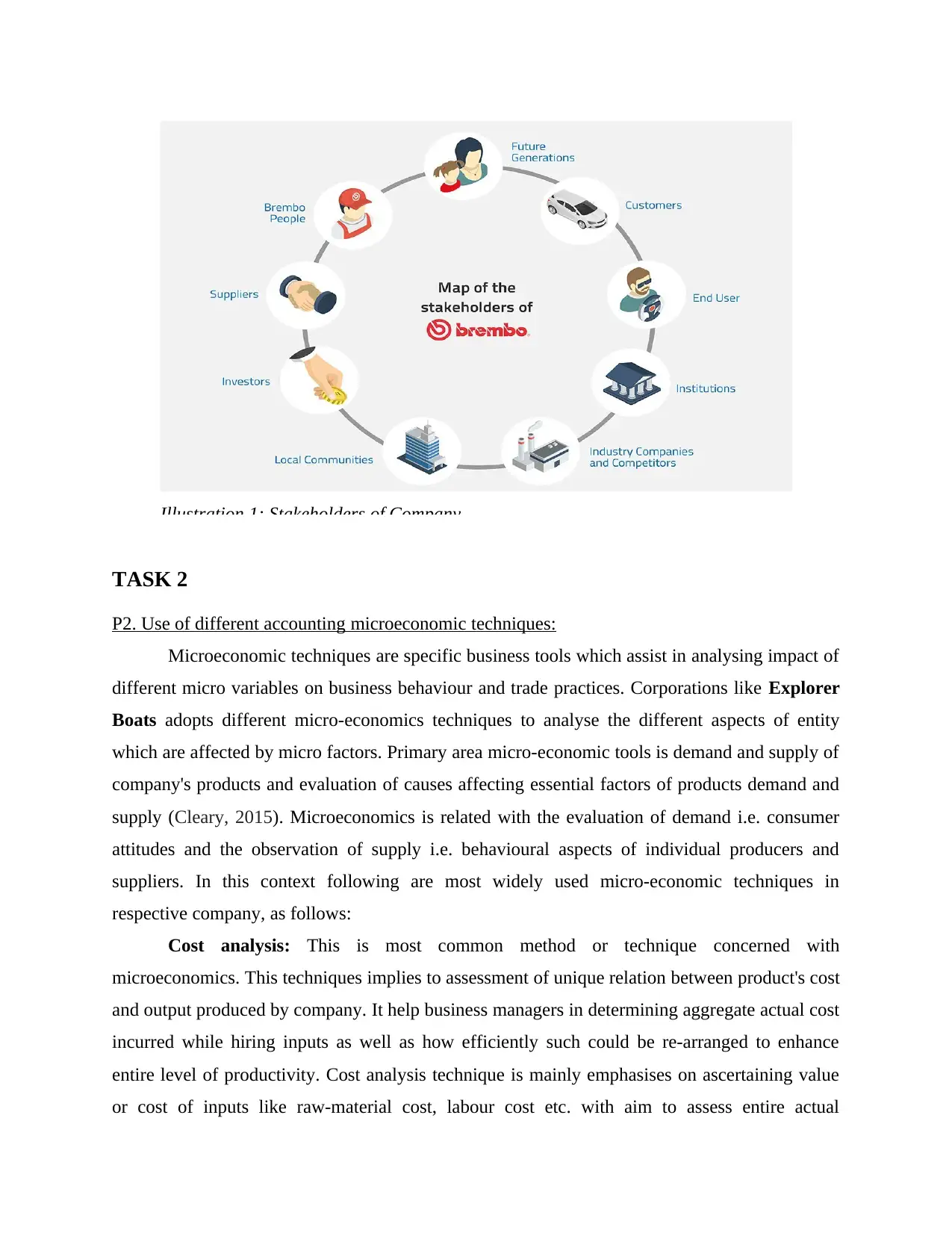
Illustration 1: Stakeholders of Company
P2. Use of different accounting microeconomic techniques:
Microeconomic techniques are specific business tools which assist in analysing impact of
different micro variables on business behaviour and trade practices. Corporations like Explorer
Boats adopts different micro-economics techniques to analyse the different aspects of entity
which are affected by micro factors. Primary area micro-economic tools is demand and supply of
company's products and evaluation of causes affecting essential factors of products demand and
supply (Cleary, 2015). Microeconomics is related with the evaluation of demand i.e. consumer
attitudes and the observation of supply i.e. behavioural aspects of individual producers and
suppliers. In this context following are most widely used micro-economic techniques in
respective company, as follows:
Cost analysis: This is most common method or technique concerned with
microeconomics. This techniques implies to assessment of unique relation between product's cost
and output produced by company. It help business managers in determining aggregate actual cost
incurred while hiring inputs as well as how efficiently such could be re-arranged to enhance
entire level of productivity. Cost analysis technique is mainly emphasises on ascertaining value
or cost of inputs like raw-material cost, labour cost etc. with aim to assess entire actual
Illustration 1: Stakeholders of Company
⊘ This is a preview!⊘
Do you want full access?
Subscribe today to unlock all pages.
Trusted by 1+ million students worldwide
production cost which ultimately assist in determining most optimal production level. In
Explorer Boats, managing personnels apply this technique to analyse the interconnection of
supply and demand in order to recognise existing and possible factors related to company's
product demand and supply (Nan, 2016).
Cost-volume profit analysis: Cost Volume Profit Analysis describes profit behaviour in
reaction to a product's cost and quantity or volume change. Simply, this is an assessment that
shows the effect on revenues of price and quantity. Commonly referred to as CVP Evaluation,
with this assessment, a management can determine the amount of revenues where business will
be in non-profit-free position. This position is termed level of break-even. Similarly, CVP
analysis may also demonstrate the number of sales-units needed to obtain a specific targeted
operating profit. Analysis (CVP) is being used to ascertain in what manner cost and quantity
shifts impact the operating profit as well as net earnings of a corporation. Analysis of the CVP
needs that all expenses of the corporation, including production, sales and administration
expenses, be recognized as varying or fixed. Explorer Boats also apply this technique to assess
the optimum production scale to avoid any potential adverse position. CVP analysis is quite
helpful for leadership as it offers an understanding into impacts and intra-relationship of
variables that affect the company's earnings. The connection between price, quantity and profit
constitutes an company's profit framework. Therefore, for financial planning as well as profit
management, CVP connection becomes crucial (Jermias, 2017).
Cost Variance: It is microeconomic techniques which mainly focuses on evaluation of
variations among budgeted and actual figures related to company's key business costs and
expenses. This simple and significant method under which management mainly analyse the
major variations which occurred in planed and actual performance of corporation in term of
costs. It assist in developing a framework for identification of factors which are responsible of
adverse variations in performance. In Explorer Boats, management conduct cost variance
analysis to enhance the overall productivity and identify adverse variables.
TASK 3
P3. Concept of variance analysis in its importance:
Variance Analysis can be described analysis of differentiation among previously planned
figures and actual figures. The total amount of all differences provides an general image of over-
Explorer Boats, managing personnels apply this technique to analyse the interconnection of
supply and demand in order to recognise existing and possible factors related to company's
product demand and supply (Nan, 2016).
Cost-volume profit analysis: Cost Volume Profit Analysis describes profit behaviour in
reaction to a product's cost and quantity or volume change. Simply, this is an assessment that
shows the effect on revenues of price and quantity. Commonly referred to as CVP Evaluation,
with this assessment, a management can determine the amount of revenues where business will
be in non-profit-free position. This position is termed level of break-even. Similarly, CVP
analysis may also demonstrate the number of sales-units needed to obtain a specific targeted
operating profit. Analysis (CVP) is being used to ascertain in what manner cost and quantity
shifts impact the operating profit as well as net earnings of a corporation. Analysis of the CVP
needs that all expenses of the corporation, including production, sales and administration
expenses, be recognized as varying or fixed. Explorer Boats also apply this technique to assess
the optimum production scale to avoid any potential adverse position. CVP analysis is quite
helpful for leadership as it offers an understanding into impacts and intra-relationship of
variables that affect the company's earnings. The connection between price, quantity and profit
constitutes an company's profit framework. Therefore, for financial planning as well as profit
management, CVP connection becomes crucial (Jermias, 2017).
Cost Variance: It is microeconomic techniques which mainly focuses on evaluation of
variations among budgeted and actual figures related to company's key business costs and
expenses. This simple and significant method under which management mainly analyse the
major variations which occurred in planed and actual performance of corporation in term of
costs. It assist in developing a framework for identification of factors which are responsible of
adverse variations in performance. In Explorer Boats, management conduct cost variance
analysis to enhance the overall productivity and identify adverse variables.
TASK 3
P3. Concept of variance analysis in its importance:
Variance Analysis can be described analysis of differentiation among previously planned
figures and actual figures. The total amount of all differences provides an general image of over-
Paraphrase This Document
Need a fresh take? Get an instant paraphrase of this document with our AI Paraphraser
performance or under-performance in respect of specific period. In variance analysis different
factors like costs, income etc. are analysed by assessing the difference in figures actually attained
and figures budgeted. The main function of variance analysis is to bring down costs and improve
efficiency. The variances are efficiency-related. Efficiency demonstration leads to favourable
variance. In variance analysis difference measured are called as variances which can be adverse
by nature and significance or favourable (Christensen, Skærbæk and Tryggestad, 2016). An
adverse variance found in any area points out towards need of improvement while favourable
variations are considered as benchmarks for further analysis. Most corporations generate budgets
to monitor business objectives and enhance manufacturing and productivity improvements.
Budgets assist management to set benchmarks for potential enhancement measurement. Most
budgets begin with projected numbers of costs and sales. Management can assertively set all
such projections for the corporation's objectives. Other factors such as direct cost return
variation, fixed-cost efficiency variation, variable-cost efficiency variation, fixed cost capability
variation and many more may also be used by management.
Importance of variance analysis:
Variance analysis helps to effectively budget as managing personnels wants to have
reduced variances from scheduled budgets. Wishing a reduced deviation generally causes
executives to create budget choices that are comprehensive and forward-looking. It functions as a
structure for control. Evaluation of large variance on important products enables the business to
address reasons and enables management explore possible methods to prevent such variance.
Analysis of variance facilitates assignment of responsibilities and involves control mechanisms
in departments where necessary. For instance, if labour efficiency variation is considered
unfavourable or raw material price variance procurement is unfavourable, these divisions may be
controlled by management to boost effectiveness. It utilizes trends of previous company
information to build future performance principle. Variance information are contextualized
allowing managers to define variables such as holiday periods or seasonal effects as the
underlying cause of positively or negatively fluctuations. Relationships between pairs of
variables might also be identified when performing variance analysis. Positive and negative
correlations are important in business planning (Shil and Das, 2018). Variance analysis offers
hints about what occurring in the business's operating financial and competitive situations. The
start of any financial slowdown can reveal by adverse variances in business's monitoring
factors like costs, income etc. are analysed by assessing the difference in figures actually attained
and figures budgeted. The main function of variance analysis is to bring down costs and improve
efficiency. The variances are efficiency-related. Efficiency demonstration leads to favourable
variance. In variance analysis difference measured are called as variances which can be adverse
by nature and significance or favourable (Christensen, Skærbæk and Tryggestad, 2016). An
adverse variance found in any area points out towards need of improvement while favourable
variations are considered as benchmarks for further analysis. Most corporations generate budgets
to monitor business objectives and enhance manufacturing and productivity improvements.
Budgets assist management to set benchmarks for potential enhancement measurement. Most
budgets begin with projected numbers of costs and sales. Management can assertively set all
such projections for the corporation's objectives. Other factors such as direct cost return
variation, fixed-cost efficiency variation, variable-cost efficiency variation, fixed cost capability
variation and many more may also be used by management.
Importance of variance analysis:
Variance analysis helps to effectively budget as managing personnels wants to have
reduced variances from scheduled budgets. Wishing a reduced deviation generally causes
executives to create budget choices that are comprehensive and forward-looking. It functions as a
structure for control. Evaluation of large variance on important products enables the business to
address reasons and enables management explore possible methods to prevent such variance.
Analysis of variance facilitates assignment of responsibilities and involves control mechanisms
in departments where necessary. For instance, if labour efficiency variation is considered
unfavourable or raw material price variance procurement is unfavourable, these divisions may be
controlled by management to boost effectiveness. It utilizes trends of previous company
information to build future performance principle. Variance information are contextualized
allowing managers to define variables such as holiday periods or seasonal effects as the
underlying cause of positively or negatively fluctuations. Relationships between pairs of
variables might also be identified when performing variance analysis. Positive and negative
correlations are important in business planning (Shil and Das, 2018). Variance analysis offers
hints about what occurring in the business's operating financial and competitive situations. The
start of any financial slowdown can reveal by adverse variances in business's monitoring
quantitative classifications. In Explorer Boats, managing personnels are applying variance
analysis to find out what are key factors which may affect corporation's sales and production of
boats also help to identify factors which can boost company's sales. Also comparisons are
conducted by managers between current year’s variations and actual results with previous
periods results and variances.
P4. Actual and standard costs to control and correct variances:
Standard and actual costs are two major aspects of variance analysis which are required
to conduct variance analysis. Standard costs are expenses figures determined by management
based on their experience and past results. These costs act as benchmarks to assess company's
efficiencies and productivity level. In determination of standard costs managing personnels apply
their skills to determine appropriate rates in respect of income and expenses. Here most
considerable thing is that scope of standard costs should be within attainable criteria. In
Explorer Boats, standard costs are set by top managers as per company's existing capabilities
and resources. In company, standards for labour costs, material costs, administration costs, sales
promotion expenses are determined which is further used in farming budgets and analysis of
variances. While actual costs are actually incurred figures of expenses. Actual cost simply refers
to actual expenses related to business which are incurred in ordinary activities and functions. In
Explorer Boats managers list out all expenses along with amount actually incurred during
specific time-period thereafter these costs are compared with standard costs to assess variations
(Nuhu, Baird and Appuhami, 2016). These variations defines company's operating effectively in
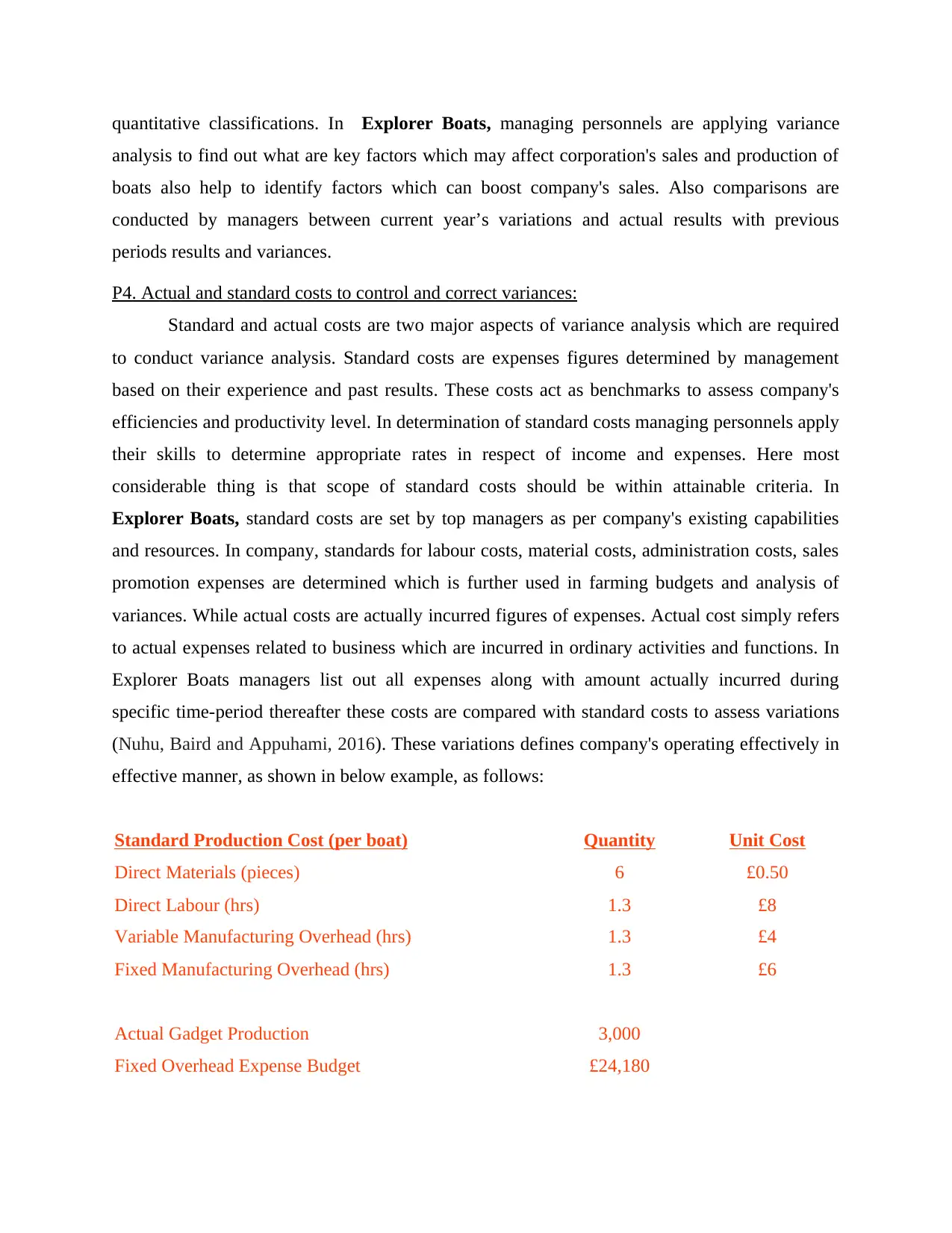
effective manner, as shown in below example, as follows:
Standard Production Cost (per boat) Quantity Unit Cost
Direct Materials (pieces) 6 £0.50
Direct Labour (hrs) 1.3 £8
Variable Manufacturing Overhead (hrs) 1.3 £4
Fixed Manufacturing Overhead (hrs) 1.3 £6
Actual Gadget Production 3,000
Fixed Overhead Expense Budget £24,180
analysis to find out what are key factors which may affect corporation's sales and production of
boats also help to identify factors which can boost company's sales. Also comparisons are
conducted by managers between current year’s variations and actual results with previous
periods results and variances.
P4. Actual and standard costs to control and correct variances:
Standard and actual costs are two major aspects of variance analysis which are required
to conduct variance analysis. Standard costs are expenses figures determined by management
based on their experience and past results. These costs act as benchmarks to assess company's
efficiencies and productivity level. In determination of standard costs managing personnels apply
their skills to determine appropriate rates in respect of income and expenses. Here most
considerable thing is that scope of standard costs should be within attainable criteria. In
Explorer Boats, standard costs are set by top managers as per company's existing capabilities
and resources. In company, standards for labour costs, material costs, administration costs, sales
promotion expenses are determined which is further used in farming budgets and analysis of
variances. While actual costs are actually incurred figures of expenses. Actual cost simply refers
to actual expenses related to business which are incurred in ordinary activities and functions. In
Explorer Boats managers list out all expenses along with amount actually incurred during
specific time-period thereafter these costs are compared with standard costs to assess variations
(Nuhu, Baird and Appuhami, 2016). These variations defines company's operating effectively in
effective manner, as shown in below example, as follows:
Standard Production Cost (per boat) Quantity Unit Cost
Direct Materials (pieces) 6 £0.50
Direct Labour (hrs) 1.3 £8
Variable Manufacturing Overhead (hrs) 1.3 £4
Fixed Manufacturing Overhead (hrs) 1.3 £6
Actual Gadget Production 3,000
Fixed Overhead Expense Budget £24,180
⊘ This is a preview!⊘
Do you want full access?
Subscribe today to unlock all pages.
Trusted by 1+ million students worldwide
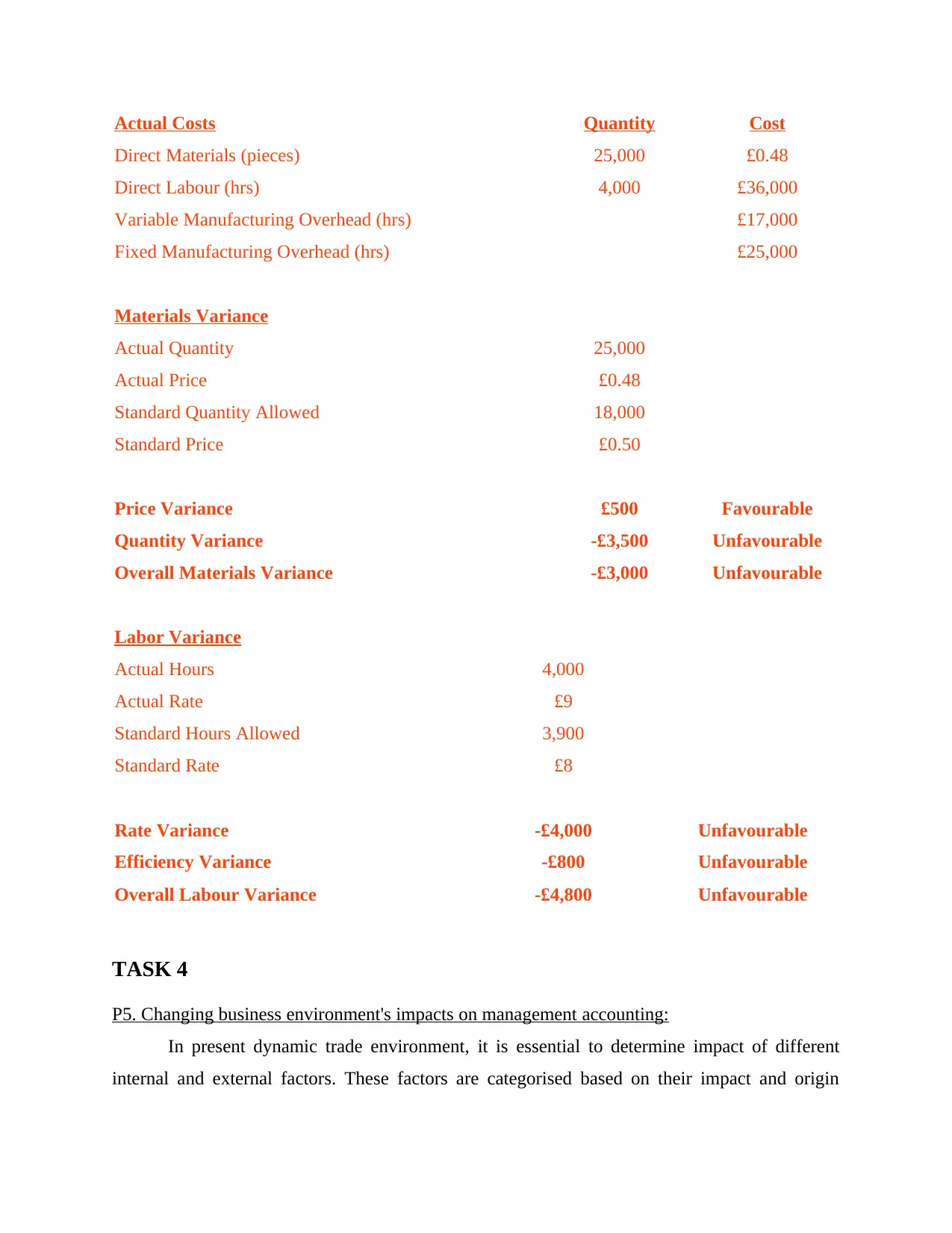
Actual Costs Quantity Cost
Direct Materials (pieces) 25,000 £0.48
Direct Labour (hrs) 4,000 £36,000
Variable Manufacturing Overhead (hrs) £17,000
Fixed Manufacturing Overhead (hrs) £25,000
Materials Variance
Actual Quantity 25,000
Actual Price £0.48
Standard Quantity Allowed 18,000
Standard Price £0.50
Price Variance £500 Favourable
Quantity Variance -£3,500 Unfavourable
Overall Materials Variance -£3,000 Unfavourable
Labor Variance
Actual Hours 4,000
Actual Rate £9
Standard Hours Allowed 3,900
Standard Rate £8
Rate Variance -£4,000 Unfavourable
Efficiency Variance -£800 Unfavourable
Overall Labour Variance -£4,800 Unfavourable
TASK 4
P5. Changing business environment's impacts on management accounting:
In present dynamic trade environment, it is essential to determine impact of different
internal and external factors. These factors are categorised based on their impact and origin
Direct Materials (pieces) 25,000 £0.48
Direct Labour (hrs) 4,000 £36,000
Variable Manufacturing Overhead (hrs) £17,000
Fixed Manufacturing Overhead (hrs) £25,000
Materials Variance
Actual Quantity 25,000
Actual Price £0.48
Standard Quantity Allowed 18,000
Standard Price £0.50
Price Variance £500 Favourable
Quantity Variance -£3,500 Unfavourable
Overall Materials Variance -£3,000 Unfavourable
Labor Variance
Actual Hours 4,000
Actual Rate £9
Standard Hours Allowed 3,900
Standard Rate £8
Rate Variance -£4,000 Unfavourable
Efficiency Variance -£800 Unfavourable
Overall Labour Variance -£4,800 Unfavourable
TASK 4
P5. Changing business environment's impacts on management accounting:
In present dynamic trade environment, it is essential to determine impact of different
internal and external factors. These factors are categorised based on their impact and origin
Paraphrase This Document
Need a fresh take? Get an instant paraphrase of this document with our AI Paraphraser
source. Currently, every firm is bound to create adjustments according to shift in business's
environment which assist them in achieving the highest advantage and survive within
competitive market situations. Following are major external and internal factors which affects
organisation's structure of management accounting, as follows:
External factors: These are factors which resides outside entity but considerably affect the
system of management accounting in context of Explorer Boats, as follows:
Economic Adversities: It is most important factor which determines company's
performance. Major economic adversities includes increasing inflation rate, adverse financial and
economic policies, decreasing in purchasing power of buyers. These adversities have direct
impact on corporation's management accounting established structure because it is difficult for
managers to identify these factors.
Competitiveness: With increase in customers demands, competitiveness in every sector
is increasing which act as external factor. It not only affects company's revenue and profits but
also affects managerial accounting structure. As with increasing competitiveness company's
strategy and stature related to different techniques of management accounting also affects
(Ismail, Isa and Mia, 2018).
Internal factors: These are closely linked with company's internal operations and management
structure. Following are some key internal variables are as follows:
Organisational Policies: Company's internal policies are acts as significant internal
factors which directly affects adopted techniques of management accounting and its structure. A
wrong or inappropriate policy can impact organisational functions which are dedicated towards
company's management accounting's structure.
Formulated action plans: It is also an internal factor which can affect management
accounting's structure. Company's actions plans defines company's performance in near future
and implementation of different techniques of management accounting.
CONCLUSION
From above study it has been articulated that management should properly develop and
present the financial information and reports as these assist in managerial decision-making
processes. Techniques concerned with field of management accounting also essential for
environment which assist them in achieving the highest advantage and survive within
competitive market situations. Following are major external and internal factors which affects
organisation's structure of management accounting, as follows:
External factors: These are factors which resides outside entity but considerably affect the
system of management accounting in context of Explorer Boats, as follows:
Economic Adversities: It is most important factor which determines company's
performance. Major economic adversities includes increasing inflation rate, adverse financial and
economic policies, decreasing in purchasing power of buyers. These adversities have direct
impact on corporation's management accounting established structure because it is difficult for
managers to identify these factors.
Competitiveness: With increase in customers demands, competitiveness in every sector
is increasing which act as external factor. It not only affects company's revenue and profits but
also affects managerial accounting structure. As with increasing competitiveness company's
strategy and stature related to different techniques of management accounting also affects
(Ismail, Isa and Mia, 2018).
Internal factors: These are closely linked with company's internal operations and management
structure. Following are some key internal variables are as follows:
Organisational Policies: Company's internal policies are acts as significant internal
factors which directly affects adopted techniques of management accounting and its structure. A
wrong or inappropriate policy can impact organisational functions which are dedicated towards
company's management accounting's structure.
Formulated action plans: It is also an internal factor which can affect management
accounting's structure. Company's actions plans defines company's performance in near future
and implementation of different techniques of management accounting.
CONCLUSION
From above study it has been articulated that management should properly develop and
present the financial information and reports as these assist in managerial decision-making
processes. Techniques concerned with field of management accounting also essential for

improvement in current operational performance of company. Business's external and internal
environment leads to some core factors which directly or indirectly affects organisation's
predefined objectives. Analysis of variations in company's performance variables like production
costs, administration costs etc. is most crucial as outcomes of analysis determines corporation's
future path in industry.
environment leads to some core factors which directly or indirectly affects organisation's
predefined objectives. Analysis of variations in company's performance variables like production
costs, administration costs etc. is most crucial as outcomes of analysis determines corporation's
future path in industry.
⊘ This is a preview!⊘
Do you want full access?
Subscribe today to unlock all pages.
Trusted by 1+ million students worldwide

1 out of 12


Related Documents


Your All-in-One AI-Powered Toolkit for Academic Success.
+13062052269
info@desklib.com
Available 24*7 on WhatsApp / Email
![[object Object]](/_next/static/media/star-bottom.7253800d.svg)
Unlock your academic potential
Copyright © 2020–2026 A2Z Services. All Rights Reserved. Developed and managed by ZUCOL.