Advanced Management Accounting Report: CMI Safe Co Case Analysis
VerifiedAdded on 2023/06/07
|16
|2646
|397
Report
AI Summary
This management accounting report provides an in-depth analysis of CMI Safe Co's costing system, contrasting traditional costing methods with activity-based costing (ABC). The report examines the impact of cost allocation on product pricing, sales, and profitability, highlighting how incorrect costing can lead to suboptimal business decisions. Through a case study approach, the report demonstrates the application of management accounting techniques to solve business problems, evaluate financial information, and improve decision-making. The analysis includes calculations and comparisons of cost allocations under both costing methods, revealing the discrepancies in product costs and net margins. Ultimately, the report emphasizes the importance of selecting an appropriate costing system that aligns with the complexity of the production process to ensure accurate financial reporting and strategic decision-making. The report concludes with recommendations for CMI Safe Co to optimize its costing system and improve its overall financial performance.
Management Accounting
1
1

Paraphrase This Document
Need a fresh take? Get an instant paraphrase of this document with our AI Paraphraser
Executive Summary
The following assignment lays down the advanced understanding of management accounting
in the contemporary business environment. We have applied the management accounting
techniques to solve and analyse the business problems. The case study discussed in the
following discussion will help us adapt knowledge to new situations to develop approaches to
problem solving.
2
The following assignment lays down the advanced understanding of management accounting
in the contemporary business environment. We have applied the management accounting
techniques to solve and analyse the business problems. The case study discussed in the
following discussion will help us adapt knowledge to new situations to develop approaches to
problem solving.
2
Contents
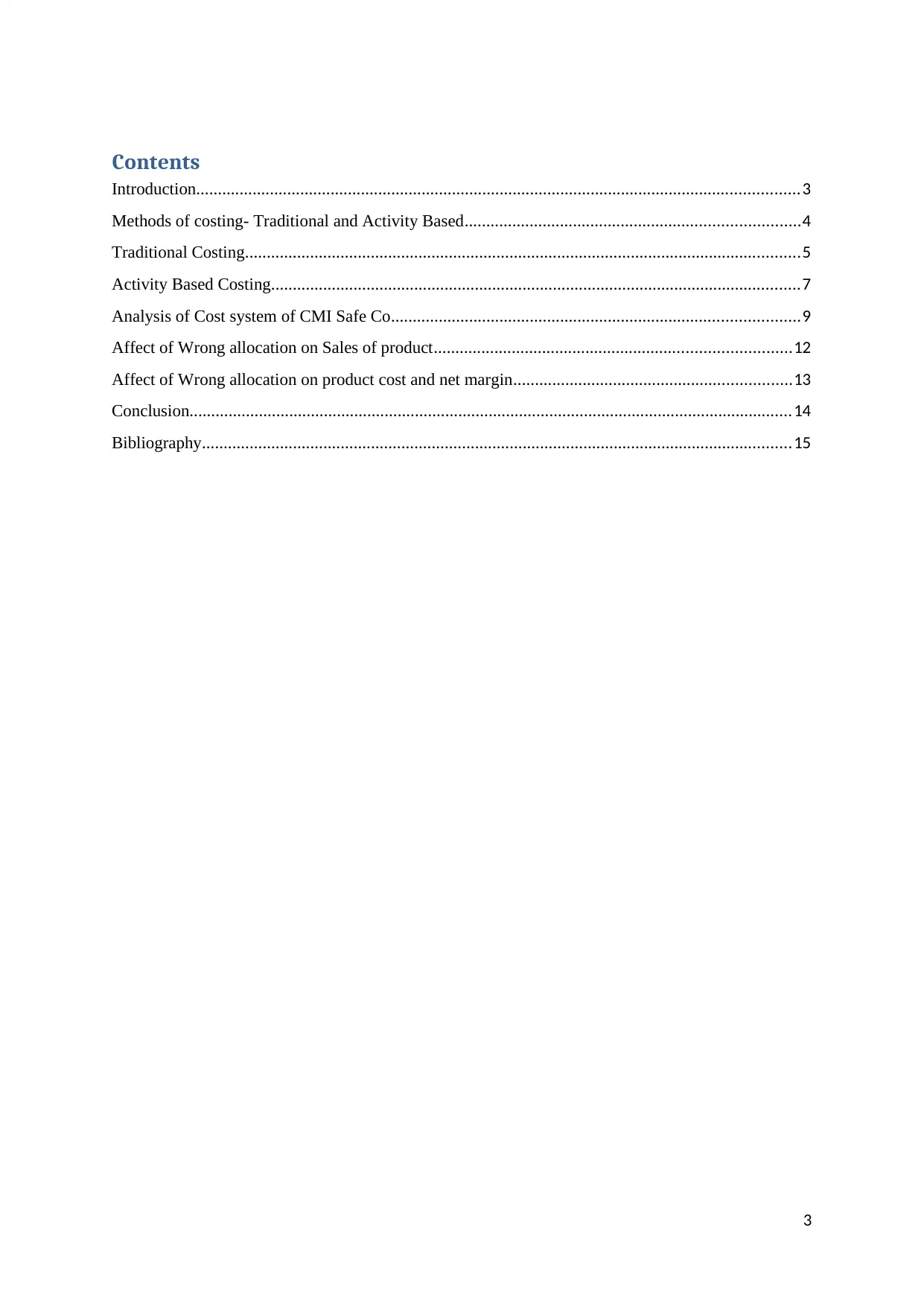
Introduction...........................................................................................................................................3
Methods of costing- Traditional and Activity Based.............................................................................4
Traditional Costing................................................................................................................................5
Activity Based Costing..........................................................................................................................7
Analysis of Cost system of CMI Safe Co..............................................................................................9
Affect of Wrong allocation on Sales of product..................................................................................12
Affect of Wrong allocation on product cost and net margin................................................................13
Conclusion...........................................................................................................................................14
Bibliography........................................................................................................................................15
3
Introduction...........................................................................................................................................3
Methods of costing- Traditional and Activity Based.............................................................................4
Traditional Costing................................................................................................................................5
Activity Based Costing..........................................................................................................................7
Analysis of Cost system of CMI Safe Co..............................................................................................9
Affect of Wrong allocation on Sales of product..................................................................................12
Affect of Wrong allocation on product cost and net margin................................................................13
Conclusion...........................................................................................................................................14
Bibliography........................................................................................................................................15
3
⊘ This is a preview!⊘
Do you want full access?
Subscribe today to unlock all pages.

Trusted by 1+ million students worldwide
Introduction
The success of a production facility is very much dependent on the costing system it follows.
There are two major methods of cost allocation- traditional costing and activity based costing.
Depending on the complexity of the production process, the appropriate costing method is
applied. We have been provided with a situation of a safe manufacturing company, CMI Safe
Co, which follows the traditional method of costing. Recently the management has realised
that it is not satisfied with the results even though the business has increased in volume and
productivity.
In our discussion below, we have disused about the methods of costing and steps required by
the management of company to be taken in order to ensure optimum results.
4
The success of a production facility is very much dependent on the costing system it follows.
There are two major methods of cost allocation- traditional costing and activity based costing.
Depending on the complexity of the production process, the appropriate costing method is
applied. We have been provided with a situation of a safe manufacturing company, CMI Safe
Co, which follows the traditional method of costing. Recently the management has realised
that it is not satisfied with the results even though the business has increased in volume and
productivity.
In our discussion below, we have disused about the methods of costing and steps required by
the management of company to be taken in order to ensure optimum results.
4
Paraphrase This Document
Need a fresh take? Get an instant paraphrase of this document with our AI Paraphraser
Methods of costing- Traditional and Activity Based
In order to calculate the cost of a product, the management collects data on all the expenses.
The expenses which can be directly attributable to products are, directly added to the cost of
the products. There are other costs and services which are jointly incurred for various
products. These costs are required to be allocated to all the products based on some attribute.
Selection of this attribute is very important as it helps in determining the actual cost of
product. Cost data is used by the management in order to make pricing decision. The demand
and sale of the products are dependent on the price and cost. Therefore, we see that cost
allocation can have direct impact on the sale of product.
For example, there are two products Product A and B, the direct cost for Product A is $5 per
unit and that for product B is $ 8 per unit. The joint cost which are incurred for these products
are $5000. Now these costs are required to be allocated amongst the product A and B so that
total cost per product can be determined.
As mentioned earlier, these are the two widely implemented method of cost allocation. Both
of these methods have their respective pros and cons. We have discussed about these methods
in detail so that solution for CMI Safe Co can be arrived at.
5
In order to calculate the cost of a product, the management collects data on all the expenses.
The expenses which can be directly attributable to products are, directly added to the cost of
the products. There are other costs and services which are jointly incurred for various
products. These costs are required to be allocated to all the products based on some attribute.
Selection of this attribute is very important as it helps in determining the actual cost of
product. Cost data is used by the management in order to make pricing decision. The demand
and sale of the products are dependent on the price and cost. Therefore, we see that cost
allocation can have direct impact on the sale of product.
For example, there are two products Product A and B, the direct cost for Product A is $5 per
unit and that for product B is $ 8 per unit. The joint cost which are incurred for these products
are $5000. Now these costs are required to be allocated amongst the product A and B so that
total cost per product can be determined.
As mentioned earlier, these are the two widely implemented method of cost allocation. Both
of these methods have their respective pros and cons. We have discussed about these methods
in detail so that solution for CMI Safe Co can be arrived at.
5
Traditional Costing
Traditional costing is the old method of cost allocation, under which the joint cost incurred
are allocated amongst the product using one single factor. This factor may be machine hours,
labour hours, number of units etc. The point is, only one attribute for cost allocation is used
irrespective of consumption of service (Berry, 2009).
For example, in above if the joint cost of $5000 includes expense of $500 which are incurred
mostly for product A, then irrespective of usage, the cost will be allocated based on machine
hours.
Traditional method of costing is best suitable for production processes which are simple and
do not comprise of various functions. This method has both its pros and cons which have
been discussed below.
The traditional costing method of cost allocation is a very simplified. It does not involve huge
data collection. Since this system uses only one attribute for cost allocation the management
does not require details of various function and there consumption. This system is very easy
to understand and implement. The management need not appoint special personnel’s in order
to implement this system of cost allocation. Since this method can be easily implemented it
saves a lot of time. Since this method allocates all other costs to the product irrespective of
their nature, we can say that it recognizes the importance of fixed cost in the method of
production. This method in generally used while the financial statements are prepares,
therefore, not much reconciliation between the costs and accounting records is required when
absorption costing method is implemented.
Therefore we see that the traditional costing method is quiet advantageous. But apart from
benefits this method has its cons. Few of the cons of this method of cost allocation has been
listed below:
The traditional costing method is not suitable where there are many production functions
involved. Since the products use same functions it is important that charge of these expenses
should be allocated based on actual usage of these functions. If this method is implemented in
a production facility involving many functions, then it results in improper cost allocation,
which leads to wrong product pricing. This may then harm the demand of the product. Since
the overheads are allocated based on pre determined rate, it always results I over or under
6
Traditional costing is the old method of cost allocation, under which the joint cost incurred
are allocated amongst the product using one single factor. This factor may be machine hours,
labour hours, number of units etc. The point is, only one attribute for cost allocation is used
irrespective of consumption of service (Berry, 2009).
For example, in above if the joint cost of $5000 includes expense of $500 which are incurred
mostly for product A, then irrespective of usage, the cost will be allocated based on machine
hours.
Traditional method of costing is best suitable for production processes which are simple and
do not comprise of various functions. This method has both its pros and cons which have
been discussed below.
The traditional costing method of cost allocation is a very simplified. It does not involve huge
data collection. Since this system uses only one attribute for cost allocation the management
does not require details of various function and there consumption. This system is very easy
to understand and implement. The management need not appoint special personnel’s in order
to implement this system of cost allocation. Since this method can be easily implemented it
saves a lot of time. Since this method allocates all other costs to the product irrespective of
their nature, we can say that it recognizes the importance of fixed cost in the method of
production. This method in generally used while the financial statements are prepares,
therefore, not much reconciliation between the costs and accounting records is required when
absorption costing method is implemented.
Therefore we see that the traditional costing method is quiet advantageous. But apart from
benefits this method has its cons. Few of the cons of this method of cost allocation has been
listed below:
The traditional costing method is not suitable where there are many production functions
involved. Since the products use same functions it is important that charge of these expenses
should be allocated based on actual usage of these functions. If this method is implemented in
a production facility involving many functions, then it results in improper cost allocation,
which leads to wrong product pricing. This may then harm the demand of the product. Since
the overheads are allocated based on pre determined rate, it always results I over or under
6
⊘ This is a preview!⊘
Do you want full access?
Subscribe today to unlock all pages.
Trusted by 1+ million students worldwide
recovery of overheads. This requires adjustment in the books, which is a lot of work. This
system fails to realise the importance of cost volume profit relationship as all the costs are
allocated to the product irrespective of their nature. Allocation of cost based on one attribute
results in wrong costing. This is the major con of this system.
Therefore, we see that the tradition system of cost allocation is easy to use, but it may affect
the profitability of the business. Not using correct cost data will result in wrong product
pricing which will end in absurd financial results. It is important that the costing system
implemented is according to the production requirements.
7
system fails to realise the importance of cost volume profit relationship as all the costs are
allocated to the product irrespective of their nature. Allocation of cost based on one attribute
results in wrong costing. This is the major con of this system.
Therefore, we see that the tradition system of cost allocation is easy to use, but it may affect
the profitability of the business. Not using correct cost data will result in wrong product
pricing which will end in absurd financial results. It is important that the costing system
implemented is according to the production requirements.
7
Paraphrase This Document
Need a fresh take? Get an instant paraphrase of this document with our AI Paraphraser
Activity Based Costing
Activity based costing is the modern costing system that tries to cover the disadvantages of
the activity based costing. Activity based costing as the name suggest, is the cost allocation
system that allocates the cost amongst the product based on actual consumption of the
activity. Under this system units consumed for each activity is individually calculated which
is then used as an attribute to allocate cost amongst the products (Atkinson, 2012).
For example, the two products A and B are required to be inspected for quality check at the
end of production. Product A requires more inspection than B. Number of total inspections
done are 20, out of which inspection solely contributed to product A is 15. If total cost for
inspection is $2000, then cost of $1500 will be charged to product A and $500 will be
charged to product B.
Just like the traditional costing system, activity based costing also has few advantages and
disadvantages.
Activity based costing takes into consideration the concept of actual usage or consumption of
activity. This system ensures that only that part of cost is allocated to the product which is
actually used by it. Activity based costing also helps the management to cut irrelevant cost.
Since the cost are all collected based on activities, the management can understand the nature
of cost, and this way they can eliminate the cost which are irrelevant or not required to be
incurred. Collection of huge cost data, cost drivers and various activities provide the
management with the insight in to total working of the organisation. This way any issues can
be noticed and resolved. Activity based costing helps in better decision making. Since this
allocation method allocates actual cost to the product, the management can use this data for
pricing policy. They can rely on the result of this system for decision making.
Activity based costing is the modern costing technique which ensures that only costs which
are actually incurred are allocated to the products. But this method also has a few
disadvantages.
ABC method requires collection of huge amount of data, like amount expense for each
activity, units consumed for each activity by each product, etc. this is a time consuming and
expensive process. This method can’t be easily implemented like any other costing method. It
requires professional knowledge and skill to be implemented. The management requires
8
Activity based costing is the modern costing system that tries to cover the disadvantages of
the activity based costing. Activity based costing as the name suggest, is the cost allocation
system that allocates the cost amongst the product based on actual consumption of the
activity. Under this system units consumed for each activity is individually calculated which
is then used as an attribute to allocate cost amongst the products (Atkinson, 2012).
For example, the two products A and B are required to be inspected for quality check at the
end of production. Product A requires more inspection than B. Number of total inspections
done are 20, out of which inspection solely contributed to product A is 15. If total cost for
inspection is $2000, then cost of $1500 will be charged to product A and $500 will be
charged to product B.
Just like the traditional costing system, activity based costing also has few advantages and
disadvantages.
Activity based costing takes into consideration the concept of actual usage or consumption of
activity. This system ensures that only that part of cost is allocated to the product which is
actually used by it. Activity based costing also helps the management to cut irrelevant cost.
Since the cost are all collected based on activities, the management can understand the nature
of cost, and this way they can eliminate the cost which are irrelevant or not required to be
incurred. Collection of huge cost data, cost drivers and various activities provide the
management with the insight in to total working of the organisation. This way any issues can
be noticed and resolved. Activity based costing helps in better decision making. Since this
allocation method allocates actual cost to the product, the management can use this data for
pricing policy. They can rely on the result of this system for decision making.
Activity based costing is the modern costing technique which ensures that only costs which
are actually incurred are allocated to the products. But this method also has a few
disadvantages.
ABC method requires collection of huge amount of data, like amount expense for each
activity, units consumed for each activity by each product, etc. this is a time consuming and
expensive process. This method can’t be easily implemented like any other costing method. It
requires professional knowledge and skill to be implemented. The management requires
8
appointing special skilled persons in order to implement ABC. This methods if implemented
then the cost data and accounting data required huge reconciliation. The implementation of
ABC is a complex process; it requires huge investment of human and financial resources
which makes it tiresome.
From the above we can see that though the process of ABC results in accurate and reliable
information, implementation of the process is very tiring and exhaustive. Continuous study of
the data and any changes are required to be incorporated in order to ensure appropriate
results. But this system helps the production enterprises with various functions to calculate
proper product cost.
9
then the cost data and accounting data required huge reconciliation. The implementation of
ABC is a complex process; it requires huge investment of human and financial resources
which makes it tiresome.
From the above we can see that though the process of ABC results in accurate and reliable
information, implementation of the process is very tiring and exhaustive. Continuous study of
the data and any changes are required to be incorporated in order to ensure appropriate
results. But this system helps the production enterprises with various functions to calculate
proper product cost.
9
⊘ This is a preview!⊘
Do you want full access?
Subscribe today to unlock all pages.
Trusted by 1+ million students worldwide
Analysis of Cost system of CMI Safe Co
The company was when established it has simple production processes, with time the
company increased its products type and so the production process became more complex.
The management of the company has been using the tradition based costing system since the
beginning.
The management has noticed a sharp decline in the sale of units of metal safes, despite the
demand in market. Also, there has been increase in the sale of plastic safes in spite of not
much demand in the market. The management is also unhappy about the decline in profit
margin of metal safes below 20 percent.
We have conducted a thorough study of the cost records of the enterprise and have found that
the implementation of improper costing methods has lead to incorrect pricing decisions,
which has affected the demand of both the products of the company.
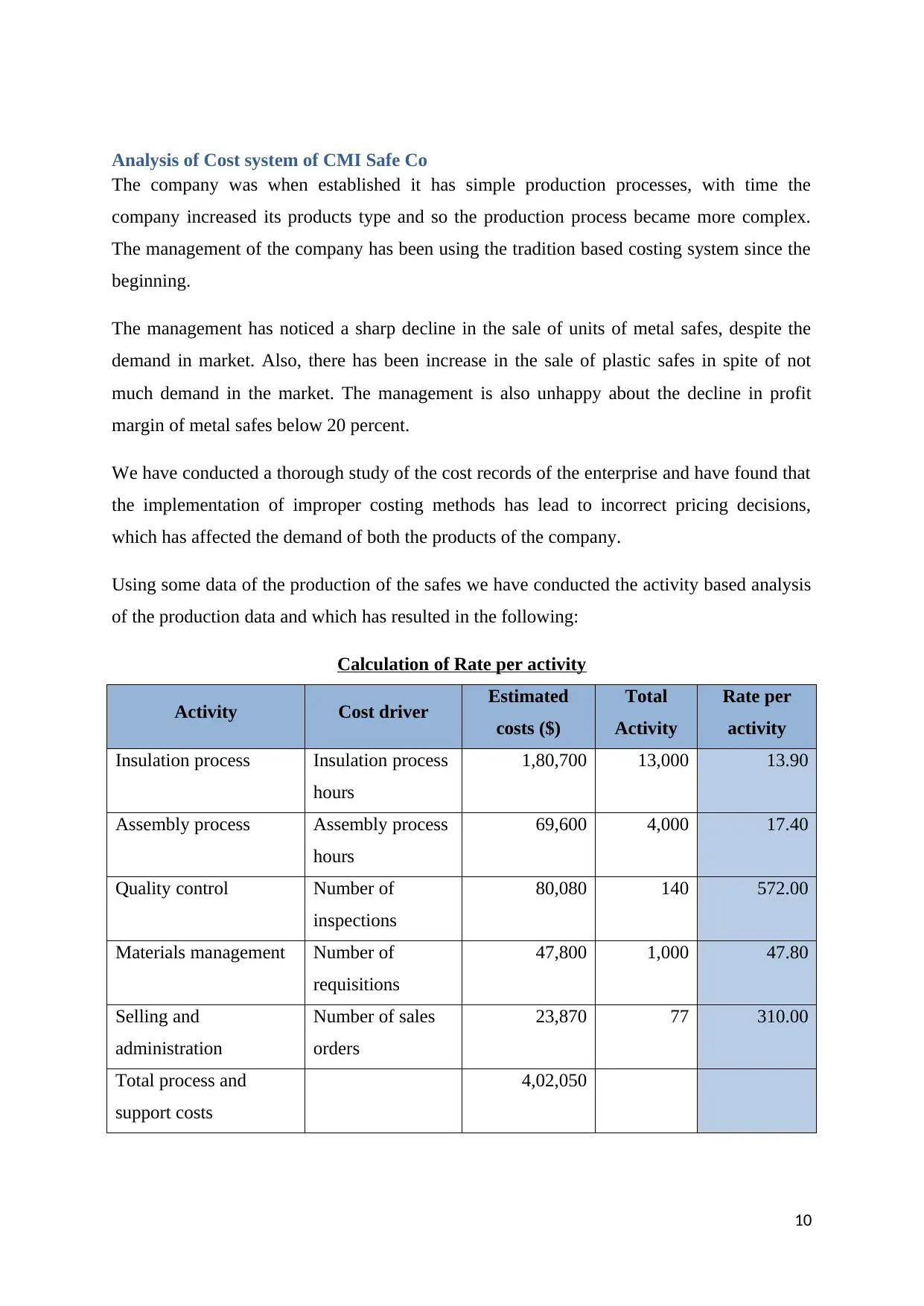
Using some data of the production of the safes we have conducted the activity based analysis
of the production data and which has resulted in the following:
Calculation of Rate per activity
Activity Cost driver Estimated
costs ($)
Total
Activity
Rate per
activity
Insulation process Insulation process
hours
1,80,700 13,000 13.90
Assembly process Assembly process
hours
69,600 4,000 17.40
Quality control Number of
inspections
80,080 140 572.00
Materials management Number of
requisitions
47,800 1,000 47.80
Selling and
administration
Number of sales
orders
23,870 77 310.00
Total process and
support costs
4,02,050
10
The company was when established it has simple production processes, with time the
company increased its products type and so the production process became more complex.
The management of the company has been using the tradition based costing system since the
beginning.
The management has noticed a sharp decline in the sale of units of metal safes, despite the
demand in market. Also, there has been increase in the sale of plastic safes in spite of not
much demand in the market. The management is also unhappy about the decline in profit
margin of metal safes below 20 percent.
We have conducted a thorough study of the cost records of the enterprise and have found that
the implementation of improper costing methods has lead to incorrect pricing decisions,
which has affected the demand of both the products of the company.
Using some data of the production of the safes we have conducted the activity based analysis
of the production data and which has resulted in the following:
Calculation of Rate per activity
Activity Cost driver Estimated
costs ($)
Total
Activity
Rate per
activity
Insulation process Insulation process
hours
1,80,700 13,000 13.90
Assembly process Assembly process
hours
69,600 4,000 17.40
Quality control Number of
inspections
80,080 140 572.00
Materials management Number of
requisitions
47,800 1,000 47.80
Selling and
administration
Number of sales
orders
23,870 77 310.00
Total process and
support costs
4,02,050
10
Paraphrase This Document
Need a fresh take? Get an instant paraphrase of this document with our AI Paraphraser
Calculation of cost of activity
Activity Rate per
activity
Metal
safes-
Activity
Cost for
Activity
Plastic Safes -
Activity
Cost for
Activity
Insulation
process hours
13.90 7,000 97,300 6,000 83,400
Assembly hours 17.40 2,800 48,720 1,200 20,880
Number of
inspections
572.00 40 22,880 100 57,200
Number of
requisitions
47.80 300 14,340 700 33,460
Number of sales
orders
310.00 30 9,300 47 14,570
Income statement under activity based costing
Particulars Metal safes Plastic safes Total
$ $ $ $ $ $
Sales revenues 2,96,90
0
2,46,800 5,43,700
Direct materials 21,500 20,680 42,180
Other activity Costs -
Insulation process 97,300 83,400 1,80,700
Assembly process 48,720 20,880 69,600
Quality control 22,880 57,200 80,080
Materials management 14,340 33,460 47,800
Selling and administration 9,300 14,570 23,870
Total costs
2,14,040 2,30,190 4,44,230
Net income 82,860 16,610 99,470
Profit margin 27.91 6.73 18.30
11
Activity Rate per
activity
Metal
safes-
Activity
Cost for
Activity
Plastic Safes -
Activity
Cost for
Activity
Insulation
process hours
13.90 7,000 97,300 6,000 83,400
Assembly hours 17.40 2,800 48,720 1,200 20,880
Number of
inspections
572.00 40 22,880 100 57,200
Number of
requisitions
47.80 300 14,340 700 33,460
Number of sales
orders
310.00 30 9,300 47 14,570
Income statement under activity based costing
Particulars Metal safes Plastic safes Total
$ $ $ $ $ $
Sales revenues 2,96,90
0
2,46,800 5,43,700
Direct materials 21,500 20,680 42,180
Other activity Costs -
Insulation process 97,300 83,400 1,80,700
Assembly process 48,720 20,880 69,600
Quality control 22,880 57,200 80,080
Materials management 14,340 33,460 47,800
Selling and administration 9,300 14,570 23,870
Total costs
2,14,040 2,30,190 4,44,230
Net income 82,860 16,610 99,470
Profit margin 27.91 6.73 18.30
11

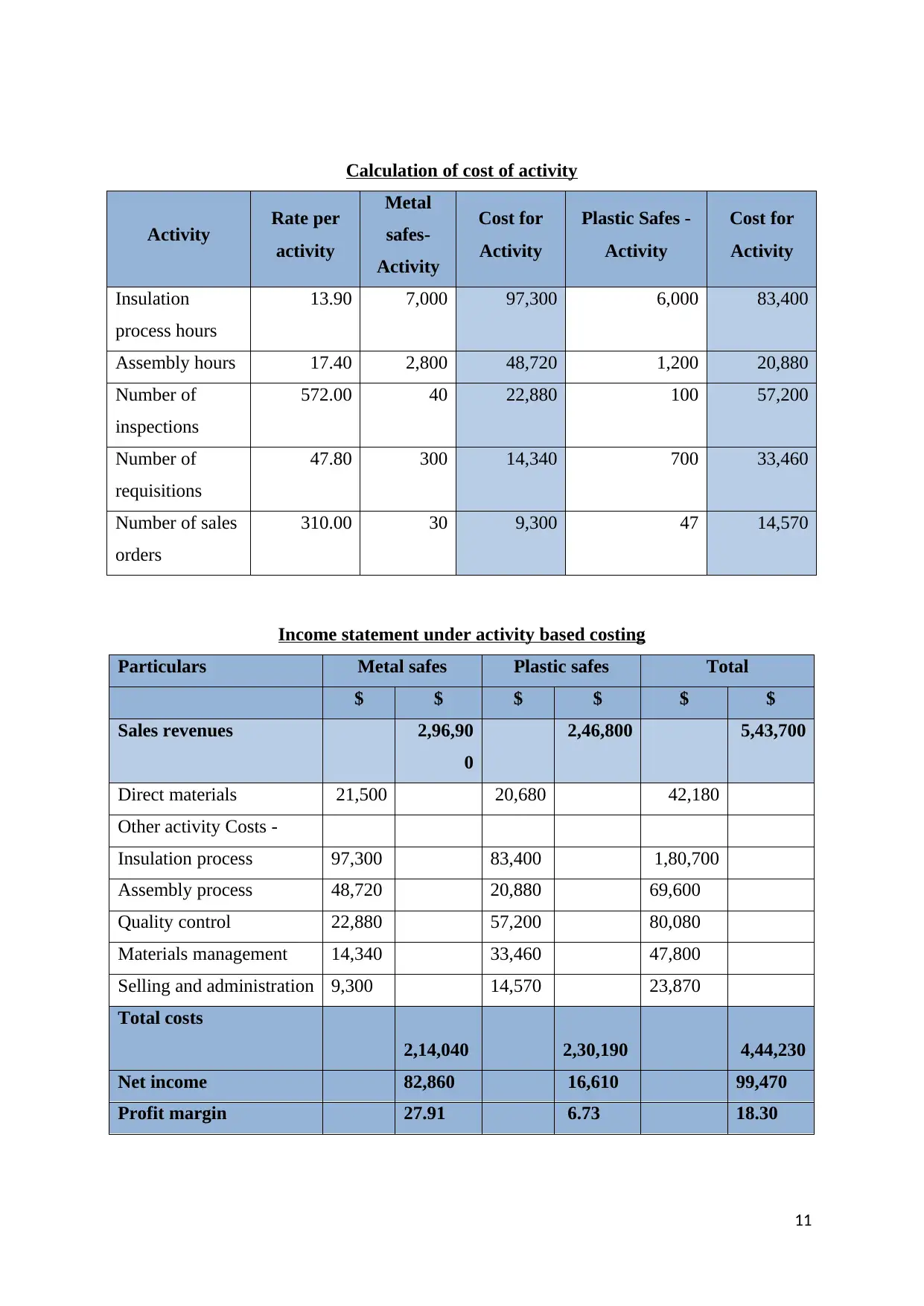
Therefore, if we allocate the overhead cost as per actual usage of activity we see that the cost
allocated to metal safe is $192540 and that to plastic safe is $209510. But if we go with the
traditional costing system, the overhead allocated to metal safe is 231770 and that to plastic
safe is $170280.
More cost was allocated to metal safes which resulted in low profitability from this section.
12
allocated to metal safe is $192540 and that to plastic safe is $209510. But if we go with the
traditional costing system, the overhead allocated to metal safe is 231770 and that to plastic
safe is $170280.
More cost was allocated to metal safes which resulted in low profitability from this section.
12
⊘ This is a preview!⊘
Do you want full access?
Subscribe today to unlock all pages.
Trusted by 1+ million students worldwide

1 out of 16


Related Documents


Your All-in-One AI-Powered Toolkit for Academic Success.
+13062052269
info@desklib.com
Available 24*7 on WhatsApp / Email
![[object Object]](/_next/static/media/star-bottom.7253800d.svg)
Unlock your academic potential
Copyright © 2020–2026 A2Z Services. All Rights Reserved. Developed and managed by ZUCOL.