Analysis of Budgeting Methods in Advanced Management Accounting
VerifiedAdded on 2023/01/13
|9
|2448
|28
Report
AI Summary
This report provides a detailed analysis of budgeting techniques within the context of Advanced Management Accounting. It begins by outlining the principles and shortcomings of traditional budgeting methods, which often rely on historical data and can be inflexible. The report then explores the emergence of 'beyond budgeting' and 'better budgeting' approaches, which aim to overcome the limitations of traditional methods. 'Beyond budgeting' emphasizes decentralized systems and adaptive management processes, while 'better budgeting' focuses on improvements like value-based management, profit planning, activity-based budgeting, rolling forecasts, and zero-based budgeting. The report discusses the principles of beyond budgeting, including leadership and management process principles, and compares the implementation challenges of both beyond and better budgeting, highlighting the need for trained staff and the cost implications of certain methods. The conclusion emphasizes the importance of moving beyond traditional approaches to achieve effective financial management and organizational goals.
ADVANCED MANAGEMENT
ACCOUNTING
ACCOUNTING

Paraphrase This Document
Need a fresh take? Get an instant paraphrase of this document with our AI Paraphraser
TABLE OF CONTENTS
INTRODUCTION...........................................................................................................................1
MAIN BODY...................................................................................................................................1
Traditional budgeting and its flaws..............................................................................................1
Emergence of beyond budgeting and better budgeting concepts and practices..........................2
Issues in implementation of beyond and better budgeting. .........................................................5
CONCLUSIONS .............................................................................................................................6
REFERENCES................................................................................................................................7
INTRODUCTION...........................................................................................................................1
MAIN BODY...................................................................................................................................1
Traditional budgeting and its flaws..............................................................................................1
Emergence of beyond budgeting and better budgeting concepts and practices..........................2
Issues in implementation of beyond and better budgeting. .........................................................5
CONCLUSIONS .............................................................................................................................6
REFERENCES................................................................................................................................7
INTRODUCTION
Budgeting refers to creation of spending plan for the organisation. Spending plans of
company are known as budgeting. Creation of budgets helps company in determining in advance
that whether company will be having enough money for carrying out operations of company. In
simple words it is concerned mainly with expenses with income. With the time budgeting has
evolved with other types of budgeting and practices that is helping companies to frame better
budgets (John, 2018). Effective budgeting helps the business organisations to achieve their
respective goals and objectives. Present report will provide and understanding about the benefits
of beyond budgeting than traditional budgeting. It will give an understanding about the concepts
and practices followed in both the budgeting.
MAIN BODY
Traditional budgeting and its flaws.
Traditional budgeting
Traditional budgeting can be referred as a process of preparing budget where the budget
of last year is taken as a base. Budget of current year is made by making alteration and
adjustments to budgets of previous years. The adjustments made are relating to inflation rates,
demands of consumers, market conditions and like factors affecting the organisation. In this
budgeting costs and revenues of last year is integral part of the budget for current year. All the
items that are over & above the budgets of last year are required to be justified by the business.
Traditional budgeting has been used from years by companies for having control over its
expenses. This is widely used by organisations as it is simple to implement and budgets are
prepared much faster as only required changes are to be made in budgets of last year (Rubin,
2019). The budgeting approach has brought stability in the working process as this is more
familiar to the organisations and everyone is aware of the things to be done.
But many experts and business specialists has considered as an ineffective budgeting
practice. Many companies have replaced their budgeting practices to rolling forecast and other
methods of budgeting. Beyond budgeting round table after spending deep research has concluded
that managers spend significant time in preparing. The traditional budgeting approach has been
left due to various problems associated with the approach.
Weaknesses of traditional budgeting.
1
Budgeting refers to creation of spending plan for the organisation. Spending plans of
company are known as budgeting. Creation of budgets helps company in determining in advance
that whether company will be having enough money for carrying out operations of company. In
simple words it is concerned mainly with expenses with income. With the time budgeting has
evolved with other types of budgeting and practices that is helping companies to frame better
budgets (John, 2018). Effective budgeting helps the business organisations to achieve their
respective goals and objectives. Present report will provide and understanding about the benefits
of beyond budgeting than traditional budgeting. It will give an understanding about the concepts
and practices followed in both the budgeting.
MAIN BODY
Traditional budgeting and its flaws.
Traditional budgeting
Traditional budgeting can be referred as a process of preparing budget where the budget
of last year is taken as a base. Budget of current year is made by making alteration and
adjustments to budgets of previous years. The adjustments made are relating to inflation rates,
demands of consumers, market conditions and like factors affecting the organisation. In this
budgeting costs and revenues of last year is integral part of the budget for current year. All the
items that are over & above the budgets of last year are required to be justified by the business.
Traditional budgeting has been used from years by companies for having control over its
expenses. This is widely used by organisations as it is simple to implement and budgets are
prepared much faster as only required changes are to be made in budgets of last year (Rubin,
2019). The budgeting approach has brought stability in the working process as this is more
familiar to the organisations and everyone is aware of the things to be done.
But many experts and business specialists has considered as an ineffective budgeting
practice. Many companies have replaced their budgeting practices to rolling forecast and other
methods of budgeting. Beyond budgeting round table after spending deep research has concluded
that managers spend significant time in preparing. The traditional budgeting approach has been
left due to various problems associated with the approach.
Weaknesses of traditional budgeting.
1
⊘ This is a preview!⊘
Do you want full access?
Subscribe today to unlock all pages.

Trusted by 1+ million students worldwide
The traditional budgets are very long and detailed. They are prepared after requiring the
items to be negotiated back & forth. It consumes lots of corporate resources in preparing the
budgets. The cost of preparing budgets under traditional approach is very high. The budgeting
approach is very flexible as it starts from top to down and becomes detailed process for bottom
up and attempts for meeting fixed goals of management. Once the budgets are prepared it do not
takes into account any other changes.
It could be inaccurate representation of the goals and objectives of business. In this
business owners and managers manipulated projections for making actual results to look
attractive (Wildavsky, 2017). This will not be helping business in long run. It takes time to
analyse the budgets of previous years and identifying the areas where changes are required to be
made. There are high chances that errors and mistakes of previous budgets are carried in the
budgets of current year if not identified properly.
Emergence of beyond budgeting and better budgeting concepts and practices.
Beyond budgeting
It is a idea based for abolishing the traditional budgeting approaches for eventually
improving the control of management over organisations. Abandonment of traditional budgeting
practices company aims at establishing a high decentralised systems and set of adaptive
management processes. Beyond budgeting is a principle where companies are required to move
forward and beyond the budgeting due to inherent flaws existing in budgeting especially when
setting contracts. It is also defined as budgeting beyond command & control towards
management model which is more adaptive and empowered. It is rethinking the management
approach in an industrial environment where innovative management model represents as the
only competitive advantage for sustainability. The budgeting is also aimed at releasing people
and staff from suffocating control system and stifling bureaucracy. Giving time for rethinking
reflects, share and helps in improving the processes (Bogsnes, 2016). The framework of beyond
budgeting is based over 6 leadership principles & six management process principles. Rationale
behind beyond budgeting is the number of flaws existing in traditional budgeting.
Beyond budgeting idea is relatively new to organisations. Active development of
frameworks started in last twenty years. The rise of beyond budgeting concepts is associated
with shift from traditional bureaucratic model of organisation to agile business structures. The
2
items to be negotiated back & forth. It consumes lots of corporate resources in preparing the
budgets. The cost of preparing budgets under traditional approach is very high. The budgeting
approach is very flexible as it starts from top to down and becomes detailed process for bottom
up and attempts for meeting fixed goals of management. Once the budgets are prepared it do not
takes into account any other changes.
It could be inaccurate representation of the goals and objectives of business. In this
business owners and managers manipulated projections for making actual results to look
attractive (Wildavsky, 2017). This will not be helping business in long run. It takes time to
analyse the budgets of previous years and identifying the areas where changes are required to be
made. There are high chances that errors and mistakes of previous budgets are carried in the
budgets of current year if not identified properly.
Emergence of beyond budgeting and better budgeting concepts and practices.
Beyond budgeting
It is a idea based for abolishing the traditional budgeting approaches for eventually
improving the control of management over organisations. Abandonment of traditional budgeting
practices company aims at establishing a high decentralised systems and set of adaptive
management processes. Beyond budgeting is a principle where companies are required to move
forward and beyond the budgeting due to inherent flaws existing in budgeting especially when
setting contracts. It is also defined as budgeting beyond command & control towards
management model which is more adaptive and empowered. It is rethinking the management
approach in an industrial environment where innovative management model represents as the
only competitive advantage for sustainability. The budgeting is also aimed at releasing people
and staff from suffocating control system and stifling bureaucracy. Giving time for rethinking
reflects, share and helps in improving the processes (Bogsnes, 2016). The framework of beyond
budgeting is based over 6 leadership principles & six management process principles. Rationale
behind beyond budgeting is the number of flaws existing in traditional budgeting.
Beyond budgeting idea is relatively new to organisations. Active development of
frameworks started in last twenty years. The rise of beyond budgeting concepts is associated
with shift from traditional bureaucratic model of organisation to agile business structures. The
2
Paraphrase This Document
Need a fresh take? Get an instant paraphrase of this document with our AI Paraphraser
framework of budgeting is based over idea about the business agility. Primarily agile enterprise
were prevalent in software development organisations. These organisations developed agile
techniques for business for quickly adjusting and adapting to constantly changing requirements
and goals in highly competitive market. Today businesses across industries are actively
implementing agile techniques for adhering to the demanding mega-trends like globalisation,
digitalisation and mobility (O’Grady, Akroyd and Scott, 2017). Principles of beyond budgeting
are developed and promoted by Beyond Budgeting Institute. Organisation host BRBT (Beyond
Budgeting Round Table) annually which is global network encouraging for learning principles of
budgeting. It also fosters information and experience sharing from adopting these principles.
Principles of beyond budgeting
Framework of beyond budgeting is based over twelve principles. It is however stated by
institute that these principles are not a checklist or recipe for the management to follow. They
merely serves as guide managers and companies adapting the framework. Pillars of beyond
budgeting are leadership and management processes. Both the dimensions consists of
frameworks of 6 principles that are
Leadership principles
1. Purpose – It is concerned with engaging and inspiring people for the bold & noble
causes. It restraints companies to revolve around the financial targets that are short term.
2. Values – It deals with governing organisation by shared values & sound judgements.
Governance should not be via wide rules & regulations.3. Transparency – The principle promotes that business should encourage learning,
innovation and control. It should not restrict the use of information and resources that
help in growth of organisation.4. Organisation – Company should establish a culture here employees have feeling of
belongingness for company (Aksom, 2017). Properly organised and responsive teams
should be established by the business enterprise.5. Autonomy – People should be given freedom for taking actions and should not be
suppressed by fear of punishments.6. Customers – Business should strive for meeting the consumer needs by properly aligning
the work avoiding conflict of interests.
Management Processes
3
were prevalent in software development organisations. These organisations developed agile
techniques for business for quickly adjusting and adapting to constantly changing requirements
and goals in highly competitive market. Today businesses across industries are actively
implementing agile techniques for adhering to the demanding mega-trends like globalisation,
digitalisation and mobility (O’Grady, Akroyd and Scott, 2017). Principles of beyond budgeting
are developed and promoted by Beyond Budgeting Institute. Organisation host BRBT (Beyond
Budgeting Round Table) annually which is global network encouraging for learning principles of
budgeting. It also fosters information and experience sharing from adopting these principles.
Principles of beyond budgeting
Framework of beyond budgeting is based over twelve principles. It is however stated by
institute that these principles are not a checklist or recipe for the management to follow. They
merely serves as guide managers and companies adapting the framework. Pillars of beyond
budgeting are leadership and management processes. Both the dimensions consists of
frameworks of 6 principles that are
Leadership principles
1. Purpose – It is concerned with engaging and inspiring people for the bold & noble
causes. It restraints companies to revolve around the financial targets that are short term.
2. Values – It deals with governing organisation by shared values & sound judgements.
Governance should not be via wide rules & regulations.3. Transparency – The principle promotes that business should encourage learning,
innovation and control. It should not restrict the use of information and resources that
help in growth of organisation.4. Organisation – Company should establish a culture here employees have feeling of
belongingness for company (Aksom, 2017). Properly organised and responsive teams
should be established by the business enterprise.5. Autonomy – People should be given freedom for taking actions and should not be
suppressed by fear of punishments.6. Customers – Business should strive for meeting the consumer needs by properly aligning
the work avoiding conflict of interests.
Management Processes
3
7. Rhythm - The management processes should be framed by the organisations as per the
business rhythms in a dynamic environment and should not be defined over particular
calendar years.
8. Targets – It states organisations should set directional and ambitious goals that can be
achieved instead of cascaded and fixed targets that are not practical to achieve.
9. Plans & Forecasts – Organisations should have unbiased and lean approach for
formation of plans and forecasting. The planning process should not be a political
exercise driving the plans to particular interests.
10. Allocation of Resources – A cost effective process and beliefs should be established by
the organisations. Resources should be made available as required instead of making
allocations through detailed budgeting process on annual basis.
11. Performance Evaluation – Performance of the organisation should be measured
holistically with proper feedback process to promote learning & developments. The
performance measurement should not be restricted towards rewards and incentives.
12. Rewards – Companies should rewards employees for achieving the success beyond the
competition. It should not be confined over performance of fixed contracts.
Better Budgeting
It is important to understand the budgets when dealing about the financial future of
business. For preparing future budgets organisations have to look over various factors that can
influence the business and its functions. Organisations should create budgets that can be
achieved and are realistic. The better budgeting approach is focused over five techniques of
improvements. These techniques are given below :
Value based management – This principle is concerned with management of value creation of
the shareholders over the time. In this approach all the plans for expenditure are concerned
towards assessing the value that will be created to shareholders and are evaluated on project
appraisals (Laval, 2016). The budgeting technique helps in establishing link between value
creation of shareholders and strategies focused towards budgeting & planning.
Profit planning – The approach is focused over planning the financial cash flow of the profit
centres for assessing whether unit or organisations are generating required cash flows, creating
economic values and is attracting adequate financial resources to make investments.
4
business rhythms in a dynamic environment and should not be defined over particular
calendar years.
8. Targets – It states organisations should set directional and ambitious goals that can be
achieved instead of cascaded and fixed targets that are not practical to achieve.
9. Plans & Forecasts – Organisations should have unbiased and lean approach for
formation of plans and forecasting. The planning process should not be a political
exercise driving the plans to particular interests.
10. Allocation of Resources – A cost effective process and beliefs should be established by
the organisations. Resources should be made available as required instead of making
allocations through detailed budgeting process on annual basis.
11. Performance Evaluation – Performance of the organisation should be measured
holistically with proper feedback process to promote learning & developments. The
performance measurement should not be restricted towards rewards and incentives.
12. Rewards – Companies should rewards employees for achieving the success beyond the
competition. It should not be confined over performance of fixed contracts.
Better Budgeting
It is important to understand the budgets when dealing about the financial future of
business. For preparing future budgets organisations have to look over various factors that can
influence the business and its functions. Organisations should create budgets that can be
achieved and are realistic. The better budgeting approach is focused over five techniques of
improvements. These techniques are given below :
Value based management – This principle is concerned with management of value creation of
the shareholders over the time. In this approach all the plans for expenditure are concerned
towards assessing the value that will be created to shareholders and are evaluated on project
appraisals (Laval, 2016). The budgeting technique helps in establishing link between value
creation of shareholders and strategies focused towards budgeting & planning.
Profit planning – The approach is focused over planning the financial cash flow of the profit
centres for assessing whether unit or organisations are generating required cash flows, creating
economic values and is attracting adequate financial resources to make investments.
4
⊘ This is a preview!⊘
Do you want full access?
Subscribe today to unlock all pages.
Trusted by 1+ million students worldwide
Organisations while framing financial plans should ensure that short-term and long terms
prospects of business are consolidated.
Activity Based Budgeting – The approach is concerned towards planning and controlling the
value added activities and processes. Activities of the organisation and the business and the
business process should be structured in a manner for achieving and meeting organisational
external and needs of customers.
Rolling forecast and budgets – The techniques is used for solving the issues of infrequent
budgeting which helps organisation in creating forecasts more accurate. It helps in overcoming
the problems of budgeting at fixed points of time and dubious practices which helps in
encouraging the cut offs. This is much more responsive with the changing circumstances. It also
requires at the same time permanent resources for administering (Tamaș and et.al., 2020).
Zero Based Budgeting – The budgeting technique assumes that expenditures of business are re-
justified in each budgeting cycle. It helps It helps in avoiding the preparation of budgets base on
inefficiencies and inaccuracies of previous budgets. Value of approach is dependent on the
stability of operating environment.
For improving the focus and accuracy of the budgeted outputs, it is more preferable to
use activity based and zero based budgeting techniques. Rolling forecast and budgets have the
potential of being used as regular approach of budgeting. Organisation widely have introduced
this approach for overcoming the traditional budgeting problems of time lag and for improving
accuracy of forecasts. Profit planning and the value based management approaches are
theoretical and are not widely adopted. They have difficulty in evaluating the efficiency as there
are few examples for the techniques of implementation & practical applications existing. There is
no universal approach for better budgeting solving the problems at once.
Issues in implementation of beyond and better budgeting.
Better budgeting involves giving participation in the setting targets. It involves giving
employees targets and process through which their performance can be measured giving clear
clear responsibilities to the participants. Budgeting process is more defined when the employees
are given opportunities in making of budgets. Budgeting practices should also be transferred
5
prospects of business are consolidated.
Activity Based Budgeting – The approach is concerned towards planning and controlling the
value added activities and processes. Activities of the organisation and the business and the
business process should be structured in a manner for achieving and meeting organisational
external and needs of customers.
Rolling forecast and budgets – The techniques is used for solving the issues of infrequent
budgeting which helps organisation in creating forecasts more accurate. It helps in overcoming
the problems of budgeting at fixed points of time and dubious practices which helps in
encouraging the cut offs. This is much more responsive with the changing circumstances. It also
requires at the same time permanent resources for administering (Tamaș and et.al., 2020).
Zero Based Budgeting – The budgeting technique assumes that expenditures of business are re-
justified in each budgeting cycle. It helps It helps in avoiding the preparation of budgets base on
inefficiencies and inaccuracies of previous budgets. Value of approach is dependent on the
stability of operating environment.
For improving the focus and accuracy of the budgeted outputs, it is more preferable to
use activity based and zero based budgeting techniques. Rolling forecast and budgets have the
potential of being used as regular approach of budgeting. Organisation widely have introduced
this approach for overcoming the traditional budgeting problems of time lag and for improving
accuracy of forecasts. Profit planning and the value based management approaches are
theoretical and are not widely adopted. They have difficulty in evaluating the efficiency as there
are few examples for the techniques of implementation & practical applications existing. There is
no universal approach for better budgeting solving the problems at once.
Issues in implementation of beyond and better budgeting.
Better budgeting involves giving participation in the setting targets. It involves giving
employees targets and process through which their performance can be measured giving clear
clear responsibilities to the participants. Budgeting process is more defined when the employees
are given opportunities in making of budgets. Budgeting practices should also be transferred
5
Paraphrase This Document
Need a fresh take? Get an instant paraphrase of this document with our AI Paraphraser
across organisations to lower level managements for improving the quality and increasing
acceptance.
Implementation of better budgeting practices is easier as compared with beyond
budgeting. Issues are faced when the management is not available with trained staff and experts
having knowledge about the budgeting approaches under better budgeting. Zero based and
activity based budgeting is primarily use by the organisations. The budgeting approach is costlier
and much more expensive as compared with beyond budgeting approaches (Wildavsky, 2017).
The time taken under better budgeting is comparatively more in better budgeting as it requires
gathering all the relevant informations. Experts and professionals are not available with practical
cases and examples for guiding the implementation of better budgeting practices. However
beyond budgeting is more difficult as professionals and management experts are not having
detailed knowledge of the leadership and management processes for driving the organisation
towards right direction.
CONCLUSIONS
From the above study it could be concluded that it is not adequate to use traditional
budgeting approach having various implications on successful management of company and
achieving the organisational goals. Organisations should shift the approach to beyond budgeting
and beyond budgeting approaches fostering innovation, creativity and effective management. It
saves both cost and time of management. The companies will be able to frame more accurate
budgets which will be helping in achieving the organisational goals and objectives in an
informed way.
6
acceptance.
Implementation of better budgeting practices is easier as compared with beyond
budgeting. Issues are faced when the management is not available with trained staff and experts
having knowledge about the budgeting approaches under better budgeting. Zero based and
activity based budgeting is primarily use by the organisations. The budgeting approach is costlier
and much more expensive as compared with beyond budgeting approaches (Wildavsky, 2017).
The time taken under better budgeting is comparatively more in better budgeting as it requires
gathering all the relevant informations. Experts and professionals are not available with practical
cases and examples for guiding the implementation of better budgeting practices. However
beyond budgeting is more difficult as professionals and management experts are not having
detailed knowledge of the leadership and management processes for driving the organisation
towards right direction.
CONCLUSIONS
From the above study it could be concluded that it is not adequate to use traditional
budgeting approach having various implications on successful management of company and
achieving the organisational goals. Organisations should shift the approach to beyond budgeting
and beyond budgeting approaches fostering innovation, creativity and effective management. It
saves both cost and time of management. The companies will be able to frame more accurate
budgets which will be helping in achieving the organisational goals and objectives in an
informed way.
6
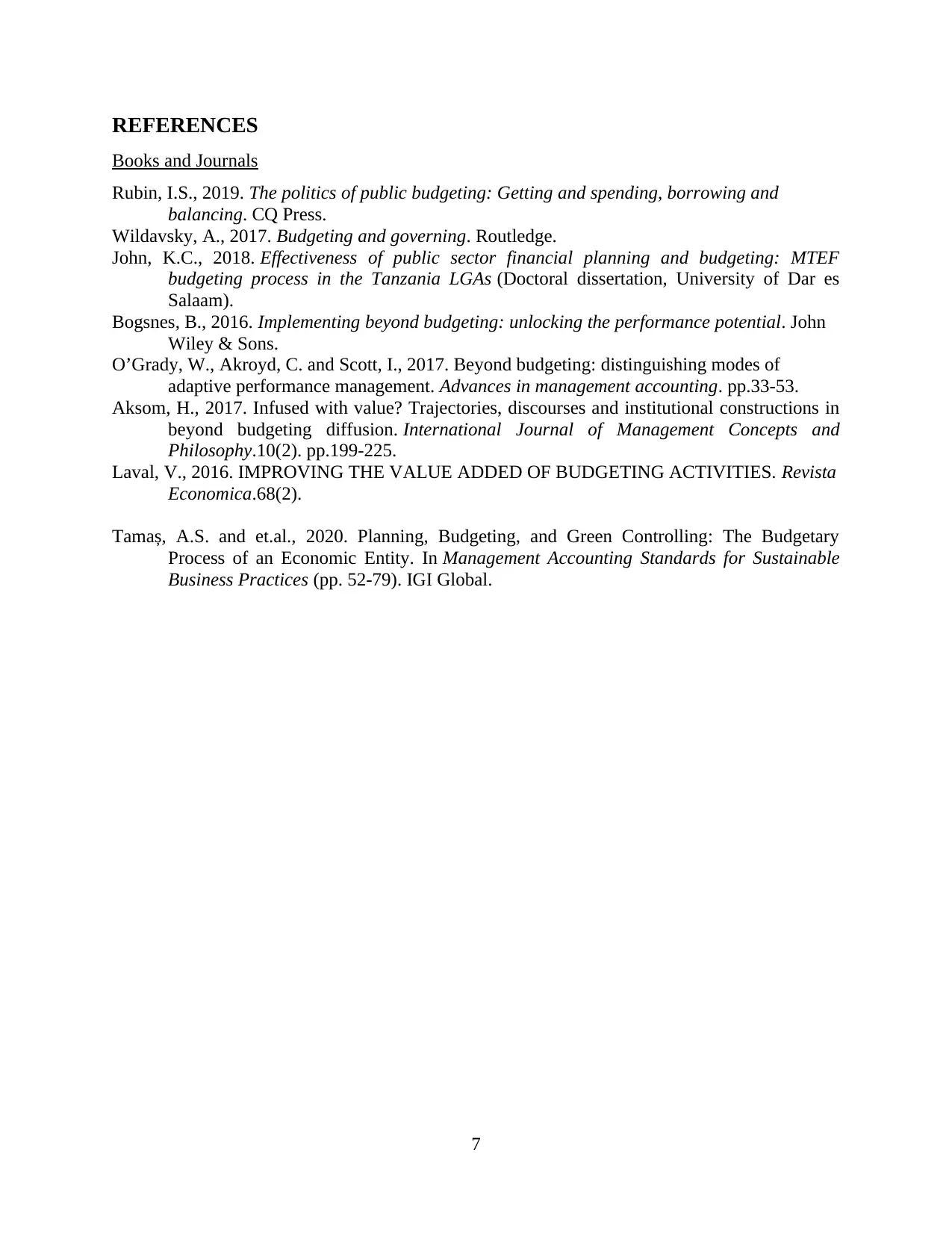
REFERENCES
Books and Journals
Rubin, I.S., 2019. The politics of public budgeting: Getting and spending, borrowing and
balancing. CQ Press.
Wildavsky, A., 2017. Budgeting and governing. Routledge.
John, K.C., 2018. Effectiveness of public sector financial planning and budgeting: MTEF
budgeting process in the Tanzania LGAs (Doctoral dissertation, University of Dar es
Salaam).
Bogsnes, B., 2016. Implementing beyond budgeting: unlocking the performance potential. John
Wiley & Sons.
O’Grady, W., Akroyd, C. and Scott, I., 2017. Beyond budgeting: distinguishing modes of
adaptive performance management. Advances in management accounting. pp.33-53.
Aksom, H., 2017. Infused with value? Trajectories, discourses and institutional constructions in
beyond budgeting diffusion. International Journal of Management Concepts and
Philosophy.10(2). pp.199-225.
Laval, V., 2016. IMPROVING THE VALUE ADDED OF BUDGETING ACTIVITIES. Revista
Economica.68(2).
Tamaș, A.S. and et.al., 2020. Planning, Budgeting, and Green Controlling: The Budgetary
Process of an Economic Entity. In Management Accounting Standards for Sustainable
Business Practices (pp. 52-79). IGI Global.
7
Books and Journals
Rubin, I.S., 2019. The politics of public budgeting: Getting and spending, borrowing and
balancing. CQ Press.
Wildavsky, A., 2017. Budgeting and governing. Routledge.
John, K.C., 2018. Effectiveness of public sector financial planning and budgeting: MTEF
budgeting process in the Tanzania LGAs (Doctoral dissertation, University of Dar es
Salaam).
Bogsnes, B., 2016. Implementing beyond budgeting: unlocking the performance potential. John
Wiley & Sons.
O’Grady, W., Akroyd, C. and Scott, I., 2017. Beyond budgeting: distinguishing modes of
adaptive performance management. Advances in management accounting. pp.33-53.
Aksom, H., 2017. Infused with value? Trajectories, discourses and institutional constructions in
beyond budgeting diffusion. International Journal of Management Concepts and
Philosophy.10(2). pp.199-225.
Laval, V., 2016. IMPROVING THE VALUE ADDED OF BUDGETING ACTIVITIES. Revista
Economica.68(2).
Tamaș, A.S. and et.al., 2020. Planning, Budgeting, and Green Controlling: The Budgetary
Process of an Economic Entity. In Management Accounting Standards for Sustainable
Business Practices (pp. 52-79). IGI Global.
7
⊘ This is a preview!⊘
Do you want full access?
Subscribe today to unlock all pages.
Trusted by 1+ million students worldwide

1 out of 9


Related Documents


Your All-in-One AI-Powered Toolkit for Academic Success.
+13062052269
info@desklib.com
Available 24*7 on WhatsApp / Email
![[object Object]](/_next/static/media/star-bottom.7253800d.svg)
Unlock your academic potential
Copyright © 2020–2026 A2Z Services. All Rights Reserved. Developed and managed by ZUCOL.